
Quick Answer
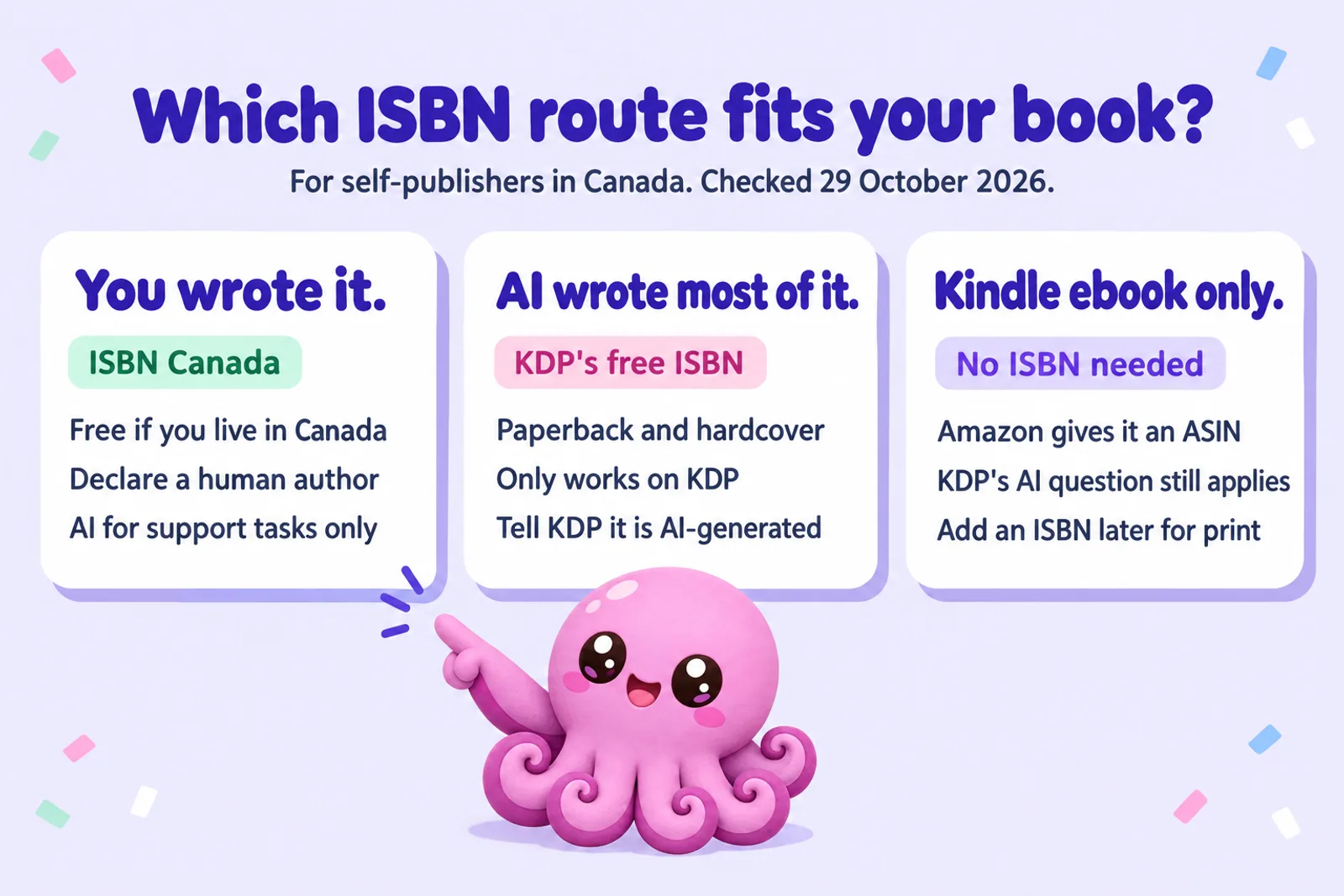
Since 9 October 2026, ISBN Canada's About ISBNs page says that by registering you declare your publication was written by a human author. AI tools are allowed only for limited support tasks, such as brainstorming ideas, checking grammar or formatting. ISBN Canada limits the quantity of ISBNs for works whose content is primarily generated by AI, covering text, illustration and translation. Library and Archives Canada says the policy is under review. If you wrote your book and used AI as a helper, declare honestly and keep records. If AI wrote most of it, don't make the declaration: a Kindle ebook needs no ISBN, and KDP gives paperbacks and hardcovers a free ISBN that only works on KDP, where you answer KDP's own AI question.
For years the main thing a Canadian self-publisher needed to know about ISBNs was that they are free. Library and Archives Canada (LAC) runs ISBN Canada and issues numbers at no cost to eligible publishers, while authors in the US, the UK and Australia pay. In October 2026 a second fact joined the first. Registering with ISBN Canada now comes with a declaration about who wrote the book, and a limit on how many numbers go to books that AI mostly wrote.
This guide is for Canadian authors who publish their own books, especially those who use AI somewhere in the process. It quotes LAC's wording exactly, explains what "limited support tasks" can reasonably cover, sets out what to do if your book is AI-assisted or mostly AI-generated, and shows how the declaration sits next to KDP's own AI question. A checker part-way down suggests an ISBN route for your book.
Disclosure: Inkfluence AI is our product, and it writes chapters with AI. That gives us an interest in this topic, so we say plainly below which kinds of Inkfluence books fit ISBN Canada's declaration and which don't.
What ISBN Canada's page now says
The change sits in a new section headed "Use of artificial intelligence" on LAC's About ISBNs page. The page's details show it was modified on 2026-10-09. This is the full section, word for word, as it read on 29 October 2026:
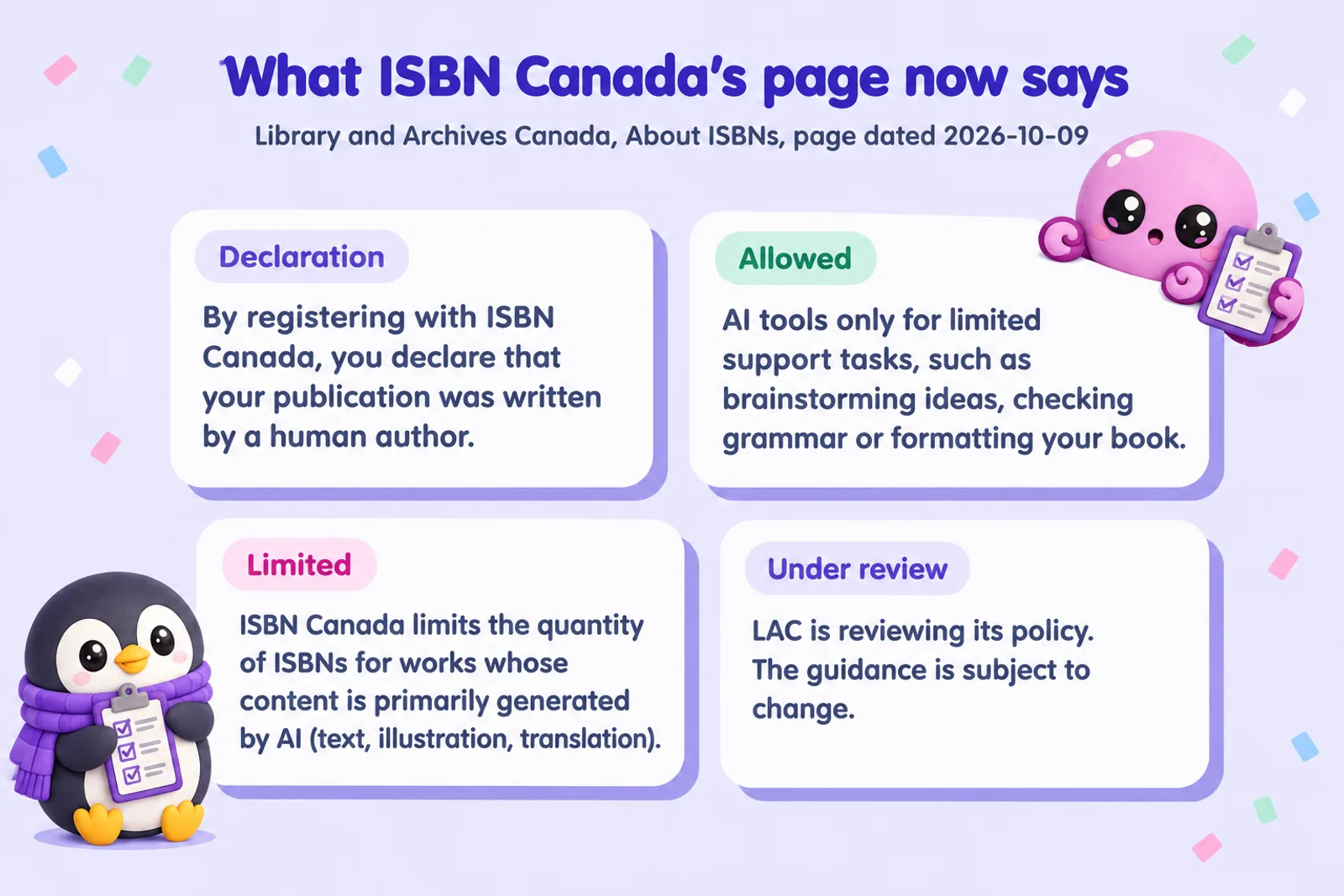
"By registering with ISBN Canada, you declare that your publication was written by a human author. You may use AI tools only for limited support tasks, such as brainstorming ideas, checking grammar, or formatting your book. ISBN Canada limits the quantity of ISBNs for works whose content is primarily generated by AI (text, illustration, translation). LAC is currently reviewing its policy regarding the use of AI content creation and our guidance is subject to change."
The French version of the page carries the same section under "Utilisation de l'intelligence artificielle (IA)", with the same date.
| What the page says | What it means in practice |
|---|---|
| "you declare that your publication was written by a human author" | Registering is itself the declaration. |
| AI "only for limited support tasks, such as brainstorming ideas, checking grammar, or formatting your book" | AI may help a human who does the writing. The three examples are not a full list. |
| "limits the quantity of ISBNs for works whose content is primarily generated by AI (text, illustration, translation)" | A limit, not a stated ban, and it covers AI illustrations and translations too. "Primarily" is not defined. |
| "LAC is currently reviewing its policy ... our guidance is subject to change" | Re-read the page before each new registration. |
The terms around it
Two sets of terms sit above the AI section on the same page, and they explain how LAC can act on the declaration (we could not tell from the page which of these lines are new). Creating a publisher profile means agreeing that "Library and Archives Canada may request proof of address, identity, business presence, or publishing operations at any time", that "You agree to provide requested records within a reasonable timeframe", and that "You will not use multiple profiles or third parties to avoid eligibility requirements or service limits." LAC also reserves the right to verify eligibility, review or audit publisher profiles, "restrict access to services where misuse has been identified" and "refuse or suspend accounts if terms and conditions are not followed".
The ISBN request terms add that LAC may "limit the number or frequency of ISBNs assigned", "require justification for large or repeated requests" and "deny or reduce requests where ISBN use suggests misuse". In short, LAC has given itself the tools to ask questions.
What it doesn't change
- ISBNs are still free to eligible publishers. The ISBN Canada home page still says "ISBN Canada provides free ISBNs to eligible publishers and publications".
- Each format still needs its own number: "Each format and edition of a publication must have its own ISBN."
- An ISBN still gives no copyright: "The ISBN does not provide copyright protection."
- Accounts are slow to open. The home page warns: "It may take up to two months to process applications for new accounts."
How it was reported, and who backed it
The change drew attention after Global News reported it on 22 October 2026 under the headline "Library and Archives Canada cracking down on AI books amid copyright threats". The report quotes the LAC wording above, and adds LAC's line that "the ISBN registration itself does not provide copyright protection".
Two industry groups responded in the piece:
- The Association of Canadian Publishers said the policy is "aligned with our values", that "We do not support the use of AI to replace or substitute for human creative work", and that "We hope that by limiting ISBNs to human-authored books, this new policy will lead to less fraud in the market."
- The Canadian Authors Association said it was "proud to have played a role through their advocacy in this change", and added: "While we applaud this change, we recognize that this is only a first step." It said it awaits "further information to see how the self declaration of human authorship is monitored and verified" and on "which penalties may be delivered should the self declaration be proven to be false."
On 28 October 2026 Jane Friedman's industry newsletter carried the story as "Canada limits use of ISBNs for AI-generated content", summarising that LAC "now requires authors to declare their work is human written." The full item is for paid subscribers; we read only the public summary.
Note the framing: the groups backing the change talk about fraud and replacing human creative work, not about authors who use AI to check their grammar. And nobody, LAC included, has yet said how a declaration would be checked.
Who it affects (and who it doesn't)
The rule applies to anyone registering publications with ISBN Canada. That is a narrower group than "Canadian authors", and a wider one than people who think of themselves as AI users.
It applies to you if
- You self-publish and live in Canada. The profile terms say: "If you are a self-publishing author, you are physically located in Canada." Canadians can't buy from another country's agency instead: Bowker sells to publishers in the US and its territories, and the International ISBN Agency says to apply where the publisher is based.
- You run a small press in Canada. Publishing companies qualify if their "main place of business is in Canada, and at least 75% of your employees are physically based in Canada". The declaration covers every publication you register.
- You publish in English, or in English and French. Bilingual publishers apply to ISBN Canada.
It doesn't apply directly if
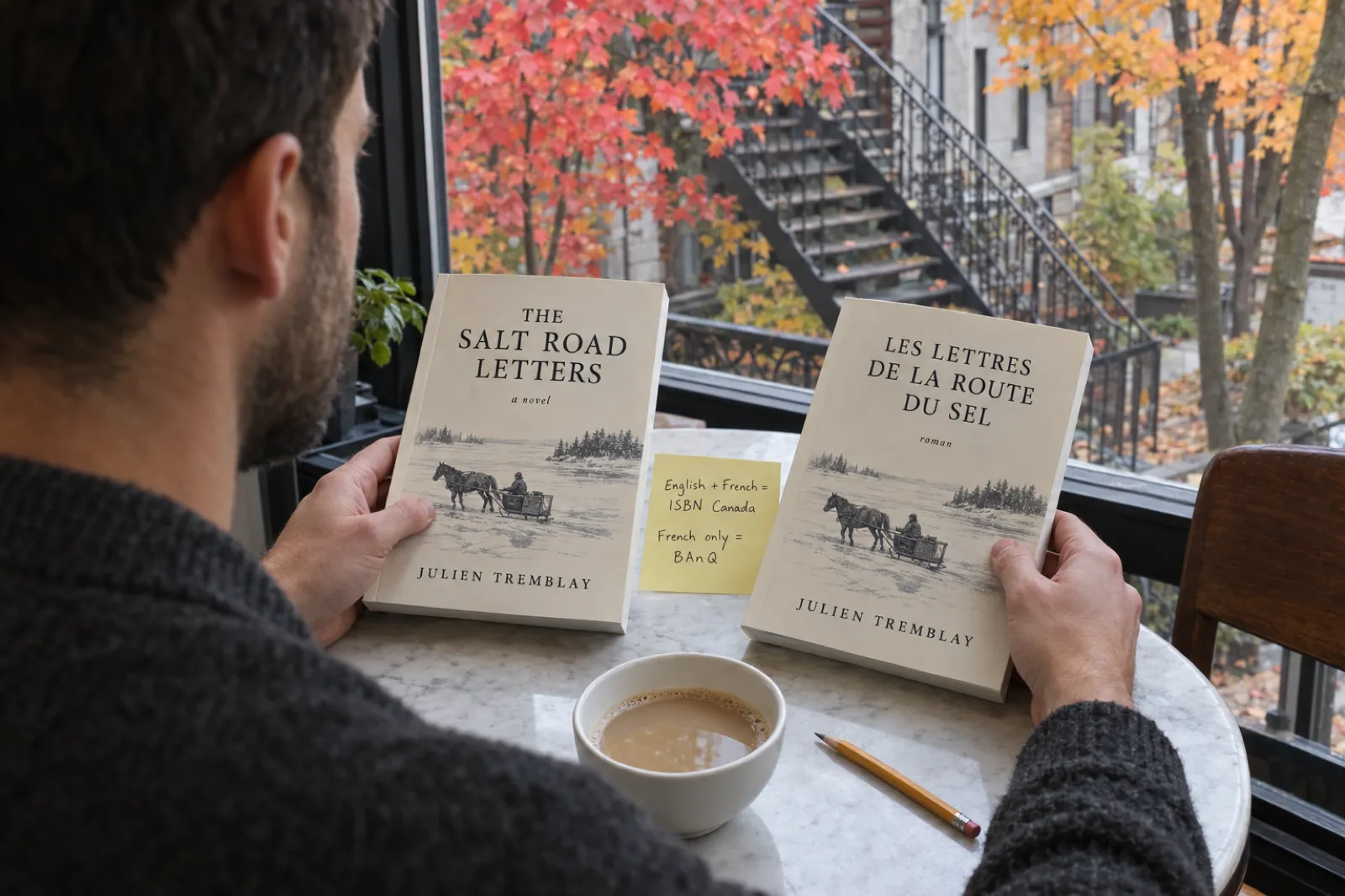
- You publish in French only. "Canadian publishers that publish in French only must contact Bibliothèque et Archives nationales du Québec (BAnQ) to apply for an ISBN." The AI section is on LAC's page; we could not find a published AI rule on BAnQ's own site on 29 October 2026. Ask BAnQ before you apply, and expect the question to come up.
- You live outside Canada. You never used ISBN Canada. Your own agency's rules apply (see how other agencies compare).
- Your book doesn't use an ISBN at all. A Kindle ebook on KDP doesn't need one, nor does a file you sell yourself. The store's own AI rules still apply.
- Your book was never eligible. LAC's list of formats that can't get an ISBN includes low-content products ("diaries, journals, logbooks notebooks, planners, sketchbooks"), activity books such as crosswords and sudoku, and "Colouring books (without significant text)". Many AI-made products fall into these groups anyway. Our guide to low-content books on KDP and how to sell colouring books cover the routes that don't need an ISBN.
Translations count
Translation is named in the limit, which matters in a bilingual country. A French edition of your English book is a separate edition with its own ISBN; if it is primarily an AI translation, it falls inside the wording even though you wrote the original. LAC doesn't say where a human-revised AI translation sits, so ask before registering one. Our guide to Kindle Translate vs translating your book yourself covers the store side of the same question, and the AI book translator page explains how our translation works.
What "limited support tasks" means in practice
LAC gives three examples: brainstorming ideas, checking grammar, formatting your book. It doesn't give a full list, and it doesn't define "primarily". So the honest answer for most tasks is a judgement, and the useful question is simple: who wrote the words, pictures and translation that readers will see? If the answer is you, and AI only helped you do that, you are in the space the page describes. If the answer is the AI, and you shaped and edited what it made, you are not.
Here is how common AI uses line up against the wording. The badges show how clearly the page covers each one, not legal certainty.
| How you used AI, against the wording | Why |
|---|---|
| Brainstorming ideas, titles, names Named support task | "Brainstorming ideas" is the first example on the page. |
| Grammar, spelling and punctuation checks Named support task | "Checking grammar" is named. A check that corrects errors and keeps your wording is the clearest case. |
| Formatting the interior or ebook file Named support task | "Formatting your book" is named. Layout, styles and export are not content. |
| Feedback on your draft (pacing, clarity, plot holes) Likely support | Not named, but you still write every change. It works like a beta reader or editor's letter. |
| An AI-suggested outline you then write from Grey area | Close to brainstorming. If you write every chapter yourself, the text is yours. Keep the outline in your records. |
| AI rewording your sentences (shorter, punchier, a different tone) Grey area | Occasional line edits are close to editing. Rewriting large parts of the book is closer to generating text. |
| AI drafting chapters that you then rewrite Beyond support | Drafting text is not a support task on the page's list. How much rewriting makes it "yours" is undefined; ask before you declare. |
| AI writing most of the chapters, lightly edited Primarily AI | The plain reading of "primarily generated by AI (text...)". |
| AI illustrations inside the book Named in the limit | Illustration is named. A picture book with AI art is the obvious case. |
| An AI translation of your own book Named in the limit | Translation is named, even when the original is human-written. |
| An AI-generated cover on a book you wrote Not addressed | The page doesn't mention covers. We list it under open questions. |
A practical test. If ISBN Canada asked how the book was made, could you show dated drafts and point to where AI helped? Then you are likely describing a human-authored book with AI support. If the honest answer is "I gave the tool a plan and it wrote the chapters", the declaration doesn't describe your book, however much you edited afterwards.
This isn't a judgement on AI-generated books; plenty of stores accept them with a disclosure (see can you sell AI-generated books). It is about which statement you can truthfully make to whom. For keeping your own voice when AI is in the room, see co-writing a book with AI.
Checker: which ISBN route fits your book?
Answer four questions. The checker applies the wording from ISBN Canada, KDP, Draft2Digital and IngramSpark as read on 29 October 2026 and suggests a route per format. It runs in your browser. It is a guide, not a ruling: borderline books get told to ask.
Suggested route
KDP's AI question
Keep these records
Sources: LAC About ISBNs (2026-10-09), KDP Help on ISBNs and AI content, Draft2Digital FAQ, IngramSpark free ISBNs page, all read 29 October 2026. Rules change; check each page before you rely on it.
Write it yourself, with help where it counts
Import a manuscript you wrote (Word, EPUB, PDF or pasted text) or write in the editor. Proofread fixes spelling, grammar and punctuation and keeps your wording, and the export gives you a KDP-ready file. Free to start.
Open your dashboardWhat to do if your book is AI-assisted or mostly AI-generated
Every book falls into one of three situations. The right move in each is different, and none of them involves stretching the truth.
1. You wrote it, and AI helped (AI-assisted)
This is the case the page describes as acceptable. You wrote the words; AI helped you brainstorm, check grammar, or format. What to do:
- Register and declare honestly, and apply early because of the backlog.
- Keep AI to support tasks until publication. A late "let the AI rewrite chapter nine" can change the answer.
- Keep records of your drafts and your AI use (more on that below).
- Use the number everywhere. An ISBN Canada number works on KDP, IngramSpark and elsewhere, one per format, with your own imprint. See IngramSpark vs KDP.
- At KDP, this is "AI-assisted", which KDP says you don't have to disclose. See how the two tests line up.
2. AI wrote most of it (AI-generated)
If AI produced most of the text, illustrations or translation, the declaration doesn't describe your book, so don't make it. That doesn't stop you publishing. The routes:
- Kindle ebook: no ISBN. KDP's help page says "eBooks and low-content books are the only formats where an ISBN is optional." Amazon assigns an ASIN instead.
- KDP paperback or hardcover: KDP's free ISBN. KDP says "You can use a free ISBN from KDP (paperback and hardcover books only)" and "Free ISBNs from us can only be used on KDP." The listing shows the imprint as "Independently published". The KDP help page doesn't tie this to where you live.
- Other ebook stores: Draft2Digital, with care. It assigns a free ISBN automatically, and "you can not use a Draft2Digital provided ISBN anywhere outside of Draft2Digital's services". Its FAQ also says: "While we support AI-assisted content, we do not accept content that has been generated entirely by AI/LLMs that has not gone through extensive editing from a human", and "Draft2Digital does not accept noncredentialled nonfiction content produced by AI." Our Draft2Digital review has the detail.
- Bookshops and libraries through IngramSpark: mostly closed. IngramSpark offers free ISBNs only "for U.S. self-publishers", and says you "can't use free ISBNs associated with your book from other platforms on IngramSpark." A Canadian therefore needs an ISBN Canada number for IngramSpark, which brings back the declaration. IngramSpark's own content guidelines also list "Works created solely using generative AI". The IngramSpark AI policy guide explains what it accepts.
- Direct sales: no ISBN. Your own site, Etsy or Gumroad don't need one. Etsy has its own AI disclosure, covered in Etsy's AI disclosure explained.
Whichever route you take, answer each store's AI question truthfully. Which stores allow AI-written books compares the rules at 21 stores and services, and how to publish AI-generated books on KDP walks through the KDP setup.
3. Somewhere in between
Many books are mixed: AI drafted a few passages you reworked, or you wrote the text and AI made the illustrations. LAC's wording doesn't settle these, and guessing in your own favour is a poor plan for a declaration. Three honest options:
- Ask ISBN Canada. Describe what you did, plainly, through the contact route on the ISBN Canada page, and keep their reply.
- Rewrite the AI-drafted parts yourself, from your own notes, so that the published text is yours. Then the declaration describes the book.
- Use the store route for this book (above), and keep ISBN Canada for books that clearly fit.
Draft fast, then make the book yours
Inkfluence can draft chapters from your plan, and you rewrite and edit every line in the editor. If AI drafted the book, publish it through the store route and disclose it; if you rewrote it in your own words, you have the records to show how.
Start your book freeHow it fits with KDP's AI question
Most Canadian self-publishers will meet two AI questions: ISBN Canada's declaration and KDP's. They use different tests.
KDP's content guidelines say: "We require you to inform us of AI-generated content (text, images, or translations) when you publish a new book or make edits to and republish an existing book through KDP." They define the two terms:
- AI-generated: "If you used an AI-based tool to create the actual content (whether text, images, or translations), it is considered "AI-generated," even if you applied substantial edits afterwards."
- AI-assisted: "If you created the content yourself, and used AI-based tools to edit, refine, error-check, or otherwise improve that content (whether text or images), then it is considered "AI-assisted" and not "AI-generated."" Brainstorming counts as assisted too, if "ultimately created the text or images yourself". And: "You are not required to disclose AI-assisted content."
| Your book | KDP's answer | ISBN Canada's declaration |
|---|---|---|
| You wrote it; AI brainstormed or checked grammar | AI-assisted. No disclosure required. | Fits: a human author, AI for support tasks. |
| You wrote it; AI edited and refined your text | AI-assisted. | Likely fits, if the edits are light. Heavy rewriting is a grey area. |
| AI drafted chapters; you edited them heavily | AI-generated ("even if you applied substantial edits"). Disclose. | Doesn't fit the wording as written. Ask, or use the store route. |
| AI wrote most of it | AI-generated. Disclose. | Doesn't fit; ISBNs are limited for these works. |
| Your text, AI illustrations | AI-generated images. Disclose. | Illustration is named in the limit. Ask first. |
Keep your answers consistent. They are statements about the same book. If you tell KDP the text is AI-generated, it would be hard to also declare to ISBN Canada that a human author wrote it. Describe the process the same way to everyone, and let each organisation's rules decide. Note that heavily editing AI-drafted text doesn't make it AI-assisted under KDP's wording. Our KDP AI disclosure guide and the shorter KDP AI disclosure explainer go through every case, and KDP rejected my book covers what happens when a listing is questioned.
How other agencies and stores compare
On 29 October 2026, ISBN Canada was the only national agency we checked with a written AI declaration. Stores have had AI rules for longer, and they vary widely.
| Agency or store | AI rule (read 29 Oct 2026) |
|---|---|
| ISBN Canada (LAC) National agency, free Declaration | Human-author declaration; AI for limited support tasks; ISBNs limited for works primarily generated by AI. |
| BAnQ French-only Canadian publishers Not found | No published AI rule found on its site. Ask before applying. |
| Bowker (US), Nielsen (UK), Thorpe-Bowker (Australia) National agencies, paid No question | Purchase pages asked nothing about how the book was written. |
| Amazon KDP Store, free ISBN for print Allowed, disclosed | Disclose AI-generated text, images and translations; AI-assisted needn't be disclosed. |
| Draft2Digital Aggregator, free ISBN Conditional | AI-assisted yes; entirely AI-generated content only after extensive human editing; no uncredentialled AI non-fiction. |
| IngramSpark Print and ebook distributor Conditional | Assistive AI fine; AI work needs "significant and material human editorial review"; works made solely with generative AI listed. |
For Apple Books, Kobo, Google Play Books, Barnes & Noble Press and more, see the full comparison in which stores allow AI-written books in 2026, and the store guides for Kobo, Apple Books and Google Play Books. For ISBN prices in nine countries, see do you need an ISBN.
Records to keep
Nobody has said ISBN Canada will ask how a book was written. But LAC's terms say it may request records and audit profiles. A simple record costs almost nothing and lets you answer any future question calmly.
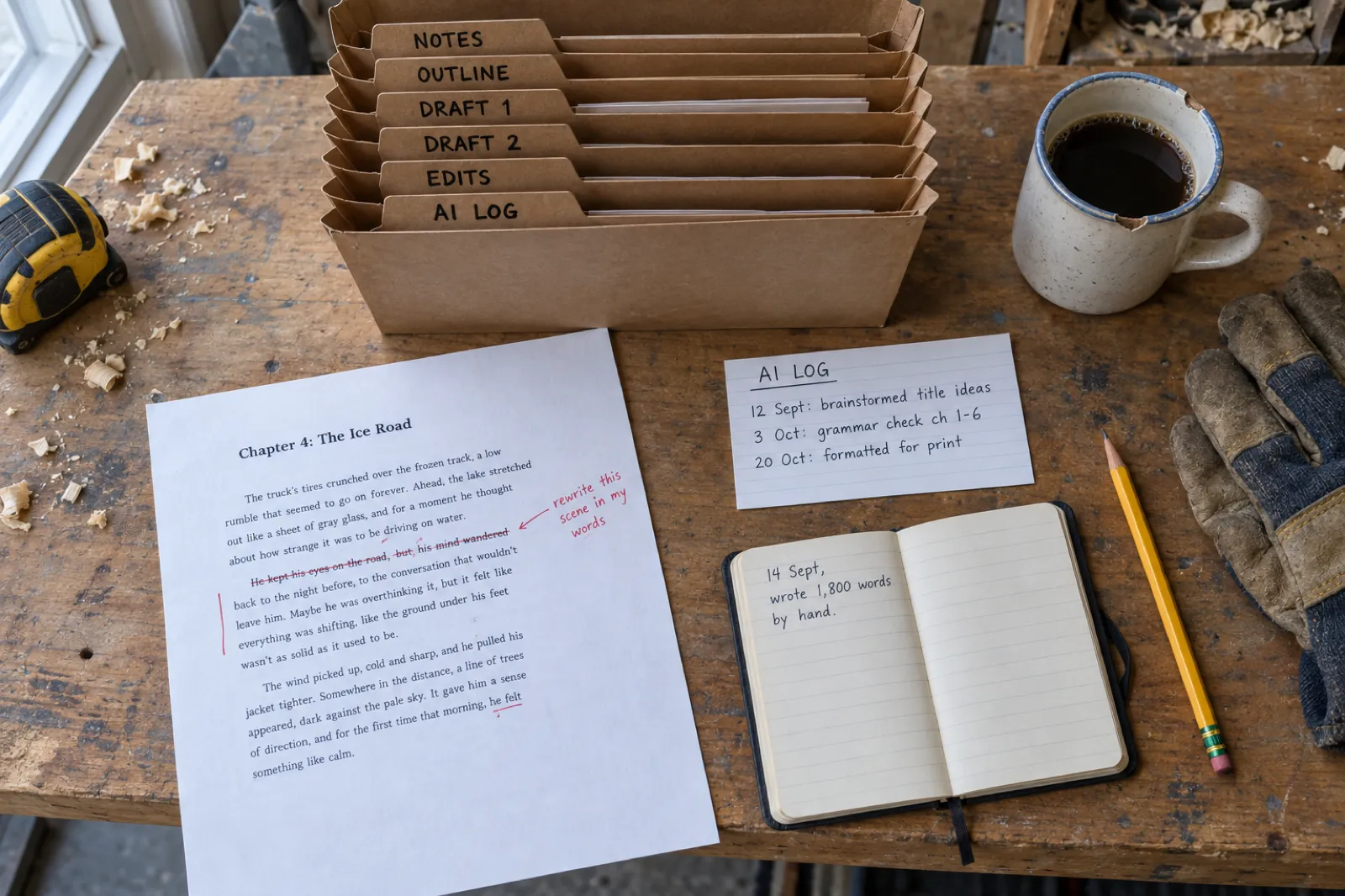
- Dated drafts. Keep each major draft as a separate file or printout with the date. Cloud documents with version history do this for you.
- Notes and outline. Your planning notes, research and outline, including any AI brainstorming you used as a starting point.
- An AI log. One line per use: the date, the tool, and what it did. "12 Sept: brainstormed title ideas. 3 Oct: grammar check, chapters 1 to 6. 20 Oct: formatted for print." It takes seconds and is the clearest evidence of support-only use.
- Editor and beta-reader notes. Tracked changes, editorial letters and feedback show a human process around the book.
- Final files and your declarations. The files you uploaded, the answers you gave KDP and others, and any replies from ISBN Canada.
The same records help elsewhere. They support a copyright claim (see can AI-written books be copyrighted), answer a store's questions, and back up an honest note on your copyright page, for which our copyright page template has AI-assisted examples. If originality is a worry, how to make sure AI book content is original covers the checks.
Where Inkfluence AI fits, honestly
Inkfluence AI can be used in two very different ways, and they land on opposite sides of ISBN Canada's wording. We'd rather you know that before you publish than after.
Books that Inkfluence drafted
Inkfluence's main feature writes chapters with AI from your brief and plan. A book whose chapters it drafted is AI-generated text under KDP's definition, even after you edit it, and it is not what ISBN Canada's declaration describes. Our books are not exempt from either rule. In Canada, the honest route for these books is the store's: a Kindle ebook with no ISBN, KDP's free ISBN for print, and a "yes" to KDP's AI question. The time AI saves is best spent rewriting, cutting and adding your own experience; see how to write a book with AI and do readers care if a book is AI-written.
Books you write yourself, with AI for support tasks
Inkfluence also works as a place to finish a book you wrote. That workflow sits inside the support tasks ISBN Canada names:
- Bring in your own manuscript. Import Word, EPUB or PDF files, or paste plain text, and your chapters arrive as you wrote them. See how to import your manuscript and the importing help articles. You can also write and dictate in the editor (voice dictation).
- Proofread without rewriting. Select text and choose Proofread: it only corrects spelling, grammar and punctuation, and keeps your wording and voice. That is "checking grammar" in LAC's sense. The other quick actions (Rewrite, Shorten, Expand) deliberately change your prose, so use them sparingly if you plan to declare.
- Ask for feedback, then make the changes yourself. The editorial review and the chat assistant can point out pacing problems or unclear passages, and help you brainstorm. You decide what to change and write it. Our AI book editor page and best AI for editing a book explain the difference between editing help and rewriting.
- Format and export. Layout, a table of contents and a KDP-ready interior are "formatting your book". The book formatter and paperback publishing guide cover the print side. Paid plans and credit packs export EPUB and the KDP paperback package; the free plan exports PDF.
Two things to watch. LAC doesn't mention AI covers either way, so you may prefer to upload your own cover art. And AI illustrations inside the book are named in the limit, so a picture book with AI art belongs in the store route. More in the Writing with AI help articles.
Finish the book you wrote
Import your manuscript, proofread it without changing your voice, get feedback you act on yourself, and export a KDP-ready file with your ISBN on the copyright page. Free to start.
Import your manuscriptWhat LAC hasn't said yet
LAC says it is reviewing the policy, so these questions may get answers soon. As of 29 October 2026 its page did not say:
- What "primarily" means. No percentage, no examples beyond the three support tasks.
- How declarations will be checked, and what happens if one is false. The Canadian Authors Association has asked both questions publicly.
- How many ISBNs a mainly AI-generated work can get. The page says the quantity is limited, not what the limit is.
- Whether ISBNs assigned before 9 October 2026 are affected.
- How AI covers are treated. Illustration is named; covers are not mentioned.
- How AI translations that a human revised are treated.
- Whether BAnQ applies the same rule to French-only publishers.
We will update this page when LAC publishes changes, with the date. If you get a written answer from ISBN Canada on any of these, keep it with your records.
A checklist before you apply
- Check you're eligible: physically located in Canada (self-publisher) or main place of business in Canada (company), and publishing in English or both languages. French only: BAnQ.
- Answer the question honestly: who wrote the words, pictures and translation? If it's you, with AI only for support tasks, the declaration fits. If not, use the store route.
- If it's borderline, ask ISBN Canada before you register, and keep the reply.
- Start your records now: dated drafts, notes and an AI log.
- Apply early. New accounts can take up to two months.
- Request one ISBN per format and edition (counting rules).
- Give KDP and each store the same honest account of how the book was made.
- Deposit your copies. The profile terms include Legal Deposit of qualifying publications. For libraries generally, see getting your ebook into libraries.
- Re-read the page before each new registration. The policy is under review.
ISBN Canada and AI: FAQ
Has Canada banned AI-written books from getting an ISBN?
Not in those words. ISBN Canada's About ISBNs page (dated 9 October 2026) says that by registering you declare your publication was written by a human author, that AI tools may be used only for limited support tasks such as brainstorming ideas, checking grammar or formatting, and that ISBN Canada limits the quantity of ISBNs for works whose content is primarily generated by AI (text, illustration, translation). Library and Archives Canada says the policy is under review.
Can I still use AI if I want a free ISBN from ISBN Canada?
Yes, for limited support tasks. The page names brainstorming ideas, checking grammar and formatting your book as examples. Writing the text, the illustrations or the translation with AI is what the limit covers.
What does "primarily generated by AI" mean?
ISBN Canada has not defined it. The page names three kinds of content: text, illustration and translation. A book where AI wrote most of the words, drew most of the pictures, or produced the translation is the plain reading. If your book sits in between, ask ISBN Canada before you declare.
I don't live in Canada. Does this rule affect me?
Not directly. ISBN Canada only serves self-publishers physically located in Canada. On 29 October 2026, the purchase pages of Bowker (US), Nielsen (UK) and Thorpe-Bowker (Australia) asked nothing about how a book was written. Store rules, such as KDP's AI question, apply wherever you live.
My book is mostly AI-generated. Which ISBN can I use?
Don't make a declaration that isn't true. A Kindle ebook needs no ISBN. For a KDP paperback or hardcover, KDP offers a free ISBN that can only be used on KDP. Draft2Digital assigns a free ISBN that only works through Draft2Digital, but it does not accept content generated entirely by AI that has not had extensive human editing. Whichever store you use, answer its AI question truthfully.
Do I need to change ISBNs I already have?
ISBN Canada's page doesn't say anything about ISBNs assigned before the change. We could not find guidance on it. If you have questions about a book already published, contact ISBN Canada directly.
I publish in French only. Does this apply to me?
Canadian publishers that publish in French only apply to Bibliothèque et Archives nationales du Québec (BAnQ), not ISBN Canada. The AI wording is on the ISBN Canada page, in English and French. We could not find a published AI rule on BAnQ's own site on 29 October 2026, so ask BAnQ before you apply.
What happens if someone makes a false declaration?
ISBN Canada has not published penalties. Its profile terms let Library and Archives Canada verify eligibility, request documents, audit profiles, and restrict, refuse or suspend accounts. The Canadian Authors Association has asked how declarations will be monitored and what penalties may apply.
Get the book right, then pick the route
Whether you write every word yourself or start from an AI draft and make it yours, Inkfluence takes the book from plan to KDP-ready files. Start free and decide on the ISBN when the book is done.
Start your book freeRelated reading
- Do you need an ISBN? Free vs bought, cost by country, and which formats need one
- How to publish an ebook wide
- KDP Select vs going wide
- The real cost of publishing an AI book
- How to print one copy of a book
- IngramSpark cost calculator
- Self-publishing on Amazon KDP
- Kindle Unlimited is now Kindle+: what it means for authors
- Is it ethical to write a business book with AI?
- Inkfluence AI for Kindle publishers
Sources
Every external fact on this page was read on the source below on 29 October 2026 unless another date is given.
- Library and Archives Canada: About ISBNs (page dated 2026-10-09: "Use of artificial intelligence" section, publisher profile terms, ISBN request terms, eligible and non-eligible publications, BAnQ for French-only publishers, one ISBN per format and edition, no copyright protection)
- Bibliothèque et Archives Canada: À propos de l'ISBN (French version of the same section, page dated 2026-10-09)
- Library and Archives Canada: International Standard Book Numbers (ISBN) (free ISBNs; backlog notice, up to two months for new accounts; page dated 2026-10-22)
- Global News: "Library and Archives Canada cracking down on AI books amid copyright threats", Ariel Rabinovitch, 22 October 2026 (Association of Canadian Publishers and Canadian Authors Association statements)
- Jane Friedman: "Canada limits use of ISBNs for AI-generated content", 28 October 2026 (subscriber item; public summary read)
- KDP Help: Content Guidelines, artificial intelligence (AI)-generated content (AI-generated vs AI-assisted definitions; disclosure requirement)
- KDP Help: What is an ISBN and Imprint? (ISBN optional for ebooks; free ISBN for paperback and hardcover only; only usable on KDP; "Independently published")
- Draft2Digital: FAQ (free ISBN assigned automatically, not usable outside Draft2Digital; AI-assisted content accepted, entirely AI-generated content without extensive human editing not accepted; noncredentialled AI non-fiction not accepted)
- IngramSpark: Free ISBNs (free ISBNs for US self-publishers only; free ISBNs from other platforms not accepted) and Content Guidelines (generative AI wording)
- Bowker, Nielsen ISBN Store and Thorpe-Bowker purchase pages (no question about AI or authorship on the pages read)
- International ISBN Agency: ISBN assignment (apply to the agency where the publisher is based)

Founder, Inkfluence AI
Sam is the founder of Inkfluence AI. He built the platform to make book creation accessible to everyone - from first-time authors to seasoned publishers.
Helpful links

Ready to write your own book?
Write with AI, make it yours, and export PDF, EPUB and KDP-ready files from one project.
Keep reading
 Tools
Draft2Digital Review 2026: Fees, Stores, AI Rules and Whether It's Worth It
An honest Draft2Digital review from its own pages in October 2026: the new $20 activation and $12 maintenance fees, the roughly 10% it keeps, every store and library it reaches (and the ones it does not), its AI rules, payments, print and audio, plus a calculator that tells you whether it pays for your books.
 Tools
Draft2Digital vs PublishDrive (2026): Fees, Stores and AI Rules Compared
Draft2Digital keeps about 10% of each sale and now charges new accounts $20. PublishDrive takes 0% commission and charges a flat plan from $0 to $99.99 a month. We compared the two on their own pricing and help pages in October 2026: fees, stores, libraries, Google Play, Amazon, print, audiobooks, AI rules, ISBNs and payouts, with a fee calculator that finds the sales level where a flat plan wins.
 Self-Publishing
How to Publish on Apple Books in 2026: Step by Step, Royalties and AI Rules
Apple Books pays 70% on every ebook at any price, takes an EPUB that passes EPUBCheck, and asks AI-generated books to carry an "AI Generated by" label. Here is every step from the iTunes Connect sign-up to your book going live, checked against Apple's own pages, with a royalty calculator against Kindle, Kobo and Google Play, the countries, pre-orders, audiobook routes and the common reasons Apple sends a book back.

Get ebook tips in your inbox
Join creators getting weekly strategies for writing, marketing, and selling ebooks.