
Can you sell AI-generated books? The rules on 10 platforms, checked and dated
Most answers to this question describe one store, usually Amazon, and treat it as the rule for everyone. It is not. Ten platforms where independent authors sell books have ten different positions on AI, from a required label to no written rule at all to a list of content they may refuse. This page puts all ten in one table, each rule quoted from the platform's own policy page and read on 24 September 2026, with the link so you can check it yourself. Then a picker sorts the routes for your book, by how it will be sold, how much of the text AI wrote and whether it has AI images.
The short answer
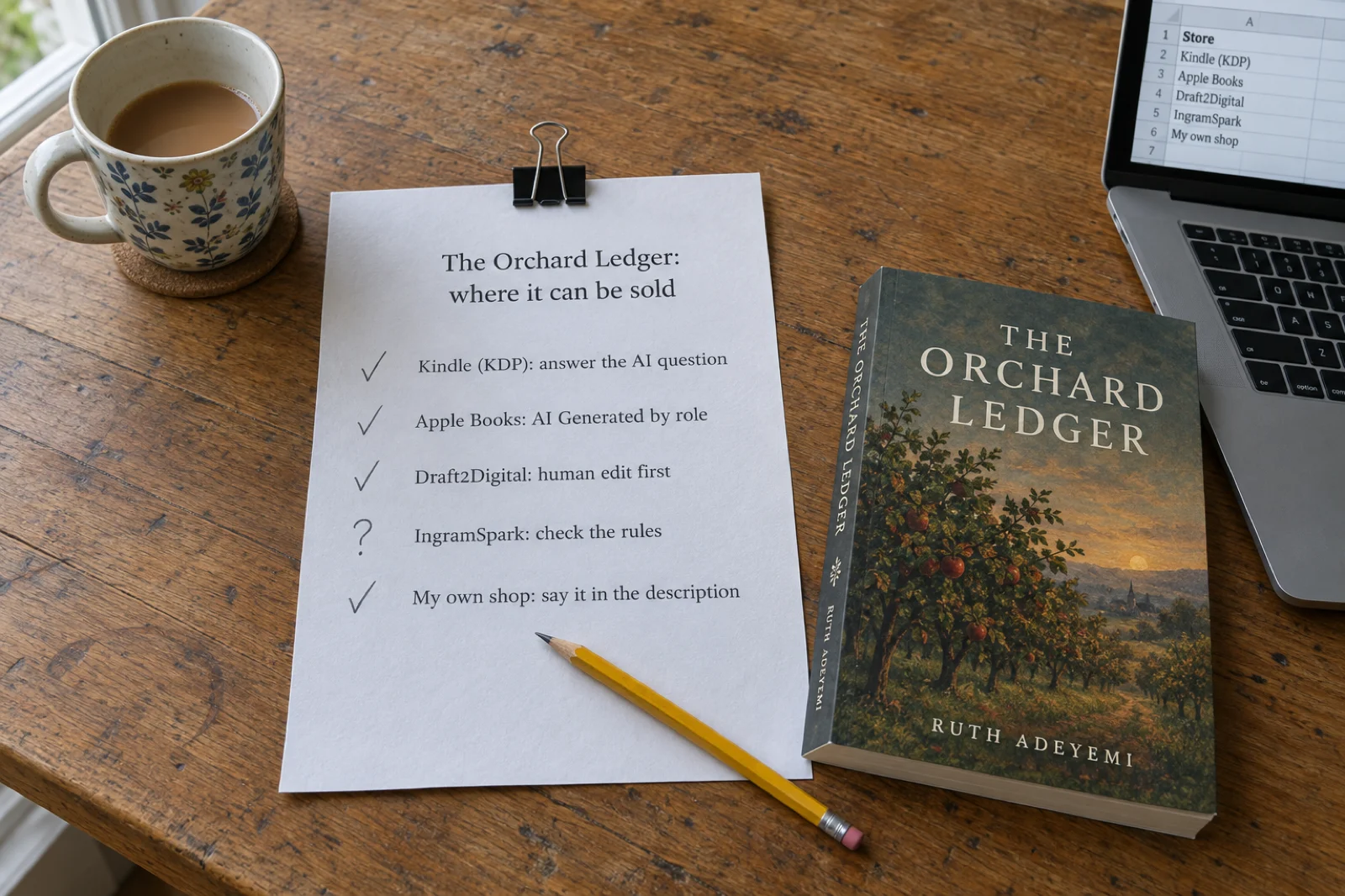
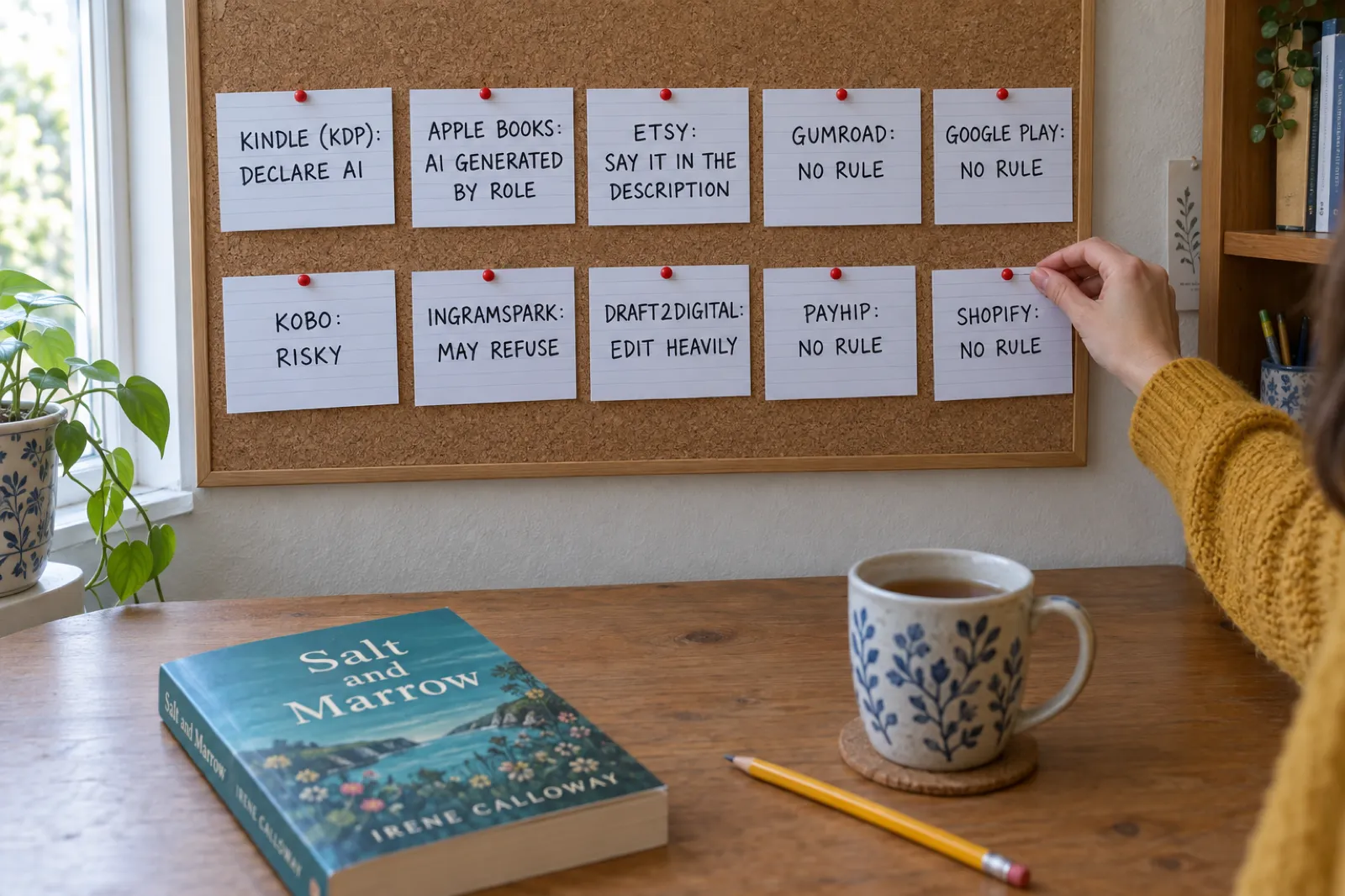
Yes, you can sell an AI-generated book, but not everywhere, and the rules differ by platform. As of 24 September 2026: Amazon KDP allows AI-generated text and images if you tell it when you publish. Apple Books allows them with an "AI Generated by" contributor role and a line in the description. Etsy allows them if the listing description says the item was made with AI. Gumroad, Payhip, Shopify and Google Play Books publish no rule about AI-made books. Draft2Digital accepts AI-assisted books and AI drafts a human has edited extensively, but not books generated entirely by AI. Kobo lists "wholly or partially AI generated" among its common reasons for declining a book, and IngramSpark lists AI-generated content among the types it may not accept. None of the ten publishes a rule against a book a person wrote with AI help for editing or ideas.
What counts as an AI-generated book?
An AI-generated book is one where an AI tool produced the words or the pictures, even if you edited them afterwards. An AI-assisted book is one you wrote yourself, using AI only to brainstorm, edit or check it. Almost every store's rule turns on this line, and the two big stores that define the terms define them in nearly the same way.
- AI-generated means an AI tool produced the words or pictures. KDP's content guidelines say that if you used an AI tool to create the actual content, it counts as AI-generated "even if you applied substantial edits afterwards". Apple's test is whether "a material portion of the content is generated by an AI-based tool as opposed to a human author or illustrator".
- AI-assisted means you wrote or drew it and used AI as a tool: to brainstorm, research, edit, check or improve. KDP says you do not need to disclose it. Apple lists "idea generation, research, editing, or producing cover images for a book composed by a human author or illustrator" and says that needs no disclosure either.
Draft2Digital draws a third line inside AI-generated: a draft that has "gone through extensive editing from a human" is acceptable, and one that has not is refused. Kobo and IngramSpark do not define the terms at all; they name AI-generated or automated content as something they may reject, and leave the judgement to their reviewers.
So the honest first step is to put your own book in the right box. If a tool wrote the chapters and you revised them, the book is AI-generated for KDP and Apple however much you changed. If you wrote the chapters and a tool helped you tighten them, it is AI-assisted. The picker below asks exactly this.
Which platforms allow AI-generated books? The rules, checked 24 September 2026
Each row comes from the platform's own policy or help page, read on the date above. Quotes are the platform's words, cut only where marked with [...]. Where a platform has no written rule on AI-made books, the table says so rather than guessing what it would do. Several of these pages carry no date of their own; where one does, it is in the source column.
| Platform | AI text allowed? | AI images allowed? | Disclosure field | The rule, quoted | Checked |
|---|---|---|---|---|---|
| Amazon KDP | Yes, disclosed | Yes, disclosed (cover and interior) | Yes. You tell KDP when you publish or republish. AI-assisted work needs no disclosure. | We require you to inform us of AI-generated content (text, images, or translations) when you publish a new book or make edits to and republish an existing book through KDP. | 24 Sep 2026 |
| Etsy | Yes, disclosed | Yes, disclosed | Yes. In the listing description. | Seller-prompted AI creations: Creations that were generated using AI tools [...] based on a seller’s original prompts. Sellers must disclose within their listing description if an item is created with the use of AI. | 24 Sep 2026 |
| Gumroad | No published rule found (checked 24 Sep 2026) | No published rule found (checked 24 Sep 2026) | None | The only AI item on the prohibited list: "AI services which includes selling access to AI tools, chatbots, image or content generation services, or subscriptions to AI services that are fulfilled outside of Gumroad" Gumroad Prohibited Products and Activities, last revised 16 Sep 2026 | 24 Sep 2026 |
| Apple Books | Yes, labelled | Yes. An AI cover on a book a human wrote needs no label; AI illustrations that make up a material part of the book do | Yes. The "AI Generated by" contributor role, and a line in the description. | Book content that is AI-generated (i.e., a material portion of the content is generated by an AI-based tool as opposed to a human author or illustrator), must be labeled as such using “AI Generated by” artist role and declaring the AI-generated creation method in the description. Apple Books Formatting and Content Guidelines, section 1.13 (undated) | 24 Sep 2026 |
| Kobo Writing Life | Rejection risk: "Wholly or partially AI generated" is on its list of common reasons books are declined | No separate rule found | None published | Automated Content Generation: Content generated primarily by automated tools that lacks genuine human effort, quality control, or is designed to exploit trends rather than offer genuine reader value. | 24 Sep 2026 |
| Google Play Books | No published rule found (checked 24 Sep 2026) | No published rule found (checked 24 Sep 2026) | None for ebooks | No AI rule. The nearest is the quality rule: "Content that provides a poor user experience, such as gibberish, nonsensical, or repetitive text that provides no narrative or educational value." | 24 Sep 2026 |
| IngramSpark | Listed as content that "may not be accepted" | Not addressed separately | None published | Content created using automated means, including but not limited to content generated using artificial intelligence or mass-produced processes. | 24 Sep 2026 |
| Draft2Digital | Yes if a human has edited it extensively; not if AI wrote it all and nobody did | No separate AI rule; "unprofessional images" fall under low quality | None published | While we support AI-assisted content we do not accept content that has been generated entirely by AI/LLMs that has not gone through extensive editing from a human. | 24 Sep 2026 |
| Payhip | No published rule found (checked 24 Sep 2026) | No published rule found (checked 24 Sep 2026) | None | No AI rule. Its list of products that are not allowed covers pornography, hate, illegal content, copyright infringement, file hosting, gambling, debt and get-rich-quick content, and similar. Payhip Help Center, What products are not allowed on Payhip? (undated) | 24 Sep 2026 |
| Shopify (your own store) | No published rule found (checked 24 Sep 2026) | No published rule found (checked 24 Sep 2026) | None | No AI rule. The main rule: "you’re responsible for following the rules of your platform, your partners, and the law." | 24 Sep 2026 |
"No published rule found" means we read the platform's content policy, prohibited-items list and terms on the date shown and found nothing about AI-made books. It does not mean the platform has promised to accept every one: all ten keep general quality, copyright and misleading-content rules that apply to any book.
Where can your book go? Ebook, print or direct sale
Three answers about the book, and the platforms for that route are sorted into what works, what works with conditions and what is closed to it. Nothing you choose leaves this page.
An AI draft that you have edited properly can go to most ebook stores. The difference between them is the label: KDP and Apple ask for one, the others do not publish a field.
Amazon KDP (Kindle)
WorksAllowed. Tell KDP that the text and the cover are AI-generated when you publish. Editing AI text heavily does not change that answer.
Apple Books
WorksAllowed with a label: add the "AI Generated by" contributor role and say so in the description.
Draft2Digital
WorksAllowed if your editing was extensive; that is its line. It then passes the book on to the stores it serves, whose rules also apply.
Kobo Writing Life
With conditionsKobo lists "wholly or partially AI generated" among its reasons for declining a book. A book with real human work in it is what it asks for, but expect scrutiny.
Google Play Books
WorksNo published AI rule. Its quality rules apply to every book.
IngramSpark
Not for this bookIts catalog guidelines list content generated using AI among the types that may not be accepted. Do not plan a launch around it for this book.
Sorted from each platform's written rule as read on 24 September 2026. "Works" means the rule allows it, not that a reviewer will approve every book: quality rules still apply everywhere.
Why AI images are a separate question from AI text
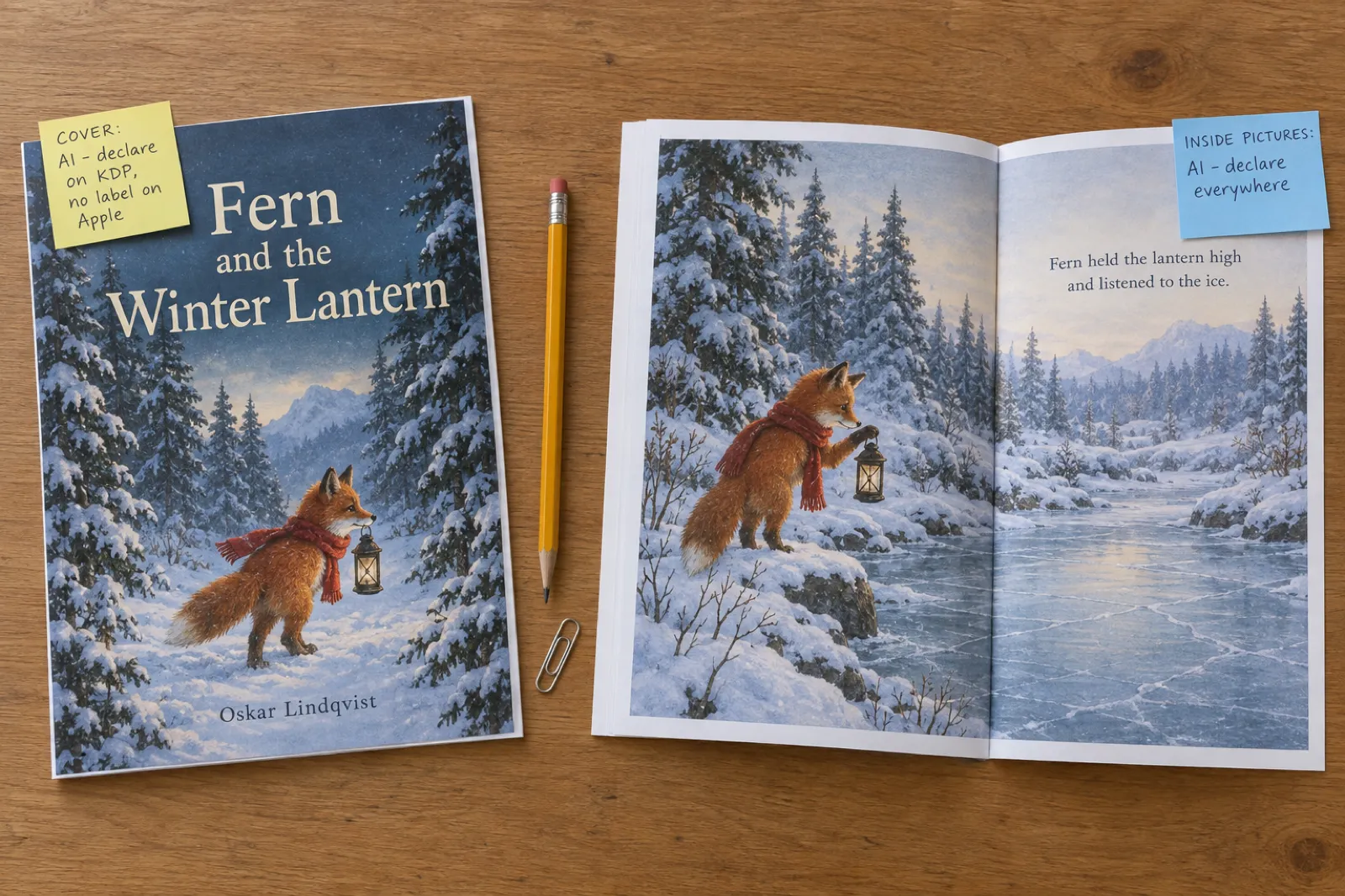
Every platform that writes about AI treats pictures on their own terms, and they do not agree. KDP says "AI-generated images include cover and interior images and artwork", so an AI cover on a book you wrote yourself still needs declaring. Apple says the opposite for covers: producing cover images with AI, for a book composed by a human, is AI-assisted and needs no disclosure, while illustrations that make up a material portion of the book need the label. Etsy's examples of seller-prompted AI creations are all images, and its rule asks for a line in the listing description for any item created with AI. The other seven publish nothing about covers or illustrations specifically.
This matters more than it sounds, because images are where AI shows up most among books that are actually put on sale. Counted on 24 September 2026 across 109,731 books made on Inkfluence AI, 5.1% (5,642) carry a cover made with the app's AI cover tool or are picture, coloring or ABC books illustrated in the app. Among the 2,555 books listed for sale through the app's Etsy and Gumroad integrations on the same day, the share is 34.8% (888): roughly one listed book in three has an AI cover or AI illustrations. Both figures are a floor, since AI images that authors placed inside other books are not counted. The practical upshot: if you are selling, check the image rule for your store as well as the text rule.
Where those listings go is lopsided too. 471 of the books carry an Etsy listing, and about five books go to Gumroad for every one that goes to Etsy; the Gumroad side of that data is on the selling on Gumroad page, and the listing rate across every kind of book is on the travel guides page.
Can you sell an AI-written book on Amazon KDP?
Yes. KDP's content guidelines say: "We require you to inform us of AI-generated content (text, images, or translations) when you publish a new book or make edits to and republish an existing book through KDP." AI-assisted content does not need to be disclosed, and KDP adds that you are responsible for making sure all of it follows the content guidelines, including intellectual property rights. The same guidelines rule out descriptive content that misleads customers and content that is "typically disappointing to customers", which is where thin, unedited books tend to fail.
The KDP rule is covered case by case in our KDP AI disclosure policy post, and the upload itself in how to publish AI-generated books on KDP. One wider choice to make first: KDP Select asks for ebook exclusivity, which rules out every other ebook store on this page for that book while it is enrolled. KDP Select vs wide distribution sets out the trade.
Can you sell AI-generated ebooks on Etsy?
Yes, as a digital download, with a disclosure. Etsy's Creativity Standards (last updated 10 June 2025) put AI work under "Designed by a seller" as "Seller-prompted AI creations: Creations that were generated using AI tools [...] based on a seller's original prompts", and add: "Sellers must disclose within their listing description if an item is created with the use of AI." The same page lists "A PDF file of a book that the seller did not personally create or design" among the items that do not qualify, so the ebook has to come from your own prompts and work, not a resold file.
What to write and tick on the listing itself is in our Etsy AI disclosure explained post, and the selling side in how to sell ebooks on Etsy.
Does Gumroad allow AI-generated products?
Gumroad publishes no rule against selling a product made with AI, including an AI-written ebook. Its Prohibited Products and Activities page, last revised on 16 September 2026, has exactly one AI entry: "AI services which includes selling access to AI tools, chatbots, image or content generation services, or subscriptions to AI services that are fulfilled outside of Gumroad". That bans selling access to an AI tool. It does not ban selling a finished book, template or course that was made with one. Gumroad's terms of service, last updated 14 September 2026, add nothing on AI-made products either; like every platform, they make you responsible for the content you sell and for not infringing anyone else's rights.
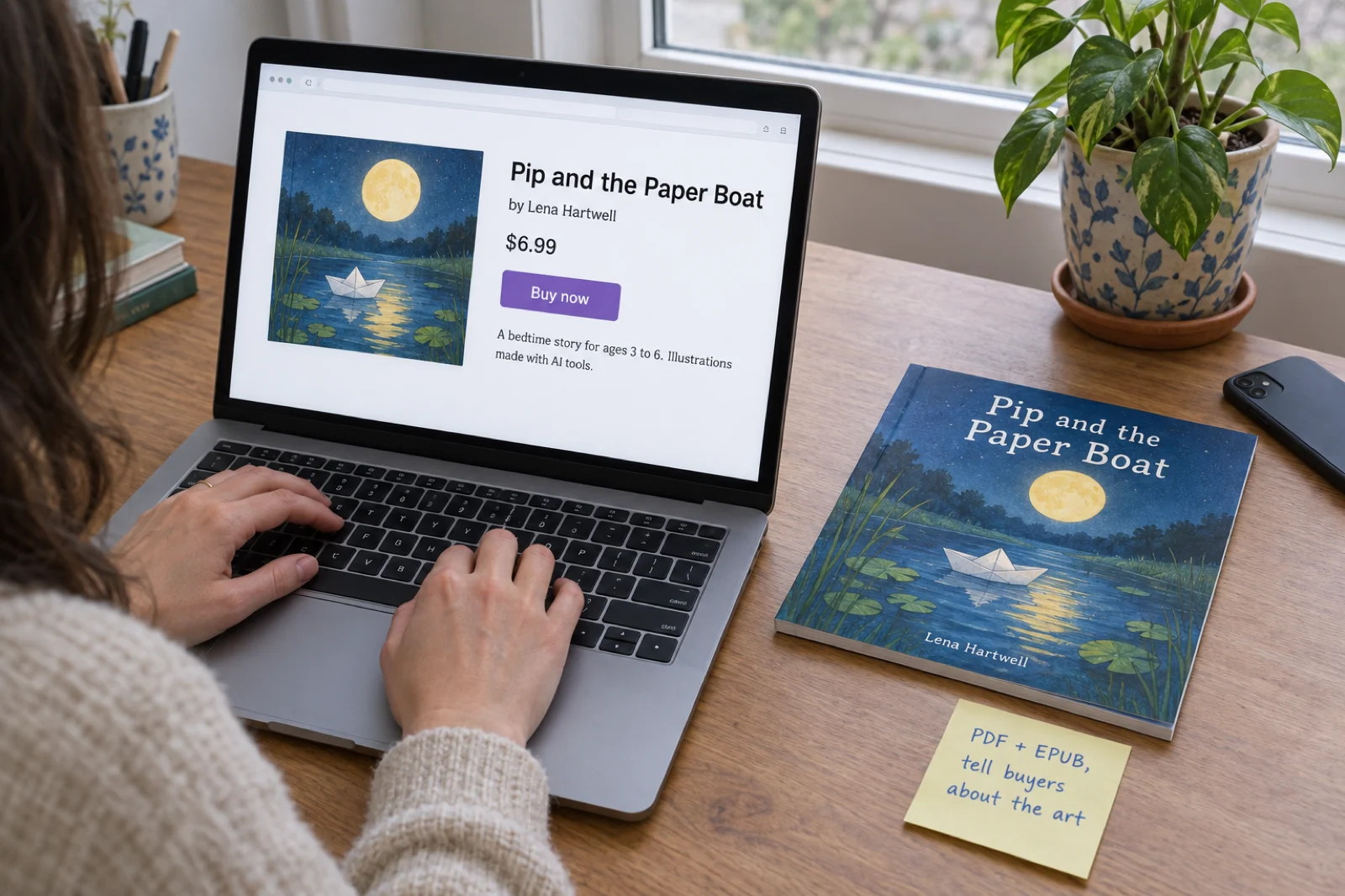
Gumroad has no disclosure field. A line in the product description saying what AI did (wrote the first draft, illustrated the pages) costs nothing and keeps refund requests down, because buyers who care can decide before they pay. Fees, pricing and what sells there are on the selling on Gumroad page, and the platform against Etsy in Etsy vs Gumroad for ebook sellers.
Does Apple Books accept AI-generated books?
Yes, labelled. Apple's Formatting and Content Guidelines are the most precise of any store on this page. Section 1.13 says a book where "a material portion of the content is generated by an AI-based tool as opposed to a human author or illustrator" must be "labeled as such using “AI Generated by” artist role and declaring the AI-generated creation method in the description." Section 2.9 repeats the role requirement under author metadata, and section 4.8 under descriptions: "Content that is AI-generated must explicitly state this in the description to avoid customer confusion."
In practice that means two edits to the listing: add a contributor with the "AI Generated by" role, and add a sentence to the description such as "The text of this book was generated with AI and edited by the author." Apple's exemption for AI-assisted work is broad and useful: idea generation, research, editing and cover images for a book a human composed need no label. That makes Apple the one platform here with a written rule that exempts an AI cover on a human-written book.
Does Kobo Writing Life accept AI-generated books?
Not reliably. Kobo is the strictest of the big ebook stores in what it publishes, without a single sentence that says "no AI". Its help page What Content is Not Allowed? (updated 26 March 2026) reserves the right to remove books containing "Automated Content Generation: Content generated primarily by automated tools that lacks genuine human effort, quality control, or is designed to exploit trends rather than offer genuine reader value." Its page Why was my Book Rejected or Blocked? (updated 6 May 2026) goes further: among books declined as an "unsatisfactory or incomplete experience", it lists those that are "Wholly or partially AI generated", alongside books that are too short, poorly translated or priced too high.
Kobo's FAQ adds context: it says it is developing machine learning tools to screen out AI-generated and pirated content, and it publishes no disclosure field for ebooks. So Kobo is a route for a book with real human work in it, where AI helped, and a poor bet for a lightly edited AI draft. Kobo does accept AI narration for audiobooks, which is a separate rule covered in where to sell an AI audiobook.
Does Google Play Books allow AI-generated books?
Google Play Books' publisher content policies contain no rule about AI-generated books; none was found on 24 September 2026. What they do have is a "Spam and content quality" section that applies to every book, AI or not. It prohibits "Content that provides a poor user experience, such as gibberish, nonsensical, or repetitive text that provides no narrative or educational value", and content "easily found online at no charge or lacks the depth and curation necessary to provide a meaningful reading experience". Google says it reviews books with a mix of automated and human evaluation.
There is no AI field for ebooks. (The "Synthesized voice" narrator option in Google's Partner Center is for audiobooks.) A well-edited AI-assisted or AI-drafted book sits inside these rules; a padded one that repeats itself is what the quality section is written to catch.
Does IngramSpark accept AI-generated content or AI cover art?
Often not. IngramSpark's position is the one most likely to surprise authors planning a print run. Its Catalog Integrity Guidelines, published on 1 October 2023, set out "the types of content that may not be accepted". One of them is: "Content created using automated means, including but not limited to content generated using artificial intelligence or mass-produced processes." Content that breaks the guidelines "will be removed from the catalog", with a review available if you think the removal was wrong.
On cover art, the guidelines say nothing separate: no exemption, no disclosure field and no definition of AI-assisted. The only cover-related rule is about covers that mimic popular titles or mislead buyers. So for a book whose text you wrote, with an AI cover, the careful course is to ask IngramSpark before you upload rather than to assume either way. For a book whose text AI generated, KDP's print service is the dependable print route; paperback publishing with KDP Print covers the files it needs.
Does Draft2Digital accept AI-generated books?
Yes, if a person has done real editing. Draft2Digital's content guidelines (last updated 27 October 2025) have a heading called AI Content: "While we support AI-assisted content we do not accept content that has been generated entirely by AI/LLMs that has not gone through extensive editing from a human." The page opens by saying Draft2Digital is not a destination "for individuals who seek to publish 100% AI-generated books", and separately refuses "content generated solely by machine or other automated processes" under mass-produced content.
Two other rules on the same page catch many AI books even when the editing is real. Non-fiction may need "further documentation of subject matter expertise", and accounts publishing non-fiction across many topics must show expertise in each. And a list of "oversaturated" subjects, including affirmations and chakras, is refused outright. Because Draft2Digital distributes your ebook to other stores, a book sent through it has to pass Draft2Digital's rules first and each store's rules after.
Can you sell AI-written books on Payhip?
Payhip publishes no rule about AI-made products; none was found on 24 September 2026. Its help article What products are not allowed on Payhip? lists pornography, hate, illegal content, copyright infringement, file hosting, gambling, debt and loan content, get-rich-quick content and a handful of other categories, and none of them is about AI. Its terms of use, last updated 19 February 2018, predate the question. The terms do make you warrant that your content does not infringe anyone's intellectual property rights, and you must also follow the rules of the payment providers Payhip uses.
Two of Payhip's banned categories matter for AI books in particular: get-rich-quick content, which covers a certain kind of AI money-making ebook, and copyright infringement. Neither is about how the book was made.
Can you sell AI-written books on your own Shopify store?
Shopify publishes no rule about AI-made products. Its Acceptable Use Policy is short and principle-based: "you're responsible for following the rules of your platform, your partners, and the law". You cannot use Shopify for anything illegal where you do business, and payment and channel partners can add their own terms. Selling an ebook you made with AI, as a download or as printed copies you ship yourself, is your store and your decision.
The freedom cuts both ways: with no platform label, your product page is the only disclosure the buyer sees. Selling your book on Shopify covers the store set-up and delivery.
Which route suits an AI-written book: ebook, print or direct?
Ebook in the big stores
The widest reach, and the most rules. KDP and Apple take AI-generated books with a label. Google Play has no AI rule. Draft2Digital needs extensive human editing; Kobo lists AI generation among its rejection reasons. The more of the book is yours, the more of these stores are open.
Printed book
KDP prints and sells paperbacks and hardcovers with the same disclosure as the ebook. IngramSpark, a global distributor that reaches bookshops and libraries, lists AI-generated content among what it may not accept. For AI-written text, KDP is the print route that says yes in writing.
Direct sale
Gumroad, Payhip and Shopify publish no AI rule, and Etsy asks for one line in the description. You keep more per sale and choose your price, but these platforms send few buyers of their own: the readers have to come from you.
One rule of thumb covers all three. A distributor that sends your book on to other stores has to protect its standing with every one of them, so it tends to be stricter than any single store. That is why Draft2Digital and IngramSpark, both distributors, draw firmer lines than Google Play or Apple, and why your own shop, which answers to nobody but the law and your payment partners, is the most open of all.
Before you list an AI-written book: a short checklist
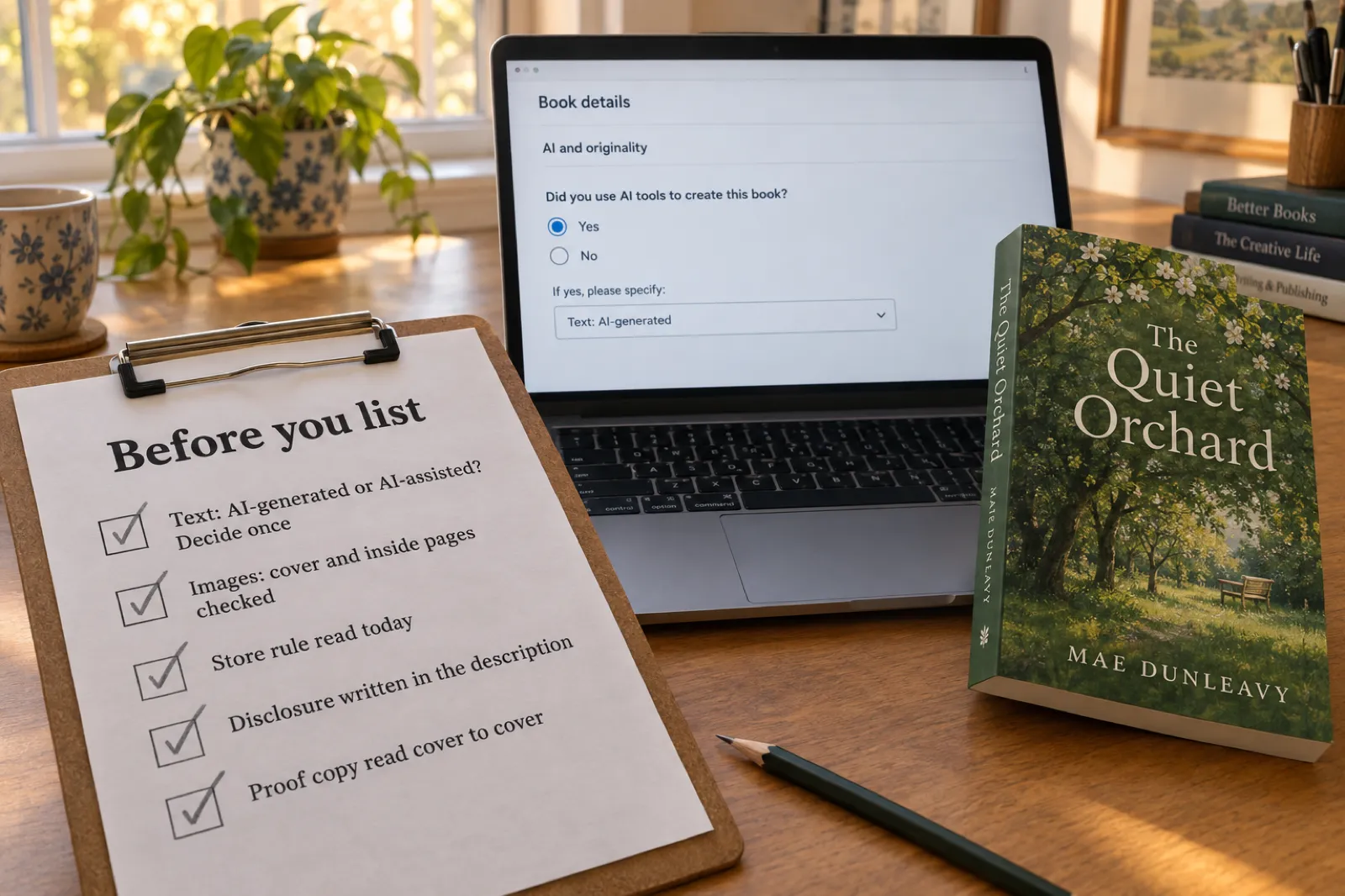
- Put the book in the right box. AI wrote it and you edited it: AI-generated on KDP and Apple, however much you changed. You wrote it and AI helped: AI-assisted. Decide this once and answer the same way on every store.
- Answer the image question separately. An AI cover is AI-generated content on KDP, needs no label on Apple for a human-written book, and needs a line on Etsy. Illustrations inside the book count everywhere that has a rule.
- Use each store's field, and the description where there is none. KDP asks when you publish. Apple wants the "AI Generated by" role and a sentence in the description. Etsy wants the description. Gumroad, Payhip and Shopify have no field, so say it on the product page.
- Edit as if a reviewer will read it. Draft2Digital's line is extensive human editing, Kobo's is genuine human effort, and every store bans repetitive, disappointing or misleading books. Read every chapter; cut repetition; check facts, names and numbers.
- Choose exclusivity before you upload. KDP Select's ebook exclusivity closes every other ebook store for that book while it is enrolled. Decide first.
- Check what you own. Selling rights and copyright are different questions. Can AI-written books be copyrighted? explains what protection an AI-drafted book has.
- Re-read the policy on the day. Every rule on this page is dated because these rules change. The linked page is the one to trust over any guide, including this one.
Where an Inkfluence AI book fits in these rules
A book whose chapters Inkfluence AI wrote is AI-generated in KDP's and Apple's terms, even after you edit it, and should be declared that way on both. A book you wrote yourself and brought in to edit, format or export is AI-assisted if you only used the app's assistant to revise it. Covers made with the AI cover tool, and illustrations in picture and coloring books, are AI-generated images.
From there the routes are the ones in the picker. The app exports PDF on every plan, and EPUB and DOCX on paid plans, with a KDP export for print. From the Publish tab, a finished book can go straight to your Etsy shop as a draft listing or to Gumroad as a priced product, which are the two channels where the AI question is simplest. How to sell your ebook walks through both on video. You keep the rights to what you make and sell, on every plan.
The one thing the app cannot do for you is the editing the stricter platforms ask for. Draft2Digital's "extensive editing from a human" and Kobo's "genuine human effort" are about you reading, cutting and rewriting. The editor is built for that, but the work is yours, and on those platforms it is the difference between yes and no.
How the rules have moved, and how to keep up
The dates in the table tell the story. IngramSpark set its guidelines in October 2023 and has not published a newer AI rule. Etsy's Creativity Standards were last updated in June 2025, Draft2Digital's guidelines in October 2025, and Kobo's two help pages in March and May 2026. Gumroad revised its prohibited list on 16 September 2026, eight days before this check, and still does not mention AI-made products. Apple and KDP do not date their pages, which is a reason to reread them before each launch rather than trust a remembered version.
The direction is consistent even where the wording differs: stores are not banning AI outright, they are asking to be told and refusing books that nobody has cared for. A book that is labelled where a label is asked for, and edited as if its author's name depends on it, is inside the rules of almost every platform here. What each route pays and how to price is covered in make money selling AI ebooks.
Selling AI-generated books: FAQ
Can you sell AI-generated books?+
Can you publish an AI-generated book?+
Does Gumroad allow AI-generated products in 2026?+
Does IngramSpark accept AI-generated content or AI cover art?+
Does Draft2Digital accept AI-generated books?+
Does Kobo Writing Life allow AI-generated books?+
Does Apple Books allow AI-generated books?+
Does Google Play Books allow AI-generated books?+
Do I have to disclose an AI cover?+
Is editing AI text enough to call it AI-assisted?+
Where can I sell an AI-written book with the fewest rules?+
Related reading
KDP AI disclosure policy
The Amazon rule in depth, case by case.
Publish an AI book on KDP
The upload, step by step.
Etsy AI disclosure explained
What to tick and write on an Etsy listing.
Make money selling AI ebooks
Pricing, niches and what sells.
Where to sell an AI audiobook
The same table for AI narration.
Sell ebooks on Gumroad
Fees, pricing and data from Gumroad-connected books.
Can AI-written books be copyrighted?
What you own, and what nobody does.
KDP Select vs wide
Exclusivity, before you pick your stores.
How to sell your ebook
Etsy and Gumroad listings from the Publish tab.
How to sell workbooks
Etsy printables, KDP paperbacks and the low-content rules.
How to sell fitness ebooks
Workout and meal plans, and the health-claim rules each store publishes.
How to sell a devotional
Devotionals and prayer journals, and how many Bible verses each translation allows.
Write it, edit it, label it, sell it.
Draft a full book from one idea, edit every chapter, and publish to Etsy or Gumroad from the same screen.
Start a book