
Amazon KDP AI Disclosure 2026: The 7 Cases Authors Get Wrong
AI-generated text, covers and translations must be disclosed on Amazon KDP, but AI-assisted work does not. A decision card for the seven edge cases authors get wrong, plus what actually happens if you skip it.

Quick Answer
Amazon KDP requires you to disclose AI-generated text, cover art, or translations during the publishing workflow. On the Content page, answer "Yes" to "Did you use AI tools in creating texts, images, and/or translations in your book?" and set the dropdown for each category that applies. AI-assisted use (brainstorming, grammar checks, outlining) does not require disclosure. Failure to disclose can result in book removal or account suspension; the disclosure itself is not shown to buyers and does not affect search ranking, royalties, or category eligibility.
Updated August 2026 · 10 min read
Disclose or Not? Decision Card
Most authors get tripped up by the same edge cases. This card covers the seven most common situations in one place; the rest of the guide goes deeper on each one.
| Situation | Disclose on KDP? | Why |
|---|---|---|
| AI wrote chapter text (Inkfluence AI, ChatGPT, Claude) and you edited it | YES | First draft came from AI; editing doesn't change the source |
| AI generated the cover image (DALL-E, Midjourney, Inkfluence cover generator) | YES | Generated imagery counts the same as generated text |
| AI translated your book to another language (DeepL, GPT) | YES | Translations are explicitly included in KDP's AI-generated category |
| You wrote the book; AI suggested edits you rewrote in your own words | No | AI-assisted, not AI-generated |
| You used AI to brainstorm an outline, wrote the book yourself | No | Idea generation is AI-assisted |
| Grammarly, ProWritingAid, spell-check polished your manuscript | No | Standard editing tools, not generation |
| Stock photo cover from Unsplash, Shutterstock, Inkfluence stock presets | No | Real photography, not AI-generated |
Amazon's AI disclosure policy has been in effect since late 2023 and has become more strictly enforced through 2025 and 2026. Whether you use ChatGPT, Claude, Inkfluence AI, Jasper, or any other AI writing tool, you need to understand exactly what Amazon requires before you hit "Publish." This guide breaks down the policy in plain language so you do not get caught off guard.

Compliance stack for KDP authors
- Amazon KDP AI Disclosure Policy (Learn guide) for step-by-step classification and checklist.
- Self-Publishing on Amazon KDP for full upload flow and launch sequence.
- KDP Categories for Beginners for cleaner listing placement.
- Kindle Keyword Research for 7-field metadata alignment.
- KDP Select vs Wide Distribution for channel decision after compliance checks.
- Ebook Export and Publishing for final file QA before submission.
What Is Amazon's KDP AI Content Policy?
Amazon KDP's AI content policy requires authors to declare whether their book contains AI-generated content during the publishing workflow. This declaration appears on the "Content" page when you set up a new title or update an existing one.
Amazon distinguishes between two categories:
- AI-generated content: Text, images, or translations that were created by an AI tool, even if you edited them afterward. This includes AI-written chapters, AI-generated cover art, and AI translations of existing works.
- AI-assisted content: Content where you used AI as a helper, such as brainstorming ideas, checking grammar, suggesting edits, or generating an outline that you then wrote yourself. Amazon does NOT require disclosure for AI-assisted content.
The key distinction is who created the content. If an AI tool generated the prose, images, or translations and you edited it, that is AI-generated. If you wrote the content yourself and used AI to polish or brainstorm, that is AI-assisted.
Amazon's own wording
"If you used an AI-based tool to create the actual content (whether text, images, or translations), it is considered 'AI-generated,' even if you applied substantial edits afterwards." - Amazon KDP Content Guidelines
What Exactly Do You Need to Disclose?
During the KDP publishing process, you will encounter a content declaration section. Here is what requires disclosure, mapped to the exact AI tools each scenario covers:
| Content Type | Requires Disclosure? | Example |
|---|---|---|
| AI-written chapters | Yes | ChatGPT or Inkfluence AI drafted the text |
| AI-generated cover art | Yes | DALL-E, Midjourney, or AI cover generators |
| AI translations | Yes | DeepL or GPT translating your book to another language |
| AI-edited text you wrote | No | Grammarly, ProWritingAid, spell-check |
| AI brainstorming / outlines | No | Using ChatGPT to brainstorm chapter titles |
| AI-suggested edits you rewrote | No | AI suggested a better paragraph, you rewrote it in your own words |
| Stock images (not AI-generated) | No | Licensed photos from Unsplash, Shutterstock |
The rule of thumb: If an AI tool produced the actual words, images, or translations in your final book, disclose it. If you used AI as a brainstorming or editing assistant and wrote the final content yourself, you do not need to disclose.

Step-by-Step: How to Disclose AI Content on KDP
The disclosure process is straightforward. Here is exactly where to find it and what to select.
- Log into KDP at kdp.amazon.com and go to your Bookshelf.
- Create a new title or select an existing title to edit.
- Navigate to the "Content" tab in the publishing workflow.
- Find the "AI-Generated Content" section. This appears below the manuscript upload area.
- Answer the AI question. The form asks: "Did you use AI tools in creating texts, images, and/or translations in your book?" Select Yes if any AI-generated material appears in the final book.
- Set the dropdown for each category that applies. The exact options are reproduced below.
- Repeat per format. The declaration is made separately for each format you publish (Kindle ebook and paperback each have their own Content page).
- Continue with publishing as normal. The disclosure does not change your royalty rate, pricing options, or category eligibility.
The actual KDP form, word for word
"Did you use AI tools in creating texts, images, and/or translations in your book?" (Yes / No)
Answering Yes opens three independent dropdowns. Each must be set separately:
- Text: None · Some sections, with minimal or no editing · Some sections, with extensive editing · Entire work, with minimal or no editing · Entire work, with extensive editing
- Images: None · One or a few AI-generated images, with minimal or no editing · One or a few AI-generated images, with extensive editing · Many AI-generated images, with minimal or no editing · Many AI-generated images, with extensive editing
- Translations: Same scale as text, from None to Entire work, with extensive editing
Note the options ask how much you edited, not whether editing changes the classification. Even "Entire work, with extensive editing" is still an AI-generated disclosure; the editing level is detail Amazon collects, not an exemption.
What Happens If You Do Not Disclose?
Amazon takes the disclosure requirement seriously. Here is what can happen if you publish AI-generated content without declaring it:
- Book removal: Amazon can remove your book from sale without prior warning.
- Account suspension: Repeat violations or egregious cases can result in your KDP account being suspended or terminated.
- Loss of royalties: If your book is removed, pending royalties for that title may be withheld.
- Republishing restrictions: A removed title may be flagged, making it harder to republish even after adding the disclosure.
Amazon combines automated checks with human review of new titles, and it capped new title creation at three per day in late 2023 specifically because of AI-generated spam. Readers and competitors can also report suspected undisclosed AI content. Betting on not getting caught is a bad trade when the disclosure itself costs you nothing.

Does Disclosing AI Content Hurt Your Sales?
This is the question every AI-assisted author asks, and the honest answer is: no, not measurably.
Amazon does not display the AI disclosure to buyers on your book's product page. The declaration is for Amazon's internal records and policy compliance. Readers browsing your book on Amazon will not see a label saying "AI-generated content" next to your listing.
Your book still competes on the same playing field: cover quality, description copy, reviews, pricing, and category placement. The disclosure is a behind-the-scenes checkbox, not a scarlet letter.
That said, quality still matters. Amazon's content quality guidelines apply to all books equally. If your AI-generated book is low-quality, repetitive, or clearly unedited, it may get flagged or receive poor reviews regardless of disclosure status.
How Inkfluence AI Users Should Handle Disclosure
Authors publish books made with Inkfluence AI to KDP every day, so this is the guidance we give from direct experience, not theory:
- Always answer Yes to the AI question on the KDP content declaration page. Inkfluence AI generates chapter text, which means the text content is AI-generated even if you edit it afterward. For the text dropdown, if AI drafted the whole book and you have edited every chapter, the accurate selection is "Entire work, with extensive editing."
- Review and edit every chapter. Do not publish raw AI output. Read through each chapter, add your own insights, fix any inaccuracies, and ensure the tone matches your voice. This improves quality and makes the content genuinely yours.
- Cover images: If you use Inkfluence AI's cover generator, that counts as AI-generated imagery. Disclose it. If you use the stock image cover presets (real photographs), those are not AI-generated and do not need separate disclosure.
- Keep records. Save your Inkfluence AI project so you can reference what was AI-generated vs. what you wrote or edited manually, in case Amazon ever asks for details.
AI Disclosure for Other Platforms (Gumroad, Etsy, Your Website)
Amazon KDP is currently the strictest major platform regarding AI disclosure. Here is how other platforms handle it:
| Platform | AI Disclosure Required? | Notes |
|---|---|---|
| Amazon KDP | Yes, mandatory | During publishing workflow |
| Gumroad | No formal requirement | Ethical best practice to disclose |
| Etsy | Partial | AI use must be disclosed in listings; see our Etsy AI disclosure explainer |
| Apple Books | No formal requirement | Subject to standard content guidelines |
| Kobo | No formal requirement | Follows Rakuten content policies |
| Your own website | No requirement | Voluntary disclosure builds trust |
Best practice: Even on platforms that do not require it, being transparent about AI assistance builds trust with your audience. A simple note like "This book was created with AI writing assistance and human editing" is enough.
Common Mistakes Authors Make with KDP AI Disclosure
- Assuming editing removes the need to disclose. Even heavily edited AI text is still AI-generated. If the first draft came from an AI, disclose it.
- Forgetting about images. AI cover art and interior illustrations require disclosure too, not just text.
- Coloring books and picture books count. The image disclosure applies to AI-generated line art and illustrations exactly as it does to covers. It does not block publishing: if you are making one, our guides to publishing an AI coloring book on KDP and illustrated picture books cover the disclosure step in context.
- Thinking paraphrasing counts as original. Running AI text through a paraphrasing tool does not make it human-written. The policy turns on where the content came from, not on whether a detector can spot it.
- Publishing dozens of unedited AI books rapidly. High-volume, low-quality publishing is the fastest way to get flagged. Even with proper disclosure, Amazon may remove books if they do not meet quality standards.
- Using AI for translations without disclosing. Many authors forget that AI-translated books count as AI-generated content on KDP.
The Future of AI Publishing on Amazon
Amazon's AI policy will continue evolving. In 2026, the key trends to watch are:
- Stricter quality standards. Amazon is increasingly focused on content quality over volume. Well-edited AI books with genuine value will continue to thrive. Low-effort AI spam will be removed more aggressively.
- Better detection. Amazon's AI content detection technology is improving. Attempting to hide AI usage is becoming riskier and less practical.
- Industry standardization. Other platforms are likely to follow Amazon's lead with formal disclosure requirements in the coming years.
- Reader acceptance. Readers are becoming more comfortable with AI-assisted books, especially in non-fiction categories where accuracy and usefulness matter more than writing style.
The bottom line: disclose honestly, edit thoroughly, and focus on creating genuine value for readers. That strategy works regardless of how Amazon's policy evolves.

Frequently Asked Questions
Does Amazon reject books with AI-generated content?
No. Amazon does not reject books simply for containing AI content. They reject books that fail to disclose AI usage, violate content quality guidelines, or are part of spam publishing operations. Properly disclosed, well-edited AI books are published and sold every day on KDP.
Can Amazon detect AI-written content?
Amazon reviews new titles with a mix of automated checks and human review, and takes reader and competitor reports. No detector is perfectly reliable, but the policy does not depend on detection: it turns on where the content came from. Attempting to evade it by paraphrasing or using "humanizer" tools is both risky and unnecessary: just disclose honestly.
Do I need to disclose if I only used AI for the outline?
No. Using AI to brainstorm ideas, create outlines, or research topics counts as AI-assisted, not AI-generated. As long as you wrote the actual book content yourself, you do not need to select the AI disclosure checkbox on KDP.
Will disclosing AI content reduce my book's visibility on Amazon?
There is no evidence that AI disclosure affects Amazon's search ranking algorithm, category placement, or recommendation engine. Your book's visibility depends on the same factors as any other book: keywords, categories, sales velocity, reviews, and click-through rate.
Can I sell AI-generated books on Gumroad without disclosure?
Gumroad does not currently require AI disclosure. However, being transparent with buyers builds trust and reduces refund requests. Many successful Gumroad sellers include a brief note about their creation process on the product page.
What about AI-generated audiobooks?
Audiobooks are stricter than ebooks: ACX (the platform that feeds Audible) does not accept AI-narrated audiobooks at all - it requires a human narrator. Amazon's own Virtual Voice program is the only AI-narration route into Audible, and it is invitation-based with its own labeling. Other audiobook platforms such as Spotify and Google Play Books do accept AI narration under their own rules.
Create KDP-Ready Books with Inkfluence AI
Generate your book, edit every chapter, export to EPUB, and publish on Amazon KDP with proper AI disclosure. Start free: no credit card required.
Related Resources
If the book in question is a business book, our guide to the ethics of writing a business book with AI covers the reader test, fabricated case studies and the acknowledgement wording that sits alongside the KDP declaration.
- Amazon KDP AI Disclosure Policy (Learn Guide)
- Self-Publishing on Amazon KDP
- Amazon KDP Categories for Beginners
- Best Free AI Book Writing Tools (2026)
- How to Self-Publish on Amazon KDP (2026)
- Self-Publishing Guide (2026)
- KDP SEO Checklist
- Amazon KDP Tools
- AI Book Writer
- AI Book Generator
- Can AI-Written Books Be Copyrighted?
- How to Write a Book with AI
- Amazon KDP Tools Guide
- Best AI Book Writing Software (2026)
- How to Ensure AI Book Content Is Original
- How to Price AI-Created Ebooks
- Do Readers Actually Care If a Book Was Written with AI?

Founder, Inkfluence AI
Sam is the founder of Inkfluence AI. He built the platform to make book creation accessible to everyone - from first-time authors to seasoned publishers.
Helpful links
Ready to Create Your Own Ebook?
Start writing with AI-powered tools, professional templates, and multi-format export.
Get Started FreeRelated Articles
 AI Writing
 Best AI for Editing a Book (2026): 9 Tools Compared by Editing Job
Which AI should edit your manuscript? We compare ProWritingAid, Grammarly, AutoCrit, Sudowrite, Novelcrafter, ChatGPT, Claude, the free checks in Google Docs and Word, and Inkfluence AI by the job each does best: grammar, line editing, story feedback, or editing and publishing in one place. Prices checked 2 October 2026.
 Self-Publishing
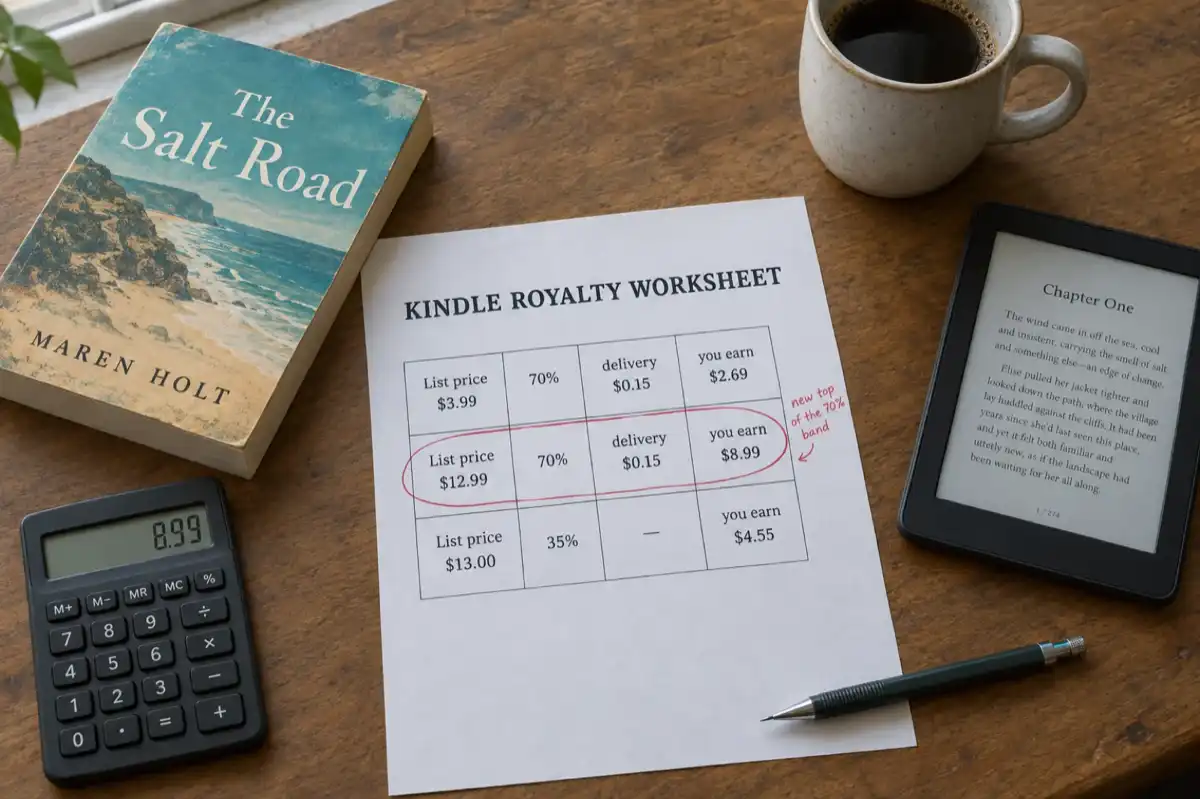
 KDP Royalties 2026: The 70% Band Now Runs to $12.99
Since 7 July 2026 Amazon KDP pays 70% on Kindle ebooks priced from $2.99 to $12.99, up from $9.99. What the change means for your price, how the delivery charge and the $13 cliff work, and what paperbacks, hardcovers and Kindle Unlimited pay, with worked examples.
 Guides
 Selling AI Coloring Books on Amazon KDP: The 2026 Rules, Specs, and Math
Are AI coloring books allowed on KDP? Yes, with disclosure. The part nobody covers: the AI workflow that passes review, style consistency across 30 pages, the interior specs that cause rejections, and the royalty ladder that decides your price.
Get ebook tips in your inbox
Join creators getting weekly strategies for writing, marketing, and selling ebooks.