
How to Price AI-Created Ebooks (Strategy Guide for 2026)
Data-driven pricing strategies for AI-assisted ebooks. Covers KDP pricing tiers, lead magnet vs premium positioning, genre-specific price points, and why production cost should never determine retail price.
Quick Answer
Price AI-created ebooks the same way you would price any ebook - based on perceived value, genre norms, and your business goals, not on production cost. Non-fiction ebooks typically sell for $4.99-$14.99; on KDP anything from $2.99 to $12.99 earns the 70% royalty, and $9.99 is the safe middle of that band. Fiction ranges from $0.99-$4.99 depending on length and series strategy. Short lead magnets work best at free or $0.99. The fact that AI helped you write faster does not reduce the book's value to the reader - and underpricing signals low quality.
Why This Matters
Your production cost dropped - your retail price should not
AI dramatically reduces the time and cost of writing a book. Some authors instinctively lower their prices to match, thinking "it only took me a weekend, I cannot charge $9.99." This is the biggest pricing mistake in AI publishing. Readers pay for the value they receive, not for how long the book took to write.
This guide gives you concrete pricing strategies, genre-specific benchmarks, and the economics behind each price point so you can maximise revenue from every book you publish.
The economics of AI-assisted publishing are different from traditional publishing in one critical way: your cost per book drops dramatically while the retail value stays the same. That gap is your profit margin - and pricing correctly is how you keep it.
Whether you are publishing on Amazon KDP, selling direct from your website, or using ebooks as lead magnets, this guide covers the pricing strategy for each scenario with real numbers.
The Core Pricing Principle
Before diving into specific numbers, internalise this: price is determined by reader value, not production cost.
A business book that helps someone land a $10,000 client is worth $14.99 whether it took you six months or six days to write. A self-help book that transforms someone's relationship with anxiety is worth $9.99 whether you typed every word or used AI to accelerate the writing.
Readers never see your production process. They see a cover, a title, a description, and a price. They evaluate whether the content is worth the money based on the promise, not the method.
The production cost comparison
| Cost item | Traditional | AI-assisted |
|---|---|---|
| Writing (ghostwriter / your time) | $2,000-$10,000 | $0-$50 |
| Editing | $500-$2,000 | $0-$500 |
| Cover design | $200-$500 | $0-$200 |
| Formatting | $100-$300 | $0 |
| Total per book | $2,800-$12,800 | $0-$750 |
Lower production cost means faster break-even and higher profit per sale - not lower retail prices.
Amazon KDP Pricing Tiers Explained
If you are publishing on Amazon KDP (and most self-published authors are), your pricing decision is shaped by Amazon's royalty structure:
| Price range | Royalty rate | You earn per sale | Best for |
|---|---|---|---|
| $0.99 | 35% | $0.35 | Loss-leader, series starter, impulse buy |
| $1.99 | 35% | $0.70 | Short fiction, pamphlets |
| $2.99 | 70% | $2.09 | Minimum for 70% royalty tier |
| $4.99 | 70% | $3.49 | Genre fiction, short non-fiction |
| $9.99 | 70% | $6.99 | Sweet spot, safe middle of the 70% band |
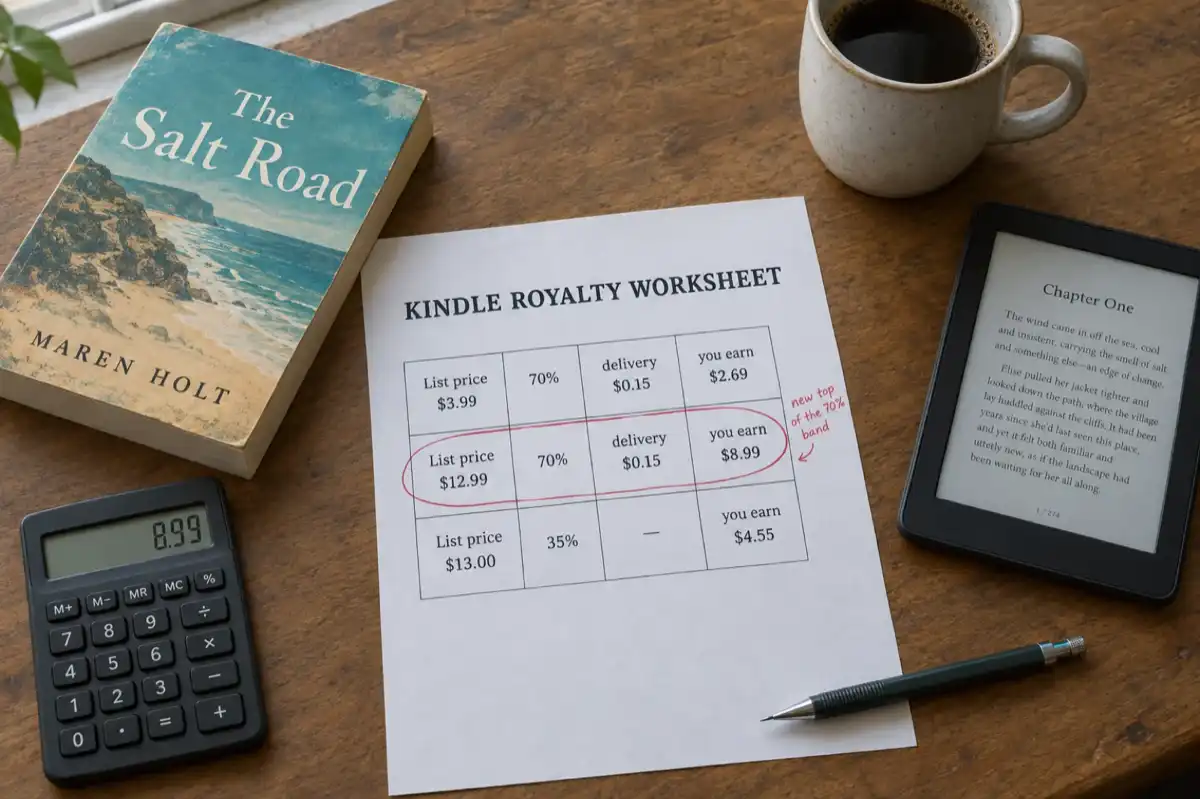
| $12.99 | 70% | $9.09 | Top of the 70% band since July 2026 |
| $14.99 | 35% | $5.25 | Premium non-fiction, textbooks |
The $12.99 ceiling is critical. Since 7 July 2026 the 70% band on Amazon.com runs to $12.99: at $12.99 you earn about $8.99 per sale after delivery on a 1 MB file (our KDP royalties 2026 guide has the full table). At $13.99 you drop to 35% and earn $4.90, roughly half the revenue for one dollar more. Unless you have the brand to justify $19.99 and beyond, $12.99 is the top of the sweet spot and $9.99 remains the safe middle of it.
For a deeper dive into Amazon publishing requirements, see our guide to KDP AI disclosure policies.
Non-Fiction Pricing by Category
Non-fiction ebooks generally command higher prices than fiction because readers buy them to solve a specific problem. Here are recommended price points by category:
| Category | Recommended price | Why |
|---|---|---|
| Business / entrepreneurship | $9.99 | High perceived ROI - readers expect actionable insights worth hundreds or thousands |
| Self-help / personal development | $7.99-$9.99 | Transformation promise justifies premium pricing |
| Health / fitness / wellness | $7.99-$9.99 | Readers invest in health; compare to cost of a single gym session |
| Cookbooks / recipe books | $4.99-$9.99 | Lower end for niche collections, higher for comprehensive guides |
| Study guides / educational | $4.99-$9.99 | Students are price-sensitive but value exam prep highly |
| Workbooks / exercise books | $7.99-$12.99 | Interactive content perceived as more valuable than passive reading |
| Travel guides | $4.99-$9.99 | Niche destination guides at $4.99, comprehensive at $9.99 |
| Devotionals / daily readers | $4.99-$7.99 | 365-day formats justify higher prices; shorter at $4.99 |
| Technical / professional | $9.99-$14.99 | Professional content commands premium - readers expense it |
These ranges assume a full-length ebook (8-15 chapters, 15,000-40,000 words). Shorter content should be priced lower or bundled. For workout programmes, meal plans and 30-day challenges sold as PDFs as well as on Kindle, see how to sell fitness ebooks; for 30-day and 365-day devotionals, and why a mostly public-domain Scripture book earns 35% on Kindle, see how to sell a devotional.
Fiction Pricing Strategies
Fiction pricing is less about the individual book and more about your series strategy and reader acquisition funnel.
Standalone fiction
| Length | Word count | Recommended price |
|---|---|---|
| Short story / novelette | 5,000-20,000 | $0.99-$2.99 |
| Novella | 20,000-50,000 | $2.99-$4.99 |
| Novel | 50,000-100,000+ | $3.99-$5.99 |
Series fiction (the volume play)
This is where AI-assisted fiction becomes a real business. The strategy:
- Book 1: $0.99 or free - This is your reader acquisition cost. Get people into the series at the lowest possible barrier. A free or $0.99 book 1 on KDP often generates hundreds of downloads per month.
- Books 2-3: $2.99-$3.99 - Readers who liked book 1 will pay more. You are building the habit.
- Books 4+: $4.99 - Committed series readers are price-insensitive. They want the next instalment.
- Box set (books 1-3): $9.99 - Capture the 70% royalty tier with a bundle that feels like a deal.
With AI-assisted novel writing, you can produce series instalments faster than traditional authors. A 5-book series at steady release velocity builds audience and revenue much more effectively than a single higher-priced standalone.
Genre-specific fiction pricing
| Genre | Typical range | Notes |
|---|---|---|
| Romance | $0.99-$4.99 | Voracious readers, series-driven, Kindle Unlimited popular |
| Mystery / thriller | $2.99-$5.99 | Series pricing works well; standalone thrillers at $4.99 |
| Sci-fi / fantasy | $2.99-$5.99 | Longer books tolerate higher prices; epic fantasy at $5.99 |
| Children's | $0.99-$3.99 | Short format, parents buy in volume, series pricing effective |
| True crime | $4.99-$9.99 | Research-heavy perception supports higher prices |
Lead Magnets and Free Ebooks
Not every ebook is meant to generate direct revenue. Lead magnets and free ebooks serve a different purpose: building your email list, establishing authority, and driving traffic to paid offers.
When to price at $0 (free)
- Email list building - "Download free in exchange for your email" is the classic lead magnet play. An AI-generated 20-page guide costs almost nothing to produce and can generate thousands of subscribers.
- Series book 1 - Free first-in-series on KDP to drive downloads. Convert readers to paid on book 2+.
- Authority building - Free ebook on your website demonstrates expertise and builds trust.
- Course upsell - Free ebook as a teaser for a $97-$497 online course.
The value of a free ebook
A free ebook is not worthless just because the price is zero. Calculate its value by the downstream revenue it generates:
Example: lead magnet economics
- Free ebook downloaded 1,000 times per month
- 40% provide email address = 400 new subscribers/month
- 5% of subscribers eventually buy your $9.99 paid book = 20 sales
- 20 sales x $6.99 royalty = $139.80/month from a free ebook
- Plus: course sales, consulting leads, affiliate revenue from the list
With AI, you can create a new lead magnet in an afternoon. The AI self-publishing workflow makes it practical to create multiple lead magnets for different audience segments.
Direct Sales vs Marketplace Pricing
Where you sell determines how you should price.
| Channel | Your cut | Pricing strategy |
|---|---|---|
| Amazon KDP | 35-70% | $2.99-$12.99 for 70% royalty. Volume-driven discovery. |
| Gumroad / Payhip | ~80-84% on Gumroad at these prices | Price higher ($14.99-$29.99). You keep most of each sale (Gumroad takes 10% plus $0.50, plus card processing) but drive your own traffic. |
| Your website (Stripe) | 97% | Maximum margin. Bundle with bonuses to justify $19.99-$49.99. |
| Apple Books | 70% | Match KDP pricing. Apple readers tolerate slightly higher prices. |
| Kobo / B&N | 45-70% | Match KDP pricing for consistency. |
The multi-channel strategy: Sell the ebook at $9.99 on KDP for discovery and volume. Sell a "premium edition" on your website for $24.99-$39.99 that includes the ebook plus bonus content: worksheets, templates, video walkthroughs, or a companion mini-course. Same core content, different packaging, higher revenue per customer.
Create your ebook and start selling
Try AI Ebook Generator Free5 Pricing Mistakes to Avoid
1. Pricing based on production cost
"It only took me a weekend with AI so I will charge $0.99." Your reader does not know or care how long it took. They care if the content solves their problem. A $0.99 price on a full-length non-fiction ebook actually signals "this is low quality" to most buyers.
2. Pricing above the $12.99 KDP threshold without reason
At $13.99 on KDP you earn $4.90. At $12.99 you earn about $9.09 before the delivery charge. Unless your brand and audience specifically support premium pricing (established author, professional niche), stay at or below $12.99 on Amazon.
3. Same price everywhere
KDP pricing ($9.99) should not be your direct sales pricing. On your own website you keep about 96% after card processing and can bundle bonuses. Price the direct version at $19.99-$39.99 with extras. Different channels, different pricing.
4. Never changing the price
Price is not permanent. Launch at $4.99 for the first two weeks to gather reviews, then raise to $9.99. Run $0.99 promotions during relevant seasons. A/B test $7.99 vs $9.99 for a month and compare total revenue, not just units sold.
5. Ignoring Kindle Unlimited
If your genre is KU-heavy (romance, sci-fi, thriller), page reads from KU subscribers can generate more revenue than direct sales. KDP pays KU authors per page read out of a monthly fund and publishes the fund, not a per-page rate; Written Word Media's estimate for Amazon.com was $0.00517 a page for August 2026, so a reader who finishes a book of 200 Kindle Edition Normalized Pages paid about $1.03. For series fiction, KU is often the primary revenue driver - factor this into your pricing and exclusivity decisions.
The romance guide works a full read through at the latest monthly estimate: Kindle Unlimited pay for a romance novel.
The AI Volume Advantage
The real pricing advantage of AI-assisted publishing is not about charging more per book - it is about producing more books efficiently. Here is how the economics work:
Traditional author vs AI-assisted author (annual comparison)
| Metric | Traditional (1 book/year) | AI-assisted (6 books/year) |
|---|---|---|
| Books published | 1 | 6 |
| Price per book | $9.99 | $9.99 |
| Sales per book/month (avg) | 50 | 30 |
| Monthly revenue | $350 | $1,259 |
| Annual revenue | $4,200 | $15,108 |
Even if each individual AI-assisted book sells fewer copies, the total revenue from a larger catalogue significantly outperforms a single title. Each new book also cross-promotes the others.
Six books sounds ambitious, but with an efficient AI co-writing workflow, you can produce a full-length non-fiction ebook in 1-2 weeks including editing. For fiction authors using AI for first drafts, a novel every 6-8 weeks is realistic.
More titles also means:
- More surface area for discovery - each book is a new search result, a new recommendation, a new entry point
- Cross-promotion - each book includes links to your other books
- Backlist compounding - older titles keep selling while you publish new ones
- Series potential - more books make bundles and box sets possible
Build your ebook catalogue with AI
Create professional ebooks in days instead of months. Start free and publish your first book this week.
Start Writing FreeFrequently Asked Questions
Should AI ebooks be cheaper than traditionally written ebooks? +
What is the best price for a first ebook on Amazon? +
How does Kindle Unlimited affect pricing? +
Can I sell AI ebooks for more than $9.99? +
Should I make my ebook free to build an audience? +
How often should I change my ebook price? +
What about bundle pricing? +
Does AI disclosure affect pricing? +
How do I price an ebook in multiple currencies? +
What is the minimum viable ebook for paid sales? +
What to Read Next
The Complete Guide to AI Self-Publishing
Full pipeline from idea to published book on KDP, Gumroad, and more.
What Types of Books Are Best Suited for AI Creation?
Match your book type to AI capabilities before committing.
Convert Your Book into an Online Course with AI
Turn a $9.99 ebook into a $97-$497 course for 10-15x revenue.
Amazon KDP AI Disclosure Policy Explained
What you must disclose when publishing AI-assisted books on Amazon.
Best AI Ebook Platforms for Personal Brands
Platform comparison and content system strategy for personal brands.

Founder, Inkfluence AI
Sam is the founder of Inkfluence AI. He built the platform to make book creation accessible to everyone - from first-time authors to seasoned publishers.
Helpful links
Ready to Create Your Own Ebook?
Start writing with AI-powered tools, professional templates, and multi-format export.
Get Started FreeRelated Articles
 Self-Publishing
 KDP Royalties 2026: The 70% Band Now Runs to $12.99
Since 7 July 2026 Amazon KDP pays 70% on Kindle ebooks priced from $2.99 to $12.99, up from $9.99. What the change means for your price, how the delivery charge and the $13 cliff work, and what paperbacks, hardcovers and Kindle Unlimited pay, with worked examples.
 Self-Publishing
 How to Publish a Poetry Book on Kindle in 2026: The Complete Indie Poet Guide
Poetry collections sell well on KDP when they are formatted properly. Most indie poets get tripped up on the same five things: stanza spacing collapses on reflow, long lines break unintentionally, the cover does not signal poetry, the description reads like fiction back-cover copy, and the categories miss the readers. Here is the complete workflow.
 Self-Publishing
 The Real Cost of Publishing a Book in 2026: A Transparent Breakdown for Indie Authors
Industry estimates put the cost of self-publishing one book at $2,940 to $5,660. The honest answer is that almost none of that is mandatory. Here is what every line item actually costs in 2026, citation-checked, with three realistic budget paths and the AI-native shortcut that collapses most of the stack into one flat subscription.
Get ebook tips in your inbox
Join creators getting weekly strategies for writing, marketing, and selling ebooks.