
The Real Cost of Publishing a Book in 2026: A Transparent Breakdown for Indie Authors
Industry estimates put the cost of self-publishing one book at $2,940 to $5,660. The honest answer is that almost none of that is mandatory. Here is what every line item actually costs in 2026, citation-checked, with three realistic budget paths and the AI-native shortcut that collapses most of the stack into one flat subscription.

Quick Answer
In 2026 the typical cost of self-publishing one professionally produced book runs $2,940 to $5,660 according to Reedsy's industry breakdown. Most of that is editing ($1,600 to $2,880), cover design ($630 to $1,200), audiobook narration ($2,000 to $4,000 at $200 to $400 per finished hour), with ISBN, formatting and distribution making up the remainder. None of those line items are strictly mandatory: a careful self-edited DIY release with a $50 cover template and a free EPUB conversion can ship for under $100. Modern AI-native platforms collapse most of that stack into a single flat subscription, with Inkfluence AI charging $9.99 a month for a Creator plan that covers chapter writing, cover design, EPUB and PDF and DOCX export, plus 15 chapters of ACX-spec audiobook narration.
Why this matters
The "$5,000 to publish a book" headline is technically accurate and almost always wrong for the person asking.
Indie authors who Google "how much does it cost to publish a book" land on guides quoting industry averages. Industry averages bake in professional services that most first-time authors do not actually need on book one: a developmental edit at $0.07 per word, a custom cover at $930, a full ACX human narration at $3,000. Those numbers describe a specific publishing path, not the path most indie authors take.
This guide does the breakdown both ways. We list the industry average for each line item with the source it comes from, then the realistic minimum the same line item can run for an author shipping their first book on a budget. At the end we put both into three real-world scenarios so you can see what a $250 budget actually buys versus a $5,000 budget, and where the AI-native subscription model fits.
The six cost categories every indie author actually pays
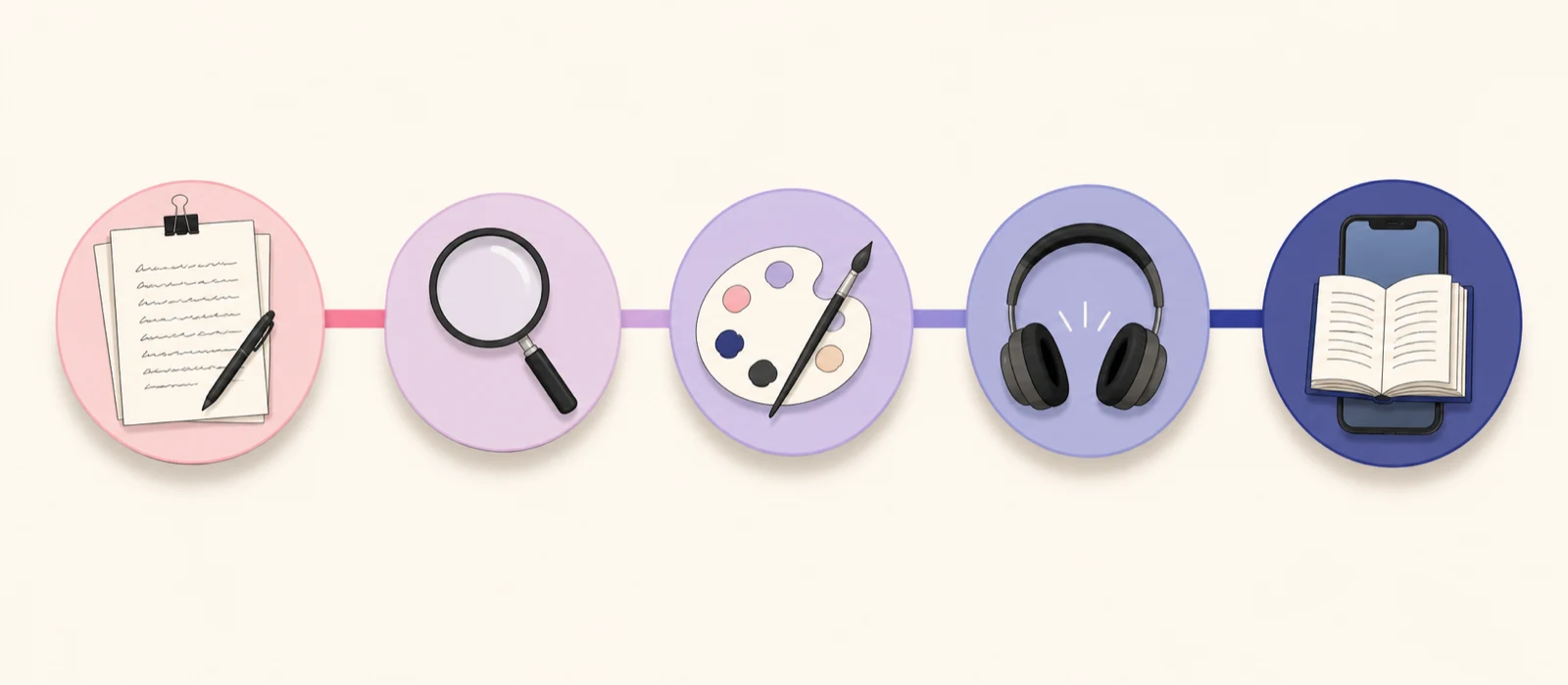
Strip the marketing jargon out and every self-published book is some combination of these six line items:
- Writing tool or platform. The software you draft in. Free word processors all the way through to AI-native subscriptions at $10 to $20 per month.
- Editing. Optional in theory, mandatory in practice if you want positive reviews. Tiers range from a careful self-edit (free) to a full developmental + copy + proofread pass at $5,000+.
- Cover design. The first thing every potential reader sees. Templates, AI generation, and human cover designers cover the full $0 to $3,000 spectrum.
- Interior formatting and ebook conversion. Turning your manuscript into a print-ready PDF and a Kindle-compliant EPUB. Free DIY tools exist; professional formatters charge $200 to $800.
- Audiobook production. Optional but increasingly expected. AI narration at $0 to $50 a month, professional human narration at $2,000 to $4,000 per book.
- ISBN, distribution and marketing. The miscellaneous bucket: ISBNs ($0 to $125 each), KDP and IngramSpark setup ($0 to $49), and a launch budget that can run from $0 to "infinite".
Average totals quoted across the industry sit between $2,940 and $5,660 per book according to Reedsy's 2026 self-publishing cost guide. Kindlepreneur's 2026 breakdown puts the realistic spread at $2,000 to $4,000 for a "high-quality" release and $300 to $3,000 for first-time authors. Both numbers describe the same reality: the floor is much lower than the headline if you make smart trade-offs.
Editing: the biggest single line item
Editing is where most authors blow their budget. The standard tiers and 2026 prices, all sourced from Reedsy's published rate data:
| Service | What it covers | Per-word rate | Cost for 80,000 words |
|---|---|---|---|
| Editorial assessment | High-level feedback on structure, plot, voice. No line edits. | Flat fee | ~$2,000 |
| Developmental editing | Story-level rewrites, pacing, character arcs. | $0.07 to $0.12 | $2,880 typical |
| Copy editing | Sentence-level grammar, syntax, consistency. | $0.02 to $0.04 | $2,160 typical |
| Proofreading | Final-pass typos, spacing, formatting glitches. | $0.01 to $0.02 | $1,600 typical |
The realistic minimum is much lower. Author beta-readers (free), a careful AI-assisted self-edit pass (free with a subscription you already have), and one round of paid proofreading at the cheap end of the range can ship a clean book for under $1,000. The "industry standard" $5,000 figure assumes you pay for all four tiers and never use a tool that overlaps with one.
Where AI assistance fits. Modern AI book editors include built-in copy and continuity passes that catch the same kinds of issues a human copy editor catches: tense slips, voice drift, contradictions between chapters. They do not replace a developmental editor for a literary novel that needs deep restructuring, but they do collapse the copy-editing line from $2,160 down to "included in your monthly subscription". For a deeper dive into the model-cost economics of AI-assisted novel writing specifically, see our BYOK vs all-included pricing breakdown.
Cover design: what is worth paying for
Reedsy's 2026 cover-design data: the median paid cover lands at $930, with 50% of projects sitting between $630 and $1,200. Genre matters: fantasy covers average around $1,100 because of the illustration work, thrillers and memoirs run closer to $800 because they lean on photography and typography.
The realistic floor is not $0. A free Canva template with no customisation reads as "self-published" to most browsing readers, which depresses click-through on Amazon. The realistic floor is "professional-looking enough that browsers do not bounce", and there are three honest ways to get there:
- Premium template ($30 to $80). A well-made paid template, customised with your title and a single photo, looks better than 80% of Amazon midlist covers. Best ROI on the first book.
- AI cover generation ($0 to ~$10 per try in subscription credits). Modern AI image tools produce print-resolution covers in two minutes. Quality is genre-dependent: contemporary fiction and self-help work well, complex fantasy illustration is still hit-or-miss.
- Custom human designer ($200 to $1,200). What you pay for is genre intuition and the ability to iterate on a brief. Worth it for series authors who reuse design elements across books.
Formatting and EPUB conversion
Print-ready interior PDFs and KDP-compliant EPUBs are the line item most often invisible to first-time authors until they upload to Amazon and see the dreaded "your file failed validation" error.
Reedsy quotes professional interior formatters at up to $800 per book. The realistic floor is $0: free DIY tools like Reedsy Studio, Vellum's free preview, and AI-native formatters with built-in EPUB and PDF export all produce files Amazon and IngramSpark accept without manual fix-ups. Pay for a human formatter only if you have unusual interior elements (heavy footnotes, complex tables, full-bleed images) that template-based tools mangle.
Audiobook narration: the biggest variable
Audiobook is where indie author budgets fork most dramatically. Three pricing models exist on ACX and the broader narration market:
| Model | Upfront cost | Royalty share | Best for |
|---|---|---|---|
| PFH (per finished hour) | $2,000 to $4,000 per 80k-word book | 100% to author after ACX cut | Books with confident sales projections |
| Royalty share (RS) | $0 | 50/50 split with narrator | First-time authors testing the audio market |
| Royalty share plus (RSP) | Reduced PFH (often $50 to $100 PFH) | 50/50 split | Mid-tier projects splitting the risk |
| AI narration (subscription) | $0 to $50/month | 100% to author | First-time authors, non-fiction, niche genres |
PFH rates per ACX's own published guidance: newer narrators charge $50 to $100 PFH, experienced narrators $150 to $300, premium and union talent $400 to $600+. ACX's SAG-AFTRA minimum is $250 PFH. An 80,000-word book runs roughly 8 to 10 finished hours, so the PFH math lines up with the $2,000 to $4,000 range.
AI narration is the line item that has changed most since 2024. Modern neural-engine voices (Polly, ElevenLabs, OpenAI's gpt-4o-mini-tts) produce ACX-spec audio at 44.1 kHz 192 kbps mono with consistent loudness, the same QC bar Audible enforces on human narration. AI narration sounds noticeably different from a great human narrator on literary fiction; on non-fiction, self-help, business books, and most genre fiction the gap is much narrower than first-time authors assume.
ISBN, distribution and marketing
The miscellaneous bucket. Real numbers, not estimates:
- Single ISBN (Bowker, US): $125. Bundle of 10: $295, which works out to $29.50 per ISBN. Buy the bundle if you plan more than three books.
- Free ISBN alternative: KDP, IngramSpark, and Draft2Digital all assign free ISBNs. The catch: those ISBNs list the platform as the publisher of record, not you. For a single-book hobbyist this does not matter; for a serious imprint it does.
- KDP setup: $0. KDP is free to publish on, takes 30% to 65% royalty depending on your price tier. See our Gumroad vs Amazon KDP comparison for the platform decision.
- IngramSpark setup: $0 in 2026 (the previous $49 setup fee was waived).
- Marketing: The honest answer is "as much as you want to spend". $0 with a focused launch list is a real path. $500 to $5,000 in Amazon ads, BookBub deals, and influencer outreach is a different real path. See our ebook marketing strategy guide for the active half. Marketing is not a fixed cost, it is a strategic decision.
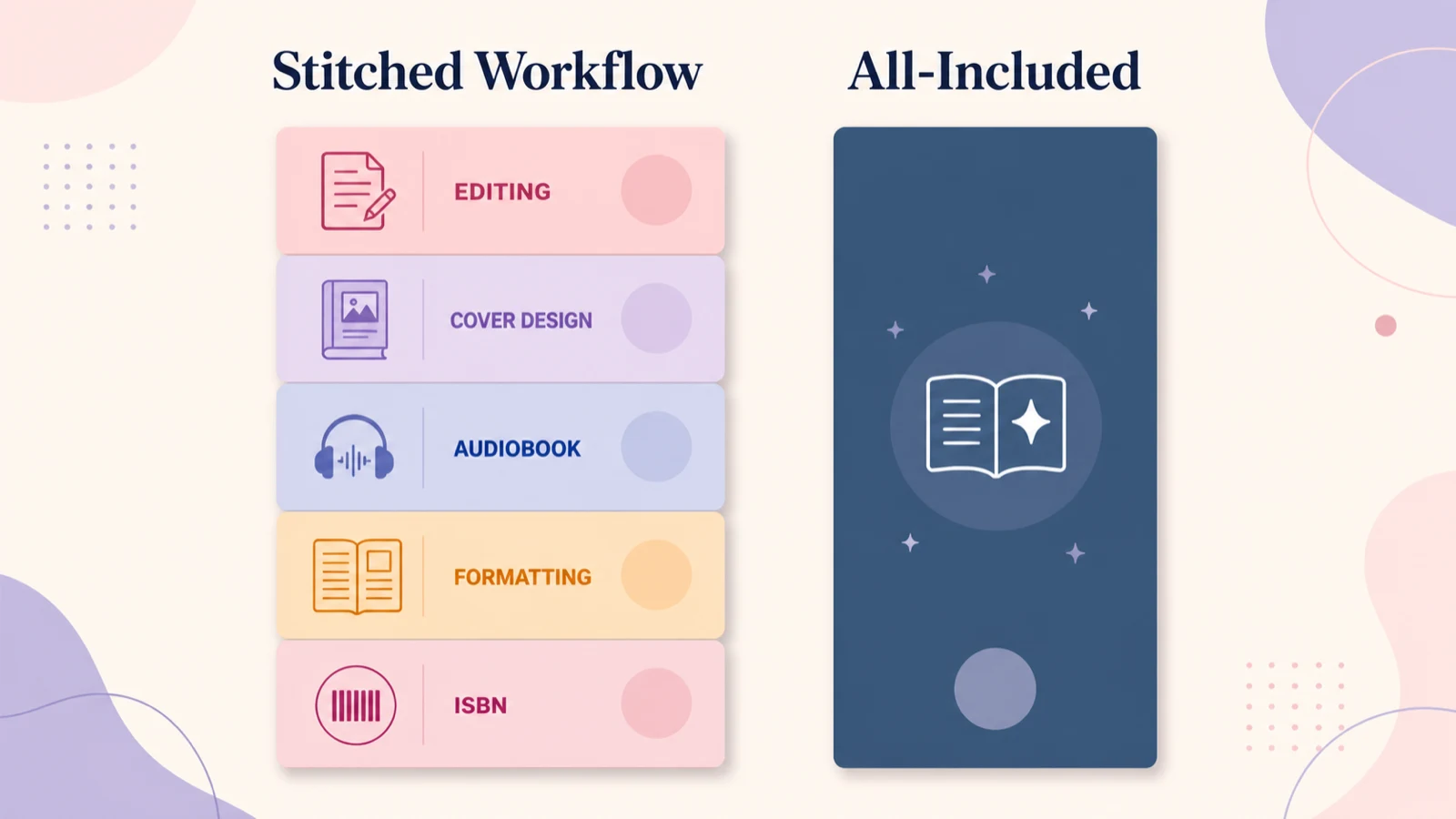
Visual cost breakdown: stitched workflow vs all-included
The single most useful comparison is the all-in cost of the traditional "stitched workflow" (one tool per line item, paid separately) versus the AI-native "all-included" subscription that covers most lines under one fee.
| Line item | Stitched workflow (industry average) | AI-native all-included (2026) |
|---|---|---|
| Writing tool | $0 (Word/Docs) to $250 (Scrivener one-time) | Included |
| Editing (copy + proofread) | $1,600 to $2,160 | AI copy + continuity included; proofread optional |
| Cover design | $630 to $1,200 (median $930) | Included (templates + AI generation) |
| EPUB and PDF conversion | $0 to $800 | Included (one-click export) |
| Audiobook narration | $2,000 to $4,000 (PFH) or 50/50 royalty (RS) | Included AI narration (15 to unlimited chapters) |
| ISBN | $125 (single) or $0 (KDP-assigned) | Free KDP ISBN compatible |
| Total per book (low / high) | $2,940 to $5,660 | $9.99 to $19.99 / month |
The all-included row reflects Inkfluence AI's plans: Creator at $9.99/mo (35 chapters/month, all formats, 15 audiobook chapters/month, advanced cover designer) and Premium at $19.99/mo (unlimited chapters, 30 audiobook chapters/month, all voices). One month of Creator covers the active drafting period for one full book; you can cancel between projects and resubscribe when the next book is ready.
Three realistic budget scenarios
Scenario A: First-time author, sub-$300 budget
You want to publish your first ebook to KDP, no audiobook on book one, no print-on-demand for now.
- Writing platform: AI-native subscription, $9.99 for one month.
- Editing: Self-edit using AI continuity tools (included), one round of paid proofreading from a freelancer at the lower end: $200 for an 80k-word book.
- Cover: AI-generated cover (included in subscription) or premium template ($30 to $80).
- Formatting and EPUB: Included in subscription.
- Audiobook: Skip on book one, add later if sales support it.
- ISBN: Free KDP-assigned.
- Total: $210 to $290.
Scenario B: Career indie, $1,200 to $2,500 budget per book
Series author, third book in a contemporary romance series, releasing both ebook and audiobook.
- Writing platform: Premium subscription, $19.99 for active drafting month.
- Editing: AI copy pass plus paid copy edit at $0.025/word for 70k words ($1,750), plus proofreading at $0.015/word ($1,050). Cuts to $1,400 if you skip the proofread.
- Cover: Custom human cover designer to maintain series consistency: $400 to $700.
- Formatting and EPUB: Included in subscription.
- Audiobook: AI narration via the subscription's audiobook studio (included for first 30 chapters, $0 incremental).
- ISBN: Bundle ($29.50 amortised).
- Total: $1,200 to $2,500. Most of that is editing.
Scenario C: Premium production, $4,000+ budget
Author with established sales pursuing a literary fiction novel with full traditional production.
- Writing platform: $0 (Scrivener already owned) or $19.99 for one month.
- Editing: Developmental ($2,500), copy ($1,600), proofread ($1,000) = $5,100.
- Cover: Custom cover from a top-tier designer: $1,000 to $1,500.
- Audiobook: Human narration via ACX, royalty-share-plus or PFH at the lower end: $2,000 to $3,000.
- Marketing: Launch budget of $500 to $1,500.
- Total: $8,600 to $11,100. This is the path the "$5,000 average" article is actually describing for one book, plus marketing on top.
How AI-native platforms collapse the stack

The AI-native subscription model is not a different content path. It is the same content path with several line items pre-paid in bulk.
Here is what one Creator subscription at $9.99/month ($89/year) on Inkfluence AI replaces from the traditional stack: the AI ebook generator (writing tool), the AI copy and continuity passes, the cover designer, the EPUB and PDF and DOCX conversion, the brand templating, the print-ready formatting, the cover thumbnail generator, and 15 chapters of ACX-spec audiobook narration. The single line item not replaced is professional human developmental editing, which remains worth paying for if your project demands it. Full pricing breakdown with feature-by-feature comparison.
If you publish more than two books a year, the math gets aggressive: a Premium subscription at $19.99/month ($179/year) covers unlimited chapters and 30 audiobook chapters per month, which is enough headroom for a four-to-six-book year. The same year of stitched-workflow tooling at industry-average prices runs $11,760 to $22,640 (six books × low/high range). Subscription saves $11,500+ at scale and even more with the savings reinvested into developmental editing on the books that actually need it.
FAQ
Is $5,000 really the average cost of self-publishing one book?
It is the upper end of the average per Reedsy's 2026 data, which puts the spread at $2,940 to $5,660 for a "professionally produced" book. That figure assumes paid editing at all four tiers, a custom cover, and human audiobook narration. Most first-time indie authors do not need all of those on book one. Realistic floor for a clean ebook release is $200 to $300 in 2026.
What is the cheapest way to publish a book in 2026?
One month of an AI-native writing subscription ($9.99 to $19.99), a free KDP-assigned ISBN, an AI-generated or template cover, and self-editing assisted by built-in AI tools. Total under $30 for the platform, optional $50 to $200 for an external proofread. KDP and IngramSpark setup are both $0.
Can I publish a book for free?
Technically yes. KDP setup is $0, free ISBN is included, free cover templates are everywhere, and free word processors handle the writing. The catch is that "free" usually translates to time investment. Free covers look free, free formatting tools have a learning curve, and self-editing without any AI assistance leaves typos that depress reviews. Inkfluence's free tier covers the first 5 chapters plus 5 more every month with PDF export: enough to ship a short book without paying anything. The realistic minimum for a release that does not visibly read as "free" is $50 to $200.
Is paid editing worth the money for a first book?
Pay for proofreading, skip developmental editing on book one. Proofreading at $0.01 to $0.02/word is the cheapest insurance against the typo-laden release that tanks your first reviews. Developmental editing at $0.07 to $0.12/word is worth it on book two onwards once you know your weaknesses, not on book one when you do not yet know whether the book will sell.
How much does it cost to make an audiobook?
Three answers: $0 (royalty share with a narrator who takes 50% of audiobook earnings), $2,000 to $4,000 (PFH human narration via ACX), or $0 to $50/month (AI narration through a subscription that includes audiobook output). For a first-time author with no audio sales history, AI narration or royalty share is the standard call.
How much does an ISBN cost?
$125 for a single ISBN from Bowker in the US. $295 for a bundle of 10 ($29.50 each). Free if you accept a KDP-assigned ISBN, with the trade-off that the ISBN lists the platform as publisher of record. Most first-time authors take the free option; serious imprints buy the bundle.
What is the realistic budget for an indie author publishing two books a year?
$400 to $1,200 per book if you use AI-native tools for writing, cover, EPUB, and basic audio narration, and pay only for proofreading externally. $3,000 to $6,000 per book if you use traditional stitched-workflow tools and pay for full editing plus a custom cover plus human audiobook narration. See our income trajectory data for what those budgets typically earn back month by month.
How does AI narration compare to human narration for audiobooks?
On non-fiction, self-help, business books, and most genre fiction, modern AI narration is close enough that listeners do not consistently flag it. Engines like Polly Neural, ElevenLabs, and OpenAI's gpt-4o-mini-tts produce ACX-spec output at 44.1 kHz 192 kbps mono with consistent loudness. Literary fiction with character-driven dialogue still benefits from a great human narrator. The cost gap is roughly 1000x ($0 to $50/month vs $2,000 to $4,000 per book), so most indie authors start with AI and graduate to human narration once a book has proven audio demand.
Are there hidden costs in AI-native subscriptions?
No per-action fees on Inkfluence AI: chapter generation, cover design, EPUB and PDF and DOCX export, audiobook narration up to the monthly chapter cap, and one-click Gumroad publishing are all included. The only external costs are platform-level: Gumroad's transaction fee on sales (about 10% to 13% effective), KDP's 30% to 65% royalty cut, ACX's 60% royalty share if you distribute audiobooks through Audible.
Can I cancel an AI-native subscription between books?
Yes, this is the standard pattern. Subscribe for one month at $9.99 or $19.99, draft and export a full book, cancel until the next project is ready. Your projects stay in your account on the free tier; only chapter generation and audiobook output are gated by the active subscription. Per-book platform cost works out to one month of subscription, regardless of how many features you use during that month.
Where can I see what my book might earn against these costs?
The Inkfluence ebook income calculator works out estimated monthly and annual earnings for a given catalogue size, price point, and platform. Pair the cost numbers in this guide with the income numbers in the calculator to project a realistic per-book profit margin. The royalty calculator goes the other direction: what one sale at one price actually nets after platform fees.
Related Resources
- Ebook Income Calculator: pair these cost numbers with realistic monthly earnings projections.
- Royalty Calculator: what one sale at one price actually nets after platform fees.
- AI Ebook Side Hustle: Realistic Expectations: the income trajectory month by month.
- Gumroad vs Amazon KDP (2026): platform-fee math for the two biggest selling platforms.
- BYOK vs All-Included AI Novel Writer Costs: the model-cost layer for novelists specifically.
- Sell Ebooks on Gumroad: one-click publishing flow + pricing strategy.
- How to Sell Ebooks on Amazon KDP: KDP-specific publishing and royalty strategy.
- AI Ebook Generator: write a finished sellable ebook from a single prompt.
- AI Book Cover Generator: replaces the $630-$1,200 custom-cover line.
- AI Audiobook Generator: replaces the $2,000-$4,000 narration line on most genre fiction and non-fiction.
- How to Create an ACX Audiobook From Your Ebook: full Audible submission spec and the streamlined manuscript-to-zip workflow.
- Inkfluence Pricing: the full plan-by-plan feature breakdown.
- For First-Time Authors: the playbook for a sub-$300 first release.
- For Kindle Publishers: KDP-focused workflow guidance.
- Ebook Marketing Strategy: the variable-cost half of the budget.
Bottom line
The "$5,000 to publish a book" headline describes one specific path that bakes in services most first-time indie authors do not need on book one. The honest 2026 floor for a professional-looking ebook release is $200 to $300 using AI-native tools and one round of external proofreading. Pay for human developmental editing on book two onwards once you know your specific weaknesses. Pay for human audiobook narration once your audio sales justify the $2,000 to $4,000 outlay. The path between those endpoints is wider than most authors realise, and the AI-native subscription model is the cleanest way to keep the per-book floor low without giving up production quality.

Founder, Inkfluence AI
Sam is the founder of Inkfluence AI. He built the platform to make book creation accessible to everyone - from first-time authors to seasoned publishers.
Helpful links
Ready to Create Your Own Ebook?
Start writing with AI-powered tools, professional templates, and multi-format export.
Get Started FreeRelated Articles
 Guides
 Selling AI Coloring Books on Amazon KDP: The 2026 Rules, Specs, and Math
Are AI coloring books allowed on KDP? Yes, with disclosure. The part nobody covers: the AI workflow that passes review, style consistency across 30 pages, the interior specs that cause rejections, and the royalty ladder that decides your price.
 Guides
 How to Make an Adult Coloring Book in 2026: From Idea to Printed Pages
The modern walkthrough: what makes line work read as "adult", the three ways to create pages (draw, convert, generate), how to assemble a real book instead of a stack of pages, and the fork between KDP paperbacks, Etsy printables, and printing at home.
 Guides
 Coloring Book Niches for 2026: Where Low Competition Meets Real Buyers
A niche framework instead of a niche list: how complexity tiers map to price points, why the senior shelf is underserved, the seasonal calendar that decides your publish dates, and how to validate before you draw a single page.
Get ebook tips in your inbox
Join creators getting weekly strategies for writing, marketing, and selling ebooks.