
Book Royalty Calculator
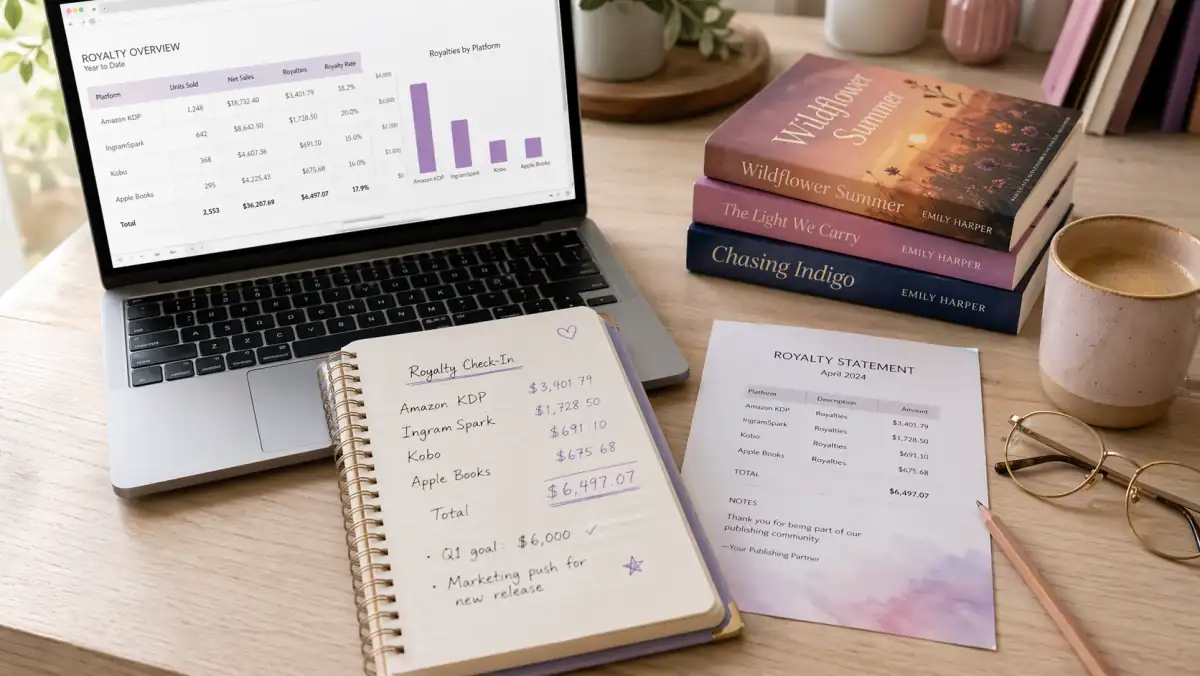
Compare what you earn per sale on Amazon KDP, IngramSpark, Kobo, Apple Books, Google Play, and Draft2Digital. Works for ebooks, paperbacks, and hardcovers. No sign-up, no email, no gimmicks.
Quick Answer
Most self-published ebooks earn 70% of list price minus a small delivery fee on Amazon KDP within the $2.99 to $12.99 price window, 70% flat on Apple Books and Kobo, 52% on Google Play Books, and ~60% on aggregators like Draft2Digital. Paperback royalties run at 60% on KDP (at $9.99 and up; 50% below) and 45% on IngramSpark, minus per-copy print cost. Use the calculator below to see your exact payout per sale on each platform. If you're still writing, our AI book generator can draft the manuscript in an afternoon.
Live Tool
Calculate your royalty per sale
Enter your list price and format. Royalty per sale and estimated monthly earnings update instantly across every major platform.
| Platform | Royalty rate | Per sale | Monthly estimate |
|---|
Estimates use current public royalty formulas. Amazon and other platforms occasionally adjust print costs and delivery fees; always cross-check against the current KDP help pages before pricing a launch.
Worked examples
Three real scenarios, fully calculated
The same book earns wildly different royalties depending on format and platform. Here's what the numbers actually look like.
A $4.99 ebook on Amazon KDP
Setup: Format: ebook. List price: $4.99. KDP falls inside the 70% royalty window ($2.99 to $12.99).
Royalty math
($4.99 − $0.15 delivery fee for a 1 MB file) × 70% = $3.39 per sale.
Takeaway: At 50 sales per month that's about $170 per month from a single ebook on Amazon. Stack 5 books and it's real part-time income.
A 250-page paperback at $14.99 via KDP
Setup: Format: paperback (6x9 B&W). List price: $14.99. Page count: 250.
Royalty math
Print cost = $1.00 + ($0.012 × 250) = $4.00. Royalty = (60% × $14.99) − $4.00 = $8.99 − $4.00 = $4.99 per sale.
Takeaway: Paperbacks feel premium to buyers and earn more per sale than ebooks, but the volume is usually lower. Ideal as a companion to an ebook on KDP.
The same paperback on IngramSpark (default 55% discount)
Setup: Same 250-page book at $14.99 on IngramSpark with the default 55% wholesale discount for bookstore reach.
Royalty math
Print cost ≈ $2.00 + ($0.015 × 250) = $5.75. Royalty = (45% × $14.99) − $5.75 = $6.75 − $5.75 = $1.00 per sale.
Takeaway: IngramSpark pays a much thinner margin, but it's the only way to reach independent bookstores, libraries, and international retailers. Hybrid authors often do KDP for Amazon + IngramSpark for everywhere else.
Once you know what each platform pays, the next question is where to list. Most indie authors put ebooks on Amazon KDP and decide about print after looking at the numbers above. Our self-publishing guide walks through the full launch workflow including cover design, formatting, and metadata.
How each platform pays
Royalty formulas, explained
Every platform has its own quirks. Here are the rules the calculator uses, with links to the official royalty documentation on each.
Amazon KDP (ebook)
Amazon pays 70% on ebooks priced $2.99 to $12.99 (minus a small per-MB delivery fee) and 35% outside that range. The 70% tier is the single most important pricing decision most self-publishers make.
Formula
70% if list price is $2.99 to $12.99, otherwise 35%. Delivery fee ~$0.15 per MB (US) on the 70% tier only.
Amazon KDP (paperback)
60% royalty on paperbacks listed at $9.99 or more on Amazon.com and 50% below $9.99, minus the print cost Amazon charges to produce each copy. Royalty is positive only if your list price covers print cost plus margin, so low page counts at high prices earn the most.
Formula
60% × list price − print cost at $9.99 and up; 50% × list price − print cost below. Black ink: flat $2.30 for 24 to 110 pages, then $1.00 + $0.012/page. Premium colour: flat $3.60 for 24 to 40 pages, then $1.00 + $0.065/page. Those are regular trims such as 6 x 9; a large trim (wider than 6.12 in or taller than 9 in, e.g. 8.5 x 11 or 8.5 x 8.5) costs $2.84 flat or $1.00 + $0.017/page in black ink, and $4.20 flat or $1.00 + $0.08/page in colour.
Amazon KDP (hardcover)
Same royalty formula as paperback (60% at $9.99 and up, 50% below), but with a higher print cost per copy because of the case-laminate binding. Hardcovers need 75 to 550 pages. Typical minimum list price to break even sits around $13 to $15 for a standard-length book.
Formula
60% × list price − print cost. Black ink at a regular trim such as 6 x 9: flat $6.80 for 75 to 108 pages, then $5.65 + $0.012/page (large trims $7.49, then $5.65 + $0.017/page). Premium colour: $5.65 + $0.065/page ($0.08 large).
IngramSpark (print)
Worldwide print distribution into bookstores and libraries. You set a wholesale discount (default 55%), meaning bookstores keep 55% of list and you get 45% minus print cost. Higher discount = wider distribution, thinner royalty.
Formula
(1 − wholesale discount) × list price − print cost. Default: 0.45 × list − print cost. Print cost ≈ $2.00 + $0.015/page (6x9 B&W paperback).
Kobo Writing Life (ebook)
Kobo's direct author program pays 70% on ebooks priced $2.99 and up, 45% on anything lower. Simpler than KDP: no delivery fee, no price-zone adjustments, and no KDP Select exclusivity requirement.
Formula
70% if list price is $2.99 or higher, otherwise 45%. No delivery fee.
Apple Books (ebook)
Apple Books pays a flat 70% royalty on every ebook sale at any price point, including free and very low-priced books. No delivery fee, no price-banding, no Select exclusivity requirement.
Formula
70% × list price at every price point. No delivery fee.
Google Play Books (ebook)
Google Play pays partners 52% of list price on ebook sales. A lower headline rate than Kobo or Apple, but Google Play reaches search-driven readers that other stores don't touch, especially outside the US.
Formula
52% × list price on ebook sales.
Draft2Digital (aggregator)
Distributes your ebook to Apple, Kobo, Barnes & Noble, Google Play, and dozens of other stores. D2D charges no upfront fee and keeps about 10% of the net royalty the retailer pays you. Good for reach without juggling seven dashboards.
Formula
Approximately 60% × list price after retailer and D2D cuts, averaged across retailers.
In the platforms' own words
What the royalty pages actually say
The formulas in this calculator aren't interpretation. They're straight from the official royalty documentation of each platform.
"You can earn 70% royalty on sales to customers in eligible countries of eBooks priced between $2.99 and $12.99."
"Kobo Writing Life offers 70% royalties on eBooks priced $2.99 USD and above, and 45% on eBooks priced below that."
"Apple Books shares 70% of the sale price with you on every eBook sold."
Pricing strategy
Royalty math is one half. Pricing is the other.
Two books at different price points earn wildly different amounts even at the same royalty rate. The right list price depends on genre, length, and how you're positioning the book.
Most first-time self-publishers make one of two pricing mistakes: they price too low (thinking $0.99 will pull more buyers, which also drops them out of the 70% royalty tier and costs them money per sale) or they price too high (pricing a novel at $14.99 in a genre where $3.99 is the norm, and watching it fail to sell). Neither mistake is fatal, but both cost real income. Pricing also compounds with presentation: a sharp, on-genre title (run the free title ideas tool if yours feels flat) raises click-through enough to move the per-sale math meaningfully.
Genre benchmarks in 2026: fiction novels usually price $2.99 to $5.99 on ebook. Non-fiction and business books price higher at $4.99 to $9.99 because buyers treat them as reference material. Short fiction novellas can price $0.99 to $2.99 at the 35% royalty rate to pull readers into a longer series. Lead magnets typically price free. Full-length paperbacks price $9.99 to $16.99.
The 70% tier matters more than most authors realise. A novel priced at $2.99 earns about $1.99 per sale (1 MB file). The same novel priced at $2.98 earns $1.04. That one-cent difference halves your royalty because the book falls out of the 70% royalty window. If you're within 10 cents of a boundary, check which side you're landing on. The official KDP royalty page lists the exact boundaries.
| Ebook list price | KDP royalty rate | Royalty per sale (1 MB file) |
|---|---|---|
| $0.99 | 35% | $0.35 |
| $2.98 | 35% | $1.04 |
| $2.99 (70% starts) | 70% | $1.99 |
| $4.99 | 70% | $3.39 |
| $9.99 | 70% | $6.89 |
| $12.99 (70% ends) | 70% | $8.99 |
| $13.00 | 35% | $4.55 |
US marketplace, 70% tier is a list price of $2.99 to $12.99 (the top of the band rose from $9.99 on 7 July 2026) with a ~$0.15/MB delivery fee subtracted first. Crossing $12.99 to $13.00 cuts the royalty per sale from $8.99 to $4.55. Source: KDP royalty documentation. Our guide to KDP royalties in 2026 works through what the wider band means for pricing, with before-and-after figures.
Print royalties depend on page count and on $9.99. A 200-page paperback at $9.99 earns $9.99 × 60% = $5.99, minus a $3.40 print cost, for about $2.59 per sale. One cent lower, at $9.98, KDP pays 50% and the same copy earns $1.59. The same paperback at $14.99 earns $8.99 minus $3.40, or roughly $5.59 per sale. Print-on-demand economics punish low list prices on thick books. Our AI book formatter helps hit a target page count when you need to price at a specific point, and the paperback printing guide covers the full cost formula. The same printing cost, plus shipping, is what you pay for a single proof or author copy; how to print one copy of a book walks through ordering one. Hardcover printing costs, trim sizes, gutter widths and spine widths are tabled in self-publishing on Amazon KDP.
What authors on our platform actually publish. Format choice drives which of these royalty formulas applies to you, and the pattern is lopsided: across the more than 33,000 books exported on Inkfluence AI, about 85% leave as print-ready PDF versus roughly 5% as EPUB. That print-heavy preference means the 60% paperback royalty math above is the one most self-publishers here are actually running, more often than the 70% ebook tier. The full breakdown is in our export-format study.
Bundle ebook + paperback + audiobook for maximum revenue per reader. A reader who buys your paperback at $14.99 doesn't compete with a reader who buys your ebook at $4.99. They're often the same person buying the same book twice, in different formats, for different contexts. Converting your book to audio through the AI audiobook generator opens a third revenue stream on the audiobook stores that accept AI narration (Audible's ACX asks for human narration unless it has authorised otherwise). Work out the finished runtime first with the audiobook length calculator, since several stores price by hours rather than by word count. To earn ACX's royalty without paying a narrator, you can narrate your own audiobook.
Context
What royalties actually look like in 2026
Real-world numbers from the latest published author income surveys and platform documentation.
Median self-published income: approximately $12,800 per year, with the top 10% earning over $100,000 and most authors under $10/month. (ALLi Author Income Survey)
KDP's 70% window: $2.99 to $12.99 on Amazon.com since 7 July 2026 (it topped out at $9.99 before), the single most important price range in self-publishing. (Amazon KDP)
Print-on-demand economics: KDP and IngramSpark both print each copy on demand. No upfront inventory cost, no warehousing, royalty deducted at the moment of sale. (IngramSpark)
Tax reporting: US publishers issue a 1099 if you earn $600+ in a year. UK authors report royalties via Self Assessment. Set aside 25-30% of royalty income for tax. (IRS)
ACX audiobook royalties: Audible's ACX pays 50% royalty on exclusive audiobook distribution and 30% on non-exclusive under the royalty model it introduced on 26 May 2026 (the old 40% and 25% rates end with 2026), and some authors hire narrators on a 50/50 royalty-share model with no upfront fee. (Audible ACX)
AI content disclosure: Amazon KDP requires authors to disclose AI-generated or AI-assisted content at publishing. Both are allowed on the 70% royalty tier. (KDP AI content guidelines)
Ebook market size: The global ebook market is projected at roughly $14.6 billion in 2026, with self-published titles claiming a rising share of US Kindle bestsellers year over year. (Statista)
US Copyright Office guidance: Works containing human-authored elements that incorporate AI-generated material remain eligible for copyright protection on the human contributions. (US Copyright Office)
Frequently Asked Questions
Everything authors ask before pricing a launch.
How do I calculate book royalties?
Multiply your list price by the platform's royalty rate, then subtract any print or delivery costs. For an ebook on KDP priced at $5.99, Amazon takes a small delivery fee first (about $0.15 for a 1 MB file) and pays 70% of the rest: ($5.99 − $0.15) × 70%, roughly $4.09 per sale. For a paperback, use 60% × list price − print cost at $9.99 and up (50% below $9.99), where print cost for a black-ink 6 x 9 book is a flat $2.30 up to 110 pages and $1.00 plus $0.012 per page after that. Our calculator does this automatically across every major platform.
What is the 70% royalty tier on Amazon KDP?
Amazon pays 70% royalty on ebooks priced between $2.99 and $12.99. Outside that range, you earn 35%. The 70% tier also charges a delivery fee of roughly $0.15 per megabyte, which usually works out to about $0.06 to $0.45 per sale depending on your book's file size. Most self-publishers target this range to maximise revenue per sale.
Which publishing platform pays the highest royalty?
Apple Books pays a flat 70% at every price point, which is the simplest and often highest headline rate. Kobo Writing Life pays 70% above $2.99 with no delivery fee (slightly better than KDP at small file sizes). Amazon KDP pays 70% only in the $2.99 to $12.99 window. For print, the highest rate is KDP at 60% minus print cost (at a list price of $9.99 or more; 50% below that); IngramSpark pays 45% minus print cost but reaches bookstores and libraries that KDP doesn't.
How much does Amazon KDP print cost per book?
For a standard 6x9 paperback in black-and-white, print cost is a flat $2.30 for 24 to 110 pages, then $1.00 fixed plus $0.012 per page. A 200-page paperback costs $3.40 to print, a 300-page paperback $4.60. Large trims (wider than 6.12 inches or taller than 9, such as 8.5 x 11 or 8.5 x 8.5) cost more: a flat $2.84, then $1.00 plus $0.017 per page. Premium colour is much more expensive: a flat $3.60 for 24 to 40 pages ($4.20 at large trims), then $1.00 plus $0.065 per page ($0.08 large). Amazon deducts this from your royalty on every sale. Figures are for Amazon.com, from KDP's printing cost page, checked 23 September 2026.
What is the minimum price for a KDP paperback to make money?
KDP's minimum list price is the print cost divided by the royalty rate, and below $9.99 the rate is 50%. A 200-page paperback costs $3.40 to print, so the minimum list is $6.80 ($3.40 / 0.50), where it pays nothing. At $9.98 the same book pays $1.59 a copy; at $9.99 the rate rises to 60% and it pays $2.59. In practice, most self-publishers price paperbacks between $9.99 and $14.99 for healthy margins. Our calculator flags unprofitable combinations in red.
How does IngramSpark royalty compare to KDP?
IngramSpark pays a lower royalty rate (45% at default 55% wholesale discount vs KDP's 60% at $9.99 and up) but gives you access to the Ingram distribution network: independent bookstores, libraries, and international retailers that KDP Print doesn't reach. Many self-publishers use KDP for Amazon sales and IngramSpark for everywhere else. Printing costs are broadly similar.
Do I pay taxes on book royalties?
Yes. Book royalties are taxable self-employment income in most jurisdictions. In the US, Amazon and other platforms issue a 1099 form if you earn over the reporting threshold ($600 in 2026). In the UK, royalties are typically reported as self-employment income via Self Assessment. Check your local tax authority. The IRS publishes guidance on royalty income at irs.gov (Schedule E for passive royalties, Schedule C if writing is your business).
Can I publish on KDP and IngramSpark at the same time?
Yes, for print books. You publish the ebook on KDP (or wherever) and the paperback on both KDP for Amazon and IngramSpark for everywhere else. Most hybrid authors use this setup. Important: do not enrol your ebook in KDP Select (Kindle Unlimited) if you also distribute ebooks elsewhere, because Select requires ebook exclusivity for 90 days.
How much do self-published authors earn per month?
The Alliance of Independent Authors' 2024 income survey found the median self-published author earned approximately $12,800 annually, with the top 10% earning over $100,000. The distribution is extremely skewed: most authors earn under $10/month, while a small minority earn six figures. Royalty rate matters less than sales volume, and sales volume is driven by genre fit, cover, blurb, and consistent publishing cadence.
What royalty do aggregators like Draft2Digital pay?
Draft2Digital (and Smashwords, which D2D now owns) takes about 10% of the net royalty the retailer pays, resulting in a blended rate around 60% of list price across stores. PublishDrive and StreetLib operate on similar terms. The trade-off: one dashboard, one tax form, and broader reach in exchange for a thinner margin on each sale vs direct publishing.
How do I price my ebook for maximum earnings?
The sweet spot on KDP is $2.99 to $12.99 for the 70% royalty tier. Within that band, higher prices increase per-sale earnings but often reduce volume. Genre benchmarks: non-fiction typically prices $4.99 to $9.99, fiction novels $2.99 to $5.99, short novellas $0.99 to $2.99 (at the 35% rate). Test two or three price points over four-week windows and measure total revenue, not just per-sale royalty.
Are there hidden fees in book royalties?
A few to watch: KDP's 70% tier charges a delivery fee per megabyte (ebooks with heavy images lose more to this). IngramSpark charges a setup fee per title ($49 for paperback, $49 for hardcover, waived under some promo codes). Subscription audiobook platforms often take a different royalty share than ebooks. Always read the current royalty help pages at the platform before committing.
How does KDP Select / Kindle Unlimited royalty work?
KDP Select is an optional 90-day exclusivity programme. In exchange for not distributing your ebook elsewhere, Amazon enrols you in Kindle Unlimited and pays you for pages read out of the monthly KDP Select Global Fund. Amazon announces the size of the fund each month but does not publish a per-page rate; trackers work one out from their own reports. Written Word Media's estimate for Amazon.com (updated 18 September 2026) was $0.005170 a page for August 2026 and $0.004221 for July. At the August estimate, a reader who finishes a book of 300 Kindle Edition Normalized Pages paid about $1.55, compared with $1.99 to $4.79 for a sale at $2.99 to $6.99 (1 MB file). Select works best for series authors; less well for standalone premium-priced titles.
Do AI-generated books qualify for the same royalty rates?
Yes. Amazon KDP, Apple Books, Kobo, IngramSpark, and other platforms apply the same royalty rates to AI-generated and human-written books. What changes is the disclosure requirement: KDP asks whether content is AI-generated or AI-assisted at the title-creation step, but this does not affect the 70% royalty tier eligibility or KDP Select enrollment. Our full walkthrough is on the Amazon KDP AI disclosure policy guide.
How does the calculator handle currency?
The calculator assumes USD pricing and USD royalty. Amazon KDP, Kobo, Apple Books, and Google Play each set separate list prices per country in local currency. Royalty rates are consistent across territories (70% / 35% on KDP, 70% on Apple) but the print costs and delivery fees vary. Use the official KDP pricing calculator for exact country-level royalty once your book is live.
Write the book. Keep the royalties.
Inkfluence AI generates full-length books, designs the cover, and exports KDP-ready EPUB and PDF. You keep 100% of every royalty on every platform. Start free, upgrade when you publish.
Related tools and reading
Pair the calculator with the rest of your self-publishing toolkit.
Best AI Book Generator 2026
Ranked comparison of the 10 leading tools.
Book Length Calculator
Word count to pages, spine width and print cost.
AI Book Generator
Generate a full book, cover, and audiobook.
For Kindle Publishers
The full KDP self-publishing playbook.
KDP Tools
Every tool an Amazon KDP author needs.
KDP Cover Size and Spine Width Calculator
The paperback wrap and spine for the page count you priced here.
KDP Publishing Calendar 2026-2027
When to submit a seasonal book so it is live before buyers start looking.
Books Needed for an Income Goal
Work back from a monthly target to the number of books it takes on KDP.
Self-Publishing Guide
Step-by-step from manuscript to published book.
Ebook Income Calculator
Project monthly + yearly net across your whole catalogue.
How Much KDP Authors Make in 2026
Survey income bands, and what one copy earns in each format.
How to Sell Travel Guides
Kindle, Etsy and Gumroad take-home for one kind of book.
How to Sell Children's Books
Colour print costs and a picture book royalty, trim by trim.
How to Sell Coloring Books
Black-ink royalties at three prices, and each paper compared.
How to Sell Romance Novels
A Kindle Unlimited read next to a sale, and a novel's paperback at three trims.
How to Sell Workbooks
An 8.5 x 11 workbook's royalty, and a printable's take-home on Etsy and Gumroad.
Make Money Selling AI Ebooks
Launch, price, and sell your first ebook.
Sell Your Book on Shopify
Keep almost all of each sale on your own store.
Passive Income Ebooks
The economics of a mature indie ebook catalog.
AI Book Writer for Kindle
KDP-optimised writing and formatting.
AI Audiobook Generator
Add an audiobook edition for the stores that accept AI narration.
What the data says. We counted 102,854 books created on this platform: the median is 5 chapters and 9,337 words, non-fiction is 63.7% of it, and 40.8% get finished. Length and completion rate for nineteen genres are in AI book writing statistics, with industry context in self-publishing statistics.