
Ebook Marketing Strategy:
The Complete 2026 Playbook
The step-by-step marketing plan that takes your ebook from published to profitable. Pre-launch timeline, email sequences, social media tactics, pricing strategies, and a launch checklist used by thousands of creators.
Inkfluence handles creation and export quality. This page focuses on distribution and positioning so the right readers can find and buy your book.
Quick Answer
A successful ebook marketing strategy combines pre-launch audience building, launch-day email sequences, and ongoing promotion across social media, SEO, and communities. Start 8 weeks before launch: build your email list with a free lead magnet, tease content on social platforms, and send advance reader copies. On launch day, coordinate email blasts, social posts, and community outreach. Post-launch, repurpose ebook content into blog posts, social snippets, and email courses. The strategy on this page is used by 20,000+ Inkfluence AI creators, covering pricing models, platform-specific tactics (KDP, Gumroad, Etsy), and the exact 6-email launch sequence that drives first-week sales.
Why your ebook needs a marketing strategy
Publishing is only half the work. Without a plan, even great ebooks get buried. Here is what marketing actually does for your ebook.
Cuts through the noise
Millions of ebooks are published every year. Marketing is the difference between a handful of downloads and real, sustainable traction.
Drives real revenue
Creators who actively market their ebooks consistently earn more than those who publish and hope. Strategy turns effort into income.
Builds your audience
Every ebook is an opportunity to grow your email list and reader base. One well-marketed ebook can launch an entire career or business.
Compounds over time
Marketing efforts stack. Reviews lead to more reviews. Readers recommend to friends. Your platform grows with every release.
Pre-launch marketing timeline (8 weeks)
The most successful ebook launches start weeks before release day. This is the timeline that consistently delivers strong launch-day results.
Foundation
- Finalise your ebook title and subtitle (keyword-optimised for Amazon or your landing page)
- Create or update your landing page with a clear value proposition
- Set up your email marketing tool (ConvertKit, Mailchimp, or similar)
- Define your ideal reader persona: who are they, what do they struggle with, where do they hang out online?
Audience growth
- Start teasing your ebook topic on social media (share insights, not just announcements)
- Create a free lead magnet related to your ebook topic to grow your email list
- Begin guest posting or podcast outreach in your niche
- Join and genuinely contribute to communities where your ideal readers spend time
Build anticipation
- Reveal your cover design (cover reveals drive strong social engagement)
- Send advance reader copies (ARCs) to bloggers, reviewers, and influencers
- Set up pre-orders on Amazon KDP or your direct sales platform
- Write your launch email sequence (announcement, sneak peek, countdown, launch day, follow-up)
Final countdown
- Announce your official launch date across all channels
- Prepare launch-day bonuses (worksheets, templates, bonus chapters)
- Finalise your Amazon listing: description, backend keywords, and categories
- Reach out personally to your network asking for launch-day support
Need an ebook to market? Use Inkfluence AI's ebook generator to create a professional ebook in under an hour, then follow this timeline to launch it.
Ebook launch day checklist
Launch day is your moment. Here is everything you need to do to maximise impact across every channel.
- Send launch announcement to your full list
- Include a clear CTA with a direct buy link
- Mention any launch-day bonuses or limited-time pricing
- Schedule a follow-up email for the evening
Social media
- Post your launch announcement on every platform
- Share behind-the-scenes content (your writing process, early drafts)
- Go live or post a short video talking about why you wrote it
- Engage with every comment and share throughout the day
Community
- Ask friends and early supporters to buy and leave a review
- Share in relevant Facebook groups, LinkedIn groups, and Slack communities
- Post on Reddit in appropriate subreddits (add genuine value, not just a link)
- DM your closest supporters and ask them to share with their audience
Platform
- Verify your Amazon listing is live and all details are correct
- Test every buy link across devices
- Monitor your sales rank throughout the day
- Screenshot any bestseller rankings or milestones for social proof
Great marketing starts with a great ebook
You can have the best marketing plan in the world, but it only works if your ebook delivers real value. Create something worth marketing.
The ebook launch email sequence
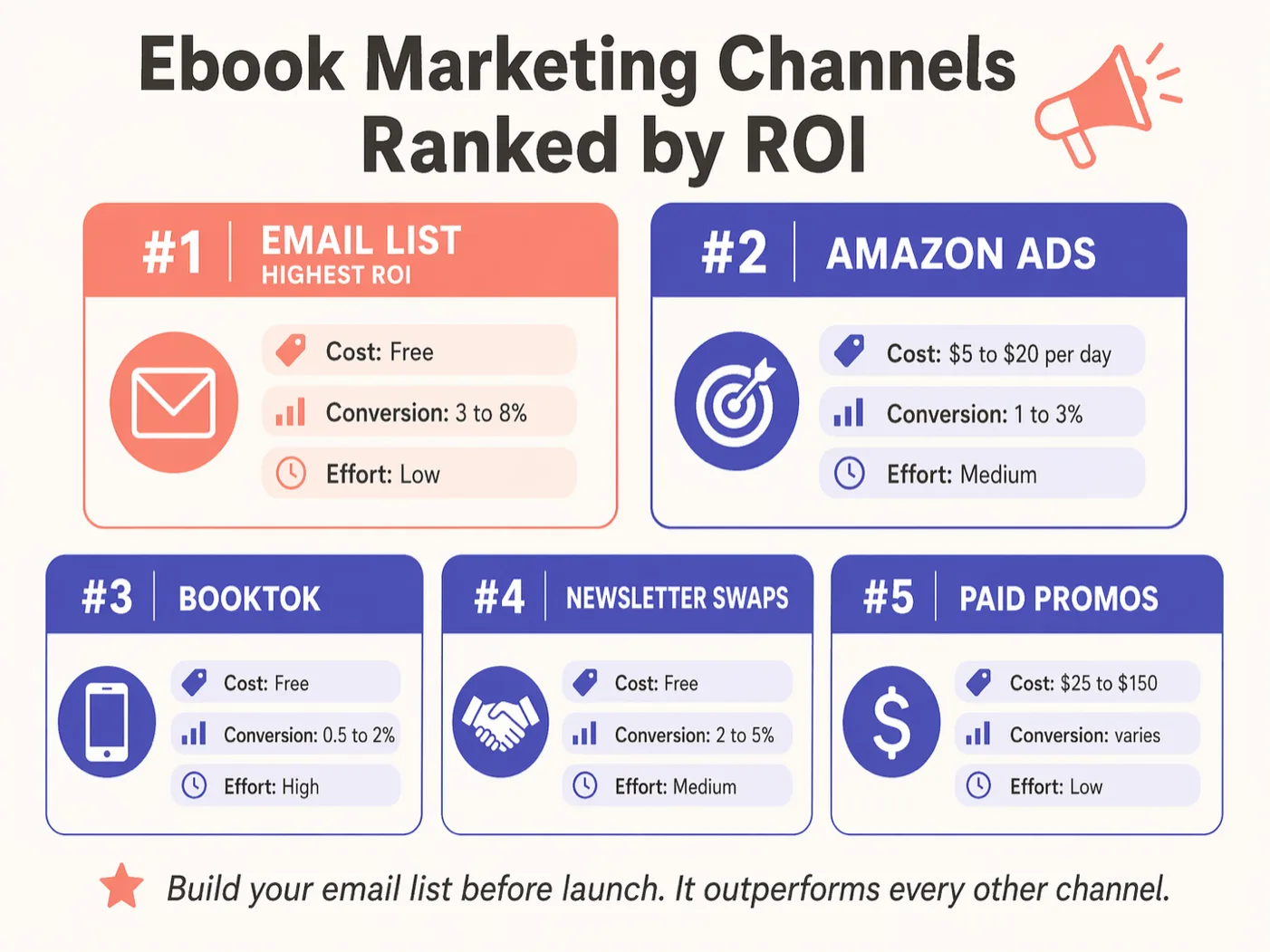
Email consistently outperforms every other channel for ebook sales. Here is the exact 6-email sequence to use around your launch.
Announcement
Reveal your ebook is coming. Share the story behind it and why you wrote it. Build anticipation without asking for anything.
Sneak peek
Share a chapter excerpt or 3 key insights from the book. Include a pre-order link if available.
Launch day
Your main launch email. Direct buy link, launch bonuses, and any early reader feedback or endorsements.
Reminder
Follow up for people who did not open. Use a different subject line and angle, focusing on a different benefit.
Last chance
Final push. Emphasise scarcity if applicable: launch pricing ending, bonuses expiring, or limited availability.
Thank you
Thank buyers, share early reader feedback, and ask for honest reviews. This email builds long-term relationships.
Build your list before launch
The fastest way to grow your email list is with a valuable lead magnet. Use our free lead magnet generator to create a PDF guide related to your ebook topic, then offer it in exchange for email signups.
Ebook pricing strategy
Pricing affects both sales volume and perceived value. Here are the standard tiers and when to use each.
| Type | Price range | Best for | Example |
|---|---|---|---|
| Free lead magnet | $0 | Building your email list, establishing authority, getting your first readers | A 15-page guide or checklist related to your main ebook topic |
| Short ebook | $2.99 - $4.99 | Amazon KDP (70% royalty tier), quick wins, impulse purchases | Under 10,000 words: checklists, quick how-tos, starter guides |
| Standard ebook | $4.99 - $9.99 | Most non-fiction, comprehensive guides, the KDP sweet spot | 10,000-50,000 words: full guides, playbooks, systems |
| Premium ebook | $9.99 - $29.99 | Specialised topics, professional content, direct sales | In-depth courses, technical guides, professional frameworks |
| High-ticket bundle | $29 - $97+ | Direct sales with bonuses, coaching upsells, course companions | Ebook + templates + video training + community access |
Launch pricing tactic: Launch at a lower price (e.g. $2.99 instead of $6.99) for the first week to drive initial sales and reviews. Higher early velocity boosts visibility, and early reviews build social proof for when you raise the price.
Ready to create your ebook?
Go from idea to publishable ebook in under an hour. AI handles the writing and formatting while you focus on your expertise.
Start creating freeOngoing marketing after launch
Launch week gets attention, but the real revenue comes from consistent marketing over months. These are the tactics that compound.
Content marketing
Write blog posts, create videos, or record podcast episodes about topics from your ebook. Each piece of content is a doorway that leads readers to your book.
Action step: Publish 2-4 pieces of content per month related to your ebook topic
SEO for your landing page
Optimise your ebook landing page for search. Target long-tail keywords like 'best [topic] guide' or 'how to [problem your ebook solves]'. Organic traffic compounds over time.
Action step: Research 5-10 keywords and optimise your page title, headings, and description
Email nurture sequences
Not everyone buys on the first touch. Set up automated email sequences that deliver value and gently promote your ebook over days or weeks.
Action step: Create a 5-email welcome sequence that leads to your ebook offer
Cross-promotion
Partner with other authors or creators in adjacent niches. Promote each other's work to your respective audiences. This works especially well for email list swaps.
Action step: Reach out to 3-5 creators in complementary niches for collaboration
Amazon optimisation
Regularly update your Amazon listing. Test different descriptions, refresh keywords based on seasonal trends, and keep your categories competitive.
Action step: Review and update your Amazon listing quarterly
Repurpose into new formats
Turn your ebook into a blog series, social media content, an online course, or even an audiobook. Each format reaches a different audience segment.
Action step: Pick one format and create a repurposed version this month
Ebook marketing metrics to track
You cannot improve what you do not measure. Track these metrics weekly to know what is working and what to adjust.
| Metric | Why it matters |
|---|---|
| Downloads / sales | Your primary success indicator. Track daily during launch, weekly after. |
| Revenue | Total earnings across all platforms. Track per-platform to see what is working. |
| Email list growth | New subscribers driven by your ebook or lead magnet. The list is your long-term asset. |
| Landing page conversion rate | Percentage of visitors who buy or download. Aim for 5-15% for paid, 25-40% for free. |
| Amazon sales rank | Relative position in your category. Lower numbers mean more sales. |
| Reviews and ratings | Social proof that drives future sales. Track count and average rating. |
| Ad ROI | If running paid ads, track cost per acquisition vs revenue per sale. |
| Traffic sources | Where your buyers are coming from. Double down on what works. |
Who needs an ebook marketing strategy?
If you are creating ebooks for any of these purposes, you need a plan to get them in front of readers.
Self-published authors
Turn your book into sustainable income with consistent, strategic promotion across Amazon and direct sales channels.
Coaches and consultants
Use ebooks as lead magnets and authority builders that attract clients and demonstrate your expertise.
Content creators
Monetise your existing audience by packaging your best ideas into ebooks they will pay for.
Course creators
Market companion ebooks to increase course sales, improve student outcomes, and add revenue streams.
Bloggers and writers
Package your best content into sellable ebooks for passive income that works while you sleep.
Entrepreneurs
Build email lists, establish thought leadership, and drive leads with strategically marketed ebooks.
Ebook marketing FAQs
Answers to the most common questions about marketing and promoting ebooks.
What is an ebook marketing strategy?
How do I market my ebook for free?
When should I start marketing my ebook?
How do I build an email list for my ebook?
What is the best social media platform for ebook marketing?
How do I price my ebook?
Should I give my ebook away for free?
How do I get reviews for my ebook?
How do I market an ebook on Amazon?
How long does ebook marketing take to show results?
Can I market an AI-generated ebook?
How much should I spend on ebook marketing?
What is the biggest ebook marketing mistake?
How do I create a marketing plan for my ebook?
Tools to create ebooks worth marketing
AI Ebook Generator
Create complete, market-ready ebooks with AI
Lead Magnet Generator
Build your email list with free PDF guides
Ebook SEO Guide
Optimise your ebook for search discovery
Related reading
Your ebook marketing plan starts now
You have the strategy. You have the timeline. You have the checklist. Now create the ebook that makes it all worth it.
No credit card required. Free plan available.
Social media marketing for ebooks
Different platforms work for different ebook types. Focus your energy where your ideal readers already spend their time.
Do not try to be everywhere. Pick the 1-2 platforms where your ideal readers already spend time. Consistent, quality content on one platform beats sporadic posts on five.