
Gumroad vs Amazon KDP for AI-Generated Ebooks (2026): Honest Comparison
Gumroad pays you 87 to 95% per sale and gives you the customer email. Amazon KDP pays 35 to 70% but ships your book to the world's biggest reading audience. Here is the honest 10-dimension comparison for indie authors choosing where to sell their AI-generated ebook in 2026.
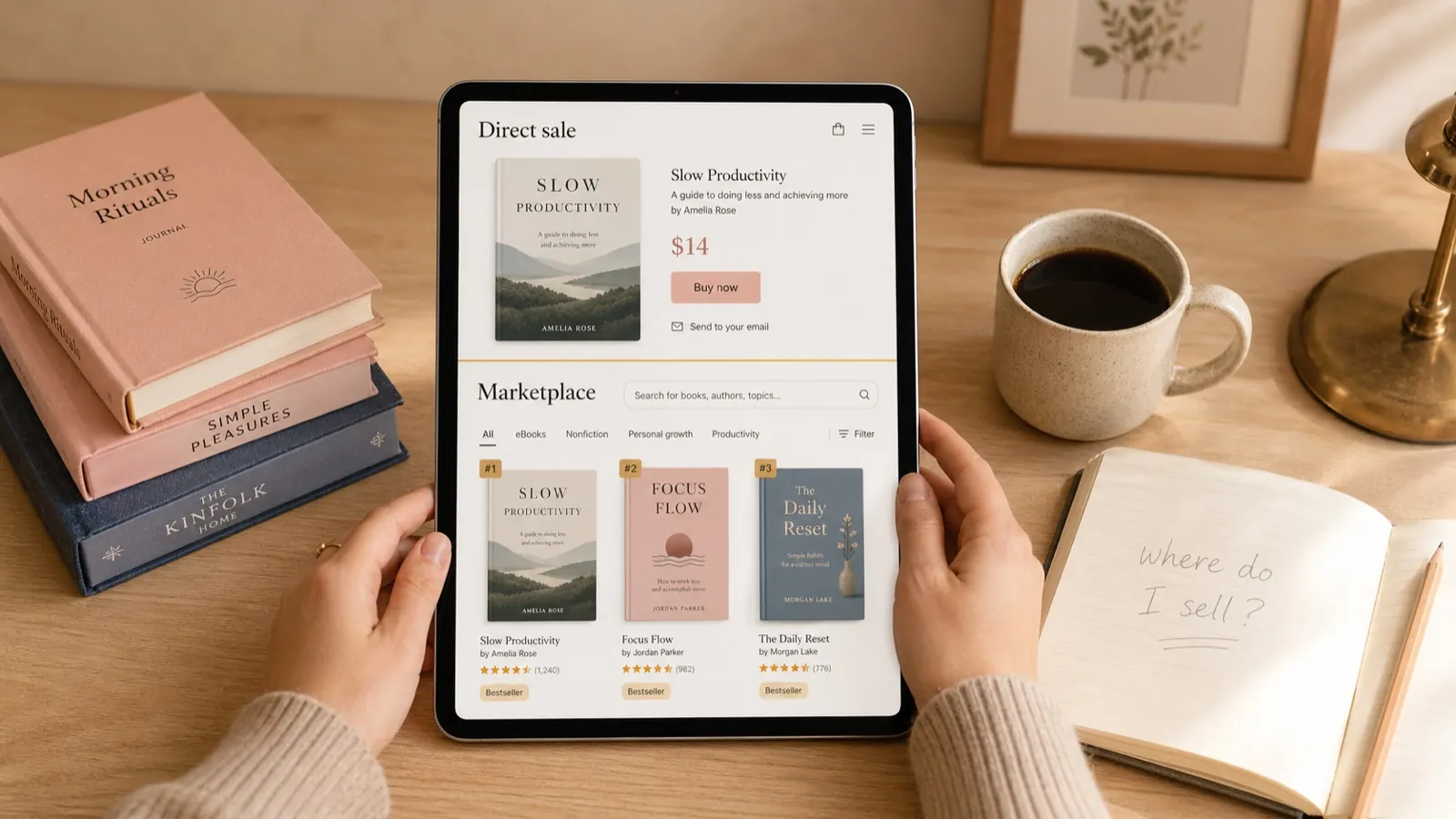
Quick Answer
Gumroad and Amazon KDP solve different halves of the indie ebook problem. Gumroad wins on take-home per sale (87 to 95% vs 35 to 70%), customer email ownership, and price flexibility (any price including pay-what-you-want). Amazon KDP wins on built-in audience and discoverability (search traffic that Gumroad cannot match). Most successful indie authors in 2026 run both: Gumroad as the high-margin direct channel for their existing audience, Amazon KDP as the discovery channel for new readers. Pick Gumroad first if you have an email list of any size; pick Amazon KDP first if you have zero audience and need search to find your book. Updated May 2026.
If you have written an ebook with AI and you are about to publish, this question is the first real fork in the road: Gumroad or Amazon KDP? The two platforms are fundamentally different products that happen to both sell ebooks, and the answer is rarely as obvious as the YouTube comparisons suggest.
This post compares the two on 10 dimensions that actually move the needle for indie authors in 2026, with a clear decision rule at the end. We will not declare a winner because there isn't one universal winner; we will give you the framework to pick the right one for your specific situation.
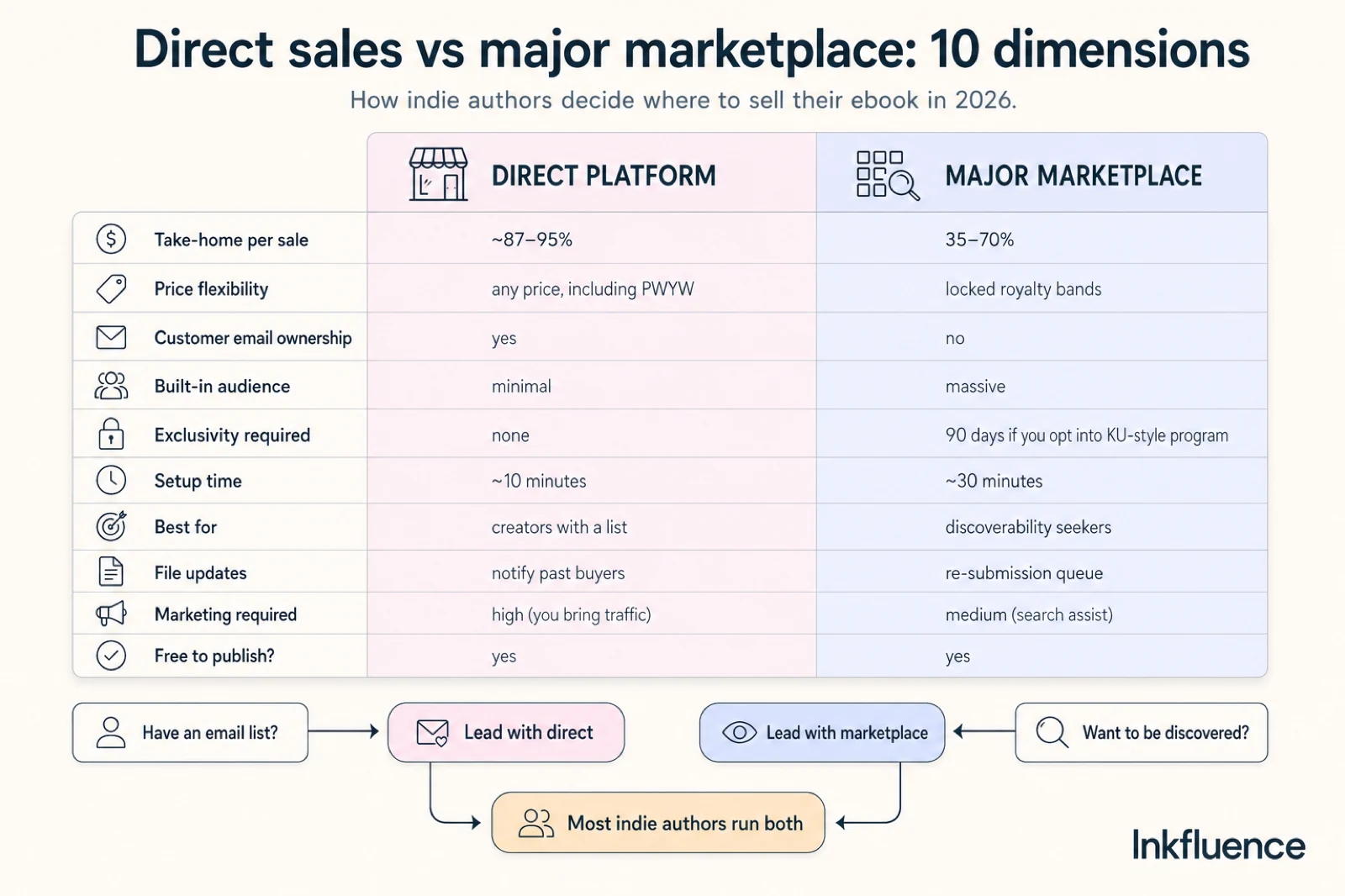
Quick Comparison: Gumroad vs Amazon KDP
| Dimension | Gumroad | Amazon KDP |
|---|---|---|
| Take-home per sale | ~87–95% | 35% (outside band) or 70% ($2.99–$12.99) |
| Price flexibility | Any price, including pay-what-you-want | Locked royalty bands |
| Customer email ownership | Yes, you keep it | No, Amazon owns the relationship |
| Built-in audience | Modest (Discover feed) | Massive (largest book marketplace globally) |
| Exclusivity required | None | 90 days if you opt into KDP Select |
| Setup time | ~10 minutes | ~30 minutes plus tax interview |
| Best for | Creators with an existing list | Authors needing discovery from search |
| File updates | Re-upload, past buyers auto-notified | Re-submission queue, 24–72h review |
| Marketing required | High (you bring all the traffic) | Medium (search + Also Bought help) |
| Cost to publish | Free, no upfront fees | Free, no upfront fees |
1. Take-Home Per Sale: Where Gumroad Wins Decisively
This is the headline number most authors look at first, and Gumroad wins on it cleanly.
Gumroad charges a flat 10% platform fee plus payment processing (roughly 3% Stripe-style). On a $14 ebook sale, you take home about $12.18 (~87%).
Amazon KDP has two royalty bands:
- 70% royalty - only on ebooks priced between $2.99 and $12.99. On a $9.99 sale, you take home about $6.99 (minus a small "delivery fee" for the file size, usually $0.05–$0.20).
- 35% royalty - on ebooks priced below $2.99 or above $9.99. On a $14 ebook in the 35% band, you take home $4.90.
So a $14 ebook nets you $12.18 on Gumroad vs $4.90 on KDP. That's 2.5x more per sale, before even thinking about the customer relationship.
BUT, this only matters if you can drive comparable sales volume. Amazon's audience can absorb 10x or 100x the volume Gumroad can for the same effort. Higher percentage on a lower number can still be less total income.
For exact per-sale math at any price across both platforms (and Apple Books, Kobo, Payhip), use our royalty calculator. To project total monthly net by combining price × volume × platform mix, use the ebook income calculator.
2. Price Flexibility: Gumroad Wins for Premium and PWYW
Gumroad lets you set any price. Free, $1, $14, $49, or pay-what-you-want with a $5 minimum. You can run sales, offer bundles, stack discount codes, and price-test without restriction.
Amazon KDP locks the 70% royalty band to $2.99–$12.99. Outside that band, you drop to 35%, which kills the math on premium-priced guides. If you want to charge $19, $29, or $49 for a comprehensive guide with bonuses, KDP will hand you 35% of that. Gumroad will hand you 87%+.
Pay-what-you-want is also a Gumroad-only move. Many indie authors use a $0 minimum / $5 suggested price on launch, then convert that goodwill into email subscribers and upsells.
3. Customer Email Ownership: The Real Compounding Advantage
This is the dimension most authors underestimate, and it compounds the most over time.
Gumroad gives you the buyer's email by default. When someone buys your $14 ebook, you get their email address. You can email them when book 2 launches. You can recommend a follow-up product. You can build a long-term reader list that travels with you wherever you publish next.
Amazon KDP does not. The customer is Amazon's, not yours. You have no way to email them, no way to know who they are, no way to follow up. Amazon may recommend your other books in their algorithm, but you can't drive that relationship directly.
Across a 5-year career, this difference is the single biggest income compounder. An author with 10,000 owned emails has a renewable launch audience. An author with 50,000 KDP customers has zero list.
4. Built-In Audience: KDP's Decisive Advantage
Amazon KDP's reverse advantage is enormous: it has the largest reading audience in the world built into the platform.
When someone searches "intermittent fasting for women over 40" on Amazon, your ebook can appear in the results without you doing anything. KDP's "Also Bought" recommendations move thousands of titles per day. Kindle Unlimited gives subscribers unlimited reads of enrolled books, paying authors per page read.
Gumroad's "Discover" feed exists, but it is roughly 1% of Amazon's organic discovery power. You bring all your own traffic to Gumroad, full stop.
The math: a brand new author with no audience can launch on Amazon KDP and see their first sale within 7–30 days from organic search alone. The same author launching on Gumroad with no list might wait 90 days for a single organic sale.
5. Exclusivity: KDP Select's Trade-Off
Gumroad never asks for exclusivity. Sell on Gumroad and Amazon and Apple and Kobo and your own newsletter all simultaneously, no problem.
Amazon KDP has KDP Select, an optional 90-day exclusivity program. Enroll in KDP Select and your ebook can only be sold on Amazon during that window. In exchange, your book becomes part of Kindle Unlimited (subscribers read it free, you earn per page read at roughly $0.004–$0.005 per page) and you get access to free promotions and Kindle Countdown Deals.
For a brand-new author with no audience, the KU exposure can be valuable in the first 90 days. For an author with their own list, the exclusivity costs more than it pays. Most indie authors enroll their first book to test KU, then opt out and go multi-platform.
6. Setup Time and Operational Friction
Gumroad: roughly 10 minutes to set up the seller account, add a payout method (Stripe Connect or PayPal), and you're live. The Inkfluence integration ships your finished book directly with one click - see our Gumroad publishing guide.
Amazon KDP: roughly 30 minutes for the initial setup including a tax interview (W-9 or W-8BEN depending on your country). After that, each book upload takes 10–15 minutes plus a 24–72 hour review window before the book goes live.
Operational difference: Gumroad is real-time. KDP has a queue. If you find a typo and re-upload, Gumroad pushes it instantly to past buyers. KDP queues your update for review and serves the new version after approval.
7. Marketing Burden
Gumroad: 100% of your traffic comes from you. Email blasts, social posts, paid ads, partnerships, your own website. The platform does not deliver buyers.
Amazon KDP: roughly 60–80% of sales come from Amazon's own discovery (search, Also Bought, KU recommendations) once your book has a foothold. The other 20–40% you still have to drive yourself.
Translation: Gumroad takes more active marketing work per dollar. Amazon takes more upfront SEO/keyword work in your listing setup, then runs partly on autopilot.
The Decision Rule
Pick based on what you have, not which percentage is bigger:
- Have an email list of 200+ engaged subscribers? Lead with Gumroad. The take-home math + email ownership combo wins decisively.
- Have zero audience and need to be discovered? Lead with Amazon KDP. The built-in search traffic makes the difference between a first sale in 14 days vs 90 days.
- Want premium pricing ($19+) or pay-what-you-want? Lead with Gumroad. KDP's 35% on out-of-band prices makes premium pricing economically unviable there.
- Writing fiction in a Kindle Unlimited-heavy genre (romance, thriller, sci-fi)? KDP Select on Amazon for the first 90 days, then evaluate.
- Have time to manage both? Run both. Gumroad for direct buyers (high margin, owned list), Amazon for discovery (high volume). Most full-time indie authors do this.
The "Run Both" Playbook (What Most Successful Indie Authors Actually Do)
The simplest reliable strategy in 2026:
- Launch on Gumroad first. Get the publishing flow right, collect your first reviews, build a small audience that owns the customer relationship. Use Inkfluence's one-click Gumroad publish for a near-instant launch.
- Add Amazon KDP after 30 days. Mirror the same EPUB to KDP. Skip KDP Select unless you're in a KU-heavy fiction genre. Amazon's organic search starts delivering passive sales.
- Add Apple Books and Kobo after 90 days. Same EPUB, two more channels, ~30 minutes of setup each.
- Use Gumroad for premium products and bundles. $29 master class ebook, $49 industry guide with worksheets, $99 limited-edition bundle. KDP can't price these competitively.
- Use Amazon for evergreen volume products. $4.99 to $9.99 standalone ebooks where the 70% royalty band keeps the math healthy and Amazon's discovery handles the marketing.
Authors who go multi-platform after the first 90 days typically see total monthly net rise 30 to 80% versus single-platform listing.1 The mix shifts the highest-margin sales (your existing audience) to Gumroad and the highest-volume sales (cold discovery) to Amazon, capturing the best of both.
What About AI-Written Ebooks Specifically?
Both platforms allow AI-assisted books in 2026. The policies differ slightly:
Gumroad: no specific AI disclosure policy as of April 2026. You can publish AI-assisted books without disclosure, though best practice is to mention "written with AI assistance" in the description for buyer trust.
Amazon KDP: requires AI disclosure during submission. KDP asks whether AI was used in the text, images, or translation. Disclosure does not affect approval; Amazon publishes AI-assisted books with disclosure as standard. Sales data is not publicly broken out by AI vs human, but indie author communities consistently report no measurable review or sales difference once book quality is comparable.
Both platforms care more about quality than the writing tool. Edit your AI output thoroughly, add your real expertise where the AI is generic, ship something you would actually read. Read more in our 2026 KDP AI disclosure policy explainer.
Frequently Asked Questions
Can I sell the same ebook on both Gumroad and Amazon KDP?
Yes, unless you're enrolled in KDP Select (Amazon's 90-day exclusivity program). Most indie authors deliberately avoid KDP Select so they can multi-platform. The Inkfluence Gumroad integration plus a manual EPUB upload to KDP gets you on both channels in under an hour.
Which platform is better for fiction vs non-fiction?
Fiction in Kindle Unlimited-heavy genres (romance, thriller, sci-fi/fantasy series) typically does better on Amazon KDP because of KU page-read income and Amazon's recommendation algorithms for series. Non-fiction with high willingness-to-pay (business, marketing, productivity, premium how-to guides) typically does better on Gumroad because of price flexibility and direct customer relationship.
How much does it cost to publish on each?
Both are free to publish. Gumroad takes 10% + payment processing per sale. Amazon KDP takes 30% (70% royalty band) or 65% (35% royalty band) plus a small per-MB delivery fee on the 70% band. Neither charges any upfront, listing, or monthly fee.
Which has better discoverability?
Amazon KDP, by a factor of roughly 100x. Amazon's search and recommendation algorithms move enormous volume daily. Gumroad's discovery is real but modest. If discovery is your primary need (you don't have an audience), KDP first.
Can I price my ebook at $19 or $29 on Amazon KDP?
You can, but you drop from the 70% royalty band to 35%. So a $19 ebook nets you ~$6.65 on KDP vs ~$16.50 on Gumroad. Premium pricing is economically only viable on direct platforms like Gumroad, Apple Books (which doesn't have a band restriction), or your own site.
Do my Amazon KDP customers carry over to Gumroad?
No. Amazon owns the customer relationship on KDP sales - you cannot email them or migrate them. This is the core reason most indie authors prioritise Gumroad for their existing audience and Amazon for cold discovery: the customer relationship splits.
How long does it take to start earning on each platform?
Gumroad: first sale typically within 24–72 hours of launch if you have any email list at all (even 50 subscribers). Cold launch: 7–30 days for first organic sale. Amazon KDP: 3–14 days for first sale via search if your title and keywords are well-optimised, even with zero audience. Long-term: KDP delivers higher passive volume; Gumroad delivers higher per-sale net.
What about Apple Books, Kobo, or Payhip vs Gumroad?
Apple Books and Kobo Writing Life take 30% across the board (you keep 70%). Payhip takes 5% on free tier or 0% on paid plans. None have Amazon's discovery scale or Gumroad's customer-email default. They make sense as additional channels once you have Gumroad and KDP running.
Is Kindle Unlimited (KDP Select) worth the exclusivity?
For first-time authors in KU-heavy fiction genres (romance, thriller, sci-fi), often yes for the first 90 days. The KU page-read income plus Free Promotion + Countdown Deal access can drive meaningful first-90-days reads. For non-fiction or for authors with an existing direct audience, the exclusivity cost is usually higher than the KU benefit.
Can I disclose AI usage in a way that doesn't hurt sales?
Yes. The pattern that works: include AI disclosure in the description (Amazon requires it during submission anyway) but lead the description with the reader outcome, not the writing process. Buyers care about whether the book solves their problem; the writing tool is a footnote. Most readers do not optimize against AI-assisted books once quality is comparable.
What's the easiest way to publish to both Gumroad and Amazon KDP from one tool?
Inkfluence AI ships finished ebooks with a one-click Gumroad publish (built into the editor) and a KDP-ready export bundle (EPUB + cover JPG formatted to KDP's exact specs) you upload manually to KDP's web interface. Two-channel listing in under an hour total. See our Gumroad guide and KDP guide.
Should I run paid ads on Gumroad or Amazon?
Amazon Sponsored Products typically delivers better break-even economics than Gumroad ads because Amazon's targeting can show your ebook to in-market buyers searching for adjacent titles. Gumroad doesn't have a comparable native ads product; most Gumroad authors run Meta Ads or Google Ads to a Gumroad listing instead. Don't run ads on either platform on book 1 before you have at least 50 organic sales worth of conversion data.
Sources
- Alliance of Independent Authors (ALLi) annual indie author income surveys for multi-platform vs single-platform revenue patterns.
- Gumroad Help Center for current platform fees and product policies.
- Amazon KDP royalty terms for official 35% / 70% bands and KDP Select rules.
- Authors Guild author income surveys for full-time vs side-income breakdowns.
Related Resources
- Sell Ebooks on Gumroad - full Gumroad publishing guide with the Inkfluence one-click flow.
- How to Sell Ebooks on Amazon KDP - KDP-specific publishing and marketing guide.
- Ebook Income Calculator - project monthly net at different platform mixes.
- Royalty Calculator - per-sale math across every major platform.
- AI Ebook Side Hustle: Realistic Expectations - what the income trajectory actually looks like.
- The Real Cost of Publishing a Book in 2026 - itemised production costs to pair with platform-fee math.
- Amazon KDP AI Disclosure Policy - current rules for AI-assisted books on KDP.
- Best Ebook Niches 2026 - high-demand niches that work on both platforms.
- AI Ebook Generator - write a finished ebook ready for both Gumroad and KDP.
- Book Description Generator - KDP-ready and Gumroad-ready outcome-led copy.
- Passive Income with Ebooks - long-term economics of an indie multi-platform catalogue.

Founder, Inkfluence AI
Sam is the founder of Inkfluence AI. He built the platform to make book creation accessible to everyone - from first-time authors to seasoned publishers.
Helpful links
Ready to Create Your Own Ebook?
Start writing with AI-powered tools, professional templates, and multi-format export.
Get Started FreeRelated Articles
 Selling
 Why Recurring AI Affiliate Programs Beat One-Time Payouts in 2026
The math behind why recurring commission affiliate programs build sustainable income while one-time payouts produce volatile spikes. Worked examples at three retention scenarios, where recurring breaks even, and how to spot programs that pay out consistently.
 Selling
 How to Write Affiliate Content That Ranks for AI Tools in 2026
A practical guide to writing AI-tool affiliate content that actually ranks on Google in 2026. Keyword strategy, post structure, internal linking, citations, AI-citation optimization, and refresh cadence.
 Selling
 How to Make Money Promoting AI Tools in 2026
A grounded guide to earning real money from AI tool affiliate programs in 2026. Revenue models, where to find programs, content that actually converts, realistic earnings at three traffic tiers, and the mistakes that quietly kill payouts.
Get ebook tips in your inbox
Join creators getting weekly strategies for writing, marketing, and selling ebooks.