
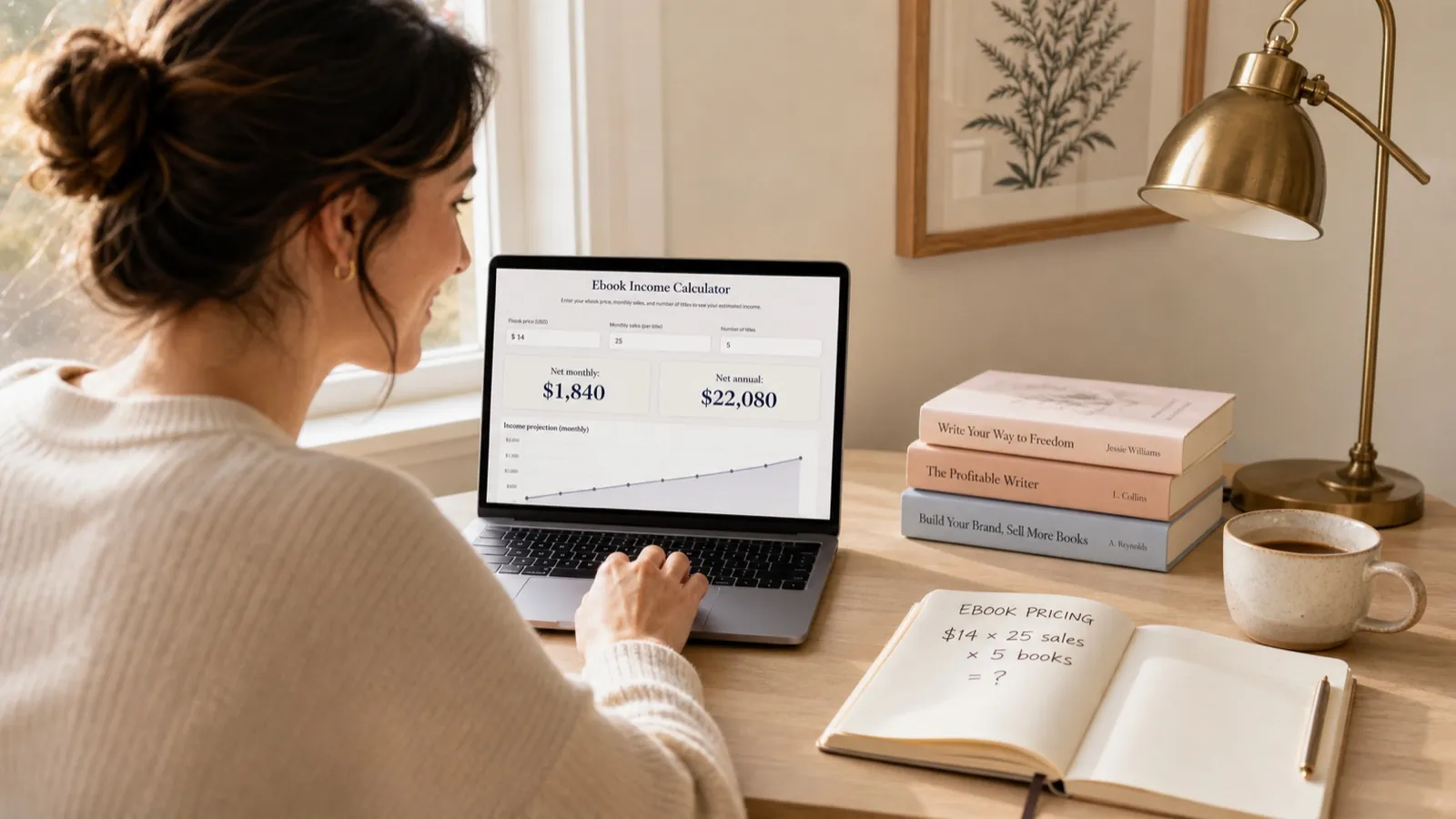
Ebook Income Calculator
Project realistic monthly and yearly ebook earnings across Gumroad, Amazon KDP, Apple Books, and Kobo.
Plug in your catalogue size, average price, monthly volume, and primary platform. The calculator returns net income after each platform's cut, with reality-check benchmarks from indie author income surveys.
Net monthly
$732
Net annual
$8,784
Gross monthly
$840
Per book / month
$244
By Sam May, founder of Inkfluence AI · Updated August 2026
Quick answer
How much can you make selling ebooks in 2026?
Realistic monthly net income from selling ebooks ranges from $0 to $200 in the first 3 months for new indie authors with a single book, up to $5,000+ per month for authors with 5 to 15 ebooks in a focused niche after 12 to 24 months of consistent publishing. Volume per book per month is the biggest driver; price is second. Platform choice (Gumroad, Amazon KDP, Apple Books, Kobo) affects net by roughly 15 to 35 percentage points.
$5–$25
Sweet-spot price for non-fiction ebooks2
10%
Gumroad's flat platform fee, plus processing1
70%
KDP royalty rate inside the $2.99–$12.99 band3
5–15
Books most full-time indie authors have live4
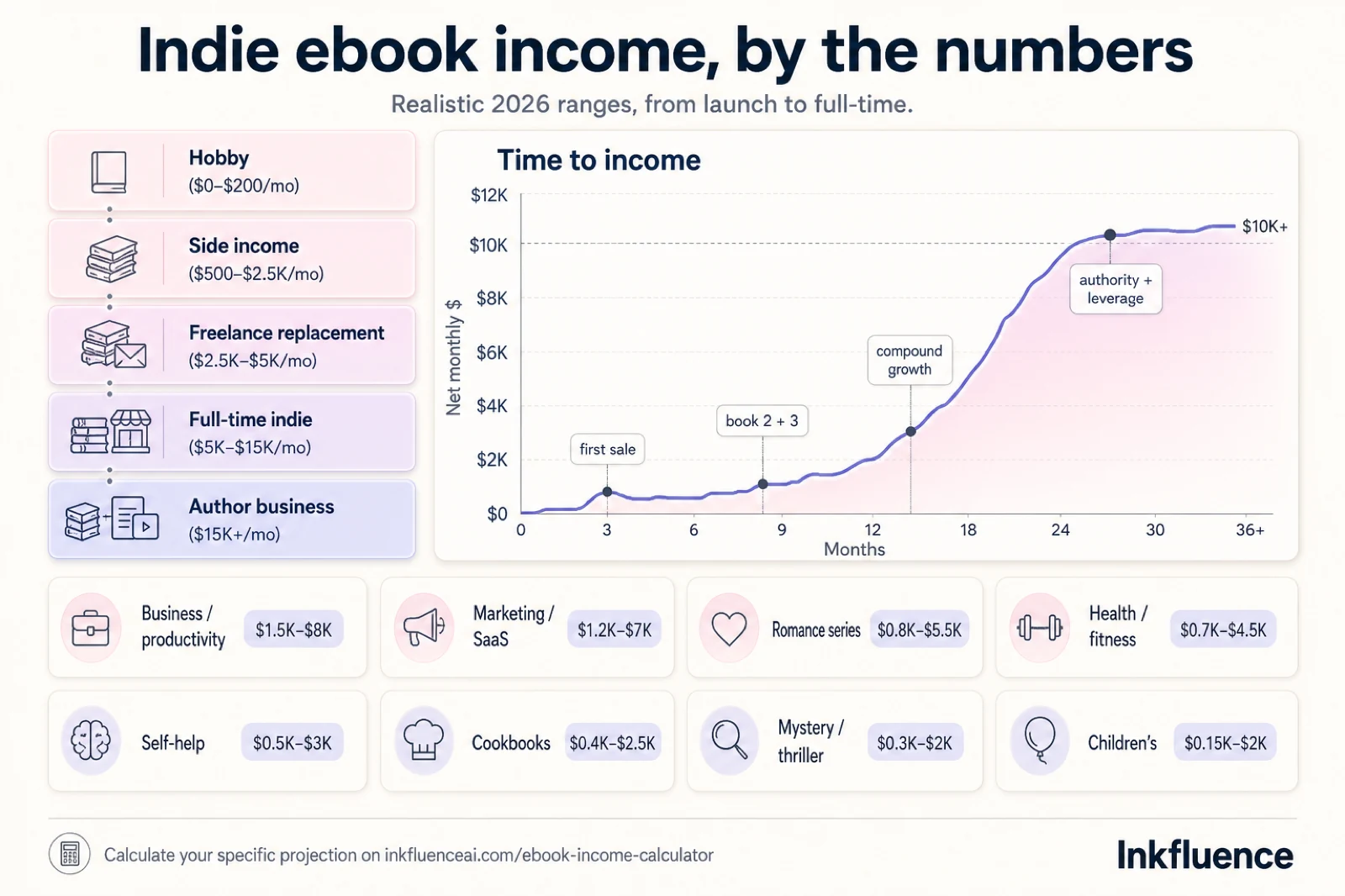
Ebook income tiers, by the numbers
Where authors actually land. Each tier represents a realistic stage indie ebook authors hit at different points of their catalogue and audience growth.
| Tier | Net monthly | Catalogue | Time to reach | Audience signal |
|---|---|---|---|---|
| Hobby | $0–$200 | 1 ebook | Months 1–3 | Friends and family |
| Lead-magnet asset | $50–$500 | 1–2 ebooks | Months 3–9 | Email list under 1K |
| Side income | $500–$2,500 | 3–7 ebooks | Months 9–18 | Email list 1K–5K, niche-focused |
| Freelance replacement | $2,500–$5,000 | 5–10 ebooks | Months 18–36 | Email list 5K–15K, established voice |
| Full-time indie | $5,000–$15,000 | 8–20 ebooks | Year 2–4 | Email list 15K+, niche authority |
| Author business | $15,000+ | 20+ ebooks plus courses, audiobooks, consulting | Year 3–5+ | Public brand, multi-channel revenue |
Brackets above are net (after platform cuts), assume non-fiction at $9–$19 average price, and are calibrated against indie author income surveys from ALLi and the Authors Guild.54 The "Hobby" and "Lead-magnet asset" tiers are where the median indie author actually sits long-term, despite YouTube tutorials suggesting otherwise.
Three realistic scenarios, fully calculated
Plug each scenario into the calculator above to compare. Net figures use the platform's standard cut.
Hobby / lead magnet
$60 net per month
- 1 ebook at $9
- 10 sales per month
- On Gumroad
- = ~$78 gross, ~$60 net (after fees + processing)
A side asset that warms an email list and pays for its own hosting.
Side income
$700 net per month
- 5 ebooks at $14 avg
- 12 sales per book per month
- On Gumroad
- = ~$840 gross, ~$732 net
Realistic after 12–18 months of consistent publishing in one niche.
Full-time indie
$5,250 net per month
- 10 ebooks at $15 avg
- 50 sales per book per month
- Multi-platform (~75% net)
- = ~$7,500 gross, ~$5,625 net
Top quartile of full-time indie authors. Requires niche dominance + active marketing.
Reality check: ALLi's annual indie author income survey consistently shows median full-time author earnings far below the optimistic numbers in YouTube tutorials. Use this calculator's worst-case (10 sales/book/month, Gumroad) and best-case (50 sales/book/month, multi) sliders to bracket your real expectations.5
Realistic income by niche and genre
Some ebook niches consistently outearn others because of buyer urgency, willingness to pay, and audience size. The ranges below assume a 5-book catalogue at the niche-average price.
High earners
Net monthly per 5-book catalogue- Business / productivity guides$1,500–$8,000
- Marketing / SEO / SaaS playbooks$1,200–$7,000
- Trading / investing guides$1,000–$6,000
- Romance series (3+ books in one)$800–$5,500
- Health / fitness programs$700–$4,500
Mid earners
Net monthly per 5-book catalogue- Self-help / personal development$500–$3,000
- Cookbooks / recipes$400–$2,500
- Parenting$300–$2,200
- Mystery / thriller fiction$300–$2,000
- Travel guides$250–$1,800
Volume-dependent
Net monthly per 5-book catalogue- Children's books$150–$2,000
- Sci-fi / fantasy (series-driven)$200–$3,500
- Devotional / faith-based$200–$1,500
- Memoir / biography$100–$1,200
- Hobby guides (gardening, knitting, etc)$200–$1,500
Low earners
Net monthly per 5-book catalogue- Poetry collections$50–$600
- Literary fiction$80–$800
- Academic / research$100–$1,000
- Photography books$50–$500
- General-audience essays$50–$700
High-earner niches share three traits: buyers face urgency (a problem they want solved this week), high willingness to pay (the alternative is hiring a consultant or buying a $200 course), and clear keyword intent (people search for solutions, not topics). Pick a niche that meets at least two of those before you commit. For deeper niche research see our 2026 niche analysis and the niche library.
Realistic timeline to each income tier
Indie ebook income is non-linear. The first 90 days look like nothing's working. Then a few signals compound and revenue starts growing faster than the catalogue does.
Months 1–3 · Launch window
First sales, audience seeded
First book lives. Marketing is mostly ad-hoc social posts plus emailing your list, and sales come in ones and twos rather than streaks. The job of this window is learning, not income: conversion data starts to be meaningful only after the first several dozen sales.
Months 4–9 · Catalogue + niche fit
$200–$1,000 monthly
Books 2 and 3 launch. Cross-sales kick in: some buyers of book 1 go on to buy book 2, and that repeat-buyer signal is the clearest evidence of niche fit. Email list grows to 1K–3K. The first repeat buyers signal niche-fit.
Months 10–18 · Compound growth
$1,000–$3,500 monthly
Books 4 and 5 published. Reviews accumulate. Search rankings start delivering organic traffic. Affiliate / partner mentions compound. This is where most authors who quit prematurely give up just before the curve bends.
Months 19–36 · Authority + leverage
$3,500–$10,000 monthly
8 to 12 books in catalogue. Niche authority is real. Marketing efficiency improves: paid ads become profitable, organic traffic plateaus higher, list growth compounds. Many authors hit freelance-replacement income here.
Year 3+ · Full-time stability
$10,000+ monthly
15+ books, multi-platform distribution, possibly courses or audiobooks added on top. Income smooths out month-over-month. A bad month is a 20% dip, not a wipe-out. This stage is rare but reachable.
The biggest single predictor of reaching the later stages is consistency. Authors who publish at least 1 ebook per quarter for 24+ consecutive months reach freelance-replacement income at far higher rates than authors who launch one book and wait to see what happens.
What actually drives ebook sales volume
The calculator above lets you set a number for "sales per book per month." That number is where most income projections fall apart. Here are the biggest drivers, ranked by impact based on indie author community reports:
- Email list size, primarily. A 1,000-person email list with engaged subscribers will outsell a 100,000-follower social account most of the time. Direct-to-inbox is the highest-conversion channel for paid digital products.
- Niche specificity. "Productivity" loses to "productivity for ICU nurses." The narrower the niche, the higher your conversion rate when someone in that niche finds you.
- Cover design at thumbnail size. Nearly every impression your cover earns is at thumbnail size in a search grid, so a title that's unreadable at 200px wide is invisible. On the listing itself, the Spiegel Research Center's research shows displaying reviews measurably lifts conversion, which is why the cover's job is to earn the click that puts those reviews in front of the buyer.6
- Description leading with reader outcome. Above-the-fold copy that says what the reader walks away with consistently outconverts copy that opens with author credentials.
- Catalogue size, with diminishing returns. Each book added to a same-niche catalogue lifts total revenue, but the lift shrinks as the catalogue grows: the audience a niche can supply is finite, so early titles add readers while later ones mostly share them.
- Reviews. Listings with 5+ reviews convert significantly better than unrated listings on every platform that displays ratings.6
- Pricing experimentation. Testing $9 vs $14 vs $19 in the first 90 days post-launch. Most authors set a price once and never revisit; that's a real revenue mistake.
For per-sale royalty math (not income projection), use our companion royalty calculator. For platform-specific pricing strategy, see our Gumroad publishing guide.
Ebooks vs other digital products: realistic income comparison
Why pick ebooks over an online course, membership, or coaching offer? Here's the honest breakdown for indie creators starting from zero in 2026.
| Product | Avg price | Build time | Monthly net at scale | Ongoing maintenance |
|---|---|---|---|---|
| Ebook | $5–$49 | Days to weeks | $500–$15K (catalogue scaling) | Quarterly file refresh |
| Mini-course | $49–$199 | Weeks | $1K–$10K | Annual content refresh |
| Flagship course | $299–$1,997 | 2–6 months | $2K–$50K (launch-driven) | Cohort support, Q&A, updates |
| Membership / community | $10–$99/mo | Weeks (then ongoing) | $500–$25K (retention-driven) | High: weekly content + community management |
| 1-on-1 coaching | $100–$500/hr | Days (just price + book) | $2K–$20K (capped by hours) | Highest: every sale = scheduled time |
| Templates / digital downloads | $5–$99 | Hours to days | $200–$5K | Low: maybe yearly refresh |
Ebooks are the lowest-effort entry point with the most catalogue compound. A mature 10-book ebook catalogue generates similar monthly net to a flagship course but without the launch cycle, cohort delivery, or content refresh load. Coaching pays per hour (capped income); courses pay per launch (boom and bust). Ebooks pay continuously and scale by adding more titles, not by adding more delivery time.
Most indie creators end up running a portfolio: ebooks for evergreen passive income, courses for high-ticket spikes, coaching for direct cash. The ebook is where most of them start because it's the lowest activation energy. Use this calculator to plan the ebook half of that portfolio.
Platform-by-platform net at $14 per ebook
How much you keep from a single $14 sale depends entirely on the platform. The table below shows take-home for one sale; multiply by your monthly volume from the calculator above to see total monthly net.
| Platform | Take-home % | Per $14 sale | Notes |
|---|---|---|---|
| Gumroad | ~87% | ~$12.18 | 10% flat + payment processing |
| Amazon KDP (70% band) | 70% | ~$9.80 | $2.99–$12.99 only; small file delivery fee |
| Amazon KDP (35% rate) | 35% | ~$4.90 | $14 falls outside 70% band, drops to 35% |
| Apple Books | 70% | ~$9.80 | Apple takes 30% across all price points |
| Kobo Writing Life | 70% | ~$9.80 | 70% above $2.99, 30% below |
| Payhip | 95% | ~$13.30 | 5% free tier; 0% on paid plans |
Volume often beats rate. A 70% royalty on Amazon's audience can outearn 95% on a platform with no traffic. The decision is about your audience location, not the percentage alone. Use the calculator above to model both scenarios.
How to actually hit your projections
Tip 01
Build the email list before the book
Start a simple lead magnet 30 days before launch. Even 200 names converts launch day far better than 0. The ROI on list-building dwarfs paid promotion in the first 18 months for indie authors.
Tip 02
Pick one niche and publish 5 books in it
Niche compound effects are real. Each book in the same niche cross-sells the others, your marketing assets get reused, and platform algorithms reward your catalogue. Don't jump topics.
Tip 03
Update each book at least once per quarter
Refreshed files ping past buyers via the platform's update email. That email is one of your highest-attention touchpoints. Use it to point readers at your next book or your email list.
Tip 04
Test 3 prices in the first 90 days
Set the price, watch checkout conversion for two weeks, change the price, repeat. Most authors lock in a price on launch day and never revisit; that's lost revenue waiting to be claimed.
Tip 05
Mirror to a second platform after 90 days
Unless you're in KDP Select (Amazon exclusivity), there's no reason to stay single-platform after the launch window. Multi-platform listing adds buyers your primary channel would never reach, with minimal incremental work.
Frequently asked questions
How much money can you realistically make selling ebooks?
Realistic monthly net income ranges widely. New indie authors with one ebook on a single platform typically see $0 to $200 in the first 3 months. Authors with 5 to 10 ebooks in a focused niche can reach $500 to $5,000 per month after 12 to 24 months. The 2024 Authors Guild and ALLi indie author income surveys both show median earnings clustered far below the marketing claims you see on YouTube. The calculator on this page lets you plug in your own assumptions instead of relying on averages.
What price should I sell my ebook for?
Most non-fiction ebooks convert best between $5 and $25. Lead magnets are often free or pay-what-you-want. Premium how-to guides with bonuses reach $29 to $49. Amazon's 70% royalty band is locked between $2.99 and $12.99, which pushes a lot of KDP authors into that range; Gumroad and Apple Books have no equivalent restriction. Try a few prices in the calculator above to see how each affects your net.
How many ebooks do I need to publish to make a full-time income?
There's no single number, and published author-income surveys (ALLi, Authors Guild) show the spread is enormous. What they agree on: full-time earners almost always run a multi-book catalogue in one focused niche, because each new title cross-sells the rest. Model a catalogue in the calculator rather than a single book: the first book alone almost never gets there.
Which platform pays ebook authors the most?
Per-sale, Gumroad and Payhip leave the most in your pocket (you keep 87 to 95%). Amazon KDP's 70% royalty is competitive but only inside the $2.99 to $12.99 band; outside it you drop to 35%. Apple Books and Kobo Writing Life both take 30%. Volume matters more than rate though: Amazon's built-in audience can mean a lower royalty percentage still outearns a 90% cut on a platform with no traffic.
Is ebook income really 'passive'?
Partially. The book file once published doesn't need rewriting, so a sale at 2 a.m. while you're asleep is real. But the marketing, ad spend, list-building, and cover refreshes that drive volume are not passive at all. Expect to actively promote each book for the first 90 days post-launch and then update at least quarterly to keep momentum.
How do platform fees actually work?
Gumroad: flat 10% plus payment processing. Amazon KDP: 35% royalty for prices outside the $2.99-$12.99 band, 70% inside it (Amazon takes the rest plus a delivery fee on the 70% rate). Apple Books: 30% to Apple. Kobo Writing Life: 30% on books under $2.99, 70% above. Payhip: 5% on free tier, 0% on paid plans (you pay a flat monthly instead). Full per-sale math is on our companion royalty calculator page.
How long until my first ebook sale?
The mechanism matters more than a day count. A KDP listing typically goes live within 72 hours of submission, and from there the first sale depends on whether anyone is looking: authors launching to an email list usually see sales the same day the announcement goes out, while a cold launch waits for marketplace search to surface the book. The predictor is the list, not the platform.
Can I sell the same ebook on multiple platforms?
Yes, unless you've enrolled in Amazon KDP Select, which requires Amazon-only exclusivity for 90 days. Most indie authors list on Amazon KDP plus one or more of Gumroad, Apple Books, Kobo, and Payhip. Listing on more than one platform adds buyers your primary channel would never reach; how much depends entirely on niche and where your audience already shops.
What's a realistic conversion rate from email subscriber to ebook buyer?
As a worked illustration: if 1,000 subscribers see your launch email and one reader in fifty buys, that is 20 launch sales at whatever price you set. Run the same arithmetic with your real list size and a conservative and optimistic rate; the calculator turns it into a launch-month projection. Your true rate emerges after your first launch, and that number beats any benchmark.
Should I focus on one niche or write many topics?
One niche, almost always. Niche authors who publish 5 ebooks on the same topic see compound effects: cross-linking inside each book pushes readers to others, marketing assets are reusable, and the catalogue authority on that one topic builds quickly. Authors who jump topics start from zero each time.
Do AI-written ebooks earn less than human-written ones on Gumroad and KDP?
Disclosed AI-assisted books earn comparably to human-written books on Gumroad (Gumroad has no specific AI policy as of April 2026). Amazon KDP requires AI disclosure during submission and applies it to listings; sales data isn't publicly broken out by AI vs human. Quality of writing, niche fit, cover design, and marketing all matter more than the AI question for revenue outcomes.
What's the difference between this and the royalty calculator?
This page projects total monthly and yearly income across your whole ebook catalogue. The royalty calculator focuses on per-sale math (what one sale at one price on one platform actually nets you). Use the royalty calculator to set your price; use this calculator to plan your monthly business.
How long does it take to start earning from ebooks?
With any email list at all, the first sale usually lands when the launch email does. Without an audience, the first organic sale waits on marketplace discovery, which is unpredictable by nature. Meaningful monthly income follows catalogue growth: it arrives book by book in one niche, not from a single launch.
Can ebooks really be passive income?
Partially. The book file itself doesn't need rewriting after launch, so the sale at 2 a.m. while you sleep is genuinely passive. The marketing, ad spend, list-building, cover refreshes, and quarterly file updates that keep volume up are not passive at all. Realistic frame: ebooks are leverage, not autopilot. You put in marketing work that compounds rather than work that resets every month like consulting.
How much should I spend on ads for an ebook?
For a $14 ebook on Gumroad, ad spend is profitable when blended cost per acquisition is roughly under $5. That sets your daily budget by working backwards from your acceptable break-even sales rate. Most indie authors who profitably run ads spend $5 to $30/day on Amazon Sponsored Products or Meta Ads, scaling up only after the first profitable cohort. Don't run ads on book one before you have organic conversion data.
Do AI-written ebooks earn the same as human-written ebooks?
Quality, niche fit, cover, and marketing matter far more than the AI question for revenue outcomes. Disclosed AI-assisted books on Gumroad earn comparably to human-written ones (Gumroad has no AI policy as of April 2026). Amazon KDP requires AI disclosure at submission. Sales data isn't broken out by AI vs human anywhere public, but anecdotal indie author reports cluster on "makes no measurable difference" once book quality is comparable.
How many ebook sales per month is realistic for a new author?
There is no honest fixed number: published income surveys show new-title sales vary enormously by niche, list size, and price. The reliable pattern is the shape, not the figures: a modest first-90-days from your existing audience, then compounding growth as books 2 and 3 launch in the same niche and cross-sales kick in. Publishing the next book in the same niche lifts total volume more than any single marketing tactic.
What ebook length earns the most?
Non-fiction sweet spot: 15,000 to 30,000 words (about 60 to 120 pages). Long enough to feel substantive, short enough to actually finish reading. Fiction: 50,000 to 70,000 words for novels, 15,000 to 25,000 for novellas. Length and price aren't tightly correlated for indie ebooks; a 20,000-word focused guide can sell for $19 if the topic is high-value. Don't pad to hit a word count.
Should I publish under my real name or a pen name?
Pen names work fine for fiction and for non-fiction in niches outside your professional brand. The economic difference is essentially zero on Gumroad, Apple, Kobo, and Payhip. On Amazon KDP, your author central page is name-bound, so you'd run two pen names = two author central setups. For most indie authors, the choice comes down to brand strategy, not income optimization.
Is it worth publishing on Amazon KDP if I already sell on Gumroad?
Almost always yes. Amazon's discovery (search, Also Bought, Kindle Unlimited if you opt in) is something Gumroad simply can't match. Amazon adds a discovery engine (search, Also Bought, Kindle Unlimited if you opt in) that a direct-sales page cannot replicate, and the buyers it brings are mostly people who would never have found you otherwise. The only reason to skip KDP is if KDP Select exclusivity is incompatible with your existing direct-sales relationships.
What's the lowest possible cost to publish an ebook in 2026?
Genuinely $0 if you write it yourself, design the cover with free tools, and publish to Gumroad / KDP / Apple (no upfront fees on any of those). Realistic spending: $0 to $50 on a cover designer (Canva Pro or Fiverr), $0 to $30/month on writing software, $0 to $200 on ads in the first 90 days. Many indie authors launch their first book for under $50 total.
Sources & references
- Gumroad Help Center: current platform fees and payout configuration.
- Reedsy: self-publishing pricing benchmarks and indie author market data.
- Amazon KDP royalty terms: official 35% / 70% royalty bands and qualifying price ranges.
- Authors Guild author income surveys: full-time vs side-income breakdowns for working authors.
- Alliance of Independent Authors (ALLi) annual indie author income surveys.
- Spiegel Research Center, Northwestern University: "How Online Reviews Influence Sales".
- Statista: global ebook market size and growth context.
Skip the math. Write the book.
A projection only matters if there's an actual book to sell. Inkfluence turns one prompt into a finished, sellable ebook. Free to start.
Start writing freeCost breakdown
Real Cost of Publishing
Pair income with cost: itemised 2026 publishing budget with three real budget scenarios.
Calculator
Royalty Calculator
Per-sale math: what one sale at one price on one platform actually nets you.
Guide
Sell Ebooks on Gumroad
Setup, pricing strategy, and the one-click publish flow from Inkfluence.