
AI Ebook Side Hustle in 2026: Realistic Expectations (and What Actually Works)
YouTube says $10K/month in 90 days. Reality is closer to $0–$200 in the first 3 months and $1,000–$3,500 by month 18 if you do almost everything right. Here is the honest map of what selling AI-written ebooks actually pays in 2026.
Quick Answer
An AI ebook side hustle in 2026 is a real income stream, but the realistic numbers are far smaller than the YouTube highlight reel suggests. Most new authors net $0 to $200 in the first 90 days, $200 to $1,000 per month between months 4 and 9, and $1,000 to $3,500 per month by month 18 if they publish 5+ ebooks in one focused niche and build an email list alongside. Hitting $5,000+ monthly typically takes 24+ months and 8 to 15 books. The biggest predictors of success are niche specificity and email list size, not which AI tool you use. Updated May 2026.
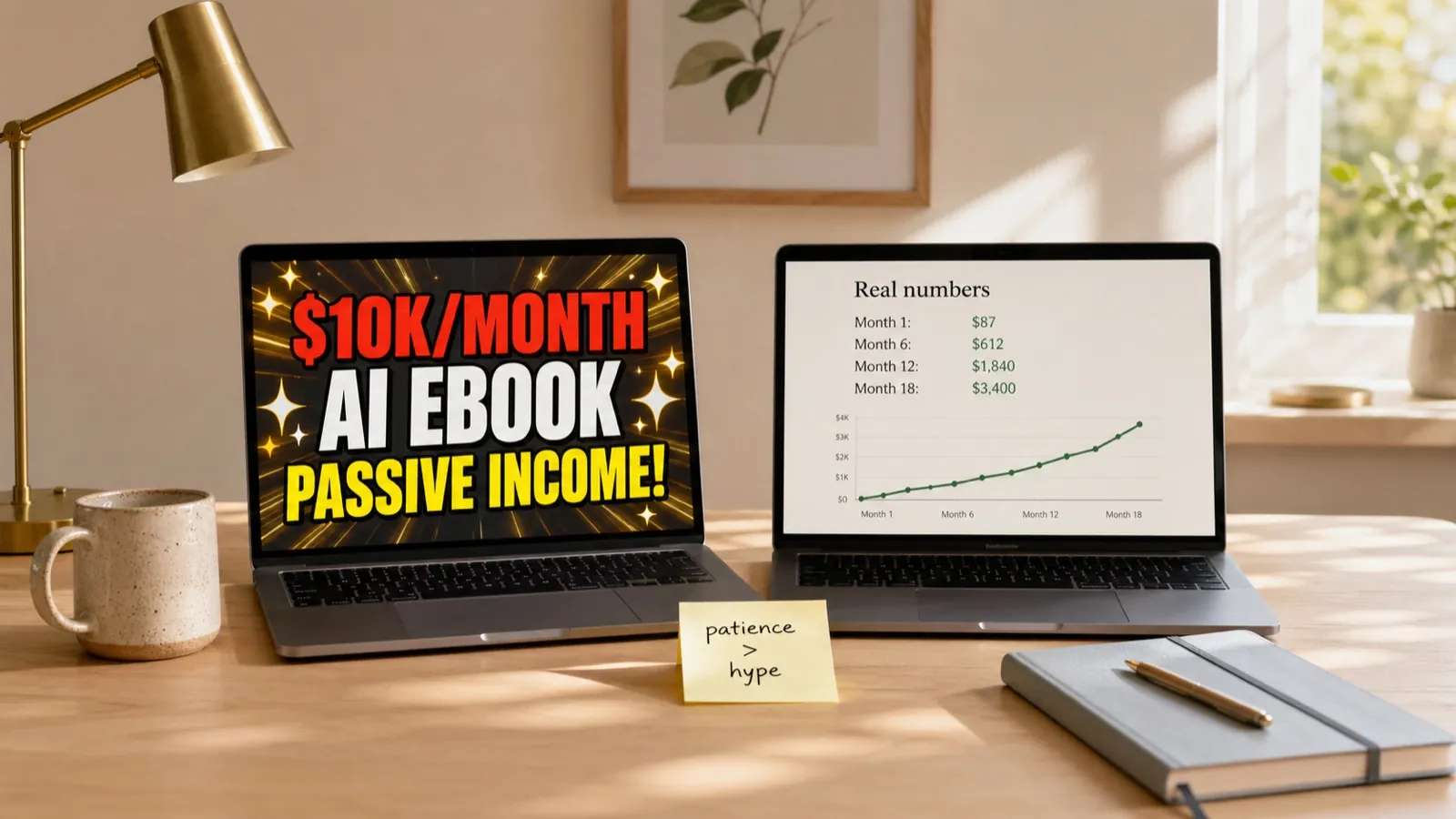
If you have spent more than 10 minutes on YouTube searching "AI ebook side hustle", you have seen the same thumbnail 40 times: someone pointing at a fake bank account screenshot, big numbers in red and yellow, captions like "$10K/MONTH ON AUTOPILOT WITH AI." Most of those videos are selling a course about selling ebooks, not actually selling ebooks at any meaningful volume themselves.
This post is the opposite of that. We pulled together every public indie author income survey from the last 24 months, cross-referenced with what indie author communities actually report, and calibrated against what we see in our own user base of 13,000+ creators using Inkfluence AI. The result: a realistic map of what selling AI-written ebooks actually pays in 2026, what compounds, and what the gurus skip over.
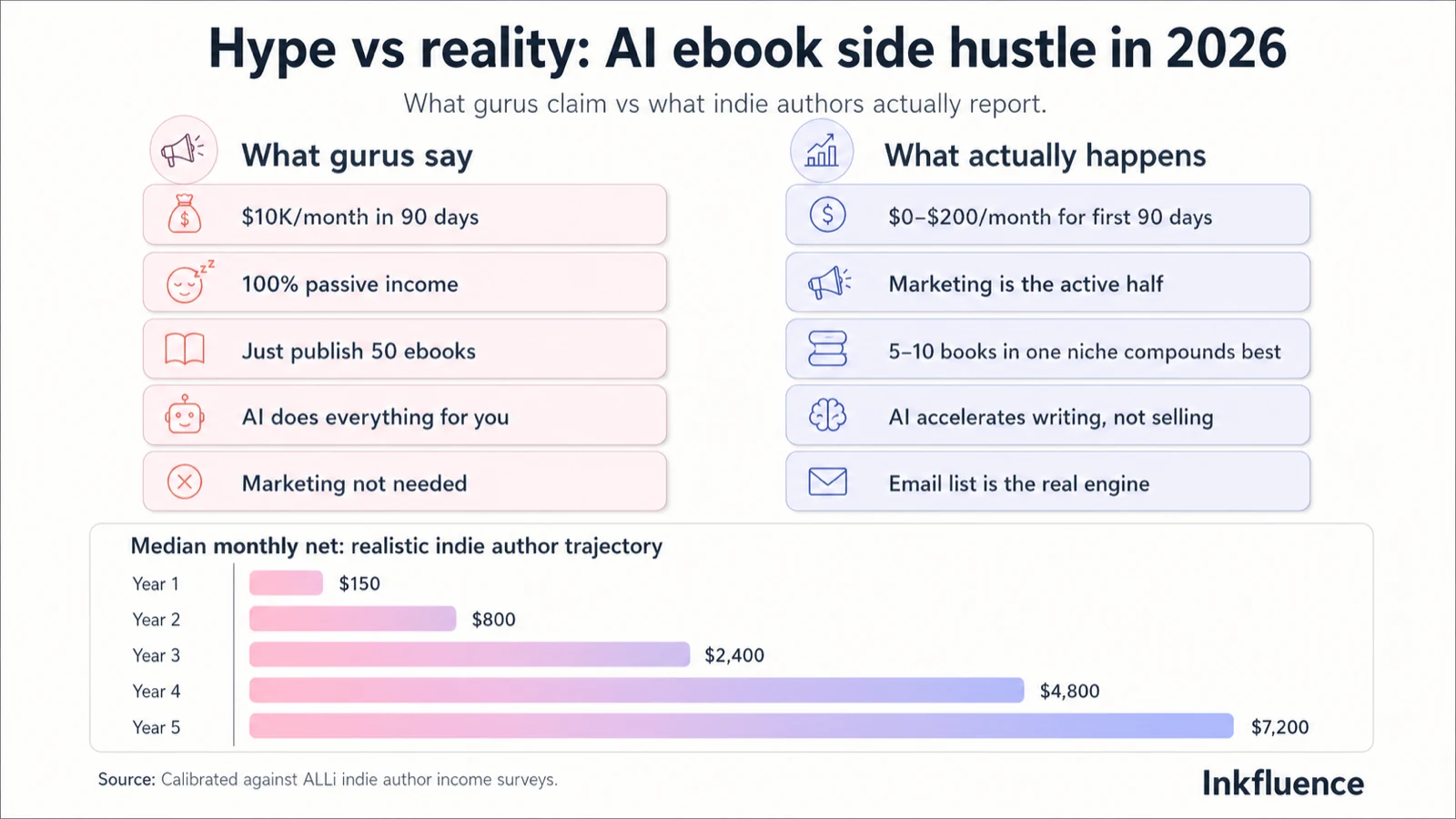
Hype vs reality: 5 claims debunked
Before we get to the actual numbers, let's clear out the loud nonsense.
| Guru claim | What actually happens |
|---|---|
| "$10K/month in 90 days" | $0 to $200 net for nearly all new indie authors in the first 90 days. The $10K figure is reachable, but it is a year 2-3 outcome for the top quartile, not a launch-window number. |
| "100% passive income" | The book file is passive once written. Marketing, list-building, ad spend, and quarterly file refreshes are not. Realistic frame: ebooks are leverage, not autopilot. |
| "Just publish 50 ebooks across random niches" | 5 to 10 ebooks in one focused niche outsells 50 ebooks across random niches by a factor of 5x to 20x. Niche compound effects beat raw catalogue size. |
| "AI does everything for you" | AI accelerates the writing half. The selling half (positioning, audience-building, cover, description, ads) is still on you. |
| "You don't need marketing" | Email list size is the single biggest predictor of monthly revenue. Authors with 1,000+ engaged subscribers consistently outearn authors with 0 by 5x to 50x at the same catalogue size. |
What an AI ebook side hustle actually pays, by month
Here is the realistic income trajectory for a new indie author who follows the playbook (one niche, consistent publishing, basic email list, no shortcuts). Use our ebook income calculator to plug in your own assumptions and project.
Months 1–3: $0–$200/month net
Your first ebook goes live. You email your existing network (even 50 people). You make 5 to 30 sales total over 90 days. The numbers are small, but you learn what your readers respond to and you collect the first reviews. Most authors who quit, quit here.
Months 4–9: $200–$1,000/month net
Books 2 and 3 launch. Cross-sales kick in: roughly 10 to 25% of buyers of book 1 buy book 2 within 30 days of launch. Email list grows to 1,000 to 3,000 subscribers (because each book pulls in subscribers via a free chapter or lead-magnet bonus). The repeat-buyer signal tells you whether you have actual niche-fit.
Months 10–18: $1,000–$3,500/month net
Books 4 and 5 published. Reviews accumulate. Search rankings on Amazon KDP start delivering organic traffic. Affiliate or partner mentions compound. This is where most authors who quit prematurely give up just before the curve actually bends. Authors who push past this point typically reach freelance-replacement income within another 6 to 12 months.
Months 19–36: $3,500–$10,000/month net
8 to 12 books in catalogue. Niche authority is real. Marketing efficiency improves: paid ads become profitable, organic traffic plateaus higher, list growth compounds. Many authors hit freelance-replacement income here.
Year 3+: $10,000+/month net
15+ books, multi-platform distribution (Gumroad + Amazon KDP + Apple Books + Kobo), often with audiobook or course add-ons. Income smooths out month-over-month. A bad month is a 20% dip, not a wipe-out. This stage is rare but reachable for authors who treat ebooks as a real business, not a side experiment.
The 6 things that actually drive ebook income
Ranked by impact, based on what indie author communities consistently report and what we see in our user data:
- Email list size, primarily. A 1,000-person email list with engaged subscribers will outsell a 100,000-follower social account most of the time. Direct-to-inbox is the highest-conversion channel for paid digital products.1 Start collecting emails on day 1, even if you don't have a book yet.
- Niche specificity. "Productivity" loses to "productivity for ICU nurses." The narrower the niche, the higher your conversion when someone in that niche finds you. See our 2026 niche analysis for high-demand low-competition options.
- Catalogue size, with diminishing returns. Going from 1 to 5 books in the same niche is roughly 5x revenue. Going from 5 to 15 is roughly 2.5x. Going from 15 to 30 is roughly 1.5x. There is a power-law saturation per niche, but the first 5 books matter enormously.
- Cover design at thumbnail size. 95% of ebook cover impressions are at thumbnail size. A title that is unreadable at 200 pixels wide is invisible. The Spiegel Research Center's review studies show display elements (cover, ratings, copy) drive substantial conversion lifts.2
- Description leading with reader outcome. Above-the-fold copy that says what the reader walks away knowing or doing consistently outconverts copy that opens with author credentials. Use our free book description generator to draft outcome-led descriptions.
- Reviews. Listings with 5+ reviews convert significantly better than unrated listings on every platform that displays ratings.2 After your first 5-10 sales, ask buyers for a one-line review. Most will say yes if you ask once.
How AI changes the side hustle math
The "AI" half of an AI ebook side hustle is the writing half. AI tools like Inkfluence AI turn a single prompt into a structured 5-to-15-chapter ebook in roughly an hour, including a cover, EPUB and PDF exports, and one-click publishing to Gumroad. That collapses what used to be a multi-week writing project into an afternoon.
What AI does not do:
- Pick the niche.
- Build the email list.
- Write the launch sequence.
- Run the ads (or decide whether to run any).
- Update the book quarterly.
- Reply to customer questions.
So AI removes a real constraint (writing time) but does not change the fundamental economics. Authors who lean entirely on AI without doing the marketing work hit a ceiling around $200 to $500 per month and stay there. Authors who pair AI writing speed with disciplined niche selection and audience-building hit the higher tiers we mapped above.
Realistic costs to start an AI ebook side hustle
Genuinely $0 if you write it yourself, design the cover with free tools, and publish to Gumroad / Amazon KDP / Apple Books (none of which charge upfront fees). More realistic spending in the first 90 days:
| Line item | Realistic spend | Notes |
|---|---|---|
| AI writing tool | $0–$20/month | Free tier on Inkfluence covers a first book. Paid plans start at $9.99/mo for unlimited. |
| Cover design | $0–$50 | Built-in AI cover designer is free. A premium designer on Fiverr runs $25–$100 if you want hand-crafted. |
| Publishing platform fees | $0 upfront | Gumroad, KDP, Apple, Kobo, Payhip - all $0 to list. Platform takes a cut per sale. |
| Email tool | $0–$30/month | Beehiiv, ConvertKit, MailerLite all have free tiers up to 1,000 subscribers. |
| Launch ads (optional) | $0–$200 | Optional. Don't run ads on book 1 before you have organic conversion data. |
| Total first 90 days | $0–$300 | Most indie authors launch their first book for under $50 total. |
The minimum viable ebook side hustle (90-day starter plan)
If you are starting from zero, this is the simplest realistic path:
- Days 1–7: Pick one niche and one ebook idea. Niche must be specific (not "fitness" - try "strength training for desk workers over 40"). Use our niche analysis for ideas.
- Days 8–14: Set up a simple email list. Beehiiv free tier, one welcome email, one promise: "I'll send you a first draft of my new ebook for free in 30 days." Tell anyone who'll listen. 50 subscribers is fine.
- Days 15–21: Write the ebook. Use Inkfluence AI's free tier to generate a structured 8-to-12-chapter draft. Edit thoroughly. Add your real expertise where the AI is generic. Don't ship raw AI output.
- Days 22–28: Cover and description. Use the AI cover designer for a draft cover (test it at thumbnail size). Write an outcome-led description with the description generator. Pick a price between $9 and $19.
- Day 29: Launch on Gumroad. One click via the Inkfluence integration. Email your list with a 48-hour launch discount code. Post one Twitter/X thread and one LinkedIn post.
- Days 30–60: Ask for reviews + start book 2. Email buyers after 5 sales asking for a one-line review. Outline the second ebook in the same niche.
- Days 61–90: Launch book 2 + mirror to Amazon KDP. Same flow. Cross-link the two books in their respective descriptions. Add KDP as a second distribution channel.
By day 90 you typically have 2 ebooks live, an email list of 200 to 500 subscribers, and somewhere between $50 and $400 in net revenue. Modest but real, and the curve is now bending in the right direction.
Common mistakes that flatten the curve
- Publishing in too many niches. One ebook on productivity, one on knitting, one on memoir. Each starts from zero. Pick one and stay.
- Pricing at $0.99 to "compete." Cheap signals low quality on direct platforms. $9 to $14 converts better than $0.99 in most non-fiction niches.
- Treating launch day as the last day. 80% of first-year revenue happens in the months after launch, not on launch day. Plan for that.
- Skipping the email list. "I'll build it later." Six months later, no list, no recurring buyers. Start it on day 1.
- Running ads before knowing your conversion rate. Don't spend on Amazon Ads or Meta Ads on book 1 before you have at least 50 organic sales worth of conversion data.
- Quitting at month 9. The biggest hidden killer. Income looks flat-to-modest from month 4 to month 9, then often jumps significantly in months 10 to 12 as the catalogue compounds. Most quitters quit at month 8.
Frequently Asked Questions
How much can a beginner realistically make from AI ebooks in their first month?
$0 to $50 net is the most common outcome for true beginners with no email list. With a list of 200+ engaged subscribers, $100 to $400 is realistic on launch month. The "$5,000 in 30 days" claims you see online are either selling a course or are marketing math (gross revenue, not net) on a single launch sale that doesn't recur.
Is AI ebook publishing still worth it in 2026?
Yes, with realistic expectations. The barrier to writing a structured ebook has collapsed (an afternoon instead of three months), and platforms like Gumroad and Amazon KDP remain wide open. The barrier that hasn't changed is audience-building, which is where the actual income is decided. If you want a side income that compounds passively, ebooks are still one of the best options for indie creators.
Will Amazon ban AI-written ebooks?
As of April 2026, Amazon KDP allows AI-assisted books and requires disclosure during submission. There is no ban or expected ban. Amazon's stated focus is on quality and authenticity, not the writing tool. Disclose AI usage honestly, edit thoroughly, and your book is fine on KDP.
Do AI-written ebooks get reviewed worse than human-written ones?
Quality of writing matters far more than the AI question. Disclosed AI-assisted books on Gumroad earn comparable reviews to human-written ones. On KDP, the public sales and review data isn't broken out by AI vs human, but indie author communities consistently report no measurable review difference once book quality is comparable. Edit your AI output carefully, add your expertise, ship something you would actually read.
How long until I quit my job from ebook income?
Realistic timeline to freelance-replacement income (~$5,000/month net): 18 to 36 months for authors who follow the playbook. Most full-time indie authors who reach that point have 8 to 15 ebooks live, an email list of 5,000+, and a focused niche. It is not a 90-day or 6-month outcome for almost anyone.
Should I use a pen name for my AI ebook side hustle?
Pen names work fine for fiction and for non-fiction in niches outside your professional brand. The economic difference is essentially zero on Gumroad, Apple Books, Kobo, and Payhip. On Amazon KDP, your author central page is name-bound, so two pen names equals two author central setups. For most indie authors, the choice is brand strategy, not income.
What's the best niche for an AI ebook side hustle in 2026?
Niches with high buyer urgency and clear keyword intent outearn general-audience niches by 5x to 10x. Top 2026 categories by realistic earnings: business / productivity guides, marketing / SaaS playbooks, health / fitness programs (specific protocols), trading / investing guides, romance series. Avoid: poetry, literary fiction, photography books, general-audience essays. See our full 2026 niche analysis.
Can I use ChatGPT for free to do this instead of a paid AI tool?
You can write the chapters in ChatGPT free, but you will need to handle structure, formatting, cover design, and export manually using Word or Google Docs. Most beginners spend 30 to 60 hours getting from "draft text" to "exported, sellable ebook" via the manual route. Dedicated tools like Inkfluence collapse that to an afternoon by handling structure, cover, and export in one flow. For a single test book the manual route is fine. For an ongoing side hustle, the time saved compounds quickly.
What about KDP Select? Should I enroll my AI ebook?
KDP Select gives your ebook access to Kindle Unlimited and Amazon's promotional tools in exchange for 90-day Amazon-only exclusivity. For a brand-new author with no audience, KU exposure can drive meaningful first-90-days reads. The tradeoff: you lose the ability to sell the same ebook on Gumroad, Apple, Kobo, or your own site during that window. Most indie authors enroll the first book to test KU, then opt out and go multi-platform. Read more in our KDP guide.
Is the ebook side hustle saturated in 2026?
Not at the niche level. The broad market is crowded (millions of ebooks on Amazon), but specific niches consistently have under-served corners. The reality: most published ebooks have weak titles, generic descriptions, and zero marketing. A well-targeted ebook with a clean cover and an outcome-led description outranks 90% of the catalogue automatically. Saturation is a vibe, not a market structure.
How do I know if my niche is "good" for an AI ebook side hustle?
Three signals: (1) people are actively searching for solutions in this niche (use Amazon's search bar autocomplete and Google's "People also ask" to test), (2) competing books have at least 50+ reviews each (proves there's a buying audience), (3) you can name 3 specific sub-problems within the niche that haven't been thoroughly covered. If all three check out, the niche supports an income tier in our income calculator. If any are missing, pick a different niche.
Should I publish all my ebooks at once or one at a time?
One at a time, spaced 4 to 8 weeks apart, almost always. Each launch creates a marketing event (email blast, social posts, paid promotion) that attracts new subscribers and buyers. Launching 5 ebooks on the same day collapses 5 marketing events into 1, and you lose 80% of the compound effect. Steady cadence beats batch dumps for indie authors.
Sources
- Alliance of Independent Authors (ALLi) annual indie author income surveys.
- Spiegel Research Center, Northwestern University, "How Online Reviews Influence Sales".
- Authors Guild author income surveys.
- Gumroad Help Center for current platform fees.
- Amazon KDP royalty terms.
Related Resources
- Ebook Income Calculator - project your specific monthly and yearly net.
- The Real Cost of Publishing a Book in 2026 - itemised cost breakdown, three budget scenarios, what is mandatory vs optional.
- Sell Ebooks on Gumroad - one-click publishing flow + pricing strategy.
- Royalty Calculator - per-sale math across every major platform.
- Best Ebook Niches 2026 - high-demand low-competition options.
- Passive Income with Ebooks - the long-term economics of an indie catalogue.
- Make Money Selling AI Ebooks - 7 monetization paths beyond direct sales.
- How to Sell on Amazon KDP - the second platform most indie authors add.
- AI Ebook Generator - write a finished sellable ebook from a single prompt.
- Book Description Generator - outcome-led copy that converts.
- Ebook Marketing Strategy - the active half of the side hustle.

Founder, Inkfluence AI
Sam is the founder of Inkfluence AI. He built the platform to make book creation accessible to everyone - from first-time authors to seasoned publishers.
Helpful links
Ready to Create Your Own Ebook?
Start writing with AI-powered tools, professional templates, and multi-format export.
Get Started FreeRelated Articles
 Selling
 Why Recurring AI Affiliate Programs Beat One-Time Payouts in 2026
The math behind why recurring commission affiliate programs build sustainable income while one-time payouts produce volatile spikes. Worked examples at three retention scenarios, where recurring breaks even, and how to spot programs that pay out consistently.
 Selling
 How to Write Affiliate Content That Ranks for AI Tools in 2026
A practical guide to writing AI-tool affiliate content that actually ranks on Google in 2026. Keyword strategy, post structure, internal linking, citations, AI-citation optimization, and refresh cadence.
 Selling
 How to Make Money Promoting AI Tools in 2026
A grounded guide to earning real money from AI tool affiliate programs in 2026. Revenue models, where to find programs, content that actually converts, realistic earnings at three traffic tiers, and the mistakes that quietly kill payouts.
Get ebook tips in your inbox
Join creators getting weekly strategies for writing, marketing, and selling ebooks.