
Best AI Ebook Platforms for Personal Brands in 2026
A practical comparison of AI ebook platforms for coaches, creators, consultants, and personal brands. Covers features that matter for authority building, lead generation, and audience growth - not just book creation.

Quick Answer
The best AI ebook platforms for personal brands combine fast content creation with professional output formats. Look for tools that support multiple book types (guides, workbooks, lead magnets), export to PDF and EPUB, offer cover design, and let you maintain your voice across all content. Inkfluence AI is purpose-built for this - supporting 33 book types, audiobook conversion, and genre-specific adaptation that matches your brand voice to each format.
Why This Matters
Books are the highest-authority content a personal brand can create
Blog posts build traffic. Social media builds awareness. But a book builds authority like nothing else. When a potential client sees "Author of [Book Title]" under your name, the trust gap closes instantly. AI makes it practical to publish multiple books per year instead of spending 12 months on one.
This guide compares the platforms available for personal brands in 2026 and shows you how to choose the right one for your specific goals - whether that is lead generation, client acquisition, speaking engagements, or passive income.
Personal brands have different needs than traditional authors. You are not just writing a book - you are building a content ecosystem that drives leads, establishes expertise, and supports your business.
The right AI ebook platform should fit into that ecosystem, not stand apart from it. This guide evaluates platforms on what matters most to coaches, consultants, course creators, and content entrepreneurs.
Why Personal Brands Need AI Book Tools
The traditional publishing timeline does not work for personal brands. Spending 6-12 months writing a single book means missing market windows, delaying lead generation, and leaving authority on the table.
AI book tools change the equation:
Speed to publish
Go from idea to finished ebook in days instead of months. Launch a lead magnet this week, a full book this month.
Multiple formats
One topic becomes a book, a workbook, a lead magnet, and a course outline. AI makes repurposing practical at scale.
Consistent voice
Good AI tools adapt to your tone and style. Your audience recognises your brand whether they read your book, your lead magnet, or your social posts.
Lower risk
Test a topic with a short ebook before committing to a full book. If it resonates, expand it. If not, the cost was minimal.
Features That Matter for Personal Brands
Not every AI writing tool serves personal brands equally. Here is what to prioritise:
Multiple book types
You need more than just "a book." You need lead magnets, workbooks, how-to guides, course companions, and full-length authority books. A platform that supports diverse formats saves you from juggling multiple tools.
Professional export formats
PDF for lead magnets and direct sales. EPUB for Kindle and Apple Books. Clean formatting that looks professional without needing a designer. Bonus: cover design built in.
Brand voice adaptation
The AI should learn and maintain your voice - your vocabulary, your examples, your storytelling style. Generic AI output that sounds like everyone else undermines your brand.
Editing and customisation
AI generates the first draft; you need tools to refine it. Chapter-by-chapter editing, content reorganisation, and the ability to inject your personal stories and case studies.
Audiobook capability
Audiobooks expand your reach to podcast listeners and commuters. AI voice technology in 2026 makes audiobook creation fast and affordable - a huge advantage for personal brands that want multi-format content.
Platform Comparison Table
| Feature | Inkfluence AI | ChatGPT / Claude | Designrr | Canva Docs |
|---|---|---|---|---|
| Full book generation | Yes - 20+ types | Manual prompting | No - formatting only | No - design only |
| Genre-specific adaptation | Automatic | Requires prompting | N/A | N/A |
| Outline to chapters | Automated pipeline | Chapter-by-chapter | No | No |
| Cross-chapter continuity | Built-in memory | Context window limit | N/A | N/A |
| PDF export | Styled, branded | Copy-paste needed | Yes - core feature | Yes |
| EPUB export | Yes | No | Limited | No |
| Cover design | AI + custom upload | No | Templates | Templates |
| Audiobook | AI voices built-in | No | No | No |
| Chapter editing | In-app editor | In chat | Visual editor | Visual editor |
| Best for | End-to-end books | Brainstorming, drafts | Repurposing content | Visual design |
Inkfluence AI: Built for Brand Content
Inkfluence AI is a purpose-built AI book creation platform designed for the full pipeline from idea to published book. Here is why it works particularly well for personal brands:
Multiple content types from one platform
Create different formats without switching tools:
- Lead magnets - Short, focused ebooks for email list building
- Authority books - Full-length guides that establish your expertise
- Workbooks - Interactive exercises for coaching clients or course students
- Course companions - Supporting materials for online courses
- Email courses - Drip content that nurtures leads over time
- Strategy guides - Playbooks and frameworks you can sell or give away
Genre-specific intelligence
When you describe your book topic, the AI automatically detects the content type and adjusts its approach. A self-help book gets a warm, transformational tone. A business book gets professional frameworks and case study structures. A workbook gets interactive exercises and reflection prompts. This genre awareness produces better first drafts than generic AI that treats every topic identically.
Full export pipeline
Export to PDF (styled and branded), EPUB (for Kindle and Apple Books), and audiobook (AI voice narration). Your lead magnet goes out as a polished PDF. Your authority book publishes to Amazon. Your audiobook reaches podcast listeners. One platform, every format.
See how it works for your brand
Try Inkfluence AI FreeChatGPT / Claude: General-Purpose AI
General-purpose AI chatbots are powerful brainstorming and drafting tools, but they have real limitations for book creation. For a detailed comparison, see our AI tools vs ChatGPT breakdown.
Where ChatGPT / Claude excel
- Brainstorming - generating topic ideas, outlines, and angle exploration
- Short-form content - individual chapters, blog posts, social content
- Research summaries - synthesising information on a topic
- Writing style experimentation - testing different tones and approaches
Where they fall short for books
- No book structure - you manage chapters, order, and continuity manually
- Context window limits - cannot keep an entire book in memory at once
- No export pipeline - you copy-paste into Word or Google Docs, then format yourself
- No cover design - need a separate tool (Canva, Book Bolt, etc.)
- No audiobook - need a separate TTS platform
- Repetitive prompting - you re-explain your voice and style for every chapter
Best for: Quick drafts, brainstorming, and content repurposing when you are already managing the book structure elsewhere. Many personal brands use ChatGPT for ideation and then move to a dedicated tool for full book creation.
Other Platforms Worth Considering
Designrr
Turns blog posts, podcasts, and existing content into formatted ebooks. Strong for repurposing but does not generate new content. Good complement to an AI writing tool if you have existing content to repackage.
Best for: Repurposing existing blog/podcast content into lead magnets
Canva Docs + Magic Write
Canva's document tool with AI writing assistance. Beautiful visual design, especially for short-form content. The AI writing is basic compared to dedicated tools - better for enhancing text you have already written than generating long-form content from scratch.
Best for: Visually-designed lead magnets and short guides
Jasper
Marketing-focused AI with long-form capabilities. Better for blog posts and marketing copy than books. Can generate individual chapters but lacks book-specific features like outline-to-chapter pipeline, cross-chapter continuity, and export formatting.
Best for: Marketing copy and blog content alongside your book projects
Sudowrite
Fiction-focused AI writing tool with strong creative features. Excellent for novelists but limited for the non-fiction content types that personal brands typically need (business books, guides, workbooks, lead magnets). See our Sudowrite review for details.
Best for: Fiction writing, creative projects
Atticus / Vellum
Professional book formatting tools for print and ebook. No AI content generation - you bring finished text and they make it beautiful. Essential for print publishing but not a content creation tool.
Best for: Final formatting for Amazon paperback or hardcover editions
Best Platform by Use Case
Different personal brand goals call for different tools. Here is what works best for each scenario:
| Goal | Best platform | Why |
|---|---|---|
| Build email list with lead magnets | Inkfluence AI | Fast lead magnet creation with professional PDF export and cover design |
| Publish authority book on Amazon | Inkfluence AI | Full pipeline from outline to EPUB with cross-chapter continuity |
| Create course companion materials | Inkfluence AI | Workbook and course content types with exercise generation |
| Repurpose blog posts into ebook | Designrr | Purpose-built for content repurposing with formatting templates |
| Create visually-designed PDF | Canva | Superior visual design tools for image-heavy short-form content |
| Brainstorm book ideas and angles | ChatGPT / Claude | Conversational ideation and research synthesis |
| Write fiction for personal brand | Inkfluence AI or Sudowrite | Both handle fiction; Inkfluence covers all formats in one place |
| Format for print publishing | Atticus / Vellum | Professional typesetting for print-ready output |
Building a Content System with AI Books
The real power for personal brands is not a single book - it is a content system where books serve multiple business functions simultaneously.
The personal brand book ecosystem
Here is how successful personal brands use AI-created books as part of a larger strategy:
Free lead magnet (3,000-5,000 words)
Short, focused guide that solves one specific problem. Given away in exchange for an email address. Created in 2-3 hours with AI.
Authority book (20,000-40,000 words)
Comprehensive guide published on Amazon. "Author of X" credential for speaking bios, LinkedIn, and media pitches. Created in 1-2 weeks with AI + editing.
Companion workbook ($7.99-$12.99)
Interactive exercises that complement the authority book. Sold separately or bundled. Created from the same topic in 3-5 days with AI.
Audiobook version
AI-narrated audio of your authority book. Reaches a different audience - commuters, podcast listeners, gym-goers. Created in hours with AI audiobook tools.
Online course ($97-$497)
Transform your book content into a structured course with video modules, quizzes, and community. 10-15x the revenue of the book alone. See our guide to converting books into courses.
This entire ecosystem - lead magnet, authority book, workbook, audiobook, and course foundation - can be created in under a month with AI assistance. Traditionally, just the authority book alone would take 6-12 months.
Revenue potential of a book-based content system
| Content piece | Price | Monthly sales | Monthly revenue |
|---|---|---|---|
| Lead magnet (email capture) | Free | 500 downloads | $0 (drives funnel) |
| Authority book (KDP) | $9.99 | 40 | $280 |
| Workbook (KDP) | $7.99 | 20 | $112 |
| Audiobook | $9.99 | 15 | $105 |
| Online course (from funnel) | $197 | 5 | $985 |
| Total | $1,482/month |
Conservative estimates. The course sales alone (driven by the book funnel) generate more revenue than all book sales combined - which is exactly the point.
For pricing strategy across these formats, see our complete ebook pricing guide.
Build your personal brand content system
Lead magnet, authority book, workbook, and audiobook - all from one platform. Start free and publish your first piece this week.
Start Writing FreeFrequently Asked Questions
What is the best AI platform for creating lead magnets? +
Can I use AI to maintain my brand voice across multiple books? +
How many books should a personal brand publish per year? +
Should I use my real name or a pen name? +
Do I need to disclose AI involvement? +
Can I turn one book into multiple products? +
What if my book topic is very niche? +
How do I promote my AI-created ebook? +
Is it worth creating an audiobook for a short lead magnet? +
What is the fastest way to publish my first personal brand ebook? +
What to Read Next
How to Price AI-Created Ebooks
KDP royalty tiers, genre benchmarks, and pricing strategy for every format.
Best Practices for Co-Writing a Book with AI
Maintain your brand voice while leveraging AI speed.
Convert Your Book into an Online Course
Turn a $9.99 ebook into a $197+ course for 10-15x revenue.
AI Tools for Authors vs ChatGPT
Detailed comparison of purpose-built tools versus general-purpose AI.

Founder, Inkfluence AI
Sam is the founder of Inkfluence AI. He built the platform to make book creation accessible to everyone - from first-time authors to seasoned publishers.
Helpful links
Ready to Create Your Own Ebook?
Start writing with AI-powered tools, professional templates, and multi-format export.
Get Started FreeRelated Articles
 Self-Publishing
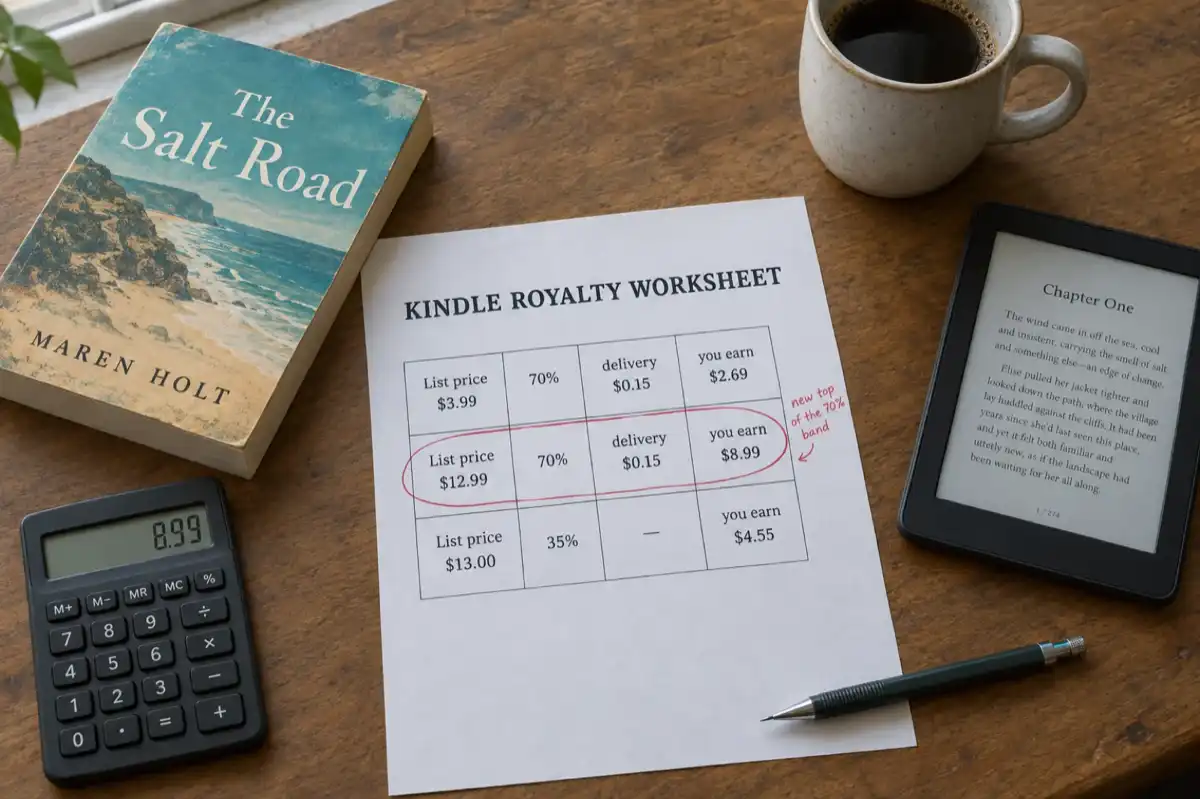
 KDP Royalties 2026: The 70% Band Now Runs to $12.99
Since 7 July 2026 Amazon KDP pays 70% on Kindle ebooks priced from $2.99 to $12.99, up from $9.99. What the change means for your price, how the delivery charge and the $13 cliff work, and what paperbacks, hardcovers and Kindle Unlimited pay, with worked examples.
 Self-Publishing
 How to Publish a Poetry Book on Kindle in 2026: The Complete Indie Poet Guide
Poetry collections sell well on KDP when they are formatted properly. Most indie poets get tripped up on the same five things: stanza spacing collapses on reflow, long lines break unintentionally, the cover does not signal poetry, the description reads like fiction back-cover copy, and the categories miss the readers. Here is the complete workflow.
 Self-Publishing
 The Real Cost of Publishing a Book in 2026: A Transparent Breakdown for Indie Authors
Industry estimates put the cost of self-publishing one book at $2,940 to $5,660. The honest answer is that almost none of that is mandatory. Here is what every line item actually costs in 2026, citation-checked, with three realistic budget paths and the AI-native shortcut that collapses most of the stack into one flat subscription.
Get ebook tips in your inbox
Join creators getting weekly strategies for writing, marketing, and selling ebooks.