

Quick Answer
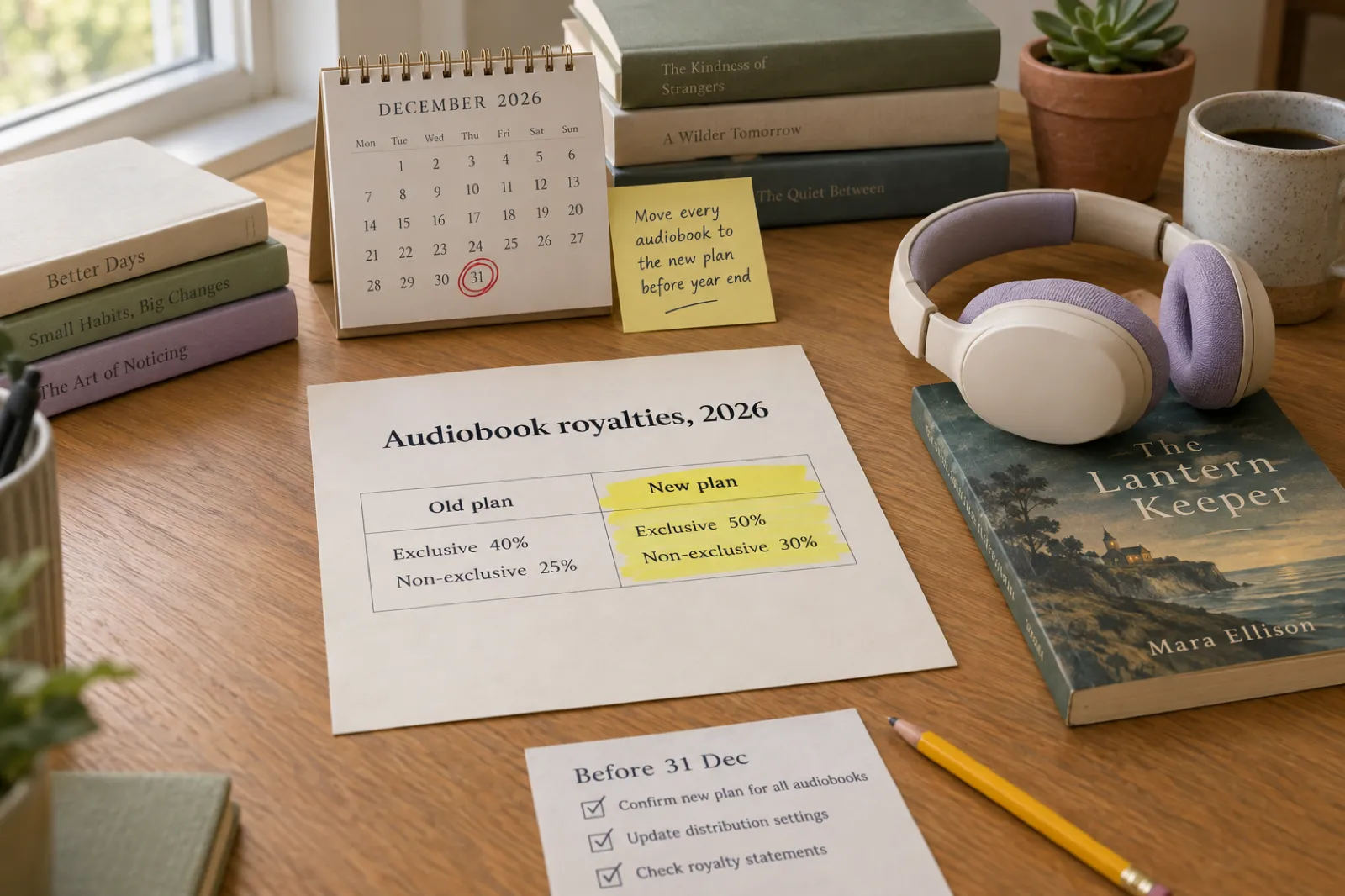
Audible is discontinuing the ACX legacy royalty model by the end of 2026, and by then every audiobook must be enrolled in the new royalty model or its distribution stops. Enrol from the My Projects tab in ACX: an existing title moves to the new model on the 1st of the following month, so enrolling by 30 November puts it on the new model from 1 December, before the cut-off. The new rates are 50% exclusive and 30% non-exclusive, up from 40% and 25%.
ACX opened its new royalty model to every creator on 26 May 2026 and said at the same time that the old one would not last the year. Most of the attention went to the higher headline rates. The part that needs action is quieter: if a title is still on the legacy model when the year ends, ACX's own wording is that you "must either choose to enroll your titles in the new model or discontinue distribution".
This guide sticks to what ACX and Audible have published, and says plainly where their pages disagree. It covers what changes, how the timing works, how royalties are now calculated, a worked example, a checklist, and what this means if you narrate your own book or use AI narration. To set an audiobook sale beside your ebook and paperback royalties, the KDP royalty calculator has an ACX tab with both models.
Disclosure: Inkfluence AI is our product. It writes books and makes audiobooks, including books the author narrates themselves, so we have an interest in this topic. We say below exactly where our audiobooks can and cannot go.
Published 1 November 2026. Facts read on ACX's and Audible's own pages the same day. We will update this page if ACX publishes an exact cut-off date.
What changes: legacy vs new rates
The rates are the easy part, and ACX states them the same way everywhere. Exclusive distribution means Audible, Amazon and Apple Books only. Non-exclusive means you can also sell the audiobook elsewhere.
| Legacy model | New model | |
|---|---|---|
| Exclusive (Audible, Amazon, Apple Books) | 40% | 50% |
| Non-exclusive | 25% | 30% |
| Each side of a Royalty Share title (exclusive) | 20% | 25% |
| Membership listening is paid by | The AudibleListener Allocation Factor | Member Value multiplied by your rate |
| Available until | The end of 2026 | Open to all creators since 26 May 2026 |
Two things do not change when you enrol. Your distribution choice stays as it is: ACX says enrolling "doesn't change" whether a title is exclusive. And Royalty Share titles keep earning their share, now at the new rate.
The timing: why November matters
ACX has not given a calendar date. Its help article, its blog and Audible's royalty page all say the legacy model ends "by end of year" or "by year-end". What ACX has been exact about is when enrolment takes effect:
- Existing titles move to the new model on the 1st of the month after you enrol.
- New DIY titles claimed after 26 May 2026 are enrolled automatically.
- Marketplace titles (Pay for Production, Royalty Share and Royalty Share Plus): the new model applies to offers sent to producers after 26 May 2026.
Put those together and November is the comfortable month. A title enrolled any time in November is on the new model from 1 December, a full month before the year ends. A title enrolled in December would move on 1 January, and ACX has not said whether that counts as in time. If you have older titles that you claimed or produced before 26 May 2026, assume they are still on the legacy model until you have checked.
How to enrol
- Sign in to ACX and open the My Projects tab.
- Choose Enroll titles.
- Select all titles, a few, or one.
- Choose Enroll title, then Confirm.
ACX's help article says eligible rights holders could do this from 26 May 2026. If you cannot see the option, contact ACX support rather than waiting for the year to end.
How royalties are calculated now
For a single cash sale, the arithmetic is familiar: a percentage of the sale. Membership listening is where the method changed. ACX's help article puts it in one line: royalties for membership "will equal Member Value multiplied by your contractual royalty rate".
- Member Value starts with what a member pays for their monthly plan, minus discounts, taxes and fees. It goes up when a member uses an extra credit beyond their plan.
- That value is shared among the titles the member engaged with that month, in proportion to each title's a la carte price.
- Your share is then multiplied by your rate: 50% or 30% on the new model.
- Listens in Audible's all-you-can-listen catalogue count as Qualified Listens, which become royalty-bearing once a length-based threshold is reached.
Audible's own royalty page describes the same idea from the listener's side: the model "captures the value of a customer's membership each month, distributed among the content the member engages with". It labels its example figures as illustrative, and so should anyone else: your real numbers depend on what members pay and what else they listen to.
The question ACX answers two ways
Do the new rates apply to cash purchases, or only to membership listening? ACX's pages do not agree, and we are not going to guess on their behalf.
| ACX page | What it says about cash purchases |
|---|---|
| Help article "Audible's new royalty model" (dated 31 July 2026) | The new rates apply to all ACX royalties, membership and a la carte. The a la carte calculation is unchanged, but the higher rate applies. |
| ACX blog post (28 April 2026), FAQ | "Our model for non-member and member cash purchases will not change" and "Our new royalty model is only for our membership offerings". The same post also says the higher rates mean you "earn higher with cash purchases". |
The later help article is the more specific of the two, but it is ACX's job to settle this, not ours. If cash sales are a large share of your audiobook income, read the current version of the help article on the day you enrol, and ask ACX support to confirm in writing. Either way the decision is the same, because staying on the legacy model is not an option after the year ends.
A worked example
These numbers are illustrations of ACX's published method, not predictions. Every input is an assumption we chose to make the arithmetic easy to follow.
Assumptions: one cash sale where the price Audible bases royalties on is $20; one member whose Member Value for the month is $15 and who listened to two titles, yours priced at $20 and another priced at $10; your title is exclusive unless stated.
| Event | Legacy model | New model |
|---|---|---|
| Cash sale, exclusive (if the new rate applies to cash sales) | 40% of $20 = $8.00 | 50% of $20 = $10.00 |
| Cash sale, non-exclusive (same condition) | 25% of $20 = $5.00 | 30% of $20 = $6.00 |
| Member listen, exclusive | Set by the Allocation Factor; not comparable line by line | Your share of Member Value: $15 x 20/30 = $10.00; 50% of $10.00 = $5.00 |
| Same member listen, Royalty Share title | Split equally | $2.50 to you, $2.50 to the narrator (25% each) |
Two things to take from it. On cash sales the new rates are simply higher, if they apply to your sales (see the section above). On membership listening the result depends on things you do not control: what members pay and what else they listen to. A member who listens to many cheap titles spreads their value thinly; a member who listens only to yours sends you all of it.
Turn your book into an audiobook you can sell
Inkfluence AI narrates books chapter by chapter, or lets you record your own reading in the browser, and exports chapter files at the specs most audiobook stores ask for. Free to start; audiobooks need a paid plan or chapter credits.
Start freeRoyalty Share titles and narrators
If you made your audiobook with a narrator on Royalty Share, the rules ACX has published are reassuring:
- The new model applies to narrators and producers on enrolled titles, and ACX notifies them when a title is enrolled.
- Royalty Share titles keep earning their share. ACX's "How royalties work" page puts each side's share at 20% on the legacy model and 25% on the new one, for exclusive titles.
- If a rights holder has not enrolled a Royalty Share title by the end of the year, ACX tells producers to contact the rights holder and, if needed, ACX support.
Some author sites report that a Royalty Share title cannot move without the narrator's approval. The ACX pages we read do not say that. Either way, a short message to your narrator before you enrol costs nothing: they are better off on the new model too, and they will hear about it from ACX anyway.
Checklist before the year ends
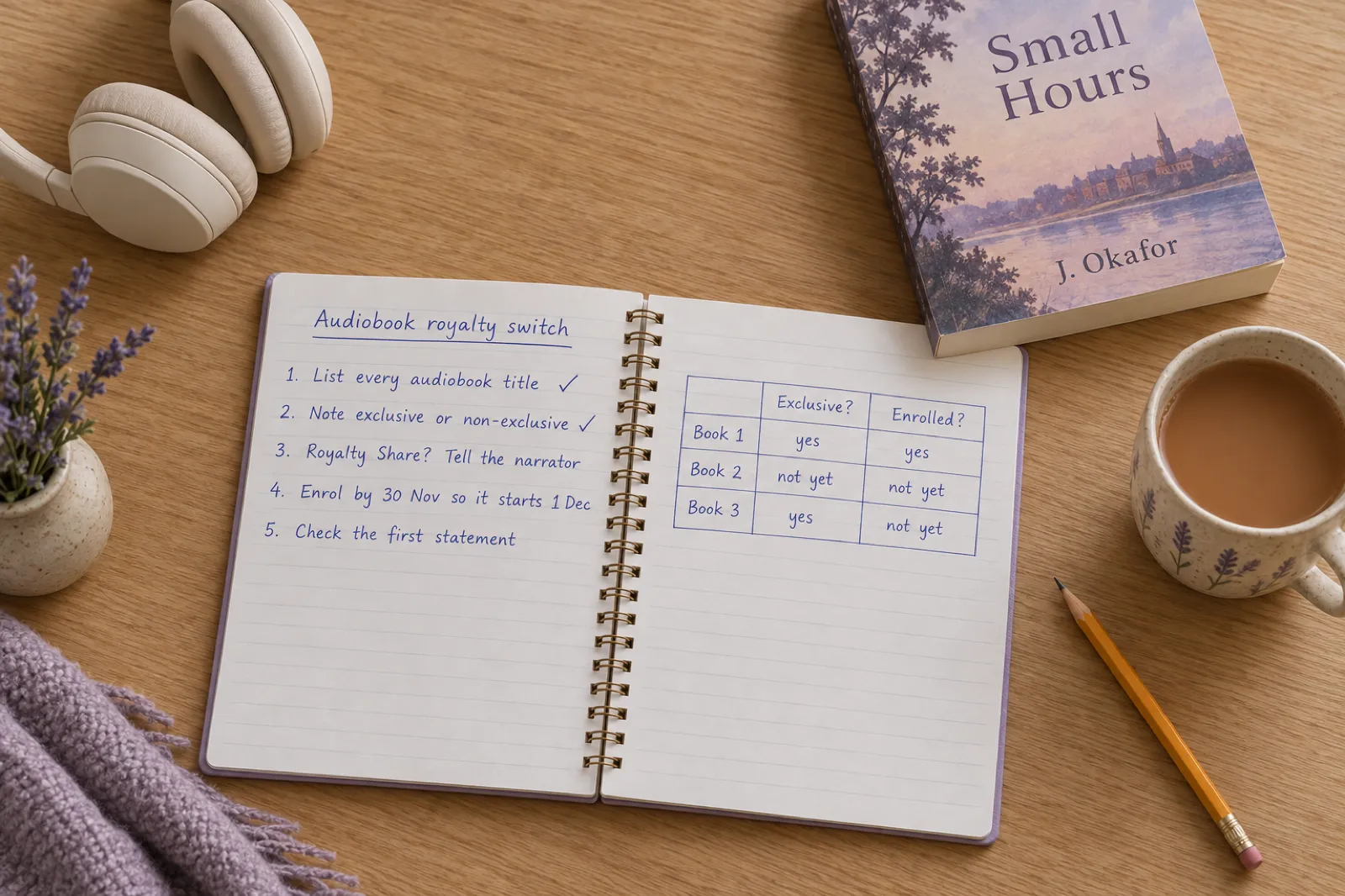
- List every audiobook you have on ACX, including old ones you have not looked at in years.
- Note each title's distribution: exclusive or non-exclusive. Enrolling does not change it.
- Check which titles are already enrolled. DIY titles claimed after 26 May 2026 should be enrolled automatically; anything older probably is not.
- Message any Royalty Share narrators before you enrol their titles.
- Enrol the rest in November, so they move to the new model on 1 December.
- Read the current ACX help article on the day you enrol, in case ACX has clarified cash purchases or published an exact date.
- Check Kindle+ while you are there. Since 22 October 2026, ACX audiobooks can join Kindle+ only on strict terms (exclusive to Audible, Pay for Production, Whispersync on, ebook in KDP Select). Our Kindle+ guide for authors has the full list.
- Decide on any title you would rather retire. ACX's other option is to discontinue distribution; do that on purpose, not by default.
- Look at your first statements under the new model in the new year and compare them with the same months last year.
Tip, added 6 November 2026: download your old ACX statements now
ACX refreshed its sales dashboard in late October. Its help article on the sales dashboard, dated 28 October 2026, now says sales data "is available from April 1, 2024", one year at a time. According to Dale Roberts' Self-Publishing News of 29 October 2026, the new dashboard shows royalty statements back to 2022, and older records stay available only for a while through the previous reporting system, with ACX advising authors to download what they need for tax or accounting before that access ends. We could not find the 2022 limit or an end date on ACX's own help pages, so treat the timing as unconfirmed and do it this month.
The comparison in the last checklist step needs last year's statements, so save every monthly earnings statement you can still reach (Earnings Statements, choose the month, Excel format) before you enrol. KDP rewrote past months in its own reports on 21 October too; our explainer on why KENP page reads dropped covers that change.
Stay exclusive or go wide?
The new model widens the gap between the two choices: 50% versus 30%, where it used to be 40% versus 25%. Exclusive means Audible, Amazon and Apple Books only. Non-exclusive at 30% lets you add Google Play Books, Kobo, Spotify, libraries and your own website, each with its own terms.
There is no single right answer. Exclusive tends to suit a book whose listeners are mostly on Audible already, and it is a condition for an ACX audiobook to join Kindle+. Wide tends to suit authors who sell direct, reach library listeners, or have readers outside Amazon's stores. Our guide to where to sell an audiobook compares the main stores, and KDP Select vs going wide covers the same choice for the ebook.
AI narration and narrating it yourself
None of this changes ACX's rule on narration. ACX requires human narration unless it has authorised otherwise, so an audiobook narrated with an outside AI voice cannot be uploaded through ACX, whichever royalty model it would be on. Amazon's own Virtual Voice audiobooks are a separate, invite-only programme for eligible KDP ebooks. Our guide to AI narration on Audible and ACX covers the rules in detail.
Where Inkfluence AI fits, honestly:
- If you narrate the book yourself, the audiobook studio lets you record each chapter in your browser or upload your own recording, then exports a ZIP of chapter files in mono at 44.1 kHz, 192 kbps constant bit rate, levelled to -20 LUFS with peaks under -3 dB. Those are ACX-spec files; the quality of the recording and the room is still yours to get right. Own recordings use no audiobook chapter allowance, though the studio itself needs a paid plan or credits on hand. The full walkthrough is on narrate your own audiobook.
- If you use AI narration, the AI audiobook generator narrates the book chapter by chapter (Creator includes 15 audiobook chapters a month, Premium 30). Those audiobooks go to stores that accept labelled AI narration, such as Google Play Books and Kobo, or to your own website. Not to ACX.
Record your own audiobook, chapter by chapter
Read each chapter in the browser or upload a recording you made elsewhere. Inkfluence levels it and exports chapter files at the specs stores ask for.
See how it worksFAQ
When does the ACX legacy royalty model end?
ACX says the legacy royalty model will be discontinued "by end of year", meaning the end of 2026. It has not published an exact date. By then every title must be enrolled in the new royalty model or its distribution stops.
What happens if I do nothing?
ACX says that by the end of the year you must either enrol your titles in the new model or discontinue distribution. A title left on the legacy model past that point is not offered a third option on the ACX pages we read, so treat doing nothing as a risk to your audiobook staying on sale.
What are the new ACX royalty rates?
50% for exclusive distribution to Audible, Amazon and Apple Books, and 30% for non-exclusive distribution. On the legacy model the rates were 40% exclusive and 25% non-exclusive.
When does enrolment take effect?
For existing titles, on the 1st of the following month. A title enrolled in November moves to the new model on 1 December. New DIY titles claimed after 26 May 2026 are enrolled automatically.
Does the new model change cash purchases?
ACX's own pages give two answers. Its help article says the new rates apply to all royalties, membership and a la carte, with the a la carte calculation unchanged. Its April 2026 blog FAQ says the model for cash purchases will not change and the new model is only for membership offerings. Check the current help article before you decide, and ask ACX support if cash sales are a large part of your income.
Does enrolling change whether my audiobook is exclusive?
No. ACX says enrolling a title does not change its exclusive or non-exclusive status. You choose distribution separately.
I have a Royalty Share narrator. What do I need to do?
Enrol the title like any other. ACX says the new model applies to narrators and producers on enrolled titles, that they are notified when you enrol, and that Royalty Share titles keep earning their share. Under the new exclusive rate each side of a Royalty Share title gets 25%, up from 20%. It is still good practice to tell your narrator before you enrol.
Can I put an AI-narrated audiobook on ACX instead?
No. ACX requires human narration unless it has authorised otherwise, so audiobooks narrated with outside AI voices cannot go through ACX. They can be sold on stores that accept labelled AI narration, such as Google Play Books and Kobo. Amazon's own Virtual Voice is a separate, invite-only programme for eligible KDP ebooks.
Do I have to enrol every title at once?
No. From the My Projects tab you can enrol all titles, selected titles or one title at a time. Each existing title moves on the 1st of the month after you enrol it.
Related reading
- Kindle Unlimited is now Kindle+: what it means for authors
- Spotify audiobook redemption codes: up to 1,000 free copies per title
- AI narration on Audible and ACX: the 2026 policy
- How to create an ACX audiobook from your ebook
- Narrate your own audiobook
- Where to sell an AI audiobook
- Audiobook length calculator
- The state of AI audiobooks in 2026
- AI audiobook generator
Sources
All read on 1 November 2026. If ACX's own pages and this guide disagree, ACX's pages win.
- ACX Help: Audible's new royalty model (dated 31 July 2026): rates, Member Value, enrolment steps and timing, narrators and producers, legacy model ending "by end of year".
- ACX Help: How royalties work: legacy and new rates, Royalty Share splits (20% legacy, 25% new), AudibleListener and a la carte definitions.
- ACX blog: Audible's new royalty model brings more ways to earn (posted 28 April 2026): rates, "enroll your titles in the new model or discontinue distribution", FAQ on cash purchases.
- Audible: Royalties: the Member Value formula and "by year-end, the legacy royalty model will be discontinued".
- ACX Help: Review your ACX sales dashboard (dated 28 October 2026, read 6 November 2026): sales data from 1 April 2024, up to one year at a time.
- Dale L. Roberts, Self-Publishing News, 29 October 2026: statements back to 2022 and older records available temporarily (secondary source).

Founder, Inkfluence AI
Sam is the founder of Inkfluence AI. He built the platform to make book creation accessible to everyone - from first-time authors to seasoned publishers.
Helpful links

Ready to write your own book?
Write with AI, make it yours, and export PDF, EPUB and KDP-ready files from one project.
Keep reading
 Self-Publishing
Why Did My KENP Page Reads Drop? KDP's Kindle+ Reporting Change Explained
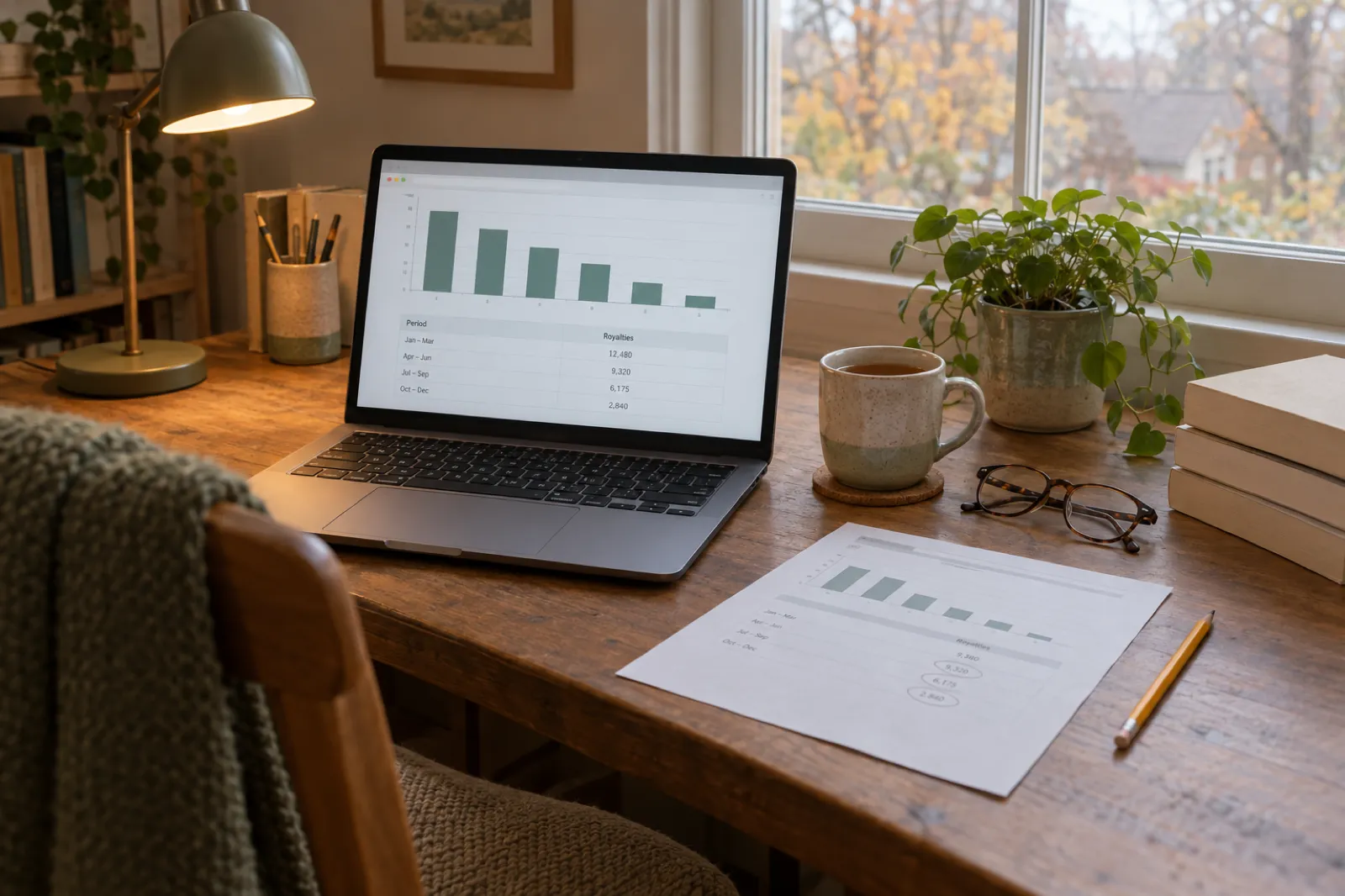
From 21 October 2026 many KDP authors saw KENP and the Royalties Estimator fall by 40 to 50%, past months included, and a new Pages Listened column appear. KDP's 31 October FAQ says Audible Plus listening for Virtual Voice audiobooks has moved out of KENP into Audible royalties, history included. Here is what moved where, what to check in your dashboard, whether your money is actually lower, and what to watch when the October Global Fund lands in mid-November.
 Self-Publishing
Spotify Audiobook Redemption Codes: Authors Can Now Give Away 1,000 Free Copies (2026)
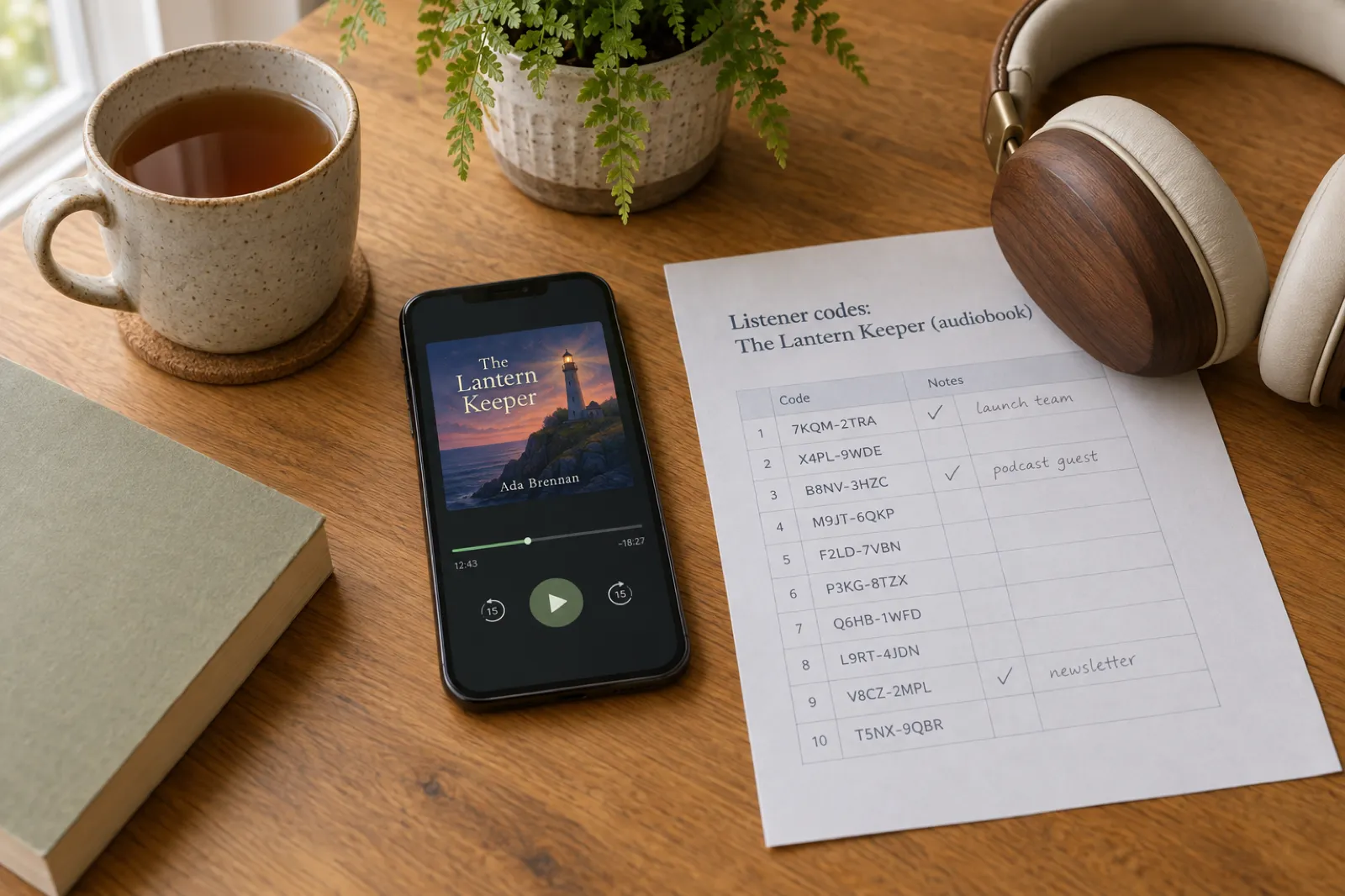
Spotify for Authors now lets you generate up to 1,000 free redemption codes per audiobook, up from 100. Listeners in 22 countries redeem them at authors-direct.com/spotify, with or without Premium. Codes earn no royalties. Here is how to generate them, how listeners redeem them, smart ways to use them, the review rules to respect, and how Spotify compares with ACX and Google Play promo codes.
 Publishing
ISBN Canada's AI Rule (2026): The Human-Author Declaration Explained
ISBN Canada now asks every registrant to declare their book was written by a human author, allows AI only for limited support tasks, and limits ISBNs for works primarily generated by AI. What changed on 9 October 2026, who it affects, what counts as a support task, what to do if your book is AI-assisted or mostly AI-generated, how it fits with KDP's AI question, and a checker for which ISBN route fits your book.

Get ebook tips in your inbox
Join creators getting weekly strategies for writing, marketing, and selling ebooks. You also get our free PDF guide, Your First Book in a Weekend.