

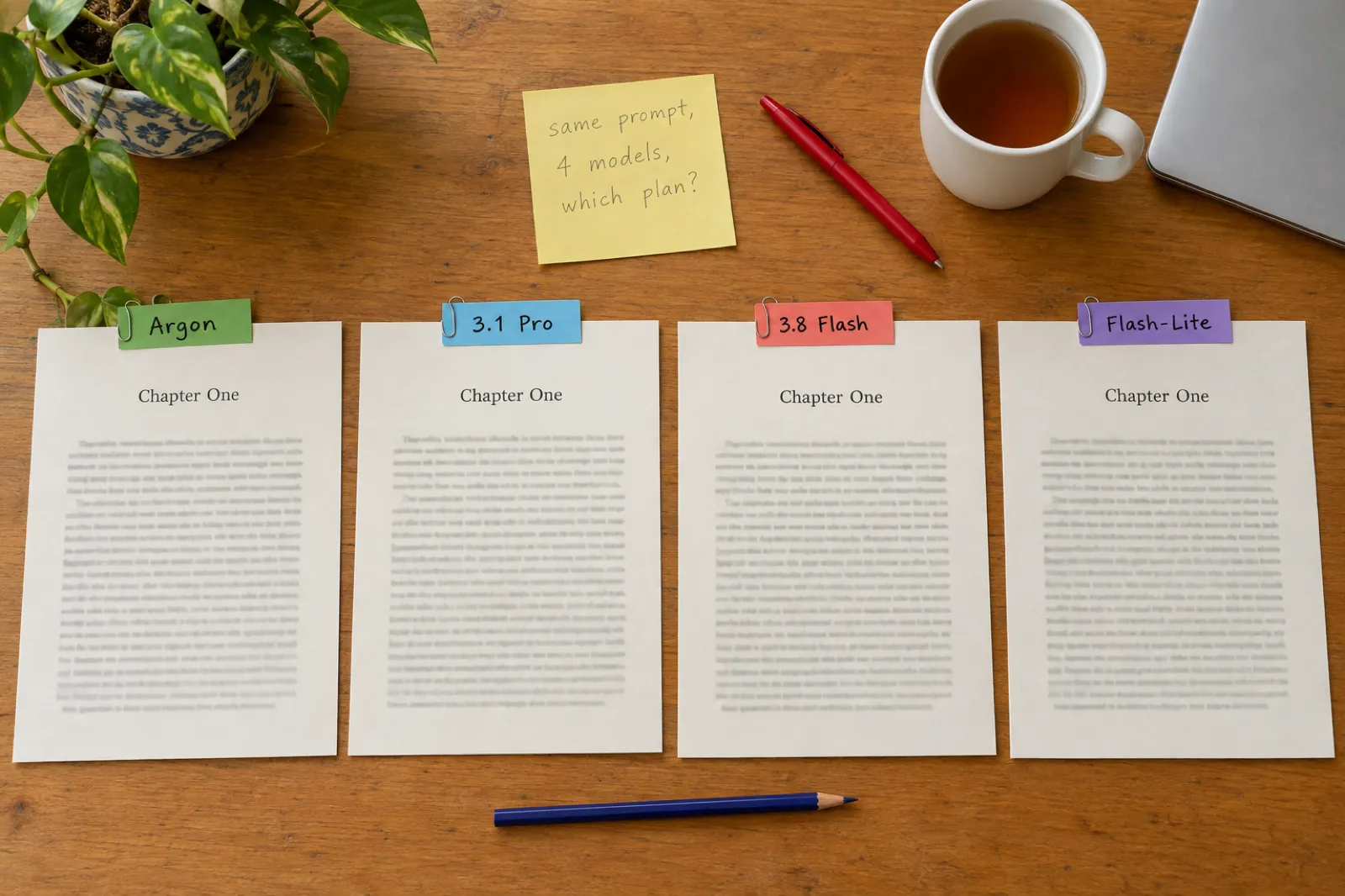
Quick Answer (October 2026)
Gemini 4 Argon is the best Gemini model for most writing. Google says it has "stronger writing capabilities" and "follows style instructions better than any of our previous Gemini models." It needs Google AI Pro ($19.99 a month) or Ultra. The free plan gives you Google's Flash-Lite model in a 32K-token window, enough for a chapter at a time. To write a whole book, Inkfluence AI handles the outline, chapters, story bible, cover and KDP files.
Google released Gemini 3.8 Flash on 2 September 2026 and Gemini 4 Argon on 13 October 2026, so most "best Gemini model for writing" advice online now names models that have been replaced. This guide sticks to what Google itself publishes about each current model: which Google AI plan includes it, how much text it holds on each plan, what it costs on the API, how long one reply can be, and what Google says it is for.
Google makes no claim about fiction or storytelling for any current Gemini model; its only writing claims are for Argon, quoted below as published. We have not run our own prose tests, so there is no fiction leaderboard here, only the facts that decide which model fits your plan, budget and book length.
Gemini for writers at a glance (checked 31 Oct 2026)
4
models that matter for writing: Argon, 3.1 Pro, 3.8 Flash and Flash-Lite
1,048,576
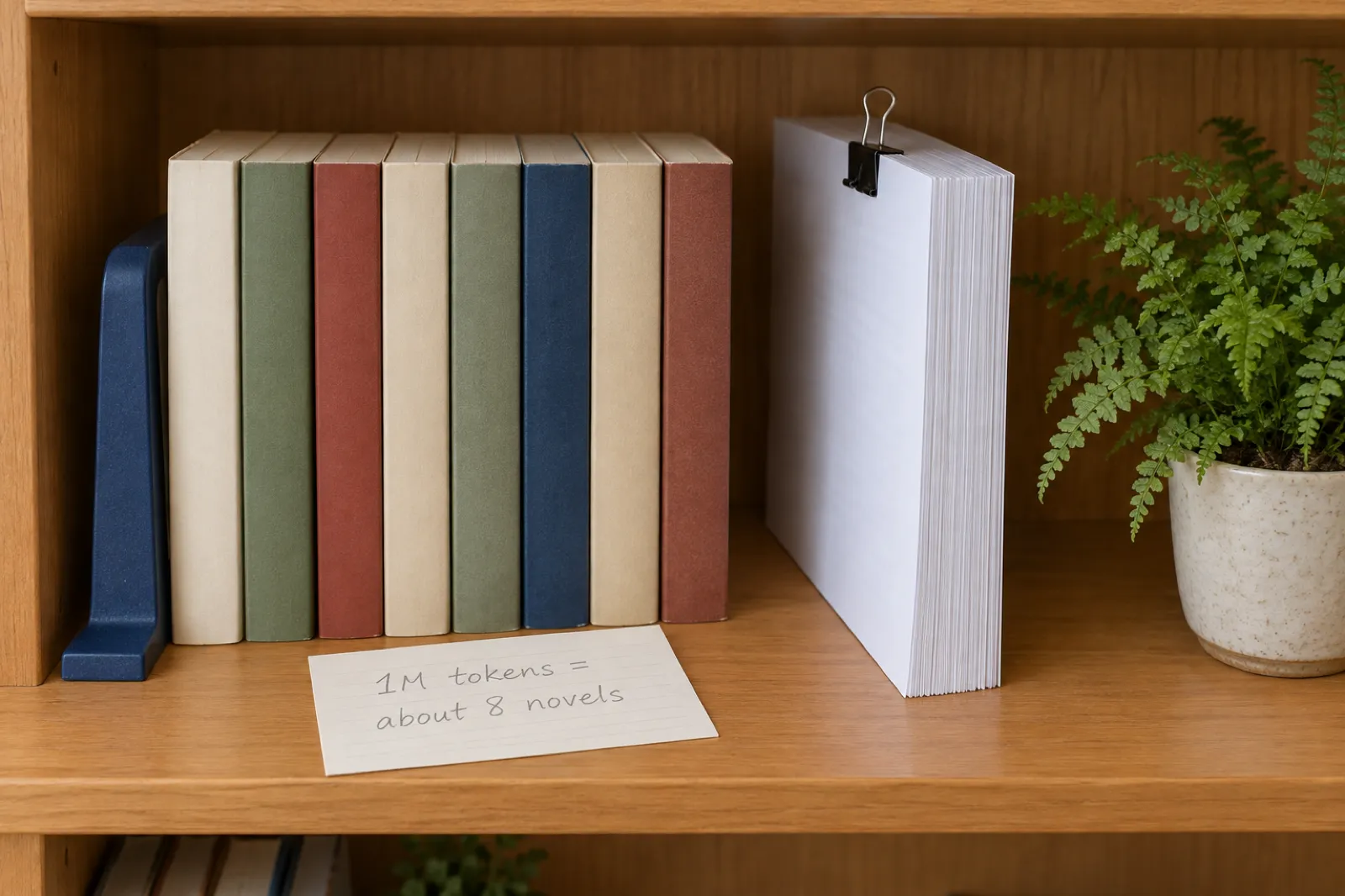
tokens of API context on all four; Google puts 1M at about 8 novels
32K / 128K / 1M
app context on no plan, AI Plus, and AI Pro or Ultra
10 to 12 pages
a usual Gemini Storybook, under KDP's 24-page paperback minimum
What changed in 2026 (dated)
- 2 Sep: Gemini 3.8 Flash launched, $0.75 / $3.75 per million tokens until 31 December, then $1.50 / $7.50.
- 13 Oct: Gemini 4 Argon arrived in the Gemini app for AI Pro and Ultra subscribers, and on the API at an introductory $2 / $10.
- 1 Dec: Argon's API price doubles to $4 / $20.
- Gemini 3 and later: temperature, top_p and top_k are ignored, so style comes from your prompt, not a dial.
- Gemini 2.5: not deprecated, but now limited to people who used it before. Gemini 3 Pro Preview shut down on 9 March, replaced by 3.1 Pro.
Which Gemini model for which writing job (October 2026)
Start here if you only need the answer for one kind of writing. The "why" column only uses what Google publishes; plans are from Google's US plans page on 31 October 2026.
| Writing job | Best pick | Why | Plan needed |
|---|---|---|---|
| A whole book, fiction or non-fiction, ready to publish | Inkfluence AI | Outline, chapters in order, a story bible that updates, an editor, a cover, then PDF, EPUB, DOCX and KDP files | Free to start (5 chapters a month) |
| A children's picture book to print or sell | Inkfluence AI picture books | Same character on every page, 8.5 x 8.5 inch KDP file with bleed, padded to Amazon's 24-page minimum | Free plan: 1 credit a page |
| Chapters, reports and long articles in a chat | Gemini 4 Argon | The only current model with Google writing claims | AI Pro $19.99/mo or Ultra |
| Novels and short fiction in a chat | Argon on Pro; Flash on Plus | No fiction claim for any model; Argon's style-following claim is the closest | Pro for Argon; Plus $4.99 for Flash |
| Reading back or editing a full manuscript | Argon or 3.1 Pro | AI Pro is the cheapest plan with a 1M window in the app; Plus stops at 128K | AI Pro or Ultra |
| Blog posts, newsletters, articles | The Flash model | Fast, and on the $4.99 plan with a 128K window | AI Plus or higher |
| Emails, captions and short copy | Flash-Lite | Google lists 3.5 Flash-Lite for "high-throughput drafts and light tasks" | Free |
| A bedtime story to read tonight | Gemini Storybook | Illustrated, read aloud, shared by link, in 1 to 2 minutes | Any Gemini user over 18 |
The model matters less than your plan and the length of the job. Free means Flash-Lite in a 32K window, Plus means Flash in 128K, and AI Pro brings Argon and the full 1M. For a whole book, the hard part becomes keeping 30 chapters consistent and turning them into files a store accepts.
The current Gemini lineup for writers (October 2026)
These are the general text models on Google's Gemini API models page, with Gemini app access from the plans page and release notes, all checked on 31 October 2026.
| Model | In the Gemini app | API price (input / output per million tokens) | Google's description |
|---|---|---|---|
| Gemini 4 Argon 13 Oct 2026. 1,048,576 tokens shared by input, thinking and output; 65,536-token reply by default, up to 1M with long decode |
AI Pro, Ultra | $2 / $10 to 30 Nov; $4 / $20 from 1 Dec. No free tier | "Our flagship reasoning model" |
| Gemini 3.1 Pro Preview on the API. 1,048,576 in, 65,536 out |
AI Pro, Ultra ("our Pro model") | $2 / $12 for prompts to 200K; $4 / $18 above. No free tier | For "software engineering and agentic workflows" |
| Gemini 3.8 Flash 2 Sep 2026. 1,048,576 in, 65,536 out |
AI Pro, Ultra (Plus lists "our Flash model") | $0.75 / $3.75 to 31 Dec; $1.50 / $7.50 from 1 Jan 2027 | For "long-horizon software engineering, autonomous agents, and complex enterprise workflows" |
| Gemini 3.5 Flash-Lite Jul 2026. 1,048,576 in, 65,536 out |
Free ("our Flash-Lite model") | $0.30 / $2.50 | "Low-latency, cost-effective" |
Notes: the plans page names "our Flash-Lite model", "our Flash model" and "our Pro model" without version numbers; its FAQ names 3.1 Pro, and Google's 3.8 Flash post says it is "available to Google AI Pro and Ultra subscribers across the Gemini app." Google states no knowledge cutoff on these model pages.
If you want GPT and Claude in the same view, see our guide to the best AI models for novel writing, and for Anthropic's lineup, which Claude model is best for writing. This page stays on Gemini.
Best Gemini model for creative writing and fiction
Here is everything Google says about how the current models write, from its launch posts and documentation:
- Gemini 4 Argon: "stronger writing capabilities" across legal, finance, science and coding work; it "follows style instructions better than any of our previous Gemini models"; and it answers "questions more directly with less hedging." The launch post adds that it repeats itself less and avoids clichés.
- Gemini 3.8 Flash: no writing claim. The launch post is about reasoning, coding and agents.
- Gemini 3.1 Pro: no writing claim; its page mentions better "factual consistency".
- Gemini 3.5 Flash-Lite: "Stronger multi-turn instruction following and persona consistency over Gemini 3.1 Flash-Lite."
That is the whole list. None of it mentions fiction, dialogue, character voice or pacing. So the honest answer to "which Gemini model is best for creative writing" is that Google does not say, and any confident ranking you read elsewhere is that site's opinion or its own test. What the facts do support:
- Start with Argon on AI Pro or Ultra. "Follows style instructions better" is the claim that matters most for fiction: give it a page of your prose and a point of view, and it is the model Google says will stick to them.
- Use Flash for fast drafting. For brainstorming scenes or trying three openings, speed is worth a lot, and Flash is on the $4.99 Plus plan.
- On the free plan, the window is the limit, not the model. Flash-Lite keeps a character voice well enough in a chat; 32K tokens is what stops a free novel.
- Judge with your own pages. Give two models the same scene brief and style sample and read both. Our guide on how to evaluate AI fiction quality lists what to look for.
Romance, fantasy, fanfiction and other genre fiction
No Gemini model is tuned for any genre; you get the meet-cute, the magic system or the canon details by putting them in the prompt or the outline. Dedicated tools do this for you: see the AI romance novel writer, the AI fantasy novel writer and the AI fanfiction writer, or our ranking of the best AI story generators.
Writing a novel, not a scene?
Inkfluence AI plans the plot, writes the chapters in order and keeps a story bible of who knows what. Free to start.
Plan my novel freeBest Gemini model for writing a book
For book-length work the question is not only which model writes the best paragraph. It is whether the model can see the whole book while it writes, how much it writes in one reply, and how much of the book your plan keeps in view.
How long are real books written with AI?
In a sample of 1,200 books finished on Inkfluence AI in the 30 days to 9 October 2026 (picture and colouring books excluded), the median book was 9,232 words, one in ten passed 24,000 words, one in a hundred passed 82,000, and the longest ran to 114,790. More in our AI book writing statistics.
What fits in Gemini's context window
Google says "100 tokens is equal to about 60-80 English words", or 1.25 to 1.67 tokens a word. The table uses the middle, about 1.4 tokens a word. Google's long-context guide puts it more simply: 1 million tokens is about "8 average length English novels."
| Book | Tokens (about 1.4 per word) | Free app (32K) | AI Plus (128K) | AI Pro, Ultra, API (1M) |
|---|---|---|---|---|
| Typical AI-written book (our median) 9,232 words |
~13,200 | 41% | 10% | 1.3% |
| Longer guide or novella (our top 10%) 24,137 words |
~34,500 | Does not fit | 27% | 3.3% |
| Short commercial novel 50,000 words |
~71,400 | Does not fit | 56% | 6.8% |
| Long novel (our top 1%) 82,518 words |
~117,900 | Does not fit | 92% | 11% |
| Longest in our sample 114,790 words |
~164,000 | Does not fit | Does not fit | 16% |
| Epic fantasy 200,000 words |
~285,700 | Does not fit | Does not fit | 27% |
Tokens needed to hold the whole book
About 1.4 tokens per word. Dashed lines mark the free app's 32K window and AI Plus at 128K. All of these fit in 1M.
Source: Inkfluence AI sample of 1,200 finished books, 30 days to 9 Oct 2026; token conversion and app windows from Google's pages, checked 31 Oct 2026.
So on AI Pro, Ultra or the API, every current Gemini model holds even the longest book in our sample with most of the window to spare. AI Plus holds a short novel, but a long one fills almost all of its 128K before you type a word, and at the top of Google's range (1.67 tokens a word) an 82,000-word novel does not fit at all. The free window holds our median book and little else: a chapter or two plus notes per chat.
Holding a book is not the same as writing one
- One reply tops out at 65,536 tokens by default, about 46,000 words, and thinking counts against it: "the response stops once thinking and output together reach it." Argon's long decode goes "up to 1M tokens minus your input", but "hard prompts can take several minutes." In practice you still write a chapter at a time.
- Usage limits run out before tokens do. In the app, "Your limit refreshes every 5 hours until you reach your weekly limit," and limits are "compute-based".
- Holding the book is not finding everything in it. Google's long-context guide says that with several look-ups at once, "the model does not perform with the same accuracy." A continuity check across 30 chapters asks for exactly that.
A workable way to write a book in the Gemini app
- Write the outline first, a paragraph per chapter. Our free book outline generator gives you a starting structure.
- Put the outline, a character list and a style sample in a Gem (saved instructions, on the free plan), so every chat starts with them.
- Keep a running facts list, a simple story bible, and update it after every chapter.
- Write one chapter per chat from the outline entry, the facts list and the last page of the previous chapter. Revise in Canvas.
- Every few chapters, on AI Pro, paste the draft and check it against the facts list, one question at a time. Our guide to AI continuity checking covers what to ask.
It works. It is also a lot of copying and pasting, the facts list is only as good as your memory, and at the end you have a pile of chats, not a book file. On the free plan, with 32K tokens and limits Google does not quantify, a novel means many chats over many days. For a free route built for whole books, see how to write fiction with AI for free and the free AI novel writer.
Why a whole book needs more than a chat model
A chat window is the right place to think out loud and rework a passage. It is a weak place to manage a 30-chapter manuscript, because you become the project manager. Four things separate a pile of good chapters from a book you can publish:
Continuity
Who knows what, where everyone is, what already happened, kept up to date after every chapter.
Structure
An outline you approve first, so each chapter has its own job and the plot builds.
Export
PDF, EPUB and DOCX with contents, chapter titles and the right page size.
Cover and KDP files
A cover and an interior Amazon accepts first time, with or without bleed.
For writing a whole book, Inkfluence AI is the best pick, because it is built for exactly that job:
- Outline first. You describe the book, it plans the chapters, and you review and edit the outline before any chapter is written.
- Chapters with continuity. Fiction chapters are written in order with the earlier chapters in mind. See how outlining and writing in sequence works.
- A story bible that keeps up. Characters, places and events are tracked as the book grows, and you can edit them in the editor.
- Editing in the same place. A full chapter editor plus an AI editing assistant for book chat, edits and editorial reviews.
- Publish without reformatting. PDF on every plan; EPUB, DOCX and the KDP package with any paid plan or credit pack. Covers from the AI book cover generator, plus series, translation and audiobooks in the same app, including the AI book series writer.
Plain limits: the free plan gives you 5 chapters a month and PDF export with a small Inkfluence credit. Creator is $9.99 a month or $89 a year (35 chapters, 15 audiobook chapters a month); Premium is $19.99 a month or $179 a year (unlimited chapters, 30 audiobook chapters). Credit packs: 15 for $9.99, 25 for $12.99, 50 for $24.99. You set length by the number of chapters, not a word dial. Details are on the pricing page, and Inkfluence AI vs ChatGPT sets a book tool and a chat app side by side.

Write the whole book, not just the next reply
Outline, chapters in order, a story bible that keeps up, a cover and a finished file at the end. Free to start, no credit card.
Start your book freeArgon vs 3.1 Pro vs Flash for writing
| Gemini 4 Argon | Gemini 3.1 Pro | Gemini 3.8 Flash | |
|---|---|---|---|
| Writing claim from Google | "stronger writing capabilities"; better at style instructions | None | None |
| API price per million tokens | $2 / $10 to 30 Nov; $4 / $20 after | $2 / $12 (prompts to 200K) | $0.75 / $3.75 to 31 Dec; $1.50 / $7.50 after |
| API status | Stable | Preview | Stable |
| Longest reply | 65,536 by default; up to 1M with long decode | 65,536 | 65,536 |
| Best writing use | Chapters you keep, style-matched prose, long reports | Reading back a manuscript, fact-heavy drafts | Fast drafts, articles, many variations |
On the API, Argon is cheaper per output token than 3.1 Pro until 30 November ($10 against $12); from 1 December it doubles and becomes the dearest of the three. In the app the difference shows up as how fast you reach your limit, since limits depend on "the models and features used." Use Flash for anything short or anything you will rewrite anyway. Switch to Argon for a chapter you intend to keep or a rewrite to match a style sample; on the API its low thinking level "also works for analysis and writing tasks that need light thinking."
Gemini Storybook for children's stories
Gemini Storybook is a Gem in the Gemini app that turns a prompt, or your own photos, into an illustrated story. Google's Storybook page and help article say:
- Length: "Storybooks generated in Gemini Apps are usually 10-12 pages."
- Pictures and voice: every page is illustrated, you can ask for another style ("Change the illustration style to watercolor"), and Listen reads it aloud; narration "is currently limited to certain languages."
- Languages and access: "stories in 45+ languages", for "all Gemini users over the age of 18."
- Editing: "you can't edit text directly on the page." You ask for changes, and a regenerated story comes with "all new images."
- Getting it out: a public share link, or print from the browser, where you can choose "Save as PDF".
For a bedtime story tonight, that is a lovely tool. The question for self-publishers is what it can do for a book you want to sell.
What Storybook cannot do for a sellable book
Too short for a paperback
KDP's paperback minimum is 24 pages for premium colour; a storybook is 10 to 12.
No print sizing or bleed
Google mentions no trim size, bleed or EPUB. KDP trims 0.125 inch (3.2 mm) off three edges, so edge-to-edge art must be built for it.
Hard to fix one page
Text cannot be edited on the page, and regenerating brings all new images.
Silent on selling
The Storybook page states no commercial-use terms. KDP asks you to disclose AI-generated text and images.
Gemini Storybook vs an Inkfluence AI picture book
| Inkfluence AI picture book | Gemini Storybook | |
|---|---|---|
| Pages | About 14 spreads by default, set with Page count | Usually 10 to 12 |
| Same character on every page | Yes: every page is drawn from one character sheet | Not stated by Google |
| Fix one page | Edit the words; redraw one picture from the same sheet; or swap in your own art | Regenerate the story, with all new images |
| Art styles | Eight: Storybook, Watercolour, Coloured pencil, Crayon, Ink and wash, Vintage, Comic, Felt and clay | Ask in the chat |
| Print file | 8.5 x 8.5 inch KDP paperback PDF with bleed, padded to 24 pages, with a READ ME FIRST for KDP's settings | Browser print or Save as PDF |
| Cover | Matching cover, editable in the cover designer | Title page in the storybook |
| Cost | Free plan: 1 credit a page, cover included (a 14-page book is 14 credits). Creator: 20 illustrations a month; Premium: 50 | Included for Gemini users over 18 |
Use each for what it is for. Storybook makes tonight's story. When the story is worth keeping, giving as a printed gift or selling, Inkfluence AI's picture book maker builds the version a printer accepts, and turn your illustrations into a picture book places art you already have as full pages. For the print rules, see KDP picture book bleed sizes, keeping characters consistent, self-publishing a children's book on Amazon and the best AI children's book creators.
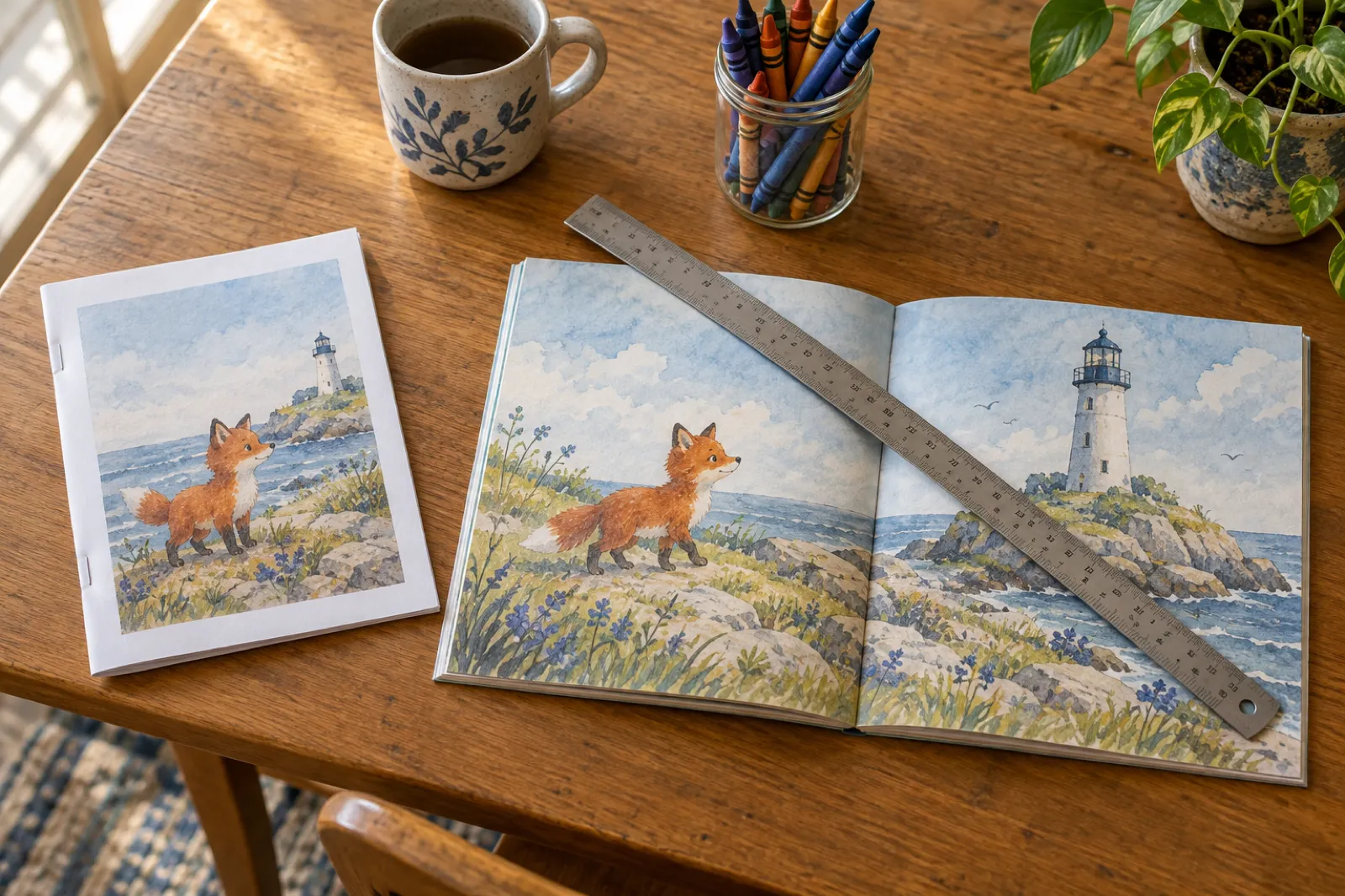
Turn tonight's story into a book you can hold
Describe the story and the hero's look, pick an art style, and get every page painted with the same character, then a KDP-ready 8.5 x 8.5 inch file.
Make a picture bookBest Gemini model for non-fiction, essays and editing a manuscript
For non-fiction chapters, essays and reports, use Argon for the version you keep and Flash for outlines and rough drafts. The fields Google names for Argon's writing, legal, finance and science, are argument-led, source-heavy work, and "less hedging" is the style non-fiction readers want.
- Sources. Google states no knowledge cutoff on the model pages. Deep Research (on the free plan) and Argon's search grounding find sources; open and check every one yourself.
- Free API data use. Google's pricing page marks the free tier "Used to improve our products: Yes" and the paid tier "No". For an unpublished manuscript, that matters.
Editing a whole manuscript. AI Pro's 1M window holds a long novel with room to spare for a structural read or a list of loose threads; on Plus a long novel barely fits, and on the free plan you edit chapter by chapter. Ask one question per message. AI Pro also adds Gemini in Docs. For dedicated tools, see the best AI for editing a book; for non-fiction books, where each chapter needs its own job and examples, see the best AI for writing non-fiction and the AI chapter generator.
Best Gemini model for everyday writing: emails, posts and copy
For emails, social posts and newsletter sections, the free plan's Flash-Lite is enough for most people. Move to Flash for longer articles, and to Argon for the email that really matters: a pitch, a cover letter. On the API, here is a worked example for 1,000 pieces of about 150 words (about 214,000 output tokens) with a 300-token prompt each (300,000 input), at list prices before thinking tokens:
| Model | Input cost | Output cost | 1,000 pieces, floor |
|---|---|---|---|
| Gemini 3.5 Flash-Lite | $0.09 | $0.54 | ~$0.63 |
| Gemini 3.8 Flash (to 31 Dec) | $0.23 | $0.80 | ~$1.03 |
| Gemini 4 Argon (to 30 Nov) | $0.60 | $2.14 | ~$2.74 |
| Gemini 3.1 Pro | $0.60 | $2.57 | ~$3.17 |
Google labels every output price "including thinking tokens", so real runs cost more than these floors. The Batch API halves every price for work that can wait, and Flash and Flash-Lite have a free API tier for testing.
Need the book around the copy?
If the short pieces are for a book (a blurb, chapter summaries, a store description), Inkfluence AI writes the book and keeps everything in one project, ready to export.
Try Inkfluence AI freeWhat it costs: Google AI plans vs the API
Google AI plans in the US (checked 31 October 2026)
| Free | AI Plus | AI Pro | AI Ultra | |
|---|---|---|---|---|
| Price | $0 | $4.99/month | $19.99/month | From $99.99/month ($199.99 higher tier) |
| Models (Google's wording) | "our Flash-Lite model" | "our Flash model" | Gemini 4 Argon, Pro and Flash | "Highest access" to all three |
| Context in the app | 32K tokens | 128K tokens | 1M tokens | 1M tokens |
| Usage limits | Standard | 2x standard | 4x standard | 5x or 20x AI Pro |
| Also for writers | Gems, Canvas, Deep Research, Storybook | Gemini Notebook, more Audio Overviews | Gemini in Gmail and Docs | More usage |
When a subscriber hits a limit, Google says you can "continue your conversation with Flash-Lite." There is no published per-reply length for the app; 65,536 tokens is the API default.
API cost of drafting an 80,000-word novel
Assumptions, so you can redo the sums: 80,000 words at 1.4 tokens a word is about 114,000 output tokens; 30 chapters with a 12,000-token prompt each (outline, notes, end of the previous chapter) is 360,000 input tokens. No thinking tokens, no rewrites, list prices.
| Model | Output (114K tokens) | Input (360K tokens) | Floor per draft |
|---|---|---|---|
| Gemini 4 Argon (from 1 Dec) | $2.28 | $1.44 | ~$3.72 |
| Gemini 3.1 Pro | $1.37 | $0.72 | ~$2.09 |
| Gemini 4 Argon (to 30 Nov) | $1.14 | $0.72 | ~$1.86 |
| Gemini 3.8 Flash (from 1 Jan 2027) | $0.86 | $0.54 | ~$1.40 |
| Gemini 3.8 Flash (to 31 Dec) | $0.43 | $0.27 | ~$0.70 |
| Gemini 3.5 Flash-Lite | $0.29 | $0.11 | ~$0.39 |
Cost floor for one 80,000-word draft (API list prices)
Treat these as floors. Thinking tokens are billed as output, most authors regenerate chapters, and pasting the whole manuscript into each request multiplies the input bill: a 160,000-token draft sent with each of 30 chapter requests to Argon adds 4.8 million input tokens, about $9.60 at the launch price and $19.20 from December (Argon does not support explicit context caching). Our AI cost calculator runs the numbers for your book, and the real cost of bring-your-own-key vs all-included tools compares API billing with a flat plan.
Prompts that make any Gemini model write better
On Gemini 3 and later, "temperature, top_p, and top_k are deprecated and ignored," so "turning the temperature up" for livelier prose no longer works. Google's prompting guide is where the levers are now:
- Always show examples. "We recommend to always include few-shot examples in your prompts." Paste a page of your own writing and ask Gemini to match its rhythm, not its content.
- Material first, question last. "Supply all the context first" and "place your specific instructions or questions at the very end of the prompt": outline, facts list and the end of the previous chapter, then the instruction.
- Set the voice once. Put the persona in the system instruction "or at the very beginning of the user prompt." In the app, a Gem does this.
- Ask for the length you want. "If you need a more conversational or detailed response, you must explicitly request it." Scenes stay short unless you say how long.
- Be precise and direct. "State your goal clearly and concisely": "close third person, past tense, short paragraphs" beats a list of banned habits.
SynthID: Gemini's text watermark
Google DeepMind's SynthID page says: "We've expanded SynthID to watermarking and identifying text generated by the Gemini app and web experience." The mark is "not noticeable to the human eye, and doesn't affect the quality of the output." The page does not say the API is watermarked, how well the text mark survives editing, or that its public SynthID Detector checks text.
In practice, assume text drafted in the Gemini app can be identified as AI-assisted. KDP already requires you to disclose AI-generated content, which it defines as text, images or translations "created by an AI-based tool", "even if you applied substantial edits afterwards." Our guide to the KDP AI disclosure policy explains what counts, and see whether AI-written books can be copyrighted.
Putting it together
On the free plan, write with Flash-Lite a chapter at a time and use Storybook for bedtime stories. On AI Plus, Flash and a 128K window cover articles and short books. On AI Pro, make Argon your default for writing you keep. For a whole book, the bottleneck is no longer the model's memory; it is keeping the outline, the facts and 30 chapters in step, then turning them into a cover and files a store accepts. Our round-ups of the best AI for writing novels, the best AI book writing software and the best AI novel writer cover the dedicated tools.
Ready to write the book?
Describe your idea, review the outline, and get chapters in order with a story bible that keeps track, then a cover and KDP files. Start free with 5 chapters a month.
Write your book with Inkfluence AIFrequently asked questions
What is the best Gemini model for writing?
As of October 2026, Gemini 4 Argon. It is the only current model Google describes with writing claims: stronger writing capabilities and following style instructions better than any previous Gemini model. It needs Google AI Pro ($19.99 a month) or Ultra. On the free plan you get Google's Flash-Lite model.
Which Gemini model is best for creative writing and fiction?
Google makes no fiction claim for any current model. Argon's claims (better at style instructions, less repetition, fewer clichés) make it the sensible start on AI Pro, with Flash on AI Plus. Test with your own scene brief and style sample before committing a whole novel.
Is Gemini 4 Argon or 3.1 Pro better for writing?
Argon. Google gives it writing claims and gives 3.1 Pro none, Argon is stable on the API while 3.1 Pro is still Preview, and until 30 November Argon costs less per output token ($10 against $12 per million). Both are on AI Pro and Ultra.
Which Gemini model is best for writing a book?
Argon on AI Pro: the 1M-token window holds even a 115,000-word novel. But one reply is 65,536 tokens by default including thinking, and app limits reset every five hours up to a weekly cap, so books are written chapter by chapter. For a whole book with outline, continuity, cover and export handled for you, Inkfluence AI's novel writer is the better fit.
Can I use Gemini 4 Argon for free?
Not in the Gemini app: Google's 13 October release notes say Argon is for AI Pro and Ultra subscribers, and AI Pro is $19.99 a month in the US. On the API it has no free tier and costs $2 / $10 per million tokens until 30 November 2026, then $4 / $20.
How much can the free Gemini app hold?
Google gives 32K tokens without a plan, 128K on AI Plus and 1 million on AI Pro and Ultra. At 60 to 80 words per 100 tokens, 32K is roughly 19,000 to 26,000 words: a short guide, or a chapter or two of a novel plus your notes.
Can Gemini Storybook make a book I can sell on Amazon?
Not on its own. A storybook is usually 10 to 12 pages, under KDP's 24-page paperback minimum, Google mentions no trim size, bleed or EPUB, and its Storybook page states no commercial-use terms. For a print-ready book, Inkfluence AI's picture book maker exports an 8.5 x 8.5 inch KDP file with bleed.
Can Gemini write a whole book?
Yes, in pieces. A novel fits in the 1M window on AI Pro, Ultra and the API, but replies are capped at 65,536 tokens by default, the app has rolling limits, and Google notes that several look-ups at once are less accurate. One chapter per chat with an outline and a facts list works; a dedicated AI book writer automates those steps and exports the files.
Is Gemini better than Claude or ChatGPT for writing?
Google, Anthropic and OpenAI publish no writing comparison with each other, so there is no official answer. For books, the bigger difference is workflow. See the best Claude model for writing and the best AI models for novel writing.
Does Gemini watermark the text it writes?
Yes, in the Gemini app: Google DeepMind says SynthID watermarks text generated by the Gemini app and web experience, without affecting quality. Google does not say the API is watermarked. Either way, KDP requires you to disclose AI-generated text.
Sources
All external facts come from Google's and Amazon's own pages, checked on 31 October 2026.
- Gemini models
- Gemini 4 Argon model page and what's new in Gemini 4 Argon
- Gemini 3.8 Flash, Gemini 3.1 Pro Preview and Gemini 3.5 Flash-Lite model pages
- What's new in Gemini 3.6 Flash and 3.5 Flash-Lite
- Gemini API pricing and deprecations
- Tokens, long context and prompt design strategies
- Introducing Gemini 4 Argon (13 Oct 2026) and Introducing Gemini 3.8 Flash (2 Sep 2026)
- Google AI plans (US), Gemini Apps limits and release notes
- Gemini Storybook overview and storybook help
- SynthID
- KDP print options, trim size, bleed and margins and content guidelines (AI disclosure)
- Book-length figures: Inkfluence AI, 1,200 books finished in the 30 days to 9 Oct 2026, excluding picture and colouring books.
Related reading
Best AI Models for Novel Writing
GPT, Claude and Gemini side by side
Best Claude Model for Writing
Opus, Sonnet, Haiku and Fable
Best GPT Model for Writing
Terra, Sol, Astra and Luna
Inkfluence AI vs Claude
A book tool next to a chat model
AI Storybook Generator
Illustrated stories you can print
Best AI Story Generators
Short stories to novels, ranked
Best AI Ebook Generators
Tools that finish the file
Best AI Tools for Long Novels
Continuity past chapter 20
AI Novel Writer
Outline to finished novel
How to Format a Book for KDP
Trim, margins, bleed and EPUB
AI Book Translator
Your book in another language
AI Audiobook Generator
Narrate the finished book
How to Write a Book
The whole process, step by step

Founder, Inkfluence AI
Sam is the founder of Inkfluence AI. He built the platform to make book creation accessible to everyone - from first-time authors to seasoned publishers.
Helpful links

Ready to write your own book?
Write with AI, make it yours, and export PDF, EPUB and KDP-ready files from one project.
Keep reading
 AI Writing
Which GPT Model Is Best for Writing? GPT-6.1 Terra, GPT-6.1 Sol, GPT-6 Astra and Luna Compared (October 2026)
Which GPT model should you write with in October 2026? GPT-6.1 Terra, GPT-6.1 Sol, GPT-6 Astra and GPT-6 Luna compared on what OpenAI actually publishes: which ChatGPT plan includes each one, API prices, context and reply limits, and what each is built for. Plus the maths of fitting a whole book, and what a book needs beyond a chat model.
 AI Writing
NaNoWriMo Alternatives 2026: Every November Writing Challenge, and Which Ones Allow AI
NaNoWriMo closed in 2025, but November is still novel month. Here is every 2026 challenge that replaced it, with dates, goals, prizes, age limits and the one thing other lists leave out: what each challenge says about AI. Plus a word-count planner, a Preptober plan for the last few days of October, and two honest 30-day plans: one for the challenge, one for an AI-assisted November that ends with a published book.
 AI Writing
Prix Pascal: The New Literary Prize for Novels Written with AI, and How to Enter by 30 November 2026
France's new Prix Pascal is a literary prize that asks entrants to say how they used AI instead of hiding it. The rules in plain English, what 300,000 characters means in words and chapters, the technical file, and a five-week plan to submit a French novel on time.

Get ebook tips in your inbox
Join creators getting weekly strategies for writing, marketing, and selling ebooks.