
AI Fantasy Novel Writer
A World That Stays Consistent to the Last Page
Write a complete fantasy novel with AI. Your magic rules, names and map live in a story bible, and every chapter is drafted against it. Free plan available.
Chapter outline - Story bible - Sequential drafting - Built-in editor - EPUB, PDF and DOCX - AI cover and audiobook
Updated September 2026
Quick Answer
Inkfluence AI is an AI fantasy novel writer that turns a premise into a chapter outline and a story bible, then drafts each chapter with the story bible, the last three chapters in full and a running record of the rest as context. The magic rules, names, places and open plot threads you write down stay in force for the whole book. Finished novels export to PDF, EPUB and DOCX, with an AI cover, an audiobook and a store listing from the same project. Fantasy is the largest fiction genre on the platform: 10,428 fantasy books were started in the 180 days to 12 September 2026. The free plan needs no credit card.

Direct answers about AI fantasy writing
The four questions fantasy authors ask before handing a world to an AI.
Does Inkfluence AI keep a magic system consistent for the whole novel?
Yes. The rules you write into the story bible are in front of the AI for every chapter, together with the last three chapters in full and a running record of everything before them. A cost you set in chapter two is still charged in chapter twenty. Rules that are not written down are not enforced, so put them in the bible.
Can Inkfluence AI build the world from a short premise?
It can propose one. From a one-paragraph premise the outline names places, factions and the shape of the magic, and writes them into the story bible for you to edit before drafting. Authors who bring their own worldbuilding notes get a draft that uses them. Authors who bring a sentence get a draft that fills the gaps, and they should read the bible before chapter one.
How long is a typical fantasy book written on Inkfluence AI?
Most fantasy projects on the platform start as a five-chapter opening on the free plan and grow from there. One project holds up to 40 chapters at roughly 1,000 to 1,500 words each, which covers a novella through a full epic fantasy volume.
Can I write a fantasy series with Inkfluence AI?
Yes. Each book is a project, and the book series writer carries the story bible into the next book, so names, places and rules do not drift between volumes. The story bible generator is where series authors do most of their work.
Fantasy Is the Biggest Fiction Genre on Inkfluence AI
Counted from the books started on the platform in the 180 days to 12 September 2026, classified by the words in each author's own premise and title.
10,428
fantasy books started in 180 days, 32% of all fiction on the platform
7,599
authors wrote them, most with a single project
36%
of those books were exported as a PDF, EPUB or DOCX
5
chapters is the median first project, the free allowance, before authors extend
Which fantasy gets written most
Sword-and-sorcery adventure leads, in roughly two fantasy premises out of five. Dark fantasy, urban fantasy and epic fantasy each appear in about three out of ten. Progression fantasy and LitRPG are in roughly a quarter, YA fantasy in just over a fifth. Cozy fantasy, portal fantasy and romantasy are the smallest named groups, each under a tenth. Premises often belong to more than one group, so the shares overlap.
What the numbers say about finishing
A median of 5 chapters means most fantasy authors start with the free opening and decide from there. Just over a third of fantasy books are exported, which is the step that turns a draft into a file a reader can open. 839 of the fantasy books were also fanfiction, most of them in existing fantasy worlds, which is why the fanfiction writer shares the same continuity machinery. About 94% of fantasy books are in English.
What the Story Bible Holds for a Fantasy Novel
Fantasy fails on continuity more than any other genre, because the world itself is invented and nothing outside the book can correct it. The story bible is the fix: a structured document the AI reads before every chapter, alongside the last three chapters in full and a running record of everything before them.
| Section | What it holds |
|---|---|
| Magic rules | What magic can do, what it costs, who can use it, what breaks it |
| Characters | Name, role, appearance, voice, wants, secrets, current status |
| Places | Cities, regions, distances, what each one is known for |
| Factions and history | Who rules, who rebels, the war that set the plot in motion |
| Open threads | Promises the plot has made and not yet paid off |
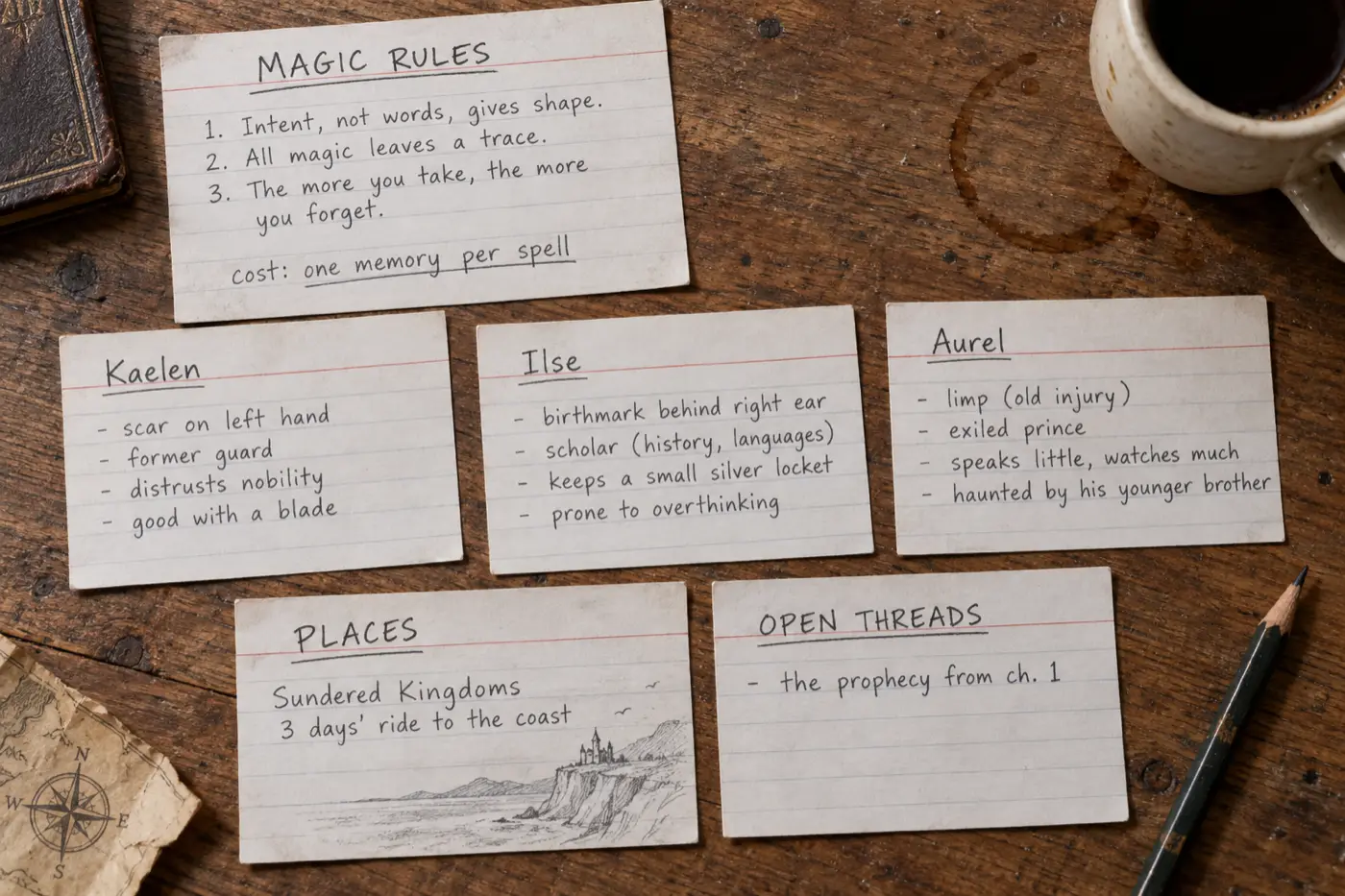
The outline step proposes the bible. Read it before you draft. If the outline has given your assassin two different eye colours or made the capital both coastal and landlocked, fix it there, once, and every chapter inherits the fix. The story bible generator and the character bible generator explain each section in detail.
Every Fantasy Sub-Genre
The sub-genre is set by your premise, not by your plan. All of these are available on the free tier.
Epic / High Fantasy
Kingdoms, prophecies, wars across a continent, multiple points of view
Dark Fantasy / Grimdark
Morally grey casts, real consequences, magic with a price
Urban Fantasy
Hidden magic in a modern city, secret societies, present-day stakes
Progression / LitRPG
Levels, systems, cultivation, a protagonist who grows in power
YA Fantasy
Academies, first magic, found family, a voice readers grow up with
Romantasy
Fae courts, enemies to lovers, a slow burn with a magic system behind it
Cozy Fantasy
Low stakes, warm settings, a tea shop with a dragon problem
Portal / Isekai
An ordinary person pulled into another world, learning its rules
Sword and Sorcery
One hero, one quest, a mercenary's morality, fast chapters
Mythology Retelling
Norse, Greek, Celtic or folklore roots retold with new eyes
Witches and Covens
Craft, lineage, small-town secrets, a hex that goes wrong
Dragon Fantasy
Riders, hoards, bonded pairs and the politics of fire
Romantasy premises are handled with the romance rules as well as the fantasy ones: the heat is written the way the romance novel writer describes, and the magic is held to the story bible.
How the AI Fantasy Novel Writer Works
Premise to a finished, exportable book in five steps. The second step is the one fantasy authors should not skip.
Write the premise with the rules in it
Sub-genre, the names of your leads, the shape of the magic and what it costs, the setting, the number of chapters and the tone. Two paragraphs is plenty. A premise that says "magic is fuelled by memory and every spell forgets something" produces a better book than one that says "a magical world".
Read the outline and the story bible
Inkfluence AI returns a chapter-by-chapter outline and the story bible for the world. Edit chapter titles, reorder beats, rename the city, tighten the magic rules. Anything you change here is what every chapter is written against.
Draft chapters in sequence
Fantasy is written one chapter after another, not all at once, because chapter twelve depends on what happened in eleven. Each chapter is drafted with the story bible, the last three chapters in full and a running record of the rest, so the wounded knight is still wounded and the treaty is still broken.
Edit in the built-in editor
Every chapter opens in a rich text editor with an AI assistant for rewrites, expansions and a review pass. Rename a character across the whole book in one find-and-replace. Cut the recap paragraph the AI likes to open with. Add the line only you would write.
Cover, export, audiobook, listing
Generate a cover from a prompt, export a KDP-ready EPUB or a print PDF, record an audiobook with a narrator voice, and publish a store listing, all from the same project. The KDP novel guide covers categories, keywords and series pricing for fantasy.
Build Your Fantasy Premise
Pick the pieces and the premise writes itself, with the magic rule and its cost stated the way the outline needs them. Edit anything, then send it straight to the dashboard.
Your premise
Edit anything. What is in this box is what the outline is built from.
Start with this premiseFree plan, no credit card. Five chapters to start.
Read Pages from AI-Written Fiction
Flip through real excerpts from novels drafted on Inkfluence AI
Loading preview...
Inkfluence AI vs NovelAI and Sudowrite for Fantasy
The honest split. NovelAI and Sudowrite are strong at what they do, and neither is trying to finish the book for you.
| What fantasy needs | Inkfluence AI | NovelAI | Sudowrite |
|---|---|---|---|
| World memory | Story bible, edited before drafting, read every chapter | Lorebook entries triggered by keywords | Story Bible feature, fills from your text |
| Whole-book drafting | Outline, then every chapter in sequence | Scene by scene, you steer each continuation | Chapter drafts from beats, one at a time |
| Recent context | Last three chapters in full plus a running record | A context window of recent text | Recent text plus bible cards |
| Export | PDF, EPUB, DOCX, print-ready PDF | Plain text and its own story format | DOCX |
| Cover, audiobook, listing | All in the project | Image generation only | None |
| Series | Bible carries into the next book | Lorebook can be reused | Bible is per project |
| Entry price | Free plan, then $9.99 a month | $10 a month | $10 a month on annual billing |
If you want to co-write a fantasy scene by scene, NovelAI is good at it. If you want a finished fantasy novel with the cover on, start here. Full pricing and feature notes in the best AI novel writer comparison and the NovelAI head-to-head.
Pricing for Fantasy Writers
Start free with a five-chapter opening. Upgrade when the book is longer than that.
| Feature | Free | Creator $9.99/mo | Premium $19.99/mo |
|---|---|---|---|
| Chapters | 5 + 5/month | 35/month | Unlimited |
| Story bible and sequential drafting | Included | Included | Included |
| PDF export | Included | Included | Included |
| EPUB and DOCX export | -- | Included | Included |
| AI cover generator | Basic designer | AI-generated | AI-generated |
| Audiobook chapters / month | -- | 15 | 30 |
| Annual price | -- | $89 | $179 |
| Credit card required | No | Yes | Yes |
Fantasy Novel Prompt Templates
Copy and adapt. Each one states a rule for the magic and a cost, which is the single instruction that most improves a fantasy draft.
Epic Fantasy
"An epic fantasy in 30 chapters. Kaelen Voss, a disgraced mapmaker, discovers the borders of the Sundered Kingdoms move when a royal dies. Magic is cartomancy: redrawing a map changes the land, and each change costs the mapmaker a year of memory. Three points of view: Kaelen, the queen's assassin Ilse, and the boy king Aurel. Tone: serious, political, no comic relief character."
Key elements: Chapter count, named leads, a magic rule with a cost, points of view, tone
Dark Fantasy
"A grimdark fantasy in 20 chapters. Mercenary captain Bram Holloway takes a contract to escort a plague doctor across the Ashen March, where the dead do not stay buried. No chosen ones, no prophecy. Every use of the doctor's necromancy shortens her own life. Ending: bittersweet, the contract completed, the captain changed."
Key elements: Anti-trope instruction, a named cost, an explicit ending
Progression / LitRPG
"A progression fantasy in 25 chapters. Tessa Marlowe wakes in a dungeon world with a System that only levels up skills she teaches to someone else. Include visible stat blocks at the end of each chapter. Tone: earnest, a little funny, never cynical. She never gains a combat skill directly."
Key elements: The System's twist stated as a rule, formatting instruction, a hard constraint
Romantasy
"A romantasy in 24 chapters, enemies to lovers, slow burn. Wren, a human envoy, is sent to the Court of Thorns to negotiate a truce with Prince Cassian, who cannot lie but can withhold. Fae bargains are binding and every bargain has a loophole. Heat: on the page, sensory, not explicit. Happily ever after."
Key elements: Trope, a world rule that drives the plot, a heat instruction, the ending romance readers expect
More premise starters in the AI story writer and the fiction book guide.
Related Tools and Guides
AI Horror Story Generator
Dread that builds chapter by chapter, with restraint rules the outline obeys
AI Sci-Fi Story Generator
Technology rules held in a story bible to the last chapter
AI Novel Writer
All fiction genres, full feature overview
AI Story Bible Generator
The document that keeps your world consistent
AI Character Bible Generator
Names, wants, secrets and scars, held in place
AI Book Series Writer
Carry the bible from book one to book five
Best AI by Fiction Genre (2026)
Fantasy, horror, sci-fi, mystery and more, judged genre by genre
Best AI Novel Writer 2026
Eight tools ranked on novel-specific criteria
AI Romance Novel Writer
For romantasy, the romance half of the rules
AI Mystery and Thriller Writer
Clues, red herrings and twists that hold
AI Fanfiction Writer
Existing fantasy worlds, same continuity machinery
AI Novel Generator for KDP
Categories, keywords and series pricing
AI Novel Editor
Catch a magic rule that drifted before readers do
AI Audiobook Generator
A narrator for the finished fantasy
Frequently Asked Questions
Can AI write a fantasy novel?
Yes. Inkfluence AI takes a premise, builds a chapter-by-chapter outline, writes a story bible for the world, and drafts each chapter in sequence with the story bible and the previous chapters as context. You edit in the built-in editor and export the finished book. What it cannot do is invent a world you have not described: the more specific your premise about the magic, the setting and the people, the better the draft.
How does the AI keep a fantasy world consistent across the book?
Three things are in front of the AI every time it writes a chapter: the story bible, which holds character names, places, factions and the rules of the magic; the last three chapters in full; and a running record of everything before them. A rule you set in chapter two, such as blood magic costing the caster a memory, is still in force in chapter twenty.
Does the AI invent a magic system, or do I have to?
Either. If your premise describes the system, the outline and the story bible use it as written. If you only name the flavour, such as elemental magic with a cost, the outline proposes rules and you can edit them before a single chapter is drafted. Rules that are written down in the story bible get enforced; rules that live only in your head do not.
Which fantasy sub-genres does it write?
Epic and high fantasy, dark fantasy and grimdark, urban fantasy, progression fantasy and LitRPG, YA fantasy, cozy fantasy, portal fantasy, romantasy, sword and sorcery, and mythology retellings. The sub-genre comes from your premise, not from your plan. Adventure, dark and urban fantasy are the three most common on the platform.
Can it write a fantasy series?
Yes. Each book is its own project, and the AI book series writer carries the story bible forward so names, places and rules stay the same from book one to book five. Most series authors draft book one, tighten the story bible, then start book two from it.
How long can the novel be?
Up to 40 chapters in one project, at roughly 1,000 to 1,500 words a chapter. Chapter count is the length lever: ask for 12 chapters for a novella, 30 to 40 for a full epic fantasy volume. There is no page or word target to set.
Can I use my own worldbuilding notes?
Yes. Paste them into the premise or into the story bible before you outline. Character sheets, a list of place names, the history of the war, the rules of the magic: anything written down is used. Long documents work best trimmed to the facts a chapter needs.
Is the AI fantasy novel writer free?
Yes. The free plan has no credit card requirement and gives you 5 chapters to start, plus 5 more on the first of each month, with PDF export and the basic cover designer. Creator at $9.99 a month adds 35 chapters a month with EPUB and DOCX export. Premium at $19.99 a month has unlimited chapters.
Will the names and the prose sound generic?
Names are the weak point of any AI fantasy draft if you leave them to chance. Name your protagonists, your capital city and your magic in the premise and the draft uses them. Leave them blank and you get serviceable placeholders you will want to replace. The editor's find-and-replace handles a rename across every chapter in one pass.
Can I publish a fantasy novel written with AI on Amazon KDP?
Yes. You own what you create, and the EPUB export on Creator and Premium is KDP-ready with a table of contents and chapter structure. Amazon asks you to disclose AI-generated content when you publish. Fantasy is one of the largest Kindle Unlimited categories, so series pricing and read-through matter more than the price of book one.
How is this different from NovelAI or Sudowrite for fantasy?
NovelAI generates scene by scene from a lorebook and leaves assembly, formatting and export to you. Sudowrite is a prose studio with strong sentence-level tools and DOCX export. Inkfluence AI is built to finish the book: outline, story bible, sequential chapters, editor, cover, EPUB, audiobook and a store listing in one project. If you want to co-write scene by scene, use those. If you want a finished fantasy novel, start here.
Can the AI write fantasy in languages other than English?
Yes. Write the premise in your language and the outline and chapters come back in it. Around 94% of fantasy books on the platform are in English; Spanish, Italian, Portuguese, German and French are the next most common. Translation of a finished book is available on paid plans.
Write the world down. Then write the book.
Five chapters free, no credit card. The story bible is generated from your first premise.
Start Your Fantasy Novel Free