
The Best AI Novel Writer in 2026
We tested 8 AI novel writers on literary fiction, genre novels, KDP self-publishing, and branching narrative projects. Scored on novel-pipeline depth, prose continuity across full-length drafts, publishing support, and price. Here's the honest ranked list, with a methodology you can audit and a best-for guide for every kind of novelist.
Quick Answer
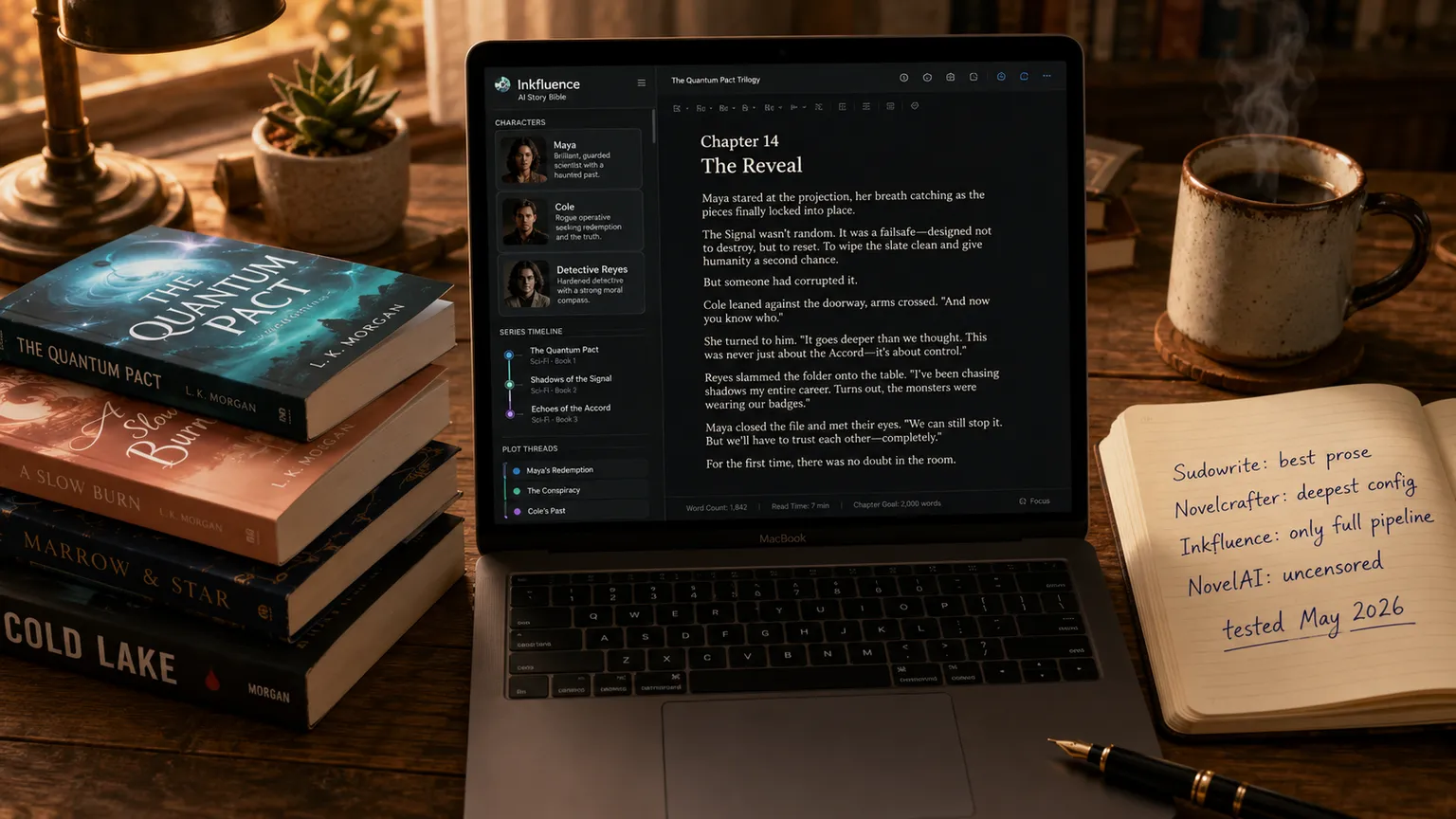
The best AI novel writer in 2026 is Inkfluence AI, the only tool on this list that writes full chapters, designs an Amazon KDP-ready cover, narrates an ACX-spec audiobook, and exports the EPUB plus JPG cover bundle in one workflow. Sudowrite wins for literary fiction prose at the draft stage. Novelcrafter wins for power-user novelists who want BYO-API flexibility. Everyone else is ranked below by workflow fit and value. Full methodology and scorecards below.
Price per novel
What a full novel actually costs per tool
Entry price alone misleads. Novelists finish novels, not months. We priced one full 60,000-word novel start to finish across every tool, including the extra subscriptions needed to cover, format, and narrate.
| Tool | Subscription | Cover | Audiobook | EPUB | Total per novel |
|---|---|---|---|---|---|
| Inkfluence AI | $9.99 (1 month) | Included | Included | Included | $9.99 |
| Sudowrite | $22 (1 month) | +$30-$50 (DIY) | +$99-$299 (AI service) | Free (Reedsy) | $151-$371 |
| Novelcrafter | $20 (Specialist, BYOK) | +$30-$50 (DIY) | +$99-$299 (AI service) | Free (Reedsy) | $149-$369 + API fees |
| NovelAI | $15 (Scroll) | +$30-$50 | +$99-$299 | Free (Reedsy) | $144-$364 |
| ChatGPT Plus | $20 (1 month) | +$30-$50 | +$99-$299 | Free (Reedsy) | $149-$369 |
Cover pricing uses DIY tools (Canva, PlaceIt) at the baseline; 99designs contests start at $299, and human designer commissions run $300 to $1,500. Audiobook pricing reflects third-party AI narration services (Speechify Studio, ElevenLabs Studio) for novel-length books; human Findaway/ACX narration runs $1,000 to $4,000 for a 60,000-word novel at $150 to $500 per finished hour. EPUB conversion is free via Reedsy Book Editor; Vellum is $199.99 one-time for ebook formatting. Vendor prices verified September 2026; Vellum's one-time price as listed in May 2026. Inkfluence AI is the only tool on the list where one subscription covers all four outputs at the all-included tier.
Before the rankings
What actually separates a good AI novel writer from a bad one
In 2026, almost every AI writing tool can produce a passable 500-word opening scene. That bar is low. The real test is whether the tool can still hold structure in Chapter 14 when Chapter 2's protagonist secret has to pay off, when a minor character from Chapter 5 reappears, and when the tone that was intimate in the prologue needs to widen for the climax. Most tools collapse somewhere around the 20,000-word mark.
There are four things to watch for when evaluating an AI novel writer. First, chapter continuity: does the tool remember what happened earlier without being re-fed the prior chapters each time? Story bible, codex, or blueprint systems exist precisely because long-form fiction cannot rely on raw context windows. Second, voice consistency: does Chapter 10 read like the same author who wrote Chapter 1, or does the prose start drifting toward generic once the model loses its initial footing? Third, publishing workflow: when the draft is done, can the tool hand you a finished artefact (EPUB, cover, audiobook) or does it hand you a DOCX and wave goodbye? The Amazon KDP submission flow requires EPUB plus JPG cover, not DOCX. Fourth, commercial rights: can you actually sell what the tool produces, and on which plan?
The ranked list below weighs all four. A tool that generates a beautiful 3,000-word scene but cannot track character arcs across 30 chapters is a draft assistant, not a novel writer. A tool that outputs a full novel but exports only DOCX is a draft assistant with extra steps. A tool that bundles the novel, the cover, and the audiobook is actually the thing novelists are trying to buy.
How we ranked
Methodology
We scored each AI novel writer across seven weighted criteria from its published feature set, its pricing page as read in September 2026, and its export formats checked against Amazon KDP's current submission requirements; Inkfluence AI is additionally scored on our own platform data. No hands-on manuscript test across the eight subscriptions was run for this page, and it does not claim one. The weights below reflect what matters most to novelists who plan to publish, not just draft. For the underlying model layer that powers most of these tools, see our head-to-head test of the AI models behind novel-writing tools.
Full-novel generation
20%Can the tool produce a complete, structured novel (multi-chapter, consistent character voice, tracked arcs) from a single prompt, or does it require stitching and re-prompting?
Prose quality and continuity
20%Does prose stay coherent across 30,000+ words? Does the tool track characters, subplots, and narrative arcs without manual patching?
Publishing workflow for novels
15%EPUB, PDF, DOCX export. KDP-ready packaging. Cover design. Audiobook output. Does the tool ship a novel or just draft one?
Pricing and value for novel-length work
15%Entry price, free tier generosity, hidden costs, refund policy. Compared like-for-like at the output volume a full novel requires.
Commercial rights on free or low tier
10%Can novelists sell what they create without paying to upgrade? Royalty-sharing traps?
Cover and audiobook integration
10%Does the tool handle cover design and audiobook narration, or are two or three additional subscriptions needed?
Learning curve for novelists
10%Can a first-time novelist get a finished draft in a weekend, or do they need weeks to learn the interface?
The Rankings
8 Best AI Novel Writers, Ranked
Scored against the methodology above. Click any tool to see the full comparison or visit our dedicated head-to-head pages.
- 1

Inkfluence AI
Best overall for novels in 2026
Free, paid from $9.99/moBest for
Novelists who want one tool for outline, chapters, cover, audiobook, and KDP export
The only entry in this list that writes a full novel, designs a KDP-compliant cover, narrates the audiobook to ACX specifications, and exports a ready-to-upload EPUB plus JPG cover bundle in one workflow. A genre-aware blueprint system handles fiction specifically, keeping chapter structure, character continuity, and voice consistent across a 30,000 to 60,000 word draft, and shaping a full dramatic arc (rising stakes, a real low point, and a payoff) so the book reads as one story instead of drifting chapter by chapter. Free plan gives 5 chapters plus 5 every month with full commercial rights. Paid plans remove chapter caps and unlock unlimited audiobook production.
Try Inkfluence AI freeStrengths
- Full novel pipeline: outline to audiobook
- Fiction blueprints hold continuity and a full story arc
- KDP-ready EPUB and JPG cover bundle
- ACX-spec audiobook export
- Commercial rights on every plan
Trade-offs
- Single-author workflow, not a team tool
- Fewer sentence-level prose controls than Sudowrite
- 2
Sudowrite
Best for literary fiction prose craft
From $19/mo, or $10/mo billed annuallyBest for
Novelists who care about sentence-level prose quality above all else
Built by novelists, for novelists. Sudowrite's Canvas, Describe, and Brainstorm features excel at prose-level craft: sensory detail, showing vs telling, voice matching. Story Bible (included on every plan) handles continuity. Output is DOCX only, which means a second tool is needed for cover design, EPUB packaging, and audiobook. Strong for the draft phase of a literary novel, weak for the publishing phase.
See the full Sudowrite comparisonStrengths
- Best-in-class prose quality for literary fiction
- Canvas for scene-level rewriting
- Story Bible continuity tracking
Trade-offs
- DOCX only, no EPUB or PDF export
- No cover design
- No audiobook
- Professional is $29/mo ($22 annual) and Max $59/mo ($44 annual); no permanent free plan
- 3
Novelcrafter
Best for power-user novelists
$4 to $20/mo, bring your own AI keyBest for
Novelists who want deep codex control and BYO-API-key flexibility
A DIY novelist's cockpit: manual codex entries for characters, locations, factions, and magic systems that the AI reads during generation. Option to bring your own API key to route through different providers. Rewards novelists who enjoy tinkering with configuration, punishes novelists who just want a draft. DOCX and Markdown export only. No cover design, no audiobook. The right tool if you see AI as a collaborator you configure rather than a service you consume.
See the full Novelcrafter comparisonStrengths
- BYO-API-key flexibility
- Manual codex for deep worldbuilding
- Low entry price
Trade-offs
- Steep learning curve
- No cover or audiobook
- DOCX / Markdown export only
- 4
NovelAI
Best for genre and uncensored fiction
From $10/moBest for
Novelists writing fantasy, sci-fi, horror, or mature themes who want minimal content filtering
Fine-tuned fiction models with lore books, memory systems, and minimal content filtering. Reliable for genre novelists where mainstream tools get squeamish. No publishing workflow: no covers, no EPUB, no audiobook, no KDP packaging. Novelists draft here and finish somewhere else. A pure drafting tool for writers who already have a downstream publishing setup.
See the full NovelAI comparisonStrengths
- Uncensored fiction generation
- Lore books for worldbuilding
- Low entry price
Trade-offs
- Text/PDF export only
- No publishing workflow
- Fiction-only focus limits versatility
- 5
Squibler
Best for outline-first novelists
Free plan (1,000 AI credits), Plus $29.99/mo or $15.83/mo annualBest for
Novelists who plot before they draft and adapt from screenplays
Squibler started as screenwriting software and carries that DNA. Its Smart Writer outline tool is strong for scene-first narrative structures. Handles novels, but the workflow feels grafted on rather than native. Best for novelists adapting a screenplay into a book or writing scene-driven genre fiction that benefits from cinematic scaffolding. The free plan has had no export since 30 June 2026, and there is no EPUB, audiobook, or store-ready cover at any tier, so the publishing phase happens in other tools.
See the full Squibler comparisonStrengths
- Strong scene-first outlining
- Handles screenplays natively
- Clean editor interface
Trade-offs
- No EPUB or audiobook export
- Cover is basic AI art, not store-ready
- Free plan has no export since 30 June 2026
- 6
Talefy
Best for interactive and branching novels
Free account; paid plans from $1.99 per its siteBest for
Novelists experimenting with choice-driven narratives and reader-path fiction
Talefy specialises in interactive stories where readers choose paths, shape character arcs, and discover endings based on their own decisions. Strong for gamebook-adjacent novelists and writers exploring branching narrative formats that don't fit the traditional linear novel. Narrow fit: not designed for straight-ahead literary fiction or a conventional 300-page novel. Use it if interactivity is core to your project, not as a general-purpose novel writer.
See the full Talefy comparisonStrengths
- Purpose-built for branching narratives
- Reader-choice mechanics
- Low entry price
Trade-offs
- Not designed for linear novels
- No traditional novel formatting
- Limited publishing workflow
- 7

ChatGPT Plus
Best general-purpose AI drafting for novelists
$20/moBest for
Novelists who already use ChatGPT and want to extend it into long-form drafting
A general-purpose chatbot, not a novel tool. ChatGPT Plus handles chapter drafts if you prompt carefully, maintain context manually, and stitch the output together. Canvas and Projects make this less painful than a year ago, but novelists still design the cover somewhere else, format the EPUB somewhere else, and export the PDF somewhere else. The price is right; the novel-writing workflow is manual.
See the full ChatGPT Plus comparisonStrengths
- Low entry price
- Canvas for longer writing
- Familiar interface
Trade-offs
- Manual novel assembly
- No chapter structure or continuity
- No cover / audiobook / EPUB / PDF
- 8

Claude.ai
Best for long-context novel revision
From $20/moBest for
Novelists who paste full manuscripts for structural critique or line edits
Claude's long context window is unmatched for feeding it an entire novel manuscript and asking for a revision pass, developmental-edit style notes, or a structural critique. Not a drafting environment for novels in the book-tool sense: no chapter management, no outline scaffolding, no export. Pair it with a real novel tool and Claude becomes a second set of eyes on a full draft at a fraction of freelance editor cost.
See the full Claude.ai comparisonStrengths
- Long-context manuscript feedback
- Strong reasoning for structural edits
- Clean interface
Trade-offs
- No novel-native workflow
- No export formats
- No cover / audiobook

The real per-month cost when API fees are added
Several tools on this list use a bring-your-own-API-key (BYOK) pricing model: a low subscription that doesn't cover the AI usage, plus separate per-token billing on the model you connect. The sticker price hides the real cost. Here is what novelists in three usage tiers actually pay each month, including API fees, for a 60,000 to 90,000-word novel pace.
| Usage profile | BYOK subscription | API fees | Real total |
|---|---|---|---|
| Hobbyist, lightweight model, 1 chapter/day | $5 | ~$3-8 | $8-13/mo |
| Active novelist, mid-tier model, 5 chapters/day | $10-15 | ~$15-25 | $25-40/mo |
| Power user, frontier model, long novel | $15-20 | ~$40-60 | $55-80/mo |
| Inkfluence AI Creator (35 chapters/mo, all-included) | $9.99 | $0 | $9.99/mo flat |
| Inkfluence AI Premium (unlimited, all-included) | $19.99 | $0 | $19.99/mo flat |
API fee estimates use public 2026 pricing for typical novel-writing workloads (40k-90k tokens drafted per chapter session). BYOK ranges reflect the spread between platforms across this list. Inkfluence AI's all-included pricing covers chapter generation, story bible, cover design, EPUB and PDF export, and ACX-spec audiobook narration in a single subscription. Pricing verified September 2026.
Want to model your own usage? Use the AI writing cost calculator to plug in your model tier and monthly chapter volume. Self-publishing on KDP specifically? See our best AI book generator for self-publishing 2026 ranking.
Pick your workflow first
The three ways novelists actually draft with AI in 2026
Most novelists fit one of three workflow patterns. Knowing which one you are makes the tool choice almost automatic, because each pattern rewards a different feature set.
The full-pipeline novelist wants one tool that takes a premise and hands back a finished novel package: drafted chapters, a designed cover, an audiobook narration, and a KDP-ready EPUB. Most first-time novelists, indie authors with day jobs, and lead-magnet writers fit here. The bottleneck is time, not craft ambition. Tools that integrate cover design and audiobook win. Tools that stop at DOCX lose, because a DOCX draft is 40% of the work, and the remaining 60% (design, formatting, audiobook production) is where most novels get abandoned.
The prose-craft novelist wants AI as a co-writer at the sentence level, not a ghostwriter at the chapter level. They're drafting a literary novel, or a character-voice-heavy genre piece where the prose is the product. They want sentence rewrites, sensory detail expansions, showing-vs-telling critiques. They already have a publishing workflow elsewhere (or an agent). The best tool here is a prose assistant, not a novel generator. Story Bible, Canvas-style editing, and per-scene rewriting matter more than chapter-by-chapter generation.
The worldbuilder novelist is three novels into a series, or writing a 150,000-word fantasy epic, or running a shared universe. Continuity is the only thing that matters. A deep codex where you can name every character, faction, magic rule, and continent pays for itself by Chapter 30. Per-chapter generation is table stakes; the differentiator is how configurable the AI context is. These novelists will happily trade a smoother UI for more configuration power, and often prefer tools with BYO-API-key flexibility.
The ranked list above accounts for all three patterns. If you recognised yourself in pattern one, the top of the list is your shortlist. Patterns two and three push different tools up: Sudowrite rises for prose-craft, Novelcrafter and NovelAI rise for worldbuilders. The feature matrix below makes the trade-offs easier to see.
Side by side
Feature Matrix: 8 AI Novel Writers Compared
Every feature that matters for publishing a novel, priced to the same month. Scroll horizontally on mobile.
| Feature | Inkfluence | Sudowrite | Novelcrafter | NovelAI | Squibler | Talefy | ChatGPT | Claude |
|---|---|---|---|---|---|---|---|---|
| Full-novel generation from one prompt | Yes | Prose-first, outline separate | Chapter-by-chapter | Scene-by-scene | Outline-first | Branching only | Manual prompts | Manual prompts |
| Chapter continuity / story bible | Auto, full draft | Story Bible (built-in) | Codex (auto-linked) | Lore books | Scene cards | Per-branch only | Manual | Long context |
| Fiction-specific blueprints | 6 fiction types | ~10 fiction modes | Custom only | Fiction-only modules | Screenplay-first | Branching templates | None | None |
| AI cover designer | Yes, KDP-ready | No | No | No | Basic AI art | Limited | Image gen only | No |
| Audiobook generation | Yes, ACX-spec | No | No | No | No | No | No | No |
| Export formats | PDF, EPUB, DOCX | DOCX only | DOCX, Markdown | Text, PDF | DOCX, PDF | Web only | Copy-paste | Copy-paste |
| Free tier with commercial rights | 5 chapters / mo | 3,000 word trial | Scribe $4/mo (no AI) | Limited trial | 1,000 credits/mo, no export | Free tier | Limited | Limited |
| Entry paid plan | $9.99/mo | $19/mo ($10 annual) | $4-20/mo (BYOK) | $10/mo | $29.99/mo ($15.83 annual) | From $1.99 | $20/mo | $20/mo |
| KDP publishing support | EPUB + JPG cover bundle | No, DOCX only | No | No | No EPUB or cover | No | No | No |
Pricing and features verified September 2026 from each vendor's pricing page. See our dedicated Sudowrite, Novelcrafter, NovelAI, Squibler, and Talefy breakdowns for deeper dives. Weighing Squibler specifically? See the best Squibler alternative.
Best for your novel
Best AI Novel Writer by Project Type
Not every novel has the same needs. Here's the right tool for each common novelist use case.
Best for literary fiction novelists
Winner: Inkfluence AI
Runner-up: Sudowrite
Inkfluence handles the full literary novel pipeline from chapter drafts to ACX-spec audiobook. Sudowrite wins only if sentence-level prose is the sole priority and a separate publishing workflow is already in place.
Best for genre and indie fiction novelists
Winner: Inkfluence AI
Runner-up: NovelAI
Fiction blueprints for romance, mystery, fantasy, sci-fi, and YA plus full KDP-ready export. NovelAI is the fallback for novelists who need uncensored output and already own a downstream publishing setup.
Best for KDP self-publishing novelists
Winner: Inkfluence AI
Runner-up: Novelcrafter
One-click EPUB plus JPG cover bundle ready to upload to Amazon KDP. Novelcrafter is a distant second because the KDP package has to be assembled manually.
Best for novelists adapting from a screenplay
Winner: Squibler
Runner-up: Inkfluence AI
Squibler's screenplay DNA helps when the source is a screenplay. Inkfluence is a solid second for straight-to-novel workflow once the adaptation starts.
Best for experimental and branching novels
Winner: Talefy
Runner-up: Inkfluence AI
Talefy is purpose-built for choice-driven narrative. Inkfluence handles straight-ahead novels and is the second choice for novelists who also want covers, audiobooks, and KDP export.
Best for novelists on a tight budget
Winner: Inkfluence AI (free)
Runner-up: Novelcrafter ($8 Hobbyist)
Inkfluence free plan gives 5 chapters plus 5 every month with commercial rights. Novelcrafter's cheapest tier with AI is Hobbyist ($8/mo, BYOK so add API costs).
Best for first-time novelists
Winner: Inkfluence AI
Runner-up: ChatGPT Plus
Guided onboarding, fiction blueprints that shape output quality automatically, and no manual prompt engineering. ChatGPT Plus also works for beginners but rewards practice.
Best for manuscript revision on a finished draft
Winner: Claude.ai
Runner-up: Inkfluence AI
Claude's long context handles a full 80,000 word manuscript in one pass for developmental-edit style notes. Inkfluence is a solid second for structured line-edit work per chapter.

Do your own evaluation
How to test an AI novel writer before committing to a subscription
Rankings are useful. A 20-minute test run on the free tier is better. Here's a repeatable way to audit any AI novel writer using the novel you actually want to write.
Write a one-paragraph brief for Chapter 1. Give it the protagonist, the inciting incident, the setting, and one line of desired voice (gritty, lyrical, wry, etc.). Paste the same brief into every tool you're evaluating. Same brief, same output window, same target length (aim for 2,500 to 3,000 words). The output quality at this stage reveals prose baseline, not continuity.
Then test continuity with Chapter 8. This is the step most reviews skip. Ask the tool to write Chapter 8 of the same novel, referencing the protagonist's flaw from Chapter 1 and a minor character introduced in Chapter 3. If the tool required you to re-paste the previous chapters, note it. If the tool auto-loads context from its own memory or story bible, score it higher. The gap between "I had to re-paste everything" and "it remembered" is the difference between a 50-hour novel and a 5-hour novel.
Finally, export the result. Most novelists skip this step until after they've subscribed, and that's where regret lives. Export the test chapters as EPUB if you plan to sell on KDP. Export as DOCX if you plan to pass the draft to an editor or agent. Export as PDF if you plan to print. A tool that produces beautiful prose but exports only as a copy-paste text blob forces a Calibre conversion step, a separate cover designer, and a separate audiobook tool. Confirm export format support before the subscription clears.
If the tool you're testing clears all three steps (Chapter 1 prose, Chapter 8 continuity, EPUB export) on the free tier, it clears the 20-minute bar. Everything else is personal taste.
What our own fiction data says
Most "best AI novel writer" pages have no data of their own. We have one platform's worth, so here is what it shows, with the caveat that it describes Inkfluence AI only and says nothing about the other seven tools.
| Measure | Figure | Where it comes from |
|---|---|---|
| Share of all books that are fiction | About 31% (fiction and romance together); romance alone 7.2%, children's fiction 3.5% | Every book started on the platform, imports excluded, 4 September 2026; homed on the niche demand map |
| Fiction chapter length | Median of roughly 1,900 to 2,000 words a chapter | Published chapter-length data on the AI novel writer page |
| Similes per sentence in fiction prose | 0.019 on the current writing engine, against 0.265 on the engine it replaced in July 2026 | Our July 2026 prose comparison on the same fiction brief, counted mechanically; the single most common reader complaint about AI fiction is simile density |
| What the chapter review finds in fiction | Continuity findings are graded high 41% of the time; style findings 4% | Whole-book editorial passes, homed on the developmental editor page |
The simile figure is the one to watch when you trial any tool: paste a chapter into a word processor and count "like" and "as if". One in five sentences is the tell of a first-generation AI novel; one in fifty reads as a person. The rest of the ranking is about what happens after the prose, because that is where the tools differ most.
Export formats against what KDP actually accepts
Amazon KDP takes a Kindle EPUB or a DOCX for the ebook, a PDF interior plus a wrap-cover PDF for paperback, and a JPG or TIFF for the ebook cover. Here is what each tool hands you.
| Tool | Ebook file | Print interior and wrap cover | Cover image | Steps left before upload |
|---|---|---|---|---|
| Inkfluence AI | EPUB, DOCX | Print PDF with trim sizes and a wrap-cover PDF | JPG from the cover designer | None; the KDP package is one export |
| Sudowrite | DOCX | No | No | Formatting tool plus a cover source |
| Novelcrafter | DOCX, Markdown | No | No | Formatting tool plus a cover source |
| NovelAI | Text, PDF | No | Its image generator, not sized for covers | Convert to EPUB or DOCX, then format |
| Squibler | PDF, DOCX (paid) | No wrap cover | Basic AI art | Cover sizing, print layout |
| Talefy | Web only | No | No | Not a KDP route |
| ChatGPT Plus and Claude | Text to paste | No | No | Everything: assembly, formatting, cover |
The KDP self-publishing guide walks the upload itself, and the paperback guide covers trim sizes and the wrap cover.
Verified references
Sources Behind the Ranking
What the ranking rests on, so you can check it.
KDP eBook list price requirements: 70% royalty on $2.99 to $12.99 on Amazon.com from 7 July 2026; 35% outside the band.
KDP cover and manuscript requirements: accepted ebook and print file formats used for the export table.
US Copyright Office, Copyright and Artificial Intelligence: human-authored elements of AI-assisted novels remain registrable.
Vendor pricing pages for Sudowrite, Novelcrafter, NovelAI, Squibler and Talefy, read in September 2026 and quoted as found; Vellum's one-time price as listed in May 2026. We do not link competitor pricing pages from this ranking; they are one search away.
Our fiction chapter-length data and the platform demand map: fiction share, romance share and chapter medians from every book written on Inkfluence AI.
Whole-book review findings: how often continuity and style findings are graded high, from real editorial passes.
Written Word Media 2026 Mid-Year Indie Author Survey: 582 indie authors, income tiers and marketing behaviour by tier.
AAP StatShot, May 2026: trade ebook and digital audio revenue, the market these novels sell into.
Search intent
Who searches for "best AI novel writer" and what they're after
Six distinct intent clusters land on this listicle each month. Here's how the ranked 8 map to each.
Generic "best AI for novel writing" searchers ("best ai for creative writing novels", "ai tools for fiction writers 2026", "best ai model for writing novels 2026")
Writers who want a quick, trustworthy verdict on which tool to start with. The Quick Answer and ranked list give them a clear top pick plus the reasoning behind it, with Inkfluence leading on full-novel pipeline depth.
Cross-shopping novelists ("novelcrafter vs sudowrite", "sudowrite vs novelai", "novelcrafter vs chatgpt")
Readers comparing two specific tools head to head. The feature matrix and 8 best-for personas resolve the comparison directly and show where Inkfluence fits against each rival.
Genre and niche fiction searchers ("best ai for chinese novel writing", "best ai for japanese novel writing", "ai for fantasy/sci-fi/horror")
Novelists writing in a specific genre or language who need a tool that handles it well. Genre blueprints and multi-language draft support are the differentiators most listicles miss.
KDP self-publishers ("ai novel writer for KDP", "EPUB export", "Amazon KDP novel")
Authors who want to publish on Amazon KDP without stitching tools together. Inkfluence is the only entry with a one-click EPUB plus JPG cover bundle ready for KDP upload, and the page maps each tool to its publishing gap.
Audiobook-curious novelists ("ai novel writer with audiobook", "ACX-ready", "book-to-audiobook AI")
Writers who also want an audiobook from the same draft. Only Inkfluence ships ACX-spec audiobook narration in-tool, and the matrix makes that explicit. See /ai-audiobook-generator for the audiobook side.
Free-tier evaluators ("best free ai novel writer", "ai novel writer free trial")
Budget-conscious novelists testing tools before they pay. The pricing column flags free-tier generosity at a glance, and Inkfluence stands out by granting commercial rights on its free plan, which most competitors lock to paid.
The bottom line
The best AI novel writer in 2026, ranked across eight tools on published features, verified prices and our own fiction data, is Inkfluence AI, the only entry that ships full-novel chapter generation with fiction blueprints (6 genre presets), AI cover design (KDP-ready JPG), ACX-spec audiobook narration (44.1 kHz, 192 kbps, loudness-compliant), and EPUB plus JPG cover bundle export, in a single $9.99/mo workflow with commercial rights on every plan including free. Sudowrite ($22/mo) wins for literary-fiction prose craft but stops at DOCX, requiring two extra subscriptions for cover and audiobook. Novelcrafter ($5-20/mo BYOK) wins for power-user worldbuilding via manual codex but lacks cover and audiobook. NovelAI ($10/mo) wins for uncensored genre fiction (horror, dark themes) but is drafting-only. Squibler (free / $15.83/mo) wins for screenplay adaptations. Talefy ($9/mo) wins for branching/interactive narratives. ChatGPT Plus ($20/mo) and Claude.ai ($20/mo) are general-purpose chatbots, capable for chapter drafts but require manual assembly into a novel. Total cost to ship one finished 60,000-word novel with cover and audiobook: Inkfluence $9.99 vs $144-$371 for the next-cheapest stack. Verified against vendor pricing pages and KDP submission specs in September 2026.
Frequently Asked Questions
Everything else novelists ask before picking an AI novel writer.
What is the difference between an AI novel writer and an AI writing studio for fiction?
An AI novel writer generates the draft from a premise: outline, chapters, continuity across the book. An AI writing studio is a revision environment for a manuscript you already have: scene scores, a codex, named versions, rewrite passes. Some tools in this ranking are one or the other; Inkfluence AI is both, which is why it ranks first for authors who want the book finished as well as improved. If you only need the studio half, Sudowrite and Novelcrafter are the strongest picks on this list.
What is the best AI novel writer overall in 2026?
Inkfluence AI is the best AI novel writer for most authors in 2026 because it is the only tool that covers the full novel workflow in one interface: full-chapter generation with fiction blueprints, AI cover design, audiobook narration with ACX-spec export, and EPUB/PDF/DOCX output. Paid plans start at $9.99/mo and include commercial rights on the free tier, which most competitors lock behind a subscription.
What makes one AI novel writer better than another?
The real differentiators are chapter continuity (does the tool remember what happened to a character in Chapter 2 when writing Chapter 18?), publishing workflow (can you export a KDP-ready EPUB and JPG cover, or just DOCX?), commercial rights on the free tier, and whether audiobook is included. Raw prose quality matters less than most reviews suggest because editing is required either way. Integration matters more because every extra tool is another subscription and another handoff.
Can AI actually write a full novel?
Yes, in 2026, purpose-built tools like Inkfluence AI, Sudowrite, Novelcrafter, and NovelAI produce full novels with prose, dialogue, and structure. General chatbots like ChatGPT and Claude produce capable chapter drafts but require manual assembly into a novel. A useful test: ask the tool to produce a single 3,000-word chapter with dialogue, scene-setting, and a transition to the next chapter. If it holds structure across that length, it holds structure across a novel.
Which AI novel writer is best for literary fiction?
Sudowrite is the strongest sentence-level prose craft tool, but stops at DOCX export. Inkfluence AI wins overall for literary novelists who want to ship a finished book, because the prose quality is competitive and the publishing workflow (EPUB, cover, audiobook) is native. Pair them only if prose craft is the single priority and budget supports both subscriptions.
Which AI novel writer is best for genre fiction (romance, fantasy, sci-fi, mystery)?
Inkfluence AI has fiction blueprints for romance, mystery, fantasy, sci-fi, and YA that handle genre conventions automatically. NovelAI is the best alternative for novelists who need uncensored output (horror, dark fiction, explicit content). Novelcrafter suits genre novelists who want a manual codex for deep worldbuilding.
Which AI novel writer is best for KDP self-publishing?
Inkfluence AI is the only tool on this list that ships an EPUB manuscript plus a JPG cover bundle formatted for Amazon KDP's 'Upload a cover you already have' flow, which only accepts JPG or TIFF. Most competitors export only DOCX, forcing novelists to convert to EPUB manually (Calibre or similar) and design a cover elsewhere. The KDP one-click bundle saves 2-3 hours per novel.
Can I publish AI-generated novels on Amazon KDP?
Yes. Amazon KDP permits AI-generated and AI-assisted content as long as novelists disclose it during publishing. Check Amazon's current AI content guidelines at kdp.amazon.com/en_US/help/topic/GVBQ3RM2QCZPZE6W. Disclosure does not affect eligibility for the 70% royalty tier ($2.99 to $12.99 list price) or KDP Select enrollment.
Do I own the rights to novels written with an AI novel writer?
This depends on the tool. Inkfluence AI grants 100% commercial rights on every plan including free. Sudowrite, Novelcrafter, NovelAI, and ChatGPT also grant commercial rights to paid users, with varying free-tier restrictions. US Copyright Office guidance (copyright.gov/ai) currently protects human-authored elements of AI-assisted works. Novelists own commercial use rights; whether the novel qualifies for copyright registration depends on the level of human contribution.
Which AI novel writer has the best free tier?
Inkfluence AI's free tier gives 5 AI-generated chapters to start plus 5 more every month with full commercial rights and PDF export. Novelcrafter's $8/mo Hobbyist tier is the cheapest tier with AI features (BYOK, so add API costs on top). Squibler has a free plan with 1,000 AI credits a month but no export since 30 June 2026. Most other tools offer time-limited or word-limited previews rather than a sustained free tier novelists can use to test a real novel project.
How long does it take to write a full novel with AI?
With Inkfluence AI, a first draft of a 30,000 to 60,000 word novel typically takes 2 to 4 hours of active work plus review time. The AI generates each chapter in seconds; time is spent reviewing output, editing, and making regeneration decisions. With a general chatbot like ChatGPT, expect 10 to 20 hours because of the manual prompting and assembly overhead required for novel-length work.
How much editing does an AI-written novel need?
Plan on 4 to 8 hours of editing per full novel. Structural issues (character continuity, pacing, factual accuracy, timeline consistency) are where most fixes happen. The strongest value-add is adding personal voice, specific sensory detail, and genre-specific nuances that generic AI output lacks. Novels published with zero human editing tend to read as generic; novels with 6-8 hours of targeted editing read as authored.
Do AI-written novels get flagged as plagiarism?
Genuinely AI-generated original text is not plagiarism in the traditional sense; it is not copied from a source. However, some AI detection tools (GPTZero, Originality.ai, Turnitin) can flag AI prose. Amazon KDP does not use these detectors for bookstore listing decisions as of 2026. Disclosure is required via the KDP publishing form. Readers and reviewers may still hold opinions; the market is still forming on AI-written fiction acceptance.
Can AI novel writers handle long-form books over 80,000 words?
Yes, with the right architecture. Inkfluence AI, Novelcrafter, and NovelAI all handle 80,000+ word novels through chapter-by-chapter generation with persistent continuity. Sudowrite's Story Bible extends its range to novel length. General chatbots (ChatGPT, Claude) hit context window limits and require manual context injection for long novels. Plan on the chapter-by-chapter approach for anything over 50,000 words.
What's the cheapest AI novel writer that produces full novels?
Inkfluence AI Creator plan at $9.99/mo supports full-length novels (35 chapters/month, no per-chapter word cap, EPUB + PDF + DOCX export). Novelcrafter's $4-20/mo range (with the $4 Scribe tier being writing-only, no AI) is cheaper on entry but lacks cover and audiobook, forcing additional subscriptions for a complete novel. ChatGPT Plus at $20/mo is not novel-native and requires manual assembly.
Did you test these tools on a real manuscript?
No, and this page no longer claims to. Each tool is assessed on its published features, its pricing page (read in September 2026) and its export formats against KDP's submission requirements. Inkfluence AI is additionally measured on our own platform data: chapter lengths, fiction share and prose metrics from tens of thousands of real books. A hands-on manuscript test across eight subscriptions is a different exercise, and if we run one we will publish the manuscript and the outputs.
Which AI novel writers export EPUB for Kindle?
Of the eight, only Inkfluence AI exports a Kindle EPUB and a print PDF with a wrap cover from the finished book. Sudowrite and Novelcrafter export DOCX (Novelcrafter also Markdown), NovelAI exports text and PDF, Squibler exports PDF and DOCX on its paid plans, Talefy is web-only, and the chat assistants give you text to paste. KDP accepts DOCX uploads, so the others are usable with a conversion step; the difference is whether the book file is one click or an afternoon.
Do AI novel writers work for series and multi-book novels?
Inkfluence AI's fiction blueprints and characterNames/sourceWork metadata persist across projects in the same account, which helps for series continuity. Novelcrafter's codex auto-links mentions and is genuinely strong for series-level worldbuilding. NovelAI lore books serve the same purpose. For series of 3+ novels, pick a tool with explicit worldbuilding state (Inkfluence, Novelcrafter, NovelAI) over general chatbots.
Write your novel in a weekend, not a year
Start on the free plan: 5 chapters plus 5 every month, full commercial rights, PDF export. No credit card. Upgrade when you need EPUB, audiobook, or unlimited chapters for a full-length novel.
Related deep-dives
Head-to-head novel-writer comparisons and tool-specific reviews.
Inkfluence AI vs BookNova
A lifetime-plan novel generator: prices, reviews and the refund clause.
Sudowrite vs Novelcrafter
The two drafting studios head to head: price, AI cost, Story Bible against Codex
AI Horror Story Generator
Dread that builds chapter by chapter, with restraint rules the outline obeys
AI Sci-Fi Story Generator
Technology rules held in a story bible to the last chapter
AI Fantasy Novel Writer
Magic rules, names and map held in a story bible for the whole book
Best AI by Fiction Genre (2026)
Fantasy, horror, sci-fi, mystery, romance and more, judged genre by genre
Inkfluence AI vs ProseEngine
Book generation, continuity checks, audiobooks and pricing, head to head with prices verified September 2026.
AI Novel Writer
The full Inkfluence novel workflow, features, and pricing.
Inkfluence AI vs Sudowrite
Novel prose craft vs full publishing workflow.
Inkfluence AI vs Novelcrafter
Power-user novelist tool vs integrated pipeline.
Interactive Fiction Generator
Branching-story template tool for gamebook novelists.
Book Outline Generator
Free 10-chapter outline tool across 8 genres.
Novel Royalty Calculator
Compare novel earnings across KDP, IngramSpark, Kobo, Apple, and more.
For Novelists
Story-bible continuity, fiction blueprints, 30-day novel workflow.
Best Novel Writing Software 2026
Sister listicle ranking 8 platforms with the real per-novel cost table including hidden API fees.
AI Story Bible Generator
Free character bible, world rules, lore, and plot-thread builder before drafting.
AI Character Bible Generator
Free character profile builder: voice, motivation, flaw, backstory, three-beat arc.
For Fantasy Authors
Magic-system-locked continuity for epic, dark, urban, and romantasy novels.
For Sci-Fi Authors
Technology-rule-locked continuity for hard SF, space opera, cyberpunk, and dystopia.
Real Cost: BYOK vs All-Included
Cost-breakdown of bring-your-own-API-key platforms vs all-included pricing per novel.
Best AI Models for Novel Writing 2026
Head-to-head model test: GPT-5, Claude Opus 4.7, Sonnet 4.5, Gemini 2.5 Pro, GPT-4o scored across 5 genres.
Sudowrite alternatives
If you came for Sudowrite: the alternatives at verified 2026 prices, and what each one is actually for.