For Sci-Fi Authors

AI Writing Software Built for Sci-Fi

Hold a technology system across 90,000 words. Track factions, FTL rules, AI personhood, and twenty named characters with the bible the AI reads at every chapter. Purpose-built for hard SF, space opera, cyberpunk, dystopia, and first contact, not a generic chatbot pretending to know what causal-loop drift means.

If you searched for AI sci-fi novel writer, ai writer for science fiction, ai space opera writer, or ai writer for hard SF series, this is the workflow that ships a finished sci-fi novel.
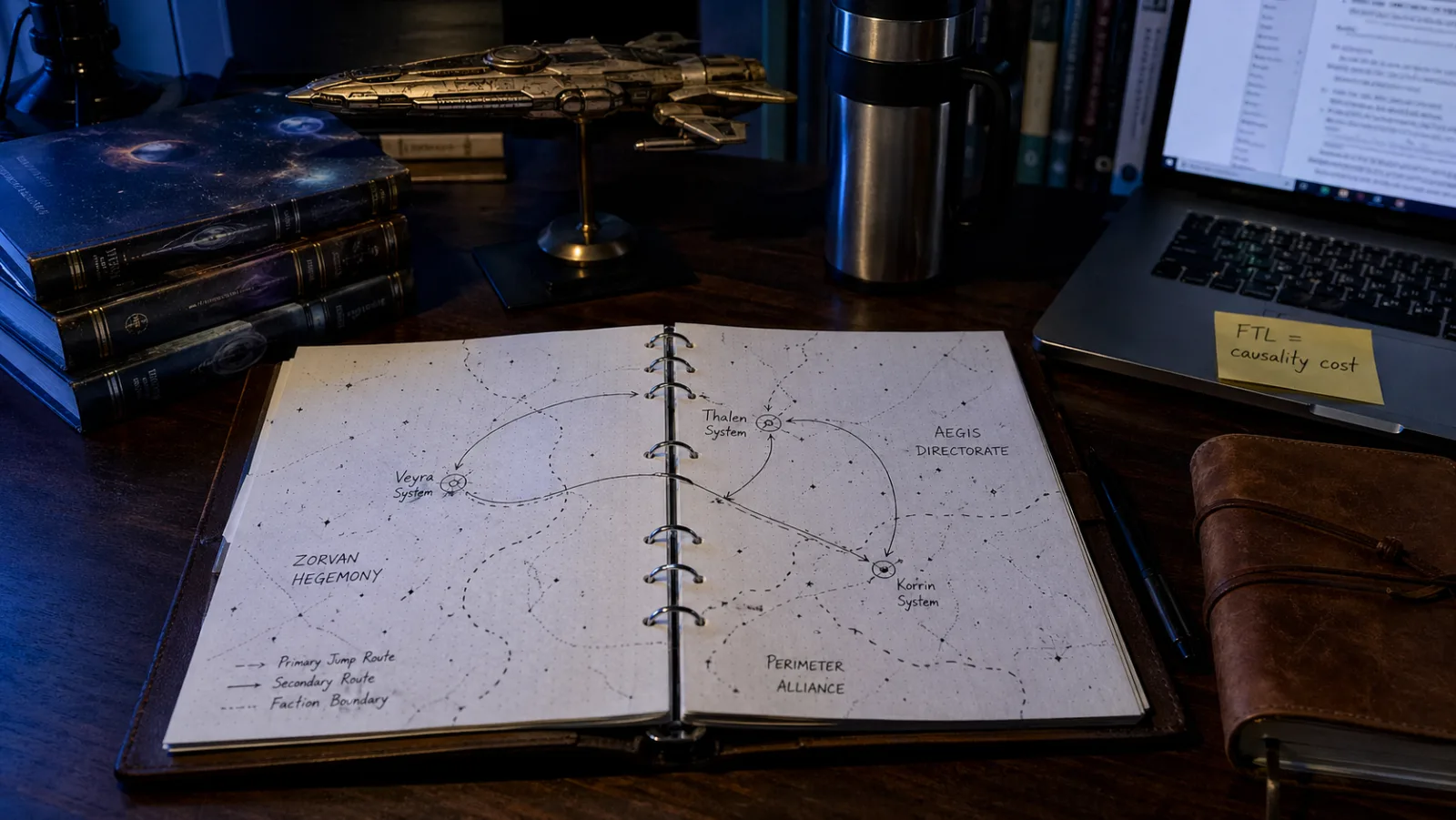
A sci-fi novelist's desk in cool blue lamplight: an open ring-bound notebook with a hand-drawn star map showing three star systems, jump-route arrows, and faction-controlled space, a stack of hardcover hard-SF novels, a model spaceship, a laptop angled at the edge of the desk showing a blurred chapter editor, and a sticky note reading "FTL = causality cost" in cursive, illustrating the sci-fi-author workflow from technology rules to chapter draft.
SM By Sam May Founder, Inkfluence AI Updated April 2026

AI writing software for sci-fi authors is a purpose-built platform that holds technology rules and worldbuilding constraints across a 90,000-word novel, drafts chapters with persistent character and faction continuity over 30 plus chapters, and exports a KDP-ready EPUB plus cover in one workflow. Inkfluence AI is a free-to-start sci-fi novelist tool with story-bible-locked technology consistency, six-genre fiction blueprints (hard SF, space opera, cyberpunk, dystopia, military SF, first contact), and ACX-spec audiobook narration on a single subscription starting at $9.99/mo (vs $144+ when stacking separate tools for draft, cover, AI-narrated audiobook, and EPUB conversion). The story bible re-injects FTL rules, AI-personhood frameworks, faction politics, and technology costs into every chapter prompt so chapter twenty-eight does not contradict chapter three.

See Real AI-Generated Books

Flip through actual pages created by Inkfluence AI - professionally formatted and export-ready.

Previewing: The Tiny Launch Kit

Loading preview...

Page 1 of 12
Swipe to browse
Professional formatting
Branded cover
Table of contents
Export PDF or EPUB

Technology-aware, faction-aware, series-aware

AI writing software for sci-fi authors that actually finishes the trilogy

Why sci-fi authors need a different tool than a general AI chatbot

A sci-fi novel is the most rule-heavy fiction format that exists. By chapter twenty you have introduced three star systems with FTL travel times, eleven characters from four different cultural backgrounds, an AI character whose legal personhood is contested across two factions, and a propulsion system whose physical limits constrain the entire plot. ChatGPT and Claude lose this context after roughly 8,000 to 20,000 tokens, which means by chapter twelve the FTL rules have drifted, the second-tier engineer character has been silently renamed, and the faction that was at war in chapter four is suddenly an ally in chapter seventeen. Inkfluence AI runs a persistent story bible that pins technology rules, faction politics, character voice, and story-arc threads into every chapter prompt, so chapter twenty-eight knows the rules chapter three established. Our ranked 2026 comparison of eight AI novel writers benchmarked this gap on real sci-fi projects and continuity is the single biggest signal separating sci-fi-capable tools from the rest.

Building a technology system the AI will respect across 30 chapters

Sci-fi authors fail on technology rules before they fail on prose. A propulsion system that has no cost is a story without stakes. A faster-than-light drive whose rules contradict between chapter five and chapter twenty-one is a one-star Amazon review. Hard-SF readers specifically will not forgive a ship that takes three days to travel between star systems in chapter four and forty minutes in chapter eighteen. Our free story bible generator includes a sci-fi-tuned worldbuilding pass: three to five technology rules with explicit costs, faction power balance, AI-personhood framework, and how the economy reflects the technology. The bible feeds every chapter generation. The AI respects the FTL cost in chapter twenty-seven the same way it did in chapter two. For deep character work, the character bible generator tracks voice, motivation, and flaw across an entire space-opera or hard-SF cast.
  • FTL consistency: if the jump drive needs forty-eight hours of charge time in chapter two, it still needs forty-eight hours in chapter twenty-eight.
  • Faction politics persist: alliances, treaties, and trade routes do not silently reorganise mid-novel.
  • Three-to-five rule technology beats thirty-rule technology. Cost, blocker, accessible-to-whom, taboo. Rest is decoration.

Ready to create your first ebook?

Go from idea to finished, exportable ebook in minutes. No writing experience required.

Start Creating Free

Sci-fi subgenres in 2026: hard SF, space opera, cyberpunk, dystopia, first contact

Sci-fi is not one genre. The blueprint for an 800-page hard-SF novel is wildly different from a 70,000-word cyberpunk thriller. Hard SF (Liu Cixin, Reynolds, Robinson) leans on rigorous physics, multi-generational time scales, and chapter lengths around 4,000 to 6,000 words. Space opera (Banks, Leckie, Corey) targets multi-POV ensembles, faction politics, large casts, and serial-friendly hooks. Cyberpunk (Gibson, Stephenson, Newitz) runs first-person or close-third with technology-as-character at 80,000 to 100,000 words. Dystopia (Atwood, Ishiguro, Mandel) leans on quiet, voice-led prose with society-as-antagonist. First contact (Chiang, Tchaikovsky, Bear) is built on a single high-concept linguistic or perceptual puzzle. Inkfluence supports all five with subgenre-tuned chapter pacing, trope awareness, and structure templates. For nuanced literary-leaning sci-fi, see also our fiction authors surface.

Hard SF rigour without falling into the worldbuilding trap

Most hard-SF novels that never finish die in the technology phase. The author spends six months on a 15,000-word appendix of orbital mechanics, alien biology, and constructed-language phonology, and never writes chapter one. The reverse trap is real too: novels that ship without enough rigour read thin to a hard-SF audience that will spot a relativistic-speed mistake from the back row. The healthy middle is a 1,500 to 4,000 word story bible: three to five technology rules with explicit costs, two or three factions with one strong sentence each, three lore hooks the reader almost discovers, and a calendar that tells you which years are wartime. The bible is internal scaffolding for the writer; the reader sees a fraction of it. The novel feels deep because the writer was building from a deeper foundation, not because the reader was handed a 15,000-word appendix. Our story bible generator defaults to this size on purpose. Beyond 4,000 words, AI tools start over-weighting the bible and chapter generation gets stilted.

See what Inkfluence AI can do

Explore our tools, see real output examples, and find the right workflow for your needs.

Sci-fi series continuity across three, five, or ten books

Series continuity is critical in sci-fi because the genre rewards long-form reader investment more than almost any other. The Expanse runs nine books with technology and faction politics that compound across the series. The Culture novels share a universe across ten books with no shared protagonists. Indie sci-fi on KDP routinely runs to four or five books in a single series, with read-through rates from book one to book two sitting at 60 to 80 percent for hard SF and even higher for space-opera serials. Inkfluence persists your story bible inside a project and lets you duplicate projects with the bible intact for book two and beyond. The named cast carries forward. The technology rules carry forward. The continuity that makes sci-fi series feel real to readers is enforced at the prompt level, not held loosely in the writer's memory. For multi-book workflows specifically, see our book series writer.

AI characters in your sci-fi novel: how to write them when the AI is also the writing tool

A particularly meta challenge in 2026: writing a novel where an AI character is central, while using AI to help write it. The pitfall is the character collapsing into either a chatbot stand-in (no interior conflict, polite to a fault) or a Hollywood-style killer AI (one-note menace). The fix is the same as for any character: a real story-bible entry with voice register, defining flaw, motivation, and a three-beat arc. The AI character should have a flaw it cannot solve, a fear it cannot articulate, and a moment of choice that nobody programmed. Our character bible generator handles AI characters under the same five-archetype framework as human characters; the role you pick (protagonist, antagonist, mentor, love interest, sidekick) shapes the voice template. The most memorable AI characters in modern SF (Murderbot, Lovelace, Breq) all sit firmly inside one of these five roles with a flaw nobody else in the cast shares.

Publishing sci-fi on Amazon KDP in 2026

Sci-fi is one of the strongest genres on KDP. The category tree (Books > Science Fiction & Fantasy > Science Fiction) splits into Hard SF, Space Opera, Military, Dystopian, Cyberpunk, Time Travel, First Contact, Post-Apocalyptic, and several romance-adjacent slots. Selecting two of the ten available KDP categories at upload is the single highest-leverage discoverability decision an indie sci-fi author makes; pick one category where you can realistically rank top-100, then a second where the absolute top-10 is reachable. AI disclosure is required at upload but does not affect 70% royalty eligibility for list prices $2.99 to $9.99 or KDP Select enrolment. Our export produces a KDP-uploadable EPUB plus a JPG cover at Amazon's 1600x2560 spec in one click. See our AI disclosure policy guide for the specific language. Pricing for a first sci-fi novel typically sits at $3.99 to $4.99 to hit both the 70% royalty band and an algorithm-friendly price point.

Editing a sci-fi first draft into your voice: the four-to-eight-hour rule

Plan four to eight hours of editing per sci-fi novel after the AI draft is in. Where to focus: Technology consistency: read every chapter that uses FTL, AI, or speculative tech. Confirm the rules hold. Hard-SF readers specifically will catch a relativistic-speed mistake or an inconsistent jump-time. Faction politics consistency: alliance lines, trade routes, and political tensions should evolve, but the evolution should be earned, not silently rewritten. Voice register per culture or species: human characters from different planets, AI characters, and alien characters should not all sound the same. The story bible voice notes are the place to fix this once and have the AI respect it across the rest of the draft. Scientific jargon load: hard SF leans dense, dystopia leans clean. Calibrate to your subgenre rather than to a generic average. Opening and closing: the first 500 words of chapter one and the last 500 of the climax deserve three to five rewrite passes each. These are the highest-leverage words in the novel. For continuity sweeps, our novel editor flags voice drift and timeline gaps against the story bible.

90,000

words of sci-fi novel supported with persistent technology-rule continuity

5 subgenres

tuned blueprints: hard SF, space opera, cyberpunk, dystopia, first contact

$9.99

full sci-fi novel cost on the Creator plan, vs $144+ on tool-sprawl alternatives

Why sci-fi drafts collapse (and what actually breaks)

The specific failure modes sci-fi authors hit with generic AI chatbots.

FTL rules drift between chapter 4 and chapter 18

Jump drive needs forty-eight hours of charge in chapter four, takes thirty minutes in chapter twelve, and is suddenly a single-shot ability in chapter eighteen. Generic chatbots cannot hold these rules. The story bible locks them.

Faction politics flip silently

Two factions at war in chapter four are inexplicably allied in chapter seventeen. Generic AI does not track political continuity. The bible pins faction state until you intentionally evolve it.

Worldbuilding paralysis before chapter one

You have a 15,000-word technology appendix and zero chapters drafted. The right bible size is 1,500 to 4,000 words; rest is decoration the reader never sees.

AI-character voice collapses into chatbot stand-in

Your AI character sounds polite, helpful, and conflict-free, because the underlying tool is. The bible needs a real flaw, fear, and arc beat for the AI character or it reads flat.

From premise to KDP in 30 days

A solo sci-fi novelist workflow that ships a real book, not a half-built tech bible.

1

Build the technology and worldbuilding bible

Three to five technology rules with explicit costs, two or three factions with one strong sentence each, named cast with voice notes, story-arc threads. Keep the bible 1,500 to 4,000 words.

2

Generate the chapter outline for your subgenre

Hard-SF three-act, space-opera multi-POV, cyberpunk single-POV thriller arc, dystopia quiet structure, first-contact concept-reveal pacing. Pick the template, name the act breaks.

3

Draft chapters sequentially with continuity

Each chapter reads the full story bible plus the last chapter's ending. Technology rules hold, faction politics hold, story-arc threads flag for payoff. Sequential dispatch by design for fiction.

4

Self-edit for technology and faction consistency

Four to eight hours of editing focused on technology consistency, faction politics, voice register per culture or species, jargon load calibration, and opening or closing chapter polish.

5

Cover, format, and publish to KDP

Design the KDP-spec cover, export EPUB and PDF, upload to Amazon KDP with AI disclosure, set pricing ($3.99 to $4.99 for a first novel), pick two categories with realistic top-100 reach.

What a sci-fi-native AI tool gives you

Architectural features no general-purpose chatbot ships out of the box.

Technology-Locked Story Bible

FTL rules, AI personhood, faction politics, and named cast persist across every chapter generation. Chapter 28 honours the rules chapter 3 set.

  • Technology consistency at the prompt level
  • Faction politics and treaty continuity
  • Story-arc threads flagged for payoff

Sci-Fi Subgenre Blueprints

Hard SF, space opera, cyberpunk, dystopia, and first-contact blueprints tuned for chapter pacing, jargon load, and reader expectations.

  • Hard SF: rigorous physics, 4,000-6,000 word chapters
  • Space opera: multi-POV ensembles with faction politics
  • Cyberpunk: first-person, technology-as-character pacing

KDP Sci-Fi Bundle

EPUB plus JPG cover at Amazon's 1600x2560 spec, one click. ACX-compliant audiobook for Audible. No Calibre, no separate cover designer, no separate audiobook service.

  • EPUB + PDF + DOCX export
  • KDP-spec cover output
  • ACX-compliant audiobook narration

AI writing software for sci-fi authors vs generic AI chatbots

Why a sci-fi-aware tool beats a repurposed chatbot once the technology system needs to hold across a trilogy.

Capability Inkfluence AI (sci-fi-native) ChatGPT / Claude (generic)

Persistent story bible across sessions

Yes, injected into every chapter prompt No, context lost between sessions

Technology rule consistency (30+ chapters)

Locked via story bible at the prompt level Drifts after ~15k tokens, FTL costs contradict

Multi-faction politics continuity

Factions persist across project Re-explained chapter by chapter, alliances flip

Sci-fi subgenre blueprints

Hard SF, space opera, cyberpunk, dystopia, first contact Manual prompt engineering every time

Series-level continuity (book 1 to book 5)

Project duplication preserves bible Start over per book, cast drifts

KDP-ready EPUB + cover export

One click, JPG at 1600x2560 Copy-paste to Word, convert with Calibre, design cover elsewhere

ACX-spec audiobook output

Built in, meets Amazon Audible spec Export manuscript, buy separate AI narration service ($99-$299) or human ACX narration ($1,000-$4,000+)

Cost to produce a sci-fi novel

$9.99 one month $144 to $371 with AI-narrated audiobook, $1,144+ with human ACX narration

What You Can Create

The Hard-SF Trilogy

Multi-POV, rigorous physics, three-book arc with technology consequences planted in book one paying off in book three. Continuity across 250,000 words is the entire job.

Example: a three-book hard-SF trilogy with consistent FTL rules and twenty named characters across 750 pages

The Space Opera Series

Multi-faction ensemble cast, large-scale political intrigue, often serial-friendly with rotating POVs across books. Read-through rates favour serial structures.

Example: a five-book space-opera series with rotating POVs and persistent faction politics

The Cyberpunk Standalone

First-person POV, near-future setting with technology-as-character, 80,000 to 100,000 words, sharp prose. Standalone or duology more often than series.

Example: a 95k-word first-person cyberpunk novel with one AI antagonist and a contested-personhood subplot

The Dystopia or First-Contact Literary Hybrid

Voice-led prose, society-as-antagonist or single high-concept perceptual puzzle. Trade-leaning literary sci-fi with crossover appeal.

Example: a 70k-word dystopia novel in the Atwood tradition with quiet voice and a clean three-act structure

Frequently Asked Questions

Everything you need to know.

What sci-fi subgenres does this tool support?
Five core subgenres with dedicated blueprints: hard SF (rigorous physics, multi-generational time scales, 4,000 to 6,000 word chapters), space opera (multi-POV ensemble, faction politics, serial-friendly hooks), cyberpunk (first-person, technology-as-character, 80,000 to 100,000 words), dystopia (quiet voice-led prose with society-as-antagonist), and first contact (single high-concept linguistic or perceptual puzzle). Each blueprint reflects reader expectations for chapter length, pacing, and jargon load.
How does AI keep my technology system consistent across 30 chapters?
The story bible pins your technology rules (FTL costs, AI-personhood framework, propulsion limits, taboo tech) into every chapter prompt. Chapter twenty-eight reads the same rules as chapter three. Without this, generic chatbots like ChatGPT and Claude lose the rules after roughly 15,000 tokens and start contradicting them. The bible is the architectural fix; you build it once at the start of the project.
Can I write a sci-fi series and keep continuity across books?
Yes. The story bible persists inside a project, and you can duplicate projects with the bible intact for book two, three, and beyond. The named cast carries forward. The technology rules carry forward. Hard SF and space opera series specifically benefit from this because read-through rates from book one to book two sit at 60 to 80 percent for sci-fi and the bible is what makes book two feel like the same universe.
How do I write an AI character when the writing tool is also AI?
Treat the AI character like any other character: build a real bible entry with voice register, defining flaw, motivation, and a three-beat arc. The pitfall is the AI character collapsing into a chatbot stand-in (no interior conflict, polite to a fault) or a Hollywood-style killer AI (one-note menace). The fix is a flaw it cannot solve, a fear it cannot articulate, and a moment of choice that nobody programmed. The most memorable AI characters in modern SF (Murderbot, Lovelace, Breq) all sit firmly inside one archetypal role with a flaw nobody else in the cast shares.
How long should a sci-fi story bible be?
For a single 90,000-word sci-fi novel, the bible should run 1,500 to 4,000 words across technology rules, faction politics, named cast, and story-arc threads. For a series spanning multiple books, plan 5,000 to 12,000 words. The trap is not too short, it is too long: when sci-fi bibles balloon past 4,000 words for a single novel, AI tools start over-weighting the bible and chapter generation gets stilted. Concise rules with sharp internal logic beat exhaustive technology appendices.
Can AI handle hard-SF rigour, or will it get the physics wrong?
AI handles hard-SF rigour well when constrained by an explicit bible. Without a bible, AI defaults to vague hand-wavium that hard-SF readers spot immediately. With a story bible that pins your specific technology rules (jump-drive charge time, communication delay, propulsion limits), the AI respects those rules consistently across chapters. Plan to fact-check any explicit physics calculations during your edit pass; AI is good at consistency-within-rules but should not be trusted for novel calculations involving relativistic speeds or orbital mechanics.
Can I publish AI-assisted sci-fi novels on Amazon KDP?
Yes. Amazon KDP permits AI-generated and AI-assisted content with disclosure during the publishing flow. See the <a href="https://kdp.amazon.com/en_US/help/topic/GVBQ3RM2QCZPZE6W" target="_blank" rel="noopener">current KDP AI guidelines</a>. Disclosure does not affect eligibility for the 70% royalty tier (list prices $2.99 to $9.99) or KDP Select enrolment. Our export produces a KDP-uploadable EPUB plus a JPG cover at Amazon's 1600x2560 spec, ready to upload in one click.
What KDP categories should a sci-fi author pick?
Selecting two of the ten available KDP categories at upload is the single highest-leverage discoverability decision an indie sci-fi author makes. The sci-fi tree splits into Hard SF, Space Opera, Military, Dystopian, Cyberpunk, Time Travel, First Contact, Post-Apocalyptic, and several romance-adjacent slots. Pick one category where you can realistically rank top-100 (so you have visibility), then a second category where the absolute top-10 is reachable (so you appear in best-seller lists). Crossover sci-fi (sci-fi romance, sci-fi mystery) benefits enormously from picking one sci-fi slot and one crossover slot.
How much editing does an AI-drafted sci-fi novel need?
Plan four to eight hours of editing per sci-fi novel. Highest-leverage focus areas: technology consistency (every FTL use, every AI scene, every speculative tech moment should follow your rules), faction politics consistency (alliance lines should evolve, but the evolution should be earned), voice register per culture or species, jargon load calibration to your subgenre, and opening or closing chapter polish (three to five rewrite passes on the first 500 and last 500 words).
What is the best free AI for writing sci-fi in 2026?
Inkfluence AI's free tier leads in free-plan generosity (5 chapters to start plus 5 every month, full commercial rights, PDF export) because most competitor free tiers cap at a few hundred words or lock export behind a paywall. NovelAI and Sudowrite are the next tier down, both paid. ChatGPT and Claude free tiers can draft chapters but lack the persistent worldbuilding bible that sci-fi authors specifically need. Our <a href="/best-ai-novel-writer-2026" class="text-indigo-600 underline-offset-4 hover:underline">ranked comparison of 8 AI novel writers</a> covers the full breakdown.
What does it cost to write and publish a sci-fi novel with AI?
A full 90,000-word sci-fi novel costs $9.99 on the Creator plan because cover design, EPUB and PDF export, DOCX export, and ACX-spec audiobook narration are all included in one subscription. The same novel on a stack-of-tools workflow (Sudowrite Pro at $22 + DIY cover $30-$50 + AI audiobook service $99-$299 + free Reedsy EPUB) lands at $151-$371 per novel for an AI-narrated workflow, and runs $1,000-$4,000+ higher if you commission human ACX narration. See our <a href="/best-novel-writing-software-2026" class="text-indigo-600 underline-offset-4 hover:underline">full ranked comparison</a> for the cost breakdown across eight tools.
Can AI continue a sci-fi novel I have already started?
Yes. Import your existing manuscript as DOCX, PDF, or EPUB. The story bible extracts your technology rules, character names, faction politics, and established tone from the chapters you already wrote, and every new chapter draft reads the last chapter's ending verbatim to stay in voice. This continue-writing workflow is one of the most common 2026 sci-fi use cases for authors who drafted twenty chapters manually and stalled.

Explore More Use Cases

AI Book Writer

The full AI book writer that holds your worldbuilding, tech rules, and chapter continuity across a 90k+ word manuscript

AI Novel Writer

The dedicated novel-writing workflow with story bible and fiction blueprints

Best AI Novel Writer 2026

Eight tools ranked and compared across novel-specific criteria

Best Novel Writing Software 2026

Sister listicle with the real per-novel cost table including hidden API fees

AI Story Bible Generator

Free tool that builds character bible, technology rules, faction politics, and story-arc threads in one click

AI Character Bible Generator

Free tool that builds a complete character profile (voice, motivation, flaw, backstory, three-beat arc) for human and AI characters in your sci-fi cast

AI Mystery & Thriller Writer

Mystery and thriller pacing for sci-fi mysteries and detective space operas

AI Book Series Writer

Multi-book series with shared characters and universe continuity

AI Chapter Generator

Generate single chapters with full story-bible continuity

AI Novel Editor

Continuity sweep, voice consistency, and jargon-load calibration for novelists specifically

AI Interactive Fiction Generator

Free branching-story plotter for sci-fi gamebooks and CYOA novelists

For Novelists

General novelist workflow including non-sci-fi genres

For Fantasy Authors

Fantasy-specific subgenre blueprints with magic-system-locked continuity

For Horror Authors

Sister page for cosmic horror, sci-fi horror, and body-horror crossovers with dread-tone-locked story bibles

For Worldbuilders

Cross-genre worldbuilding workflow including TTRPG campaign support and series-level technology-rule continuity

For Series Authors

Multi-book continuity for sci-fi trilogies, space-opera serials, and progression-fantasy series

For Fiction Authors

General fiction workflow including short stories and novellas

For First-Time Authors

Writing your first sci-fi novel with guided AI assistance

Book Outline Generator

Free 10-chapter outline tool across eight genres including sci-fi

Start your sci-fi novel today

Free plan gives you 5 chapters plus 5 every month, full commercial rights, and PDF export. The story bible holds your technology rules, factions, and named cast across the whole novel. No credit card required.