For Worldbuilders

AI Worldbuilding Software For Real Worlds

Build a magic system that holds across 90,000 words. Track twelve factions, a hundred-year history, and three named pantheons in a bible the AI reads at every chapter. Made for novelists, TTRPG designers, and series authors who care about consistency, not for cosy hobbyists with a 12,000-word codex and zero finished chapters.

If you searched for AI worldbuilding software, ai magic system generator, ai world bible for novelists, or ai worldbuilding for ttrpg campaigns, this is the tool that builds the world and keeps it consistent.
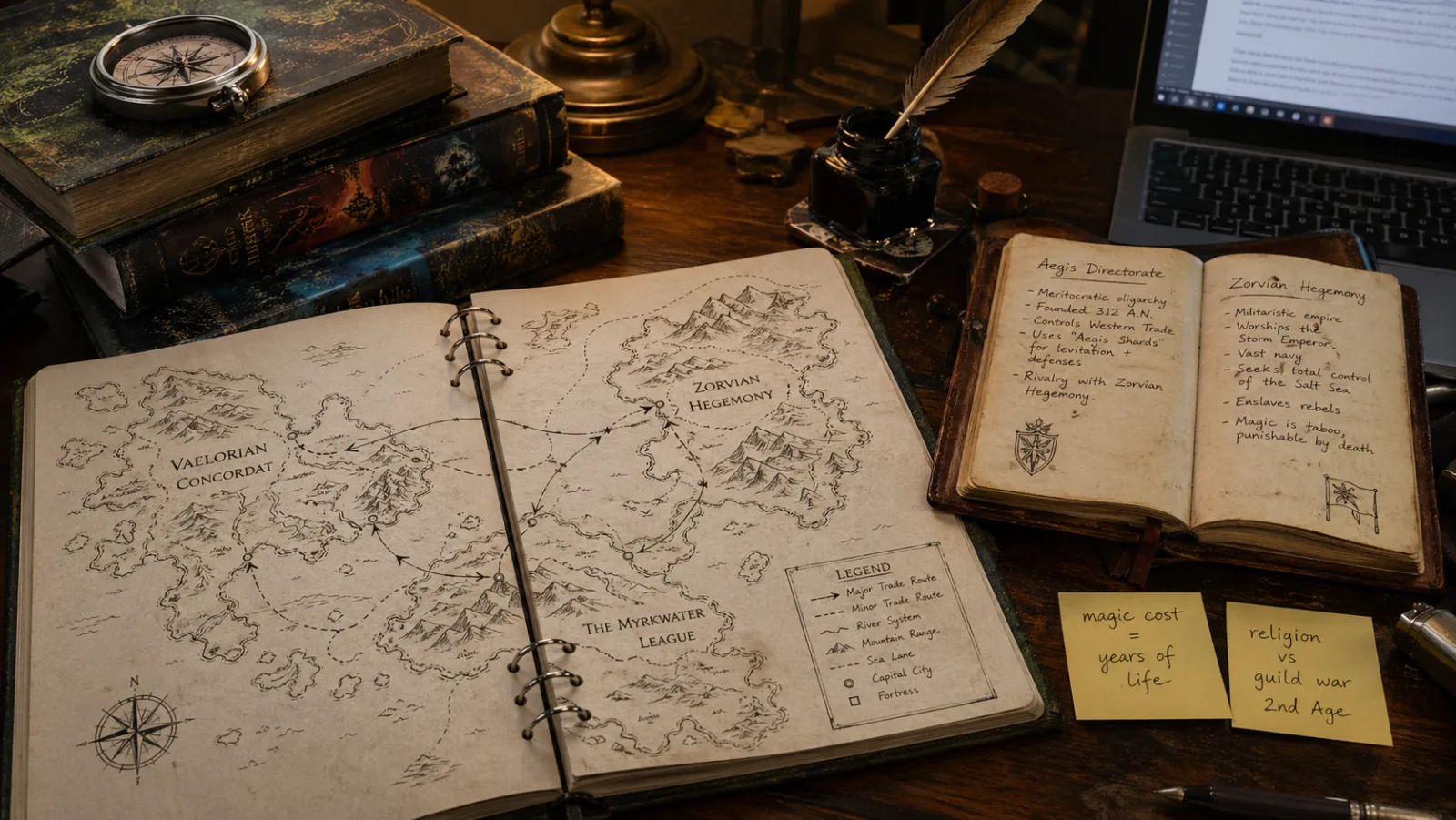
A worldbuilder's desk in warm afternoon light: an open ring-bound notebook with a hand-drawn world map showing kingdoms, mountain ranges, river systems, and a labelled trade-route legend; stacks of hardcover fantasy and sci-fi novels (no readable titles); a pewter compass; an inkwell with a quill; a leather-bound journal with handwritten faction notes; a laptop angled at the edge showing a blurred chapter editor; sticky notes reading "magic cost = years of life" and "religion vs guild war 2nd Age" in cursive.
SM By Sam May Founder, Inkfluence AI Updated April 2026

AI worldbuilding software for novelists, TTRPG designers, and series authors is a tool that builds and maintains a single source of truth for a fictional world's magic system, factions, geography, calendar, and lore, then keeps those rules consistent across long-form output (a 90,000-word novel, a five-session campaign, or a multi-book series). Inkfluence AI is a free-to-start worldbuilding platform with a story-bible-locked codex that re-injects world rules into every chapter or scene generation, fantasy and sci-fi subgenre blueprints, free standalone tools for character bibles and story bibles, and ACX-spec audiobook narration for finished novels. Subscriptions start at $9.99/mo all-included with no separate API key, no token-counting, and full commercial rights to everything you create.

See Real AI-Generated Books

Flip through actual pages created by Inkfluence AI - professionally formatted and export-ready.

Previewing: The Tiny Launch Kit

Loading preview...

Page 1 of 12
Swipe to browse
Professional formatting
Branded cover
Table of contents
Export PDF or EPUB

World-rule-locked, faction-aware, series-aware

AI worldbuilding software for novelists, TTRPG designers, and series authors

Why worldbuilders need a different tool than a wiki or a general chatbot

Worldbuilders fall into two failure modes that are well-documented in the worldbuilding community. The first is the Tolkien trap: spending two years building a 50,000-word world bible without ever finishing a chapter. The second is the chatbot trap: drafting a novel directly in ChatGPT or Claude and watching the magic system, faction politics, and named characters drift after roughly 8,000 to 20,000 tokens because no system holds the rules in place. The middle path is a tool that lets you build a 1,500 to 4,000-word world bible (the right size, beyond which AI tools start over-weighting the bible during chapter generation), then re-injects that bible into every chapter or scene generation so the world stays consistent across the full draft. Inkfluence AI runs exactly this pipeline. The story bible is the architectural fix for both failure modes simultaneously: it forces enough discipline to keep the bible right-sized, and enough automation to keep the rules respected. Our free story bible generator produces a complete world-bible scaffold in one click across six fiction genres.

Building a magic system or a technology system the AI will respect across 30 chapters

The single highest-leverage worldbuilding decision is the cost of magic (or technology). A magic system with no cost is a story without stakes. A faster-than-light drive whose rules contradict between chapter five and chapter twenty-one is a one-star Amazon review. The healthy pattern is three to five rules with explicit costs (years of life, blood, memory, gold for fantasy; energy budgets, AI rights, propulsion limits, taboo tech for sci-fi), pinned into the bible, re-injected at every chapter. Beyond five rules, the system starts contradicting itself. Below three, it does not constrain enough to generate dramatic stakes. Our story bible generator defaults to this size on purpose. For deep character work alongside the worldbuilding, the character bible generator tracks voice, motivation, and flaw across the entire cast under the same bible.
  • Magic-cost consistency: if the wizard pays in years of life in chapter two, she still pays in chapter twenty-eight.
  • Faction politics persist: alliances, treaties, and trade routes do not silently reorganise mid-novel.
  • Three-to-five-rule magic systems beat thirty-rule magic systems. Cost, blocker, gift, taboo. Rest is decoration.

Ready to create your first ebook?

Go from idea to finished, exportable ebook in minutes. No writing experience required.

Start Creating Free

Faction politics that actually evolve (and the difference between evolution and contradiction)

Healthy worldbuilding has factions whose state changes over the course of the story. A treaty signed in chapter four is broken in chapter eighteen. A king who was an ally becomes an enemy. A guild that was wealthy is bankrupt. The trick is making the change feel earned rather than contradicted. The bible is where this happens. Each faction gets a one-sentence current state, plus an evolution flag noting what triggers a state change and when. When the AI drafts a chapter that crosses a known evolution point, the bible updates and the new state ships into the next chapter's prompt. Without a system that tracks faction state explicitly, generic AI rewrites alliances on every chapter without warning, which reads as continuity error rather than narrative development. Our story bible specifically supports this by tracking faction state separately from static rules, so worldbuilders can author political evolution intentionally.

Worldbuilding for novels vs worldbuilding for TTRPG campaigns

The format matters less than people think. The same world bible serves a 90,000-word fantasy novel and a five-session D&D campaign with minor tweaks. Novels need character voice notes (handled by our character bible generator), scene-level pacing, and chapter beats. TTRPG campaigns need encounter difficulty curves, NPC motivations, and player-facing handouts (which can be generated as short scenes from the same bible, then read aloud at the table). The story bible itself, magic and technology rules, factions, geography, and lore work identically across both formats. A worldbuilder running a TTRPG campaign while also writing a novel set in the same world specifically benefits from this: build the bible once, draft the novel and the campaign from the same source of truth, and the player handouts read like authentic in-world documents rather than DM-generated filler.

See what Inkfluence AI can do

Explore our tools, see real output examples, and find the right workflow for your needs.

Series-level worldbuilding across three, five, or ten books

Series worldbuilding is harder than single-novel worldbuilding because the bible has to survive across years of real time and across evolving plot arcs. The Wheel of Time runs fourteen books with a prophecy from book one paying off in book fourteen. A Song of Ice and Fire has foreshadowing planted in book one that has yet to resolve. Indie fantasy and sci-fi on KDP routinely run to four or five books in a series, with read-through rates from book one to book two sitting at 60 to 80 percent for fantasy and even higher for romantasy. Inkfluence persists your story bible inside a project and lets you duplicate projects with the bible intact for book two and beyond. The named cast carries forward. The magic-system rules carry forward. Faction state evolves intentionally rather than drifting. For multi-book workflows specifically, see our book series writer surface and the genre-specific guidance on the fantasy authors and sci-fi authors pages.

How big should a world bible be? The 1,500 to 4,000 word rule

Most worldbuilders fail by going too big, not too small. A 12,000-word codex is the most common size for an unfinished worldbuilding project; a 2,500-word bible is the most common size for a finished one. The reason is mechanical: AI tools that read the bible into every chapter prompt have a context-window budget, and beyond roughly 4,000 words of bible content the chapter quality starts dropping because the AI over-weights the worldbuilding context relative to the prose itself. The healthy pattern is a 1,500 to 4,000 word bible covering: three to five magic or technology rules, two or three factions with one strong sentence each, two or three settings with atmosphere notes, three named characters with voice and flaw, a calendar and timeline anchor, and three to five lore hooks the reader almost discovers. Beyond that, anything you write goes in a separate "deep lore" document for the writer's reference but not for AI injection. Our story bible defaults to the right size and warns when the bible grows past the AI-friendly threshold.

Common worldbuilding mistakes (and how the bible fixes each one)

Five patterns we see repeatedly on indie drafts and TTRPG campaigns: (1) Too many rules. Magic systems with thirty distinct mechanics are unworkable. Three to five rules generate more story than thirty. (2) No cost. Magic and technology that cost nothing produce stories without stakes. The bible should make the cost explicit and constant. (3) Cosmetic factions. Factions described only by name and colour palette do not generate political conflict. Each faction needs a one-sentence current state plus a one-sentence motivation. (4) Zero geography. A world without a map drifts spatially across chapters. Travel times, climates, and trade routes anchor the world physically. (5) The Tolkien trap. The 12,000-word bible that never produces chapter one. Cap at 4,000 words for AI injection and ship the novel before adding more. Each of these is fixable in the bible before chapter one is written, which is what the story bible generator exists to do.

Publishing a novel set in a richly-built world on KDP

Fantasy and sci-fi are two of the strongest genres on KDP. The fantasy tree splits into Epic, Sword & Sorcery, Urban, Paranormal, Coming of Age, Historical, and several romantasy-adjacent slots; the sci-fi tree splits into Hard SF, Space Opera, Military, Dystopian, Cyberpunk, Time Travel, First Contact, and Post-Apocalyptic. Selecting two of the ten available KDP categories at upload is the single highest-leverage discoverability decision an indie worldbuilder makes; pick one category where you can realistically rank top-100, then a second where the absolute top-10 is reachable. AI disclosure is required at upload but does not affect 70% royalty eligibility for list prices $2.99 to $9.99 or KDP Select enrolment. Our export produces a KDP-uploadable EPUB plus a JPG cover at Amazon's 1600x2560 spec in one click. See our AI disclosure policy guide for the specific language. Pricing for a first novel typically sits at $3.99 to $4.99 to hit both the 70% royalty band and an algorithm-friendly price point.

1,500-4,000

words: the right bible size for AI injection across a 90,000-word novel

3-5 rules

in a working magic or technology system. Beyond five they contradict; below three they do not constrain

$9.99

full novel cost on the Creator plan, vs $144+ on tool-sprawl alternatives

Why worldbuilding projects collapse (and what actually breaks)

The specific failure modes worldbuilders hit with general tools.

The 12,000-word codex with zero finished chapters

The Tolkien trap. Two years of bible work, no novel. Cap at 4,000 words for AI injection and ship chapter one before adding more.

Magic system drifts between chapter 4 and chapter 18

Costs blood in chapter four, costs nothing in chapter twelve, costs years of life in chapter eighteen. Generic chatbots cannot hold these rules. The bible locks them.

Faction politics flip silently

Two factions at war in chapter four are inexplicably allied in chapter seventeen. Faction state needs to be tracked explicitly, evolved intentionally, not drift on autopilot.

Wiki has no draft enforcement

A 50,000-word World Anvil wiki cannot stop your AI chatbot from inventing a new currency in chapter twelve. The bible has to live inside the writing tool, not adjacent to it.

From blank world to drafted novel or campaign in 30 days

A solo workflow that ships a real book or a playable campaign, not a half-built codex.

1

Build the world bible

Three to five magic or technology rules, two or three factions with one strong sentence each, named cast with voice notes, a calendar, lore hooks. Keep the bible 1,500 to 4,000 words.

2

Pick the format

Novel, TTRPG campaign, or both. The same bible serves both. Novel projects flow into chapter generation; TTRPG projects flow into scene-level handouts.

3

Draft chapters or scenes with continuity

Each generation reads the full bible plus the last chapter or scene's ending. Magic costs hold, faction politics hold, lore hooks flag for payoff.

4

Self-edit for world consistency

Four to eight hours of editing per novel focused on rule consistency, naming convention, voice register per culture or species, lore callbacks, and opening or closing chapter polish.

5

Cover, format, and publish (or run the campaign)

For novels: design the KDP-spec cover, export EPUB and PDF, upload to Amazon KDP with AI disclosure, set pricing in the 70% royalty tier. For campaigns: print player handouts, run the table.

What a worldbuilding-native AI tool gives you

Architectural features no general chatbot or wiki software ships out of the box.

Rule-Locked World Bible

Magic costs, technology limits, faction politics, and lore persist across every chapter generation. Chapter 28 honours the rules chapter 3 set.

  • Magic and technology consistency at the prompt level
  • Faction state tracked, evolution intentional
  • Lore hooks flagged for payoff

Worldbuilding Blueprints

Fantasy and sci-fi worldbuilding presets cover magic systems, kingdoms, factions, calendars, and lore in one structure. Generated in seconds, edited in your voice.

  • Fantasy: magic, kingdoms, prophecy, lineage
  • Sci-fi: technology, factions, AI rights, FTL
  • Adaptable to TTRPG campaigns and novel projects equally

KDP-Ready Output

EPUB plus JPG cover at Amazon's 1600x2560 spec, one click. ACX-compliant audiobook for Audible. No Calibre, no separate cover designer, no separate audiobook service.

  • EPUB + PDF + DOCX export
  • KDP-spec cover output
  • ACX-compliant audiobook narration

AI worldbuilding software vs general AI chatbots vs wiki software

Why a purpose-built worldbuilding tool beats either alternative once the world needs to hold across a novel or a campaign.

Capability Inkfluence AI (worldbuilding-native) ChatGPT / Claude / wiki software

Persistent world bible across sessions

Yes, injected into every chapter prompt No, context lost between sessions; wiki has no AI injection

Magic / technology rule consistency (30+ chapters)

Locked via story bible at the prompt level Drifts after ~15k tokens; wiki cannot enforce in drafts

Faction politics state tracking

Faction state persists, evolution flagged intentionally Re-explained chapter by chapter, alliances flip silently

Subgenre worldbuilding blueprints

Fantasy + sci-fi blueprints with worldbuilding presets Manual prompt engineering every time

Series-level continuity (book 1 to book 5)

Project duplication preserves bible Start over per book; wiki shared but no draft enforcement

KDP-ready EPUB + cover export

One click, JPG at 1600x2560 Copy-paste to Word, convert with Calibre, design cover elsewhere

Standalone bible generator (no sign-up)

Yes, free with unlimited regenerations Build wiki manually or pay per query

Cost to produce a novel from a built world

$9.99 one month $144 to $371 with AI-narrated audiobook, $1,144+ with human ACX narration

What You Can Create

The Fantasy Series Worldbuilder

Multi-POV epic fantasy or romantasy series where book one plants threads that book three pays off. Worldbuilding has to survive across 250,000+ words and three to five years of real time.

Example: a four-book romantasy series with a fae-court setting, dragon lineage, and a 4,000-word bible carried across all four books

The Hard-SF Trilogy Author

Multi-POV hard SF with rigorous physics, large faction casts, and political evolution across three books. The bible is the trilogy's spine.

Example: a three-book hard-SF trilogy with consistent FTL rules and twenty named characters across 750 pages

The TTRPG Campaign Designer

Five-session campaign with a deep world, NPC motivations, faction politics, and player handouts. Same bible serves the campaign and any tie-in fiction.

Example: a five-session D&D campaign with handouts, NPC voices, and faction state tracked across sessions

The Cross-Format Worldbuilder

Novelist who is also running a TTRPG campaign in the same world. The bible serves both formats; the campaign feeds character ideas back into the novel and vice versa.

Example: a novelist drafting an urban-fantasy series while running a Monster of the Week campaign in the same world

Frequently Asked Questions

Everything you need to know.

What does AI worldbuilding software actually do?
It maintains a single source of truth for a fictional world (magic system, factions, geography, calendar, named cast, lore) and re-injects that source into every chapter or scene generation, so a 90,000-word novel or a five-session campaign keeps internal consistency without the writer holding it all in memory. The architectural fix is the bible-into-prompt pipeline; without it, AI tools drift after roughly 15,000 tokens regardless of how well-built the world is.
How big should a world bible be?
1,500 to 4,000 words for a single 90,000-word novel; 5,000 to 12,000 words for a multi-book series. Beyond 4,000 words for a single novel, AI tools start over-weighting the bible content during chapter generation and prose quality drops. The healthy bible covers: three to five magic or technology rules, two or three factions with one strong sentence each, two or three settings with atmosphere notes, three named characters with voice and flaw, a calendar, and three to five lore hooks. Beyond that, anything goes in a separate deep-lore document for the writer's reference but not for AI injection.
How is this different from a wiki like World Anvil or Notion?
Wikis store information; they do not enforce it during drafting. A 50,000-word World Anvil wiki cannot stop your generic AI chatbot from inventing a new currency in chapter twelve, because the bible lives adjacent to the writing tool, not inside it. Inkfluence's story bible is read into every chapter prompt at generation time, which is the architectural fix wikis cannot provide. Wikis are great for static reference; bibles inside the writing tool are what enforce consistency during drafts.
Does this work for sci-fi worldbuilding as well as fantasy?
Yes, with sci-fi-tuned blueprints. The story bible structure is the same: three to five technology rules with explicit costs, two or three factions, named cast, calendar, lore hooks. Hard SF, space opera, cyberpunk, dystopia, and first contact each have their own subgenre blueprints. See our <a href="/for/sci-fi-authors" class="text-indigo-600 hover:underline">sci-fi authors page</a> for the full sci-fi workflow.
Can I use this for TTRPG campaigns?
Yes, and many of our power users run a TTRPG campaign in the same world they are writing a novel in. The bible serves both formats. Novels flow into chapter generation; campaigns flow into scene-level handouts that read like authentic in-world documents rather than DM-generated filler. NPC motivations and faction politics from the bible drive both formats consistently.
How do I build a magic system the AI will respect?
Three to five rules with explicit costs is the right pattern. Beyond five rules the system contradicts itself; below three it does not generate dramatic stakes. Costs should be specific (years of life, blood, memory, gold) and constant across chapters. Pin the rules in the bible at the start of the project. The <a href="/ai-story-bible-generator" class="text-indigo-600 hover:underline">story bible generator</a> produces a complete magic-system scaffold in one click across six fiction genres.
Can I write a series with consistent worldbuilding across books?
Yes. The story bible persists inside a project, and you can duplicate projects with the bible intact for book two and beyond. Named cast carries forward. Magic-system rules carry forward. Faction state evolves intentionally rather than drifting. Read-through rates from book one to book two sit at 60 to 80 percent for fantasy and even higher for romantasy, so the bible is the load-bearing piece that makes book two feel like the same world.
Can I publish AI-assisted worldbuilt novels on Amazon KDP?
Yes. Amazon KDP permits AI-generated and AI-assisted content with disclosure during the publishing flow. See the <a href="https://kdp.amazon.com/en_US/help/topic/GVBQ3RM2QCZPZE6W" target="_blank" rel="noopener">current KDP AI guidelines</a>. Disclosure does not affect eligibility for the 70% royalty tier (list prices $2.99 to $9.99) or KDP Select enrolment. Our export produces a KDP-uploadable EPUB plus a JPG cover at Amazon's 1600x2560 spec, ready to upload in one click.
How long should I spend on worldbuilding before starting chapter one?
One to two days for a single novel; one week for a multi-book series. Beyond that, you are likely in the Tolkien trap. The fastest path is to use the <a href="/ai-story-bible-generator" class="text-indigo-600 hover:underline">story bible generator</a> to produce a 1,500 to 4,000-word bible scaffold in seconds, edit voice and flaw notes for the named cast, and start chapter one the same week. Worldbuilding that takes longer than this is usually procrastination dressed as craft.
What is the best free AI for worldbuilding in 2026?
Inkfluence AI's free tier leads in free-plan generosity (5 chapters to start plus 5 every month, full commercial rights, PDF export) because most competitor free tiers cap at a few hundred words or lock export behind a paywall. The standalone <a href="/ai-story-bible-generator" class="text-indigo-600 hover:underline">story bible generator</a> and <a href="/ai-character-bible-generator" class="text-indigo-600 hover:underline">character bible generator</a> are unlimited and free with no sign-up. Our <a href="/best-ai-novel-writer-2026" class="text-indigo-600 hover:underline">ranked comparison of 8 AI novel writers</a> covers the full breakdown.
What does it cost to write and publish a worldbuilt novel with AI?
A full 90,000-word novel costs $9.99 on the Creator plan because cover design, EPUB and PDF export, DOCX export, and ACX-spec audiobook narration are all included in one subscription. Tool-sprawl alternatives run $144 to $371 per novel for an AI-narrated workflow, and run $1,000-$4,000+ higher if you commission human ACX narration. See our <a href="/blog/real-cost-byok-vs-all-included-ai-novel-writer-2026" class="text-indigo-600 hover:underline">BYOK vs all-included cost breakdown</a> for the full comparison.
Can I import a world bible I have already built?
Yes. Paste your existing bible content into the project setup. The AI uses your structure rather than generating from scratch. If your existing bible is over 4,000 words, the system will trim or section it for AI injection while keeping the full document available for your reference. This is the most common path for writers migrating from a wiki or a long-form document.

Explore More Use Cases

AI Book Writer

The full AI book writer with persistent story-bible context — every chapter is generated knowing your world rules

AI Story Bible Generator

Free tool that builds magic system, world rules, faction politics, lore, and plot threads in one click

AI Character Bible Generator

Free tool that builds a complete character profile (voice, motivation, flaw, backstory, three-beat arc) for the cast in your built world

AI Novel Writer

Expand the world bible into a full chaptered novel with continuity at every chapter

Best AI Novel Writer 2026

Eight tools ranked and compared on continuity, worldbuilding, and full-novel support

Best Novel Writing Software 2026

Sister listicle with the real per-novel cost table including hidden API fees

Real Cost: BYOK vs All-Included

Cost-breakdown of BYOK API fees vs all-included pricing per novel

For Fantasy Authors

Fantasy-specific subgenre blueprints (epic, dark, urban, romantasy, sword and sorcery)

For Sci-Fi Authors

Sci-fi-specific subgenre blueprints (hard SF, space opera, cyberpunk, dystopia, first contact)

For Novelists

General novelist workflow including non-fantasy, non-sci-fi genres

For Fiction Authors

General fiction workflow including short stories and novellas

For Series Authors

Multi-book continuity, project duplication, and rapid-release support for built worlds spanning multiple novels

AI Book Series Writer

Multi-book series with shared characters and world continuity

AI Chapter Generator

Generate single chapters with full story-bible continuity

AI Novel Editor

Continuity sweep, voice consistency, and worldbuilding-rule audits

AI Interactive Fiction Generator

Free branching-story plotter for gamebooks and CYOA novels set in built worlds

Book Outline Generator

Free 10-chapter outline tool across eight genres including fantasy and sci-fi

Build the world. Then ship the novel.

Free plan gives you 5 chapters plus 5 every month, full commercial rights, and PDF export. The story bible holds your magic system, factions, and named cast across the whole novel. The standalone story bible and character bible generators are free with no sign-up.