
AI Story Bible Generator
The blank-page story bible problem, solved in one click. Pick a genre, hit generate, and get a complete novel bible: three main characters with voice and flaw, two supporting cast, world rules, setting, lore hooks, and plot threads to set up and pay off. Edit what you keep, regenerate what you don't, drop it into your novel project.
Quick answer
A story bible is the master reference document for a novel: every named character with their voice and flaw, every world rule, every setting, and every plot thread that sets up and pays off across the book. This generator produces a complete bible scaffold in one click across six fiction genres (fantasy, mystery, sci-fi, horror, romance, literary), unlimited regenerations, no sign-up. Edit what resonates, regenerate what doesn't, then drop the result into your novel project. Inkfluence AI is the AI book writer and AI ebook maker that reads the story bible into every chapter generation and shapes a full story arc across the book (rising stakes, a real low point, a payoff), so the bible you build here flows directly into a coherent, KDP-ready novel.
Build in seconds
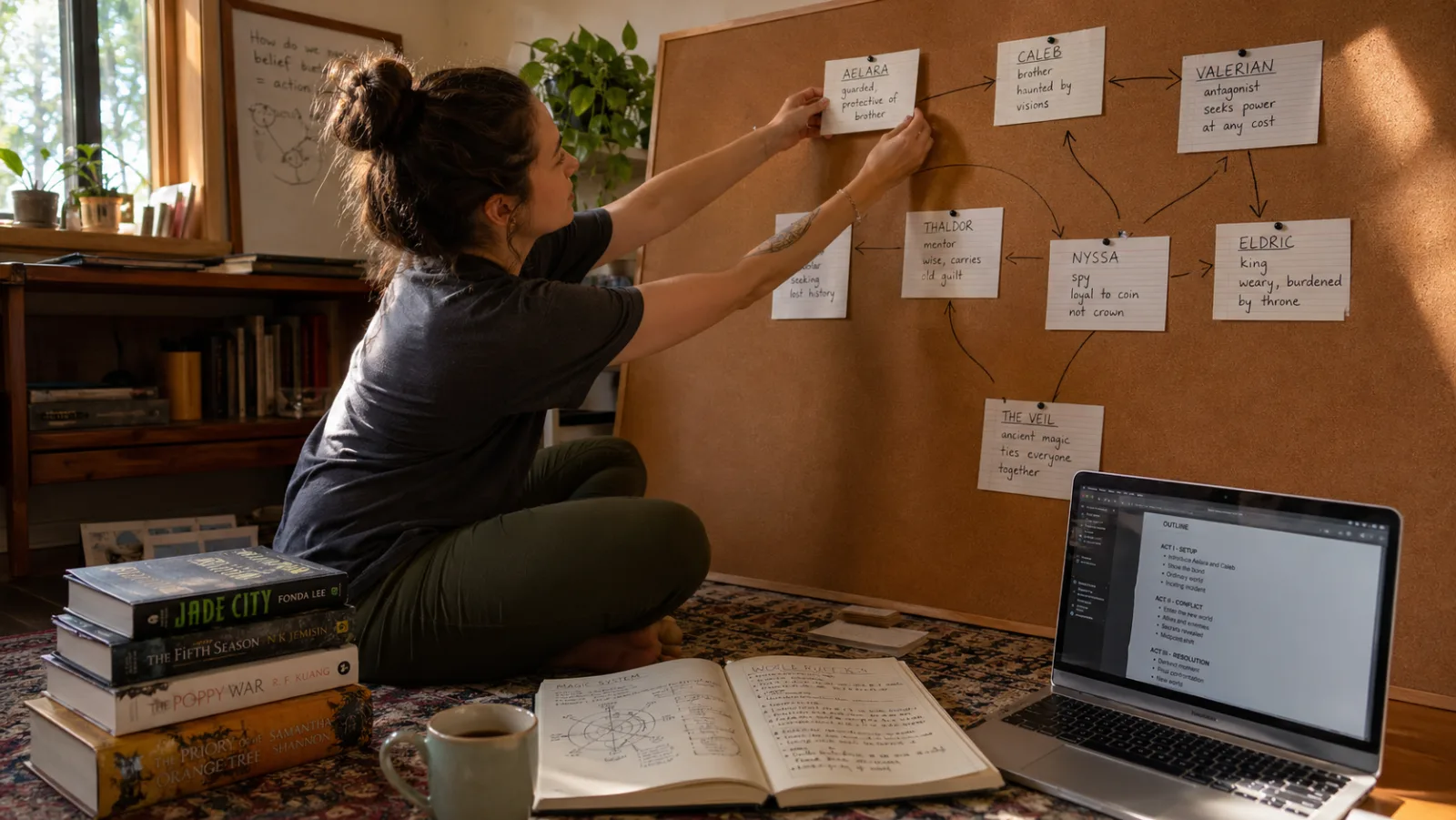
Generate a complete story bible
Pick a genre and click generate. Each click produces a fresh bible with characters, world rules, setting, lore, and plot threads. Regenerate as many times as you want until something clicks.
Like the bible? Use it as the foundation for your novel in the AI novel writer.
Write the full novelThe bible
Why every novel needs a story bible (and why most novelists skip it)
A story bible is the master reference document for a novel. Every named character with their voice, age, motivation, and flaw. Every world rule (magic system, technology limits, social hierarchy). Every setting with its atmosphere and history. Every plot thread that sets up early and pays off late. Professional novelists keep one. Indie novelists who skip it tend to write Chapter 28 contradicting Chapter 3, which is the most common one-star Amazon review for indie fiction.
The reason most novelists skip the bible is not that it's hard, it's that it's blank-page work upfront. You sit down to write your novel, you're excited, and the system says "first, fill in 2,000 words of character notes." Most novelists never finish that step. They start drafting the novel, the characters drift, and by chapter twelve the bible is a vague recollection of "I think she's a botanist? Or maybe an architect?" By the time they hit the editing phase, the continuity errors are baked in.
The fix is to never start the bible from a blank page. This generator produces a complete starting scaffold in seconds: three main characters with voice and flaw notes, two supporting cast, three to five world rules, a setting, lore hooks, and plot threads designed to set up early and pay off late. You read it, edit what resonates into your own voice, and discard or regenerate what doesn't. Most novelists report 30 to 60 minutes of editing instead of a full afternoon of generation. The hardest part of bible work is starting. Skip that part.
Story bibles are not unique to Inkfluence. Sudowrite ships a feature called Story Bible and Novelcrafter ships one called Codex. The difference is what happens after the bible is built. Sudowrite and Novelcrafter store the bible but require the user to manually re-inject it during chapter prompts; the AI book writer mode of Inkfluence reads the bible into every chapter generation automatically, so character names, voice notes, and world rules don't drift even at chapter forty. This is the difference between a story bible that exists and a story bible the AI actually uses.
Why bibles win, the continuity math
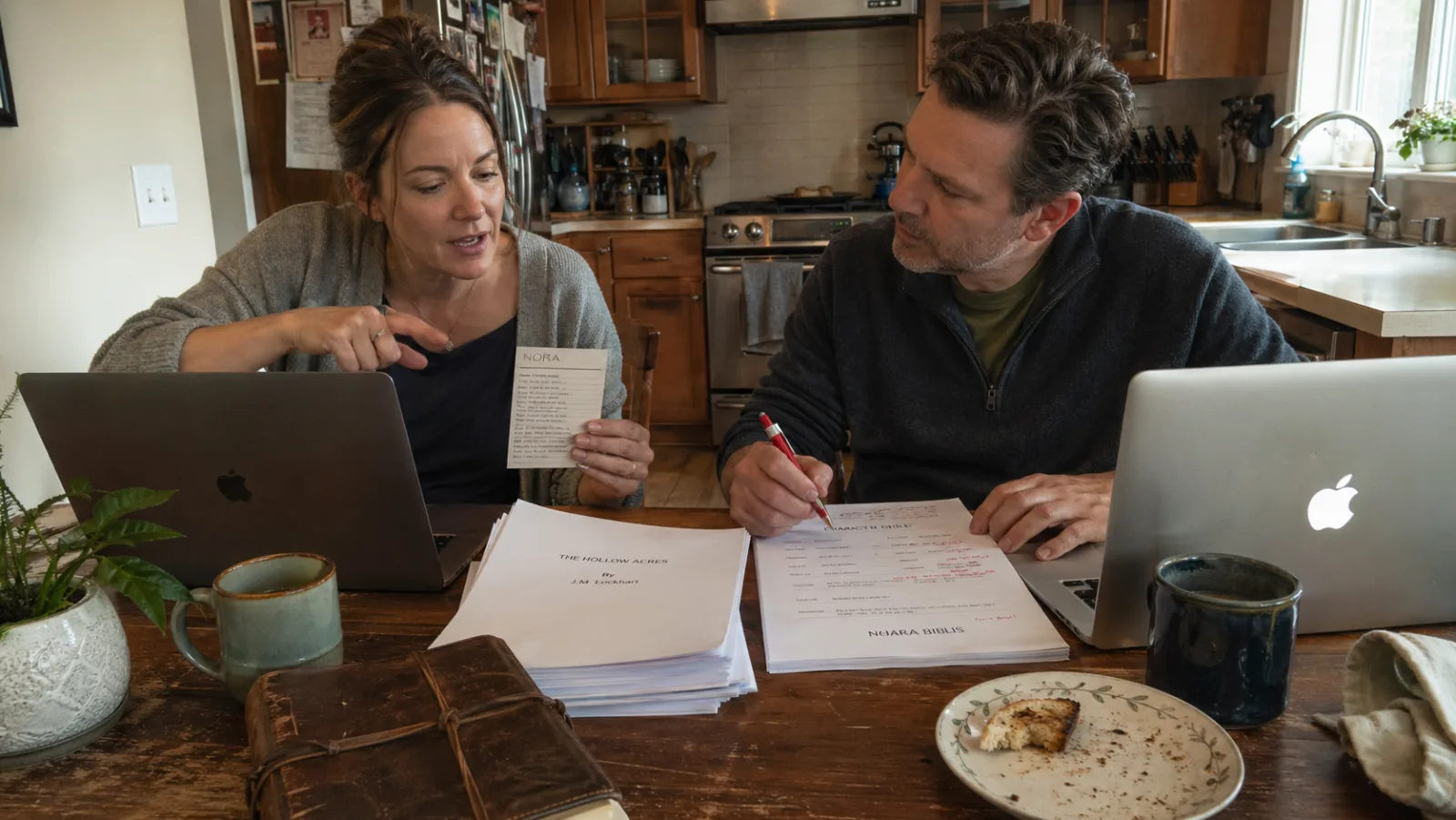
Continuity errors are the single most common one-star Amazon review for indie fiction. The two most-cited categories on KDP review pages: characters changing physical descriptions or jobs mid-novel, and world rules contradicting themselves between earlier and later chapters. Both are caught by a story bible used during drafting and missed by every novel that drafts without one. AI novel writers that read a bible at every chapter generation lock these errors out at the prompt level rather than catching them in revision.
Checklist
Five questions every story bible should answer
1. Who are the named characters and what makes each voice distinct?
Every named character with at least name, role, voice register (formal / clipped / wry / earnest / etc.), and a single defining flaw. If two characters in your bible could deliver each other's lines without changing meaning, one of them is not characterised strongly enough. The bible is the place to fix that, before chapter one.
2. What rules govern the world and which ones cannot be broken?
For fantasy: magic-system rules, what magic costs, who can use it, and what blocks it. For sci-fi: technology limits, FTL behaviour, AI rights, social hierarchy. For mystery: time pressure, jurisdictional limits, evidence rules. For literary fiction: socioeconomic context, the era's specific texture. Three to five rules is usually enough; more than that and the rules start contradicting each other.
3. What is the setting's atmosphere and what is its history?
A small town in autumn carries different weight than the same town in summer. A drowned city carries different weight than a coastal village. Atmosphere is half the novel's emotional register. The history (what happened ten or twenty years before page one) is what makes minor characters feel real.
4. What plot threads will set up early and pay off late?
A locket in chapter one. An iron coin appearing in the protagonist's pocket. A photograph the protagonist does not recognise. The bible should list three to five planted plot threads with their planned payoff. This is the single most underused part of a story bible and the single most reader-rewarding when done well.
5. What lore hooks does the reader almost discover?
The bible tracks the world's hidden depth even when the novel does not directly explain it on the page. The protagonist's grandmother's history. A war forty years before the story starts. A treaty that is technically still in effect. Readers sense lore even when they don't see it surfaced. Bibles that capture lore produce novels that feel three-dimensional rather than story-shaped.
Workflow
From bible to drafted novel in 30 days
Days 1-2: Generate and edit the bible. Click generate. Read every entry. Keep what fits your novel, regenerate what does not, edit voice notes into your actual register. By the end of day two you have a 1,500 to 4,000 word bible you can build a novel on. The bible saves into the same project that the Inkfluence AI book writer and AI ebook maker draw from, so what you build here flows directly into chapter generation and KDP-ready ebook export without re-entering anything.
Days 3-18: Draft the chapters. Move into the Inkfluence AI novel writer. The bible is read into every chapter generation, so character names stay locked, voice notes re-inject, world rules don't drift, and plot threads from earlier chapters flag for payoff. Target 3,000 to 5,000 words per writing day. A 60,000 to 90,000 word novel drafts in 12 to 16 active sessions.
Days 19-24: Self-edit. Read the full draft end to end. Update the bible as new characters and lore emerge mid-draft. The bible becomes a living document that catches continuity errors before publication. Use our dedicated AI novel editor to run a structural sweep against the bible.
Days 25-30: Cover, format, publish. Design the KDP-spec cover (1600x2560 JPG output), export EPUB and PDF, upload to Amazon KDP with AI-content disclosure, set pricing in the 70% royalty tier ($2.99 to $12.99), launch. The full KDP self-publishing walkthrough covers account setup, cover specs, pricing, and KDP Select enrolment in detail.
Verified references
Sources and further reading
Story-bible craft references, KDP policy, and AI-assistance guidelines behind the recommendations above.
Writer's Digest: novel craft guidance, character development, and worldbuilding fundamentals.
Reedsy Novel Writing Guide: professional editor perspectives on continuity, story bibles, and structural editing.
Amazon KDP AI Content Guidelines: AI disclosure required at upload, no impact on royalty eligibility for $2.99-$12.99 list prices.
US Copyright Office AI Policy: human-authored elements of AI-assisted novels remain copyrightable.
Alliance of Independent Authors: indie novelist editing-spend and craft-investment surveys.
Poets & Writers: literary fiction craft references and novelist publishing guidance.
Frequently Asked Questions
Everything novelists ask about story bibles before drafting a novel.
What is a story bible?
A story bible is the master reference document for a novel: every named character with their voice, age, motivation, and flaw; every world rule (magic system, technology limits, social hierarchy); every setting with atmosphere and history; every plot thread that sets up and pays off across the book. Professional novelists keep one. Indie novelists who skip it tend to write Chapter 28 contradicting Chapter 3, the most common one-star Amazon review for indie fiction. Story bibles are sometimes called codex, lore wiki, or novelist database. Same thing, different names.
Why does my novel need a story bible?
Without a story bible, character names drift across chapters, magic-system rules get inconsistent, secondary characters disappear and reappear with different jobs, and the timeline slips. Readers notice. With a story bible, your novel stays internally coherent across 60,000 to 100,000 words. The bible is also what AI novel writers read to generate chapters that respect your world. Without one, AI drafts collapse into generic prose by chapter ten.
What genres does this generator support?
Six genres with tuned templates: fantasy (magic systems, prophecies, kingdoms), mystery (clue placement, suspect tracking, reveal pacing), sci-fi (technology rules, first contact, dystopia logic), horror (dread escalation, survival, entrapment), romance (chemistry arcs, tropes, happily-ever-after structure), and literary or general fiction (voice-led prose, theme reinforcement, character interiority). Each genre's templates reflect what readers expect from the form.
How is this different from manually writing a story bible?
A blank-page story bible takes 4 to 12 hours of upfront work that most novelists never finish. This generator produces a starting scaffold in seconds, three main characters with voice and flaw, two supporting cast, three to five world rules, a setting, lore hooks, and plot threads, that you then edit into your voice. Most novelists report 30 to 60 minutes of editing instead of a full afternoon of blank-page generation. The hardest part of bible work is starting; this gets you past it.
Is the AI story bible generator free?
Yes. The story bible generator on this page is free with unlimited regenerations, no sign-up, and no credit card. Every click produces a fresh bible. Use it to plan as many novels as you want. If you want to expand the bible into a full chaptered novel with continuity locked at chapter generation, use the Inkfluence AI novel writer (free tier includes 5 chapters plus 5 every month with full commercial rights).
Can I use this for an existing novel I have already started?
Yes, and it is one of the highest-leverage uses. Most novelists who drafted 20,000 to 40,000 words manually never built a bible because it felt like make-work upfront. Generate the bible based on what you have already written, then update it with the characters and rules from your draft. The bible then catches continuity gaps in your existing manuscript and steers any AI-assisted continuation that follows.
How long should a story bible be?
For a single 60,000 to 100,000 word novel, the bible should run 1,500 to 4,000 words across all entries. For a series spanning multiple novels, plan 5,000 to 12,000 words. The trap is not too short, it is too long: when story bible entries balloon past 4,000 words for a single novel, AI tools start over-weighting bible content versus the prose, which produces stilted output. Concise entries with sharp voice notes beat exhaustive entries with everything-but-the-kitchen-sink.
What is the difference between a story bible and a codex?
Same concept, different names. 'Codex' is the term used in some AI novel-writing tools for their built-in bible system. Story bible is the older publishing term. Lore wiki is the term writers borrow from worldbuilding communities. Whichever name you use, the function is identical: a single source of truth for the rules of your fictional world that the writer (and the AI) can refer to without re-reading 80,000 words.
Can I publish a novel built from this bible on Amazon KDP?
Absolutely. The bible is internal scaffolding for your novel; it does not appear in the published book. You expand the bible into a full novel, edit the prose into your voice, design the cover, and upload to KDP with AI-assistance disclosure. Amazon KDP permits AI-assisted content with disclosure (no impact on royalty eligibility for $2.99 to $12.99 list prices). See current KDP AI guidelines.
Do I own the rights to the story bible I generate?
Yes. Everything you generate with this tool is yours to use commercially without royalties or attribution. Modify freely, keep what you like, discard the rest. The story bible is scaffolding; your novel is what you build on top of it, where the human authorship is highest and the copyright strongest (per current US Copyright Office guidance on AI-assisted works).
How is this different from filling in a story bible template?
Template-only tools give you blank fields to fill in yourself. This generator fills the fields for you with genre-tuned starting content, then lets you edit. Templates work for novelists who already know their characters and world. Generators work for novelists who are still discovering the story. Most useful: generate first, edit second, never start from blank fields again.
Can I share this story bible with co-writers, beta readers, or editors?
Yes. Copy the generated bible into a Google Doc, Notion page, or shared workspace. Co-writers can edit collaboratively. Beta readers can use it as a reference when reading your draft. Editors can flag continuity issues against it during their structural pass. The bible becomes the team's source of truth for every named character, world rule, and plot thread in the novel.
Is the AI story bible generator part of the wider AI book writer and AI ebook maker?
Yes. The story bible generator on this page is the upfront-planning entry point into the broader Inkfluence AI book writer and AI ebook maker. The same engine that builds the bible reads it into every chapter generation in the AI novel writer, runs a continuity sweep against it in the AI novel editor, and exports the finished novel as a KDP-ready EPUB ebook. The full AI book writer covers all 33 content types from novels to lead magnets to non-fiction ebooks. Story bible generation is free with unlimited regenerations; chapter generation starts at 5 free per month, paid plans from $9.99/month.
Build the bible. Then write the novel.
Use this generator to scaffold your story bible for free. Then expand the bible into a full chaptered novel with the Inkfluence AI novel writer, the fiction mode of the broader AI book writer and AI ebook maker. 5 chapters free every month, full commercial rights, no credit card.
Related tools for novelists
Everything else in the plotting and drafting toolkit.
AI Sci-Fi Story Generator
Technology rules held in a story bible to the last chapter
AI Fantasy Novel Writer
Magic rules, names and map held in a story bible for the whole book
Sudowrite vs Novelcrafter
Two story records compared: Story Bible against Codex
Inkfluence AI vs ProseEngine
Book generation, continuity checks, audiobooks and pricing, head to head with prices verified September 2026.
AI Book Writer
The full engine the bible feeds into. 33 content types: novels, business books, lead magnets, cookbooks, and more.
AI Ebook Generator
The AI ebook maker side: generate the finished ebook with cover, EPUB export, and KDP-ready formatting.
AI Character Bible Generator
Sister tool. Deep-dive on a single character with voice, motivation, flaw, backstory, three-beat arc.
AI Novel Writer
Expand your bible into a full chaptered novel with story-bible continuity at every chapter.
Book Outline Generator
10-chapter linear outline across 8 genres for traditional novels.
AI Interactive Fiction Generator
Plot a branching gamebook with two main choices and six endings.
Best Novel Writing Software 2026
8 platforms ranked with the real per-novel cost table.
Best AI Novel Writer 2026
Sister listicle ranking 8 AI novel writers across novel-specific criteria.
Real Cost: BYOK vs All-Included
Why BYOK platforms quietly cost 3-4x their advertised price for one finished novel.
For Novelists
Story-bible continuity, fiction blueprints, KDP-ready export.
For Fantasy Authors
Fantasy-specific blueprints with magic-system-locked continuity across 30+ chapters.
For Sci-Fi Authors
Sci-fi-specific blueprints with technology-rule-locked continuity for hard SF, space opera, and cyberpunk.
For Worldbuilders
Cross-genre worldbuilding for novelists, TTRPG designers, and series authors.
Write a Book Series with AI (Video)
Continue a finished book as a series: the story bible and what already happened carry into the next book.
For Series Authors
Multi-book continuity for indie series, quarterly release cadence, KDP series functionality.