For Novelists

AI Writing Software Built for Novelists

Plot a 60,000 to 120,000 word novel, draft every chapter with story-bible continuity, export a KDP-ready EPUB plus cover in one workflow. Purpose-built for long-form fiction, not a generic chatbot dressed up as a novel tool.

If you searched for AI writing software for novelists, AI novel writer with chapter continuity, free AI novel writer unlimited, or AI tool for a 90,000-word novel, this is the workflow from premise to published.
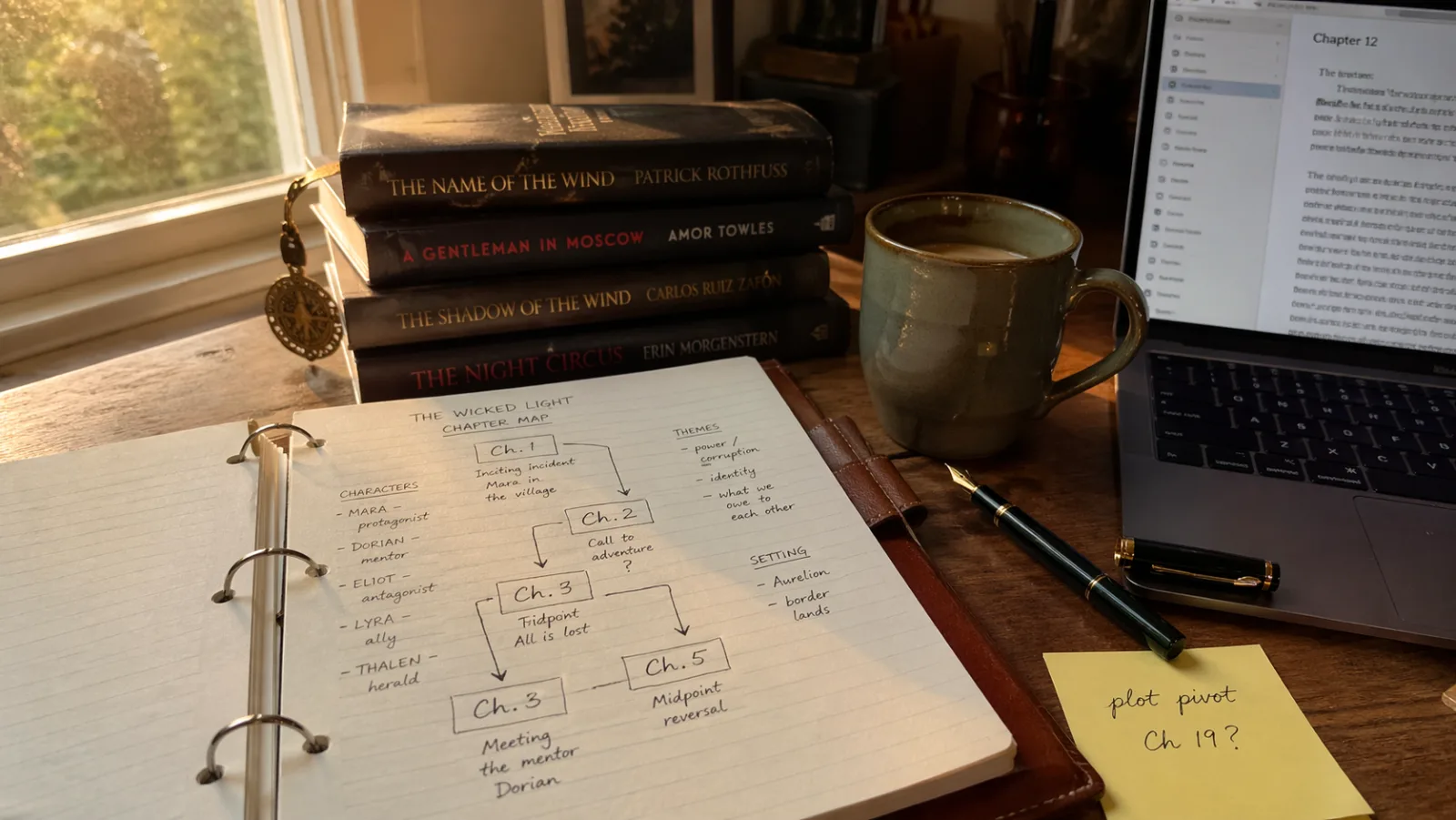
A novelist's home writing desk photographed in warm afternoon window light, showing an open ring-bound notebook with a hand-drawn chapter map across chapters 1 through 6, a laptop angled at the edge of the desk displaying a blurred chapter editor, a stack of hardcover literary novels, a ceramic mug half full of coffee, a fountain pen, and a sticky note reading "plot pivot Ch 19?" in cursive, illustrating the novelist workflow from outline to chapter draft.
SM By Sam May Founder, Inkfluence AI Updated April 2026

AI writing software for novelists is a purpose-built platform (as opposed to a generic chatbot) that plots a full-length novel, drafts chapters with persistent story-bible continuity across 80,000+ words, and exports a KDP-ready EPUB plus cover in one workflow. Inkfluence AI is a free-to-start novelist tool that covers plotting, chapter generation, cover design, ACX-spec audiobook narration, and EPUB/PDF/DOCX export on a single subscription starting at $9.99/mo (vs $259+ when using separate tools for draft, cover, audiobook, and conversion). It supports six fiction genres (romance, mystery, fantasy, sci-fi, horror, thriller), tracks character voice across 30+ chapters, and permits commercial use and Amazon KDP publishing with AI disclosure.

See Real AI-Generated Books

Flip through actual pages created by Inkfluence AI - professionally formatted and export-ready.

Previewing: The Tiny Launch Kit

Loading preview...

Page 1 of 12
Swipe to browse
Professional formatting
Branded cover
Table of contents
Export PDF or EPUB

Purpose-built for long-form fiction

AI writing software for novelists that actually finishes the book

Why novelists need a different tool than a general AI chatbot

A novel is not a blog post scaled up. At 80,000 words, you are writing a protagonist whose flaw in chapter one has to pay off in chapter thirty-two, a minor character from chapter five who reappears in chapter nineteen, and a world whose rules cannot contradict themselves between chapter ten and chapter twenty-four. ChatGPT and Claude are capable drafting tools at the scene level but they lose context after roughly 8,000 to 20,000 tokens which means they start fabricating character details, renaming supporting characters, and forgetting the weapon your hero picked up in chapter one. Inkfluence AI runs a persistent story bible and chapter continuity system that injects the characters, world rules, and prior chapter endings into every new chapter generation, so chapter twenty-eight still remembers chapter two. This is the architectural gap that separates novel-native AI novel writers from repurposed chatbots. Our ranked 2026 comparison benchmarked eight tools on real novel projects and this gap is the single biggest ranking signal.

Plotting a 90,000-word novel with AI without losing the through-line

Most novelists fail at the plotting stage, not the prose stage. The writing gets hard when the structure is weak. Inkfluence generates a chapter-by-chapter outline tailored to your genre using the common novel structures (three-act, Save the Cat, Hero's Journey, seven-point) and then lets you name your protagonist, antagonist, supporting cast, setting, magic or technology rules, and tone before the first chapter is drafted. The outline includes act breaks, the inciting incident, pinch points, the midpoint reversal, the dark night of the soul, the climax, and the resolution. For branching narratives or gamebook-style interactive novels, our free AI interactive fiction generator plots a branching tree with two main choices, four sub-choices, and six distinct endings. Whichever structure you pick, the outline flows into chapter generation with every beat pre-allocated, so you write into a plan rather than against a blank page. Stuck on chapter titles? The free outline generator produces 10-chapter linear outlines across eight genres in seconds.
  • Outline to chapter pipeline: every beat you name in the outline becomes a chapter prompt with the right context injected.
  • Story bible persists across chapter regenerations. Character names, ages, motivations, voice notes, and flaw arcs stay locked.
  • Genre-aware pacing: thriller chapters target 2,000 to 3,000 words for momentum, literary chapters target 4,000 to 5,000 for depth, epic fantasy varies.

Ready to create your first ebook?

Go from idea to finished, exportable ebook in minutes. No writing experience required.

Start Creating Free

Chapter continuity across 30, 50, or 80 chapters

Continuity is the single hardest problem in long-form fiction. The character names drift, the timeline slips, the picked-up-in-chapter-one weapon is missing by chapter four, and the villain's motivation changes between the midpoint reveal and the climax. Readers notice. One-star reviews on Amazon KDP for indie fiction disproportionately cite continuity breaks. Inkfluence addresses this at the architecture level: each chapter generation reads the full story bible, the summary of all prior chapters, and the last chapter's ending verbatim, then drafts the new chapter with those hard constraints. Character names are locked. Voice notes are re-injected. Plot threads from earlier chapters are flagged as due-for-payoff. For fiction novels, chapter dispatch is sequential by design so each new chapter knows exactly what came before. Our dedicated chapter generator is the same continuity pipeline exposed as a standalone tool for one-off chapter work or when you want to finish a novel you have already started.

Is there a free AI novel writer? What you actually get on the free tier

Yes. Inkfluence AI's free plan gives novelists five AI-generated chapters to start plus five more every month with full commercial rights, PDF export, and unlimited projects. Unlike most free AI novel writer tools which cap output at a few hundred words or lock EPUB behind a paywall, our free tier produces real full-length chapters (2,000 to 5,000 words each) that count toward a genuine novel-length manuscript. That is enough to draft a 25,000 to 50,000 word novella on the free tier alone or to test whether the chapter continuity and fiction blueprints actually hold up before committing to a subscription. The Creator plan at $9.99/mo removes the chapter cap and unlocks EPUB, DOCX, and ACX-spec audiobook export. Most novelists complete a full novel on Creator in a single billing month, then cancel if they are between books. See the full side-by-side of what each tier includes on our pricing page. For a broader comparison of free AI novel writing tools in 2026 see our ranked listicle of eight tools.

See what Inkfluence AI can do

Explore our tools, see real output examples, and find the right workflow for your needs.

AI novel writer vs AI ghostwriter: what is the difference for novelists?

These terms overlap but have different implications. An AI ghostwriter is a tool that writes chapters on your behalf, typically without strong continuity systems, aimed at producing a finished manuscript from a brief with minimal author involvement. An AI novel writer is a collaboration tool: you provide the outline, characters, and voice guidance, and the tool drafts chapters that you then edit and polish. Inkfluence sits firmly in the second camp. The prose is yours to edit before publishing and the commercial rights belong to you on every plan including free. The ghostwriter framing is closer to traditional for-hire ghostwriting (typically $15,000 to $75,000 and six to eighteen months) compressed into a software cost. Our AI ghostwriter page covers the workflow when you want to hand the AI more of the drafting burden; this novelist page assumes you want to stay in the creative driver's seat.

Can AI continue writing a novel you already started?

Yes. If you have the first five, ten, or twenty chapters of a novel drafted in Word, Google Docs, or Scrivener, you can import your manuscript directly into Inkfluence (DOCX, PDF, or EPUB), build the story bible from your existing characters, and let the AI draft the next chapter in your established voice. The "continue writing AI" workflow is one of the most common novelist use cases in 2026: writers who drafted 30,000 words manually and stalled, now want AI to help push through to the finish line without breaking the voice they already established. The key is feeding the system your existing chapters as context. The story bible extracts character names, settings, and tone from what you wrote, and every new chapter reads the last chapter's ending verbatim. This is the opposite failure mode from ChatGPT, where continuation rapidly drifts because the chat memory is too shallow to hold the novel's established rules. For a guide on finishing a stalled manuscript, see Can AI outline and write chapters in sequence?.

The novelist's publishing workflow: outline to KDP in 30 days
Realistic novelist timelines for AI-assisted drafting have tightened dramatically in 2026. A well-planned 60,000 to 90,000 word novel drafted with AI assistance and edited by the author typically ships in 30 days of solo work: Days 1-2 plotting: define the premise, build the story bible, generate the chapter outline. Days 3-18 drafting: generate each chapter in the editor, revise voice and emotional beats by hand, 3,000 to 5,000 words per day. Days 19-24 self-editing: read the full manuscript end to end. Fix continuity breaks the AI missed. Tighten dialogue. Strengthen opening and closing hooks. Cut filler. Days 25-28 cover and formatting: design the cover with our built-in cover designer (KDP-spec 1600x2560 output), export EPUB and PDF. Days 29-30 publish: upload to Amazon KDP with AI-content disclosure, write the book description using our description generator, set pricing (target $2.99 to $9.99 for the 70% royalty tier), and launch.

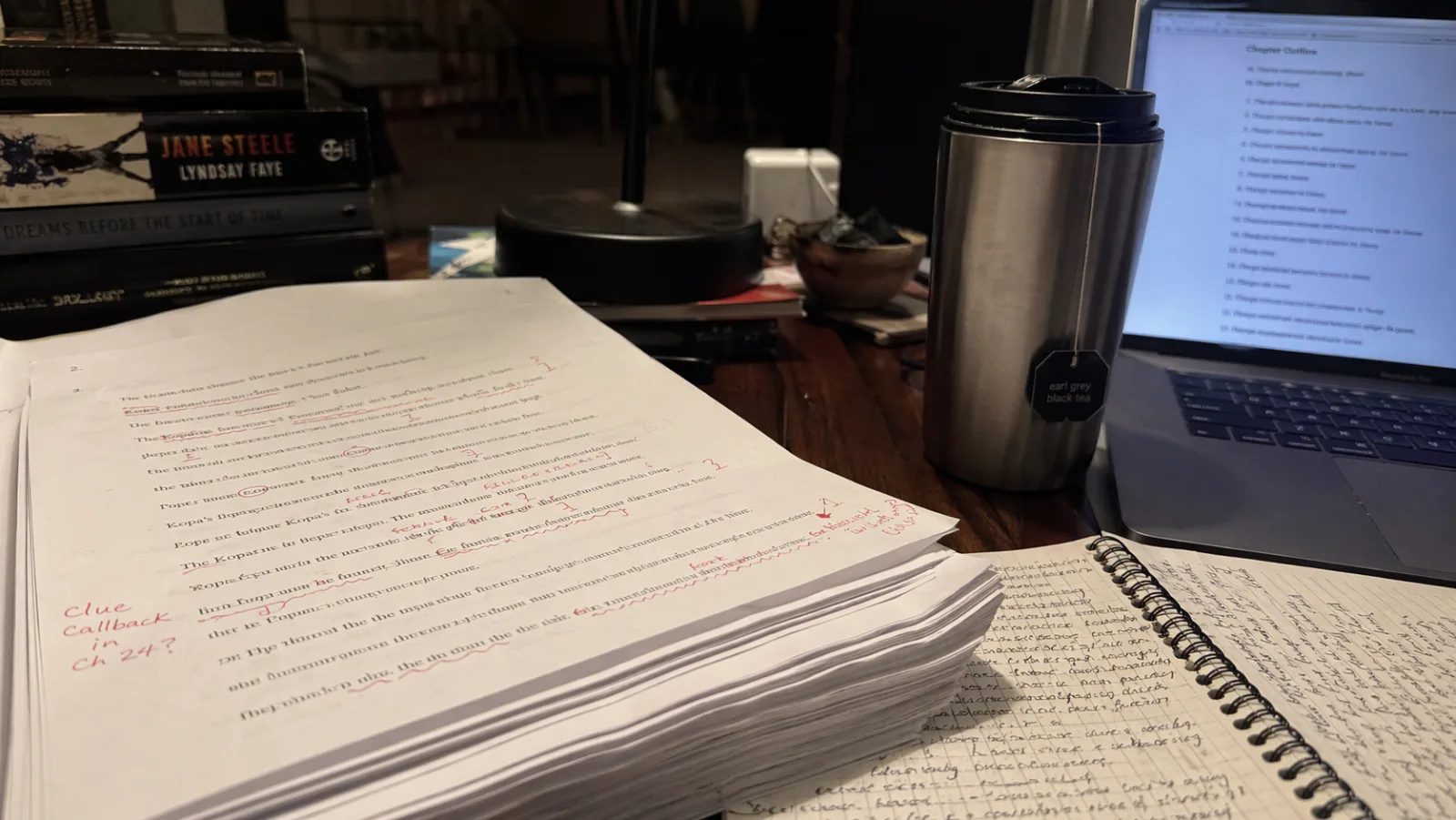
A novelist's printed manuscript covered in red-pen edits, circled passages, and handwritten margin notes reading 'clue callback in Ch 24?', with a thermos of tea and a scruffy notebook beside the stack and a thin laptop blurred in the background showing a chapter outline, photographed under warm overhead lamplight at night during a revision session.
The revision pass is where the novel becomes yours. AI drafts the plot, you add the emotion, the sensory detail, and the sentences that make readers pause.
For genre-specific guides, see mystery and thriller, romance, or general fiction authors.

Can I use AI to write a novel and sell it on Amazon KDP?

Yes. Amazon KDP permits AI-generated and AI-assisted content in 2026 with disclosure during the publishing flow. You check a box indicating AI assistance when uploading; the disclosure is stored on Amazon's side but does not appear publicly on your listing. AI disclosure does not affect your eligibility for the 70% royalty tier (list prices $2.99 to $9.99), KDP Select enrolment, or algorithmic recommendations. Our AI disclosure policy guide covers the exact language to use and the rare edge cases where policy tightens (heavily AI-translated international editions, for example, face stricter review). Inkfluence exports a KDP-uploadable EPUB manuscript plus a JPG cover at Amazon's 1600x2560 spec in one click, so you skip the Calibre conversion step and the separate cover designer that most competing tools force on you. Launch-day pricing for a first novel typically sits at $2.99 to $4.99 to hit both the 70% royalty tier and an algorithm-friendly price point.

NaNoWriMo, 100-day novel challenges, and the rapid-release playbook

The 50,000-word NaNoWriMo target is 1,667 words per day across November. Novelists on AI tooling routinely exceed that target at a pace closer to 3,000 to 5,000 words per active writing day, which means a NaNoWriMo novel can be drafted in roughly 12 to 16 sessions rather than 30. The rapid-release indie playbook (four books per year, shared universe, email list growth between launches) is only possible with tooling that handles the production overhead. Our platform sits comfortably inside this model: persistent projects for series work, fiction blueprints that handle genre conventions automatically, chapter-by-chapter regeneration so stuck scenes never block the whole book, and one-click exports to the formats your distributors require. Romance authors specifically have found that chapter-per-day pacing with AI first drafts lets them hit the quarterly release cadence that drives Amazon algorithm momentum. If your writing is already disciplined, AI compresses the production weeks; if it is not, AI removes the blank-page paralysis that kills most novels before chapter three.

Writing a novel series: continuity across three, five, or ten books

Series continuity is harder than single-novel continuity because the story bible has to survive across projects, across months or years of real time, and across evolving plot arcs. Inkfluence persists your characters, settings, and lore within a single project, and lets you duplicate projects with the story bible intact as a base for book two. For long-running series where the cast grows to twenty or more named characters, a dedicated codex is the scalable pattern (our book series writer surface covers this workflow). Romance series, cozy mystery series, and genre fantasy trilogies are the three highest-ROI formats for indie authors in 2026: readers who finish book one buy book two at 60 to 80 percent read-through rates, and book three readers are near-certain to buy book four on release day. The economics favour writing three connected novels over three unrelated ones. For interactive or gamebook-format series, our interactive fiction generator produces branching trees that can cross-reference earlier volumes.

Editing an AI first draft into your voice: the four-to-eight-hour rule

The honest truth about AI-assisted novels: the first draft is the easy part, the editing is where the book becomes yours. Plan on four to eight hours of editing per full novel. Where to focus: Voice consistency: read every chapter opening aloud. If it does not sound like you, rewrite it. Dialogue distinctness: each named character should have a recognisable voice. If two characters sound interchangeable, one of them is not characterised strongly enough in the story bible. Emotional beats: AI drafts the plot. You add the emotion, the sensory detail, the specific sentence that makes a reader pause. Continuity sweeps: scan for character names, object locations, and timeline facts that may have drifted across chapters. The story bible catches most of this, but human eyes catch the subtle ones. Opening and closing: the first 500 words of chapter one and the last 500 words of the final chapter deserve three to five rewrite passes each. These are the highest-leverage words in the novel. Many novelists describe AI-assisted drafting as "the first draft took a week, the real writing took three weeks." That is a faster and more sustainable workflow than grinding through a blank-page first draft for six months. Our manuscript editor handles the final polish pass once your self-edit is done.

30 days

realistic solo timeline from premise to published novel with AI assistance

80,000+

words per novel supported with persistent chapter continuity

$9.99

full novel cost on the Creator plan (vs $259+ on tool-sprawl alternatives)

Why novel drafts stall (and what actually breaks)

The specific failure modes novelists hit with generic AI chatbots.

Character name drift by chapter 15

Generic AI chatbots lose your protagonist's best friend's name by chapter ten and start renaming minor characters without warning. The story bible in a novelist-native tool prevents this.

Blank page paralysis at chapter 1

You have the idea and the outline. You have been staring at chapter one for three weeks. AI removes the first-draft barrier without removing the creative decisions that are yours to make.

Tool sprawl: four subscriptions per novel

AI writer + cover designer + audiobook service + EPUB converter = four subscriptions and four handoffs. Inkfluence collapses this into one tool on one bill.

Continuity breaks readers notice

One-star KDP reviews for indie fiction disproportionately cite continuity errors. Weapons that vanish, characters whose ages change, timelines that slip. A persistent bible catches these before publish.

From premise to published novel in 30 days

A realistic solo-author workflow that actually ships a book, not a half-written draft.

1

Define the premise and build the story bible

Name your protagonist, antagonist, supporting cast, setting, tone, and plot arc. The bible is injected into every chapter prompt.

2

Generate the chapter outline

Pick your structure (three-act, Save the Cat, 7-point, Hero's Journey). The outline includes act breaks, pinch points, midpoint reversal, and climax.

3

Draft chapters sequentially with continuity

Each chapter reads the full story bible plus the last chapter's ending. Character names stay locked, voice notes re-inject, plot threads flag for payoff.

4

Self-edit the manuscript end to end

Four to eight hours of editing per full novel. Focus on voice consistency, dialogue distinctness, emotional beats, and continuity sweeps.

5

Cover, format, and publish to KDP

Design the KDP-spec cover (1600x2560 JPG), export EPUB + PDF, upload to Amazon KDP with AI-content disclosure, set pricing for the 70% royalty tier.

What a novelist-native AI tool gives you

Architectural features you will not find in ChatGPT, Claude, or Gemini.

Story Bible That Actually Remembers

Characters, world rules, and plot threads persist across every chapter generation. Chapter 28 knows what chapter 2 said.

  • Character name and voice locking
  • World-rule consistency checks
  • Per-chapter continuity injection

Fiction Blueprints, Not Generic Prompts

Six fiction blueprints (romance, mystery, fantasy, sci-fi, horror, thriller) tuned for genre conventions, pacing, and payoffs.

  • Genre-appropriate chapter lengths
  • Structure templates (3-act, 7-point, Save the Cat)
  • Trope-aware openings and climaxes

KDP-Ready Export Bundle

One click produces a KDP-uploadable EPUB manuscript and a JPG cover at Amazon's 1600x2560 spec. No Calibre, no DIY conversion.

  • EPUB + PDF + DOCX
  • JPG cover at KDP spec
  • ACX-compliant audiobook option

AI writing software for novelists vs generic AI chatbots

Why a purpose-built novelist tool beats a repurposed chatbot when the manuscript crosses 50,000 words.

Capability Inkfluence AI (novel-native) ChatGPT / Claude (generic)

Persistent story bible across sessions

Yes, injected into every chapter prompt No, context lost between sessions

Character voice locking (30+ chapters)

Locked via story bible Drifts after ~15k tokens

Full novel length support

80,000 to 150,000 words with continuity Context window caps at ~20k tokens of output

Fiction blueprints (romance, mystery, fantasy, etc.)

Six genre-tuned blueprints Manual prompt engineering every time

Chapter-by-chapter outline generator

Built in, 3-act / Save the Cat / 7-point Ask and re-paste context manually

KDP-ready EPUB + cover export

One click, JPG at 1600x2560 Copy-paste to Word, convert with Calibre, design cover elsewhere

ACX-spec audiobook output

Built in, meets Amazon Audible spec Export manuscript, buy separate audiobook service ($199+)

Commercial rights on free tier

100% commercial, every plan Paid tier required

Cost to produce a full novel

$9.99 one month $259 to $273 (subscription + cover + audiobook + conversion)

What You Can Create

The First-Novel Writer

You have the idea and the outline. You have been staring at the blank page for months. AI removes the first-draft paralysis so you can focus on the creative decisions only you can make.

Example: a 70,000-word literary debut drafted in four weeks and edited in two

The Series Novelist

Three-book romance or cozy mystery series. Readers expect book two within 90 days of book one. Continuity across series is the make-or-break factor.

Example: a 90-day three-book cozy mystery release cycle with shared cast

The Rapid-Release Indie

Four to six novels per year, shared universe, email list growth between launches. The production overhead has to disappear for this model to work.

Example: quarterly releases in a romance subgenre with matched cover treatments

The Stalled-Manuscript Novelist

You drafted 30,000 words and stopped six months ago. Import the existing manuscript, build the bible from what you wrote, let AI push through to the finish.

Example: finish a stalled literary novel without losing the voice of the first ten chapters

Frequently Asked Questions

Everything you need to know.

What length of novel does this tool handle?
We support novels up to 80,000 to 150,000 words via chapter-by-chapter generation with persistent story bible continuity. Individual chapters can target 2,000 to 6,000 words depending on your genre. Most traditional novels sit between 60,000 and 100,000 words across all chapters, and the tool scales comfortably in that range without losing continuity. For novels over 120,000 words (epic fantasy, multi-POV literary fiction), the story bible remains the critical component.
How does AI maintain character voice across 30+ chapters?
The story bible locks each character's name, age, motivation, voice notes, and distinguishing speech patterns in a persistent project document. Every new chapter generation reads this bible and injects the constraints into the prompt. Without this system (for example, in ChatGPT or Claude directly), characters drift in voice and even rename themselves by chapter ten because the context window is not large enough to hold the prior chapters.
Is there a free AI novel writer that I can use without signing up?
Inkfluence's free plan requires a lightweight account (email only, no credit card) to save your work across sessions. If you want truly anonymous single-session drafting, our landing-page tools (book title, outline, author bio, and interactive fiction generators) run client-side in the browser with no sign-up needed. For a full novel draft with story-bible continuity, the free account is the minimum because the persistent bible is what makes the chapters hang together.
Can AI continue writing a novel I have already started?
Yes. Import your existing manuscript as DOCX, PDF, or EPUB. The story bible extracts your characters, settings, and established tone from the chapters you wrote manually, and every new chapter draft reads the last chapter's ending verbatim to stay in voice. This "continue writing AI" workflow is one of the most common 2026 novelist use cases and is where persistent continuity beats generic chatbots most obviously.
Can I write a novel series with AI and maintain continuity across books?
Yes. Story bibles persist within a project, and you can duplicate projects with the bible intact to seed book two, three, and beyond. For long-running series with twenty-plus named characters, the dedicated series workflow handles shared universes, timeline tracking, and cross-book plot threads. Romance trilogies, cozy mystery series, and genre fantasy series are the highest-ROI formats for indie novelists because read-through rates from book one to book two sit at 60 to 80 percent.
Can AI write a novel in my voice if I give it sample chapters?
Partially. The AI adapts to the register, pacing, and vocabulary of the sample you provide, but "voice" in fiction is made of thousands of micro-decisions that the first draft will not capture perfectly. Plan on editing every chapter opening and every dialogue beat to bring the prose fully into your voice. Novelists typically report that 70 to 80 percent of the AI draft works as-is and the remaining 20 to 30 percent is where the book becomes theirs. See our <a href="/blog/how-to-avoid-generic-ai-book-output-2026" class="text-indigo-600 underline-offset-4 hover:underline">guide on avoiding generic AI output</a>.
What fiction genres are supported?
Six blueprints with genre-specific conventions: romance (tropes, chemistry arcs, happily-ever-after structure), mystery and thriller (clue placement, red herrings, reveals), fantasy (worldbuilding, magic systems, prophecies), sci-fi (technology rules, first contact, dystopia), horror (dread-building, survival, entrapment), and literary or general fiction (character-driven pacing, voice-led prose). Each blueprint reflects genre reader expectations so the AI drafts with the right pacing and tropes.
Can I publish AI-assisted novels on Amazon KDP in 2026?
Yes. Amazon KDP permits AI-generated and AI-assisted content with disclosure during the publishing flow. See the <a href="https://kdp.amazon.com/en_US/help/topic/GVBQ3RM2QCZPZE6W" target="_blank" rel="noopener">current KDP AI guidelines</a>. Disclosure does not affect eligibility for the 70% royalty tier (list prices $2.99 to $9.99) or KDP Select enrolment. Our export produces an EPUB manuscript plus a JPG cover at Amazon's 1600x2560 spec, ready to upload in one click.
What is the best free AI for novel writing in 2026?
Inkfluence AI's free tier leads in free-plan generosity (5 chapters to start plus 5 every month, full commercial rights, PDF export) because most competitor free tiers cap at a few hundred words or lock export behind a paywall. NovelAI ($10/mo) and Sudowrite (3,000-word trial) are the next tier down. ChatGPT and Claude free tiers can draft chapters but lack any novel-specific continuity, export, or blueprint system. Our <a href="/best-ai-novel-writer-2026" class="text-indigo-600 underline-offset-4 hover:underline">ranked comparison of 8 AI novel writers</a> covers the full breakdown.
What is the difference between an AI novel writer and an AI ghostwriter?
An AI ghostwriter typically produces chapters on your behalf with minimal author involvement, aimed at a finished manuscript from a brief. An AI novel writer is a collaboration tool where you provide outline, characters, and voice guidance and the tool drafts chapters you then edit. Inkfluence is in the second camp. The <a href="/ai-ghostwriter" class="text-indigo-600 underline-offset-4 hover:underline">AI ghostwriter workflow</a> is available if you want to hand the AI more of the drafting burden.
How much editing does an AI-drafted novel need?
Plan on four to eight hours of editing per full novel. The highest-leverage edits are voice consistency (each chapter opening should sound like you), dialogue distinctness (each character should have a recognisable speech pattern), emotional beats (AI drafts the plot, you add the emotion), continuity sweeps (catch any drift the story bible missed), and opening and closing chapter polish (three to five rewrite passes on the first and last 500 words). Many novelists describe the workflow as "first draft in one week, the real writing took three."
What does it cost to write and publish a full novel with AI?
A full 60,000-word novel costs $9.99 on the Creator plan because cover design, EPUB and PDF export, DOCX export, and ACX-spec audiobook narration are all included in one subscription. The same novel on Sudowrite or Novelcrafter costs $259 to $273 once you add a separate cover designer, a separate audiobook service, and EPUB conversion. See our <a href="/best-ai-novel-writer-2026" class="text-indigo-600 underline-offset-4 hover:underline">full ranked comparison</a> for the cost breakdown across eight tools.

Start your novel today

Free plan gives you 5 chapters plus 5 every month, full commercial rights, and PDF export. No credit card. Upgrade when you need the full novel pipeline.