
How Inkfluence AI keeps a long book consistent: characters, facts, timeline and the next book
When a novel is written one chapter at a time, the hard part is not the next sentence. It is remembering, at chapter nineteen, who already knows the secret, where the compass was left and which night of the storm it is. This page sets out exactly what Inkfluence AI puts in front of the AI before it writes each chapter, what it writes down after each one, how it stops the outline from repeating something the book has already done, what you can see and change, and where the limits are. It also covers non-fiction, picture books and carrying a cast into book two. Everything described is how the app works on the date below, and the numbers are counted from books written on the platform.
23,565
novels written on Inkfluence AI in the 90 days to 23 September 2026, by 14,466 people, picture books not counted
3,019
of those ran to 20 chapters or more; 1,814 to 30 or more and 1,288 to the 40-chapter maximum
1,509 of 2,406
chapters written from 21 to 23 September 2026 had at least one line of their plan changed by the check against what the book had already done
How does Inkfluence AI keep a long book consistent?
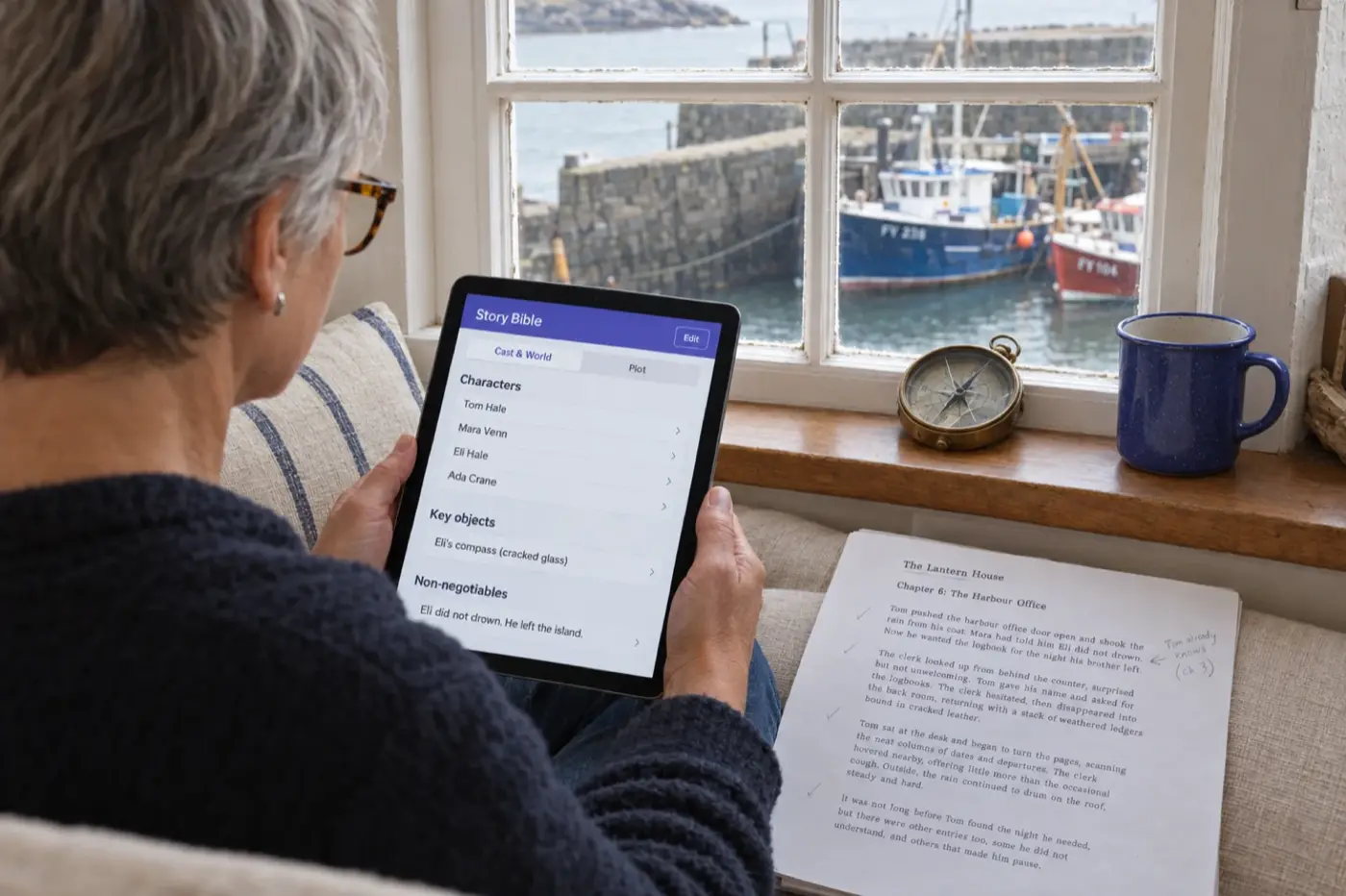
A novel on Inkfluence AI is written one chapter at a time, in order. Before each chapter the AI has in front of it the story bible (characters, key objects, point of view and the rules the story must keep), the last three chapters word for word, the closing lines of the previous chapter, a running record of the whole book so far (who knows what, where everyone is, the state of key objects, every event already shown and the story's clock), a list of what the people in this chapter already know, and the next three chapters' planned events, which it leaves for later. Before it writes, the chapter's plan is checked against what the book has already done, so a secret revealed in chapter 3 is not revealed again in chapter 6. You can set the characters, point of view and world rules before it starts, edit the story bible afterwards, and Continue as a series carries all of it into the next book.
Direct answers
Does it only remember the last three chapters?
No. The last three chapters are the part it reads word for word, for voice and the scene in progress. What happened before them is carried by the story bible and a running record of the book, and both cover the whole book.
How does it stop the same reveal happening twice?
Before each chapter, the chapter's plan is checked against the record. A line that plans something the book has already done becomes what happens next, and the AI is given a list of what the people in the chapter already know.
Can I see and edit what it remembers?
You can see and edit the story bible: open a novel, click Story Bible in the editor header, then Edit. The running record is written from the chapters and is not edited by hand, so anything that must hold goes into the story bible.
Do characters carry into book two?
Yes. Continue as a series carries the story bible, including who knows what and what has happened, into the next book, and chapter 1 of book two opens from where book one ends.
Does non-fiction repeat itself?
Non-fiction chapters are planned together before any is written, each with its own method, opening and example person, so they do not repeat each other. They are written at the same time and do not read one another.
Is Inkfluence AI limited to a three-chapter window?
No. You may have read that it only remembers the last three chapters; some comparisons say so, and a few of our own older pages described it that way before we corrected them. Here is where the number three really comes from and what it does.
The last three chapters are the part of the book the AI reads word for word before it writes the next one. That is deliberate. Word-for-word text is what carries a voice, the rhythm of a scene, the exact thing a character said a page ago. The chapters just written are also where most of the threads the next chapter picks up are sitting. Three chapters of full text is enough to continue a scene naturally, and short enough that nothing in it is lost in the middle of a very long input, a problem explained further down.
Everything before those three chapters is still there, in two other forms. The story bible holds what is permanent: the characters and the spelling of their names, the key objects, the point of view and the rules the story must keep. The running record holds what has happened: who has learned what and in which chapter, where each person is and in what state, where each important object is, each event the book has already shown, and what day or night it is. Both are in front of the AI for every chapter, from the second to the fortieth.
So the accurate version of "it only remembers three chapters" is this: it reads three chapters in full and carries the rest of the book as a written record. A callback in chapter 20 to something a character learned in chapter 2 does not depend on you pasting chapter 2 back in, because the fact was written down when chapter 2 was finished. (On the longest novels the record has a limit, covered under the honest limits below.)
| What the AI is given | How much of the book |
|---|---|
| Chapters read word for word | The three before this one (a very long chapter is read from its later part) |
| Short summaries of recent chapters, inside the story bible | The latest three |
| Planned events held back for later | The next three chapters |
| Story bible | The whole book |
| Running record, and what each person already knows | The whole book so far |
What the AI has in front of it before every chapter
Every fiction format works this way: novels, romance, comedy, kids' fiction, biography and true crime. None of them is written all at once. Chapter 1 is written, read back and recorded, then chapter 2, and so on to the end. When the AI comes to write chapter N, this is what it is given, in plain words:
- The story bible. The book's permanent facts: the story goal, the audience, the point of view, the characters, the key objects, the rules the story must keep, the open threads and the timeline anchors. Names and objects are marked as fixed, with the instruction never to swap a surname or let one object turn into another.
- The last three chapters, word for word. The full text of chapters N-3 to N-1, for voice, pacing and the scene in progress.
- The closing lines of the previous chapter. The last two paragraphs of chapter N-1, as the exact place to pick up from, so a chapter does not reset to a fresh morning when the last one ended mid-argument.
- The running record of the book so far. Who knows what, where everyone is, the state of key objects, the events already shown and the story's clock, each entry tagged with its chapter.
- What the people in this chapter already know. For everyone named in the chapter's plan, the facts from the record they already hold, with the instruction to react to them as known, never as news.
- This chapter's plan, checked against the book. The outline's plan for the chapter (where it opens, what the chapter is for, the conflict, what changes, where it lands), after the check described below has updated anything the book has already done.
- The next three chapters' events, held back. What the following chapters are planned to do, so this chapter can set them up but leaves them for the chapters they belong to.
Around all of that sit the book's own settings: the genre, tone, audience and language you chose and the idea you typed at the start. Here is what each input is for and how you can change it.
| Input | Covers | Protects against | How you change it |
|---|---|---|---|
| Story bible | The whole book | Names and their spelling, key objects, point of view, the rules the story must keep, open threads | Story setup before writing; Story Bible, then Edit, afterwards |
| The last three chapters, word for word | The three chapters before this one | Voice, the scene in progress, who is in the room, what was just said | The AI assistant reads your edited versions when you continue or regenerate |
| The previous chapter's closing lines | The end of the chapter before | A chapter that picks up where the last one stopped instead of resetting | Edit the ending; a regenerated chapter opens from your version |
| The running record | The whole book so far | Who knows what, where everyone is, where objects are, what has happened, the story clock | Built from the chapters as they are written; put lasting changes in the story bible |
| What the people in this chapter already know | Everyone named in the chapter's plan | A character receiving news they already have | Follows from the record |
| The chapter's plan, checked against the book | This chapter | An outline that asks for something the book has already done | Review and edit the outline before the book is written |
| The next three chapters' events, held back | The three chapters after this one | A chapter running ahead and using up the next chapter's event | Review and edit the outline |
See it chapter by chapter
Here is the same thing for an invented 24-chapter mystery, The Lantern House. Tom comes back to a tidal island for the memorial of his brother Eli, whom everyone believes drowned. Move the slider to any chapter to see what the AI is given before writing it. Chapter 6 is where the plan check earns its place: the outline, written before any chapter existed, planned for Tom to learn that Eli is alive in chapter 6, but Mara already told him in chapter 3. Chapter 10 shows the same thing for an object.
This chapter's plan
Chapter 6 of 24: The Harbour Office
Plan as written, before chapter 1 existed
Tom learns that Eli is alive. He searches the harbour office in the storm and meets Ada Crane, the harbour master.
Plan after the check against the book
Tom acts on what Mara told him: he searches the harbour office for the logbook of the night Eli left. He meets Ada Crane, the harbour master, in the storm.
Tom already knows Eli left (chapter 3), so the reveal becomes what he does about it. The storm, the office and Ada are kept exactly as planned.
Story bible
Every chapter, the whole book
- Characters: Tom Hale, Mara Venn, Eli Hale, Ada Crane
- Point of view: Third person, following Tom
- Key object: Eli's compass
- Rule: Eli did not drown. He left the island.
- Rule: Nobody crosses the causeway while the storm is up.
Read word for word
The last three chapters
- Chapter 3: What Mara Saw
- Chapter 4: The Compass
- Chapter 5: Harbour Lights
Opens from the last lines of chapter 5.
Chapters 1 to 2 are not re-read. What they made true is in the record.
Running record
The whole book so far, tagged by chapter
Who knows what
- Tom knows: Eli did not drown; he left the island by boat ch 3
Where everyone is
- Mara: at the lantern house ch 1
- Tom: at the harbour ch 5
Objects
- Eli's compass: with Tom, glass cracked ch 4
Already happened
- The storm cuts the causeway; nobody can leave ch 2
- Mara tells Tom what she saw the night Eli left ch 3
Story clock
Second night of the storm ch 5
Already known to the people in this chapter
Taken from the record
- Tom knows: Eli did not drown; he left the island by boat ch 3
They react to these as things they already know, never as news.
Held back for later
The next three chapters' planned events
- Chapter 7: the logbook shows a boat missing
- Chapter 8: the power fails at the lantern house
- Chapter 9: Ada says the boat was scrapped
This chapter can set these up and leaves them for their own chapters.
An invented example. Real books have the same shape; in a real novel the record holds more entries than the handful shown here, and the plan has more detail (where the chapter opens, the conflict, what changes, where it lands).
After each chapter: what gets written down
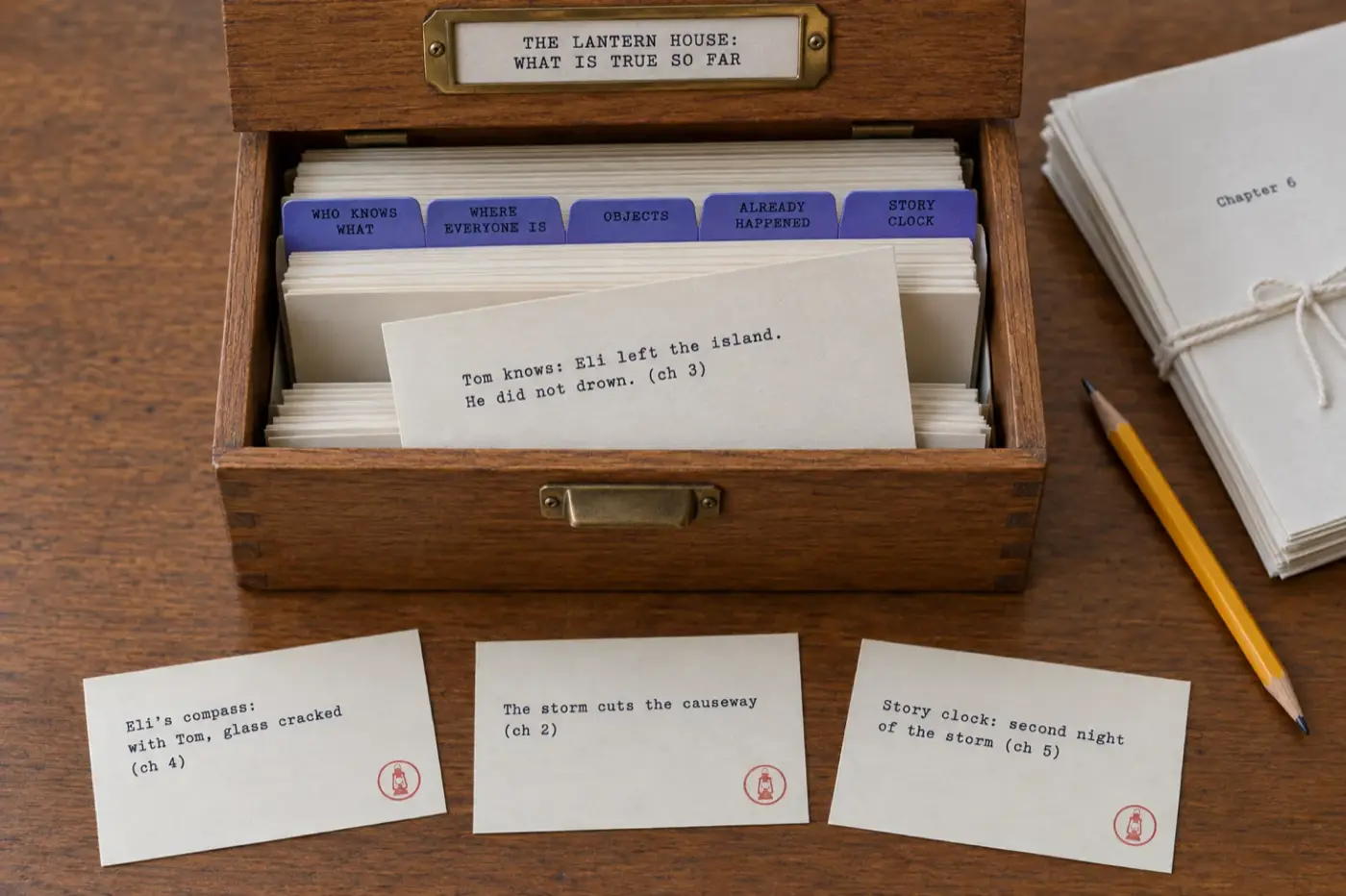
When a chapter is finished, the app reads it back and writes down what is now true on the page. Not a summary of the prose: the facts a later chapter could get wrong. Every entry carries the chapter it came from, and a fact that turns up again keeps its first chapter, because that is when the reader learned it. There are five kinds.
Who knows what
Tom knows: Eli did not drown; he left the island by boat (ch 3)
Each character's new knowledge, and the chapter they learned it in. This is the entry that stops a character being surprised by news they already have, the most common continuity slip in a long novel.
Where everyone is
Mara: at the lantern house. Tom: at the harbour (ch 5)
Each person's latest place and state: with whom, free or held, hurt, dead. Only the latest position is kept for each person, because that is the one the next chapter needs.
Key objects
Eli's compass: with Tom, glass cracked (ch 4)
Who has each object that matters to the plot, where it is and what condition it is in. This is what stops a knife in chapter 4 turning into a pistol in chapter 11, or a burnt letter turning up in a drawer.
What has already happened
The storm cuts the causeway (ch 2)
The events the book has shown: first meetings, confessions, deaths, departures, decisions. Each happened once; later chapters carry its consequences instead of staging it again.
The story's clock
Second night of the storm
What day or time it is now in the story, so two chapters do not both claim to be the next morning, and a night does not last for three chapters.
The record is written in the book's own language, so a novel in Spanish or German keeps its facts in Spanish or German. It sits inside the story bible, so the AI sees it before every chapter that follows, and so does the AI assistant in the editor: when you use Smart Continue or rewrite a chapter, the assistant works from the same facts.
The story bible itself is kept up as the chapters are written, too. Open threads and timeline anchors are updated after each chapter, and a short summary of each chapter's outcome is kept, the latest three of which travel with the story bible. The difference between the two is what they are for: the story bible is the book's canon, and the record is its history.
Before the next chapter: the plan is checked against what the book has already done
Every novel starts with an outline, and the outline is written once, before chapter 1 exists. Chapters then take on a life of their own. A conversation in chapter 3 goes further than planned, a character works something out early, an object ends up somewhere the outline never imagined. By chapter 6 the plan can be asking for something the book has already done, and an AI given a plan follows it: left alone, it writes the reveal again, and the reader watches a character learn the same thing twice.
So before every chapter after the first, the chapter's plan is restated against the running record. Three rules decide what changes:
- What the book has already made true becomes what happens next. "Tom learns that Eli is alive" becomes "Tom acts on what Mara told him". An object the record puts in someone's pocket is not found again under an altar.
- Everything else keeps the plan's own words. The storm, the harbour office and Ada Crane stay exactly as planned. A rewrite that changes too much of the plan is thrown out and the original plan is used, and if the check fails for any reason, the original plan is used too.
- Your idea wins over the plan. If a line of the outline contradicts a rule from your brief (a different cause of death, a relationship that does not exist), it is corrected to agree with the brief.
Chapter 6 of The Lantern House, before and after the check
Plan as written, before chapter 1 existed
Tom learns that Eli is alive. He searches the harbour office in the storm and meets Ada Crane, the harbour master.
What the record says
Tom knows: Eli did not drown; he left the island by boat (ch 3).
Plan after the check
Tom acts on what Mara told him: he searches the harbour office for the logbook of the night Eli left. He meets Ada Crane, the harbour master, in the storm.
Also given to the AI
Already known to Tom: Eli did not drown; he left the island by boat (ch 3). Held back: the logbook's missing boat (ch 7), the power cut (ch 8), Ada's story about the boat (ch 9).
The events held back matter as much as the check. Without them, a chapter that is going well tends to run ahead: the missing boat turns up in chapter 6, and chapter 7 has nothing left to do. Naming the next three chapters' events as theirs lets this chapter set them up and leave them alone.
In the first two days after this went live, 21 to 23 September 2026, the check ran before 2,406 chapters and changed at least one line of the plan in 1,509 of them. A change can be as small as a single sentence. Another 44 rewrites changed too much of the author's plan and were thrown out, and those chapters were written from the original plan.
The loop, chapter after chapter
- 1The plan for chapter N, from the outline
- 2Checked against what the book has already done
- 3Written with the story bible, the last three chapters, the record, what people already know and later events held back
- 4Read back: what is now true on the page
- 5The record is updated, then chapter N+1 starts again at step 1
What you control: Story setup and the story bible
Most of this runs without you touching anything. Two places let you steer it, and on any book longer than a handful of chapters they are worth two minutes.
Before it writes: Story setup
When you start a novel from New Book, the screen where you describe your idea has a section called Story setup (optional). Open it and there are three fields: Main characters (type a name and press Enter), Point of view (for example "First person, past tense") and World rules (a rule the story must keep; press Enter after each). Whatever you put there goes into the story bible before chapter 1, ahead of anything the AI works out from your idea. Skip it and the AI decides.
A good world rule is a fact that must never be broken, stated plainly. "Magic always costs the caster a memory." "Eli did not drown; he left the island." "Nobody crosses the causeway while the storm is up." "Mara is 34 and has never been to the mainland." In the story bible these are called non-negotiables, and they are in front of the AI for every chapter. The character bible generator is a quick way to get your cast straight on paper first.
The plan matters as well. A book started from New Book pauses to show you its chapter plan before anything is written, and you can rename, reorder, add or remove chapters, then click Write the book. (The one-line Quick Start box on the home page goes straight through without the pause.) The plan you approve is the one each chapter is checked against, so a reveal you want in chapter 12 belongs in chapter 12 of the plan.
After it writes: the Story Bible panel
Open a finished novel in the editor and click Story Bible in the header; the button appears on fiction books. The panel has two tabs, Cast & World and Plot. Click Edit and you can change:
- Story goal: what the book is about, in a line or two
- Point of view: whose eyes, which tense
- Target audience: who it is written for
- Characters: the names, spelled as they must stay
- Key objects: the things that must not change into other things
- Non-negotiables: the rules the story must keep
- Unresolved threads: what is still open
- Timeline anchors: dates, ages, durations that must add up
Recent outcomes, the short chapter summaries, are tracked automatically and are not edited in the panel. Saved changes are used the next time a chapter is generated or regenerated, by the AI assistant in the editor, and by Continue as a series. They do not rewrite chapters that already exist.
To rename a character across the whole book, click the character's name in the panel, or use Find & Replace in Tools with the scope set to Whole book and leave "Also update this book's character list" ticked, so the AI keeps using the new name. The help article on renaming a character shows both, and getting to your first finished book covers checking the story bible along the way.
A fiction book that was not written in the app, such as a duplicate of another book, has no story bible until you add one: the panel shows "No story bible yet" with an Add details button. Type the characters and rules in, and the editor's AI assistant and Continue as a series will use them. There is no file upload for a story bible; you type it, or paste it field by field. An imported manuscript comes in as a general book, so it has neither a story bible nor a running record; the AI assistant works from the chapters just before the one you are editing, and a line of context in your request covers a callback to an early chapter.
When you edit chapters by hand
Most authors rewrite parts of the book. Some of what the app keeps follows your edits and some does not, and knowing which is the difference between a smooth rewrite and a chapter 14 that contradicts your new chapter 9.
Follows your edits
- The AI assistant in the editor reads the chapters before the one you are working on as they are now, including your changes: three chapters back on a novel, two on other books. Continuing, rewriting and regenerating a chapter all work from your version.
- Story bible edits, for every chapter generated or regenerated after you save, and for the next book in a series.
- AI review, in the Review tab of the AI panel, reads the text as it is now and gives Clarity, Pacing and Consistency notes on a chapter or the whole book.
Does not follow your edits
- The running record. It was written as each chapter was generated. If you change who knows what, move a character or kill someone off by hand, the record does not know.
- Chapters already written. Changing the story bible does not reach back into them.
After a big hand edit: a checklist
The help centre covers continuing a chapter from where you left off and the editorial review step by step, and the AI novel editor page covers the editing tools as a whole.
How long a book can it keep consistent?
A book can run to 40 chapters on a paid plan, and 5 chapters a book on the free plan. Chapter count is the length control: there is no word or page target. On novels written from 21 to 23 September 2026 the median chapter came out at 2,040 words, and chapters vary with the scene and the genre.
Long books are not unusual on the platform. Of the 23,565 novels written on Inkfluence AI in the 90 days to 23 September 2026, the median ran to 5 chapters, but 4,170 ran to 10 chapters or more, 3,019 to 20 or more, 1,814 to 30 or more and 1,288 to the 40-chapter maximum. 3,233 of them were written in a language other than English.
Everything on this page works the same way from chapter 2 to chapter 40. What changes with length is the record: on a long novel it fills up, and its oldest entries give way to newer ones. The story bible does not age out. Its characters, key objects and rules are in front of the AI at chapter 40 exactly as they were at chapter 2, which is why anything that must hold for the whole book belongs there. The AI novel writer page covers structure and genre for long fiction.
Non-fiction: why chapters do not repeat each other
Non-fiction is written differently, on purpose. A how-to guide, a business book or a self-help book does not have a secret that must not be revealed twice. Its risk runs the other way: the same framework, the same opening anecdote and the same example person turning up in every chapter. So non-fiction is planned together and written together.
When the outline is written, each chapter is given three things of its own: a named method or framework, an opening style (an anecdote, a statistic, a question, a quote or a scenario, rotated across the book) and an example person to use as its case study. Then every chapter is written at the same time from its own allocation, with the others' kept off limits. That is why a ten-chapter guide arrives in minutes, and why chapter 7 does not reintroduce the framework from chapter 2.
The trade-off, stated plainly: non-fiction chapters do not read each other. Their variety and their order come from the plan, not from reading back. If you want chapter 8 to refer to an exercise in chapter 3, add the reference while editing, or name the exercise when you ask the AI assistant to rewrite chapter 8.
Formats that are self-contained by design, including list books, recipe books, devotionals, Q&A books, workbooks, study guides and travel guides, write each chapter as its own unit: a recipe does not need to know about the recipe before it. The non-fiction walkthrough shows the plan review step on video.
Picture books: the same character on every page
In a picture book the consistency that matters most is visual. Before any page is painted, the app paints a character reference sheet: the main character from the front and from the side, with three expressions, and any companion animal alongside. Every page, and the cover, is painted from that sheet, so the fox on page twelve has the same ears as the fox on the cover.
The words of a story picture book are written spread by spread, in order, each following on from the ones before. Coloring book pages and ABC pages stand alone by design: each page is its own picture. A picture book series carries the cast, the setting and the character sheet into the next book. The picture book walkthrough shows the character sheet on screen, and the AI picture book maker page covers the three kinds of picture book.
Book two: carrying the characters into the next book
A series is the longest continuity problem there is: everything a reader remembers from book one has to hold in book two. Open the three-dot menu on a finished book, on the Home or My Books tab, and pick Continue as a series. Your book becomes book 1. After that, any book in the series shows Write the next book, which always continues from the latest one.
What carries into the next book:
- The story bible: the characters and the spelling of their names, the key objects, the point of view, the rules the story must keep and the open threads, including your own edits to the bible.
- The running record, marked as earlier: who knows what, where everyone is, the state of objects and every event book 1 showed. Book 1's facts have their own room, so book 2's new facts never push them out.
- The ending: chapter 1 of book 2 opens from where the last chapter of book 1 stopped.
- A plan built from what book 1 actually contains: a chapter-by-chapter summary, the characters, the rules, the events and how the book ends, plus your optional note on what should happen next.
- The language and the length: the same language as book 1 and the same number of chapters.
Novels continue one book at a time, because each book starts from the real ending of the one before, and there is no limit on how many. Non-fiction can add one to three books at once, as a Sequel, a Companion or an Expanded volume, building on the first book's terms instead of repeating them. Each new novel is then written like any other: the same story bible, the same record and the same plan check from chapter 1.
Before you continue, open the Story Bible of book 1 and fix anything wrong there, a misspelt name or a missing rule. Whatever it says is what book 2 follows. Series is included on the Creator and Premium plans, and each new book uses chapters from your monthly allowance. The series guide has the steps and the numbers on how series are used, the help article has the short version, and the AI book series writer page covers planning a series from scratch.
What we measured, and how
These are small, dated tests, reported as they came out. None of them says a continuity slip can no longer happen. They are how we checked that the plan check fixes the mistake it was built for without costing anything else.
- The repeated reveal, nine times each way (21 September 2026). We took one real novel in which a character was told a piece of news in chapter 3 and then heard it again as news in chapter 6, and regenerated chapter 6 nine times with each approach. Written the old way, the character treated the news as new in 2 of 9 runs. With only the list of what he already knew added, 3 of 9: the list on its own did not fix it. With the chapter's plan checked against the record as well, 0 of 9. The plan was telling the AI to stage the reveal, so changing the plan was the fix.
- The same outline, written both ways (21 September 2026). One 18-chapter outline was written twice on the live app. The old way repeated a known fact as news in 1 chapter, the new way in none, and the two books came out at 41,206 and 41,170 words. That is one pair. A second pair with a much longer brief did not separate the two approaches, so we do not quote a rate.
- The first full day (22 September 2026). A sample of 35 novels written that day with the running record, 231 chapters in all, was checked for a character receiving known news as new. None was found: the one chapter flagged was read by a person and was a false alarm. Chapter length did not change. For scale, the old way was already rare on this measure, at 1 flagged chapter in 175.
- The first two days of the plan check (21 to 23 September 2026). 488 novels, 2,896 chapters. The plan was checked before 2,406 of them (a book's first chapter has nothing to check against) and changed in 1,509; 44 rewrites that changed too much were thrown out. The median chapter was 2,040 words.
How it was counted. Book counts are completed novels (novel, romance, comedy, kids' fiction, biography and true crime; picture books excluded), each counted once from the platform's own writing records on 23 September 2026, with the team's own accounts left out. Tests 1 and 2 were run by the team, test 2 on the live app from the team's own account. Tests 1 to 3 used a separate AI reader that asked, chapter by chapter, whether a character treated something they already knew as news, and a person read every flag. No title, idea, chapter text or account is published. The figures are published under a Creative Commons Attribution 4.0 licence: quote them with a link to this page.
The honest limits
- Hand edits do not update the running record. It is written as the book is generated. Put lasting changes into the story bible, which every later chapter reads.
- The record keeps facts, not every sentence, and it has a limit. It holds what a later chapter could get wrong, not the prose. On a long novel it fills up and the oldest entries give way to newer ones. The story bible does not age out.
- A written chapter is not rewritten for you. Each chapter is read after it is written, for names, point of view, timeline and open threads, and what that read finds updates the story bible and the record. It is not a rewrite pass: a slip stays in the chapter until you change or regenerate it. The plan check works before the chapter; your own read and AI review are the safety net after it.
- Story bible edits work forwards. They shape chapters generated or regenerated after you save, not the chapters already written.
- Non-fiction chapters do not read each other. Their consistency comes from the plan.
- An imported manuscript has no record and no story bible. Nothing was generated, so there is nothing to read back. The AI assistant works from the chapters just before the one you are editing; add a line of context to your request for a callback to an early chapter.
- Length is set by chapters. Up to 40 chapters a book on paid plans and 5 on the free plan, with no word or page target.
- It is not perfect memory. The aim is fewer slips and a book that is quick to fix, not a book you do not need to read.
Why a chat window forgets, and how this differs
If you have written a story in a chat assistant, you have probably met the moment it forgets a name from an hour ago. That is not carelessness; it is how a conversation works. Everything the assistant can use has to fit into the text it is shown at once, and a long story either overflows that space or ends up in the middle of it.
Research on long inputs explains why even a very large input is not the same as memory. A study published in the Transactions of the Association for Computational Linguistics found that models use information best when it sits at the beginning or the end of a long input, and that performance "significantly degrades" when the relevant part is in the middle (Liu et al., Lost in the Middle). A benchmark of long-context models found that although every model tested claimed to handle long inputs, only half kept satisfactory performance at a length they all claimed to support, and almost all dropped sharply as inputs grew (Hsieh et al., RULER). And a study of AI summaries of whole books found that most unfaithful claims were about events and character states, the very facts a novel's continuity depends on (Kim et al., FABLES).
That is the reason for the design on this page. Pasting a whole book back in each time is not the same as remembering it. Inkfluence AI gives the AI the three most recent chapters in full, where the scene is, and turns everything before them into short, chapter-tagged facts, written down as the book goes: who knows what, where everyone is, what has happened.
Some writing tools keep a reference you write and maintain yourself, a list of characters and places that is pulled in when they are mentioned. That works well if you keep it up to date. Here the record is written for you as each chapter is finished, and the story bible is the part you maintain. If you want to audit a finished manuscript for slips instead, the continuity checking guide compares the tools for that job.
Consistency FAQ
Does Inkfluence AI remember earlier chapters when it writes a new one?+
Is Inkfluence AI limited to a three-chapter context window?+
How does Inkfluence AI keep characters consistent across a whole novel?+
How does it stop a character finding out the same secret twice?+
What is the story bible, and can I edit it?+
Can I add my own characters, world rules or story bible before it writes?+
What happens if I edit chapters by hand?+
How long a book can it keep consistent?+
Why does ChatGPT forget earlier parts of my story, and what is different here?+
Does it keep non-fiction consistent, without repeating examples?+
How does a book series keep the same characters in book two?+
Can I tell it what happens in the next book?+
Does it work in other languages?+
Does it keep characters looking the same in a picture book?+
Related reading
AI novel writer
Premise to finished novel: genres, structure and the editor.
AI book writer
Every book type Inkfluence AI writes, fiction and non-fiction.
Story bible generator
What goes in a story bible, with a template to start from.
Character bible generator
Write your cast down before chapter 1.
How to write a book series with AI
The series steps, and how series on the platform are shaped.
AI book series writer
Series planning for novels and non-fiction.
How to write a non-fiction book with AI
Format choice, outline review and editing, on video.
How to make a picture book with AI
The character sheet a picture book is painted from.
AI picture book maker
Story, coloring and ABC picture books.
Checking a finished manuscript for continuity
Tools for auditing a novel you already have.
Smart Continue
Extending a chapter with the AI assistant.
AI novel editor
Rewriting, reviewing and polishing a draft.
Write the first chapter. The record starts there.
Set up your cast, approve the plan, and let the chapters write in order.
Start a novel