
AI Novel Editor
Catch the things that kill an indie novel: character names that drift, dialogue voices that collapse, plot threads that never pay off, timelines that slip. Built for the post-draft editing phase of long-form fiction, not for proofreading a paragraph.
Quick answer
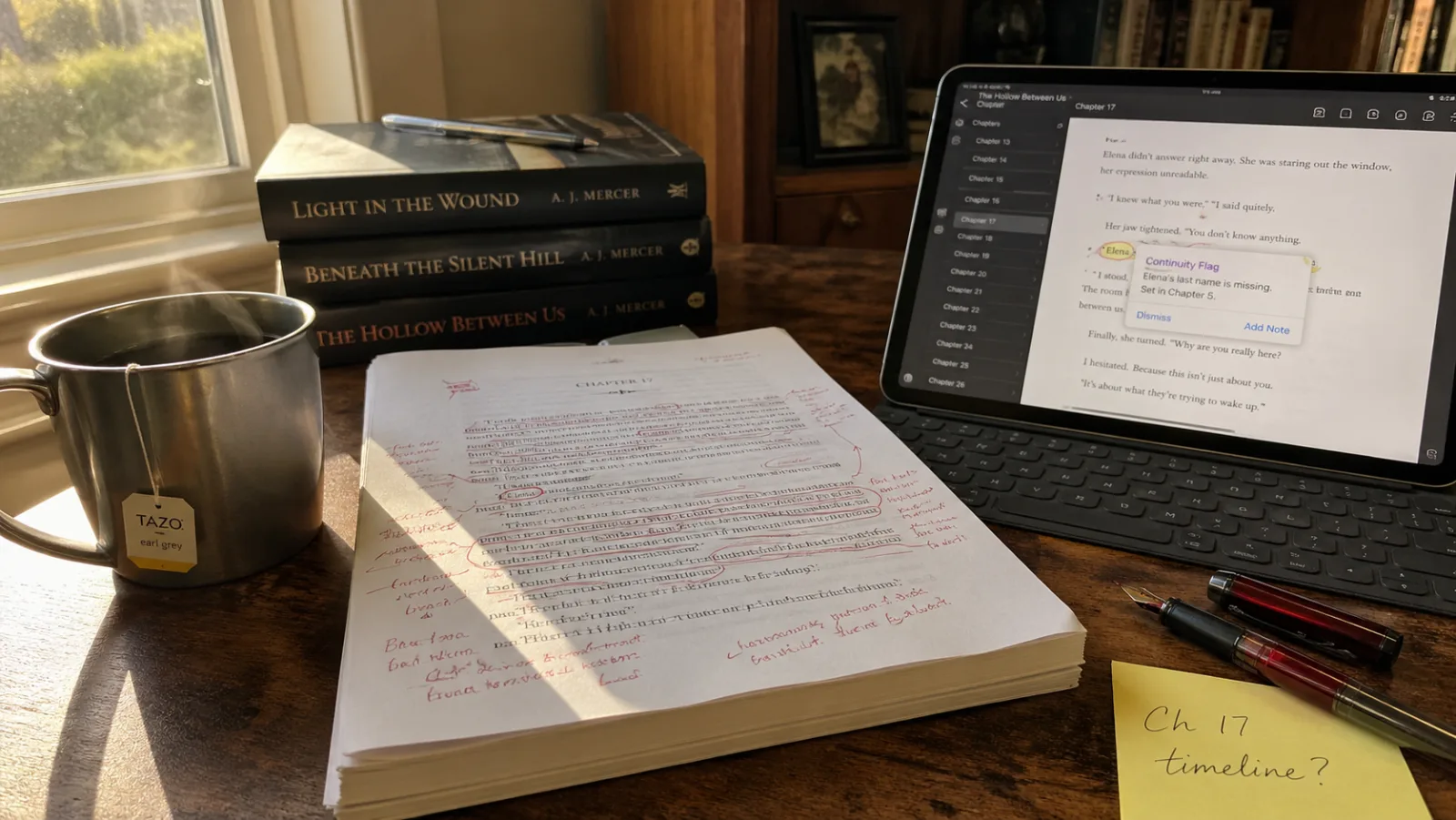
An AI novel editor is a tool for the post-draft editing phase of long-form fiction. It runs alongside a story bible to flag character name drift, dialogue voice collapse, plot continuity gaps, pacing slips, and structural inconsistencies that creep into a 60,000 to 100,000 word manuscript. Inkfluence AI is the AI book writer and AI ebook maker with built-in novel editing: the same engine that drafts your chapters also edits them for continuity in one workflow, free to start. Supports DOCX / PDF / EPUB import, catches roughly 70 to 85 percent of continuity issues in one sweep, with genre-aware checks for romance, mystery, fantasy, sci-fi, horror, and literary fiction.
What it is
What an AI novel editor actually does, and why a generic proofreader is not enough
Most novelists who reach the editing phase reach for Grammarly, ProWritingAid, or AutoCrit. Grammarly is a line-level tool: it will catch a typo in chapter twelve and an awkward sentence in chapter thirty. ProWritingAid and AutoCrit go further, with manuscript and story reports on their paid plans, but they read the text you give them without your outline and story bible beside it. The problems that sink a novel are usually about the whole book: your protagonist's eye colour shifting between chapter four and chapter eighteen, the inn from chapter six becoming a tavern by chapter twenty-two, a prophecy foreshadowed wrong in the midpoint reveal. Those are structural editing problems and they are what kill indie novels in one-star reviews.
An AI novel editor sits one layer higher. It runs alongside the story bible (characters, world rules, timeline, locations, object inventory) and reads the manuscript as a single 80,000-word artefact, not a sequence of paragraphs. When chapter twenty-seven contradicts a fact established in chapter three, the editor flags it. When a named character drops out of the prose entirely between chapters fifteen and forty-two, the editor flags it. When a chapter ends on a cliffhanger that the next chapter does not pick up, the editor flags it. The output is a list of specific lines to review, not a vague "rewrite this for clarity" suggestion. Pair it with our AI novel writer and the same story bible flows from drafting to editing without re-import. The novel editor is the post-draft mode of the broader AI book writer, the same engine that handles 33 content types from novels to lead magnets to non-fiction ebooks.
Compare
AI novel editor vs proofreaders vs human editors
Five common editing tools, what each does well, and what they fail to catch on a 90,000-word novel.
| Tool | Continuity | Voice consistency | Line edits | Cost (per novel) |
|---|---|---|---|---|
| Inkfluence AI Novel Editor | Yes (story-bible) | Yes (genre-tuned) | Limited | $0 free / $9.99 paid |
| Grammarly | No | No | Yes | Free plan; Pro from $12/mo |
| ProWritingAid | Partial | Partial | Yes | Free plan; $10-36/mo |
| AutoCrit | Partial (Story Analyzer+) | Partial | Yes | Free plan; Pro $15-30/mo |
| Sudowrite (general AI writer) | Partial (Story Bible) | Partial | Yes (Describe / Rephrase) | $10-59/mo |
| Novelcrafter (general AI writer) | Partial (Codex, manual) | No | Limited | $4-20/mo + API |
| ChatGPT / Claude (chatbot) | Partial (no saved story record) | No | Yes (per-paragraph) | Free plans; paid $8-20/mo |
| Human dev editor | Yes | Yes | Often separate | $1,500-$5,000 |
Cost benchmarks per Editorial Freelancers Association rates; tool prices checked 2 October 2026 on each vendor's pricing page. AI novel editor handles structural and continuity editing; pair with a $200 copy-edit pass for line-level polish before publishing. General AI writers like Sudowrite and Novelcrafter offer some critique features but were built for drafting first. Human editor rates per word for each type of edit and genre are in our book editing cost guide.
The fix list
Seven things to fix in a draft before you publish
1. Character name drift
A minor character introduced in chapter five is referred to by a slightly different name in chapter twenty-two. Or a place name picks up an extra apostrophe halfway through. The story bible catches this in one pass.
2. Dialogue voice collapse
Two named characters sound interchangeable. Reader cannot tell which one is speaking without the dialogue tag. Run a dialogue-isolation pass per character, read out loud, rewrite until each voice is recognisable.
3. Plot threads that never pay off
A weapon picked up in chapter one. A secret hinted in chapter four. A minor character who reappears in chapter ten and then disappears. Either pay these off in the third act, or cut the setup. Unresolved threads are the single most common one-star indie review.
4. Timeline slips
Three days pass in chapter eight, then a different chapter implies it has only been one. The wedding is in October but the leaves are budding. Build a timeline grid as part of the bible and audit against it.
5. Voice drift in chapter openings
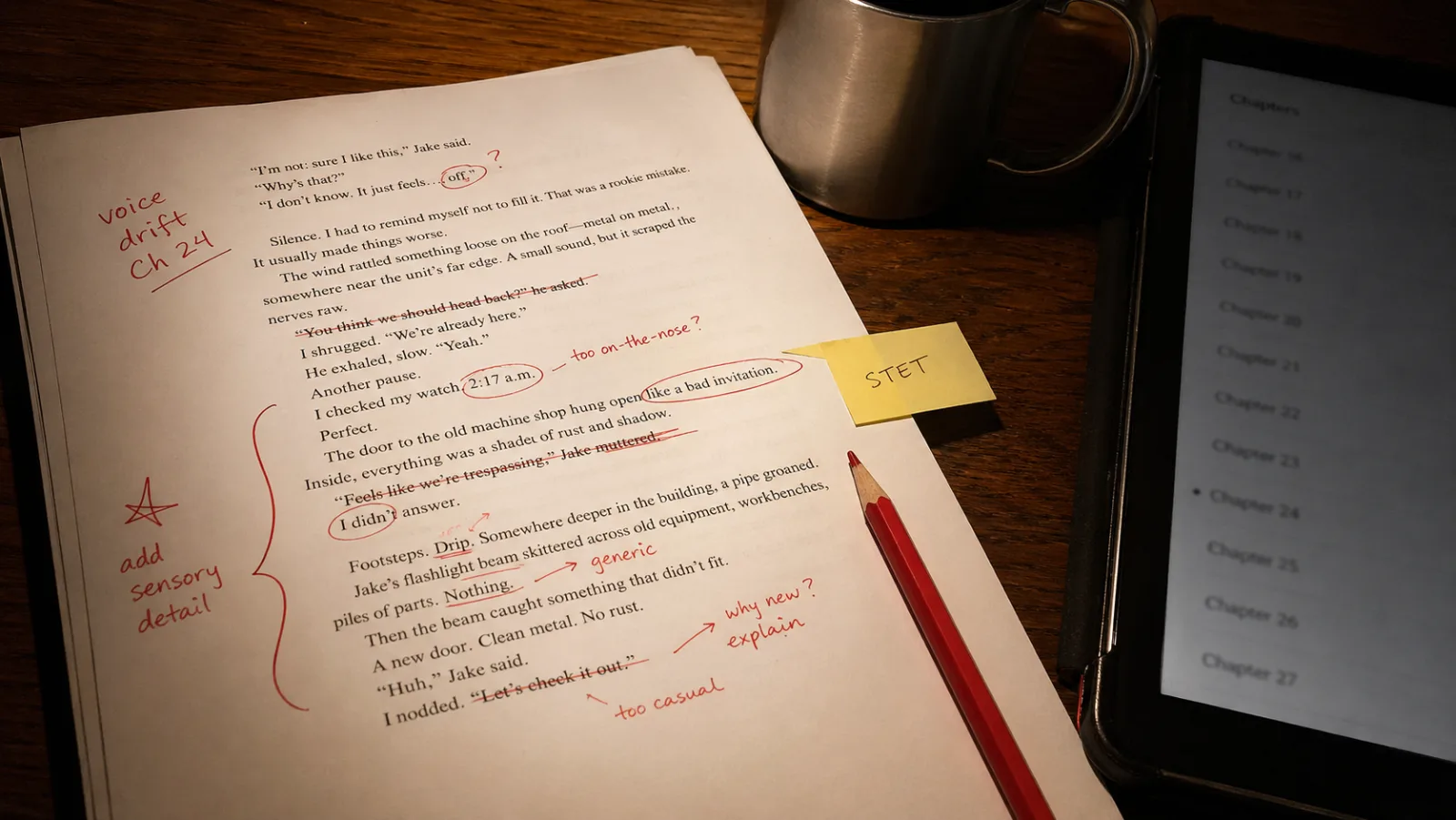
Chapter one opens in your voice. By chapter twenty-eight the prose has flattened into the AI-generic chapter register. Read every chapter opening aloud and rewrite the first 200 to 300 words of any chapter that does not sound like you.
6. Filler dialogue and over-described scenes
"Hello," he said. "Hi," she said. "How are you?" he said. Cut. Anything that does not advance plot, deepen character, or earn its line count goes. Aim to cut 8 to 12 percent of total word count on the tightening pass.
7. Weak openings and weak closings
The first 500 words of chapter one and the last 500 words of the final chapter deserve three to five rewrite passes each. These are the highest-leverage words in the novel: they decide whether a reader buys book two and whether they leave a review. Once these are polished, the KDP self-publishing walkthrough covers the next step: account setup, cover specs, pricing, and KDP Select enrolment.
Two failure modes
Voice consistency vs plot continuity: which one ruins more novels?
The two structural problems that most often kill indie novels in one-star reviews are voice drift and plot continuity gaps. They look similar in symptoms (the book feels off) but they are actually opposite problems and you fix them with different tools.
Voice drift is gradual. Chapter one sounds like you. Chapter five still mostly sounds like you. By chapter twenty the prose has flattened into a register that is competent but generic, the way an AI tool sounds when nobody is editing. Voice drift is fixed by reading every chapter opening out loud and rewriting any opening that does not sound like the author of chapter one. This is not an AI fix. It is a human-attention fix. The AI editor can flag passages where vocabulary register shifts dramatically, but the rewrite is yours.
Plot continuity gaps are the opposite. They are mechanical, specific, and AI-detectable. A character's age changes between chapters. A weapon vanishes. A secondary character disappears for thirty chapters. A timeline implies events happen in a different order than they actually did. Continuity gaps are caught reliably by the editor running against the story bible, because the bible is the source of truth and the editor flags anything that contradicts it. Plan on AI catching 70 to 85 percent of these in one sweep. The remaining 15 to 30 percent is what your beta readers and your own re-read surface.
For literary novels and character-driven fiction, voice drift is the bigger threat. For genre fiction (romance, thriller, mystery, epic fantasy), continuity gaps are the bigger threat because genre readers are extremely good at catching them and unforgiving when they do. For most novels you are dealing with both, in different proportions per chapter.
Genre playbook
Genre-specific editing priorities
What to fix first depends on what you wrote. Editing a thriller and editing a literary debut are not the same job.
| Genre | First fix | Second fix | Reader hot-button |
|---|---|---|---|
| Romance | Chemistry-arc consistency | HEA structure landing | Hero / heroine voice distinctness |
| Mystery & thriller | Clue placement timing | Red-herring tracking | Reveal-setup chains |
| Fantasy | Magic-system rule consistency | Worldbuilding contradictions | Prophecy callback resolution |
| Sci-fi | Technology-rule consistency | First-contact protocol logic | Dystopia internal consistency |
| Horror | Dread escalation pacing | Foreshadow payoff | Survival logic believability |
| Literary / general fiction | Voice consistency | Sensory detail balance | Theme reinforcement |
Workflow
The 7-step novelist edit, four to eight hours total
Realistic time-on-task for a 60,000 to 80,000 word novel. Most novelists complete this in a single weekend.
Continuity sweep (90 min)
Read every chapter end-to-end with the story bible open. Flag every name, age, location, object, and timeline detail that drifted from canon.
Dialogue distinctness audit (90 min)
Read each named character's dialogue out loud, ideally in a different voice. Each character should sound distinct without their dialogue tag.
Voice drift fix on chapter openings (2 hr)
Read every chapter's first 200 to 300 words. Rewrite any opening that has flattened into AI-generic register.
Emotional beat additions (90 min)
Mark moments in the manuscript that need emotional weight on first read. Come back and add the sensory details and specific sentences on a second pass.
Opening and closing polish (90 min)
Three to five rewrite passes on the first 500 words and the last 500 words. These decide whether a reader buys the next book.
Cuts and tightening (60 min)
Remove filler dialogue, over-described scenes, and anything that does not earn its line count. Aim to cut 8 to 12 percent of total word count.
Final continuity pass and KDP-ready export (45 min)
One last read with the story bible open. Then export EPUB and a JPG cover at KDP spec, upload to Amazon KDP with AI-content disclosure, and publish.
Verified references
Sources and further reading
Editing rates, KDP policy, and structural-editing references behind the recommendations above.
Amazon KDP Formatting Guidelines: 70% royalty tier on $2.99 to $12.99, AI disclosure required at upload.
US Copyright Office AI Policy: human-authored elements of AI-assisted novels remain copyrightable.
Reedsy Book Editor Workflow: structural, copy, and proofreading edit cost benchmarks.
Editorial Freelancers Association Rates: developmental edit and copy edit per-hour benchmarks.
Alliance of Independent Authors: indie novelist editing-spend survey data.
Writer's Digest: structural editing: long-form fiction editing best practices.
Frequently Asked Questions
Everything novelists ask before running an AI editing pass on a finished manuscript.
What is an AI novel editor?
An AI novel editor is a tool designed for the post-draft editing phase of long-form fiction. Where a generic AI writing tool focuses on generating text, an AI novel editor focuses on detecting and fixing problems in an existing manuscript: character name drift, dialogue voice collapse, plot continuity gaps, pacing issues, and inconsistencies that creep in across 30 to 80 chapters. The most useful AI novel editors run a story bible alongside the manuscript so they can flag a contradiction in chapter 27 against an established fact from chapter 3.
How is an AI novel editor different from Grammarly or ProWritingAid?
Grammarly works at the sentence level: typos, grammar, clarity and tone. ProWritingAid goes further, with style reports and, on its paid plans, whole-manuscript analysis bought as Story Credits. The difference with an AI novel editor built into your book is context: it reads each chapter against your outline and story bible, so it can flag that your protagonist's eye colour shifted between chapter 4 and chapter 18, and you apply the fix in the same manuscript you export from.
Can AI catch all the continuity errors in my novel?
An AI novel editor catches the mechanical continuity errors very reliably (named entities, ages, dates, locations, object inventories). It catches subtler logical contradictions (motivation drift, thematic inconsistency) less reliably. For a publish-ready manuscript, plan on AI catching roughly 70 to 85 percent of continuity issues; the remaining 15 to 30 percent is what your beta readers and your own re-read will surface. The AI editor does not replace human editing, it dramatically reduces the surface area that human editing has to cover.
How long does it take to edit an AI-drafted novel?
Plan on four to eight hours of editing per full 60,000 to 80,000 word novel. The breakdown most novelists report: ninety minutes for a continuity sweep, ninety minutes for dialogue distinctness, two hours for voice consistency edits across chapter openings, ninety minutes for opening and closing chapter polish, and another hour for cuts and tightening. This is dramatically faster than the eight to twelve hours per novel a developmental edit traditionally takes, because the AI editor surfaces specific lines for review rather than asking you to re-read the entire manuscript blind.
Does the AI novel editor preserve my voice?
Yes when used correctly. The editor flags issues and proposes alternatives but the final rewrite is yours. The mistake new users make is accepting every suggested rewrite verbatim; do that and the prose flattens into AI-generic register. The right pattern is: AI flags the issue, you rewrite in your voice, the editor confirms the issue is resolved. Voice belongs to the human; the AI is a continuity and consistency checker, not a stylistic ghostwriter at the edit stage.
Can I use this on a novel I wrote without AI?
Absolutely. The AI novel editor is genre-agnostic about how the draft was produced. Import your DOCX, PDF, or EPUB, build a quick story bible from the existing chapters, and run the sweep. Many novelists who drafted manually use the AI editor specifically because the structural-editing pass is the part of self-editing they hate, not the prose-level fixes.
Does it work on a novel-in-progress, or only finished manuscripts?
Both. For a novel in progress, the editor identifies continuity issues as you write each new chapter, which prevents structural problems from compounding by chapter 30. For a finished manuscript, you run the full sweep before sending to beta readers or before KDP upload. Most novelists use it in both modes: light running checks during drafting, full sweep before publishing.
Will an AI-edited novel pass an AI detection check?
AI detection tools (GPTZero, Originality.ai, Turnitin) are designed to flag wholly-AI-generated prose, not human-written prose that received AI-assisted editing. A novel where the prose was authored by you and an AI editor flagged continuity issues that you then fixed by hand will read as human-authored to detection tools because the underlying prose IS human-authored. Amazon KDP does not use these detectors for bookstore listings as of 2026; AI disclosure is required at upload time but does not affect listing eligibility or 70 percent royalty status.
Can I publish an AI-edited novel on Amazon KDP?
Yes. Amazon KDP permits AI-generated and AI-assisted content with disclosure during the publishing flow. Editing assistance is treated the same as drafting assistance under current KDP guidelines: disclose at upload, no impact on royalty tier eligibility, no impact on KDP Select enrolment. See the current KDP AI policy for the disclosure language.
Is the AI novel editor free?
Yes for the core editor. Inkfluence AI's free plan includes the editor on every project with no chapter cap on edit operations. The Creator plan ($9.99/mo) unlocks unlimited regeneration of suggested fixes plus the full chapter-rewrite workflow. Most novelists complete a single-novel edit on the Creator plan in one billing month and cancel between books. Free tier is enough to test whether the editor catches the kind of continuity issues your novel actually has before committing.
Should I still hire a human editor after using the AI novel editor?
For a novel you are publishing commercially, especially as a debut, yes. The AI editor handles structural and continuity editing reliably. A professional copy editor catches the line-level fixes (em-dash usage, punctuation, scene-break formatting) that elevate a manuscript from publishable to polished. Many indie novelists use the AI editor to do the heavy lifting and then commission a 200-dollar copy edit for the final pass, rather than the full 1,500-dollar developmental plus copy edit traditional path.
What genres does the editor support?
All fiction genres with genre-tuned editing checks. Romance: chemistry-arc consistency, HEA structure, hero-heroine voice distinctness. Mystery and thriller: clue placement, red herring tracking, reveal-setup chains. Fantasy: magic system rules, worldbuilding consistency, prophecy callbacks. Sci-fi: technology-rule consistency, first-contact protocol, dystopia internal logic. Horror: dread escalation, survival logic, payoff of foreshadowed dread. Literary and general fiction: voice consistency, sensory detail balance, theme reinforcement.
Is the AI novel editor the same as the wider AI book writer?
The AI novel editor is the post-draft mode of the broader Inkfluence AI book writer and AI ebook maker. The same engine that drafts your chapters (with story bible, character continuity, and genre blueprints) also edits them: continuity sweep, dialogue distinctness, voice drift, and structural fixes. If you are editing a novel you drafted elsewhere, import the DOCX, PDF, or EPUB and the editor runs against a story bible you build in-app. If you are drafting AND editing in one workflow, the full AI book writer at /ai-book-writer covers both modes alongside cover design, EPUB export, and ACX-spec audiobook narration.
Edit your novel into a publishable draft
Free to start: continuity sweep, voice consistency, dialogue distinctness, and KDP-ready export. No credit card. Upgrade to unlimited regenerations when you want them. Built on the Inkfluence AI book writer and AI ebook maker engine.
Related tools for novelists
Everything else in the novelist toolkit, from drafting to publishing.
AI Book Writer
The full engine behind the editor. 33 content types: novels, business books, lead magnets, cookbooks, and more.
AI Ebook Generator
The AI ebook maker. Generate complete ebooks with cover, EPUB export, and KDP-ready formatting.
AI Novel Writer
Draft a 70,000+ word novel with story-bible continuity. Fiction blueprints, chapter generation, KDP-ready export.
AI Manuscript Editor
General manuscript editor for fiction and non-fiction, late-stage polish.
For Novelists
The novelist-specific workflow: story bible, fiction blueprints, 30-day publish timeline.
Best AI Novel Writer 2026
Ranked comparison of 8 AI novel writers tested on real novel projects.
AI Interactive Fiction Generator
Plot a branching novel or gamebook with two main choices, four sub-choices, and six endings.
AI Chapter Generator
Generate single chapters with full story-bible continuity.
Book Outline Generator
10-chapter outline tool across 8 genres for traditional novels.
Book Description Generator
Amazon KDP descriptions across 5 proven frameworks.
Author Bio Generator
Novelist author bios across 8 author types.
How to Import Your Manuscript (Video)
A finished novel from Word into the editor in three minutes, one chapter per Heading 1.