
Author Bio Generator
Enter your name and topic. Get 10 publishable author bios in varied lengths for your back cover, Amazon KDP profile, Goodreads, and speaker intros. Eight author types covered.
Quick Answer
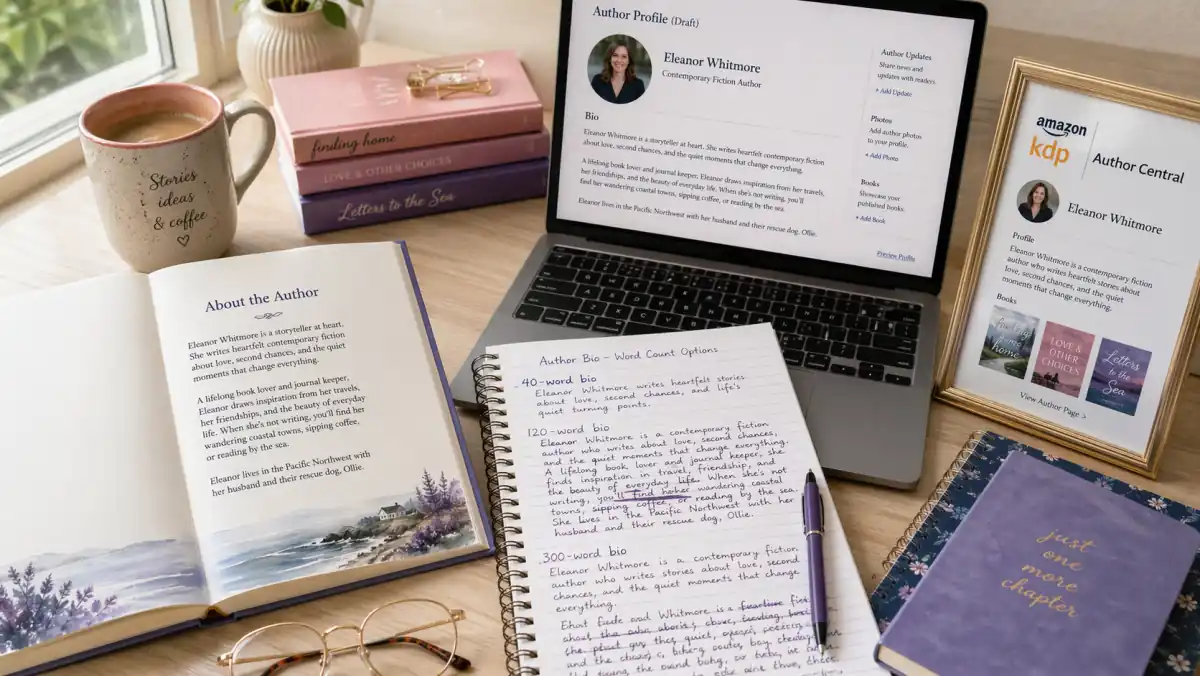
A strong author bio runs 40 to 150 words in third person, leads with what you do and who you help, and ends with one human detail. For fiction, open with the stories you write and the emotional register. For non-fiction, open with expertise and outcome. Generate 10 candidates below, pick the two or three that best capture your voice, and save one to your Inkfluence AI author profile with one click - it auto-applies to every book you publish.
Live Tool
Generate 10 author bios in seconds
Pick your author type, enter your name and topic, hit generate. Free, instant, no sign-up. Click any bio to copy and save to your author profile. Writing under another name? Pick one first with the pen name generator.
Save it in one click
Click any bio above to save it to your Inkfluence AI author profile.
Auto-applies to every book you publish: back cover, About the Author page, and public author landing.
Bio formulas
What makes a bio work in each author type
Different author types follow different conventions. Here's what works in 2026.
Non-fiction expert
Lead with your area of expertise and the outcome you help readers achieve. Credentials go second: a relevant degree, a major client, or a past book. Avoid job titles that don't signal authority to a reader outside your industry.
Proven patterns
- • Name + expertise + audience + outcome (classic two-sentence)
- • Credential + audience + method + prior work (authority-forward)
- • Origin story + present focus + promise (narrative opener)
Typical length: 50 to 120 words for back cover; 150 to 250 for Amazon; 300+ for keynote intros
Novelist
Open with the kinds of stories you write and what readers can expect emotionally. Prior novels and awards are worth naming; day-job bios are not (unless the day job is relevant to the writing, like a lawyer writing legal thrillers).
Proven patterns
- • Genre + emotional promise + prior titles (three-sentence classic)
- • Origin (why you write) + current project + setting (literary opener)
- • Voice-forward: let the bio sound like the book's own prose
Typical length: 40 to 80 words for back cover; 120 to 200 for author page
Coach / self-help
Transformation is the currency. Open with who you help and the change you help them make. A personal origin story carries a lot of weight in this category, more than credentials do. Most readers want to know you've been where they are now.
Proven patterns
- • Past struggle + breakthrough + method + audience served (origin arc)
- • Current role + audience + framework + result (outcome-forward)
- • Credential + audience + proof (numbers, client wins, book sales)
Typical length: 70 to 150 words standard; 250+ for speaker bios
Business / leadership
Lead with title + company or framework + reach. Numbers matter: revenue led, teams built, companies scaled. Media mentions (HBR, Forbes, WSJ) land well. Avoid resume filler; nobody needs to know your first job.
Proven patterns
- • Role + company + achievement (founder bio)
- • Framework + institutional validation + reach (thought-leader)
- • Author of X + former role at Y + current role at Z (career arc)
Typical length: 80 to 160 words for business book back covers
Memoir / personal essay
Memoir bios are the most flexible. Reveal what the book is already about: geography, obsession, relationships, the way you moved through the world. Restraint wins. Don't summarise the book in the bio, tease the voice.
Proven patterns
- • Geography + life history + current home (place-forward)
- • Core image from the book + life fact + closing image
- • One surprising fact + one grounding fact (tonal mismatch that intrigues)
Typical length: 40 to 100 words typically
Academic / research
Academic bios follow a tighter convention: current affiliation, research focus, notable grants or chairs, recent book. Less personality, more signalled authority. Shorter than trade-book bios, rarely more than 100 words.
Proven patterns
- • Title + institution + research area + recent work
- • Chair / professorship + field + two representative publications
- • Area of study + methodology + funding (grant-funded projects)
Typical length: 50 to 120 words for academic press; 60 to 150 for conference intros
Children's author
Warm, playful, often uses second-person address to young readers. Illustrator credits when relevant. What you loved as a child is more important than your adult career. Living with pets and making messes on purpose is welcome material.
Proven patterns
- • Name + what you love + where you live (warm opener for picture books)
- • Author + illustrator + favourite subject (middle-grade)
- • Fun fact + book series + invitation to readers (series bio)
Typical length: 30 to 80 words for picture books; 80 to 150 for middle-grade
Journalist / investigative
Publication affiliation + beat + notable prior work + awards. Journalists' bios are tighter than memoirists and more fact-forward. Byline credits carry weight: New Yorker, Atlantic, NYT Magazine all land instantly. Awards (Pulitzer, Peabody) go first.
Proven patterns
- • Staff writer at X + beat + recent award
- • Journalist + publications + recent book on subject
- • Byline + investigation topic + award (investigative focus)
Typical length: 60 to 120 words for trade non-fiction
Where bios get seen
Three placements, three bio styles
The same author needs different bios for different placements. Here's how to adapt.
Amazon KDP Author Central
Your Amazon author bio shows on every book's product page and on your KDP Author Central profile page. Amazon's recommendation is to lead with the hook (a genre, a credential, a signature phrase), keep paragraphs short, and avoid third-person passive voice drift.
Rule of thumb
Write in third person. Lead with the hook. Include one personal detail at the end to humanise.
Goodreads profile
Goodreads reader audience expects a more personal bio than Amazon's product page. Share genre preferences, influences, and what you're currently working on. Length can run longer (200 to 400 words) and benefits from a warm, conversational register.
Rule of thumb
Go longer and warmer than your Amazon bio. Name your influences. Mention your next book if you have one.
Back-of-book copy
The back cover bio is the last thing a browsing reader sees before deciding to buy. It reinforces the book's promise. Short is better (40 to 80 words). Lead with credibility for non-fiction, with voice and prior titles for fiction. A small photo helps but isn't required.
Rule of thumb
Keep to 40 to 80 words. Reinforce the book's promise. Hint at the voice through word choice.
Head-to-head
Author bio generators compared
What each tool offers for dedicated author bio generation as of April 2026.
| Feature | Inkfluence AI | Sudowrite | Novelcrafter | Jasper | ChatGPT |
|---|---|---|---|---|---|
| Author bio generator included | Yes, free on this page | No | No | Yes, marketing template | Manual prompt |
| Genre / author-type specific templates | 8 author types | Not applicable | No | Generic | Prompt-dependent |
| Saves bio to your book profile | Yes, one click | No | No | Copy-paste | Copy-paste |
| Multiple bio lengths per run | Short, medium, long | No | No | Single output | Ask manually |
| No sign-up for the generator | Yes | N/A | N/A | Trial only | Free tier limited |
| Price | Free | N/A | N/A | From $49/mo | Free or $20/mo |
Inside the book
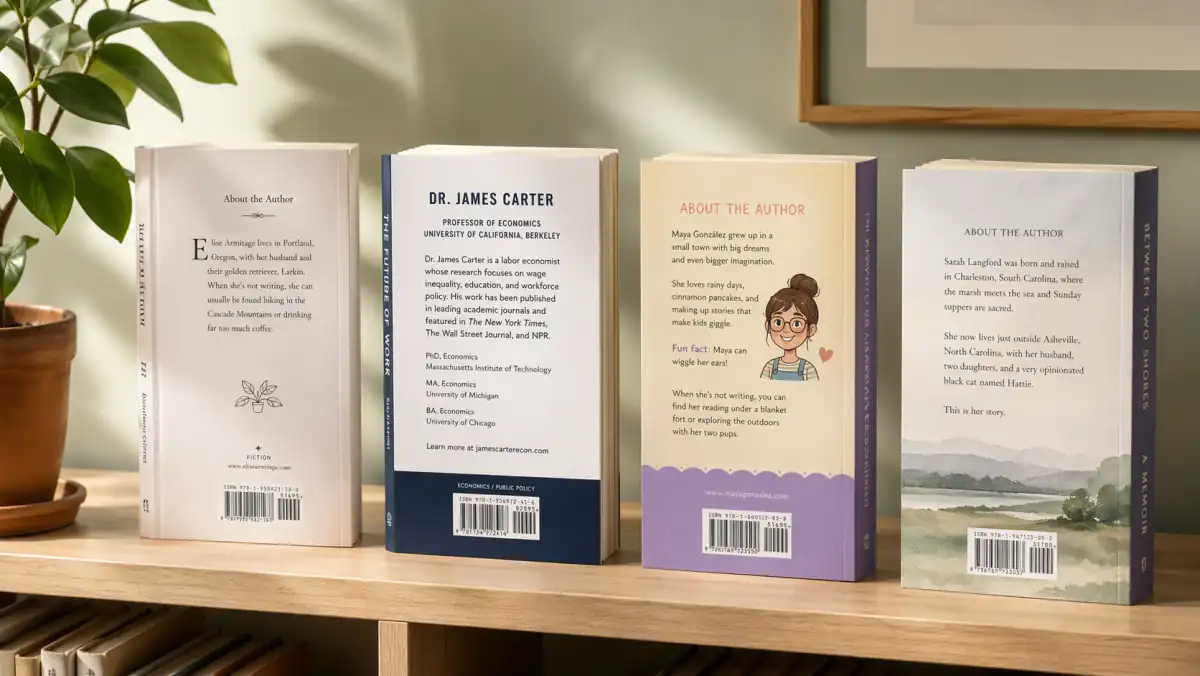
The About the Author page, and how it differs from a back-cover bio
Same person, same facts, different reader. One is trying to sell the book, the other is talking to someone who already finished it.
A back-cover bio is sales copy. It sits next to the blurb and its job is to make a browsing stranger trust you enough to buy. An About the Author page sits at the very end of the book, so by the time anyone reads it they have finished your last chapter. That reader is not deciding whether to buy, they are deciding whether to look for your next one. It is the one place in the book where a slightly longer, warmer paragraph earns its space.
| Back-cover bio | About the Author page | |
|---|---|---|
| Who is reading | A stranger deciding whether to buy. | Someone who just finished the book. |
| Job to do | Establish credibility fast. | Turn a reader into a returning reader. |
| Length | 40 to 80 words. Space is scarce. | Up to a full page, though most run well short of it. |
| Tone | Compressed and credential-forward. | Warmer. You have earned the reader's attention by now. |
| What to end on | The credential that matches the book. | What you are working on next, and where to find you. |
In Inkfluence AI the About the Author page is generated from the bio saved to your author profile, so you write it once and it appears at the back of every book you export from then on. Paste a bio from the generator above into your profile and it flows through to the formatted export without you touching the layout.
From our own data
A quarter of author bios are 25 words or fewer
Across 1,039 author bios saved by people writing books in Inkfluence AI, 26% run to 25 words or fewer. That is worth knowing if you have been staring at a blank box feeling like you need a paragraph of achievements before you are allowed to publish. A quarter of them settled on roughly two sentences.
Short works because a bio is not a CV. It answers one question, which is why this person is worth reading on this subject, and then it stops. If you have a credential, one is enough. If you do not have one yet, the book itself is the credential, and saying so plainly reads better than padding.
Context
Where authority comes from in 2026
Sources for the conventions baked into this generator.
Amazon KDP Author Central: Amazon's own guidance for how bios appear on product pages and Author Central profiles, with character limits and style recommendations. (Amazon Author Central)
Goodreads Author Program: Goodreads offers a free author program with a dedicated profile page; their guidance recommends warmer, reader-facing bios compared to the Amazon product page. (Goodreads)
Publishers Weekly style coverage: Ongoing industry coverage of what makes trade bios work in different genre categories. (Publishers Weekly)
Writer's Digest bio craft: Long-form craft pieces on author bios, including common first-draft traps (burying the lede, passive voice, resume filler). (Writer's Digest)
Alliance of Independent Authors: ALLi's practical guidance on author branding for self-publishers, including the case for placement-specific bios rather than one-size-fits-all. (ALLi)
BookBub Partners: Data-driven analysis of what drives click-through on daily deal newsletters, including how prominent author bios correlate with higher trust and conversion. (BookBub Partners)
Frequently Asked Questions
Everything authors ask before locking a bio.
How do I write a good author bio?
Write in third person. Lead with what you do and who you help (non-fiction) or the kind of stories you write and how they make readers feel (fiction). Keep it to 80 to 150 words for most placements. Add one unexpected personal detail at the end to make readers feel you're a human, not a resume. Our author bio generator produces 10 candidates at a time in varied lengths so you can see patterns across the whole space and pick what fits.
What should be in an author bio?
For non-fiction: your expertise, the outcome you help readers achieve, relevant credentials (degree, past book, major client, notable media), and a small human detail. For fiction: genres you write, the emotional promise of your books, prior titles if any, and one voice-forward sentence that sounds like your prose. For memoir: geography, life history, and restraint - the book itself will tell the story, the bio just invites the reader in.
How long should an author bio be?
Back cover: 40 to 80 words. Amazon KDP author page: 150 to 300 words. Goodreads: 200 to 400. Speaker intro: 100 to 200. Academic conference: 50 to 120. Media kit: varies. Most new authors write one long 300-word bio and trim down for shorter placements. Our generator outputs a mix of lengths every run so you can cover every placement with one brainstorm.
Should author bios be written in first or third person?
Third person is the convention for back covers, Amazon KDP, and most speaking intros. First person works on personal websites, Goodreads (optional), and social media bios. If in doubt, third person. The generator on this page outputs in third person because that's what 95% of placements expect.
Can AI really write a good author bio?
AI can assemble a serviceable first draft quickly, especially from a template library that knows what works in each author type. The output is a starting point, not a finished bio. Plan on 10 to 20 minutes of editing to add specifics (names of your past books, client names, specific numbers). The combination of AI-generated draft plus your own editing produces a cleaner bio than writing from scratch, because the template has already filtered out the usual first-draft mistakes (buried lede, passive voice, resume filler).
What author bio format does Amazon KDP need?
Amazon KDP Author Central accepts plain text up to approximately 2,000 characters. Third person is standard. Line breaks render as paragraph spacing. No markdown, no HTML tags. Photos go in a separate field. The bio appears on every book's product page below the description as well as on your Author Central profile, so write for a browsing reader who hasn't decided to buy yet.
Do I need a different bio for fiction and non-fiction?
If you publish both, yes. The tone is different: fiction bios foreground voice and emotional register, non-fiction bios foreground expertise and outcomes. Mixing them confuses the reader who arrived at one genre and didn't ask for a lesson in the other. Write one bio for each pen name or each distinct author identity. Our generator has separate author types so you can produce both without mixing the register.
How often should I update my author bio?
Every time you publish a new book, win an award, or land major media. At minimum, once a year. Old bios that still say 'she is currently working on her first novel' four books later make you look inattentive. A calendar reminder on December 1st to refresh bios for the new year is a good habit.
Should I mention my day job in my author bio?
Only if it strengthens your authority or is relevant to the book. A lawyer who writes legal thrillers should mention the law. A dentist who writes cozy mysteries should not. The test: does the day job help sell this particular book? If yes, lead with it. If no, leave it out. Nobody browsing Amazon cares about your LinkedIn.
Can I use the same bio on my website and Amazon?
You can, but you'll convert better with placement-specific bios. Your website can afford to be longer, warmer, and first-person. Amazon wants third-person and shorter. Goodreads wants warm and reader-focused. Generate one 300-word master bio and create trimmed versions for each placement. Our generator outputs multiple lengths per run precisely for this reason.
Does Inkfluence AI save author bios to my profile?
Yes. When you click 'Use this bio' on any generated option above, you'll land on your dashboard with the bio ready to save to your author profile. From there it appears on every book you publish automatically, including the back cover, the About the Author page, and your public author landing if you enable it. You can always overwrite or update it later.
Is this author bio generator free to use online?
Yes, and there is no account needed to use it. The generator on this page runs in your browser, so you can regenerate as many times as you like without signing up, hitting a credit limit, or entering a card. You only need an Inkfluence AI account if you want to save a bio to your author profile so it drops into your books automatically.
What is an About the Author page, and is it different from an author bio?
Same text, different placement. The author bio is the short marketing paragraph on a back cover or an Amazon profile. The About the Author page is a full page inside the book, usually the last page, where the same bio gets room to breathe. Because it sits after the final chapter, a reader arriving there has already finished the book, so it can be slightly longer and warmer than the back-cover version.
Can I generate an author biography rather than a short bio?
The generator produces bios in the 40 to 300 word range, which covers back cover, Amazon, Goodreads, and speaker intros. A full author biography, meaning a long-form life story, is a different job and a different length. If that is what you are after, the book writing tools are the better fit, not a bio generator.
Do I have to write the bio myself if I already have a book?
No. If your book is already in Inkfluence AI, the About the Author page picks up whatever bio is saved to your author profile, so you write it once and it appears in every book you export from then on. Change it later and future exports pick up the new version.
How should a first-time author with no credentials handle their bio?
Lean into the book itself and the reader. 'Sam May lives in Kelowna and writes about systems for small businesses. This is his first book.' is a perfectly fine bio. The fact of having written the book is already a credential. Don't stretch: inventing 'thought leader' or 'speaker' when you haven't done those things reads as hollow. Readers prefer honest.
Bio locked. Now write the book.
Once your bio is saved, Inkfluence AI applies it automatically to every book you publish. Start free: 5 AI chapters plus 5 every month, no credit card.
Related tools and reading
The rest of the self-publishing toolkit.
Book Title Generator
24 title ideas per click across 16 genres.
Book Title Ideas
Published titles sorted by genre and by formula.
Book Blurb Generator
Write the back-cover blurb and Amazon description.
Pen Name Generator
The name your bio is written for.
AI Book Generator
Generate the full book after your bio is set.
Best AI Book Generator 2026
10 tools ranked and compared.
KDP Tools
Everything an Amazon author needs.
AI Ghostwriter
Draft in your voice after the bio.
Book Outline Generator
Structure the book behind your bio.
For Self-Publishers
The full indie author playbook.