
AI Interactive Fiction Generator
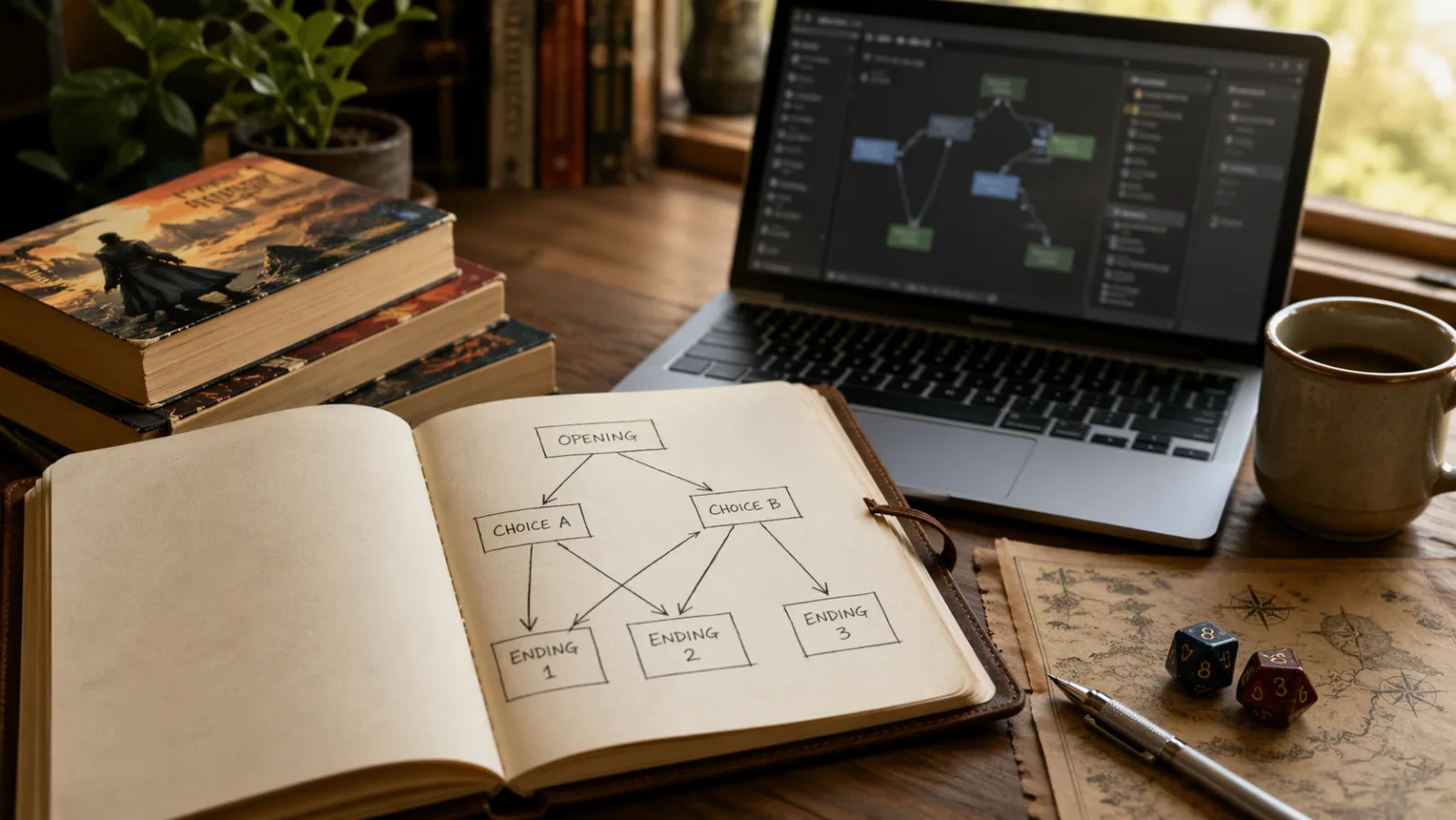
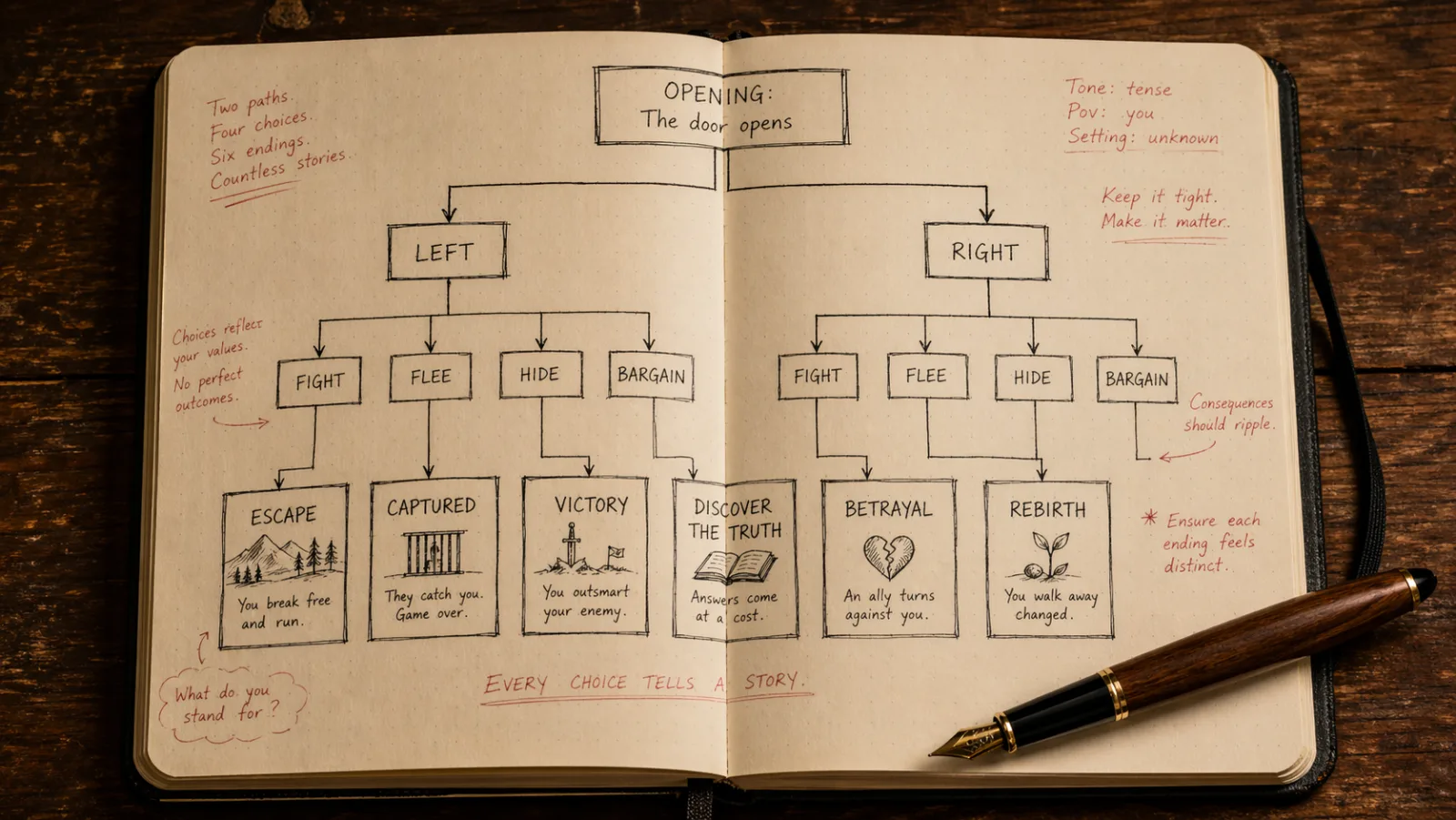
Plot a branching novel or gamebook in seconds. Pick a genre, click generate, and get a complete scaffold: opening scene, two main choices, four sub-choices, and six distinct endings. Regenerate as many times as you want.
Quick answer
An AI interactive fiction generator plots a branching novel structure in seconds: one opening scene, two main choices, four sub-choices, and six distinct endings. That is thirteen narrative nodes you can expand into a 40,000 to 80,000 word branching novel or Choose Your Own Adventure style gamebook. This tool runs fully client-side across six genres (fantasy, mystery, sci-fi, horror, romance, thriller) with unlimited regenerations, no sign-up, no credit card required.
Plot in seconds
Generate a branching story
Choose a genre, click generate, and get a full scaffold: opening, two main choices, four sub-choices, six endings. Regenerate as many times as you want to find a structure that sings.
Like the structure? Expand each node into a full chapter with the AI novel writer.
Write the full novelThe format
What interactive fiction actually is, and why the structure is everything
Interactive fiction is not a gimmick. It is a narrative form with a serious pedigree, from Edward Packard's Choose Your Own Adventure series in the 1980s to Steve Jackson and Ian Livingstone's Fighting Fantasy gamebooks to modern text-game platforms like Inkle Studios' 80 Days and Failbetter Games' Fallen London. The form pairs traditional prose craft with the discipline of branch design: every choice must carry weight, every ending must feel earned, and no path can feel like filler. For a detailed taxonomy, The Interactive Fiction Archive catalogues thousands of works across every sub-genre.
The hardest part of writing interactive fiction is not the prose. Any competent novelist can write a scene. The hard part is the structure: deciding where choices branch, how deep to branch them, and how to design endings that each feel like a legitimate destination rather than a dead end. A weak interactive novel has six endings where five of them feel like the losing screen. A strong one has six endings where any one of them could be the 'true' ending, depending on what the reader values. This generator exists to get that structural skeleton out of your head and onto the page in under ten seconds, so the rest of your time is spent on the prose instead of the plotting.
Compare
Interactive fiction platforms compared
Five tools, five very different output formats. Pick the one that matches where you want your branching novel to live: web, Amazon KDP, Unity, or a dedicated gamebook store.
| Platform | Best for | Output | Curve | Price | Built-in AI plotting |
|---|---|---|---|---|---|
| Inkfluence AI | Branching novels for KDP | EPUB + PDF + audiobook | Low | Free tier; $9.99/mo paid | Yes |
| Twine | Web-based visual novels | HTML | Low | Free, open source | No |
| ink (Inkle) | Game narrative, Unity | Game-engine script | Medium | Free, open source | No |
| Inform 7 | Parser text adventures | Z-machine / Glulx | High | Free, open source | No |
| ChoiceScript | Commercial gamebooks | Choice of Games store | Medium | Free + revenue share | No |
Inkfluence AI produces novel-format output optimised for Amazon KDP rather than web or game-engine delivery. Twine, ink, Inform 7, and ChoiceScript are the incumbent interactive fiction toolchain - use this generator's branching tree as a starting scaffold for any of them.
Craft
How to structure a branching novel that does not collapse
The trap every first-time interactive novelist falls into is exponential explosion. If every choice branches into three new choices, by the time you reach a fourth layer you have 81 nodes to write. Nobody finishes that book. The structure this generator uses (two main branches, four sub-branches, six distinct endings) is intentionally bounded: 13 nodes total, each expandable to a 3,000 to 8,000 word chapter. The total novel sits between 40,000 and 100,000 words across all paths, which matches the volume of a traditional novel but splits it across meaningful choices.
The other trap is choice-that-does-not-matter. A choice between 'open the door' and 'leave the door closed' is not really a choice if both lead to the same next scene. The branches produced by this tool are designed so each choice leads to a genuinely different sub-scene and a different cluster of endings. If you want to expand a single path into a linear novel, any of the six endings can sit at the end of a 50,000 to 80,000 word traditional draft, with the discarded branches becoming future standalone short stories or sequel material.
For publishing, Amazon KDP accepts interactive fiction formatted either as a standard paperback with 'turn to page X' references or as a Kindle ebook with hyperlinked choices. Twine (twinery.org) exports to HTML for web reading, ink by Inkle Studios exports to game engines for screen-based works, and Inform 7 is the historical standard for parser-style text adventures. For a branching novel that reads as a book rather than a game, KDP plus a clean chapter-linked Kindle export is still the simplest path to market.
Structure
The five classical branching patterns
Interactive fiction theorist Sam Kabo Ashwell catalogued five recurring shapes in his 2015 essay "Standard Patterns in Choice-Based Games." Most modern branching novels use a blend. The generator on this page produces a Branch-and-Bottleneck by default, which is the easiest shape to write and publish.
| Pattern | How it works | Classic example | Writing cost |
|---|---|---|---|
| Time Cave | Every choice branches, no paths merge. Exponential content explosion. | Early Choose Your Own Adventure titles | Very high |
| Branch-and-Bottleneck | Branches diverge, then converge at key scenes. Manageable and dramatic. | 80 Days, Heaven's Vault | Low-medium |
| Gauntlet | One main path surrounded by many dead-end branches. | Most text adventures (Zork, Anchorhead) | Medium |
| Quest | Regular choice points with real consequences, mostly linear backbone. | Fighting Fantasy, Lone Wolf | Medium |
| Open Map | Hub-based, freely explorable, sequence determined by the reader. | Fallen London, Cragne Manor | Very high |
Lineage
Five gamebooks that shaped the form
Knowing the lineage of interactive fiction changes how you plot one. The best branching novels borrow structural tricks from the genre's 40-year history. Here are the five works worth reading before you write your own. Each represents a different answer to the core question: what should a choice feel like to the reader?
- The Cave of Time (Edward Packard, 1979) - The first Choose Your Own Adventure book and the template every branching novelist has been rewriting since. 40 endings across 117 pages. Time Cave pattern taken to its extreme. Reads fast, but most endings feel arbitrary. That is the lesson to unlearn.
- The Warlock of Firetop Mountain (Steve Jackson, Ian Livingstone, 1982) - First of the Fighting Fantasy series. Adds stats, combat, and inventory. Showed interactive fiction could sustain a 400-paragraph adventure with character progression. Sold 15 million copies worldwide across the franchise.
- Life's Lottery (Kim Newman, 1999) - A serious literary novel in branching form. Thriller author Kim Newman used gamebook mechanics to write a meditation on determinism, luck, and class. Proof that interactive fiction can hold adult themes without losing its form.
- 80 Days (Inkle Studios, 2014) - Circumnavigate the globe as Phileas Fogg's valet. 750,000 words across all branches; every playthrough is 30,000 to 50,000 words. Branch-and-Bottleneck pattern executed to its peak. Still the current gold standard.
- Disco Elysium (ZA/UM, 2019) - Technically a video game, but 1 million words of branching text. Showed that literary fiction in branching form can win game awards and critical acclaim in roughly equal measure. What interactive fiction at book length could aspire to.
Avoid
Five pitfalls that kill branching novels
1. Exponential explosion
Three choices per node across four depth levels produces 81 endings. Nobody writes all 81. Use the Branch-and-Bottleneck pattern so paths converge at key scenes. You get the feeling of consequence without the writing cost.
2. Fake choice
"Open the door" vs "leave the door closed" where both lead to the same next scene. Readers feel the fakery within two choices. Every branch must produce a different sub-scene and a different ending cluster, or remove the choice entirely.
3. The losing-screen ending
Five of your six endings read like game-over screens, only one feels like the real ending. Strong interactive novels give each ending a distinct emotional register (triumphant, bittersweet, tragic, ironic) so no path feels like the wrong answer.
4. Forgetting state
The reader picks up the silver dagger in chapter one, then in chapter four the narration asks "do you have a weapon?". Breaks immersion instantly. Either track state explicitly (Twine and ink handle this) or design branches so earlier decisions do not need to be remembered later.
5. Over-engineering before writing prose
Writers spend months on branching diagrams before a single chapter is drafted. The prose is where the book lives or dies. Plot the tree fast (this generator takes ten seconds), then spend the remaining 29 days on actual writing.
Workflow
From plot tree to published novel in 30 days
A realistic timeline for solo indie authors. Heavy edit weeks can extend it, but the spine of the work is achievable inside a calendar month.
Day 1 - Plot the branching tree
Run this generator until a 13-node tree feels right. Save the output as a text file. Total time: 20 minutes.
Days 2-4 - Write the opening and both main branches
Three chapters, roughly 3,000 words each. Expand each node prompt with Inkfluence AI or any capable AI novel writer, then revise by hand.
Days 5-14 - Draft all six endings
Each ending chapter 4,000 to 6,000 words. Write them in order of emotional intensity: start with the most difficult (usually the tragic or ironic ones) while your energy is fresh.
Days 15-20 - Draft the four sub-choice bridges
Short transition chapters, 1,500 to 2,500 words each. These are the connective tissue between main branches and endings.
Days 21-26 - Self-edit and consistency pass
Read every path end to end. Fix broken state (weapons that appear and then vanish, characters whose names change), tighten prose, cut fake choices.
Days 27-30 - Format, cover, publish
Export to EPUB with internal hyperlinks for Kindle Interactive, or format with "turn to page X" style for paperback. Upload to Amazon KDP, add AI-assistance disclosure, publish.
Verified references
Sources and further reading
Every claim on this page is backed by a primary source. Verify the numbers yourself.
The Interactive Fiction Archive: the canonical library of interactive fiction works, tools, and history.
Inkle Studios: ink: the narrative scripting language behind 80 Days and Sorcery!, free and open-source.
Twine: free open-source interactive fiction editor, exports branching stories to HTML.
Inform 7: natural-language programming environment for parser-style interactive fiction.
Amazon KDP Formatting Guidelines: covers interactive ebook and print formatting for branching fiction.
US Copyright Office AI Policy: human-authored portions of AI-assisted interactive novels remain copyrightable.
Chooseco (Choose Your Own Adventure): the original gamebook series trademark holder and ongoing publisher.
Fantastic Fiction: bibliographic reference for Fighting Fantasy, Lone Wolf, and historical gamebook series.
Frequently Asked Questions
Everything novelists ask before plotting an interactive novel.
What is interactive fiction?
Interactive fiction is a narrative format where the reader makes choices that change the story's direction and outcome. It includes Choose Your Own Adventure style gamebooks, text adventures, visual novels, and branching novels. Interactive fiction pairs traditional prose craft with structural design of choices, consequences, and distinct endings. The genre has roots in the 1980s Choose Your Own Adventure series by Edward Packard and the Fighting Fantasy series by Steve Jackson and Ian Livingstone. Modern interactive fiction runs on platforms like Twine, Inform 7, Ink by Inkle Studios, and now on AI-assisted writing tools that help plot branching structures faster.
What is a gamebook?
A gamebook is the physical-book form of interactive fiction. Readers progress by making choices at the end of numbered sections that direct them to different pages based on their decision (for example, 'If you open the door, turn to page 87; if you retreat, turn to page 113'). Classic examples include Choose Your Own Adventure, Fighting Fantasy, Lone Wolf, and Give Yourself Goosebumps. Gamebooks are enjoying a modern revival both as nostalgia titles and as a publishing format for indie novelists who want to distinguish their work from linear fiction.
How is this generator different from other AI writing tools?
Most AI writing tools produce linear prose; this tool produces a structured branching tree with an opening, two main choices, four sub-choices, and six distinct endings. It gives novelists the scaffolding of a gamebook or choose-your-own-adventure structure, which is the hardest part of plotting interactive fiction. Once the structure is set, any AI novel writer can expand each node into prose. Pair this generator with our full Inkfluence AI novel writer for the prose expansion step.
Can I publish an interactive novel on Amazon KDP?
Yes. Amazon KDP accepts interactive fiction formatted as a standard paperback or Kindle ebook with clear choice prompts and page references. Kindle Interactive Text supports hyperlinked choices directly. For print, the traditional 'turn to page X' format works well. Disclosure of AI-assisted content is required on the KDP publishing form, as with any AI-assisted work. Refer to Amazon KDP guidelines at kdp.amazon.com for current formatting requirements for interactive titles.
Do I own the rights to the stories I generate?
Yes. Everything you generate with this tool is yours to use commercially without royalties or attribution. Modify freely, keep what you like, discard the rest. The branching tree is scaffolding; your real novel is the prose you expand each node into, where the human authorship value is highest and the copyright strongest (per current US Copyright Office guidance on AI-assisted works).
How long should an interactive novel be?
Most modern interactive novels sit between 20,000 and 50,000 words across all branches combined, which is shorter than a linear novel because individual readers experience only one path per read. Each branch-tip ending should feel complete in 3,000 to 8,000 words. Longer interactive novels (80,000+ words across branches) exist but require significantly more plotting discipline to keep each path satisfying.
Is this generator free to use?
Yes, the interactive fiction generator on this page is free with unlimited regenerations, no sign-up, no credit card. Every click produces a new branching tree. Use it to plot as many interactive novels as you want. If you want to expand each node into full prose with a KDP-ready novel export, upgrade to the Inkfluence AI novel writer (free tier includes 5 chapters plus 5 every month).
Can I use this for Twine or Inform stories?
Yes. The branching tree produced by this tool maps cleanly to Twine passages, Inform 7 rooms, or Ink knots. Treat each node (opening, choice, sub-choice, ending) as one passage and add your prose inside it. Platforms like Twine (twinery.org) and Inkle's ink engine are free and open-source, which pairs well with free plotting scaffolding generated here.
What genres does this generator support?
Six genres with distinct choice patterns and ending tropes: fantasy (magic, prophecies, kingdoms), mystery (clues, suspects, reveals), sci-fi (technology, discovery, moral dilemmas), horror (dread, survival, entrapment), romance (attraction, obstacles, resolution), and thriller (stakes, deception, betrayal). Each genre's templates reflect the genre's archetypes; the branching structure remains consistent so you can switch genres without relearning the tool.
Can I turn a branching novel into a linear novel later?
Yes, and it is a common workflow. Plot the branching tree, pick the strongest path from opening to one ending, expand that single path into a traditional linear novel. You keep the structural rigour of interactive fiction plotting without committing to the publishing complexity of a true gamebook. The discarded branches often make excellent short stories, series prequels, or alternate-edition extras.
Plot the branches. Then write the novel.
Use this generator to plot the skeleton for free. Then expand each node into a full chapter with the Inkfluence AI novel writer. 5 chapters free every month, full commercial rights, no credit card.
Related tools for novelists
Everything else in the plotting and drafting toolkit.
AI Novel Writer
Expand each node into a full chapter. Fiction blueprints, chapter continuity, ACX-spec audiobook.
Book Outline Generator
10-chapter linear outline across 8 genres for traditional novels.
Book Title Generator
Free title ideas across 10 genres including fantasy, thriller, and mystery.
Best AI Novel Writer 2026
Ranked comparison of 8 AI novel writers tested on real novel projects.
Book Description Generator
Amazon KDP book descriptions across 5 proven frameworks.
Author Bio Generator
Novelist author bios across 8 author types.
For Novelists
Full novelist workflow: story bible, fiction blueprints, 30-day publish timeline.
AI Story Bible Generator
Free character bible, world rules, lore, and plot-thread builder in one click.