
How to Write a Book Series with AI (Watch One Book Become Three in 3 Minutes)
Writing one book with AI is a solved problem. Writing the second and third, with the same characters, the same world and the same rules, is where most tools fall over, because each book is a fresh prompt with no memory of the last. In the video above, James from the Inkfluence team opens a finished book, clicks Turn into a series, chooses three books and the Sequel style, and watches all three write at the same time with the character Luca carried through them. This page walks through every click, explains exactly what is passed from book to book and what is not, and takes the finished set through to export and sale.
232 series
generated on the platform between the feature's first use on 11 April 2026 and 14 September 2026, by 148 authors, adding up to 805 books
3 books
the most common series length: 113 of the 232 chose three, 87 chose four and 31 chose two
7 chapters
the average length of a volume across all 805, which is also what the three books in the video come out at
Quick Answer
To write a book series with AI, finish one book first, then turn it into a series rather than prompting each sequel from scratch. In Inkfluence AI, open the book from Working on, click Turn into a series, choose two, three or four books, pick a continuation style (Sequel for a story that carries on, Companion for the same subject from new angles, Expanded to turn brief sections into full books), check the tone and audience, and click create. The series is planned one volume at a time with every earlier volume's plan in view and the first chapter of the source book as the anchor, then all the books are written at once. Each comes into your dashboard as its own book to edit, cover and export. The video shows the whole flow in three minutes; the transcript is further down the page.
In this video
- 0:00 Start from Working on and pick the book the series grows from
- 0:18 The tools list, and Turn into a series
- 0:32 How many books: two, three or four
- 0:45 Sequel, Companion or Expanded: the three continuation styles
- 1:08 Tone and audience, then Create 3-volume series
- 1:28 Luca: one character, three books
- 1:50 Three progress bars: the books write at the same time
- 2:15 What comes after: edit, proofread, export, publish to the Showcase
- 2:40 Three seven-chapter books, all at once
Where do you start?
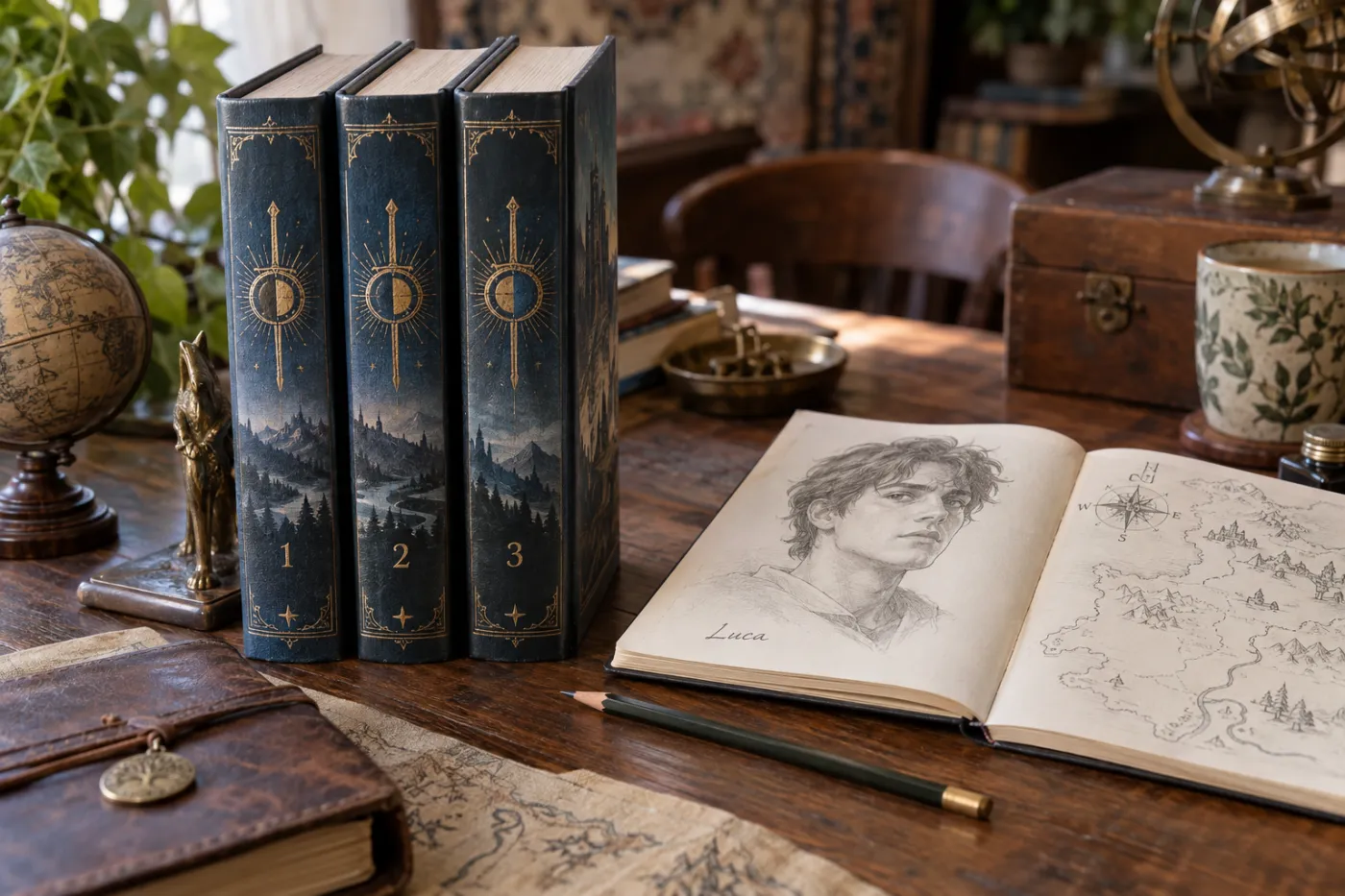
With a finished book, and the video is clear about that. James scrolls down the dashboard home page to Working on, which lists the books you have been editing most recently, and opens one. Every book has a tools list beside it, and Turn into a series is one of the tools. It sits alongside the other ways of building on a book you already have, which is the point: a series is something you grow out of a book that works, not something you plan from a blank page.
That has a practical consequence. The first book is the source for everything that follows, and one part of it matters more than the rest: the opening chapter. As the next sections explain, the first chapter of the source book travels with every chapter of every later volume as the anchor for names, voice and setting. If your main character's name, the place, and the one rule of the world are all stated in chapter one, the series inherits them. The story bible generator and the character bible generator are the quickest way to write those facts down before you start. If they only appear in chapter nine, put a line about them in chapter one before you begin. The book walkthrough covers writing that first book; this page starts where it ends.
Two, three or four books?
The first choice after expanding Turn into a series is the number of books, and the feature offers two, three or four in one run. James picks three. So does almost everyone: of the 232 series generated on the platform since the feature launched, 113 were three books, 87 were four and only 31 were two. Three is the trilogy shape readers already recognise, and it is long enough for the middle book to have a job of its own rather than being a bridge.
The number also sets the workload. Each volume is planned at five to eight chapters, and the average across every volume written so far is seven, which is what the three books in the video come out at. A three-book series is therefore about 21 chapters, or roughly 20,000 to 30,000 words, written in one run. If you want more than four books, run the feature again from the last volume; it becomes the source book for the next set, and its first chapter becomes the new anchor.
Sequel, Companion or Expanded: which continuation style?
The second choice is how the books relate to each other, and the video reads out the three options. This is the decision that most changes what you get, so it is worth being precise about what each one tells the planner to do.
| Style | What each book does | What the planner is told | Best for |
|---|---|---|---|
| Sequel | Continues chronologically, building on where the previous book left off | Continue from where the previous volume ended; advance the story or move to the next phase of the topic | Fiction of every kind, memoir in parts, a course that builds week on week |
| Companion | Explores the same subject from a different angle or for a different audience | Each volume stands alone and complements the others; vary the perspective, audience or application | Guides for different readers (beginners, managers, parents), devotionals by theme, workbooks by situation |
| Expanded | Deep-dives into sections the first book covered briefly, expanding each into a full book | Take a single concept or chapter and give it a full multi-chapter treatment with richer examples and exercises | A survey book that becomes a set of specialist books; a how-to whose chapters each deserve a volume |
James chooses Sequel because his book has a character, Luca, and a story to continue. Fiction almost always wants Sequel. Non-fiction is where the other two earn their place: a book on starting a small business becomes, with Companion, a set for freelancers, for shop owners and for online sellers, and with Expanded it becomes one book each on pricing, marketing and hiring. The fiction guide and the non-fiction walkthrough cover how each kind of first book is best written.
Tone and audience: the two boxes worth a second look
Below the style sit two text boxes, tone and audience, pre-filled from the source book, and the video points out that you can edit both. They apply to every volume, and they are the only free-text steer you have over the whole series, so they deserve ten seconds. If book one was written warm and conversational for first-time readers, leave them. If you want the sequels to read darker, or to speak to a more experienced reader, this is the place to say so, and it will hold across all the books rather than drifting.
Then the button: Create 3-volume series. The video is honest about what follows. There is no outline preview at this step; the series plans itself and starts writing, and the books appear in the dashboard with a progress bar each.
What happens when you click create?
Two stages, and the first is the one that decides whether the series hangs together. Before a word of prose is written, the series is planned volume by volume, in order. Volume one's plan is written from the source book's opening chapter and told that it is the first of three: set things up, do not try to cover everything. Volume two's plan is written with volume one's title and chapter list in front of it, and told not to repeat any chapter or topic already covered. Volume three's plan sees both earlier plans and is told it is the final volume and must bring the series to a satisfying conclusion. Each plan also gets a series title that works across all the books (the title generator is there if you want to rename it), so you end up with "The Salt Road: The Ferryman's Debt" rather than "The Salt Road Volume 2".
Only then does writing start, and it starts for all the books at once. This is the moment the video lingers on: three progress bars, three books filling in side by side, seven chapters each. Each chapter is written with the series title, its volume's place in the run, the plans of every earlier volume, the tone, the audience, and a slice of the source book's opening in front of it, plus an instruction to build on earlier volumes without repeating them. You can sit and watch, as James does, or leave; the books finish in the background and wait in your dashboard.
What is actually carried from book to book
This is the question behind every "can AI write a series" search, and the honest answer is more useful than a vague yes. Here is exactly what travels between volumes, what it is used for, and what does not travel.
| What travels | Where it goes | What it protects |
|---|---|---|
| The source book's first chapter | Anchors volume one's plan, and a slice of it is in every chapter prompt of every volume | Names, voice, setting, the premise as first stated |
| Every earlier volume's plan | Title and full chapter list, in the plan of each later volume and in every chapter it writes | Chronology, no repeated ground, a conclusion in the last book |
| Tone and audience | Every plan and every chapter | A series that reads as one author |
| Series title and volume position | Every chapter knows it is chapter four of volume two of three | Set-up in book one, escalation in the middle, resolution at the end |
| Cast, setting and character sheet (picture books) | Copied from the source book onto every volume, including the drawn reference sheet | The same drawn character in book three as in book one |
What does not travel is every sentence of every earlier book. A detail that appears only in the middle of book one, a scar, a secret, a rule of magic first mentioned in chapter nine, is not in the material later volumes are written from unless it is in the first chapter or implied by the plan. That is not a flaw to hide; it is the thing to plan around, and the checklist below is how.

Keeping characters consistent: five things to do before you click
- Put the anchor facts in chapter one. Full names, the setting, the relationship that drives the story, and the one rule that must never break. If chapter one of your source book already does this, you are done. If not, add a paragraph; it is the highest-leverage edit in series writing.
- Read the last chapter of book one and make its ending clear. Sequel picks up from where the previous volume ended, and the plan is what carries it. An ambiguous ending produces an ambiguous book two. If your first book ends on a cliffhanger, that is fine; make sure the cliffhanger is stated, not implied.
- Use the tone and audience boxes to fix the voice. "Dry, first-person, for adult crime readers" holds across three books far better than hoping the sequels catch the voice from the excerpt alone.
- Choose Sequel for any book with a character. Companion and Expanded are built for subjects, not people. A character-led book run through Companion produces three parallel stories, not a saga.
- Plan the human pass. The series will be coherent at the level of the plan. Continuity at the level of the sentence, the colour of a coat or the name of a tavern, is a read-through job, and it is quick because the books are short. The editor and its AI assistant are where that pass happens.
Fantasy and science fiction authors carry the most rules and gain the most from step one, and the series authors page covers the publishing side of a multi-book career: release cadence, read-through and the KDP series page. The novel writer page covers world-building for the first book, and the fanfiction data shows how much of the platform's fiction is written inside established universes, where the rules are already fixed and a series is the natural shape.
What 232 series tell us about how people use it
These figures come from the platform's own generation records, measured on 14 September 2026, the day the video went up. The series feature was first used on 11 April 2026. They are published here because this page is their home; other pages cite them.
- 232 series, 805 books, 148 authors. Some authors have made one series; a few have made many. The average author who tries it makes more than one.
- Three books is the default people choose, at 113 of 232, with four books close behind at 87. Two-book runs are rare, at 31. Nobody is using the feature for a single sequel; they are building sets.
- The pace is rising. 166 of the 232 series were made in the 90 days to 14 September, and 50 in the last 30 days, before the feature had a video or a page of its own.
- Seven chapters a volume, on average, across all 805 books, which puts a typical three-book series at around 21 chapters and a four-book series at around 28.
- The titles run the full range: epic fantasy and horror sit next to devotionals, a Japanese light-novel side story, an Arabic advertising course and a book-club origin story. Series are not a fiction-only habit.
The wider picture of what people write on the platform, genre by genre, is on the what people write with AI page; this page keeps to series.
Six series shapes, and the style that makes each one
The same feature builds very different sets depending on the source book and the style. These are shapes that work, with the one setting that makes each of them.
| Source book | Style | What the series becomes |
|---|---|---|
| A fantasy novel with one protagonist | Sequel, 3 books | A trilogy: the world is set in book one, the stakes rise in book two, the last book concludes |
| A cosy mystery | Sequel, 4 books | One detective, four cases, a personal arc running underneath; the classic read-through series |
| A children's picture book | Sequel, 3 books | The same drawn character in three adventures, painted from one character sheet |
| A beginner's guide to a skill, or a workbook | Expanded, 3 or 4 books | Each chapter that was a survey becomes its own specialist book |
| A guide written for one audience | Companion, 3 books | The same method for three different readers, each book sold to its own market |
| A 30-day devotional or challenge | Companion, 4 books | Four themes, one format, a set that reads as a collection on a store page |
The second row is the one to study if you want to sell fiction. A recurring lead character with a case per book is the shape of most of the best-selling series on Amazon, because a reader who liked the detective will buy the next case without being sold on it. The romance writer page and the romance guide cover the other high read-through genre, where each book follows a new couple in the same town, and the fanfiction writer is the same idea inside a universe whose rules are already fixed.
After the books are written: edit, cover, export, sell
The video ends with the list of what comes next, and it is the same list as for any book: edit, proofread, export to Etsy, Gumroad or Amazon, or publish to the Showcase. Each volume is a normal book in your dashboard, and three things are worth doing in order.
Read them in order, in one sitting if you can. The books are short, and continuity errors show up on a straight read far better than on a chapter-by-chapter edit. Keep a note of the details the series established, a name, a place, a date, and check each book against it. The editor's AI assistant can rewrite a passage to match a fact you give it, which is faster than retyping.
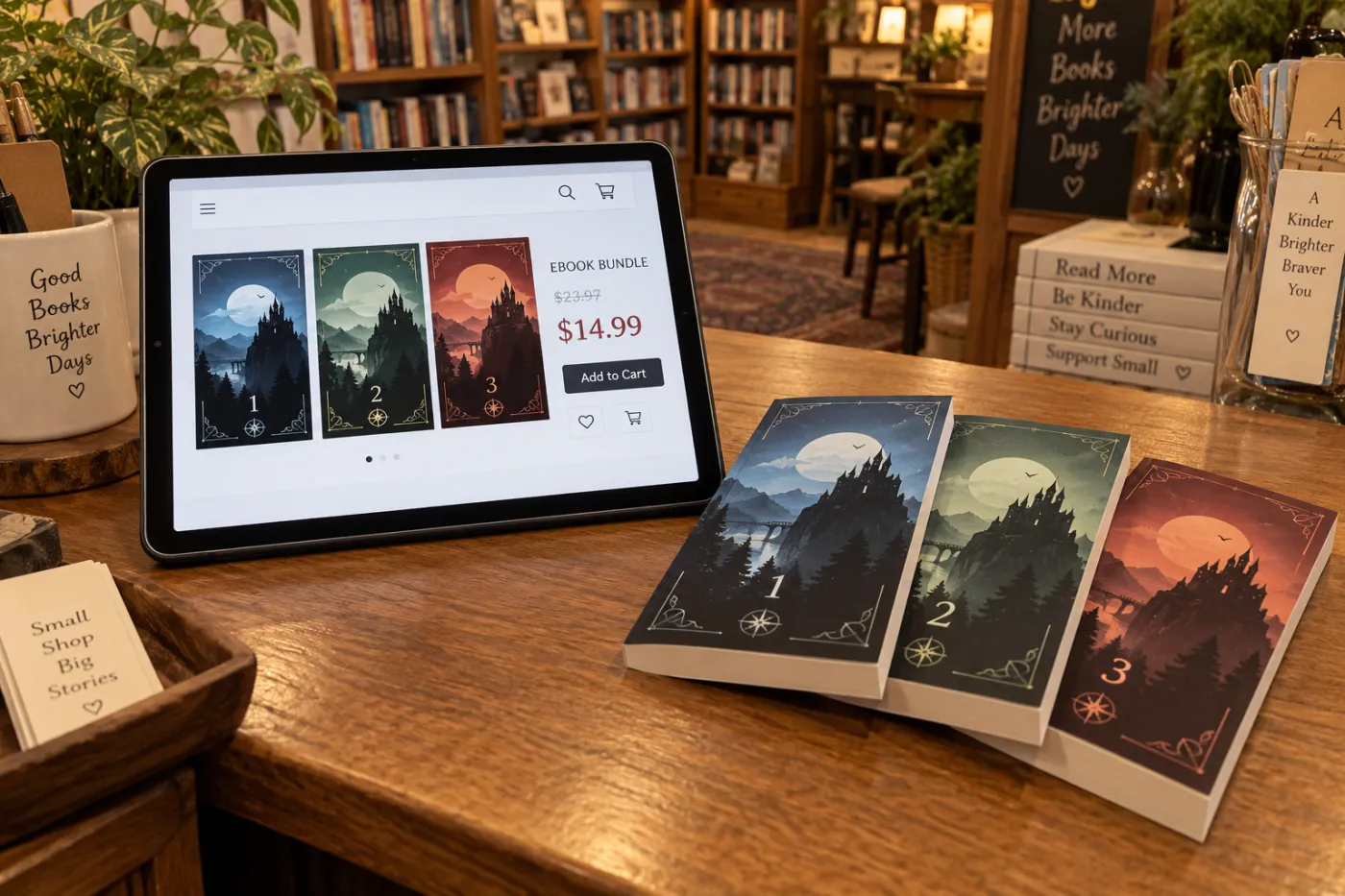
Give the set matching covers. Readers identify a series by its covers before its titles. Design volume one in the cover designer, then keep the layout, fonts and title treatment and change the image or the accent colour per book. Number the volumes on the cover; a buyer who cannot tell which book is first will buy none of them.
Publish them close together. Series economics is read-through: the reader who finishes book one and buys book two the same evening. Release all volumes within days of each other, link them as a series on Amazon so they share a page, and price book one low or free. The selling walkthrough covers Etsy and Gumroad, where a bundle of all three volumes at a set price is the usual listing, and the KDP guide covers the Amazon side, including the AI content declaration, which does not block a listing.
A narrated edition of each volume is one more click in the same project through the audiobook generator, and series audiobooks benefit from the same voice across every book, which the voice picker makes a matter of choosing the same narrator each time.
Five mistakes that break an AI book series
- Turning a draft into a series. The source book is the anchor. If it is unedited, its mistakes are inherited three times. Finish book one properly first.
- Leaving the anchor facts out of chapter one. The opening chapter travels; chapter nine does not. Names, setting and rules belong at the start.
- Running a character-led book through Companion. Companion writes three parallel takes on a subject. For a character, use Sequel.
- Skipping the straight read. The plan keeps the books coherent; the sentences are yours to check. Three short books read in an evening.
- Publishing book one alone and waiting. Readers who have to wait months for book two forget book one. Release the set together.
Which plan do you need for a series?
| Plan | Price | Turn into a series | What a three-book series uses |
|---|---|---|---|
| Free | $0 | Not included | Write and edit the first book; series needs a paid plan |
| Creator | $9.99 a month | Included | 35 chapters a month included; a three-book series is roughly 15 to 24 of them, with room left for edits |
| Premium | $19.99 a month | Included | No monthly chapter limit; run series back to back |
The dialog shows the chapter estimate and your remaining allowance before you click create, so there is no surprise. Lifetime plans include the feature. The pricing page has the current numbers.
Watch this, or read the written guides?
The video shows the clicks and how long the wait is, which is what people ask first. The craft of the first book, which is where a series is won or lost, lives on the written pages: the novel guide for structure and pacing, the fiction guide for genre, and the outline generator if you want to see a book's shape before you write it. If you only have three minutes, watch the video, open a finished book, and click Turn into a series; the two choices on that screen will teach you the rest.
Full video transcript
Lightly punctuated for readability; the wording is as spoken.
Read the transcript (3:01)
This is James from Inkfluence AI, and today I'm going to be showing you how to create a series from your book. So, if we scroll down on the homepage, you can select the book that you want to edit or create a series with, and you do that by clicking Working on, and then it will have the book that you want to edit. Now, as you can see, there's a list of different tools that you can use. But for this, we're going to go to Turn into a series, and we'll expand that.
And as you can see, we've got an option selection for how many books in this series we want Inkfluence AI to create. So we'll go for three books. And what we're going to do is we can select from the continuation style. So Sequel: each book continues chronologically, building on where the previous left off. Companion: each book explores the same topic from a different angle or for a different audience. And Expanded: each book deep dives into sections that were briefly covered, expanding them into full treatments. For this, we're going to go for the Sequel option. And as you can see here, you can also edit the tone and the audience as well.
We're going to then go to Create three-volume series, and Inkfluence AI is starting to create our series for us. Now, this is really good if you want to create the three books that follow on from each other. So if you've got a character, so for this we've got Luca, and we want to create some books around that character, then you can do this and Inkfluence AI will take care of the rest.
Now, as you can see, we've got the three different books that are being created, and we've got a progress bar for each one. Now it's creating each book through Inkfluence AI. So what we just need to do is sit back, relax, and wait for our three books to be created. And then we can edit them, proofread, and once we're happy, we can then look at listing them and exporting them to Etsy, Gumroad, Amazon, and you can also publish them on Inkfluence AI's Showcase to really highlight your book and reach your target audience.
As you can see, it's amazingly quick. We've got three different seven-chapter books being created at once, and it's absolutely flying through each book.
Book series FAQ
How do you write a book series with AI?+
How does the AI keep characters consistent across a book series?+
What is the difference between Sequel, Companion and Expanded?+
How many books can a series have?+
How long is each book in the series?+
Does the series continue the story or just copy the first book?+
Can I write a fantasy series with AI?+
Can I make a picture book series?+
Is the series feature free?+
Can I edit the books after the series is generated?+
Where can I publish a series made with AI?+
Should the books in a series have matching covers?+
How do you make money from a book series?+
Can I turn a non-fiction book into a series?+
Where does the video happen, and can I follow along?+
Keep reading
- How to write a book with AI: the walkthrough for the first book, same dashboard.
- AI novel writer: world-building, character and structure for fiction.
- How to write a fiction book: genre by genre, with read-through rates.
- How to make a picture book with AI: the character sheet a picture-book series is painted from.
- The most popular AI fanfiction fandoms: series inside established universes.
- How to sell your ebook: Etsy and Gumroad, where a series sells as a bundle.
- Self-publishing on Amazon KDP: linking the volumes as a series on Amazon.
- For series authors: the publishing cadence and economics of a multi-book career.
- AI story bible generator: write the world rules down before book one.
- The AI novel writing guide: the full first-book process, from premise to book two.
- Pricing: which plans include Turn into a series.
Open a finished book and click Turn into a series
Two choices on one screen. The books write while you watch.
Start a series