
Newer figures are available. This study is kept as published. The current counts, recounted on 15 September 2026 across 102,854 books, are on AI book writing statistics, with industry context on self-publishing statistics.
What People Actually Write with AI
We analyzed 79,789 books and 284 million words to see what people really make with AI.
By Sam, Founder of Inkfluence AI · Updated October 2026
Quick Answer
People use AI mostly to write practical non-fiction, not novels. Across 79,789 books created with Inkfluence AI (more than 284 million words), the most common type is the how-to or practical guide (17.9%), with fiction second (17.6%) and self-help third (6.9%). The typical AI book is short and focused, about 8,500 words, not an 80,000-word epic. Books span 30+ genres and 15+ languages (about 1 in 6 is non-English). The takeaway: AI's real-world use in books is the everyday practical guide people can finish and publish quickly, with a large and healthy slice making fiction, children's books, and romance.
79,789
books created
284M
words written
15+
languages
30+
genres
What kinds of books do people make with AI?
Across the books people make with Inkfluence AI, practical non-fiction and fiction lead together. The single most common type is the how-to or practical guide (17.9%), with fiction second (17.6%) and self-help and personal development third (6.9%). Add up all the practical categories (guides, self-help, business, finance, cookbooks, education, health, workbooks) and they account for more than half of every AI book made. The full top 10:
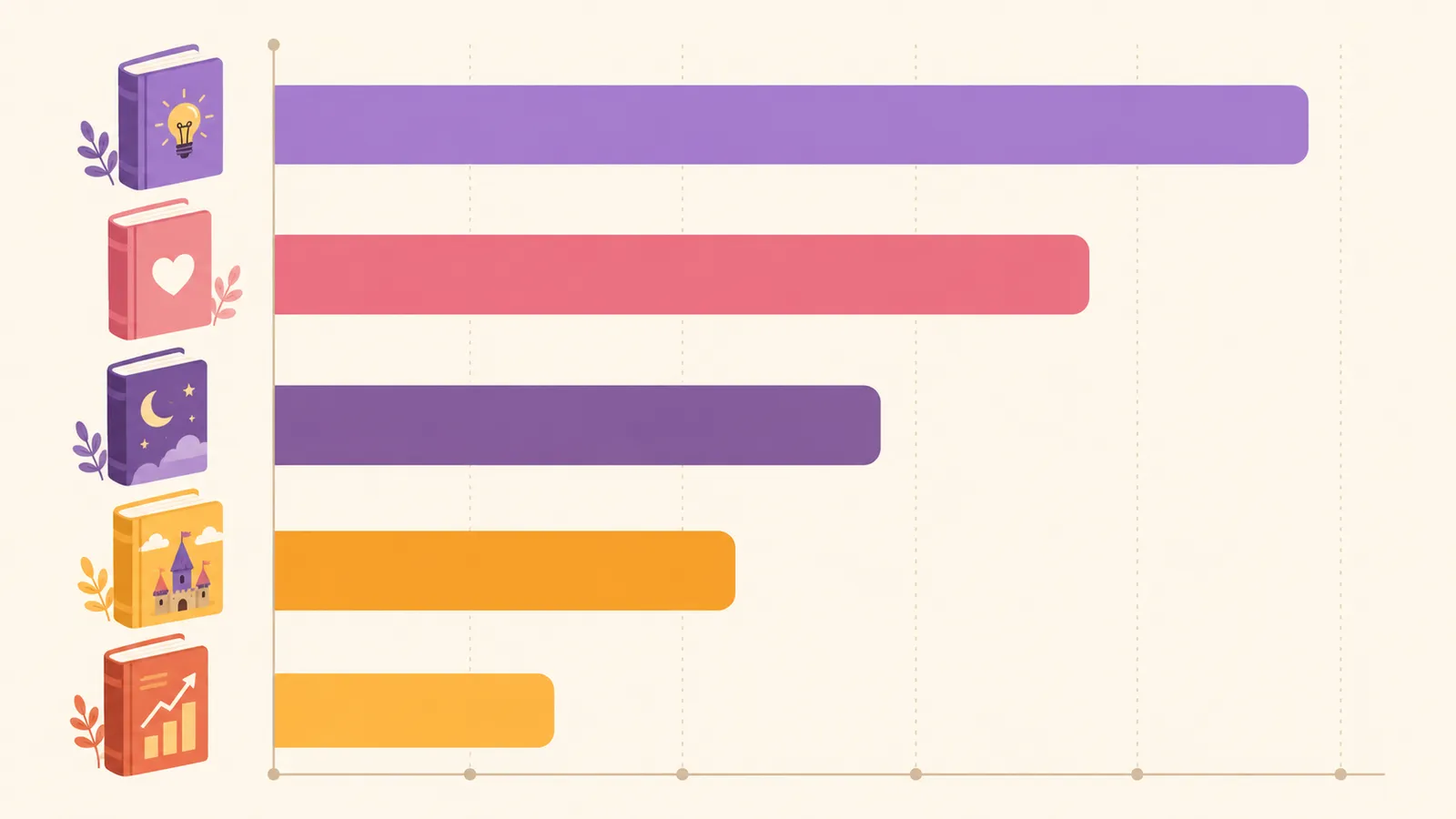
The pattern is consistent: people use Inkfluence AI to produce the kind of book that has a clear purpose and a clear buyer. A how-to guide, a self-help book, a cookbook, a study guide. These are formats where a finished, well-structured draft is genuinely useful, and where the writing-plus-formatting grind is exactly what stops most people from ever publishing.
The gaps say as much as the leaders. Of the 48 books on the platform about short-term rentals, counted on 23 September 2026, 46 are about running the rental and only 2 are the welcome book the guests actually read; the Airbnb guidebook maker has the breakdown. Some kinds of book are made to be sold more than others: 5.4% of travel guides are listed on Etsy or Gumroad through the app, against 2.4% of all books, and most of those travel listings are on Etsy (counted 23 September 2026; the travel guide selling data has the method).
How long is the average AI book?
Shorter than most people expect. The average AI book is about 8,500 words, a few focused chapters rather than a full-length novel. That tells you something real about how people use AI: to produce a tight, useful, finished book quickly, rather than to grind out an 80,000-word manuscript that may never get done. The same chapter-by-chapter generation can go much longer when someone wants it to, but most people deliberately keep it lean. For comparison, a novel starts at 40,000 words; see how many words are in a novel for the ranges by genre. Across all 79,789 books made with Inkfluence AI, authors have written more than 284 million words.
Why are AI books so short, and is that a good thing?
At first glance, an average of about 8,500 words sounds slight next to a traditional 60,000 to 90,000-word non-fiction book. In practice it is a deliberate and smart choice. Short, focused books get finished and published, where ambitious manuscripts stall for years. They also match how people actually buy and read now: a tight how-to guide, a 30-minute self-help read, a single-topic workbook. Amazon's short-reads category and the classic lead-magnet ebook both live in exactly this range. A focused book that solves one clear problem for one clear reader will usually outsell a sprawling one that tries to do everything. The Inkfluence AI data is not saying AI writes thin books, it is showing that people choose the length that actually gets read. When someone does want a full-length work, Inkfluence AI's chapter-by-chapter engine scales up to 40 chapters, but most people choose lean on purpose.
Is AI mostly used to write novels?
Not mainly, though it is closer than people assume. On Inkfluence AI, fiction is the biggest single creative category (about 23% once you include novels, children's books, and romance), but practical non-fiction still leads overall. People reach for AI more often to make practical, sellable non-fiction than to write novels. The popular narrative that "AI is only for writing novels" is backwards: AI's biggest real-world use in books is the everyday practical guide. Fiction writers do use it heavily, especially for fanfiction and genre stories, but they are not the whole story.
What languages do people write AI books in?
On Inkfluence AI, books have been written in 15+ languages. English leads at about 84.0%, followed by French, Spanish, Portuguese, German, and Arabic, with a long tail that includes Indonesian, Bengali, Ukrainian, Italian, Hindi, and Chinese. So about 1 in 6 AI books is written in a language other than English, a reminder that AI writing is a global behaviour, not an English-only one. Because the same one-idea workflow can generate or translate a book into 30+ languages, a single idea can become a multi-language catalogue.
How does this fit the wider author trend?
It lines up with where the whole industry is heading. A 2025 BookBub survey of more than 1,200 authors found that about 45% already use generative AI somewhere in their process, and the Alliance of Independent Authors reports that writers who adopt AI tools tend to report higher earnings. What the Inkfluence AI data adds is the missing detail: it shows what those authors are actually making, and the answer is practical, publishable books, not just chat-assisted drafts. People are not only experimenting with AI, they are finishing and publishing real books with it: complete with audiobooks and cover designs.
Five myths about writing with AI, checked against the data
It is easy to assume things about AI books that the numbers simply do not support. Here are five of the most common myths, each checked against the 79,789 books people have made with Inkfluence AI.
Myth: AI is mostly for churning out novels.
Reality: Fiction is second at 17.6%; the how-to or practical guide leads at 17.9%. Practical non-fiction overall is still the largest bloc, a bit over half of everything made.
Myth: AI books are giant auto-generated tomes.
Reality: The average book is about 8,500 words, a few focused chapters. People deliberately keep them tight and finishable.
Myth: It is an English-only thing.
Reality: Books span 15+ languages, and about 1 in 6 is written in a language other than English.
Myth: Only tech-savvy people use it.
Reality: Tens of thousands of authors made everything from cookbooks (3.3%) to children's books (3.0%) to poetry and devotionals.
Myth: Nobody actually finishes an AI book.
Reality: More than 41% of all 79,789 books have been exported at least once, and 99.5% have a real title. People finish these books and take them out into the world.
What does the data tell us?
Three things stand out across the Inkfluence AI data. First, the real use of AI for books is practical non-fiction: guides and self-help people can publish and sell, with fiction a strong second, not a distant one. Second, people make short, focused books (about 8,500 words), because a finished useful book beats an unfinished ambitious one. Third, it is global and multi-format: tens of thousands of authors across 15+ languages, from cookbooks to children's books to business guides. If you have an idea for a book, you are squarely in the most common, most successful use of AI book writing, and you can watch the whole process or just start one free.
Methodology
This study is based on all 79,789 books created with Inkfluence AI as of August 2026, not just the subset authors chose to make public on the showcase. Genre is the book's assigned type; language is the book's set language; the total word count is summed across every author's writing activity, and the average per book is that total divided by the number of books. Export figures come from per-book export counts. Percentages are rounded, and live totals grow daily.
Sources
- Inkfluence AI first-party data: 79,789 books created / 284 million words written, across tens of thousands of authors (June 2026).
- BookBub, survey of 1,200+ authors on AI (2025): ~45% of authors use generative AI.
- Alliance of Independent Authors, writers using AI report higher earnings.
- Alliance of Independent Authors, self-publishing facts.
Write your own book with AI
Join tens of thousands of authors. Free plan includes AI chapters, PDF export, and a cover designer.
Start writing free