
How to Write a Novel with AI
Go from a single premise to a complete 50,000-100,000 word manuscript. AI drafts every chapter sequentially with a story bible that tracks your characters, plot threads, and world - so chapter 15 remembers what happened in chapter 2.
Quick Answer
To write a novel with AI, describe your story premise, protagonist, central conflict, and genre in detail. Inkfluence AI generates a structured chapter outline with plot progression and character arc milestones, then writes each chapter sequentially using a story bible that tracks continuity. Each chapter receives the full context of everything before it - character states, unresolved plot threads, and the previous chapter's ending. Edit in the built-in editor to deepen voice and add sensory detail, then export as PDF or Kindle EPUB. Supports every genre: thriller, romance, sci-fi, fantasy, literary fiction, and more. Free to start with 5 chapters.
Searching for how to write a novel with AI, AI novel writing software, or AI tool to write a full-length novel? This guide covers everything from crafting your premise to publishing on Amazon KDP.
What Does AI Novel Writing Actually Mean?
AI novel writing means using artificial intelligence to draft a full-length manuscript - 50,000 to 100,000+ words - while you direct the story, characters, and creative vision. You provide the premise (genre, protagonist, conflict, setting, tone) and the AI generates chapter after chapter of narrative prose. Tools like Inkfluence AI's novel writer are purpose-built for long-form fiction. The critical difference from short-form AI writing is continuity: a novel must track characters, plot threads, world rules, and emotional arcs across dozens of chapters.
The biggest challenge is not generating words - any AI can produce text. The challenge is generating words that remember. Chapter 12 needs to know that your protagonist broke up with their partner in chapter 5, discovered the hidden letter in chapter 8, and has been growing more reckless since chapter 10. Inkfluence AI solves this with sequential generation and a story bible: each chapter is written one at a time, with the story bible, the last three chapters in full and a running record of every character's state, what they know and every unresolved thread fed into the generation. The result reads like a novel with forward momentum, not like twelve unrelated scenes stitched together.
A typical workflow: describe your story in a detailed premise, the AI generates an outline with structural beats (inciting incident, midpoint, climax), you adjust the arc, the AI writes each chapter in sequence with full continuity, and you polish in the built-in editor by deepening voice, adding sensory detail, and refining dialogue before designing a cover and exporting.
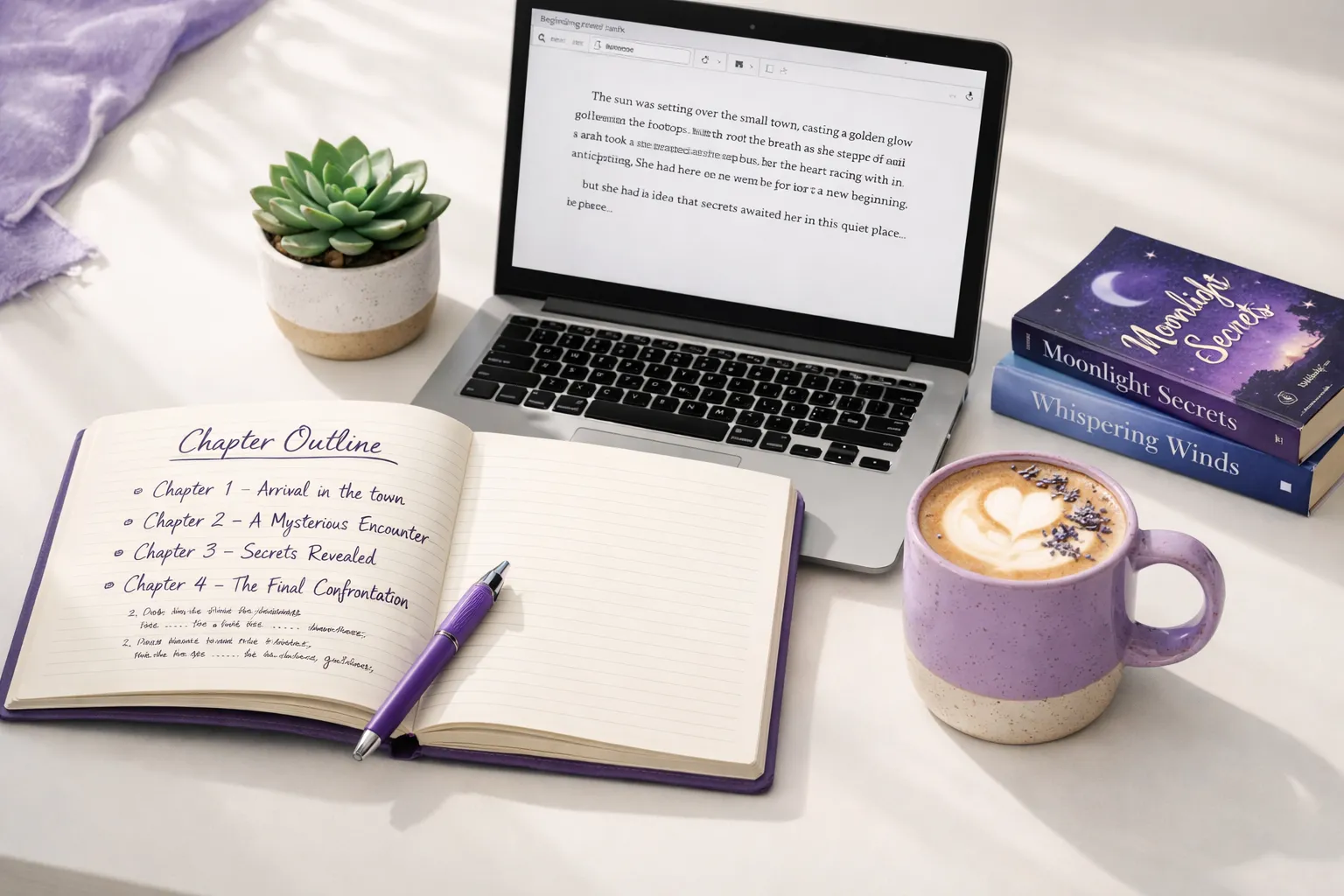
How the Story Bible Maintains Novel Continuity
The most common failure in AI-generated novels is continuity breakdown: characters change eye colour, dead characters reappear, resolved conflicts resurface, and the plot contradicts itself. Inkfluence AI prevents this with a story bible system. Before generation begins, the AI builds profiles for every named character (traits, relationships, goals, speech patterns) and logs world rules (magic systems, technology level, geography, social structures). As each chapter is generated sequentially, the story bible updates: if a character reveals a secret in chapter 6, all subsequent chapters know that secret is out. If a subplot resolves in chapter 10, the AI does not resurrect it in chapter 11. The system also tracks previous chapter endings verbatim, so each new chapter opens with natural narrative continuity. This is why Inkfluence uses sequential generation for novels (one chapter at a time) rather than parallel generation - story-level consistency requires each chapter to know everything that came before it. Combined with genre-specific writing rules, the output reads like a drafted novel, not a collection of disconnected scenes.
The Novel Market in 2026
Fiction novels remain the backbone of the publishing industry. Self-published novels now account for a growing share of bestseller lists.
$8.6B
US fiction ebook and audiobook market (2025)
40%
Of Amazon fiction sales are self-published
$2.99-$5.99
Sweet spot pricing for debut novels on KDP
50K-100K
Standard novel word count range
Why now is the best time to write your first novel
The barrier to publishing a novel has never been lower. Amazon KDP gives you global distribution. AI handles the most time-intensive part of novel writing: producing the first draft. The revision pass - where you add your unique voice, deepen characters, and polish prose - is where the real craft lives, and that part gets easier when you have a complete draft to work with instead of a blank page. Combined with professional cover design, AI audiobook narration, and instant export, first-time novelists can go from idea to published in weeks instead of years. Romance, thriller, and sci-fi genres in particular reward consistent output - readers want the next book.
Every Novel Genre Supported
Each genre routes to craft-appropriate rules for pacing, tone, dialogue, and structure. See the AI Novel Writer for the full feature breakdown.
Literary Fiction
Character-driven narratives exploring the human condition. Interior monologue, thematic depth, lyrical prose. The genre where voice matters most.
Thriller and Suspense
High-stakes plots with escalating tension, plot twists, and ticking clocks. Pacing is everything. See the dedicated mystery and thriller writer.
Romance
Love stories with emotional arcs, chemistry-building scenes, and satisfying resolutions. Every subgenre from contemporary to paranormal. See the romance novel guide.
Science Fiction
Speculative worlds grounded in scientific concepts. From hard sci-fi to space opera. World-building rules tracked through the story bible.
Fantasy
Invented worlds with magic systems, political intrigue, and epic quests. The story bible tracks your world rules, magic constraints, and invented terminology.
Mystery and Detective
Whodunits, police procedurals, cozy mysteries, and amateur sleuth stories. Clue placement, red herrings, and fair-play revelation structure.
Horror and Dark Fiction
Psychological horror, supernatural terror, cosmic dread, and gothic atmosphere. Building unease across chapters requires precise pacing control.
Historical Fiction
Stories set in real historical periods with period-accurate language, customs, and world details. Research-intensive - use the premise to anchor specific eras.
Young Adult
Coming-of-age narratives for teen readers. First-person voice, identity themes, accessible prose. 50,000-80,000 words. See the story writer for shorter YA formats.
Dystopian and Speculative
Near-future social commentary, post-apocalyptic survival, alternate histories. The story bible tracks your world's rules, technology, and social structures.
Magical Realism
Literary fiction with supernatural elements treated as ordinary. Latin American tradition, contemporary magical realism, and fabulist narratives.
Adventure and Action
Fast-paced narratives driven by physical journeys, quests, and survival. Set-piece structure with escalating challenges and geographic progression.
What the AI Generates for Each Chapter
Every novel chapter includes these narrative craft elements. Refine everything in the built-in editor.
Genre-specific additions: thrillers add cliffhangers and pacing shifts, romance adds chemistry beats and emotional turning points, fantasy adds world-building anchors, literary fiction adds thematic resonance.
The Midpoint Problem: Why Novels Die at 40,000 Words
Ask any writing community where manuscripts get abandoned and the answer clusters in the same place: the middle. The premise carried act one, the ending is vivid in your head, and the 30,000 words between them are a swamp. This is a structure problem, not a discipline problem.
Give the midpoint a reversal
Something at the exact middle should change what the protagonist wants or what the reader knows: a false victory, a betrayal, the real antagonist revealed. A midpoint that merely continues is a midpoint that sags.
Outline the middle hardest
Most outlines are detailed for act one, vivid for the climax, and vague in between ("things escalate"). Invert that: the middle chapters need the most specific what-changes-here notes, because they are the ones with no momentum of their own.
Let the story bible carry continuity
Mid-book is where dropped threads and forgotten wounds happen, and where sequential generation with a story bible earns its keep: chapter 14 is written knowing what chapter 6 set up, so the middle tightens instead of drifting.
A useful test before you generate: can you say what changes in each middle chapter in one sentence? If three chapters in a row answer "they keep travelling", merge them.
How to Write a Novel with AI in 4 Steps
From your story idea to a complete manuscript. See the full ebook workflow for a deeper look at each stage.
Craft Your Premise and Characters
Enter a detailed premise with your novel's genre, setting, protagonist (name, age, flaw, desire), the central conflict, and the emotional arc. Example: 'A literary thriller set in coastal Maine, 2024. Nora Callahan, 34, marine biologist, discovers her missing sister's research notes hidden in a tide pool - notes that suggest she did not drown accidentally but was investigating something in the town's fishing industry. Nora is methodical and avoids confrontation (her flaw), but her sister was fearless. Dual timeline: present-day investigation and sister's journal entries from the months before she vanished. Atmospheric, slow-burn tension. 14 chapters, 75,000 words.' The more specific your characters and conflict, the better every chapter.
Review and Shape the Outline
The AI generates a chapter-by-chapter outline with plot progression, character arc milestones, and structural beats (inciting incident, midpoint reversal, dark night, climax). Review the arc: does the tension escalate naturally? Does the protagonist change meaningfully? Are subplots woven in at the right moments? Reorder chapters, adjust pacing, and ensure every chapter advances both plot and character. This is where you architect the reading experience.
Generate Chapters Sequentially
Novel chapters are generated one at a time because each chapter depends on everything before it. The AI maintains a story bible tracking character states, unresolved plot threads, relationship dynamics, and world details. Chapter 8 knows the exact emotional state your protagonist was in at the end of chapter 7. Use the built-in editor between chapters to refine voice, add sensory details, and deepen character moments. Sequential generation prevents the inconsistency problems that plague AI fiction.
Revise, Design, and Publish
Read the complete manuscript for narrative momentum, voice consistency, and emotional payoff. Strengthen the opening hook, tighten the midpoint, and make sure the ending delivers on the promise of chapter one. Add the sensory details, subtext, and character-specific dialogue that make a novel feel alive. Design a genre-appropriate cover with the AI cover designer. Export as EPUB for Amazon KDP or PDF for beta readers and print-on-demand.
Novel Structure by Genre
Different genres follow different structural conventions. The AI adapts pacing, chapter length, and narrative approach to match your genre.
| Genre | Structure | Pacing | Word Count |
|---|---|---|---|
| Literary Fiction | Character arc, thematic exploration, quiet revelations | Slow burn, interior-driven | 70K-100K |
| Thriller | Inciting event, escalation, twists, explosive climax | Fast, short chapters, cliffhangers | 70K-90K |
| Romance | Meet, obstacles, midpoint crisis, grand gesture, HEA | Moderate, chemistry-building beats | 50K-80K |
| Fantasy | World intro, quest/conflict, escalation, epic climax | Steady build, world-building woven in | 80K-120K |
| Science Fiction | World premise, inciting discovery, consequences, resolution | Varies by subgenre (hard vs space opera) | 80K-110K |
| Mystery | Crime, investigation, false leads, revelation, resolution | Methodical, clue-driven chapters | 70K-90K |
| Horror | Normality, creeping unease, escalation, confrontation | Slow build, dread accumulation | 60K-90K |
| Young Adult | Identity crisis, discovery, trials, growth, new normal | Brisk, accessible, emotionally direct | 50K-80K |
The AI detects genre from your premise and applies the matching structural conventions automatically.
Novel Structure Explained
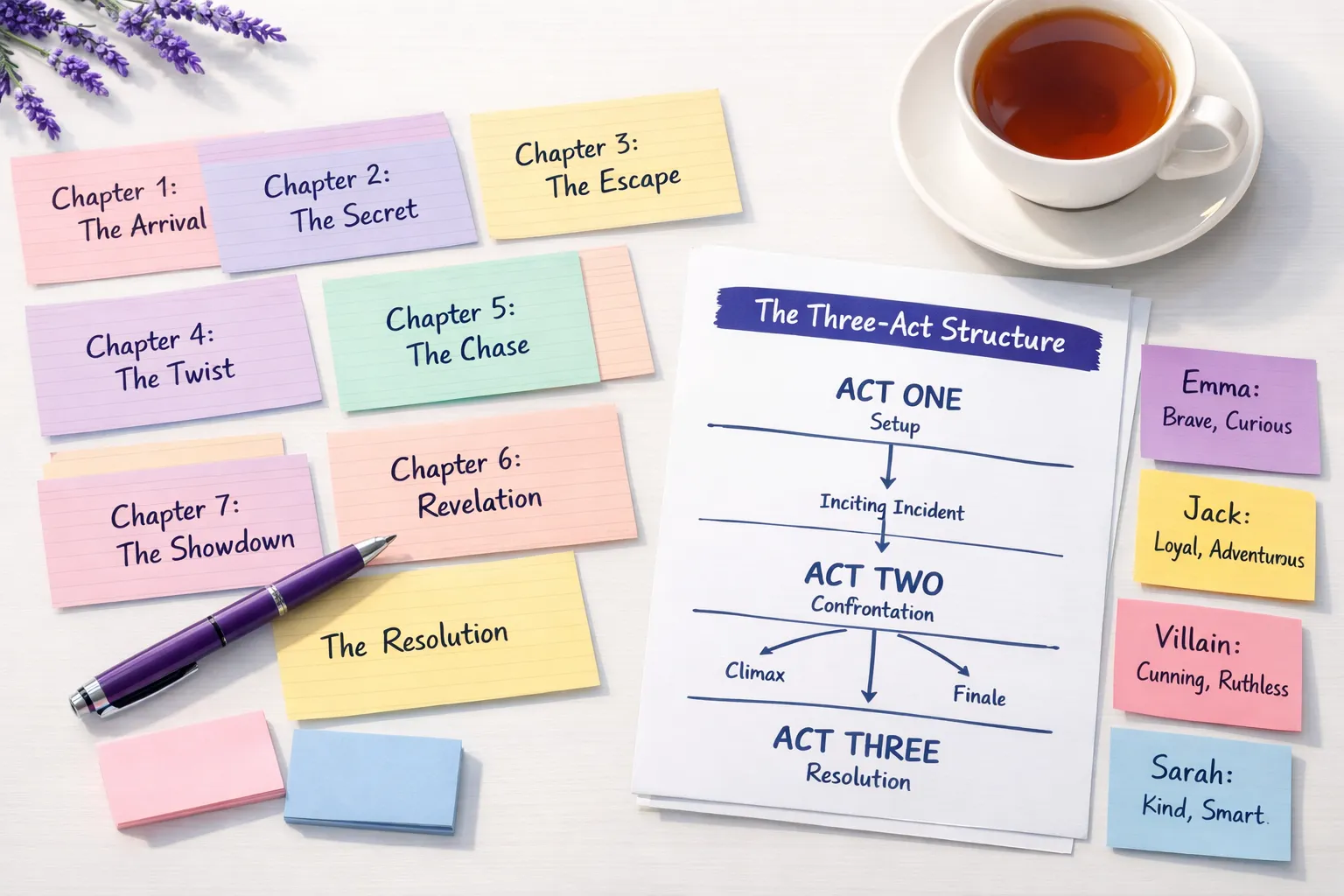
Most successful novels follow a three-act structure adapted to genre conventions. Act I (chapters 1-3): establish the protagonist's ordinary world, introduce the central conflict through an inciting incident, and end with the protagonist crossing a threshold into the story's main tension. Act II (chapters 4-10): escalating complications, a midpoint reversal that changes the stakes, subplot development, and a "dark night" moment where everything seems lost. Act III (chapters 11-14): climax, resolution of primary and secondary conflicts, and a denouement that lands the emotional payoff. The specific beats vary by genre - romance novels require a "happily ever after" in the denouement, thrillers often add a final twist after the climax, and literary fiction may leave threads deliberately unresolved for thematic effect. Inkfluence AI's outline generator maps these beats to your specific chapter count and genre.
Inkfluence AI vs ChatGPT for Writing a Novel
ChatGPT can write a scene. Inkfluence AI writes a novel that holds together from chapter 1 to chapter 15. See our full comparison guides for deeper analysis.
ChatGPT
- Good for brainstorming ideas and dialogue
- Quick single-scene drafts
- Flexible creative partner for plotting
- No story bible or character tracking
- Characters lose consistency after a few chapters
- Context window limits kill long novels
- No PDF, EPUB, or audiobook export
- Manual copy-paste into Word or Google Docs
Inkfluence AI
- Story bible tracks characters, plots, and world rules
- Sequential generation with full chapter memory
- Genre-specific pacing and structure rules
- PDF, EPUB, and audiobook export included
- AI cover designer built in
- Built-in editor for voice refinement
- Handles 50,000-120,000 words without losing context
- Previous chapter endings fed into next chapter
The key difference: Inkfluence AI produces a novel where chapter 15 remembers chapter 1. ChatGPT's context window means your characters lose their memory.
Traditional Novel Writing vs AI-Assisted
Where the time actually goes when writing a 75,000-word novel
| Task | Traditional | With Inkfluence AI | Time Saved |
|---|---|---|---|
| Premise and character development | 2-4 weeks | Detailed premise in 1-2 hours | ~3 weeks |
| Outlining and plot structure | 2-6 weeks | AI outline with beats in minutes | ~4 weeks |
| Writing first draft (14 chapters) | 3-12 months | 2-5 hours (sequential generation) | ~6 months |
| Maintaining continuity notes | Ongoing (manual spreadsheets) | Automatic story bible | Entire task |
| Revision and voice polish | 4-8 weeks | 3-5 weeks (deepening, not rewriting) | ~3 weeks |
| Cover design | $300-1,500 or weeks DIY | AI cover designer (minutes) | $500+ or weeks |
| Total time to publish | 6-18 months | 4-8 weeks | 80-90% |
Time not saved: your creative vision, revision instinct, and the editorial pass where you make the novel distinctly yours.
Pricing for Novelists
Start free. Upgrade when you are ready for full-length manuscripts. Full pricing details.
| Feature | Free | Creator $9.99/mo | Premium $19.99/mo |
|---|---|---|---|
| Chapters | 5 + 5/month | 35/month | Unlimited |
| Smart Continue / day | 3 | Unlimited | Unlimited |
| PDF export | Included | Included | Included |
| EPUB (for KDP) | -- | Included | Included |
| AI cover generator | Basic | AI-generated | AI-generated |
| Audiobook generation | -- | -- | Included |
| Custom branding | -- | -- | Included |
| Credit card required | No | Yes | Yes |
Novel Premise Templates
Copy and adapt these premise prompts for popular novel genres. The more specific your characters and conflict, the better every chapter. For more ideas, browse our 50+ AI writing prompts guide.
Thriller
"A psychological thriller set in a prestigious London architecture firm, 2024. Maren Shaw, 29, junior architect, discovers that the award-winning building her mentor designed has a structural flaw that will kill people within 5 years - and her mentor knows. Maren is a people-pleaser who has never stood up to authority (her flaw), and her mentor controls her career, her reference letters, and her professional reputation. Fast-paced, dual POV (Maren and the mentor), unreliable narrator elements. Each chapter ends on a revelation or escalation. 15 chapters, 80,000 words."
Key elements: specific setting, clear stakes, character flaw tied to conflict, structural directive (dual POV, chapter endings)
Literary Fiction
"A literary novel about grief and reinvention, set across three cities (Dublin, Lisbon, Kyoto) over one year. Sadie Brennan, 41, speech therapist, takes a sabbatical after her partner of 12 years dies suddenly. She promised him she would visit the three cities they always talked about but never went to. Each city forces her to confront a different dimension of their relationship: Dublin (where they met), Lisbon (where they almost broke up), Kyoto (where they planned to grow old). Lyrical, introspective, sensory-rich. The real journey is internal. 12 chapters, 75,000 words."
Key elements: emotional core, geographic structure, internal arc, tone directive (lyrical, introspective)
Fantasy
"An epic fantasy set in an archipelago where magic is tied to the tides. Kael, 22, tide-reader (lowest caste of magic users), discovers he can reverse the tides - a power that was supposed to be extinct. The ruling caste wants to use him as a weapon. The rebel fleet wants to use him as a symbol. Kael just wants to go home to his fishing village, but going home means the fleet burns it. Political intrigue, found-family dynamics, one perspective with ensemble cast. Magic system: tide-readers sense currents, storm-callers control weather, deep-divers commune with sea creatures. 16 chapters, 100,000 words."
Key elements: defined magic system, political stakes, character motivation, world-building anchors, ensemble dynamics
Science Fiction
"Hard sci-fi set aboard a generation ship 80 years into a 200-year journey to Proxima Centauri. Dr. Yuki Tanaka, 35, ship geneticist, discovers the population's DNA is degrading faster than projected - they will not make it to the destination with viable genetics. The ship's AI recommends a selective breeding protocol. Yuki's partner is flagged as genetically unsuitable. Ethical sci-fi meets political thriller. Explores bodily autonomy, algorithmic governance, and what humanity means in transit. 14 chapters, 85,000 words."
Key elements: scientific premise, ethical dilemma, personal stakes, thematic questions, genre blend
Young Adult
"A YA contemporary set in a competitive summer music programme in Austin, Texas. Devi Malhotra, 17, classical violinist, has been preparing for this audition her entire life - it is her path to Juilliard and the only future her immigrant parents will accept. But the programme pairs her with a jazz drummer who thinks sheet music is a prison, and Devi starts questioning whether she even likes classical music or just likes being good at it. First-person, witty internal voice, slow-burn friendship that reframes identity. 12 chapters, 60,000 words."
Key elements: identity conflict, cultural specificity, voice directive (witty first-person), relationship dynamic
Paste any of these into Inkfluence AI, edit the characters and conflict to match your story, and generate your outline in seconds.
Who Writes Novels with AI?
Anyone with a story that deserves to exist on a page
First-Time Novelists
You have the story in your head but cannot get past chapter 3. AI gives you a complete first draft to revise, which is infinitely easier than staring at a blank page. Start with the free novel writer to test the workflow.
NaNoWriMo Participants
50,000 words in 30 days. AI handles the drafting velocity while you focus on the creative decisions: which scene comes next, how the character reacts, where the subplot leads. Use the story bible to keep continuity tight under pressure.
Series Authors
Readers want the next book. AI accelerates your production cycle from one book a year to one every few months. Critical for romance, thriller, and fantasy readers who consume voraciously.
Plotters Who Hate Drafting
You love outlining, world-building, and character creation but the actual writing drains you. Give AI your detailed outline and let it draft the prose. You do the creative architecture; AI does the construction.
Genre Fiction Entrepreneurs
Publishing is a business. Romance, thriller, and sci-fi readers buy more books per year than any other audience. AI lets you publish consistently across a series while maintaining quality. Export for Amazon KDP with optimised metadata.
Stuck-in-the-Middle Writers
You have 30,000 words but cannot push through the midpoint. Import your existing chapters and let AI continue from where you stopped. It reads your voice, pacing, and plot trajectory to generate chapters that match.
How to Write a Novel with AI: The Complete Process
Every novelist has the same problem: the gap between the story in their head and the manuscript on the page. That gap is measured in months of drafting, dozens of abandoned starts, and the soul-crushing moment around chapter 7 when the plot stops making sense. AI does not eliminate the creative work of writing a novel. It eliminates the bottleneck. You still make every creative decision. AI turns those decisions into prose faster than you can type. Here is the complete process.
Step 1: Build the Foundation - Premise, Characters, World
The premise is the single most important input. A vague premise ("a thriller about a detective") produces generic output. A specific premise ("a psychological thriller where an architecture firm junior discovers her mentor knows the building will collapse, and her mentor controls her entire career") gives the AI material to work with for 15 chapters without repeating itself. Include: genre, setting (specific location and year), protagonist (name, age, occupation, defining flaw, deepest desire), antagonist or antagonistic force, central conflict, tone, and word count. See the prompt templates for fully worked examples across genres.
Step 2: Shape the Arc - Outline and Structural Beats
The AI generates a chapter-by-chapter outline with structural beats: inciting incident (chapter 1-2), first plot point, midpoint reversal, second plot point, dark night of the soul, climax, and denouement. Review the arc critically. Does the tension escalate in every act? Does the protagonist change meaningfully? Are subplots introduced and resolved at the right moments? Does the midpoint actually reverse something, or is it just another complication? This is the architecture of your novel. Get it right here and every chapter writes itself.
Step 3: Draft Sequentially - Let the Story Bible Do Its Job
Each chapter generates in sequence because novels are cumulative narratives. The story bible tracks: character emotional states (chapter 8 knows your protagonist was angry at the end of chapter 7), plot thread status (resolved, active, foreshadowed), relationship dynamics (allies, enemies, complicated), and world facts (rules established, places described, timeline). Between chapters, use the editor to add your voice: sensory details the AI missed, subtext in dialogue, the specific way your character would react to a moment. The AI gives you the skeleton and muscle. You add the skin and soul.
Step 4: The Revision Pass - Where Novels Become Good
Every professional novelist will tell you: the first draft is just the beginning. Read the complete manuscript for three things: (1) narrative momentum - does every chapter end with a reason to turn the page? (2) voice consistency - does the prose sound like the same author throughout? (3) emotional payoff - does the ending deliver on the promise of chapter 1? Then go deeper: strengthen the opening hook (agents and readers decide in the first page), tighten the saggy middle (most novels lose energy in chapters 7-10), and make sure every subplot resolves rather than evaporating. For continuity checking, AI can also help audit your manuscript for inconsistencies.
Step 5: Cover, Format, and Launch
Readers judge novels by their covers - literally. Use the AI cover designer and study the top 20 covers in your genre on Amazon before designing yours. Genre conventions are strict: romance covers, thriller covers, and fantasy covers look fundamentally different, and readers use those visual cues to decide what to click. Export as EPUB for Amazon KDP, Apple Books, and Kobo. Or PDF for beta readers, advance review copies, and print-on-demand. Consider AI audiobook narration because fiction audiobook consumption has exploded. Price debut novels at $2.99-$4.99 to build readership, then increase for sequels. For Amazon strategy, follow the ebook launch checklist and optimise with KDP SEO.
Ready to write the novel you have been putting off?
Start Writing FreeBest Novel Genres to Self-Publish in 2026
Not all genres sell equally in self-publishing. The highest-earning indie novelists write in genres where readers consume voraciously and series loyalty is high. For broader market research, see our best ebook niches guide.
Romance (All Subgenres)
The highest-earning self-publishing genre by a wide margin. Contemporary, dark, paranormal, historical - readers consume 2-4 books per month and follow authors through series. Build a backlist and income compounds. See the romance novel guide.
Thriller and Domestic Suspense
Consistently in the top 5 Kindle categories. Psychological thrillers, domestic suspense, and legal thrillers have built massive indie author careers. Short read times mean readers finish fast and buy more. See the thriller writer.
LitRPG and Progression Fantasy
The fastest-growing fiction subgenre. Readers are intensely loyal and buy long series (5-10+ books). Quantified magic systems and character progression arcs are perfect for AI-assisted writing with detailed story bibles.
Cozy Mystery
Light, fun, and clean - cozy mysteries attract a devoted readership that consumes series voraciously. Small-town settings, amateur sleuths, and themed series (bakery mysteries, bookshop mysteries) have proven commercial formulas.
Science Fiction (Space Opera and First Contact)
Space opera and first contact stories have a loyal self-publishing audience. Series performance is strong. World-building-heavy subgenres benefit from AI story bible tracking of technology, alien species, and political systems.
Young Adult Fantasy and Dystopian
YA readers are voracious and loyal to series. Coming-of-age arcs with fantasy elements, chosen one narratives, and rebellion plots remain commercially strong. Shorter word counts (50K-70K) mean faster production cycles.
For more ideas, see our 150+ Ebook Ideas That Sell or explore 50+ Low-Competition Ebook Niches.
Novel Publishing and Monetisation Strategies
The most profitable self-published novelists share one strategy: series and backlist depth. A single novel earns modestly. A series of 3-5 novels in the same genre compounds because each new release drives sales of every previous book. KDP pricing: debut novels at $2.99-$4.99 (70% royalty tier starts at $2.99), sequels at $3.99-$5.99. Kindle Unlimited: enroll for page-read income alongside sales - especially effective for voracious-reader genres like romance and thriller. Audiobook revenue: generate an AI narrated audiobook for a second income stream (fiction audiobook revenue up 30% year over year). Direct sales: sell DRM-free ebooks through your website or Payhip (5% a sale on Payhip's free plan, 0% on Pro, plus payment processing). Reader magnets: offer book 1 free or a prequel novella as a lead magnet to build your email list. For Amazon optimisation, genre-specific keywords and accurate category selection matter more than book quality for discoverability.
Novels on Inkfluence AI: How They Actually Get Written
How novels really get made on the platform: fiction is one of the two most-written categories on Inkfluence AI, and novels here are generated sequentially with a story bible, characters, threads, and timeline tracked across the whole book, with each chapter written in the light of the ones before it. That is the difference between a novel and a stack of disconnected chapters.
The pattern among finished novels: premise and main cast locked in the brief, the outline reshaped before generating, and revision effort focused where readers judge hardest, the first chapter and the last.
Write the Novel You Have Been Putting Off
Free plan. No credit card. From premise to complete manuscript with AI-powered chapter continuity.
Frequently Asked Questions
Can AI actually write a full-length novel?
How is this different from the fiction book guide?
Will my AI-written novel feel repetitive across chapters?
What genres of novel does the AI support?
How long should my novel be?
Is this free to use?
How does the AI handle character consistency?
Can I write a novel series?
What if I already have a partial manuscript?
Can I write a novel in a language other than English?
What export formats are available?
Is the content original? Will I own the rights?
Related Tools
AI Horror Story Generator
Dread that builds chapter by chapter, with restraint rules the outline obeys
AI Sci-Fi Story Generator
Technology rules held in a story bible to the last chapter
AI Spicy Romance Writer
On-page heat set by your premise, with the boundaries stated up front
AI Fantasy Novel Writer
Magic rules, names and map held in a story bible for the whole book
Best AI by Fiction Genre (2026)
Fantasy, horror, sci-fi, mystery, romance and more, judged genre by genre
AI Novel Writer
Full-length novel generation with continuity
AI Novel Writer Free
Write fiction for free, no credit card
AI Story Writer
Short stories, flash fiction, and creative writing
AI Mystery and Thriller Writer
Suspense, detective, and crime fiction
AI Romance Novel Writer
Love stories across all subgenres
AI Ghostwriter
Draft a book from your prompt
AI Book Cover Generator
Genre-appropriate cover design
AI Audiobook Generator
Narrate your novel with AI voices
More Writing Guides
Step-by-step AI writing guides for every genre
Related Reading
Guides for novelists and fiction writers
AI Novel Writer Free Unlimited (2026)
What actually works for writing a novel with AI for free. Features, limits, and honest comparison of the available tools.
Read guideBest AI for Novel Continuity Checking
5 tools compared for catching plot holes, character inconsistencies, and timeline errors in your manuscript.
Read guideAI Novel Writing: Complete Guide
The definitive walkthrough for using AI to write fiction - from premise to published novel on Amazon KDP.
Read guideHow to Write a Book
Word counts by genre, outlining, revising and publishing routes.
Read guide