
How to Write a Business Book with AI
From your business expertise to a published authority book. AI handles the structure, frameworks, and chapter consistency while you bring the hard-won knowledge, real case studies, and strategic insights that readers pay for.
Quick Answer
To write a business book with AI, define your target reader (role, industry, company stage), the business problem you solve, and your named methodology. Inkfluence AI generates a structured outline following the Problem-Method-Result arc, then writes each chapter with professional voice, actionable frameworks, and implementation templates. Edit the draft to add your real case studies and proprietary insights, design a cover with the AI cover designer, then export as print-ready PDF or Kindle EPUB. The AI business book writer supports 12+ sub-niches from startup guides to consulting frameworks. Free to start with 5 chapters.
Searching for how to write a business book with AI, AI thought leadership book generator, or business book writing software? This guide covers everything from framework design to publishing on Amazon KDP.
What Does AI Business Book Writing Actually Mean?
AI business book writing uses artificial intelligence to transform your expertise, frameworks, and business experience into a structured, reader-ready book. You provide the strategic insight: the problem your industry faces, the methodology you have developed or applied, and the results it delivers. The AI handles the structural heavy lifting. Tools like Inkfluence AI's business book writer are purpose-built for this: generating chapters with consistent professional voice, case study formats, and implementation templates that build on each other.
This is not about producing hollow thought leadership. The business books that establish real authority share three things: a specific audience, a proprietary framework, and evidence from real results. AI accelerates the drafting process while you focus on the substance that differentiates your book from every other title in the category. Think of it as having a co-writer who handles structure and formatting while you direct the strategy.
A typical workflow: describe your business methodology in a detailed premise (target reader, problem, framework name, chapter topics, tone), the AI generates a structured outline with unique frameworks per chapter, you refine the progression, the AI writes each chapter with case studies and templates, and you personalise in the built-in editor with your real data and client stories before exporting.
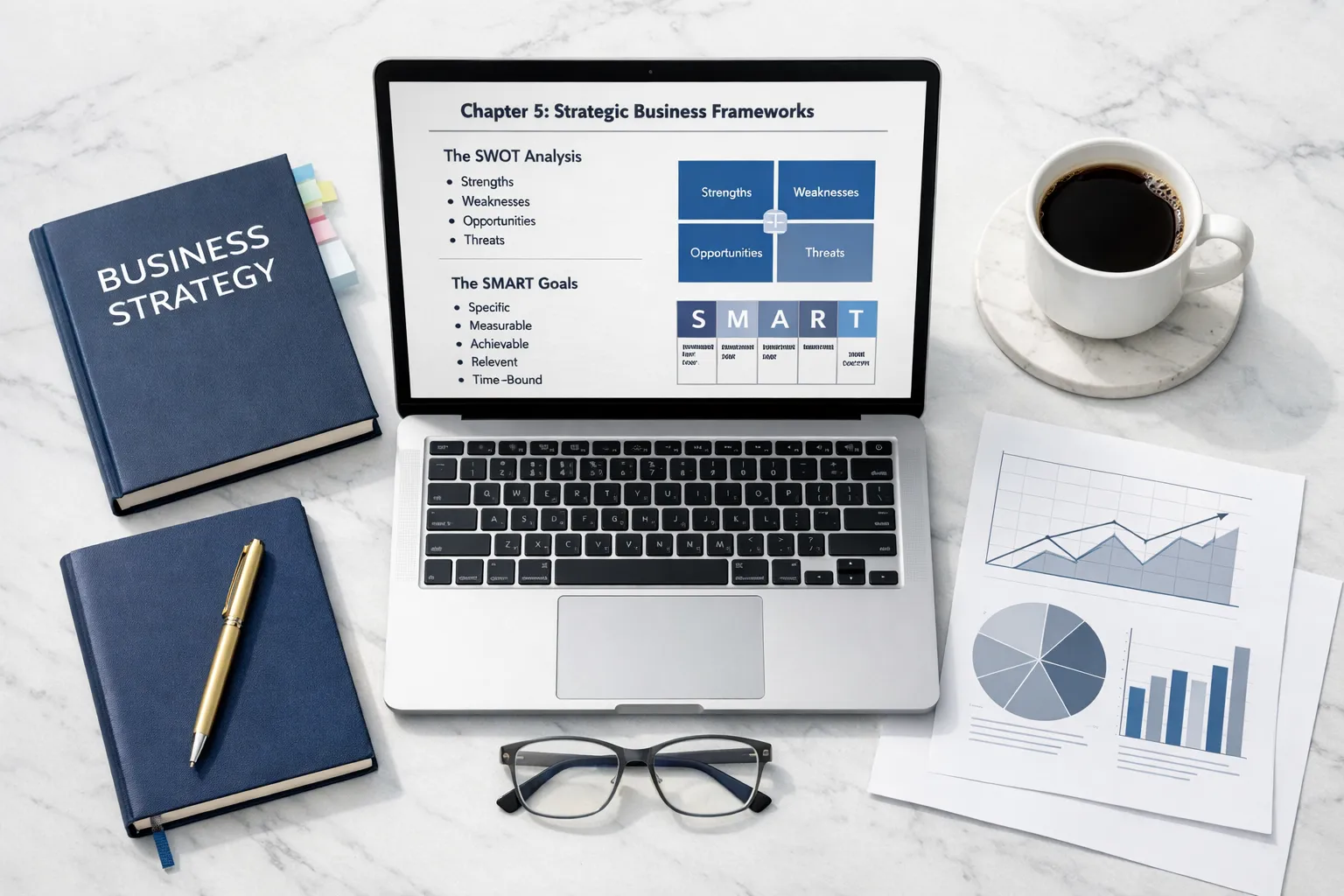
Why Business Books Need Frameworks, Not Just Advice
The difference between a business book that builds your authority and one that gets forgotten is structure. Effective business books follow a Problem-Method-Result arc: chapters 1-2 diagnose the industry problem and establish credibility; chapters 3-4 explain why conventional approaches fail (building trust through contrarian insight); chapters 5-8 walk through your proprietary framework step-by-step with case studies and templates; chapters 9-10 address implementation challenges and scale; the final chapter paints the result and calls the reader to action. AI business book generators encode this arc, assigning each chapter a unique framework element, opening strategy, and case study scenario to prevent the "here is another tip" pattern that undermines credibility. The built-in editor lets you refine the strategic flow after generation.
The Business Book Market in 2026
Business books are the highest-value non-fiction category. Readers pay more, share more, and convert to clients more than any other ebook niche.
$13.4B
Global business book market (2025), growing 4-5% annually
$9.99-$14.99
Sweet spot pricing for business ebooks (paperback $16.99-$24.99)
4.1x
More consulting leads for authors vs non-authors in the same field
72%
Of business readers cite "actionable frameworks" as the top purchase driver
Why business books are the highest-ROI content asset for consultants and founders
A business book is not just a product - it is a credibility engine. Consultants who write books report 3-5x more inbound leads. Founders who publish establish thought leadership that differentiates in crowded markets. The book itself does not need to be your primary revenue. It is the anchor of your authority ecosystem: the book feeds your consulting, speaking, courses, and content. Use a condensed version as a lead magnet, the full book as a KDP product, and the methodology inside as an online course. Combined with professional cover art and instant PDF export, you can go from framework to published author in days.
Every Business Book Niche Supported
Your niche is defined by your premise, not your plan. Every category below works on the free tier. See the AI Business Book Writer tool page for the full feature breakdown.
Startup and Entrepreneurship
Launch playbooks, bootstrapping guides, fundraising strategies, MVP frameworks, and zero-to-one thinking for aspiring and early-stage founders.
Leadership and Management
Team building, executive communication, remote leadership, culture building, and decision-making frameworks for current and aspiring leaders.
Marketing Strategy
Content marketing, SEO, paid acquisition, brand building, demand generation, and growth marketing playbooks for B2B and B2C.
Sales and Persuasion
Sales methodologies, negotiation frameworks, objection handling, pipeline management, and consultative selling for B2B and high-ticket.
Business Finance
Cash flow management, financial modelling, pricing strategy, fundraising, and profitability frameworks for non-finance founders and operators.
E-Commerce and DTC
Product sourcing, Shopify optimisation, conversion rate, email marketing, and scaling strategies for online retail and direct-to-consumer brands.
Consulting Frameworks
Diagnostic models, engagement structures, proposal templates, pricing packages, and authority positioning for independent consultants.
Freelancer Business Guides
Client acquisition, pricing, proposals, project management, and scaling from solo to agency. For freelancers who want to build a real business.
SaaS and Tech Business
Product-market fit, metrics (MRR, churn, LTV), growth loops, pricing tiers, and go-to-market playbooks for software founders and operators.
Real Estate Investing
Deal analysis, financing strategies, portfolio building, property management systems, and market evaluation frameworks for investors.
Business Automation
Systems, SOPs, delegation frameworks, AI integration, and operational efficiency guides for founders who want to work on the business, not in it.
Personal Branding
LinkedIn authority, thought leadership content, speaking, podcast guesting, and building a personal brand that drives business revenue.
What the AI Generates for Each Chapter
Every chapter in your business book includes these elements as appropriate to your methodology. Adjust everything in the built-in editor.
Specify preferences in your premise: "Include a case study, implementation checklist, and ROI template per chapter."
How to Write a Business Book with AI in 4 Steps
From your business framework to a published authority book in days, not months. See the full ebook workflow for a deeper look at each stage.
Define Your Expertise and Reader
Enter your business book idea as a detailed premise. Include: who the reader is (role, company size, industry), what business problem they face, your methodology or framework name, the transformation arc (from struggle to result), and tone (authoritative advisor, peer-to-peer, mentor). Example: 'A marketing strategy book for B2B SaaS founders spending under $10K/month on marketing. The Compound Content Method: 4-phase framework for building organic pipeline through content that compounds over time. Phases: Foundation, Production, Distribution, Compounding. Each chapter includes a ROI calculator template and implementation checklist. Direct, evidence-based tone. 10 chapters.'
Shape the Strategic Outline
The AI generates a chapter-by-chapter outline following the Problem-Method-Result arc. Each chapter gets a unique framework, opening approach, and case study scenario to prevent repetition. Reorder chapters, adjust the business logic progression, and ensure each step builds on the previous one. The outline is your book's strategic backbone.
Generate and Add Your Expertise
The AI writes each chapter with consistent professional voice, actionable frameworks, and structured templates. Use the built-in editor to add your real client stories, data from your experience, proprietary insights, and the specific examples that establish your credibility. This is where your book becomes an authority piece.
Cover, Export, and Leverage
Design a professional cover with the AI cover designer - business book covers should be clean, bold, and convey authority. Export as PDF for direct sales, consulting leave-behinds, and speaking handouts, or EPUB for Kindle. Business books perform well across all channels: Amazon KDP, Gumroad bundles, corporate bulk sales, and as the anchor of your consulting practice.
Business Book Structure Types
Different business niches call for different structures. The AI adapts the architecture to match your methodology and audience.
| Structure Type | Best For | Architecture | Chapter Pattern |
|---|---|---|---|
| Methodology Book | Consultants, coaches, founders | 10-12 chapters, linear | Problem > Framework > Case Study > Template > Implementation |
| Playbook | Marketing, sales, operations | Topic-based (modular) | Play name > When to use > Steps > Metrics > Variations |
| Industry Guide | SaaS, real estate, e-commerce | Comprehensive reference | Landscape > Strategy > Tactics > Tools > Benchmarks |
| Leadership Narrative | CEOs, executives, founders | Story-driven + frameworks | Personal story > Lesson > Framework > Reader exercise |
| How-to System | Freelancers, solo entrepreneurs | Step-by-step progression | Concept > Why it works > Exact steps > Pitfalls > Template |
| Contrarian Thesis | Thought leaders, analysts | Argument-driven | Conventional wisdom > Why it fails > Evidence > New model > Implications |
Specify your structure type in the premise. The AI adapts chapter architecture to match. For playbook-specific content, see the playbook generator. For technical documentation, see the documentation generator.
How Business Authors Build Authority with AI
The most effective AI-assisted business authors use a content ecosystem strategy: start with a focused lead magnet (10-15 pages solving one specific business problem) to build an email list, then expand into a full business book (30,000-50,000 words) with the business book writer, then repurpose chapters into a course, playbook, or consulting offer. The book is the credibility asset. It positions you as the expert, generates inbound consulting leads, and provides a framework clients already understand before the first meeting. Use KDP SEO to ensure your book ranks for the specific problem your reader searches: "B2B sales playbook for bootstrapped SaaS" outperforms "business book" in conversion.
Inkfluence AI vs ChatGPT for Writing Business Books
ChatGPT can brainstorm business ideas. Inkfluence AI produces a complete, structured authority book with frameworks and templates. See our full comparison guides for deeper analysis.
ChatGPT
- Good for brainstorming topic angles
- Can generate individual frameworks
- Flexible research assistant
- No Problem-Method-Result structure
- Chapters repeat similar advice differently
- No PDF or EPUB export
- No cover designer or publishing pipeline
- Professional tone drifts across long content
Inkfluence AI
- Problem-Method-Result arc built in
- Unique framework per chapter (no repetition)
- Case studies and templates per chapter
- PDF and EPUB export included
- AI cover designer built in
- Consistent professional voice throughout
- Free plan, paid plans from $9.99/month
The key difference: Inkfluence AI produces a complete business book with progressive frameworks and implementation templates. ChatGPT produces disconnected business advice you have to structure and format manually.
Traditional Business Book Writing vs AI-Assisted
Where the time actually goes when creating a 45,000-word business book
| Task | Traditional | With Inkfluence AI | Time Saved |
|---|---|---|---|
| Framework design and outlining | 2-6 weeks | 1-2 hours + editing | ~4 weeks |
| Writing 10-12 chapters | 4-8 months | 1-2 hours generation | ~5 months |
| Case studies and templates | 3-4 weeks | Auto-generated per chapter | ~3 weeks |
| Editing and expertise injection | 4-8 weeks | 2-3 weeks (your data) | ~4 weeks |
| Cover design | $300-800 or weeks DIY | AI cover designer (minutes) | $400+ or weeks |
| PDF/EPUB formatting | 3-5 days manual | One-click export | ~4 days |
| Total production time | 8-14 months | 3-5 weeks | 80-90% |
Time not saved: building the actual business experience that gives you something worth publishing. That takes years - but now the book only takes weeks.
Pricing for Business Authors
Start free. Upgrade when you are ready to publish at scale. Full pricing details.
| Feature | Free | Creator $9.99/mo | Premium $19.99/mo |
|---|---|---|---|
| Chapters | 5 + 5/month | 35/month | Unlimited |
| Smart Continue / day | 3 | Unlimited | Unlimited |
| PDF export | Included | Included | Included |
| EPUB (for KDP) | -- | Included | Included |
| AI cover generator | Basic | AI-generated | AI-generated |
| Audiobook generation | -- | -- | Included |
| Custom branding | -- | -- | Included |
| Credit card required | No | Yes | Yes |
Business Book Prompt Templates
Copy and adapt these premise prompts for popular business book niches. The more specific your reader and framework, the stronger the book. For more prompt ideas, browse our prompts for book writing guide.
Startup and Entrepreneurship
"A business book for first-time SaaS founders who have built a product but cannot get past $10K MRR. The Traction Flywheel: 5-phase framework for building repeatable growth without a sales team. Phases: Signal (finding product-market fit indicators), Channel (identifying one scalable acquisition channel), Engine (building the conversion machine), Flywheel (creating self-reinforcing growth loops), Scale (hiring and systems for $100K+ MRR). Each chapter includes a metrics dashboard template and real startup examples. Authoritative but practical tone. 10 chapters."
Key elements: specific audience, revenue stage, named methodology, phased progression, templates specified
Marketing Strategy
"A B2B content marketing playbook for companies spending $5K-$20K/month on marketing who are stuck on the content treadmill (publishing lots, generating little). The Compound Content Method: how to build a content engine where every piece compounds in value over time. Covers: content pillars vs one-off posts, SEO compounding, content repurposing systems, distribution beyond social, measuring content ROI (not vanity metrics), and building a content team. Each chapter includes a template and a 'common mistake' callout. Direct, evidence-based tone. 8 chapters."
Key elements: B2B focus, budget range, contrarian positioning, named method, practical templates
Leadership and Management
"A leadership book for new managers promoted from individual contributor roles who are struggling with the identity shift from doer to leader. The Manager Transition Playbook: navigating the first 90 days, building trust with former peers, running effective 1:1s, giving feedback that lands, delegating without micromanaging, and building a high-performance team culture. Each chapter includes conversation scripts and a self-assessment exercise. Supportive but direct, like a mentor who has been there. 10 chapters."
Key elements: specific transition point, emotional challenge, conversation scripts, self-assessment, mentor voice
Consulting Frameworks
"A business book for independent consultants earning $100K-$300K who want to scale to $500K+ without hiring a team. The Leverage Consulting Model: replacing hourly billing with packaged IP (frameworks, diagnostics, and group programmes). Covers: productising your expertise, the diagnostic-to-engagement pipeline, pricing transformation (hourly to value), building a referral engine, creating scalable group offerings, and designing a consulting practice that runs without you in every meeting. Each chapter includes a pricing template or proposal framework. Peer-to-peer tone. 10 chapters."
Key elements: revenue range, scaling ambition, named model, pricing focus, peer tone
E-Commerce and DTC
"A business guide for Shopify store owners doing $50K-$500K/year who are spending too much on paid ads and not enough on retention. The Retention Engine: building a direct-to-consumer brand that grows through repeat customers not new acquisitions. Covers: email and SMS flows that drive 30%+ of revenue, loyalty and referral programmes, subscription models, post-purchase experience design, reducing CAC through organic, and the unit economics of retention vs acquisition. Each chapter includes a Shopify flow setup tutorial and benchmark data. Actionable, metric-driven tone. 10 chapters."
Key elements: platform-specific (Shopify), revenue range, contrarian thesis (retention > acquisition), benchmark data
Paste any of these into Inkfluence AI, edit the details to match your expertise, and generate your outline in seconds.
Who Writes Business Books with AI?
Anyone with business expertise worth publishing
Consultants and Advisors
Turn your consulting methodology into a book that positions you as the definitive expert in your niche. Clients who read your book arrive pre-sold on your framework. Use the book as part of your lead magnet funnel or sell it at speaking events.
Founders and CEOs
Document the playbook that built your company. Attract talent, investors, and press by publishing your approach. A business book is the ultimate thought leadership asset - it outlasts any tweet, podcast, or LinkedIn post.
Speakers and Trainers
A published book gets you better speaking slots, higher fees, and back-of-room revenue. Write the book around your signature talk. Each chapter becomes a workshop module. The audiobook version extends your reach.
Industry Experts
You know your industry better than anyone but have never had time to write the book. AI handles the draft. You add the insider knowledge, proprietary data, and the hard-won lessons that make the book genuinely valuable.
Course Creators
Use a business book as the companion resource for your course. Write the book first, repurpose chapters into modules. Students get the book included. Create the course with the AI course creator.
KDP Business Publishers
Business books command the highest ebook prices on Amazon ($9.99-$14.99). Produce niche-specific titles for underserved verticals. Use KDP SEO to target specific professional searches that competitors ignore.
How to Write a Business Book with AI: The Complete Process
Business books are the highest-value non-fiction category for both authors and readers. They command premium pricing, generate consulting leads, and establish lasting authority. The barrier for most experts is not lack of knowledge - it is the daunting process of organising years of experience into a structured, engaging book. AI removes that barrier. Here is exactly how.
Step 1: Find Your Angle and Audience
The business shelf is crowded. Your book needs a specific reader and a specific promise. Not "how to grow your business" but "how B2B agencies add $500K in recurring revenue without outbound sales." The narrower your reader definition, the stronger your book and the easier your marketing. Browse 150+ ebook ideas for niche inspiration, or check the best ebook niches guide for categories with demand.
Step 2: Name Your Framework
Every memorable business book has a named methodology: "The Lean Startup," "Getting Things Done," "Blue Ocean Strategy." Your framework does not need to be revolutionary - it needs to be yours and it needs a name. A named method gives readers something to reference, share, and buy into. Include your framework, its phases, and the business outcome it delivers in your premise. Use the outline generator to map your methodology across chapters.
Step 3: Write a Premise That Produces a Real Book
Your premise is the strategic brief. Include: who the reader is (role, industry, company stage, revenue range), what business problem they face, why conventional approaches fail, your methodology name and its phases, what business outcome it delivers, tone (authoritative advisor, peer, mentor), and whether to include case studies, templates, or checklists. See the prompt templates above for fully worked examples. For more creative direction, browse how to create an ebook for business.
Step 4: Add Your Evidence
The AI generates the structure, frameworks, and case study formats. Your job in the editor is to add what only you can: real client outcomes (anonymised if needed), proprietary data, industry benchmarks you have collected, war stories from the trenches, and the contrarian insights that come from doing the work. Business readers buy credibility. That comes from specifics, not generalities.
Step 5: Publish and Leverage
Design your cover with the AI cover designer - business covers should be clean, bold, and convey authority at thumbnail size. Export as EPUB for Kindle ($9.99-$14.99) or PDF for direct sales, consulting proposals, and event handouts ($14.99-$24.99 on Gumroad). Use a condensed version as a lead magnet. For launch strategy, follow the ebook launch checklist and the ebook marketing strategy guide.
Ready to write your business book?
Start Writing FreeBest Business Book Niches to Sell Online in 2026
Niche specificity is everything. "Marketing book for B2B SaaS companies under $5M ARR" outsells "marketing book" because the reader feels seen. For broader niche research, see our best ebook niches guide.
AI Business Integration
Practical guides for specific industries integrating AI: AI for law firms, AI for real estate agents, AI for accounting practices. Massive demand, minimal competition in niche verticals.
Remote Team Operations
Async communication, remote culture building, distributed team management, and remote hiring. Companies are still figuring this out. Practical playbooks sell well to team leads and HR.
Solopreneur Scaling
One-person businesses doing $100K-$1M. Automation, productised services, digital products, and leverage without employees. Growing audience with high willingness to pay for systems.
Industry-Specific Sales Playbooks
Sales methodologies for specific verticals: selling to hospitals, selling to schools, enterprise B2B procurement. Niche sales books command premium prices and drive consulting.
Creator Economy Business
Monetisation frameworks for content creators, newsletter operators, and community builders. Sponsorship, digital products, membership models, and audience-first business building.
First-Time Manager Playbooks
The transition from individual contributor to manager. 1:1s, feedback, delegation, performance reviews, and difficult conversations. Corporate bulk purchases common.
For more ideas, see our business guides for entrepreneurs or explore 150+ Ebook Ideas That Sell for cross-genre inspiration.
Business Book Monetisation Strategies
Business books have the highest monetisation ceiling of any non-fiction genre because they naturally lead to high-ticket backend offers. Direct sales: price ebooks at $9.99-$14.99 on Amazon KDP, paperbacks at $16.99-$24.99 (business readers pay more). Lead generation: give away a condensed version as a lead magnet to capture consulting leads, then nurture with an email course. Course conversion: repurpose each chapter into a module via the course creator ($197-$997 courses). Corporate bulk sales: companies buy 50-500 copies for team training. Speaking: a published book gets you on stages, podcasts, and panels. For marketing strategy, focus on the specific business problem your reader searches - "B2B content marketing playbook" converts better than "business book."
Business Book Differentiation Strategy
The business book market is crowded. Differentiation comes from specificity, not breadth. Narrow your audience: "a leadership book for new engineering managers at mid-stage startups" beats "a leadership book" because it speaks directly to a searchable, underserved niche. Name your framework: a proprietary method (The Traction Flywheel, The Leverage Stack) gives readers a mental anchor and makes your book quotable and referenceable. Lead with contrarian positioning: challenge an accepted practice in your industry and offer a tested alternative. Include proprietary data: original case studies, benchmarks, and client results that readers cannot find elsewhere. Use Inkfluence AI to generate the chapter framework with your named method, then add data, stories, and expertise via the editor. For Amazon discovery, target problem-specific keywords that match how your ideal reader searches.
Business Books on Inkfluence AI: What Actually Works
Instead of testimonials, an honest first-party observation: authors have created more than 2,400 business books on Inkfluence AI (our platform data, August 2026), and they are overwhelmingly written as positioning assets, the book that wins a consulting client or anchors a talk, rather than for royalty income. That changes how you should write one: optimise for the reader finishing it and remembering your framework, not for page count.
The pattern among finished business books: a named framework introduced early, one worked example per chapter allocated at outline time, and a tight 6 to 9 chapter arc a busy reader can finish on two flights. The neighbouring finance category, about 1,600 books of its own on the platform, follows the same shape: the specific money problem in the title, the method in the chapters.
Write Your Business Book Today
Free plan. No credit card. From your expertise to a published authority book in days, not months.
Frequently Asked Questions
Can AI write a credible business book?
Will my AI-generated business book sound like generic business advice?
Do I need business credentials to write a business book?
How long should a business book be?
Can I include frameworks, templates, and worksheets?
Is this free to use?
Can I use my business book as a lead magnet?
How do I differentiate my business book from competitors?
Can I write a business book series?
Will the AI maintain a professional tone throughout?
How do I sell my AI-generated business book?
Is the content original? Will I own the rights?
Related Tools
AI Business Book Writer
Full business book creation with frameworks
AI Playbook Generator
Marketing, sales, and brand playbooks
AI Documentation Generator
Technical guides, SOPs, and training manuals
Lead Magnet Generator
Condensed book chapters as lead magnets
AI Course Creator
Turn your book into an online course
AI Book Cover Generator
Professional business book covers
AI Email Course Generator
Nurture leads with drip email sequences
AI PDF Ebook Maker
Print-ready PDFs for KDP and direct sales
More Writing Guides
Step-by-step AI writing guides for every genre
A Business Book Is a Positioning Asset, Not a Royalty Play
Business books earn differently from every other genre: the royalties are usually the smallest line. The book's real job is to make the sales conversation you were already having easier, to be the thing a prospect reads before the call, the leave-behind after the keynote, the reason a podcast books you. Price it to be read, not to maximise per-copy margin, and measure it in inbound conversations rather than units.
The craft that makes that work: a named framework. Readers remember and repeat methods with names ("the 3-Bucket Method") and forget generic advice, so before generating, name your methodology and let every chapter advance one stage of it. That name is also what clients say when they refer you, which is the entire point.
If your goal includes consulting or speaking, write the final chapter as the bridge: what working with you looks like, without a hard pitch. The reader who finishes a useful book is the warmest lead your business will ever get.
Related Reading
Guides for business authors, consultants, and thought leaders
Inkfluence AI vs First Book ai
A per-book business-book generator against a full pipeline, facts checked 14 September 2026.
Is It Ethical to Write a Business Book with AI?
What readers, Amazon and your clients expect, with disclosure wording.
How to Create an Ebook for Your Business
Complete guide to creating business ebooks that generate leads, establish authority, and drive revenue for your company.
Read guideThe Complete Ebook Marketing Strategy Guide
How to market and sell your business book across Amazon KDP, Gumroad, LinkedIn, and your own website for maximum impact.
Read guideBusiness Guides for Entrepreneurs (2026)
Business book ideas, frameworks, and publishing strategies for entrepreneurs who want to establish thought leadership.
Read guide