
Is It Ethical to Write a Business Book with AI? What Readers, Amazon and Your Clients Actually Expect (2026)
The honest answer, with the three positions authors take, what Amazon KDP requires at upload, the reader test, the one thing that is never fine, and disclosure wording you can use.
Quick Answer
Yes, writing a business book with AI is ethical when three things hold: the ideas, judgement and examples are yours; nothing in the book is invented and presented as fact; and you answer Amazon's AI-content questions truthfully at upload. It stops being ethical at exactly the points a human ghostwriter would also fail: a fabricated case study, a testimonial that never happened, or advice you do not stand behind. The tool is not the ethical question. What you put your name to is.
Business books carry a professional name on the cover for a professional reason. That is why the ethics of writing one with AI get argued more sharply than the ethics of an AI-drafted thriller: the reader is buying your judgement, not a plot. This guide sets out the three honest positions, what the platforms actually require, the test readers apply, the single practice that is never acceptable, and the disclosure wording that works in 2026.
The Three Positions Authors Take
Almost every business author who uses AI lands on one of three positions, and each is defensible if it is held honestly.
1. AI as a tool
The author writes, the AI tightens, restructures, suggests headings and catches repetition. This is the spell-checker position extended, and nobody seriously argues it needs disclosure. If you dictated the book and an editor shaped it, you would still be the author.
2. AI as a co-author
The author supplies the thesis, the frameworks, the examples and the argument; the AI drafts chapters from a brief and the author edits every page. This is where most business books written with a tool like the AI business book writer sit. It is the position a ghostwritten book has occupied for a century, with one difference: the ghost is a model rather than a person, and it does not interview you, so the personal material has to be put in deliberately.
3. AI as the author
A topic and a target audience go in, a book comes out, and the author's contribution is choosing the title. This is the position most people have in mind when they call AI business books unethical, and they are right to be uneasy about it, not because a machine wrote it but because nobody with expertise checked it. The book makes claims its named author cannot vouch for. That is the actual ethical failure, and it is the same failure as putting your name on a book a stranger wrote and you never read.
The line between the second and third positions is not how much of the prose the model produced. It is whether the person on the cover has read every claim and would defend it to a client.
What Amazon KDP Requires
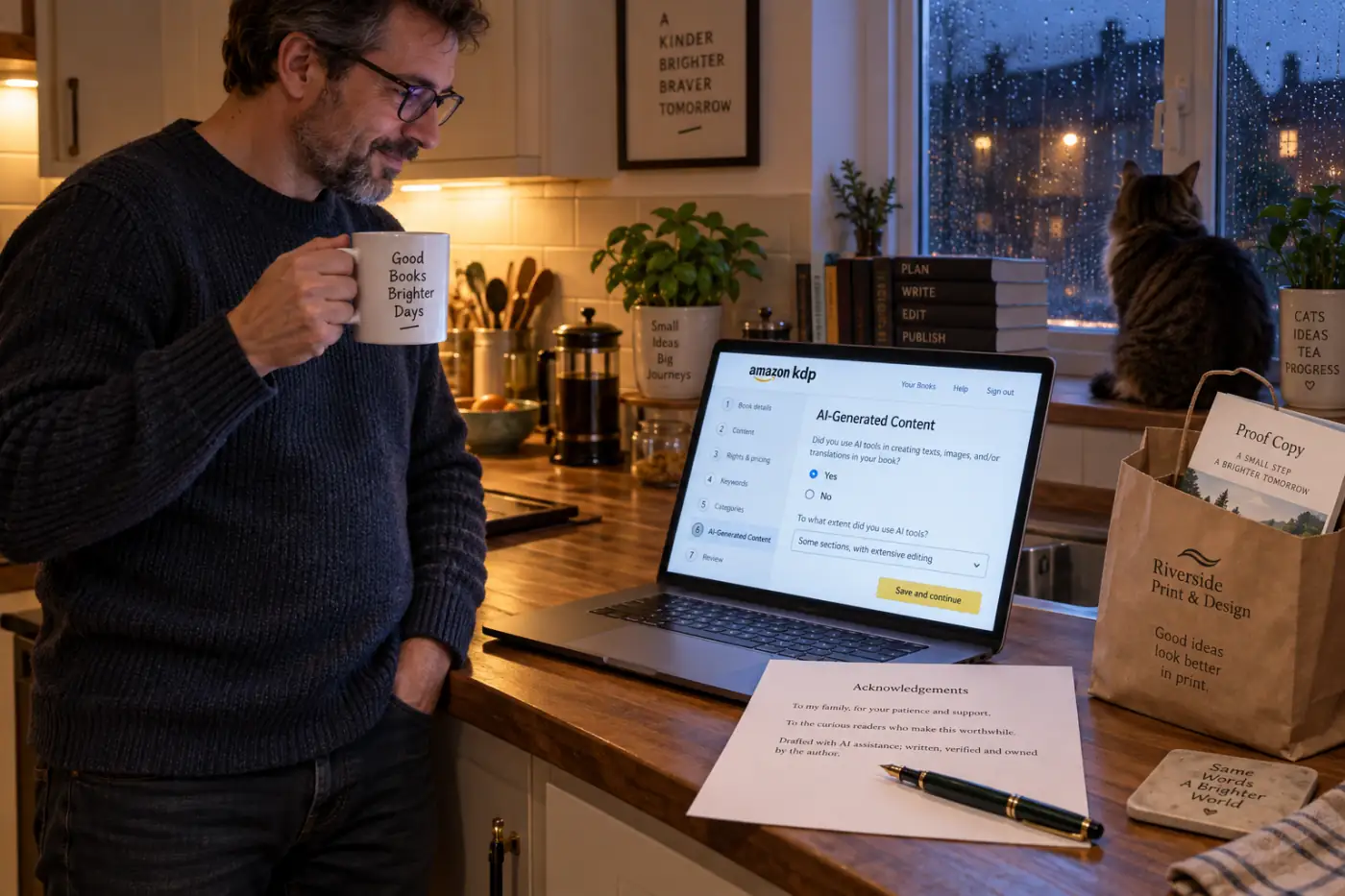
Amazon distinguishes AI-generated content (text, images or translations created by an AI tool, even if you edited it afterwards) from AI-assisted content (you created it yourself and used AI to edit, refine or check it). At upload, KDP asks whether the book contains AI-generated content and, if so, which elements and how much. The answers are not shown to readers; they are a declaration to Amazon, and a false one is a terms violation. Our KDP AI disclosure guide has the current wording and the branching questions.
Two practical consequences. First, an AI-drafted business book that you heavily edited is still AI-generated by Amazon's definition, because the draft came from the tool; answer accordingly. Second, no writing tool can make this declaration for you, and any tool that implies its output needs no disclosure is wrong. The same declaration applies to the cover if it was AI-generated.
Other stores differ. Gumroad has no AI-content question at listing; Etsy's creativity standards ask sellers to disclose AI use in a listing and to be the creative director of what they sell. Audible's ACX does not accept AI narration at all, while the other audiobook stores do with disclosure. The pattern is the same everywhere: the platform wants an honest answer, not an absence of AI.
The Reader Test
Strip the platforms away and one question remains: would the reader feel cheated if they knew how the book was made? For a business book the answer depends on what the reader believed they were buying.
- They believed they were buying your method. If the frameworks, the sequence and the recommendations are yours, they got it. The prose being machine-drafted changes nothing they paid for.
- They believed they were buying your experience. If the client stories are real, anonymised where they need to be, and the lessons drawn from them are the ones you actually drew, they got it. If the stories are invented, they did not, and this is the failure people mean when they say AI books are hollow.
- They believed they were buying your prose. Almost nobody buys a business book for the sentences. The exception is the memoir-shaped business book, where voice is the product, and there the author's edit has to be deep enough that the voice is genuinely theirs.
Readers of AI-drafted business books complain, in public reviews of every tool on the market, about two things above all: repetition (the same example person or the same opening move in chapter after chapter) and the generic register (the sentences that could open any book on any topic). Neither is an ethics problem. Both are quality problems that the author's edit exists to fix, and a tool that assigns each chapter a different framework, opening style and example before drafting removes most of the first one at the source.
The One Thing That Is Never Fine
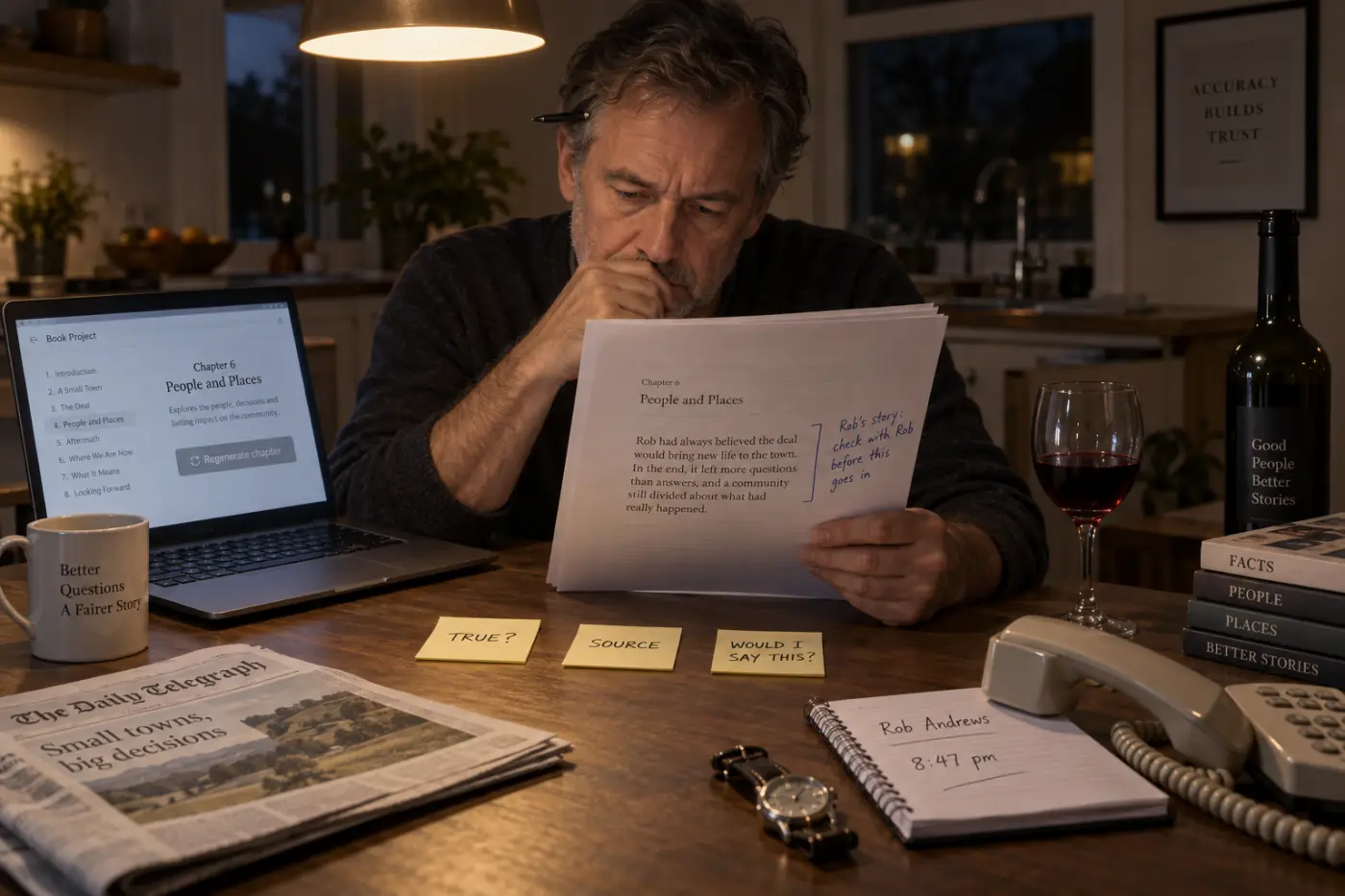
Fabricated evidence. A case study about a client who does not exist, a testimonial nobody gave, a statistic with no source, a quotation attributed to a named person who never said it. AI drafts produce these readily when a brief asks for "examples" without supplying any, because the model fills the slot with something plausible. In fiction that is invention. In a business book it is a false claim under your name, and a reader who checks one of them stops trusting the rest of the book.
The fix is procedural, not moral. Supply the real examples in the brief, mark every example the model added as a placeholder, and replace or cut each one during the edit. Treat any statistic or quotation in the draft as unverified until you have found the source yourself. This is exactly what a good ghostwriter does with a first draft, and it is the part of the job that cannot be delegated to the tool.
What the Data Says About Where Invented Examples Come From
We counted every business-purpose book on Inkfluence AI on 14 September 2026 (full figures on the business-book comparison page). Two numbers matter for this question.
- 83% of business books were written from an author brief, and the median brief is 228 characters. That is about three sentences. Three sentences can name the reader and the method; they cannot supply eight chapters of client situations. When the brief has no examples, the draft invents them, and the author's edit has to catch every one. A brief that lists two real, anonymised situations per framework removes most of that work before it exists.
- 98% of exported business books are first exported within 24 hours of being created. The draft, the read and the export happen in one sitting for most authors. That is the speed everyone now has; it is also exactly the window in which a placeholder example slips through. The one-day book is fine. The one-day book with no fact check is where the ethics complaints come from.
The practical reading: the tool's speed is not the risk, the empty brief is. Spend the afternoon on the brief and the edit becomes a check rather than a rescue.
What Your Clients Expect
The audience for a business book is usually smaller than the sales figure and more important than it: prospects, existing clients, event organisers, the people who decide whether to hire you. They expect the book to be an accurate account of how you think and work. Most of them assume, correctly, that busy professionals get help writing books, and have done since long before AI. What they do not forgive is finding out that the book misrepresents your practice, or that you cannot discuss its contents in the room.
The practical standard, then, is the same one a partner at a firm would apply to a report going out under the firm's name: you have read every page, you agree with every recommendation, every example is real, and you could defend any paragraph to the person it is about. Meet that and the drafting method is a production detail. Miss it and no drafting method saves the book.
Disclosure Wording You Can Use
There is no legal requirement to disclose AI drafting to readers in most markets in 2026, and most authors do not, in the same way ghostwritten books do not carry a note. If you want to say something, say it plainly and once, in the front matter or the acknowledgements. Three forms that read well:
- The acknowledgement: "This book was drafted with the help of AI writing tools and edited, checked and rewritten by the author. Every framework, recommendation and example is the author's own."
- The method note: "I wrote this book the way I run projects: I set the structure, an AI tool produced first drafts of each chapter, and I rewrote them until they said what I would say to a client. The client stories are real, with names and details changed."
- The short line: "Drafted with AI assistance; written, verified and owned by the author."
Avoid the two extremes: a disclaimer that reads as an apology ("the author cannot guarantee the accuracy of AI-generated content") undermines the book, and silence combined with an "I wrote every word myself" claim in the introduction is the kind of statement that gets found out.
Would I Sign This? A Seven-Point Check
Tick each one for the chapter in front of you. If all seven are ticked, the chapter is yours in the sense that matters, whatever drafted it.
Nothing is saved or sent; the boxes are for you. Copy the seven lines into the front of your manuscript and run them per chapter.
A Workflow That Keeps the Book Yours
- Write the brief as if briefing a ghostwriter. Who the reader is, what they should be able to do by the end, the three to five frameworks you actually use, and two or three real client situations (anonymised) per framework. Your author bio goes in too. The more you supply, the less the model has to invent.
- Edit the outline before any prose exists. Set the chapter count to the shape the material needs rather than a fixed grid, and make sure every chapter has a distinct job. Repetition is cheaper to fix here than in 30,000 words.
- Read the draft as an author, not a proofreader. For each chapter ask: is this what I would say, is every example real, would I defend this recommendation? Rewrite the passages that fail, using the assistant to change the tone or expand a thin section, or regenerate the chapter with a sharper brief.
- Verify every fact. Statistics, quotations, named companies, dates. Cut what you cannot source.
- Declare honestly at upload. Amazon's AI-content questions, Etsy's listing disclosure where it applies, and whatever note you choose for readers.
On Inkfluence AI this is the default shape of the work: the outline assigns each chapter its own framework, opening style and example person before drafting; the chapter count follows your prompt; every chapter opens in an editor with an assistant; and the export preview checks the file against the stores' requirements before you upload. The AI ghostwriter page covers the cost side, and the comparison with per-book generators covers what changes when the tool writes a fixed shape from a questionnaire instead.
Frequently Asked Questions
Is it ethical to write a business book with AI?
Yes, if the ideas and examples are yours, nothing invented is presented as fact, and you answer the platforms' AI-content questions truthfully. The ethical failures are the same as for a ghostwritten book: fabricated evidence and a name on a book its author has not read.
Do I have to tell readers the book was written with AI?
Not by law in most markets in 2026, and most authors do not, as with ghostwriting. You do have to answer Amazon KDP's AI-content questions honestly at upload, and Etsy asks for disclosure in the listing for some categories. A one-line note in the acknowledgements is a reasonable middle path.
Does editing an AI draft make it "AI-assisted" on Amazon?
No. Amazon's definition turns on who created the text. If the draft came from an AI tool, it is AI-generated content even after heavy editing. AI-assisted means you wrote it and used AI to refine it.
Can I use AI-generated case studies?
Not as fact. An invented client presented as a real one is a false claim. Either use real, anonymised situations you supply in the brief, or label a scenario clearly as illustrative ("Imagine a firm that...").
Will clients think less of me for using AI?
Most assume professionals get help with books and care whether the book accurately represents how you work. What damages trust is a book you cannot discuss, or an example that turns out not to be true.
Is a per-book AI generator more or less ethical than a subscription tool?
Neither. The ethics live in the brief, the edit and the declaration, not the pricing model. The practical difference is control: a tool that lets you edit the outline, set the chapter count and rewrite any passage makes the author's edit easier to do properly.
What about the cover?
An AI-generated cover is AI-generated content in Amazon's terms and is declared the same way. Stock or designer covers are not.
Related Reading
- Amazon KDP AI disclosure policy in 2026
- AI vs ghostwriter cost in 2026
- Why writing a book is still the best career move for a consultant
- AI business book writer
- Inkfluence AI for thought leaders
- Best practices for co-writing a book with AI
- First Book ai alternatives, with prices
- How to write a business book with AI
- Inkfluence AI for consultants

Founder, Inkfluence AI
Sam is the founder of Inkfluence AI. He built the platform to make book creation accessible to everyone - from first-time authors to seasoned publishers.
Helpful links
Ready to Create Your Own Ebook?
Start writing with AI-powered tools, professional templates, and multi-format export.
Get Started FreeRelated Articles
 Business
 Why Writing a Book Is Still the Best Career Move for a Consultant (and How Long It Takes Now)
What a business book actually does for a consulting, coaching or advisory practice, the seven ways it pays, why the old 12-month timeline no longer applies, and the honest week-by-week plan for 2026.
 Guides
 Selling AI Coloring Books on Amazon KDP: The 2026 Rules, Specs, and Math
Are AI coloring books allowed on KDP? Yes, with disclosure. The part nobody covers: the AI workflow that passes review, style consistency across 30 pages, the interior specs that cause rejections, and the royalty ladder that decides your price.
 Guides
 How to Make an Adult Coloring Book in 2026: From Idea to Printed Pages
The modern walkthrough: what makes line work read as "adult", the three ways to create pages (draw, convert, generate), how to assemble a real book instead of a stack of pages, and the fork between KDP paperbacks, Etsy printables, and printing at home.
Get ebook tips in your inbox
Join creators getting weekly strategies for writing, marketing, and selling ebooks.