
Do Low-Content Books Still Make Money in 2026? Journal and Coloring Book Income, Worked Out
What journals, notebooks, planners and coloring books really earn on KDP in 2026: royalty per copy by trim, pages and price, why most titles sell few copies, the two-a-week limit, the rules that cut income, and where the money still is, with an estimator.
Quick Answer
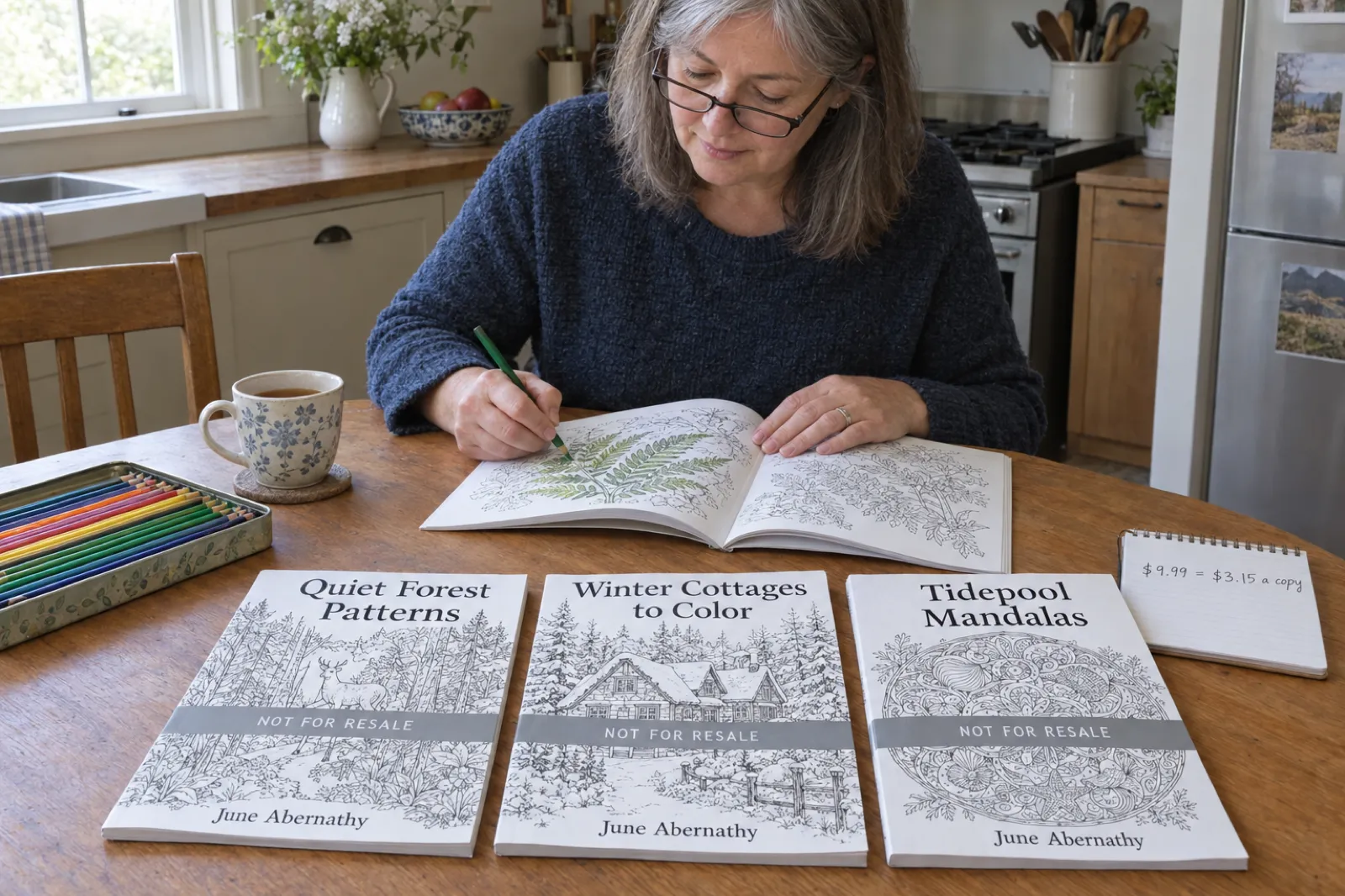
Yes, but much less than most pages claim. On Amazon.com a $6.99 journal earns $1.06 a copy and a $7.99 coloring book $1.16; at $9.99 they earn $3.55 and $3.15. Most indie books sell a few copies a month, so ten journals at the typical rate earn about $21 a month. KDP now takes two new titles per format a week, low-content books cannot use Expanded Distribution, and their review can take 3 to 4 weeks. The money left is in coloring and activity books with a clear audience, books with real content priced at $9.99 or more, seasonal titles published early, and the same designs sold as printables.
Low-content books were sold for years as the easy corner of KDP: no writing, a cover and a template, upload fifty and wait. In 2026 the arithmetic has caught up with the pitch. Each copy of a cheap notebook earns cents, Amazon has cut new titles to two per format a week, and the low-content label itself switches off several things that help a book sell. That does not mean nobody earns from journals, planners or coloring books. It means the income comes from different books than the ones the old advice recommends.
This guide works out what these books really earn. Every royalty figure is computed with the same formulas as our how many books calculator and checked against KDP's help pages on 19 Oct 2026, and the sales levels come from the largest recent survey of indie authors. If you need the rules themselves (what KDP counts as low-content, ISBN choices, the Look Inside sample), our low-content books on KDP guide covers them in full; this page is about the money.
Which books this covers
"Low-content" is used loosely online, and KDP uses it precisely, so it helps to separate the two before any numbers. KDP's own list of low-content books is notebooks, planners, diaries and journals, prompt journals, log books, coupon books, score card and crafting templates, and blank sheet music. On the same page it lists coloring books and puzzle books as "Not Generally Low-Content", and says activity books typically are not either, because their pages are not repetitive.
Sellers lump all of these together because they are made and sold the same way: short print books, large trims, mostly priced under $10, bought as gifts or for a hobby rather than read. This page covers both groups, and says where the rules differ. The difference matters for income: a coloring book keeps the free ISBN, the Look Inside sample and the normal review time, and a journal does not. In the same breath, note that "prompt journals" sit on KDP's low-content list, so a journal with one short prompt a page is still low-content however good the prompts are.
What one copy earns, by trim, pages and price
KDP's paperback formula is simple: (royalty rate x list price) minus printing cost. On Amazon.com the rate is 60% at a list price of $9.99 or more and 50% at $9.98 or less. Printing in black ink costs a flat $2.30 for 24 to 110 pages at a regular trim and $2.84 at a large trim (wider than 6.12 in or taller than 9 in, which includes 8.5 x 8.5 and 8.5 x 11). Above 110 pages it is $1.00 plus $0.012 a page, or $0.017 a page at a large trim. Here is what that gives for the books people actually make.
| Book | Trim and pages | List price | Printing | Royalty a copy |
|---|---|---|---|---|
| Lined notebook | 6 x 9 in, 120 | $5.99 | $2.44 | $0.56 |
| Lined notebook or journal | 6 x 9 in, 120 | $6.99 | $2.44 | $1.06 |
| Same journal | 6 x 9 in, 120 | $9.99 | $2.44 | $3.55 |
| Guided journal | 6 x 9 in, 160 | $12.99 | $2.92 | $4.87 |
| Undated planner | 8.5 x 11 in, 200 | $9.98 | $4.40 | $0.59 |
| Same planner | 8.5 x 11 in, 200 | $12.99 | $4.40 | $3.39 |
| Kids' coloring book, 20 designs | 8.5 x 11 in, 44 | $6.99 | $2.84 | $0.66 |
| Coloring book, 50 designs | 8.5 x 11 in, 104 | $7.99 | $2.84 | $1.16 |
| Same coloring book | 8.5 x 11 in, 104 | $9.98 | $2.84 | $2.15 |
| Same coloring book | 8.5 x 11 in, 104 | $9.99 | $2.84 | $3.15 |
| Adult coloring book, 20 designs | 8.5 x 8.5 in, 44 | $9.99 | $2.84 | $3.15 |
| Same book | 8.5 x 8.5 in, 44 | $12.99 | $2.84 | $4.95 |
| Activity or puzzle book | 8.5 x 11 in, 120 | $8.99 | $3.04 | $1.46 |
| Workbook with written content | 8.5 x 11 in, 120 | $14.99 | $3.04 | $5.95 |
Amazon.com, US dollars, black ink on white paper. Royalty = 60% of list price at $9.99 and up or 50% at $9.98 and below, minus printing. Printing: $2.30 flat for 24 to 110 pages at a regular trim, $2.84 at a large trim; above 110 pages $1.00 + $0.012 a page (regular) or $0.017 (large). Coloring books assume one design per page with a blank page behind it. Sources: KDP help pages G201834330 and G201834340, read 19 Oct 2026. Computed with the how many books calculator engine; the royalty calculator gives other stores.
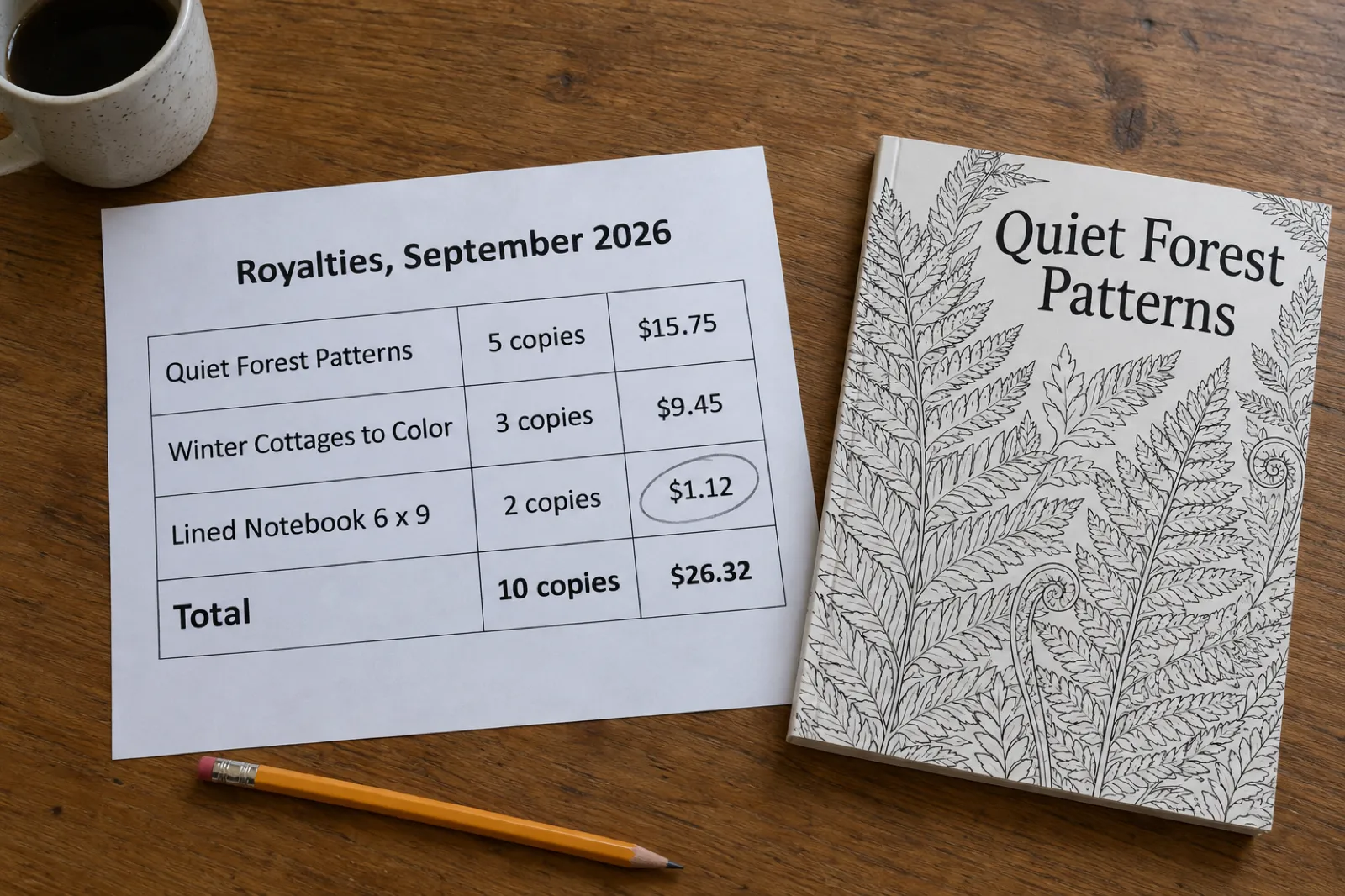
Four things in that table decide most low-content income:
- Under $9.99, a copy earns about a dollar. The 50% rate and a fixed print cost leave little. A $5.99 notebook keeps 56 cents, and a kids' coloring book at $6.99 keeps 66 cents.
- One cent is worth a dollar. The same coloring book earns $2.15 at $9.98 and $3.15 at $9.99. Nothing else in a seller's control moves the number this much.
- Up to 110 pages, more pages cost nothing extra. A 20-design and a 50-design coloring book cost the same $2.84 to print at 8.5 x 11, so a fuller book is a better offer at the same margin. Past 110 pages the per-page charge starts, which is why a 200-page planner at $9.98 earns 59 cents.
- Books with written content reach higher prices. A workbook at $14.99 earns $5.95 a copy, as much as ten copies of a $5.99 notebook. Buyers pay for content, not paper.
Trim choice is covered in our KDP trim sizes guide, and the spine and cover wrap for any page count in the cover size and spine width calculator.
Make the book that can carry $9.99
A full coloring book on one theme, a guided journal with something on every page, or a workbook with exercises. Inkfluence AI draws or writes the whole book and exports KDP paperback files with the cover wrap sized to your page count.
Start a book freeWhy most titles sell few copies
Royalty is half of income. The other half is copies, and this is where most low-content pitches quietly assume too much. Amazon does not publish sales per book. The most useful public evidence is the Written Word Media 2025 Indie Author Survey (1,346 authors, self-reported, published 2 Dec 2025): 44% earned $100 a month or less, about 80% of authors with one to three books earned under $100 a month, and the median author with five to nine books earned about $50 a month. That works out to about two copies a book a month at a $4.99 ebook price, the "typical" level our calculator uses. Our KDP author income guide sets out the full survey.
Most of those respondents write ebooks and fiction, which are read, reviewed and followed in series. Low-content books have fewer of those advantages, so for a journal or coloring book catalogue, two copies a book a month is a fair starting assumption and probably not a cautious one. Several things push it down:
Search is crowded with near-identical books
A blank or lined notebook has nothing a shopper can tell apart except the cover. Search a common theme and you will see pages of books with the same interior at the same price. A new title with no sales history and no reviews starts at the back of that queue and mostly stays there.
The label takes away selling tools
A low-content book without its own ISBN shows no Look Inside sample, cannot join a series, cannot be scheduled with a release date, and waits longer in review. Each of these removes a way to persuade or reach a buyer. Coloring and puzzle books avoid most of this because KDP does not count them as low-content.
Demand is seasonal and narrow
Coloring books, gratitude journals and planners sell around Christmas, the new year and back to school, and much less between. A book that misses its season can sit unsold for most of the year. Our KDP publishing calendar counts back from each holiday to the date a journal or coloring book must be submitted.
Copies come from a reason to buy this one
Books that sell repeatedly answer a specific need: a large-print coloring book for a grandparent with poor eyesight, a reading log a teacher sets for a class, a journal for a particular recovery programme. The narrower and clearer the buyer, the more copies a modest listing can sell. Our coloring book niches guide goes through themes with steady demand.
Catalogue maths under two titles a week
If each title sells a few copies, income has to come from many titles, and that is the part of the old playbook that broke this autumn. KDP's limits page now allows "Up to 2 new titles per book format each week", counted the first time you submit, with drafts included and updates excluded, reset "every Sunday at 12:00 AM Coordinated Universal Time (UTC)". The page gives no start date; the Alliance of Independent Authors reported on 24 September 2026 that it took effect on Monday 21 September, down from ten. Coloring books and journals are print-only in practice (KDP says they do not suit Kindle), so for most sellers this is a ceiling of about 104 new paperbacks a year.
Here is what $1,000 a month needs, from the how many books calculator at its three sales levels (2, 10 and 35 copies a book a month), with the weeks the limit forces if you publish two paperbacks every week from 19 Oct 2026:
| Book and royalty a copy | 2 copies a book a month | 10 copies | 35 copies |
|---|---|---|---|
| Journal, $6.99 ($1.06) | 472 books, 236 weeks | 95 books, 48 weeks | 27 books, 14 weeks |
| Coloring book, $7.99 ($1.16) | 432 books, 216 weeks | 87 books, 44 weeks | 25 books, 13 weeks |
| Coloring book, $9.99 ($3.15) | 159 books, 80 weeks | 32 books, 16 weeks | 10 books, 5 weeks |
Books = $1,000 / (copies x royalty), rounded up. Weeks = books / 2, the KDP limit for one format. Copies-per-book levels are our arithmetic on the Written Word Media 2025 survey: typical (median at 5 to 9 books), better than most new authors, and established (median at 25+ books). They include ebook-led authors, so a print-only catalogue is likely to sell fewer. An estimate, not a forecast.
Read the first column first, because it is the likely one. At typical sales, a $7.99 coloring book catalogue needs more than four hundred books and more than four years of every weekly slot to reach $1,000 a month. Raising the price to $9.99 cuts that to 159 books, which is the single biggest change in the table and costs nothing to make. Moving from two copies to ten matters just as much, and that comes from better books, clearer audiences and timing, not from more uploads.
The same table explains why some income claims circulating this autumn do not hold. A plan of 30 coloring books selling three copies a day each is 2,700 copies a month. At $9.99 that earns $8,505 a month, and at $7.99 $3,132; a $27,000 month would need $10 royalty on every copy, which no low-price paperback earns. Three a day is also about 90 copies a book a month, 45 times the typical rate. Our calculator's hype check works through two of these claims in full.
Four low-content rules that cut income
The rules themselves are set out on our low-content rules guide. Here is what each one costs in money.
- No Expanded Distribution. "Expanded Distribution is not supported for low-content books, regardless of the ISBN option you select," KDP says, and its Expanded Distribution page separately lists "Paperbacks containing frequent lined or blank pages" and "Coloring books" as content its distributors do not take. Every sale has to come from Amazon's own stores. In fairness, Expanded Distribution pays only 40% minus printing, so on a $7.99 coloring book it would earn 36 cents a copy; the loss is reach into shops and libraries, not much margin.
- A 3 to 4 week review. KDP's timelines page says "reviews may take 3-4 weeks to complete due to higher-than-normal publishing volumes" for low-content books such as journals and notebooks, against up to 72 hours for most print books on Amazon.com. For a Christmas planner, a month of review can be most of the selling season. Coloring and puzzle books get the normal review.
- No series, no release date. Low-content books cannot be grouped as a series on Amazon, so a run of themed journals cannot send a buyer from one to the next, and they cannot be scheduled ahead. Series are one of the strongest links to higher income in the author survey; low-content books lose that lever.
- No free ISBN, so often no Look Inside. Low-content books cannot use the free KDP ISBN. Without one there is no Look Inside sample, which is a real handicap when the interior is the product. Buying an ISBN or showing the inside in A+ Content fixes it; our A+ Content examples show how.
Three of the four do not apply to coloring and puzzle books, which is a large part of why they earn more than blank journals for the same effort.
Estimator: what your catalogue could earn
This estimator multiplies titles by copies by royalty, using KDP's rules for print books and Etsy's and Gumroad's fees for printable PDFs. Pick a book, adjust price, pages and titles, and choose a sales level. It runs in your browser; nothing is sent anywhere. To work backwards from a target, use the how many books calculator.
Low-content income estimator
Amazon.com, US dollars. KDP royalty and print costs checked 19 Oct 2026; store fees checked 10 Oct 2026.
Kept a copy
$3.15
60% of $9.99 minus $2.84 printing
A month
$63.00
10 titles x 2 copies x $3.15
A year
$756.00
Before ads, tax and other costs
Paperback royalty = 60% x price at $9.99 and up, 50% at $9.98 and below, minus printing (black ink: $2.30 regular trim or $2.84 large trim for 24 to 110 pages; above that $1.00 + $0.012 or $0.017 a page; odd page counts round up to even). KDP's lowest list price is printing / 50%, or printing / 60% if that is above $9.98. Etsy keep = price - 6.5% - (3% + $0.25) - $0.20 listing. Gumroad keep = price - (10% + $0.50) - (2.9% + $0.30) card processing. Sales levels derived from the Written Word Media 2025 Indie Author Survey (self-reported, mostly ebook authors). An estimate, not a forecast.
Where the money actually is
Put the per-copy table, the copies evidence and the rules together and a pattern shows. The books that still earn are the ones that get around each of the three problems: a low royalty, few copies, and the restrictions of the label.
1. Coloring and activity books, not blank journals
Coloring books keep the free ISBN, the Look Inside sample and the normal 72-hour review. Each one is visibly different from the next: the designs are the product, and a buyer can see what they are paying for. A themed adult coloring book at $9.99 earns $3.15 a copy, nearly six times a $5.99 notebook. Kids' books often sell lower, so the theme and audience have to justify the price. Adult books in particular split into styles with their own buyers: fine, detailed patterns for experienced colorists, and bold, simple designs for relaxing, large print or older hands. Our guides to selling coloring books and selling AI coloring books on KDP cover listings, prices and covers.
2. Medium-content: books with something on every page
A guided journal with a short teaching note and real questions each day, a workbook with exercises and answer space, a 30-day programme with a lesson per day: these sit between a notebook and a full book. They justify $9.99 to $14.99, and the table shows what that does: $3.55 for a $9.99 journal, $5.95 for a $14.99 workbook. They are also harder to copy, so a decent listing holds its place longer. Whether KDP still counts a particular journal as low-content depends on its pages, and the rules guide explains the line. For workbooks, how to sell workbooks covers the buyers and prices.
3. Seasonal titles, published early
Christmas coloring books, new-year planners, back-to-school reading logs and gratitude journals for November all have a short buying window. Inside it, a modest book can sell more copies in a month than the rest of the year. The catch is timing: a low-content planner needs about four weeks of review, a coloring book about three days, and both need a printed proof checked first. The publishing calendar gives the submit-by date for each holiday and format.
4. The same designs, sold as printables
A printable PDF has no printing cost and no weekly limit. A $4.99 printable keeps about $4.07 on Etsy and $3.55 on Gumroad after fees, against $1.16 for a $7.99 coloring paperback on KDP. Printable planners, habit trackers and coloring pages are among the steadiest digital downloads, and the same work that made the paperback makes the PDF: delete the blank backs and list it. The trade-off is that on Etsy you compete with many other sellers and your buyer prints at home. Our guides to selling on Etsy and selling on Gumroad cover setup, and how much you can make selling printables on Etsy works through the fees and income in detail.
5. Your own buyers
Some of the steadiest low-content income does not come from Amazon search at all: a coach selling a workbook to clients, a teacher selling a reading log to other teachers, a craft-fair stall selling coloring books by the dozen, a church group ordering devotional journals. Author copies cost the printing price plus shipping, so a $12 coloring book sold in person keeps far more than one sold on Amazon. If you already have an audience, write for it first. Our digital product ideas page lists formats that suit an existing audience.

One set of designs, three places to sell
Make a coloring book or guided journal once, export the KDP paperback files, and publish the printable PDF to your Etsy or Gumroad shop from the same book. Start free and judge the pages first.
Make a coloring book or journalOur data: coloring books get KDP files far more often
We can add one first-party measure of what people do with these books once they are made. Inkfluence AI cannot see Amazon sales, but it can see which books are packaged for KDP and which are listed on Etsy or Gumroad. The gap between coloring books and text books is large.
Of the coloring books made on Inkfluence AI from 1 to 19 October 2026, 35.7% have a KDP print export, against 19.9% of picture books, 3.9% of novels and fiction, 3.5% of workbooks, planners and journals, 2.1% of non-fiction guides and 1.8% of cookbooks. Listing shows the same order: of books made since 29 August 2026, 11.5% of coloring books and 8.8% of picture books are listed on Etsy or Gumroad, against 2.2% to 2.5% for workbooks, cookbooks, fiction and non-fiction.
| Kind of book | Made 1 to 19 Oct | With a KDP export | Made since 29 Aug | Listed on Etsy or Gumroad |
|---|---|---|---|---|
| Coloring book | 70 | 35.7% | 174 | 11.5% |
| Picture book (incl. ABC) | 161 | 19.9% | 363 | 8.8% |
| Novel or fiction | 5,166 | 3.9% | 13,300 | 2.3% |
| Workbook, planner or journal | 892 | 3.5% | 2,782 | 2.2% |
| Non-fiction guide | 5,005 | 2.1% | 15,361 | 2.5% |
| Cookbook | 217 | 1.8% | 719 | 2.2% |
Read plainly: people who make a coloring book on Inkfluence AI are about nine times as likely as novelists, and about ten times as likely as workbook makers, to download the files Amazon needs for a paperback, and about five times as likely to list it for sale directly. That fits everything above. A coloring book is a print product by nature and has no Kindle edition to fall back on; text books more often end as a PDF, an ebook or a document to share. It also suggests coloring sellers are already selling in two places at once, which is where the margin is.
What this does not show is income. A KDP export means the files were downloaded, not that the book was published, and a listing is not a sale. We do not see Amazon sales, and too few authors share store sales with us to report them.
Method. Counted from Inkfluence AI's book records at 02:42 UTC on 19 October 2026, our three test accounts excluded; aggregates only, no individual books or authors. "Made" means a book project created in the window, finished or not. "KDP export" means the book's KDP package (print interior PDF and full-wrap cover) was downloaded at least once; the KDP window starts on 1 October 2026 because our export log covers every book made from that date. "Listed" means published to Etsy or Gumroad from the app's Publish page, or a store link saved on the book. The listing window starts on 29 August 2026, when coloring books launched, so every kind is compared over the same weeks. Kinds come from the book type chosen when the book was started; a non-fiction book whose title or brief names a planner, journal or log book counts as a workbook, planner or journal. The coloring sample is small (70 books in the KDP window, 174 in the listing window), so treat the exact percentages as approximate; the size of the gap is the finding. Free to cite with a link to this page.
Three sellers, worked through
These three people are invented, to show the arithmetic on realistic catalogues. The sales rates are the estimator's levels, not predictions for any real book.
Illustration 1: Dan, 30 lined notebooks at $5.99
Each 120-page 6 x 9 notebook keeps $0.56 a copy (50% of $5.99 minus $2.44 printing). At the typical two copies a month: 30 x 2 x $0.56 = $33.60 a month. Uploading them took 15 weeks of slots under the two-a-week limit, and each spent up to a month in low-content review. Dan's notebooks cannot be told apart from hundreds of others in search, and they have no Look Inside. His best change is not notebook 31. It is turning his strongest theme into a guided journal at $9.99, which keeps $3.55 a copy, six times as much.
Illustration 2: Priya, 12 adult coloring books at $9.99, plus printables
Each 8.5 x 8.5 book of 20 designs keeps $3.15 a copy. At two copies a month: 12 x 2 x $3.15 = $75.60 a month from Amazon. She also lists each book as a $4.99 printable on Etsy, keeping $4.07 a sale; at two sales a book a month that adds 12 x 2 x $4.07 = $97.68, so $173.28 a month together. If her best themes reach ten copies a month on Amazon, those books earn $31.50 each a month. She published the twelve in six weeks and times new ones to Christmas and spring.
Illustration 3: Grace, a recovery coach with 4 workbooks at $14.99
Each 120-page 8.5 x 11 workbook keeps $5.95 a copy on Amazon. Grace sells mostly to her own clients and mailing list, so her books sell ten copies a month each: 4 x 10 x $5.95 = $238 a month from four books, more than Dan's thirty notebooks seven times over. Workbooks with written content are not low-content, so they keep the free ISBN and normal review. Her advantage is not the format; it is that she knows exactly who buys and can reach them.
Across the three, the royalty a copy varies more than tenfold and copies a title fivefold. Dan's catalogue is the largest and earns the least. That is the low-content market in 2026 in one comparison.
Making these books with Inkfluence AI
We make a book-making tool, so here is what it does for this kind of income and what it does not. It does not sell books, and nothing here is a promise of sales. What it does is make the books that the evidence favours, coloring books with a clear style, guided journals and workbooks with content on every page, quickly and with print files KDP accepts. We think it is the best tool for that job, for these reasons:
- Whole coloring books in three line styles. Describe the theme and audience, and pick Children's (bold, smooth outlines and big shapes), Bold and easy (extra-thick lines, few large areas, good for large print and older colorists) or Detailed (fine, intricate line art for adults and teens). Inkfluence plans every page as a distinct scene, draws the whole book in one consistent style, from 12 to 40 designs (20 by default), and puts a blank page behind each design. You can add a line of words under any design. See the AI coloring book generator, with style pages for adult, bold and easy, mandala, cozy and Christmas books.
- Guided journals and workbooks, written in full. The AI journal generator writes daily entries with a short note, real questions and an exercise, and the workbook generator adds exercises, self-checks and ruled answer space. That is the medium-content end of the market, where $9.99 to $14.99 makes sense.
- KDP print files, including the cover wrap. The KDP package lays out the interior at the trim you choose (8.5 x 8.5 or 8.5 x 11 for coloring books) and builds a full-wrap cover with KDP's 0.125 in bleed and the spine worked out from the real page count. Picture and ABC books print edge to edge with bleed; coloring interiors stay at the exact trim because the line art sits inside the margins, and the READ ME FIRST file tells you which bleed answer to give KDP. The KDP picture book bleed guide explains the sizes.
- Etsy and Gumroad from the same book. Creator and Premium plans publish a finished book straight to your Etsy or Gumroad shop from the Publish page, so the printable edition is a few clicks, not a second project.
The honest limits: Inkfluence AI is not a blank notebook, calendar or puzzle maker, and does not try to be; if your book is mostly empty grids, a layout tool suits it better. Coloring books are a paid feature, drawn from the monthly image allowance (20 images on Creator, 50 on Premium, extras with credits), and the app shows what a book will use before it starts. The KDP package comes with any paid plan or a credit pack; the free plan exports PDF only. The Low-content checkbox, ISBN choice and AI disclosure in KDP are your decisions. Plans are on the pricing page.
Pick a style, describe the theme, check the proof
Children's, Bold and easy or Detailed line art, 12 to 40 designs, a blank back on every page and KDP files with the cover wrap. Or a guided journal with something worth paying for on every page.
Start your book in Inkfluence AIA sensible plan in six steps
- Choose content over paper. Prefer a coloring, activity or guided book with a clear buyer to a blank notebook. It earns more a copy and avoids most of the low-content rules.
- Price for the 60% rate. Check the royalty at $9.98 and $9.99 in the royalty calculator or the estimator above, and give the book enough designs or content to justify $9.99 or more.
- Plan with two copies a title a month. Treat ten as a good result and anything more as a bonus. Work out what that means for your catalogue in the how many books calculator.
- Spend your two weekly slots on your best ideas. At two new paperbacks a week, a slot is worth more than a template. Put seasonal books in early: a month ahead for a journal, two weeks for a coloring book with its proof.
- Sell the same work twice. List the printable edition on Etsy or Gumroad and keep a box of author copies for local sales.
- Publish a few, then look at real numbers. Three months of real sales tell you more than any table, including this one. Then make more of what sold.
For a dated verdict on whether KDP suits you at all, read is KDP worth it in 2026. For the publishing steps for an AI-assisted book, see publishing AI-assisted books on KDP, and for an adult coloring book from scratch, how to make an adult coloring book.
Your first real number beats any estimate
Make one coloring book or guided journal, order a proof, publish it at the right price and see what it sells. Inkfluence AI gets you from idea to KDP files in an afternoon.
Make my first book freeFrequently asked questions
Do low-content books still make money on Amazon in 2026?
Some do, but most earn very little. A typical low-price journal or coloring book earns about $1 a copy on Amazon.com, and most titles sell a few copies a month. Since 21 September 2026 KDP accepts only two new titles per format a week, so the old plan of uploading hundreds of notebooks no longer works. The money that remains is in books with real content priced at $9.99 or more, coloring and activity books with a clear audience, seasonal titles published early, and selling the same designs as printables.
How much can you make selling journals on KDP?
A 120-page 6 x 9 journal at $6.99 earns $1.06 a copy on Amazon.com, and the same journal at $9.99 earns $3.55. At two copies a month, the typical rate for indie books in the Written Word Media 2025 survey, ten journals at $6.99 earn about $21 a month. Journals are low-content on KDP, so they cannot use Expanded Distribution and their review may take 3 to 4 weeks.
How much can you make selling coloring books on KDP?
Per copy, $1.16 for an 8.5 x 11 coloring book at $7.99 and $3.15 at $9.99, because Amazon.com pays 50% below $9.99 and 60% from $9.99, minus $2.84 printing. Ten coloring books at $9.99 selling two copies each a month earn about $63 a month. To reach $1,000 a month at that rate would take 159 books, which KDP's two-a-week limit spreads over at least 80 weeks.
How much does a low-content book make per sale?
Usually between about 50 cents and $3.50 on Amazon.com. A $5.99 notebook earns $0.56, a $6.99 journal $1.06, a $7.99 coloring book $1.16, a $9.99 coloring book $3.15 and a $9.99 journal $3.55. A $14.99 workbook earns $5.95. Figures use KDP's paperback royalty and printing cost pages, read on 19 October 2026.
Are coloring books low-content books on KDP?
No. KDP lists coloring books and puzzle books as not generally low-content, and says activity books typically are not, so they keep the free KDP ISBN, the Look Inside sample and the normal review time. Notebooks, planners, journals, prompt journals and log books are low-content. Coloring books are still excluded from Expanded Distribution by KDP's distributors.
How many low-content books can I publish on KDP a week?
Two new titles per format per week, and separately two titles created per format, drafts included. Paperback and hardcover are counted separately, updates do not count, and the limit resets every Sunday at 12:00 AM UTC. It was ten a week until 21 September 2026. That is at most about 104 new paperbacks a year.
How many coloring books do you need to make $1,000 a month on KDP?
At $7.99 and two copies a book a month, about 432 books; at $9.99, about 159. If each book sells ten copies a month, 87 at $7.99 or 32 at $9.99. These come from the how many books calculator, which uses KDP's royalty rules and copies-per-book levels derived from the Written Word Media 2025 survey.
What price should a coloring book or journal be on KDP?
Check what one copy earns at $9.98 and at $9.99 before you decide. On Amazon.com the royalty rises from 50% to 60% at $9.99, so an 8.5 x 11 coloring book of up to 110 pages earns $2.15 at $9.98 and $3.15 at $9.99. A book has to give buyers a reason to pay that, such as a clear theme, an audience and enough designs.
Can low-content books use Expanded Distribution?
No. KDP says Expanded Distribution is not supported for low-content books whatever ISBN option you choose, and its Expanded Distribution page also excludes paperbacks with frequent lined or blank pages and coloring books. These books sell through Amazon's own stores only.
How long does KDP take to review a low-content book?
KDP's timelines page says low-content reviews such as journals and notebooks may take 3 to 4 weeks, against up to 72 hours for most print books on Amazon.com. Support cannot speed it up. Plan seasonal journals and planners about a month earlier than other books.
Is it better to sell printables on Etsy than journals on KDP?
Per sale, often yes. A $4.99 printable PDF keeps about $4.07 on Etsy and $3.55 on Gumroad after fees, with no printing cost and no weekly title limit, against $1.06 for a $6.99 journal on KDP. The trade-off is traffic: on Etsy you compete with many sellers and buyers print at home. Many sellers do both with the same designs.
Can I sell AI-made coloring books and journals on KDP?
Yes. KDP asks you to tell it when text, images or translations were created by an AI tool, even if you edited them afterwards; content you wrote yourself and only edited with AI does not need disclosing. Disclosure does not block publishing. Quality and KDP's content guidelines decide whether a book stays up.
Sources
KDP figures were read on KDP's help pages on 19 October 2026 and are for Amazon.com in US dollars.
- KDP: Low-Content Books (what counts and what is not generally low-content; no free KDP ISBN, no Expanded Distribution, no series, no Release Date), checked 19 Oct 2026
- KDP: Expanded Distribution (content not accepted, including frequent lined or blank pages and coloring books; 40% royalty), checked 19 Oct 2026
- KDP: Paperback Royalty (50% at or below $9.98, 60% at or above $9.99 on Amazon.com; formula), checked 19 Oct 2026
- KDP: Printing Cost (black ink $2.30 and $2.84 flat for 24 to 110 pages, then $1.00 + $0.012 or $0.017 a page; large trim definition), checked 19 Oct 2026
- KDP: Title Creation and Submission Limits (two per format per week, reset Sunday 12:00 AM UTC), checked 19 Oct 2026
- KDP: Publishing Timelines (low-content reviews may take 3 to 4 weeks; print up to 72 hours on Amazon.com), checked 19 Oct 2026
- KDP: Content Guidelines, AI-generated content (disclose AI-generated text, images and translations; AI-assisted need not be disclosed), checked 19 Oct 2026
- Alliance of Independent Authors, 24 September 2026 (weekly limit took effect Monday 21 September 2026, previously ten), checked 19 Oct 2026
- Written Word Media, 2025 Indie Author Survey (published 2 December 2025, 1,346 responses, self-reported), checked 19 Oct 2026
- Gumroad pricing (10% + $0.50 on direct sales; we also deduct card processing of 2.9% + $0.30 to be safe), checked 19 Oct 2026
- Etsy fees ($0.20 listing, 6.5% transaction, US payment processing 3% + $0.25; Offsite Ads 12% or 15% on ad-driven sales), checked 10 Oct 2026
- Inkfluence AI book records, counted 19 October 2026 (method above)
Related reading
- Low-Content Books on KDP in 2026: the rules
- How Much Do KDP Authors Make?
- How Many Books to Make $1,000 a Month on KDP? Calculator
- KDP Publishing Calendar
- How to Sell Coloring Books
- How to Sell Workbooks
- Coloring Book Niches for 2026
- How Much Can You Make Selling Printables on Etsy?
- KDP Royalties in 2026
- Etsy vs Gumroad for Ebook Sellers

Founder, Inkfluence AI
Sam is the founder of Inkfluence AI. He built the platform to make book creation accessible to everyone - from first-time authors to seasoned publishers.
Helpful links
Ready to Create Your Own Ebook?
Start writing with AI-powered tools, professional templates, and multi-format export.
Get Started FreeRelated Articles
 Selling
How Much Can You Make Selling Printables on Etsy? Fees, Real Numbers and a Calculator (2026)
What one printable sale keeps after Etsy's fees, compared with Gumroad and KDP, what Etsy's own annual report says about shop sizes, our data on 2,921 books listed by 473 authors, and a calculator for your own prices.
 Publishing
Is KDP Worth It in 2026? An Honest Verdict by Book Type
A dated verdict for novels, non-fiction, picture books, coloring books, journals and family books: what changed on KDP in 2026, what publishing really costs, what most authors earn, when Etsy, Gumroad or going wide fits better, and a checklist that picks the route for your book.
 Publishing
How Much Do KDP Authors Make? Real 2026 Numbers, by Format and Catalogue Size
Most KDP authors earn under $100 a month and a minority earn a living. The 2026 survey numbers, what one copy earns in each format under KDP's new rules, why most books sell little, and what changes it, with an estimator for your own catalogue.
Get ebook tips in your inbox
Join creators getting weekly strategies for writing, marketing, and selling ebooks.