
KDP Royalties 2026: The 70% Band Now Runs to $12.99
Since 7 July 2026 Amazon KDP pays 70% on Kindle ebooks priced from $2.99 to $12.99, up from $9.99. What the change means for your price, how the delivery charge and the $13 cliff work, and what paperbacks, hardcovers and Kindle Unlimited pay, with worked examples.
Quick Answer
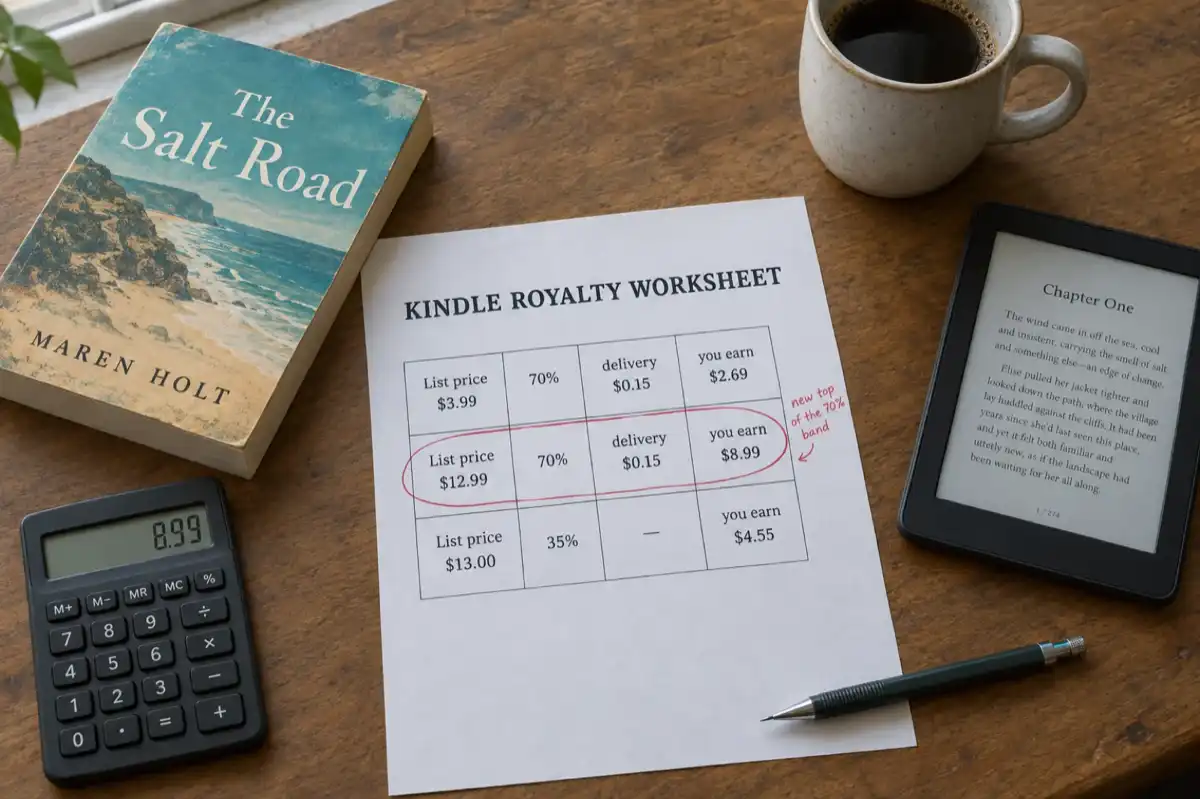
On Amazon.com, KDP pays 70% on a Kindle ebook priced from $2.99 to $12.99, after a delivery charge of $0.15 a megabyte, and 35% at any price outside that band. The top of the band was $9.99 until 7 July 2026. A 1 MB ebook at $3.99 pays $2.69 a sale, at $12.99 it pays $8.99, and at $13.00 it drops to $4.55. Paperbacks pay 60% of the list price at $9.99 and up (50% below), less the printing cost. Kindle Unlimited pays from a monthly fund, not a fixed rate per page.
For most of KDP's history the 70% royalty stopped at $9.99. Price an ebook at $10.99 and Amazon paid 35%, which left you with less money per sale than at $9.99. That ceiling shaped how nearly every self-published ebook was priced. On 7 July 2026 KDP moved it to $12.99 on Amazon.com. This post sets out the current rules for ebooks, paperbacks, hardcovers and Kindle Unlimited, shows the arithmetic with real prices, and covers what the change means when you set or revisit a price.
Every figure here is for Amazon.com in US dollars before tax unless it says otherwise. For your own book, with your file size, page count and trim, the royalty calculator does the sums for KDP and the other stores side by side.
$2.99
Lowest price that earns 70% on a Kindle ebook on Amazon.com.
$12.99
Highest price that earns 70%, since 7 July 2026. It was $9.99.
$0.15
Delivery charge per megabyte, taken before the 70% is worked out.
60%
Paperback royalty at $9.99 and up, less printing. 50% below $9.99.
What changed on 7 July 2026
KDP offers two royalty options for a Kindle ebook: 35% and 70%. The 70% option has always come with conditions, and the main one is price. On Amazon.com the book has to be listed between a floor and a ceiling. The floor is still $2.99. The ceiling rose from $9.99 to $12.99 on 7 July 2026.
Nothing else about the calculation moved. The 70% is still worked out on the list price less a delivery charge based on the file size, the 35% option still has no delivery charge, and prices outside the band still pay 35% whichever option you tick. The rule is still set per marketplace, so each Amazon store has its own band in its own currency.
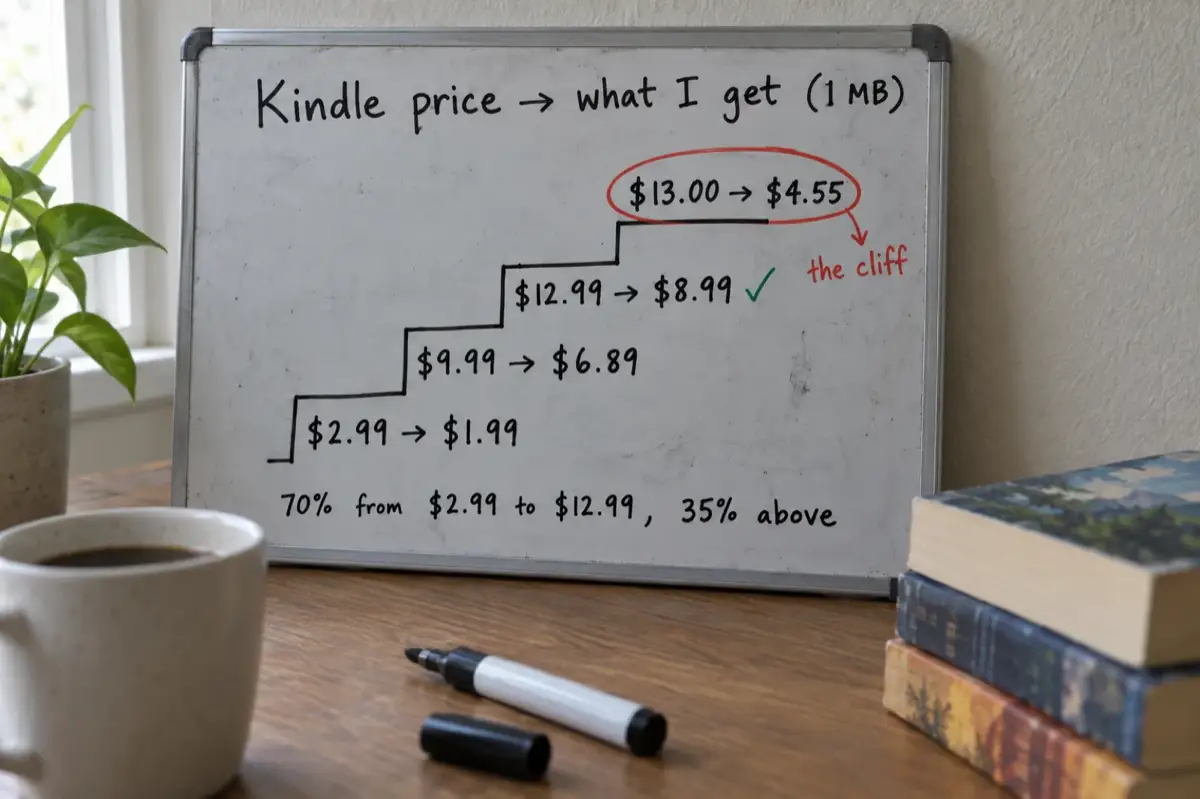
The practical effect is simple to state: the three dollars between $9.99 and $12.99 used to be a dead zone where a higher price paid less, and now they pay 70% like the rest of the band. A book at $12.99 used to earn $4.55 a sale. On a 1 MB file it now earns $8.99.
Books already live are not repriced for you
The change applies to whatever price your book carries. If you priced at $9.99 because it was the old ceiling, the book stays at $9.99 until you change it on the KDP pricing page. If a book was already priced between $10.00 and $12.99, check that its royalty option is set to 70%; a book on the 35% option stays on 35% even inside the band.
How the Kindle ebook royalty is worked out
The 70% royalty is 70% of the list price after the delivery charge, and after VAT where a marketplace includes VAT in the price. In US dollars on Amazon.com, where the list price has no VAT in it, the formula is:
70% royalty = 0.70 x (list price - $0.15 x file size in MB)
35% royalty = 0.35 x list price
The delivery charge is based on the size of the converted file Amazon sends to the reader, not the size of the file you upload, and KDP shows it on the pricing page once the book has been processed. A novel or a text-only non-fiction book is usually around 1 MB, so the charge is about 15 cents. A book full of photographs can be many megabytes, which matters and gets its own section below.
Take a 1 MB ebook at $3.99. The delivery charge is $0.15, so 70% applies to $3.84, which is $2.69. At the same price the 35% option would pay $1.40. At $12.99, 70% of $12.84 is $8.99. At $13.00 the book is outside the band, so it pays 35% of $13.00, which is $4.55.
What each price pays, before and after
This table uses a 1 MB file on Amazon.com. The "before" column is the royalty under the old $9.99 ceiling; the "now" column is the royalty since 7 July 2026. Rounded to the cent.
| List price | Before 7 July 2026 | Now | Worked out as |
|---|---|---|---|
| $0.99 | $0.35 | $0.35 | 35% of $0.99 |
| $1.99 | $0.70 | $0.70 | 35% of $1.99 |
| $2.99 | $1.99 | $1.99 | 70% of ($2.99 - $0.15) |
| $3.99 | $2.69 | $2.69 | 70% of ($3.99 - $0.15) |
| $4.99 | $3.39 | $3.39 | 70% of ($4.99 - $0.15) |
| $6.99 | $4.79 | $4.79 | 70% of ($6.99 - $0.15) |
| $9.99 | $6.89 | $6.89 | 70% of ($9.99 - $0.15) |
| $10.99 | $3.85 | $7.59 | 70% of ($10.99 - $0.15) |
| $11.99 | $4.20 | $8.29 | 70% of ($11.99 - $0.15) |
| $12.99 | $4.55 | $8.99 | 70% of ($12.99 - $0.15) |
| $13.00 | $4.55 | $4.55 | 35% of $13.00 |
| $13.99 | $4.90 | $4.90 | 35% of $13.99 |
| $14.99 | $5.25 | $5.25 | 35% of $14.99 |
Two things stand out. Below $9.99 nothing changed, so a book priced at $2.99 to $9.99 earns exactly what it did in June. And the cliff moved rather than disappeared. It used to sit between $9.99 and $10.00; now it sits between $12.99 and $13.00, where one extra cent takes the royalty from $8.99 to $4.55.
Sources: KDP's eBook Royalties, List Price Requirements and Digital Book Pricing help pages, checked 23 September 2026.
What the change means for your price
The new ceiling does not tell you to raise prices. It removes a penalty that used to stop some books from being priced where their readers would have paid. Whether a higher price sells as many copies is a question about your book and your category, and only a test answers it. What the royalty rule now does is let you run that test without the 35% drop getting in the way.
Books that were held at $9.99
A lot of longer books sat at exactly $9.99 because the next price up paid less. A long non-fiction reference, a technical guide, a 150,000-word fantasy novel or a professional handbook often sells at higher prices in print and from traditional publishers. For those, $10.99, $11.99 or $12.99 are now real options. On a 1 MB file each dollar above $9.99 adds 70 cents a sale: $9.99 pays $6.89 and $12.99 pays $8.99, a difference of $2.10 a copy.
A simple way to judge a move: at $12.99 the book earns about 30% more a copy than at $9.99 ($8.99 against $6.89). If a price rise costs you less than about 23% of your unit sales, total royalties go up; if it costs more, they go down. Those percentages are only arithmetic, not a prediction of how readers in your category will respond.
Box sets and bundles
A three-book or four-book box set is where the old ceiling hurt most. Many series authors priced a box set at $9.99 to stay on 70%, even when the books inside were $4.99 each. At $12.99 the set now pays $8.99 a sale and can still sit well below the price of the books bought one at a time. Box sets are also bigger files, so check the delivery charge on the pricing page: a 3 MB box set at $12.99 pays 70% of ($12.99 - $0.45), which is $8.78.
Books priced above $12.99
If a book is priced above $12.99 today, it earns 35%. To match what the same book would earn at $12.99 on 70%, a 1 MB ebook would have to be priced at about $25.69, because 35% of $25.69 is $8.99. Under the old rules the equivalent point was $19.69 against $9.99. So a book at $14.99 or $16.99 now earns noticeably less a copy than it would at $12.99: $5.25 and $5.95 against $8.99. Books above the band tend to be professional or academic titles whose readers are not very price-sensitive; for anything else, the band is worth a second look.
Books under $2.99
Nothing changed at the bottom. A $0.99 ebook pays $0.35 and a $1.99 ebook pays $0.70, while $2.99 pays $1.99. So $2.99 pays more than five times as much per copy as $0.99. A permanently free or $0.99 first book in a series can still make sense as a way in, but it is a deliberate choice, not a default. If the book is in KDP Select, a Kindle Countdown Deal can take the price below $2.99 for up to seven days and keep the 70% rate.
Series pricing
For fiction series the usual shape still works: a low entry price on book one and a higher price on the later books. The new band gives more room at the top end, so later books, omnibus editions and complete-series sets have somewhere to go that still pays 70%. Our ebook pricing guide covers price testing and positioning in more depth.
Worked example: moving a reference guide from $9.99 to $12.99
- Before: 1 MB file at $9.99. Royalty 70% of ($9.99 - $0.15) = $6.89. Sixty copies a month = $413.40.
- After, same sales: $12.99. Royalty 70% of ($12.99 - $0.15) = $8.99. Sixty copies = $539.40.
- Break-even: $413.40 divided by $8.99 is 46 copies. If sales stay at 46 or more a month at $12.99, royalties are at least what they were.
- Read with care: the copy counts are made-up inputs to show the arithmetic. Give any price change a few weeks, and change one thing at a time.
The delivery charge and image-heavy books
The delivery charge only applies on the 70% option, and it is taken before the 70% is calculated. For a text book at 1 MB it hardly matters. For a cookbook with a photo on every page, a travel guide full of maps or an illustrated children's book, it can decide which royalty option is better.
Take a 20 MB illustrated ebook at $4.99. On the 70% option the delivery charge is $3.00, so the royalty is 70% of $1.99, which is $1.39. On the 35% option there is no delivery charge, so it pays 35% of $4.99, which is $1.75. At that size and price, 35% pays more. At $12.99 the same 20 MB file pays 70% of $9.99, which is $6.99, against $4.55 at 35%, so 70% wins again. The higher ceiling therefore helps picture-heavy books more than most: they can now be priced where 70% beats 35% by a wide margin.
Two ways to keep the charge down: compress images to the size a reader actually needs on a screen, and check the file size KDP reports after conversion rather than the size of your upload. Our guide to selling children's books works through the numbers for picture books, where the file size matters most.
UK, euro and other marketplaces
Each Amazon marketplace has its own 70% band in its own currency, and the band has to be met in each one for the 70% to apply there.
- Amazon.co.uk: 70% from £1.77 to £12.99, with a delivery charge of £0.10 a megabyte. A 1 MB ebook at £2.99 pays about £2.02.
- Euro marketplaces (Germany, France, Spain, Italy, the Netherlands): 70% from €2.69 to €12.99, with a per-megabyte delivery charge in euros. Prices there include VAT, and the royalty is worked out on the price after VAT.
- Brazil, Japan, India and Mexico: the 70% royalty is only available on these stores if the book is enrolled in KDP Select. Outside Select, sales there pay 35%.
KDP can fill in the other marketplaces' prices from your US price. The converted figures do not always land inside each local band or on a round number, so it is worth checking each marketplace by hand on the pricing page whenever you move the US price.
KDP Select and Kindle Unlimited
KDP Select is Amazon's exclusivity program. Enrol an ebook and it must be sold only through Amazon for each 90-day term; in return it goes into Kindle Unlimited, where subscribers read it without buying it, and it becomes eligible for Kindle Countdown Deals, free-book promotions, and the 70% royalty in Brazil, Japan, India and Mexico.
Kindle Unlimited reads are not paid at a fixed rate. KDP announces the size of the KDP Select Global Fund each month, and the fund is shared by the pages read. The fund for August 2026 was $66 million. KDP does not publish a per-page rate. Trackers work one out from their own reports: Written Word Media's estimate for Amazon.com in August 2026 was $0.00517 a page. That is a third-party estimate, not an Amazon figure, and it changes every month.
Pages are counted as Kindle Edition Normalized Pages (KENP), which KDP calculates for your book once it is enrolled, and a page is paid only the first time a given reader reads it. At the August estimate, a reader who reads 300 normalised pages earns about $1.55, and 350 pages about $1.81.
The new ebook ceiling does not change what a Kindle Unlimited read pays, because the list price plays no part in a KU payout. It does change the comparison. A $12.99 sale now pays $8.99, which makes each paying buyer worth several full KU reads. Whether Select is right for a book depends more on where your readers are than on the royalty rules; our comparison of KDP Select and wide distribution sets out the trade-off.
Paperback royalties
Paperback royalties did not change in July, but they are worth setting out alongside the ebook numbers because the two formats are usually priced together. KDP pays 60% of the list price on Amazon.com when the paperback is priced at $9.99 or more, and 50% below $9.99. The printing cost is then taken off that share. In the UK the 60% rate starts at £7.99; in Canada and Australia it starts at 13.99 in local currency.
Paperback royalty = 60% x list price - printing cost (at $9.99 and up; 50% below)
Printing cost
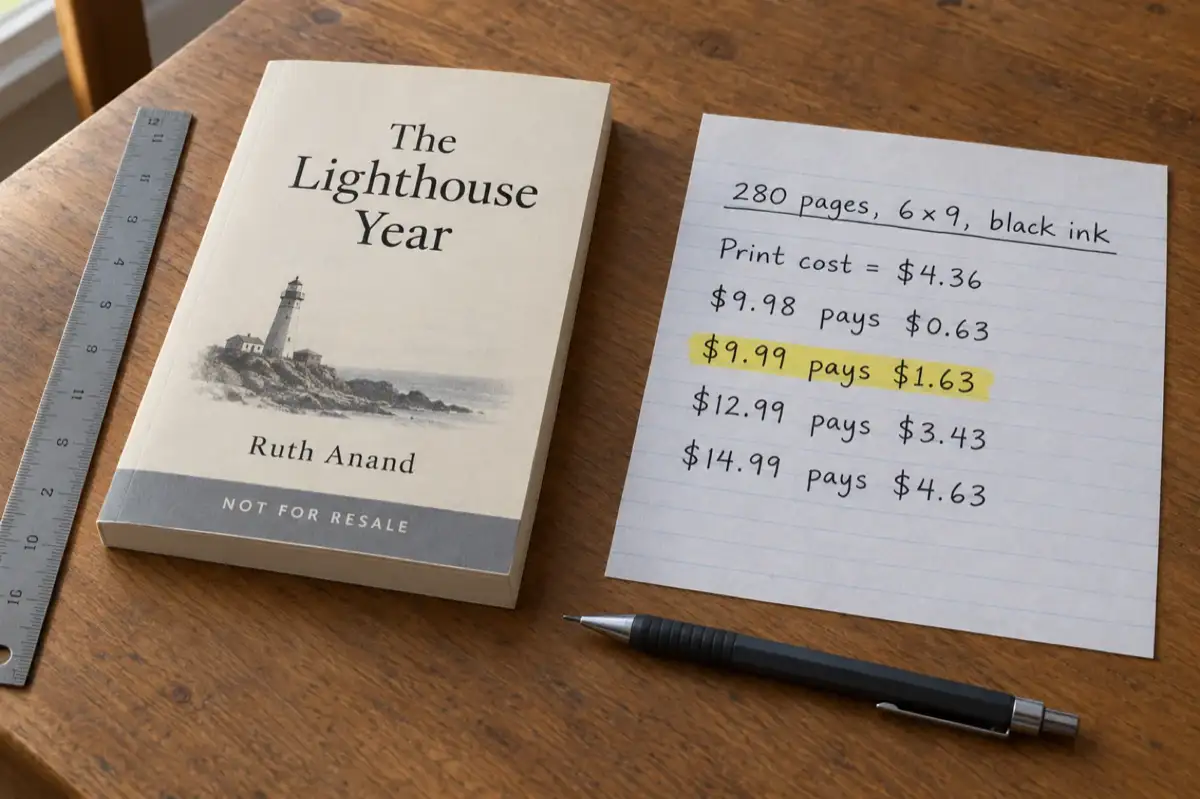
For a black-ink paperback at a regular trim size such as 6 x 9 inches, KDP charges a flat $2.30 for 24 to 110 pages, and from there $1.00 plus $0.012 a page. A 280-page book costs $4.36 to print. Large trims, meaning wider than 6.12 inches or taller than 9 inches, cost more: a flat $2.84 for short books, then $1.00 plus $0.017 a page, so the same 280 pages at a large trim cost $5.76. Colour interiors cost a good deal more again.
| 280-page paperback, regular trim | Rate | Worked out as | Pays |
|---|---|---|---|
| $9.98 | 50% | $4.99 - $4.36 | $0.63 |
| $9.99 | 60% | $5.99 - $4.36 | $1.63 |
| $12.99 | 60% | $7.79 - $4.36 | $3.43 |
| $14.99 | 60% | $8.99 - $4.36 | $4.63 |
| $14.99, Expanded Distribution | 40% | $6.00 - $4.36 | $1.64 |
The paperback has its own cliff, running the other way from the ebook's: one cent below $9.99 the rate falls to 50%, so $9.98 pays $1.00 less than $9.99 on this book. Price paperbacks at $9.99 or above unless there is a reason not to.
Expanded Distribution
Expanded Distribution makes the paperback available to bookshops, libraries and other retailers outside Amazon. Those sales pay 40% of the list price less printing, so they need a higher list price to be worth much: the 280-page book pays $1.64 a copy that way at $14.99 and $0.84 at $12.99. Our guide to KDP paperbacks covers trim sizes, page counts and cover files.
Why the ebook change matters for print pricing
Readers compare formats on the same product page. A paperback at $14.99 next to an ebook at $4.99 looks like one price relationship; the same paperback next to an ebook at $12.99 looks like another. If you move an ebook towards the top of the new band, look at the paperback in the same sitting, so the gap between the two still makes sense to a reader choosing between them.
Hardcover royalties
Hardcovers follow the same 60% and 50% rule as paperbacks, with a higher printing cost because of the case binding. For black ink at a regular trim, KDP charges a flat $6.80 for 75 to 108 pages, then $5.65 plus $0.012 a page. A 300-page hardcover costs $9.25 to print, so at $24.99 it pays 60% of $24.99 less $9.25, which is $5.74. Hardcovers need 75 to 550 pages. They are usually priced well above the paperback, so the ebook change has little direct effect on them.
Write the book, then export the EPUB and a KDP paperback file from the same project.
Start Creating FreeEPUB, DOCX and the KDP paperback package come with a paid plan or a credit pack
One book, every format: a worked example
Here is one 280-page non-fiction book, sold on Amazon.com, with a 1 MB ebook file and a black-ink 6 x 9 paperback. The prices are illustrations, not recommendations.
| Format and route | Price | Worked out as | Pays a copy |
|---|---|---|---|
| Kindle ebook, old ceiling | $9.99 | 70% of ($9.99 - $0.15) | $6.89 |
| Kindle ebook, new ceiling | $12.99 | 70% of ($12.99 - $0.15) | $8.99 |
| Kindle ebook, one cent over | $13.00 | 35% of $13.00 | $4.55 |
| Kindle Unlimited, 300 pages read | n/a | 300 x $0.00517 (third-party August estimate) | about $1.55 |
| Paperback on Amazon | $14.99 | 60% of $14.99 - $4.36 | $4.63 |
| Paperback, Expanded Distribution | $14.99 | 40% of $14.99 - $4.36 | $1.64 |
At these prices the ebook earns nearly twice what the paperback earns per copy, which reverses the old picture for longer books. Under the $9.99 ceiling, a book whose readers would have paid $12.99 for the ebook was capped at $6.89 a copy, or $4.55 if you priced above the ceiling anyway. How many copies sell in each format is the part nobody can calculate in advance; these are royalty rates, not sales forecasts.
For more worked cases by genre, the romance, colouring book and travel guide selling guides each run the numbers for their own page counts, trims and file sizes.
A repricing checklist
- List the titles sitting at $9.99 or between $10.00 and $12.99. These are the books the change affects. Anything from $2.99 to $9.98 earns what it did before.
- Check the royalty option on each. A book set to 35% stays on 35% even inside the band.
- Read the delivery charge. KDP shows it on the pricing page. For a large file, compare both options at your chosen price.
- Look at comparable books. See where books like yours in your category are priced now, in ebook and in print. Some will already have moved.
- Change one price at a time. Move a single title, leave it for a few weeks, and compare units and royalties with the weeks before. Changing several things at once makes the result impossible to read.
- Check every marketplace. Converted prices can fall outside a local band. Set UK, euro and other prices by hand if they matter to you.
- Recheck the paperback. Keep it at $9.99 or above for 60%, and keep a sensible gap between print and ebook.
- Run the numbers once more. The royalty calculator gives the per-copy figure for each format and store.
If you are setting up a first book rather than repricing, our guides to self-publishing on Amazon KDP and selling an ebook on Amazon cover the listing itself: keywords, categories, description and launch.
Frequently Asked Questions
What is the KDP royalty rate in 2026?
For Kindle ebooks on Amazon.com, 70% of the list price less a delivery charge of $0.15 a megabyte when the price is between $2.99 and $12.99, and 35% of the list price outside that band. Paperbacks and hardcovers pay 60% of the list price at $9.99 and above, or 50% below, less the printing cost. Kindle Unlimited reads are paid from a monthly fund.
When did the 70% band change to $12.99?
On 7 July 2026. Before that, the 70% royalty on Amazon.com stopped at $9.99, and it had done so for most of KDP's history.
How much does KDP pay on a $12.99 ebook?
On a 1 MB file on Amazon.com, $8.99 a sale: 70% of $12.99 less the $0.15 delivery charge. Before 7 July 2026 the same price paid 35%, which was $4.55.
Why does a $13 ebook pay less than a $12.99 one?
Because $13.00 is outside the 70% band, so it pays 35%: $4.55, against $8.99 at $12.99. To earn the same $8.99 at 35%, a 1 MB ebook would have to be priced at about $25.69.
Should I raise my ebook from $9.99 to $12.99?
Only if your readers are likely to pay it. At $12.99 each sale earns about 30% more than at $9.99 on a 1 MB file, so royalties rise as long as unit sales fall by less than about 23%. Look at what comparable books charge, change one title at a time, and give it a few weeks before you decide.
What is the KDP delivery charge?
On Amazon.com, $0.15 per megabyte of the converted file, taken from the list price before the 70% is calculated. It only applies to the 70% option. In the UK it is £0.10 a megabyte. KDP shows your book's charge on the pricing page.
Is the 70% band the same in the UK and Europe?
Each marketplace has its own band. On Amazon.co.uk it runs from £1.77 to £12.99. On the euro marketplaces it runs from €2.69 to €12.99. In Brazil, Japan, India and Mexico the 70% royalty is only available to books enrolled in KDP Select.
How much does Kindle Unlimited pay per page?
KDP does not publish a per-page rate. It announces a monthly fund, which was $66 million for August 2026. Written Word Media, a third party, estimated the Amazon.com rate for August at $0.00517 a page. It changes every month.
What does a KDP paperback pay?
60% of the list price at $9.99 and up (50% below), less printing. A 280-page black-ink paperback at a regular trim costs $4.36 to print and pays $3.43 at $12.99 or $4.63 at $14.99. Through Expanded Distribution it pays 40% of the list price less printing.
Does the ebook change affect paperback or hardcover royalties?
No. The July change was to the Kindle ebook price band only. Paperback and hardcover royalties still follow the 60% and 50% rule with the printing cost taken off.
Is 35% ever better than 70%?
Yes, for large files at low prices. A 20 MB ebook at $4.99 pays $1.39 on the 70% option, after a $3.00 delivery charge, and $1.75 on the 35% option, which has no delivery charge. Compare both on the pricing page for image-heavy books.
Related Reading

Founder, Inkfluence AI
Sam is the founder of Inkfluence AI. He built the platform to make book creation accessible to everyone - from first-time authors to seasoned publishers.
Helpful links
Ready to Create Your Own Ebook?
Start writing with AI-powered tools, professional templates, and multi-format export.
Get Started FreeRelated Articles
 Publishing
 Is It Ethical to Write a Business Book with AI? What Readers, Amazon and Your Clients Actually Expect (2026)
The honest answer, with the three positions authors take, what Amazon KDP requires at upload, the reader test, the one thing that is never fine, and disclosure wording you can use.
 Guides
 Selling AI Coloring Books on Amazon KDP: The 2026 Rules, Specs, and Math
Are AI coloring books allowed on KDP? Yes, with disclosure. The part nobody covers: the AI workflow that passes review, style consistency across 30 pages, the interior specs that cause rejections, and the royalty ladder that decides your price.
 Guides
 How to Make an Adult Coloring Book in 2026: From Idea to Printed Pages
The modern walkthrough: what makes line work read as "adult", the three ways to create pages (draw, convert, generate), how to assemble a real book instead of a stack of pages, and the fork between KDP paperbacks, Etsy printables, and printing at home.
Get ebook tips in your inbox
Join creators getting weekly strategies for writing, marketing, and selling ebooks.