
KDP rules checked 19 October 2026 · Amazon.com, US dollars
How Many Books Do You Need to Make $1,000 a Month on KDP?
The honest answer turns on one number most income pages skip: how many copies each book sells. This calculator works backwards from the income you want to the books you need, with KDP's 2026 royalty rules, its new limit of two titles a week, and sales rates taken from a survey of 1,346 indie authors instead of a best case.
How many books do you need to make $1,000 a month on KDP?
With $4.99 Kindle ebooks, each earning $3.45 a copy: about 145 books if they sell like the typical indie author's (2 copies a book a month), 29 books if they sell better than most new authors' (10 copies), and 9 books if they sell like an established author's (35 copies). A $12.99 paperback needs 132, 27 or 8. A $7.99 coloring book, which earns $1.16 a copy, needs 432, 87 or 25. KDP now accepts two new titles per format a week, so even 29 books take at least 15 weeks to submit.
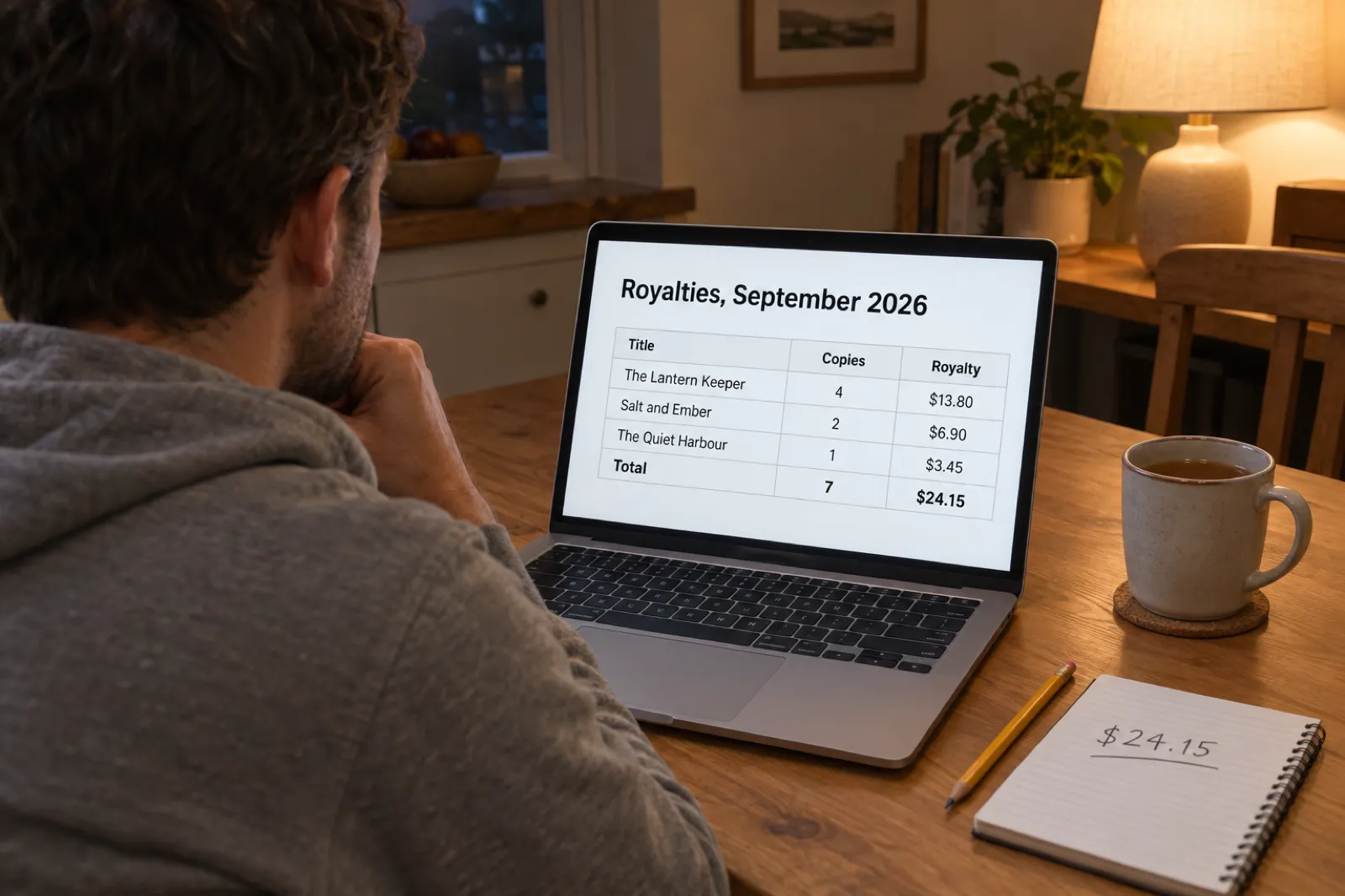
Sales rates derived from the Written Word Media 2025 Indie Author Survey (self-reported); royalties from KDP's help pages for Amazon.com. A single typical ebook earns about $6.90 a month.

How many books calculator
Set the income you want each month and the kind of book. The calculator shows the royalty per copy, then the books needed in three sales scenarios side by side, and the earliest date KDP's weekly limit lets you get there. It runs in your browser; nothing is sent anywhere.
Royalty per copy
$3.45
70% of $4.99 after $0.06 delivery (a 0.4 MB file at $0.15 per MB).
Books needed (typical)
145 books
145 books for $1,000 a month. That is 2.8 years at one a week, and more books than most authors ever publish. Raise copies per book (a series, an email list, a stronger niche) before adding titles.
| Measure | Typical | Better than most | Established |
|---|---|---|---|
| Copies a book a month | 2 | 10 | 35 |
| Each book earns a month | $6.90 | $34.50 | $120.75 |
| Books needed | 145 | 29 | 9 |
| Earliest under KDP's limit | 5 Mar 2028 | 24 Jan 2027 | 15 Nov 2026 |
| At your pace (one a week) | 23 Jul 2029 | 3 May 2027 | 14 Dec 2026 |
One book gets you 0.7% of the way at typical sales ($6.90 a month), 3.5% if it sells better than most ($34.50), and 12.1% at an established author's rate ($120.75).
KDP's weekly limit: two new titles per format, reset Sunday 12:00 AM UTC. Dates count from 19 Oct 2026 (today, in UTC).
Start with book one
Book one of a cosy mystery series for Kindle: a retired teacher solves a small-town case, about 12 chapters, ending with a hook into book two.
Royalties from KDP's help pages, checked 19 October 2026, for Amazon.com in US dollars: ebooks 70% of (list price minus $0.15 per MB delivery) from $2.99 to $12.99 and 35% outside that band; paperbacks 60% of list at $9.99 and up, 50% at $9.98 and below, minus KDP's printing cost. The copies-per-book scenarios are our arithmetic on the Written Word Media 2025 survey, explained in the method section below. They are averages over whole catalogues, not forecasts for any book. Sales tax, VAT, other marketplaces, ads and Expanded Distribution are not included.
The fastest number to change is the first one. You cannot measure copies per book until a book exists. Inkfluence AI drafts a full book, a coloring book or a picture book in minutes, so you can find out what yours really sells.
Start book oneThe maths in three lines
Every "how many books" answer, honest or not, is the same three lines. The difference is what goes into them.
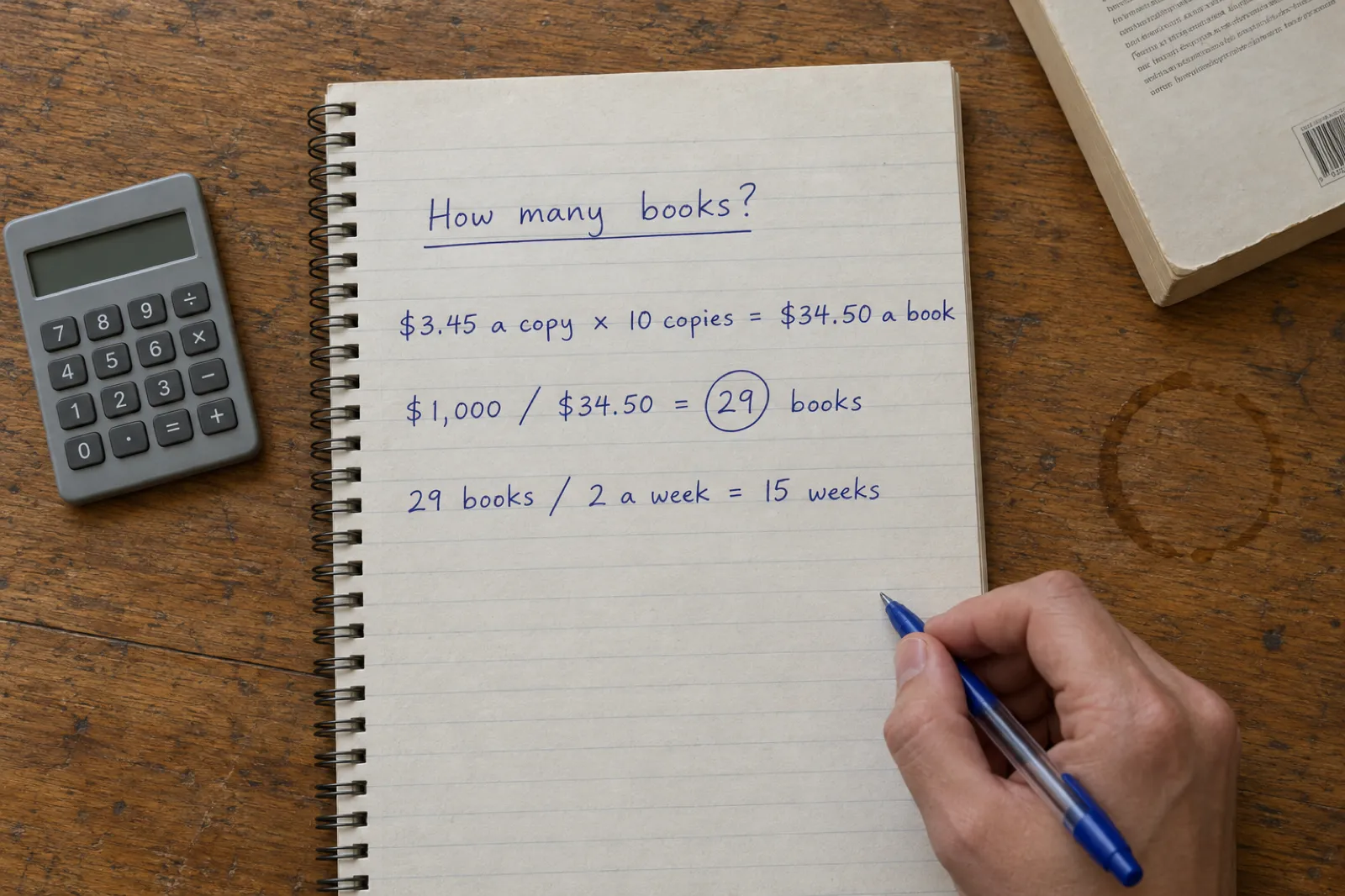
- Royalty per copy x copies per book per month = what one book earns a month.
- Monthly target / what one book earns = books needed (round up).
- Books needed / 2 a week = the fewest weeks KDP allows (per format).
With a $4.99 Kindle ebook and the "better than most" rate of 10 copies a book a month: $3.45 x 10 = $34.50 a book; $1,000 / $34.50 = 29 books; 29 / 2 = 15 weeks of submission slots, so the last book could go in during the week of 24 Jan 2027 at the earliest.
Line one is where income pages go wrong. The royalty is fixed by KDP's rules and your price, so it is easy to get right. The copies figure is a guess, and most pages guess "one sale a day" or "three sales a day" per book, forever. That single assumption is the difference between 29 books and 145. The rest of this page is about getting both numbers right: what KDP actually pays per copy in 2026, and what real authors' books actually sell.
Royalty per copy by format (2026 rules)
KDP pays a share of the list price, minus a delivery charge for ebooks and the printing cost for paperbacks. These are Amazon.com figures in US dollars; other marketplaces have their own bands. For any store or price, the book royalty calculator gives the per-sale figure, and KDP royalties explained covers the rules in full.
Kindle ebooks
Since 7 July 2026, the 70% band on Amazon.com runs from $2.99 to $12.99 (it stopped at $9.99 for years). The 70% royalty is worked out on the list price minus a delivery cost of $0.15 per MB; KDP says the average is about $0.06 a copy, which is a file of about 0.4 MB, so that is what the table uses. Outside the band you get 35% and pay no delivery cost.
| List price | Royalty rate | You earn per copy |
|---|---|---|
| $0.99 | 35% | $0.35 |
| $1.99 | 35% | $0.70 |
| $2.99 | 70% | $2.05 |
| $4.99 | 70% | $3.45 |
| $9.99 | 70% | $6.95 |
| $12.99 | 70% | $9.05 |
| $13.99 | 35% | $4.90 |
| $14.99 | 35% | $5.25 |
Two prices to notice: $12.99 earns $9.05 and $13.99 earns $4.90. A dollar more on the price nearly halves the royalty, so the top of the band is a hard ceiling for most authors. At the bottom, $1.99 earns $0.70 and $2.99 earns $2.05. For how to choose within the band, see how to price an ebook.
Paperbacks, coloring books and journals
Paperbacks earn 60% of the list price at $9.99 and above on Amazon.com, and 50% at $9.98 and below, minus the printing cost. Printing is a fixed charge plus a charge per page, set by ink and trim. In black ink, a book of 24 to 110 pages costs $2.30 to print at a regular trim such as 6 x 9 in and $2.84 at a large trim such as 8.5 x 11 in; longer books cost $1.00 plus $0.012 a page ($0.017 for large trims). Premium colour costs $3.60 or $4.20 for 24 to 40 pages, then $1.00 plus $0.065 or $0.08 a page.
| Book | Print spec | List price | Printing | Per copy | At $9.98 | At $9.99 |
|---|---|---|---|---|---|---|
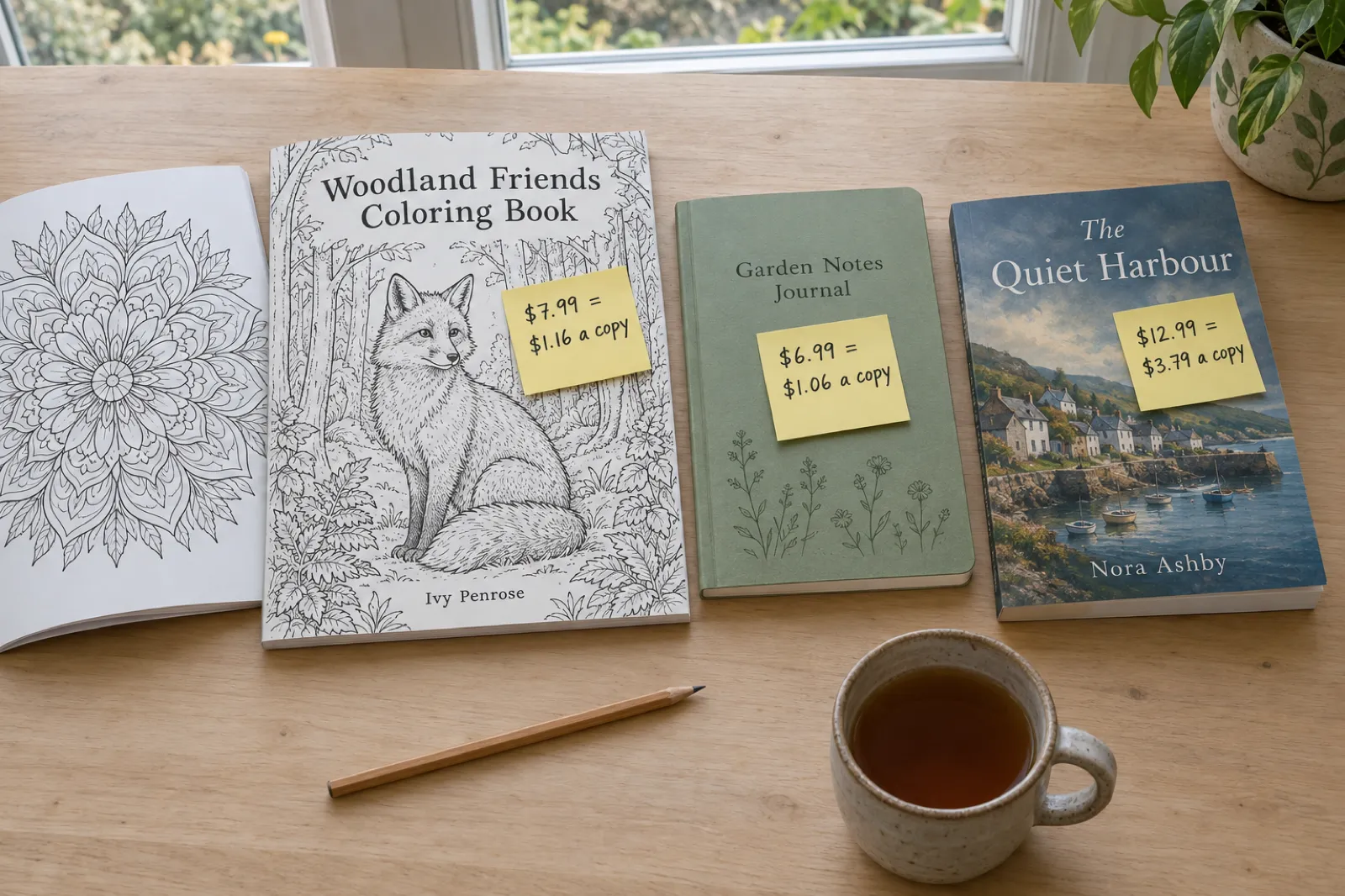
| Novel | 6 x 9 in, 250 pages, black ink | $12.99 | $4.00 | $3.79 | $0.99 | $1.99 |
| Non-fiction guide | 6 x 9 in, 150 pages, black ink | $9.99 | $2.80 | $3.19 | $2.19 | $3.19 |
| Coloring book | 8.5 x 11 in, 104 pages, black ink | $7.99 | $2.84 | $1.16 | $2.15 | $3.15 |
| Journal or notebook | 6 x 9 in, 120 pages, black ink | $6.99 | $2.44 | $1.06 | $2.55 | $3.55 |
| Picture book | 8.5 x 8.5 in, 32 pages, premium colour | $12.99 | $4.20 | $3.59 | $0.79 | $1.79 |
The $9.99 cliff. One cent decides the rate. A 104-page coloring book earns $2.15 at $9.98 and $3.15 at $9.99, almost half as much again for a cent. At the common coloring price of $7.99 it earns $1.16. A 250-page novel feels it even more sharply: at $9.98 it would earn $0.99, at $9.99 $1.99. This is why so many low-cost paperbacks earn about a dollar a copy, and why the calculator shows both figures for any print book. More on page counts and sizes in KDP trim sizes, and on the cover wrap in the cover and spine calculator.
Expanded Distribution, KDP's route into bookshops and libraries, pays 40% minus printing and is not available for low-content books. Most self-publishers sell almost all their paperbacks on Amazon itself, so the calculator leaves it out.
Why copies per book matter more than the number of books
The best public data on what indie authors earn is the Written Word Media 2025 Indie Author Survey: 1,346 authors, published on 2 December 2025, every figure self-reported and monthly. It does not say how many copies a book sells. It does say what authors earn at different catalogue sizes, and that is enough to work the copies out. For the full income bands and what one copy earns in each format, see how much KDP authors make.
| What the survey found | Figure |
|---|---|
| Authors earning $100 a month or less | 44% |
| Authors earning $500 to $5,000 a month | 20% |
| Authors earning over $5,000 a month | 13% |
| Authors earning over $10,000 a month | 8% |
| Authors with 1 to 3 books under $100 a month | about 80% |
| Median, authors with 5 to 9 books | about $50 a month |
| Median, authors with 25 or more books | about $3,000 a month |
| Authors with 25 or more books earning $5,000+ a month | over 40% |
Read the catalogue rows together and the shape is clear. Income rises much faster than the number of books. Five to nine books bring a median of about $50 a month; twenty-five or more bring about $3,000. That is roughly four times the books for sixty times the money. The extra books are not the whole reason: authors with big catalogues have usually written for years, built series and email lists, and learned what their readers buy. More books by themselves do not make each book sell more. That is why this calculator asks for copies per book separately and does not assume that book thirty sells like the average book of an author who has been at it a decade.
Method: how the three scenarios are worked out
Each scenario takes an income and a catalogue size from the survey, divides to get income per book, then divides by the royalty on a reference book to get copies. The reference is a $4.99 Kindle ebook earning $3.45 a copy, because most respondents are ebook-led authors (Amazon was the top revenue source for 83% of them). Copies are rounded to the nearest whole copy.
Typical
2 copies
$50 / 7 books = $7.14 a book; / $3.45 a copy = 2.1, rounded to 2.
Better than most
10 copies
$100 / 3 books = $33.33 a book; / $3.45 a copy = 9.7, rounded to 10.
Established
35 copies
$3,000 / 25 books = $120.00 a book; / $3.45 a copy = 34.8, rounded to 35.
- Typical (2 copies a book a month). The median author with five to nine books earns about $50 a month. Seven books is the middle of that band: $50 / 7 = $7.14 a book, or about two copies.
- Better than most (10 copies). About 80% of authors with one to three books earn under $100 a month, so an author earning $100 from three books is doing better than four in five of their peers: $33.33 a book, or about ten copies.
- Established (35 copies). The median author with 25 or more books earns about $3,000 a month. Dividing by 25, the smallest catalogue in that band, gives $120 a book, or about 35 copies. This is the generous reading: many in that group have more than 25 books, which would mean fewer copies each.
Three honest limits. The survey income includes Kindle Unlimited page reads and sales on other stores, so "copies" here means copy-equivalents. The figures are self-reported by authors who chose to answer a survey, who are likely to be more committed than the average person with a KDP account. And the copies figure is applied the same way to every format; a paperback-only or coloring-book catalogue probably sells fewer copies per book than an ebook-led fiction catalogue, so print answers are on the kind side.
Why no "new books sell more" curve. Real books sell most in their first months and then settle. We kept the copies flat on purpose. The survey medians are already averages over each author's whole catalogue, old books and new, so they already include the slowdown. Adding a decay curve on top would count it twice. The flat figure is a long-run average per book, which is what a monthly income target needs.
The 2026 changes that broke older answers
Most "how many books" pages were written before three KDP changes this year. Each one moves the answer.
1. The 70% band now reaches $12.99 (from 7 July 2026)
For years the top of the 70% band was $9.99, so pages assumed nobody could earn more than about $6.95 a copy at 70%. A $12.99 ebook now earns $9.05. That is a real lever for long non-fiction, box sets and series bundles. It changes less for a typical novel, where readers still expect $2.99 to $5.99.
2. Paperbacks pay 50% below $9.99
Many pages still quote a flat 60% on paperbacks. On Amazon.com it is 60% only at $9.99 and up; at $9.98 and below it is 50%. Low-price print books, which is most coloring books and journals, take the lower rate and then lose the printing cost, which is why they earn about a dollar a copy.
3. Two new titles per format a week (from 21 September 2026)
KDP now accepts two new titles per format each week, and lets you create two per format, drafts included. The limits reset every Sunday at 12:00 AM UTC; updates to existing books do not count. It was ten a week. Ebooks, paperbacks and hardcovers are counted separately, so the ebook and paperback of one book use one slot each. In a year that is at most about 104 new titles per format. Any plan that needs 50 books by next month is now impossible in one format, whatever the tool or the effort. Our KDP publishing calendar shows what the limit means for seasonal books.
Two income claims, checked with the same maths
Two claims are doing the rounds in ads for book tools this autumn. Here is what each one needs to be true.
"30 books x 3 sales a day = $27,000 a month"
30 books x 3 a day x 30 days = 2,700 copies a month. $27,000 / 2,700 = $10.00 royalty per copy. No low-cost paperback earns that: a 104-page coloring book earns $3.15 at $9.99, so the same copies pay $8,505, or $3,132 at $7.99. And three a day per book is about 90 copies a book a month, 45 times the typical rate.
"25 books by New Year = about $7,500 a month"
$7,500 / 25 = $300 a book a month. At $3.15 a copy, that is 96 copies a book a month, about three a day, every book. And from 19 Oct 2026 the weekly limit allows 22 new paperbacks before 1 January; the 25th could go in during the week of 10 Jan 2027 at the earliest.
Neither claim is impossible for one exceptional author. Both are presented as the normal result of making books quickly, and the survey says the normal result is a few copies a book a month.
No income promises here. What we can promise is speed: a finished draft in minutes, KDP-ready files on paid plans, and more of your week left for the parts that sell books.
Try it freeEbook vs paperback vs coloring book vs journal: worked examples
The same $1,000 target, five kinds of book, default prices. Books needed in the typical, better-than-most and established scenarios:
| Format | Per copy | Typical | Better than most | Established |
|---|---|---|---|---|
| Kindle ebook, $4.99 | $3.45 | 145 | 29 | 9 |
| Paperback, $12.99, 250 pages | $3.79 | 132 | 27 | 8 |
| Ebook $4.99 + paperback $12.99 | $3.62 | 139 | 28 | 8 |
| Coloring book, $7.99, 104 pages | $1.16 | 432 | 87 | 25 |
| Journal, $6.99, 120 pages | $1.06 | 472 | 95 | 27 |
Kindle ebook
The ebook is the cheapest book to make and the best paid for the effort at normal prices: $3.45 at $4.99, with nothing to print. It is also where most survey respondents make their money, so the scenarios fit it best. 145 books at typical sales is more than most people will ever write, but 29 at ten copies a book is a few years of steady work, and an author with a working series is in the established column, where 9 books do it. Fiction readers buy series; non-fiction readers buy answers to a problem. Our guides to publishing AI-assisted books on KDP and KDP Select vs going wide cover the choices after the book is written.
Paperback
A 250-page paperback at $12.99 costs $4.00 to print and earns $3.79, a little more than the ebook. Per copy, print is not the problem; volume is, because most indie readers buy the ebook. Price below $9.99 to compete and the royalty falls to $0.99 at $9.98. A 150-page guide at $9.99 earns $3.19, which is why short non-fiction works well in print. The print setup is in paperback publishing on KDP.
Ebook and paperback of the same book
Publishing both formats uses one ebook slot and one paperback slot a week per book, so you submit four books a week but still add two new titles. The calculator splits the same copies evenly between the two, which gives $3.62 a copy on average and 139, 28 or 8 books. That is deliberately cautious: it assumes the paperback adds no new readers, only a choice for existing ones. If your paperback finds buyers who would never buy the ebook, which happens with gift books and non-fiction, the real number is lower. Either way, both formats cost nothing extra in slots.
Coloring book
Coloring books are the format income ads like best, and the hardest maths. At $7.99 a 104-page 8.5 x 11 book earns $1.16, so $1,000 a month takes 432 books at typical sales and 87 at ten copies a book. Raise the price to $9.99 and the royalty becomes $3.15: the typical answer drops to 159. That single price change does more than a year of extra books. Coloring books also sell into gifts and seasons, so timing matters; see how to sell coloring books and coloring book niches for 2026. The AI coloring book generator makes the designs and the KDP files.
Low-content journal or notebook
A 120-page 6 x 9 journal at $6.99 costs $2.44 to print and earns $1.06. At typical sales that is 472 journals for $1,000 a month, which the weekly limit alone would take 4.5 years to submit. Low-content books also review more slowly (KDP says up to three to four weeks), cannot use Expanded Distribution, and have the most competition. The route that works better is "medium content": a guided journal or workbook with real prompts and teaching inside, priced at $9.99 or more, where the same journal earns $3.55. The rules are in low-content books on KDP; the journal generator writes the prompts and how to sell workbooks covers pricing. For journal, planner and coloring catalogues worked through in full, see what low-content books earn in 2026.
Books needed for $500, $1,000, $2,000 and $5,000 a month
Default prices for each format. Each cell reads typical / better than most / established.
| Format | $500 a month | $1,000 a month | $2,000 a month | $5,000 a month |
|---|---|---|---|---|
| Kindle ebook | 73 / 15 / 5 | 145 / 29 / 9 | 290 / 58 / 17 | 725 / 145 / 42 |
| Paperback (novel or non-fiction) | 66 / 14 / 4 | 132 / 27 / 8 | 264 / 53 / 16 | 660 / 132 / 38 |
| Ebook and paperback of the same book | 70 / 14 / 4 | 139 / 28 / 8 | 277 / 56 / 16 | 691 / 139 / 40 |
| Coloring book paperback | 216 / 44 / 13 | 432 / 87 / 25 | 863 / 173 / 50 | 2,156 / 432 / 124 |
| Low-content journal or notebook | 236 / 48 / 14 | 472 / 95 / 27 | 944 / 189 / 54 | 2,359 / 472 / 135 |
Ebook $4.99; paperback $12.99, 6 x 9 in, 250 pages; coloring book $7.99, 8.5 x 11 in, 104 pages; journal $6.99, 6 x 9 in, 120 pages; all black ink. Change any of them in the calculator.
How long it really takes to build the catalogue
The weekly limit sets the fastest possible date. Your own pace sets the real one. Here is the "better than most" ebook catalogue (29 books) and the typical one (145 books) for $1,000 a month, starting on 19 Oct 2026:
| Pace | 29 books done by | 145 books done by |
|---|---|---|
| Two a week (the KDP limit) | 24 Jan 2027 (3 months) | 5 Mar 2028 (17 months) |
| One a week | 3 May 2027 (6 months) | 23 Jul 2029 (2.8 years) |
| One every two weeks | 15 Nov 2027 (13 months) | 26 Apr 2032 (5.5 years) |
| One a month | 14 Feb 2029 (2.3 years) | 4 Oct 2038 (12 years) |
Two books a week is the ceiling, not a target. Each book still needs reading through, a cover, a description, a proof for print, and a listing that someone can find. A careful author with a full-time job might manage one a month; a full-time author with a fast drafting tool might manage one a week for a while. Plan on the pace you can keep for a year, then look at the date.
Income also lags the catalogue. A book published this week will not earn its long-run average this week, and the survey medians describe authors who have been publishing for years. If a catalogue of 29 books is done in 6 months, expect the income to keep building for a while after that, if the books sell at all. The useful early signal is the first three books: if they sell two copies a month each, the plan needs a different book, not more of the same one.
Where a tool helps is the drafting. Inkfluence AI writes a full draft of a novel or non-fiction book, paints a picture book or draws a coloring book in minutes, and builds the KDP package: interior PDF, cover wrap with the spine sized from the page count, Kindle cover and EPUB. The days you save go on the parts that change copies per book: the edit, the cover, the description and the next book in the series.
What moves the number
Every lever below works on copies per book or royalty per copy. None of them is "more books".
A series
A reader who finishes book one and wants book two is the cheapest sale there is. The survey notes that marketing spend "gets amortized across the whole series", and the authors in the established column are mostly series authors. A standalone has to find every reader from scratch; book four of a series inherits readers from books one to three. If you write fiction, plan the series before book one. Our book series writer continues a book you have written with the same characters and world, and how to write a book series with AI walks through it.
An email list
The survey's strongest predictor of income: authors with an email list had a median of about $300 a month; authors without one, about $15. A list lets you tell readers about the next book on launch day, which is when Amazon's own ranking decides whether strangers see it. A free short book or sample chapters as a sign-up gift is the usual start; the lead magnet generator makes one, and building an email list with downloadable PDFs covers the setup.
Genre
Romance authors were 21% of the survey's respondents and about 44% of those earning over $10,000 a month. Romance readers read a lot, buy series and use Kindle Unlimited heavily. That does not make romance easy, but it does mean copies per book vary hugely by genre, and a "typical" figure across all genres flatters some and undersells others. If you write romance, how to sell romance novels and the romance novel writer are the places to start.
Price
The easiest lever and the most ignored. A coloring book at $9.99 instead of $7.99 earns $3.15 instead of $1.16 per copy. A non-fiction ebook at $7.99 instead of $3.99 earns $5.55 instead of $2.75. If the higher price costs fewer than half the sales, it wins. Test it on one book before deciding for the catalogue.
Marketing spend
The survey asked this too. Average spend was $636 a month; authors earning over $10,000 a month spent about $4,500, and those under $100 spent about $81. High earners spend more because they can, and spending more does not by itself produce high income. But it is a reminder that the established column has costs behind it that a royalty calculator does not show. Ads, covers, editing and proofs come out of the income, not on top of it.
Kindle Unlimited, as a note
Books in KDP Select can be borrowed in Kindle Unlimited, and the author is paid per page read from a monthly fund. KDP reports $69.3 million in total KDP Select author earnings for September 2026, but its fund page does not state a per-page rate, so we do not model page reads separately. The survey incomes behind the scenarios already include them: 38% of respondents had every book in KDP Select, and 43% of those earning over $5,000 a month did. For fiction in a series, especially romance, it often matters; for coloring books and journals, which are print-only, it does not apply.
Plan a series, not a pile. Describe book one and Inkfluence AI drafts it; when it is done, continue it as book two with the same characters and world.
Draft book one of a seriesSelling outside Amazon: more per sale, no weekly limit
KDP is not the only shop. A coloring book, planner or guide also sells as a PDF download on Etsy or Gumroad, where there is no printing cost, no review queue and no weekly title limit. The per-sale maths is very different.
| Where and what | Price | You keep |
|---|---|---|
| KDP, coloring book paperback (104 pages) | $7.99 | $1.16 |
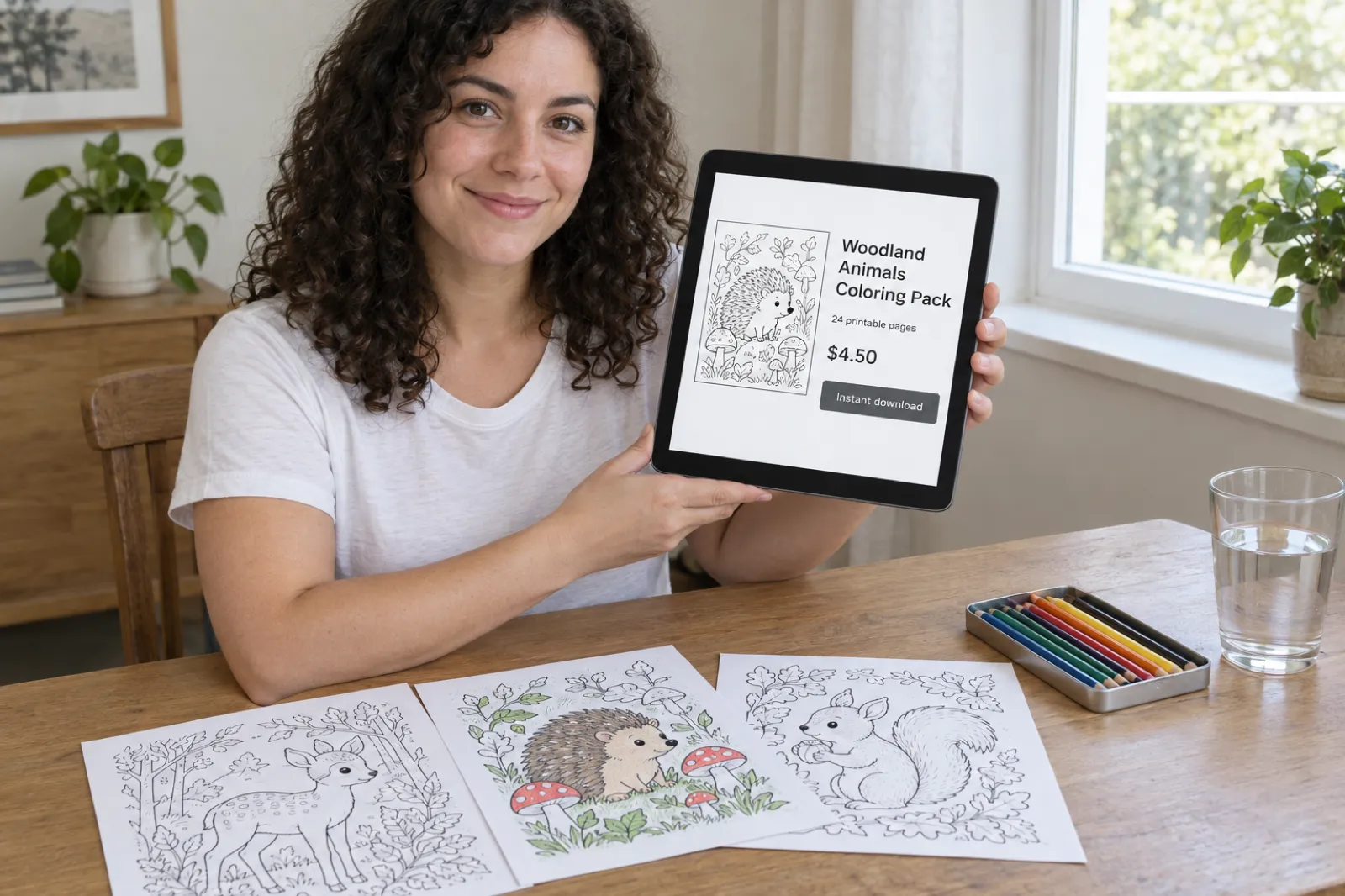
| Etsy, printable coloring pack (PDF) | $4.50 | $3.62 |
| Gumroad, printable coloring pack (PDF) | $4.50 | $3.12 |
Etsy: 6.5% transaction fee, 3% + $0.25 payment processing and a $0.20 listing fee, without Offsite Ads (charged only on sales Etsy's ads bring in). Gumroad: 10% + $0.50, with card processing of 2.9% + $0.30 taken off as well to be safe. US fees, checked 10 October 2026.
A cheaper product keeps about three times as much per sale. The trade-off is traffic: Amazon brings buyers who are already searching for books, while an Etsy shop competes inside Etsy search and a Gumroad page needs you to send people to it. Many authors do both: the paperback on KDP for buyers who want a printed book, the PDF on Etsy or Gumroad for buyers who print at home, from the same files. Our list of digital product ideas compares formats, selling ebooks on Etsy and selling on Gumroad cover the setup, and Gumroad vs Amazon KDP weighs the two. What a single printable sale keeps on Etsy after every fee, set against Gumroad and KDP, is in how much Etsy printables really make.
On paid plans, Inkfluence AI sends a finished book to Etsy or Gumroad as a listing for you to check and switch on, and every plan exports a PDF.
Seven mistakes in "how many books" maths
- Assuming one sale a day per book, forever. One a day is 30 copies a month: close to the established rate, and 15 times the typical one.
- Quoting a flat 60% on paperbacks. Below $9.99 on Amazon.com it is 50%, minus printing.
- Using the old $9.99 ceiling for ebooks. The 70% band reaches $12.99 since 7 July 2026, and $13.99 drops to 35%.
- Planning more titles than the limit allows. Two new titles per format a week since 21 September 2026: about 104 a year per format at most.
- Treating a top author's month as the average. 44% of indie authors in the survey earned $100 a month or less.
- Forgetting the costs. Proofs, author copies, covers, ads and software come out of royalties. A plan that only just reaches $1,000 in royalties nets less.
- Adding books before checking the first ones. Three books at two copies a month each is a signal. Change the genre, the price or the cover before writing number four.
For the wider picture, see our self-publishing statistics; for the forward direction (you know your sales and want the income), the ebook income calculator.
How to work out how many books you need, step by step
- Pick a monthly target. $500, $1,000, $2,000 or $5,000 a month are common goals. Use the number you would actually be pleased with.
- Work out the royalty per copy. Ebook: 70% of the list price minus delivery between $2.99 and $12.99, 35% outside it. Paperback: 60% at $9.99 and up, 50% at $9.98 and below, minus the printing cost for your trim, ink and pages.
- Choose an honest copies-per-book rate. Two copies a book a month is typical; ten is better than most new authors; 35 is an established author with 25 or more books. Use your own sales once you have three books out.
- Divide. Royalty x copies = what one book earns. Target / that = books needed, rounded up.
- Check the weekly limit and your pace. Books / 2 = the fewest weeks KDP allows in one format. Books / your real pace = the likely date.
- Raise copies per book before adding books. A series, an email list, the genre and the price move the answer more than volume.
- Make book one and measure it. Draft it, edit it, publish it in the right format (children's books have their own print rules), and tell KDP if AI made the text or images, as the KDP AI disclosure policy requires. Then let the real numbers replace the guesses in step three.
Step seven takes minutes to start. Describe the book in a sentence and Inkfluence AI drafts it. Export a PDF on any plan, or a KDP package, EPUB or DOCX on paid plans. See pricing for what each plan includes.
Draft book oneHow many books to make money on KDP: questions
How many books do you need to make $1,000 a month on KDP?
It depends on how many copies each book sells, far more than on the number of books. With a $4.99 Kindle ebook earning $3.45 a copy: about 145 books if they sell like the typical indie author's (2 copies a book a month), 29 if they sell better than most new authors' (10 copies), and 9 if they sell like an established author's (35 copies). A $12.99 paperback needs 132, 27 or 8. A $7.99 coloring book needs 432, 87 or 25. The scenarios come from the Written Word Media 2025 Indie Author Survey.
How many books do you need to make $500 a month on KDP?
For $4.99 Kindle ebooks: about 73 at typical sales, 15 if each sells 10 copies a month, or 5 at an established author's 35 copies a book. Half the $1,000 answer, because the maths is a straight division.
How many books do you need to make $2,000 a month on KDP?
For $4.99 Kindle ebooks: about 290 at typical sales, 58 at 10 copies a book a month, or 17 at 35. Under KDP's weekly limit of two new titles per format, 58 books take at least 29 weeks to submit.
How many books do you need to make a living on KDP?
Take $5,000 a month as a living. For $4.99 ebooks that is about 725 books at typical sales, 145 at 10 copies a book and 42 at 35. In the Written Word Media survey, 13% of indie authors earned over $5,000 a month, and authors with 25 or more books had a median of about $3,000 a month.
How much does one book make a month on KDP?
For most authors, very little. In the Written Word Media 2025 survey, about 80% of authors with one to three books made under $100 a month in total, and the median author with five to nine books made about $50 a month, roughly $7 a book. One $4.99 ebook at 2 copies a month earns $6.90; at 10 copies, $34.50.
How much do you make per book sold on KDP?
A $4.99 Kindle ebook earns $3.45 a copy (70% after about $0.06 delivery). A $12.99, 250-page 6 x 9 paperback earns $3.79 after $4.00 printing. A $7.99, 104-page 8.5 x 11 coloring book earns $1.16, and the same book at $9.99 earns $3.15, because paperbacks get 60% from $9.99 and 50% at $9.98 and below.
Is three sales a day per book realistic on KDP?
Not as a plan. Three a day is about 90 copies a book a month: 9 times our "better than most" rate and 45 times the typical rate derived from the Written Word Media survey. Some books do it, usually in a series, with an email list or ads behind them. Plan with the typical column and treat anything better as upside.
How many books can I publish on KDP per week?
Two new titles per format per week, and separately two titles created per format, drafts included. Ebook, paperback and hardcover count separately, updates do not count, and the week resets every Sunday at 12:00 AM UTC. The limit was ten a week until 21 September 2026. At most that is about 104 new titles a year in each format.
Do coloring books and low-content books need more titles?
Usually far more, because each copy earns less. A $7.99 coloring book earns $1.16 a copy and a $6.99 journal $1.06, against $3.45 for a $4.99 ebook. At typical sales that is 432 coloring books or 472 journals for $1,000 a month. Pricing at $9.99 or more roughly triples the coloring book's royalty, to $3.15.
Does Kindle Unlimited change the answer?
Not in this calculator. The survey incomes behind the scenarios already include Kindle Unlimited page reads, so the copies figures are copies plus borrows. KDP publishes the total paid to KDP Select authors ($69.3 million for September 2026) but its fund page gives no per-page rate, so we do not model page reads separately.
Is it better to publish more books or better books?
Better books, then more of them. Moving a book from 2 to 10 copies a month cuts the ebook catalogue for $1,000 from 145 books to 29. The things that move copies per book are a series, an email list (a median of about $300 a month with one against $15 without, in the survey), the genre and the price.
Can I make more per sale outside Amazon?
Yes. A $4.50 printable coloring pack keeps about $3.62 on Etsy and $3.12 on Gumroad after fees, against $1.16 for a $7.99 coloring paperback on KDP, and there is no weekly title limit. The trade-off is that you bring more of the buyers yourself.
Sources
KDP pages checked 19 October 2026. KDP changes its rates and limits; if a figure here and KDP's own page disagree, KDP's page wins.
- KDP: eBook list price requirements: the 70% band of $2.99 to $12.99 on Amazon.com, effective 7 July 2026.
- KDP: eBook royalty options: the 70% formula and the $0.06 average delivery cost.
- KDP: Digital pricing page: Amazon.com delivery at $0.15 per MB.
- KDP: Paperback royalty: 60% at $9.99 and up, 50% at $9.98 and below; Expanded Distribution 40%.
- KDP: Printing cost: fixed and per-page costs by ink and trim.
- KDP: Title creation and submission limits: two per format per week, Sunday 12:00 AM UTC reset.
- Alliance of Independent Authors, 24 September 2026: the limit took effect on 21 September 2026, down from ten.
- KDP: Select Global Fund: $69.3 million total KDP Select author earnings, September 2026.
- KDP: Low-content books: what counts and what is restricted.
- Written Word Media: 2025 Indie Author Survey Results, 2 December 2025, 1,346 responses, self-reported monthly income.
- Etsy and Gumroad fees as published by each, checked 10 October 2026.
Amazon, Kindle, Kindle Unlimited and KDP are trademarks of Amazon.com, Inc. or its affiliates; Etsy and Gumroad are trademarks of their owners. Inkfluence AI is an independent tool and is not affiliated with or endorsed by any of them.
Related tools and guides
Book Royalty Calculator
What one sale pays on KDP and other stores.
Ebook Income Calculator
From copies sold to monthly income.
KDP Publishing Calendar
Submit-by dates for every holiday.
KDP Royalties Explained
The 2026 royalty rules in full.
Low-Content Books on KDP
Journals, notebooks and planners.
How to Sell Coloring Books
Pricing, print costs and printables.
Digital Product Ideas
What sells as a download.
Sell Ebooks on Etsy and Gumroad
Selling outside Amazon, step by step.
How to Sell Children's Books
Picture books in print and online.
Etsy vs Gumroad
Which download shop suits your book.
Why KDP Rejects Books
Avoid losing a week to a rejection.
KDP Tools
Every free KDP tool we make.
The number that matters most is the one you can only measure.
Copies per book is a guess until book one is out. Make it this week, publish it, and let its sales tell you how many more you need. Free to start, with a PDF export on every plan.
Make your first book on Inkfluence AI