
Coloring Book Niches for 2026: Where Low Competition Meets Real Buyers
A niche framework instead of a niche list: how complexity tiers map to price points, why the senior shelf is underserved, the seasonal calendar that decides your publish dates, and how to validate before you draw a single page.
Quick Answer
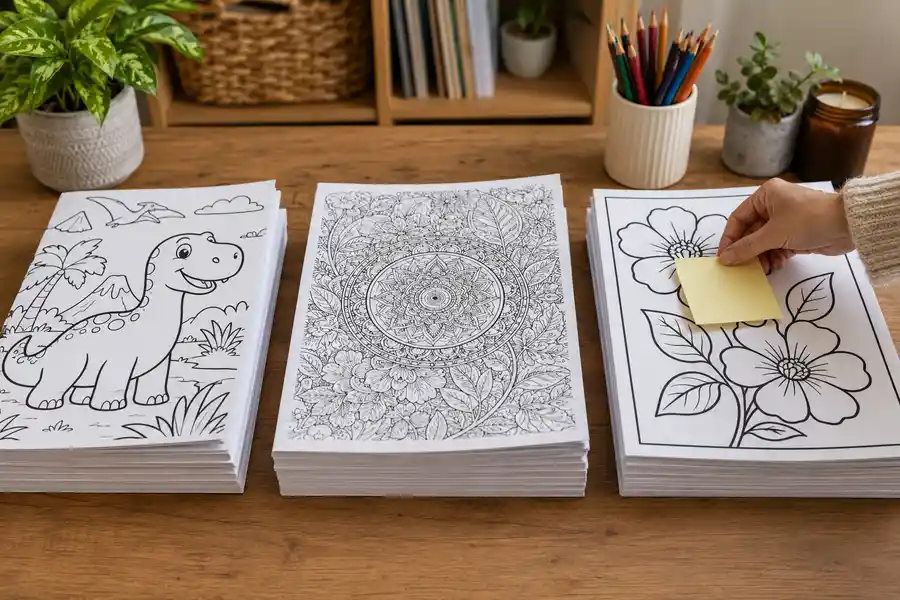
The best coloring book niches for 2026 are specific combinations of audience + subject + twist, not broad categories: "dinosaurs doing everyday things" for kids, intricate botanical and cozy-interior books for adults, and large-print simple designs for seniors, a genuinely underserved shelf. Complexity is a pricing lever (adult intricate books support higher list prices than kids' books at identical production cost), Q4 is the category's gift season, and validation costs nothing: search your exact niche phrase on Amazon and count how many decent books answer it. Framework and niche map below.
Every coloring book niche list on the internet is the same twenty ideas in a different order. This is not another one. It is the framework behind the lists: how to construct a niche, how complexity maps to price, where the genuinely empty shelves are, and how to validate demand in ten minutes before you generate a single page. Bring your own subject; leave with a book worth publishing.
Niches are built, not found
A workable coloring book niche has three parts (the same construction our wider niche guide applies to every category):
- Audience: who holds the crayon (toddler, older kid, teen, adult, senior). This decides line complexity, page density, and price band.
- Subject: what is on the page (dinosaurs, gardens, trucks, cats). This decides what buyers type into search.
- Twist: the angle that makes yours the specific book someone wants ("...doing everyday things", "...in famous paintings", "...at the beach"). This is your differentiation and, usually, your title.
"Animals" is a category. "Woodland animals having a picnic, for ages 4-8" is a niche. The twist is where a recurring character earns its keep, and where an AI coloring book generator changes the economics: a themed 20-to-40-page book with a consistent character used to be the expensive part, and now it is the easy part, which moves all the value into choosing the niche well.
The complexity ladder is a price ladder
The least-discussed fact in the category: production cost is flat across audiences, but list price is not. A toddler book and an intricate adult book take the same effort to generate, but they sell in different price bands, and Amazon's royalty structure amplifies the difference. At the 8.5" x 11" and 8.5" x 8.5" coloring trims, a black-ink paperback of up to 110 pages costs a flat $2.84 to print on Amazon.com, and royalties run 60% of list at $9.99 and above (50% below), so:
- Kids' book at $7.99: about $1.16 per sale
- Kids' book at $9.99: about $3.15 per sale
- Adult intricate book at $12.99: about $4.95 per sale
Same generation workflow, more than four times the royalty at the top of the ladder. That does not mean only make adult books; kids' books sell in volume and make wonderful series. It means know which rung you are publishing on, and price accordingly. Full math in our KDP coloring book guide.
The niche map, rung by rung
Toddlers and preschool (very bold, very simple)
Big shapes, thick lines, one subject per page, nothing fiddly, exactly what the kids setting of the generator draws. Perennial subjects: farm animals, vehicles, fruits, "first" themes (first words, first animals). The buyer is a parent looking for something a two-year-old cannot fail at, and reviews reward exactly that. Adjacent play: pair with an ABC book on the same theme, one audience, two products.
Kids 4-8 (the volume heart of the market)
The busiest rung and the most fun to differentiate with twists: dinosaurs doing everyday things, monster trucks at the beach, cats being dramatic, robots learning to cook. A recurring character turns a book into a series, and series are how kids' coloring publishers compound: the child who finishes "Rex Bakes Cookies" asks for the next Rex.
Teens and adults (intricate, meditative, premium)
Botanical gardens, mandala-style patterns, cozy interiors, fantasy landscapes, ocean scenes, seasonal collections. Buyers here pay for density and mood; "relaxing" and "stress relief" are genre words, not decoration (the adult style switch is automatic in the adult coloring book generator, and pattern books have their own mandala generator). This is also where the digital-download market is strongest: adult colorers print favorite pages repeatedly, which makes the Etsy printable version (covered in our Etsy guide) unusually attractive. The full build walkthrough for this rung is how to make an adult coloring book.
Seniors and low-vision colorers (the empty shelf)
Here is the gap worth underlining: large-print, low-clutter, high-contrast coloring books designed for older adults, arthritis-friendly big regions, calm subjects, dignified covers that do not look like children's books. The audience is large, the shelf is thin, and most publishers ignore it entirely because it is neither the kids' rung nor the intricate rung. If you want a niche with real demand and little serious competition in 2026, start here.
25 constructed niches to steal (or beat)
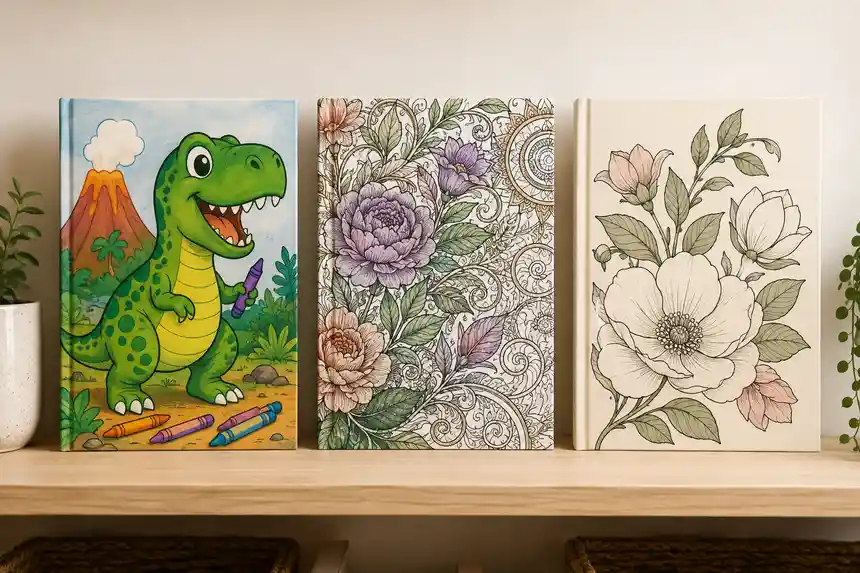
The framework matters more than any list, but a list makes the framework concrete. Twenty-five niches built the audience + subject + twist way, spread across the rungs:
Toddler/preschool: first farm animals · big machines that go · fruits with faces · bath time friends · my first dinosaurs
Kids 4-8: dinosaurs doing everyday things · monster trucks at the beach · cats being dramatic · robots learning to cook · woodland animals having a picnic · space puppies · construction site birthday party · dragons at school
Teens/adults: intricate botanical gardens · cozy bookshop interiors · mandala-style ocean patterns · fantasy treehouse villages · rainy city windows · vintage kitchen still lifes · enchanted forest doorways
Seniors/large-print: simple garden flowers · countryside cottages · songbirds on branches · classic cars, big and bold · seaside villages
Every one of these passes the construction test: a parent, colorist, or activity coordinator could type it into a search box, and a recurring character or consistent world (see how consistency actually works) turns each into a series. Validate before building; the ten-minute check below filters the duds.
The seasonal calendar
Coloring books are gift products, which makes the calendar part of the niche:
- Q4 (publish by early autumn): the gift season dominates the category's year. Christmas themes, but also giftable evergreen books (the personalized-feeling twist niches, and matching ABC book bundles) ride the same wave.
- Spring: Easter, Mother's Day, garden themes waking up with the gardens.
- Summer: travel and activity books, parents buying quiet-time material for holidays.
- Back-to-school: teacher-adjacent themes and classroom sets.
- Halloween: the shortest window of all, almost all of it in October; the Halloween coloring book generator has the dated plan for Etsy printables and next year's KDP book.
To see a seasonal book made ahead of its season, the cozy autumn coloring book walkthrough makes one for ages 6 to 8 at the end of summer and lists it the same day.
The publish-by dates that follow: Q4 gift books live by early October; Easter and Mother's Day titles by February; summer activity books by April; back-to-school themes by July. Not because Amazon requires it, but because reviews and rank take weeks to accumulate and the wave does not wait. For the exact publish-by date for each holiday and format, the calendar counts back from the holiday with KDP's review times.
Amazon's review flywheel takes weeks to spin up, so a Q4 book published in November missed Q4. Work one season ahead: the generation takes an afternoon, but the listing needs runway.
Reading the Amazon shelf like a professional
The validation search gets sharper once you know what to read on the results page:
- Review counts tell you the shelf's age (our KDP tools help with the keyword side of the same research). Top books with thousands of reviews mean an entrenched shelf where you need a sharper twist; top books with 40 to 200 reviews mean a niche that sells but has not locked in incumbents, the sweet spot for a new title.
- Cover patterns tell you the buyer's expectations. If every adult botanical book has a detailed floral cover on cream, a neon cartoon cover will read as the wrong product, not a bold choice. Differentiate inside the visual genre.
- "Ships from Amazon" paperbacks vs printables in the results tell you which channel owns the niche; if Etsy printables outrank paperbacks in Google for your phrase, lead with the digital edition.
- The also-boughts under a top book are a free map of adjacent niches, and frequently your book two and three.
The pricing playbook per rung
Anchoring to the royalty math above (check any scenario in the royalty calculator), the bands that work in practice: toddler and kids' books cluster at $6.99 to $9.99, and if your book genuinely belongs at the top of that band, list at $9.99 rather than $8.99, because crossing Amazon's 60% threshold roughly doubles the royalty for one dollar of price. Adult intricate books support $10.99 to $14.99, where every sale clears $4 to $6. Seniors' large-print books price like adult books, not kids' books; the buyer is an adult purchasing dignity, and underpricing signals the children's shelf they are precisely trying to avoid.
Digital editions run their own band: $3.99 to $6.99 on Etsy, where the comparison is other printables rather than printed books. Do not price the printable above the paperback; buyers notice and reviews say so. For the paperback side, what a coloring book pays per copy is worked through at three prices.
Series math: how one validated niche compounds
The real economics of this category are series economics. Book one in a validated niche (generated in an afternoon with the coloring book generator) does the expensive work: proving demand, gathering the first reviews, teaching you what one-star reviewers hate. Book two launches into an audience that already found book one, shares its also-bought shelf, and costs one more generation run. By book four, the niche's search results are partly your backlist, which is the quiet moat: a shelf where a third of the good options are yours converts far better than any single title can. A series page is open to coloring books because KDP does not count them as low-content (low-content books cannot join a series); our low-content books guide sets out the difference.
This is also the honest answer (the fuller economics live in our cost breakdown) to "do coloring books still make money in 2026": single random books, rarely; validated niches compounded into series with both channels running, reliably enough that it is the standard playbook of every serious publisher in the category. To size a series against a monthly goal, you can work back from an income target to the number of coloring books it takes at three sales levels. The per-copy and catalogue numbers behind that answer, with coloring books set against journals and planners, are in what coloring and journal books earn on KDP.
Ten-minute validation, before you generate anything
- Search your exact niche phrase on Amazon ("dinosaur coloring book for kids 4-8"). Count the results that look professionally made. A handful of strong books = proven demand with room. Two hundred = a red ocean. Zero = check the demand exists at all before celebrating.
- Read the one-star reviews of the top books. They are a free product spec (and the quality bar our step 3 checklist exists to clear): "lines too thin", "pages double-sided so markers bleed", "half the pages are repeats". Your book fixes what reviewers hate.
- Check the price band. What do the top five charge? Price with the band, not under it; underpricing reads as low quality in gift categories (sanity-check per-sale earnings in the royalty calculator).
- Search the same phrase on Etsy. If printable versions sell there, you have a second channel for the same file from day one; the Etsy playbook covers listing it.
Case study: constructing a niche from scratch
Watch the framework run once, end to end. Start with a subject you personally find funny or lovely, because you are about to spend an evening with it; say, capybaras. Rung check: capybaras skew kids-4-8 (cute) and adult-cozy (memes and calm energy), so there are two possible books here, not one. Twist construction for the kids' rung: "capybaras running a bakery" (subject + unexpected job, a proven shape). For the adult rung: "capybaras in hot springs, cozy and intricate" (the animal's real famous habit, meditative framing).
Validation: the Amazon search for "capybara coloring book" returns a young shelf, a handful of books, modest review counts, clear buyer demand from the animal's popularity wave. The one-star reviews of the incumbents complain about repetitive pages and thin lines. Price band: kids at $8.99 to $9.99, adult at $11.99 to $13.99. Etsy check: capybara printables sell, so the digital edition has a channel.
Decision: build the kids' book first ("Capy's Bakery: A Capybara Coloring Book", 24 pages, recurring capybara baker, bold closed lines, $9.99, title stress-tested against the title generator's alternatives), with the adult hot-springs book as the fast follow into the same audience gravity. Total time from idea to two validated, differentiated, priced concepts: about fifteen minutes, which is the entire point of having a framework instead of a list.
From niche to book in one afternoon
Once the niche passes validation, production is the short part: describe the theme, audience, and recurring character to the coloring book generator, get 20 to 40 distinct scenes in one consistent line-art style, regenerate the weak pages, and export the KDP package at 8.5" x 8.5" (the default) or the 8.5" x 11" KDP trim, with a blank page already behind every design. The full publish walkthrough, specs, disclosure, and royalty math included, is in the companion guide.
Then do the thing most one-book publishers never do: make book two in the same niche. The niche you validated is an audience, not a single sale.
Where AI changes niche strategy (and where it does not)
Generation cost falling to near zero changes which strategies are rational. Testing gets cheap: publishing three differently-twisted books into one niche and letting sales pick the winner used to be a quarter's illustration budget and is now a weekend (the full cost picture is in the real cost of publishing an AI book), so the smart posture shifts from "pick perfectly" to "pick sensibly, test, double down". Seasonal books become viable: a Valentine's coloring book that sells for six weeks a year never justified commissioned art, and now it does. And the personalization tier opens: niche-of-one books (a coloring book of your daughter's actual dog) exist as products on Etsy precisely because the marginal book costs minutes.
What AI does not change: demand. No generation speed makes people search for something they do not want, which is why the validation step stays the spine of this whole framework, and why the sellers who skip it produce beautifully drawn books nobody was looking for. Tools moved the bottleneck; the bottleneck is now judgment, which is the most durable moat there is.
Frequently asked questions
What coloring book niches are low competition in 2026?
Constructed twist-niches (audience + subject + twist) rather than categories, and above all the seniors/large-print shelf, which remains genuinely underserved. Broad categories like "animals" or "mandala" are saturated at the category level but open at the twist level. The same construction logic applies across book niches generally; see our wider low-competition niches guide.
Do adult or kids' coloring books sell better?
Kids' books sell in higher volume and build series loyalty; adult books support higher prices and stronger per-sale royalties. The honest answer is a portfolio: same workflow, both rungs.
How do I validate a coloring book niche before making it?
Search the exact niche phrase on Amazon and count professional-looking results (a handful is ideal), read the one-star reviews of the top books as a free product spec, check the top five's price band, and search the phrase on Etsy to confirm a printable second channel.
How many pages should a niche coloring book have?
At least 24 (KDP's paperback minimum); 24-50 drawings is typical for kids, more for adult books. Single-sided printing with blank backs doubles the page count and stops marker bleed-through, a top-three complaint in one-star reviews.
Can AI-generated coloring books compete on quality?
Yes, if you curate. Generation quality cleared the bar in 2026; what separates books now is niche selection and the human quality pass: closed lines, no near-duplicates, no anatomy glitches. The drawing stopped being the moat; taste is the moat.
When should I publish a seasonal coloring book?
One season early. Q4 gift books need to be live with reviews accumulating by early autumn; a December publish date is a next-year book.

Founder, Inkfluence AI
Sam is the founder of Inkfluence AI. He built the platform to make book creation accessible to everyone - from first-time authors to seasoned publishers.
Helpful links
Ready to Create Your Own Ebook?
Start writing with AI-powered tools, professional templates, and multi-format export.
Get Started FreeRelated Articles
 Selling
 How Much Can You Make Selling Printables on Etsy? Fees, Real Numbers and a Calculator (2026)
What one printable sale keeps after Etsy's fees, compared with Gumroad and KDP, what Etsy's own annual report says about shop sizes, our data on 2,921 books listed by 473 authors, and a calculator for your own prices.
 Publishing
 Is KDP Worth It in 2026? An Honest Verdict by Book Type
A dated verdict for novels, non-fiction, picture books, coloring books, journals and family books: what changed on KDP in 2026, what publishing really costs, what most authors earn, when Etsy, Gumroad or going wide fits better, and a checklist that picks the route for your book.
 Publishing
 Do Low-Content Books Still Make Money in 2026? Journal and Coloring Book Income, Worked Out
What journals, notebooks, planners and coloring books really earn on KDP in 2026: royalty per copy by trim, pages and price, why most titles sell few copies, the two-a-week limit, the rules that cut income, and where the money still is, with an estimator.
Get ebook tips in your inbox
Join creators getting weekly strategies for writing, marketing, and selling ebooks.