
How to Make an Adult Coloring Book in 2026: From Idea to Printed Pages
The modern walkthrough: what makes line work read as "adult", the three ways to create pages (draw, convert, generate), how to assemble a real book instead of a stack of pages, and the fork between KDP paperbacks, Etsy printables, and printing at home.
Quick Answer
To make an adult coloring book: pick a specific theme and intricacy level (intricate, mandala, or bold-and-easy), create 20 to 40 distinct pages of pure black-and-white closed-line art in one consistent style, assemble them single-sided at 8.5" x 11", add a full-color cover, and export a print PDF. Create the pages by drawing them, converting photos to line art, or generating the whole book with AI in one run. Then publish to Amazon KDP (24-page minimum), sell the PDF on Etsy, or print at home. Full steps below.
Most "how to make a coloring book" guides were written before AI could draw consistent line art, so they either hand you scissors and a ribbon or a 20-step design-tool workflow. This is the 2026 version: what adult colorists actually expect from a page, the three real ways to create the art, and how to end up with a book someone would pay for, not a folder of unrelated printables.
What makes a coloring page "adult"
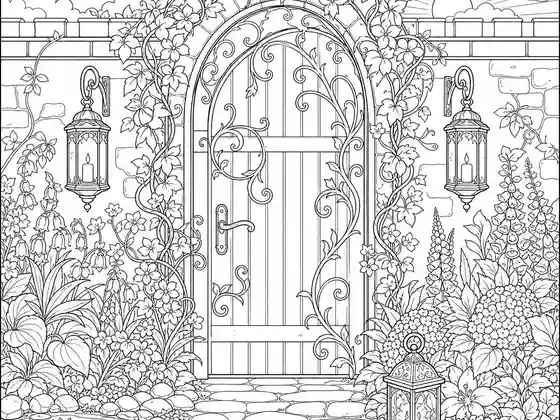
The difference between a kids' page and an adult page is not the subject, it is the line work. Adult pages have finer lines, denser detail, varied region sizes, and compositions that reward twenty minutes of quiet attention. Kids' pages have bold outlines and big open regions a crayon can handle. Four principles carry the adult style:
- Closed shapes everywhere. Every region must be fully enclosed by line work. Broken lines are the single most common complaint in coloring book reviews, because color has nowhere to stop.
- Pure black and white. No gray fills, no shading, no halftones. Gray prints muddy and steals the colorist's job.
- Varied region sizes. A good adult page mixes tiny detail areas with a few larger rest areas. Uniform density is exhausting to color.
- Single-sided printing in mind. Adult colorists use markers, and markers bleed through. Books are laid out with art on one side of each sheet.
There is also a deliberate exception to the intricacy rule: bold and easy books, thick-line low-density pages for seniors and colorists who want relaxation without eye strain. It is one of the fastest-growing shelves in the category and one of the emptiest, and it is covered in the niches guide.
Step 1: Pick a theme one notch more specific than feels safe
"Flowers" is a shelf; "Victorian greenhouse botanicals" is a book. "Mandalas" is a thousand competitors; "ocean life mandalas" is a collection with its own identity. The audience + subject + twist construction from the niches framework applies doubly to adult books, because adult buyers browse by mood and aesthetic, not by category. Validation costs ten minutes: search your exact phrase on Amazon, count the decent books answering it, and check whether the top results have recent reviews.
Step 2: Choose your creation route
There are three real ways to produce the pages, and they are not equal in effort.
Route A: Draw them yourself
The traditional route: pen and ink or a tablet, one page at a time. Full artistic control, and for artists with an existing style it is the point of the exercise. Budget 1 to 3 hours per finished page, so a 30-page book is a serious month of evenings. Consistency is free because every page comes from the same hand.
Route B: Convert photos to line art
Photo-to-sketch tools turn photographs into colorable outlines. Fast for single personalized pages (a pet portrait, a family photo), but weak for books: converted photos produce open lines and gray artifacts that violate the closed-shape rule, and thirty converted photos never feel like one designed collection.
Route C: Generate the book with AI
The route that did not exist when the older guides were written. An adult coloring book generator takes one prompt, plans every page as a distinct scene inside your theme, draws all of them as closed black-and-white line work in one consistent style, and assembles the book with a painted cover. A 20-page intricate book generates in under half an hour. The catch to respect: quality varies wildly between tools, most generate single pages rather than books, and you should always review every page before publishing, regenerating any that miss.
The honest comparison: Route A gives the most artistic identity at the highest time cost, Route B suits one-off personalized pages, and Route C is the only route where a complete, consistent 30-page book is an evening's work instead of a month's.
Step 3: Plan pages as one collection
A book reads as designed when its pages are varied but related. Before creating anything, list every page as a one-line scene: "moonlit rose arch", "dewdrop spiderweb", "stone fountain ripple". Thirty distinct scenes in one world beats one great scene repeated with variations. If you generate the book, this plan is produced for you and is editable before anything draws; if you draw it, the list is your production schedule.
Step 4: Assemble at the right specs
Adult coloring books live at 8.5" x 11", the standard trim on Amazon KDP. The assembly rules that matter:
- Art pages single-sided, with the back of each sheet blank or a light pattern, because markers bleed.
- 24 pages minimum for a KDP paperback; 20 to 50 illustrations is the category norm.
- 300 DPI art for print sharpness.
- No text over the art. Captions and titles belong on their own lines or nowhere; nobody wants words inside the picture they are coloring.
- A full-color cover, because the cover sells the book while the interior is the product.
Doing this manually means a design tool and an afternoon of layout; a book generator exports the assembled PDF at trim size directly.
Step 5: Choose your fork: KDP, Etsy, or home printing
Amazon KDP paperback
The volume route. Amazon prints and ships on demand; a black-ink paperback of up to 110 pages costs a flat $2.84 to print at the 8.5" x 11" and 8.5" x 8.5" coloring trims, and royalties run 60% of list price at $9.99 and above (50% below), which is exactly where intricate adult books naturally price. Amazon requires AI-generated content to be disclosed during setup, and disclosure does not block publishing; the full policy walkthrough is in the KDP AI disclosure guide, and the coloring-specific requirements are in selling AI coloring books on KDP. Leave the Low-content box unticked: KDP lists coloring books as not generally low-content, as our low-content books guide explains.
Etsy or Gumroad printable
The margin route. The same PDF sells as a digital download with no printing cost at all, so nearly every dollar is margin, and buyers print the pages they like as many times as they like. Etsy printables and KDP paperbacks are not either-or: the same book earns on both shelves, and the Etsy guide covers the listing mechanics. The Etsy, Gumroad and export screens are clicked through one by one in the cozy coloring book video, if you would rather watch them than read them. Which files to put in the download, and how to name them so Etsy accepts them, is in selling coloring books as printables.
Print at home
For gifts, classrooms, or your own coloring: print single-sided on 60 to 70lb paper if colorists will use markers, or standard paper for pencils. A home-printed, spiral-bound book of your own themed pages is a genuinely lovely gift at the cost of a coffee.
The pricing ladder, briefly
Production cost is flat across styles; list price is not. A $7.99 kids book pays roughly $1.16 per KDP sale, while a $12.99 intricate adult book pays about $4.95, the same generation effort at more than four times the royalty. Cross the $9.99 threshold and the royalty rate itself jumps from 50% to 60%. Run your own numbers in the royalty calculator before you pick a price, and always confirm current printing rates in your KDP dashboard.
Common mistakes to skip
- Inconsistent line weight across pages, the tell of pages made one at a time in different sessions or tools.
- Gray shading, which prints muddy and reads as unfinished.
- Near-duplicate pages, the fastest route to a one-star review; plan distinct scenes.
- Generic titles: "Adult Coloring Book Vol. 1" competes with everything. Name the world instead; the title generator helps.
- Skipping the outline review: whether drawn or generated, fixing the page plan costs minutes; fixing finished pages costs the evening.
Frequently asked questions
How many pages should an adult coloring book have?
24 to 50 art pages is the category norm. 24 is Amazon KDP's paperback minimum; digital downloads can be any length, and shorter themed collections do well on Etsy.
How long does it take to make one?
Drawing by hand: expect a month of evenings for 30 pages. Generating with AI: a complete consistent book in an evening, including reviewing and regenerating a few pages. Photo conversion sits between but produces the weakest books.
Do adult coloring books still sell in 2026?
Yes: the category has steady year-round demand with a Q4 gift-season peak, and market analyses put North American adult coloring sales in the hundreds of millions of dollars annually. The saturated part is generic content; specific themed books keep finding their buyers.
Can I use AI-generated pages commercially?
Check your tool's license: several page generators restrict output to personal use or reserve commercial rights for top-priced tiers. Inkfluence AI's Terms of Service say you keep all rights, title and interest in the content you create, with no exception by plan, and Amazon's only extra requirement is the AI-content disclosure at setup.
What paper and printing settings matter?
For KDP: black-and-white interior, white paper, 8.5" x 11", single-sided art layout. For home printing with markers: 60 to 70lb paper, single-sided.
Start with the theme. One sentence, one notch more specific than feels safe, and by tonight you can be looking at a finished book: the adult coloring book generator handles the plan, the pages, the cover, and the print-ready PDF from that one sentence.

Founder, Inkfluence AI
Sam is the founder of Inkfluence AI. He built the platform to make book creation accessible to everyone - from first-time authors to seasoned publishers.
Helpful links
Ready to Create Your Own Ebook?
Start writing with AI-powered tools, professional templates, and multi-format export.
Get Started FreeRelated Articles
 Selling
 How Much Can You Make Selling Printables on Etsy? Fees, Real Numbers and a Calculator (2026)
What one printable sale keeps after Etsy's fees, compared with Gumroad and KDP, what Etsy's own annual report says about shop sizes, our data on 2,921 books listed by 473 authors, and a calculator for your own prices.
 Publishing
 Is KDP Worth It in 2026? An Honest Verdict by Book Type
A dated verdict for novels, non-fiction, picture books, coloring books, journals and family books: what changed on KDP in 2026, what publishing really costs, what most authors earn, when Etsy, Gumroad or going wide fits better, and a checklist that picks the route for your book.
 Publishing
 Do Low-Content Books Still Make Money in 2026? Journal and Coloring Book Income, Worked Out
What journals, notebooks, planners and coloring books really earn on KDP in 2026: royalty per copy by trim, pages and price, why most titles sell few copies, the two-a-week limit, the rules that cut income, and where the money still is, with an estimator.
Get ebook tips in your inbox
Join creators getting weekly strategies for writing, marketing, and selling ebooks.