
How to Sell AI-Generated Books on Etsy in 2026 (The Complete Playbook)
Etsy allows AI-generated ebooks if you disclose properly. A complete walkthrough of the policy, pricing, niches, the exact disclosure dropdowns, and how Inkfluence AI gets your ebook listed on Etsy in one click with everything pre-filled correctly.
Quick Answer
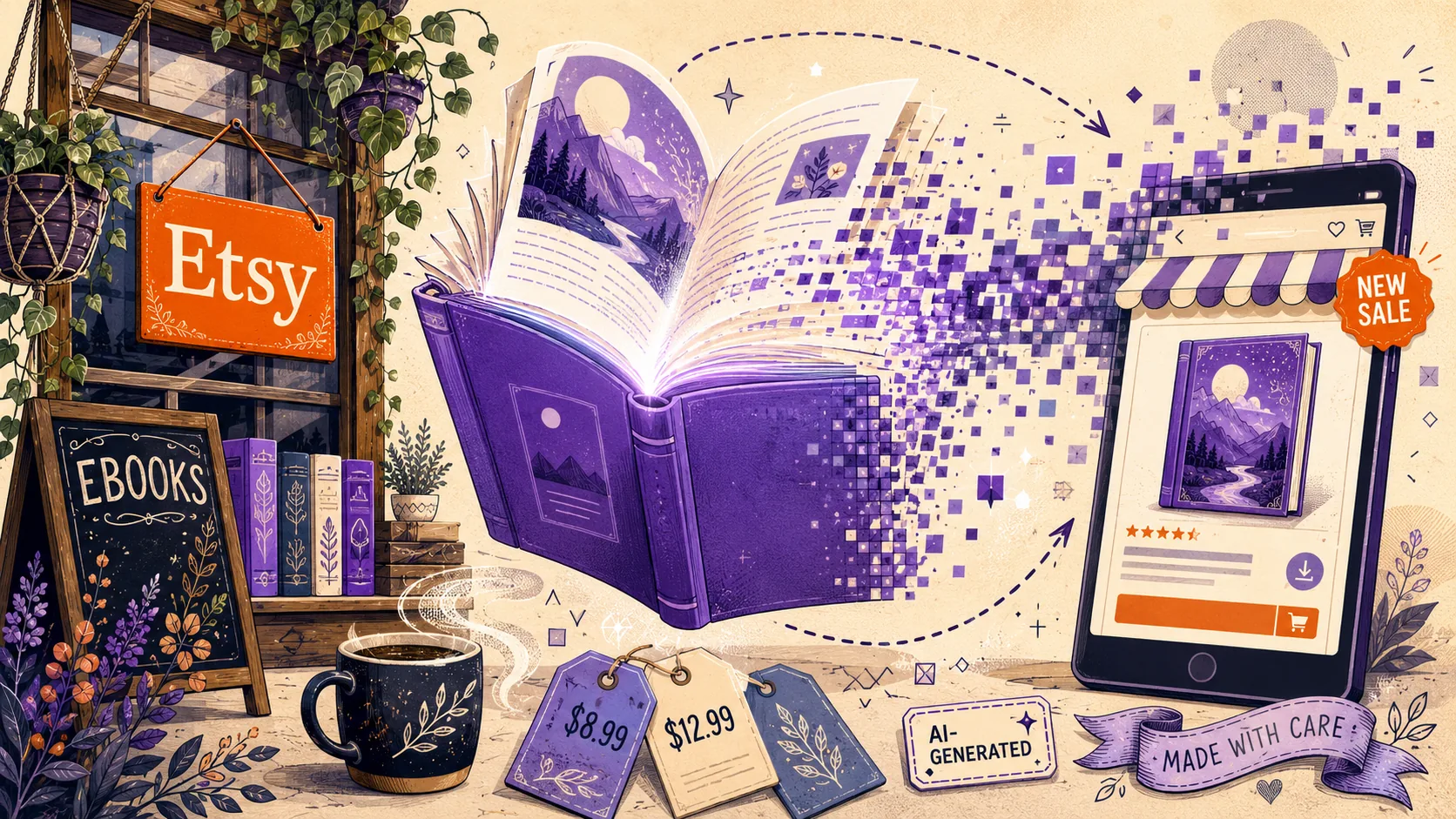
Yes, you can sell AI-generated ebooks on Etsy in 2026. Under Etsy's Creativity Standards, AI-generated items must be categorized as "Designed by a seller" and the AI assistance must be disclosed in the listing description. Beyond that there is no exclusivity, no royalty cut beyond standard fees ($0.20 per listing + 6.5% per sale + 3% + $0.25 payment processing), and no special review process. Inkfluence AI writes the book, designs the cover, sets the production fields correctly, and auto-appends an AI disclosure line to the description before publishing to your Etsy shop in one click.
By Sam May, founder of Inkfluence AI · Updated August 2026
Why this matters now
Etsy's digital-download category is the fastest way to start selling ebooks without a platform.
You don't need an audience. You don't need a newsletter. You don't need to figure out Amazon KDP's categorisation maze or pay a designer for a cover. Etsy buyers are already searching for ebooks, journals, devotionals, recipe collections, and printable workbooks. They pay because Etsy is a discovery-first marketplace, not a "you need to drive traffic yourself" platform like Gumroad.
This guide covers exactly what Etsy allows, how to disclose AI correctly so your listings don't get flagged, which ebook niches actually sell on Etsy in 2026, real pricing data, and how to publish your first listing in under five minutes using Inkfluence AI.
86.6M¹
Active Etsy buyers (Q1 2026)
$0.20²
Per-listing fee (lasts 4 months)
6.5%²
Transaction fee per sale
$5-15³
Typical price band for digital ebooks
Inkfluence is the only AI ebook tool with native Etsy publishing built in. Other AI writers stop at "here is your PDF, good luck uploading it somewhere." We write the book, design the cover, generate the title, description, and tags, auto-append the AI disclosure line, and create the listing in your Etsy shop as a draft in under a minute; you give it a final look, tick the AI disclosure dropdown, and activate. Everything below assumes you either use Inkfluence (one-click) or do it manually (the 5-minute Etsy upload form). Either way, the rules are the same.
Why selling AI ebooks on Etsy is a real opportunity in 2026
For most of the last decade, the default advice for selling ebooks was "build an audience first, then sell to them." That works if you already have a newsletter, a podcast, or a social following. It does not work if you are starting from zero.
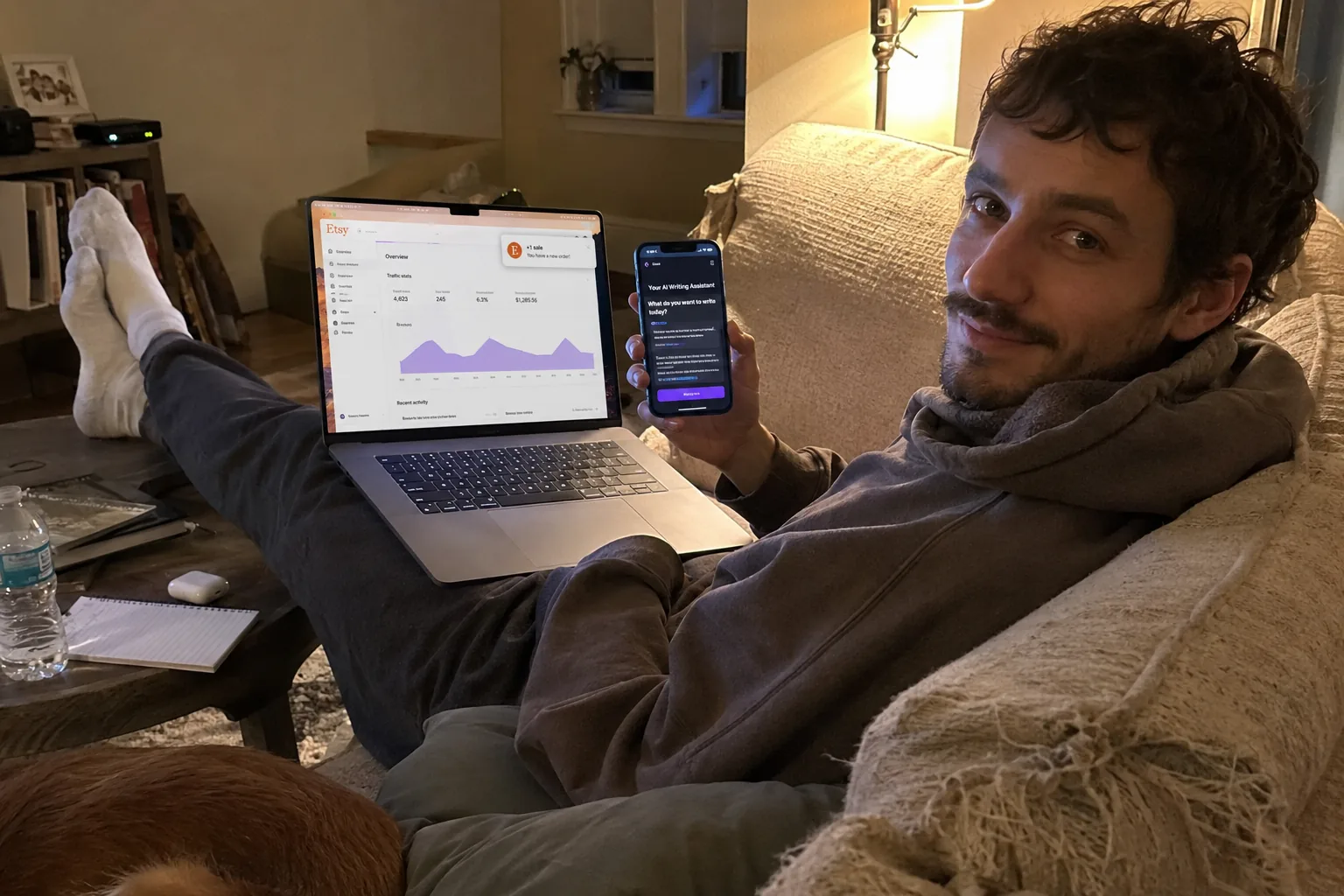
Etsy flips that model. It is a search-driven marketplace with 86.6 million active buyers (Q1 2026) who arrive already searching for things to download and print: planners, journals, devotionals, kids activity packs, recipe collections, niche guides. They are not browsing your homepage. They are searching "anxiety journal printable" or "gratitude workbook" or "ADHD planner ebook" and Etsy decides which listings to show them. If your listing matches the query and the cover catches their eye, you make a sale, even if you have zero followers anywhere.
Three structural reasons this works particularly well right now:
1. Digital downloads are one of Etsy's strongest categories
Etsy's active buyer count is down slightly year-over-year (86.6M in Q1 2026 vs 89.2M in 2025), but spend per buyer has been growing, and digital downloads outperform on both counts. Buyers love them because there is no shipping wait, no risk of damage, and instant gratification. Sellers love them because there are no production costs, no inventory, and no fulfilment work after the first upload.
2. AI ebooks are not yet saturated on Etsy
There are millions of physical ebook listings on Amazon KDP. On Etsy, the AI ebook category is still genuinely thin in many niches. You can find sub-niches where the top three competitors have under 200 sales each, which means winning visibility is achievable in weeks, not years.
3. Etsy buyers expect to pay for digital products
This is huge and overlooked. Amazon KDP buyers compare your $4.99 ebook against the entire library of Kindle Unlimited freebies. Etsy buyers compare your $9.99 journal against handmade planners that cost $25. The price ceiling is genuinely higher.
4. Repeat purchases are common
Etsy buyers who like your gratitude journal will buy your anxiety workbook three months later. Amazon book buyers rarely come back for more from the same author unless you are running a series. Catalogue depth on Etsy compounds.
None of this means Etsy is a magic money machine. It means the structural conditions for selling AI ebooks on Etsy are unusually favourable in 2026, and they will not stay this way forever as more sellers notice. The window is open right now.
Is it actually allowed? Etsy's AI policy in plain English
Yes. Etsy explicitly permits AI-generated content in their Creativity Standards⁴, with three conditions:
- You disclose that AI was used in the creation process.
- You list yourself as the "designer" (the person who directed and edited the AI output).
- You do not infringe on copyrighted characters, names, or styles.
That third one matters. An AI-generated romance novel is fine. An AI-generated Harry Potter fan-fiction novel is not. The rule is not about AI specifically. It is about IP, which applies whether a human or an AI writes it. The same applies to using AI to generate images "in the style of" a famous living illustrator. Etsy will flag both. If you plan to sell the same book beyond Etsy, can you sell AI-generated books compares the AI rules of ten platforms.
Etsy treats AI-generated digital downloads the way they treat handmade goods. You have to be honest about how they were made. The platform is not trying to ban the category. They are trying to keep buyers informed so the marketplace stays trustworthy.
The short version
If you wrote the prompt, directed the output, edited the result, and chose the cover, you are the designer. AI was your tool. Disclose it. List it. Sell it.
Worth noting: Etsy's policy here is more permissive and clearer than most marketplaces. Amazon KDP also requires AI disclosure but does not surface it to buyers in the same way. Apple Books has been gradually tightening. Etsy is currently the most explicit and the most predictable, which is part of why it is the safer place to learn the ropes of selling AI content.
How to disclose AI on every listing
Etsy's disclosure has two parts. First, three production fields you set in the listing form. Second, an explicit AI mention in the listing description. Here is what each looks like:
Step 1: Production field "Who made it?"
Select I did. You directed the work, you own the listing. (Inkfluence sends this automatically as who_made=i_did when publishing.)
Step 2: Production field "When was it made?"
Select Made to order for a fresh ebook (each buyer downloads a copy of the master file). Use Made within the last year if you genuinely have a backlog of older ebooks.
Step 3: Production field "Is this a finished product or a supply?"
Set this to a finished product (Etsy stores it as is_supply=false). Ebooks are finished products, not raw materials.
Step 4: AI disclosure in the listing description (this is the important one)
Etsy's Creativity Standards require AI-generated listings to be categorized as "Designed by a seller" and to explicitly disclose AI use in the listing description. A simple line at the bottom of your description is enough. For example:
"Created with AI assistance. Edited and finalized by the seller."
Inkfluence's Etsy publish flow auto-appends a short disclosure line to your description for you. You can edit or remove it before publishing if you want different wording, but having something there is what keeps your listing safe.
If you publish through Inkfluence's Etsy integration, the three production fields are set correctly via the API and the AI disclosure is appended to your description automatically. You never have to remember the policy text or worry about getting flagged. Etsy's Creativity Standards tightened on June 10, 2025, with explicit new rules for digital downloads and AI-generated items, and sellers report stricter enforcement in 2025-2026 (including occasional false-positive flags on properly-disclosed listings). Having disclosure language in the description is the easiest way to stay safe.
How Inkfluence makes the whole thing actually easy
This is where the comparison to "just use ChatGPT and upload manually" falls apart. ChatGPT will write you a 10,000-word document. Now you have to format it as a book (chapters, page breaks, table of contents), design a cover (and Etsy is a visual marketplace, so the cover is doing 80% of the work), export it as a clean PDF, write the listing title and description, pick 13 tags, fill in the three production dropdowns correctly, set a price, upload everything, and pray Etsy's algorithm notices.
Inkfluence does all of that for you. Here is what the full workflow actually looks like:
1. Tell us what your book is about (60 seconds)
Type a sentence like "30-day gratitude journal for new moms" or "anxiety workbook with CBT techniques." Inkfluence builds the outline, picks the chapter structure, and gets ready to write.
2. Generate the full book (5-15 minutes)
Every chapter is written in parallel with your tone, audience, and goal baked in. You get a complete first draft, ready to review and edit.
3. Design a cover that actually stops the scroll (2 minutes)
Our cover designer has 30+ fonts, AI background generation, drop caps, layouts proven to convert on marketplaces. Title and author baked in. No Canva required. No paying a designer $50.
4. Export as a print-ready PDF (one click)
Properly formatted with table of contents, drop caps, chapter dividers, page numbers. Looks like a $39 book you would buy from a real publisher. Free tier exports PDF; paid tiers add EPUB, DOCX, and KDP paperback.
5. Click "Publish to Etsy" (literally one click)
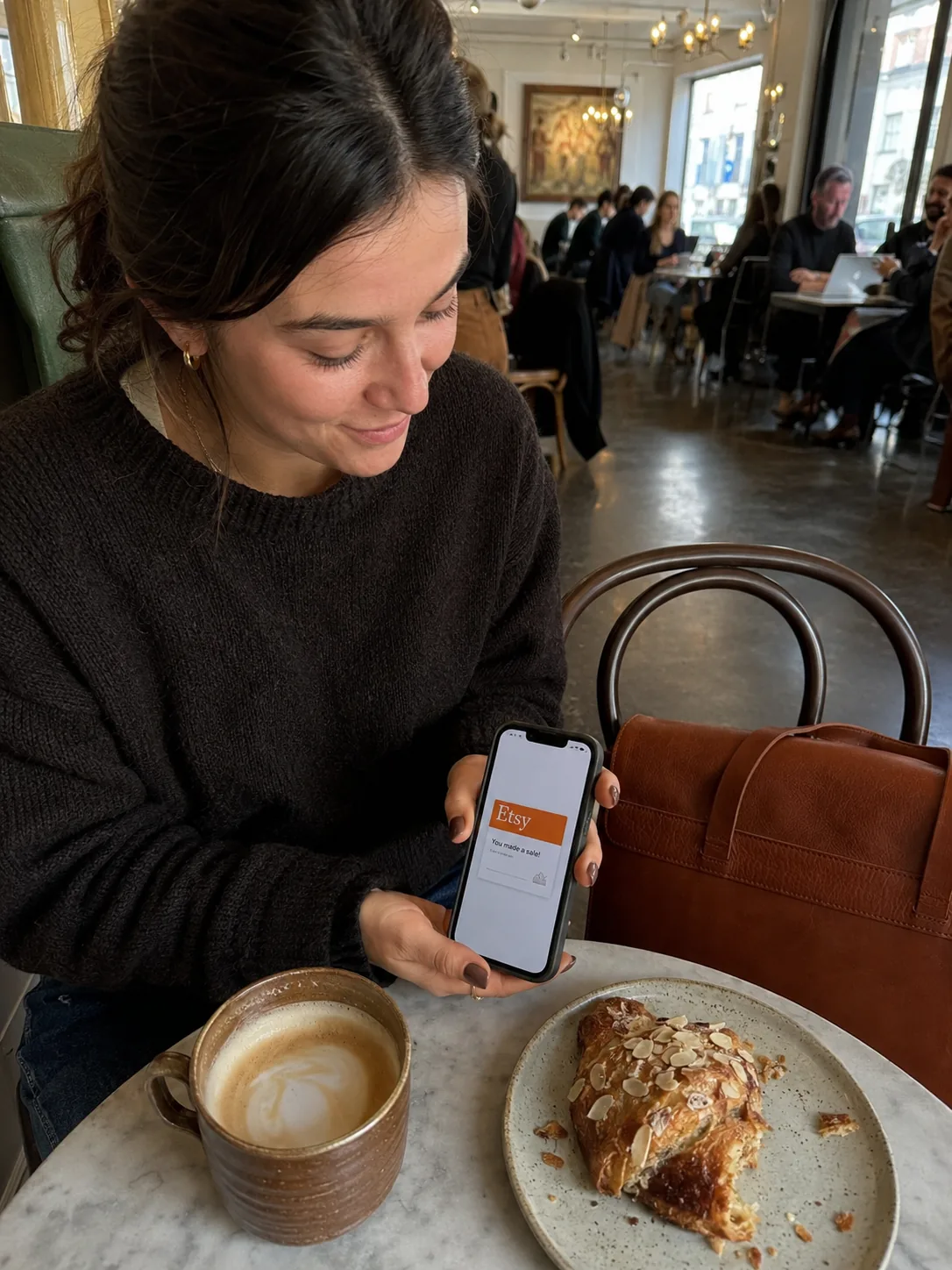
First time you do this, you authenticate your Etsy shop via OAuth (30 seconds). After that, every future book is genuinely one click. We pre-fill the title, description, suggested price, and 10 SEO tags (Etsy allows 13, so you can add 3 more by hand), and auto-append the AI disclosure line to the description. The listing arrives in your shop as a draft: review it, tick 'With an AI generator' under How it's made, and activate.
The total time from "I have an idea" to "my ebook is live on Etsy" is typically under 30 minutes on the first book. By the third book you will do it in 15. By the tenth you stop thinking about it as a workflow because it is just a habit.
Compare that to the manual path: brainstorm topic, write 10,000 words yourself (10-30 hours) or wrestle ChatGPT into producing it (still 4-8 hours of prompt iteration), open Canva to design a cover (1-3 hours if you are not a designer), format the document in Word or Google Docs and export it cleanly (1-2 hours), open Etsy and fill in the listing form (45 minutes the first time, 15 after). You get to the same place. It just takes 20x longer.
The Etsy publish integration is included in both Creator and Premium plans. See pricing here. The free tier lets you write up to 5 chapters per month, perfect for testing a niche before committing.
Best AI ebook niches for Etsy in 2026
Etsy buyers are not searching for "novels." Different platform, different intent. Etsy shoppers want specific, useful, gift-worthy, or aesthetically beautiful digital products. The ebook niches that consistently sell:
📓 Guided journals & workbooks
Price band: $5-12. Gratitude journals, anxiety workbooks, manifestation guides, ADHD-friendly planners, shadow-work prompts, therapist-style worksheets. Buyers want prompts plus structure they can use, not a 200-page novel. Inkfluence's workbook content type is purpose-built for this.
🙏 Devotionals & faith-based readers
Price band: $7-14. 30-day, 60-day, 90-day reading plans. Highly repeat-purchase category. Buyers collect them and gift them. Christian, Catholic, and broad-spiritual variants all sell well. Use the devotional content type for the right daily-entry structure.
📚 Kids printable activity books
Price band: $4-9. Reading comprehension packs, handwriting practice, story collections for specific age bands, summer activity books, "Bible verses for kids" colouring journals. Parents pay $5-9 happily for niche content their child will actually use.
💼 Business "playbooks" & guides
Price band: $15-29. Etsy shop owner guides, Instagram growth playbooks, AI prompt collections, freelancer onboarding kits, Pinterest strategy ebooks. Niche-specific is the winner. "Marketing for dog groomers" beats "marketing for everyone." Buyers treat this as a course alternative at one-tenth the price.
🎁 Holiday & seasonal
Price band: $6-12. Advent reflection guides, summer reading lists, "100 things to do before Christmas" planners, New Year goal-setting journals. Strong seasonal demand spikes. List 6-8 weeks before the season starts.
📦 Niche bundles
Price band: $19-39. "5 cozy mystery novellas for autumn," "Self-care ebook bundle," "Romance starter pack." Higher AOV than single books, bundles signal value, and they let you discount existing books without changing their individual price.
Travel guides belong on the list as well. A named trip ("a long weekend in Lisbon for first-time visitors") is exactly what an Etsy shopper types, and a guide with a dated fact check and real listing photos stands out among generic city guides. How to sell travel guides covers the titles, the photos and the per-sale fees.
What does not work as well on Etsy: literary fiction novels (Amazon's territory), generic "how to start a business" books (saturated), and anything that competes directly with Amazon KDP at scale. Etsy buyers want specific and aesthetic. Go niche, not broad. For a deeper niche breakdown, see our digital product niches guide and the low-competition ebook niches list.
Pricing strategy (and why most sellers price too low)
The single biggest mistake new Etsy ebook sellers make is pricing at $2.99 or $4.99 because "it is just a PDF." Etsy buyers are not comparing your price to Amazon KDP. They are comparing it to handmade goods, planners they would buy at a stationery shop, or a paid course module. Underpricing actively hurts you in two ways: buyers assume cheap means low quality, and the Etsy algorithm deprioritises low-revenue-per-click listings.
Real price points that work on Etsy in 2026:
| Product type | Sweet spot | Why |
|---|---|---|
| Short guided journal (30 prompts) | $5-8 | Impulse-buy band, low decision friction |
| Devotional or 30-day plan | $7-12 | Buyers expect higher price for structured content |
| Full ebook or novella (50+ pages) | $9-15 | Compared to a paperback this still feels cheap |
| Niche business playbook | $15-29 | Buyers treat this as a course alternative |
| Bundle (3-5 ebooks) | $19-39 | Higher AOV, signals value, easier to discount |
After Etsy's fees ($0.20 listing fee + 6.5% transaction fee + 3% + $0.25 payment processing for US sellers), a $10 sale nets you about $8.30. Compare that to Amazon KDP's 70% royalty on a $9.99 ebook, which works out to roughly $6.84 on a 1MB text ebook after the $0.15/MB delivery fee (and less on larger files), and Etsy actually pays you more per sale for the same price point. For higher-priced ebooks ($15+), the gap widens because KDP's royalty rate drops to 35% outside the $2.99-$12.99 sweet spot, while Etsy's fees stay flat as a percentage at any price.
One more pricing trick most new sellers miss: Etsy lets you offer a "sale" price that is visibly discounted from a higher original. Listing at $14.99 "on sale for $9.99" converts better than a flat $9.99, because the buyer sees they are saving 33%. This is a built-in Etsy feature, not a marketing trick.
Three ways real sellers use this
Different goals, different strategies. Pick the one closest to what you actually want:
The side-hustler: 1 ebook a month, steady side income as the catalogue grows
You have a full-time job and 3-5 hours a week to invest. Goal is supplementary income.
Strategy: Pick one niche cluster (e.g. "anxiety workbooks for adults"), publish one new ebook per month, keep them themed so buyers who like one buy another. After 6 months you have 6 listings working for you 24/7.
Workflow: 90 minutes per month total, mostly review and edit time. Inkfluence handles generation, cover, export, and Etsy publish.
The niche specialist: 5-10 ebooks in one micro-niche
You want to dominate one specific Etsy search cluster.
Strategy: Pick a sub-niche (e.g. "ADHD planners for women," "low-content kids activity books for ages 6-8," "manifestation journals"). Publish 5-10 variations covering different angles, formats, and length. Cross-link them in each listing's description ("Customers also liked..."). Bundle 3-5 of them for an upsell.
Workflow: Heavy upfront (5-10 books in 2-4 weeks), then steady passive income. Eventually one strong niche with 8-12 listings can carry a meaningful monthly income; catalogue size is the strongest predictor anyone can honestly point to.
The trend-rider: seasonal & reactive
You want to capitalise on spikes (back-to-school, Q4 holidays, New Year, summer).
Strategy: Notice a trend forming. Generate a relevant ebook in 30 minutes. Publish before anyone else. Ride the spike for 2-8 weeks, then keep the listing live for the long tail. Repeat for the next trend.
Workflow: 30 minutes per ebook, but timing is everything. The speed of generation is the differentiator. Hand-written ebooks cannot compete on turnaround time.

Scaling from one listing to a real catalogue
Your first listing matters less than you think. The Etsy algorithm rewards active shops with depth, not single perfect listings. Most sellers who say "I tried selling on Etsy and it did not work" tried with one listing for two weeks and gave up. Here is the realistic progression:
Listings 1-3: testing
Sales will be slow. The point is to learn the workflow, see which niche resonates, get the first few reviews. Run $1-3/day Etsy Ads on each listing for the first 30 days to bootstrap visibility.
Listings 4-7: finding your sweet spot
You should see which niche or format is converting. Double down on it. Drop the underperformers (do not delete; just stop promoting them). Most sellers report the first meaningful traction here.
Listings 8-15: the catalogue compounds
Etsy's algorithm now treats your shop as established. Returning buyers exist. Buyers add multiple items to one cart. You start showing up in "Customers also bought" sections on other people's listings. Revenue per new listing increases.
Listings 16+: optional but profitable
At this point, every new listing is incremental revenue on top of a working baseline. Some sellers stop here and let the catalogue earn passively. Others scale to 30-50+ listings across multiple niches.
The math: at an average $1.50/listing/month (realistic for a well-niched shop), 20 listings = $30/day = $900/month passive. Not life-changing, but it pays a car, a mortgage, or fully covers a side budget. The compounding only happens if you keep listing. The shop that publishes 1 ebook a week for a year ends up with 50 listings. The shop that publishes 1 ebook and waits ends up where it started.
This is also where Inkfluence's speed becomes the real moat. A hand-written ebook takes 20-40 hours. With Inkfluence, you can realistically publish a new ebook every Sunday afternoon. After 12 months, you have a 50-listing catalogue. Try doing that without AI assistance.
5 mistakes that get AI ebook listings flagged
-
1. Skipping the "With an AI generator" disclosure
Etsy's automated moderation flags listings that look AI-generated but do not disclose. Their detection has gotten significantly better in 2025-2026. Disclose every time. Inkfluence auto-appends the disclosure line to your description, but the 'With an AI generator' dropdown on the Etsy listing is always your tick: do not skip it.
-
2. Using copyrighted characters or franchises
"AI-generated Marvel fan fiction" is an instant removal. Same for Disney, Hogwarts, Star Wars, anime IP, anything from a major studio. AI does not change copyright law. Use original characters and worlds.
-
3. Pricing at $1.99 to "compete on price"
Buyers assume cheap means low quality. Listings under $5 also trigger Etsy's algorithm to deprioritise you (low absolute revenue per click). Price for value, not volume. Even short journals should start at $5.
-
4. Generic stock-photo covers
Etsy is a visual marketplace. A generic cover with a Shutterstock photo and Times New Roman title will not sell, even at the right price. Use Inkfluence's cover designer (free) or hire an illustrator. Covers are the single biggest CTR driver on Etsy.
-
5. Listing one ebook and hoping
Etsy rewards active shops. Sellers with 5-10 listings get meaningfully more visibility than single-listing shops. Plan to release a small catalogue, not a single product. This is the #1 reason sellers "fail" on Etsy: they give up after one listing.
FAQ
Is it really legal to sell AI-generated books on Etsy?
Will Etsy ban my shop for selling AI ebooks?
What's the difference between Etsy and Amazon KDP for AI ebooks?
How fast do Etsy ebook listings start selling?
Do I need an Etsy shop before I can publish from Inkfluence?
Can I sell the same ebook on Etsy, Gumroad, and Amazon KDP simultaneously?
How many ebooks should I list before expecting consistent sales?
Can I use AI-generated cover images on my Etsy listings?
What about Etsy Pattern, Pinterest, and external traffic?
Does Inkfluence charge anything per Etsy listing?
What to read next
Sell ebooks on Etsy: the complete guide
Deep walkthrough of fees, schemas, the one-click publish flow, and what differentiates Etsy from KDP.
Inkfluence AI for Etsy sellers
Persona page: niches, the weekly workflow, side-hustle math, scaling to 5-10 listings.
Best digital product niches for 2026
Data-driven niche guide on where the demand is, what sells, and what to avoid.
Gumroad vs Amazon KDP for ebook sellers
Decision-stage comparison: fees, audience, marketing, and why you would pick one over the other.
Ebook ideas that actually sell in 2026
100+ ebook concepts with demand signals, suggested price points, and platform recommendations.
Sell ebooks on Gumroad
If you have an existing audience, Gumroad may convert faster than Etsy. Full setup guide here.
Sources & references
- Etsy Investor Relations, Q1 2026 10-Q filing (active buyer count 86.6M, March 31 2026). investors.etsy.com
- Etsy Help Center, "Fees and taxes on Etsy" ($0.20 per listing / 4-month duration, 6.5% transaction fee). help.etsy.com
- Etsy seller market data; common pricing surveys for digital downloads across the ebook, planner, and journal category, 2025-2026.
- Etsy, "Creativity Standards" (the official AI disclosure policy, updated June 10, 2025 with explicit rules for digital downloads). etsy.com/legal/creativity
- Etsy Help Center, "What are Payment Processing Fees for Selling on Etsy" (3% + $0.25 per US transaction). help.etsy.com
- Amazon KDP, "eBook Royalties" (70% band $2.99-$12.99, 35% outside, $0.15/MB delivery fee). kdp.amazon.com

Founder, Inkfluence AI
Sam is the founder of Inkfluence AI. He built the platform to make book creation accessible to everyone - from first-time authors to seasoned publishers.
Helpful links
Ready to Create Your Own Ebook?
Start writing with AI-powered tools, professional templates, and multi-format export.
Get Started FreeRelated Articles
 Selling
 Why Recurring AI Affiliate Programs Beat One-Time Payouts in 2026
The math behind why recurring commission affiliate programs build sustainable income while one-time payouts produce volatile spikes. Worked examples at three retention scenarios, where recurring breaks even, and how to spot programs that pay out consistently.
 Selling
 How to Write Affiliate Content That Ranks for AI Tools in 2026
A practical guide to writing AI-tool affiliate content that actually ranks on Google in 2026. Keyword strategy, post structure, internal linking, citations, AI-citation optimization, and refresh cadence.
 Selling
 How to Make Money Promoting AI Tools in 2026
A grounded guide to earning real money from AI tool affiliate programs in 2026. Revenue models, where to find programs, content that actually converts, realistic earnings at three traffic tiers, and the mistakes that quietly kill payouts.
Get ebook tips in your inbox
Join creators getting weekly strategies for writing, marketing, and selling ebooks.