
Can AI Write Real Poetry? An Honest Answer for Indie Poets in 2026
The skeptical answer is "no, it just produces a heartless approximation of what is popular." That answer is partly right and mostly out of date. Here is the honest framework for when AI poetry works, when it does not, and how to use it without producing the bland mush the critics warn about.
Quick Answer
Yes, AI can write real poetry, but the answer is conditional. Form-aware generation in 2026 produces structurally correct sonnets, villanelles, haiku, and ghazals that did not exist three years ago. Free verse is harder; AI tends to produce competent-but-generic free verse unless the poet adds specificity, voice, and personal reference during refinement. The poets shipping books that sell on Kindle in 2026 use AI as a draft engine and themselves as the editor, not the other way around. The "AI poetry is bland mush" critique is fair when applied to first-draft, prompt-only, no-editing output. It is not fair when applied to AI-assisted poetry that has gone through a real editorial pass.
Why this matters
The argument is not "is AI poetry good." It is "what is AI for, in a poet's workflow."
The poetry community has been louder than most creative communities about its skepticism toward AI. Reddit's r/Poetry subreddit calls AI-generated poetry "bland mush" and "heartless approximation of what's popular." A widely-discussed 2024 study published in Scientific Reports claimed that AI-generated poetry was rated more favourably than human-written poetry by general readers, and the response from working poets was overwhelmingly negative.
Both reactions point to something real. The skeptics are right that prompt-only AI output reads as competent generic. The study is right that general readers cannot tell the difference. The synthesis the working poet needs is: AI is a draft engine, not a finished-product engine. This guide covers what AI does well in 2026, what it still does badly, and how to use it without producing the work the critics are warning about.
The critique, steel-manned
If you only read the headlines, the case against AI poetry sounds defensive. Read the actual r/Poetry threads and the working-poet response to the 2024 Scientific Reports study, and the critique is more substantive. The four serious arguments:
- Pattern-matching is not making. Most AI poetry is statistically average across the corpus it learned from. The result reads as "what poetry sounds like" rather than as a specific poem. A poem reads as itself when it is built from one person's specific experience, not from the median of every poem on the internet.
- The hardest moves in poetry require the poet's body. A line break that lands because of where the breath ends. An image that surfaces because of a specific moment the poet lived through. Sound work that comes from the poet's own ear. AI does not have a body, a breath, an ear; it has training data.
- Workshop voice is bad voice. The 2024 study showed AI poetry rated MORE favourably than human poetry by general readers, which sounds like a win for AI but is closer to a loss for poetry. The AI was being preferred because it was more readable, more generic, less risky. Working poets read this as: AI poetry is winning because it has been trained to please, and pleasing is not what poetry does at its best.
- Disclosure is not enough. Even when AI poetry is labelled, readers may grant it the same credit as human-written work, which dilutes the value of the labour and craft that went into actual handmade poems. This is closer to a market argument than an aesthetic one, but it is the argument that has driven the loudest pushback.
Three of the four are real. The fourth is partly real. None of them rule AI out of a working poet's toolkit; they shape how it should be used.
What changed between 2023 and 2026
The honest answer to "can AI write real poetry" depends heavily on which AI you mean and what year. The 2023 baseline (early ChatGPT, generic prompt → generic output) earned every word of the bland-mush critique. The 2026 reality is meaningfully different in three specific ways:
1. Form-aware generation. A 2023 prompt for "write a sonnet about loss" returned 12-16 lines of poetry-shaped text, often with no rhyme scheme, often without the closing-couplet turn. A 2026 form-aware generator (the kind built into Inkfluence AI's poetry blueprint) enforces line counts and structural rules at generation time. A sonnet really lands at 14 lines with three quatrains and a closing couplet. A villanelle really repeats its refrains. A haiku really has 5-7-5 syllables. The structural failure mode is gone.
2. Specificity-rich prompting. The bland-mush AI poems are the ones generated from one-line prompts. The 2026 poet who supplies a specific image or moment ("a poem about the year after my mother died, anchored on her empty third chair at the kitchen table") gets meaningfully different output than the poet who types "write a sad poem about loss." The instruction layer matters more than people realise. AI generation rewards the poet who can frame their own experience precisely.
3. Refinement workflows. First-draft AI output should never be the final poem. The poets shipping books in 2026 generate a draft, then refine line by line, often regenerating specific lines that fall flat, often replacing AI-generated specifics with their own lived specifics. The selective replacement matters: a poem with even three or four genuinely-the-poet's lines reads as the poet's poem, not the AI's. The Inkfluence editor's "Improve" tool refines selected passages without rewriting unselected ones, so the poet keeps every line they want intact.
What AI poetry does well in 2026
- Formal forms. Sonnets, villanelles, haiku, ghazals. The structure is enforceable; the AI lands the line count, the rhyme scheme, the refrain pattern. A first-draft sonnet on a topic is genuinely usable as a starting point.
- Concrete imagery on assigned themes. Given a specific anchor ("the kettle that whistles too long", "the chipped mug", "the third chair"), AI produces evocative imagery that the poet can refine.
- Collection structure. Planning thematic sections, ordering poems, identifying gaps in an arc. AI is genuinely useful as an editorial collaborator at the structural level.
- Translation drafts. Bilingual poets often use AI for first-pass translation and refine by hand. The structure-preserving translation is reasonable in 2026.
- Form variation. When the poet wants to try a villanelle but does not yet know the form well, AI produces a structurally correct example to learn from. Educational use.
Where AI poetry still falls short
- Voice. AI does not have one. Voice in poetry is what makes a Mary Oliver poem unmistakable from an Ocean Vuong poem from a Maggie Smith poem. The reader recognises the poet from the line. AI output, even good AI output, does not have this signature unless the poet imposes it during editing.
- The hardest line breaks. The line break that lands because of where the human breath ends, or because of an emotional pause the poet felt. AI line breaks are competent but rarely revelatory.
- True specifics from lived experience. A poem about your mother's funeral has details only you know, the smell of the carpet at the church, the specific brand of cracker on the reception table. AI cannot produce these because it never lived them. The poet must add them.
- Sustained obsession. Some forms (villanelle, ghazal) work because the poem keeps coming back to the same word from different angles. AI is good at the structure but not always at the obsessive depth, the why-does-this-word-keep-arriving feeling that drives the form.
- Performance forms. Slam poetry, spoken-word with specific vocal cadence. The form lives in the body and the room, not on the page. AI is poorly suited to it.
- Highly experimental work. Avant-garde, conceptual, and form-breaking poetry by definition does what nobody has done before. AI is trained on what has been done; it lags the cutting edge by definition.
The workflow that produces real poetry
The poets who ship AI-assisted poetry collections that sell well in 2026 follow roughly the same workflow:
- Brief the AI specifically. Not "write a poem about grief." A specific anchor: "a poem about the year after my mother died, set in her kitchen, with the third chair always empty." The more specific the brief, the less generic the output.
- Generate a first draft. Take what the AI produces. Do not edit during generation. Read the whole thing.
- Mark the lines that are not yours. Most lines in a first-draft AI poem will not feel like you. Mark them. Keep the lines that surprise you favourably.
- Replace the unmarked lines with your own. This is where the poem becomes yours. Substitute generic imagery for specific imagery from your own life. Substitute competent line breaks for the line break the poem actually needs. Substitute polite endings for the ending you want.
- Read aloud. Cut anything that sounds smooth-but-empty. Cut anything you cannot say in your own voice.
- Repeat across the collection. Each poem gets the same treatment. The collection is the poet's collection because of the editing, not because of the generation.
This is the model traditional editors have always used: writer drafts, editor refines. AI plays the role of the writer-of-first-drafts, the poet plays the role of the editor-of-refinements. The work is the poet's because the editor's choices determine what reads as the poem.
Side-by-side: AI draft vs poet-refined
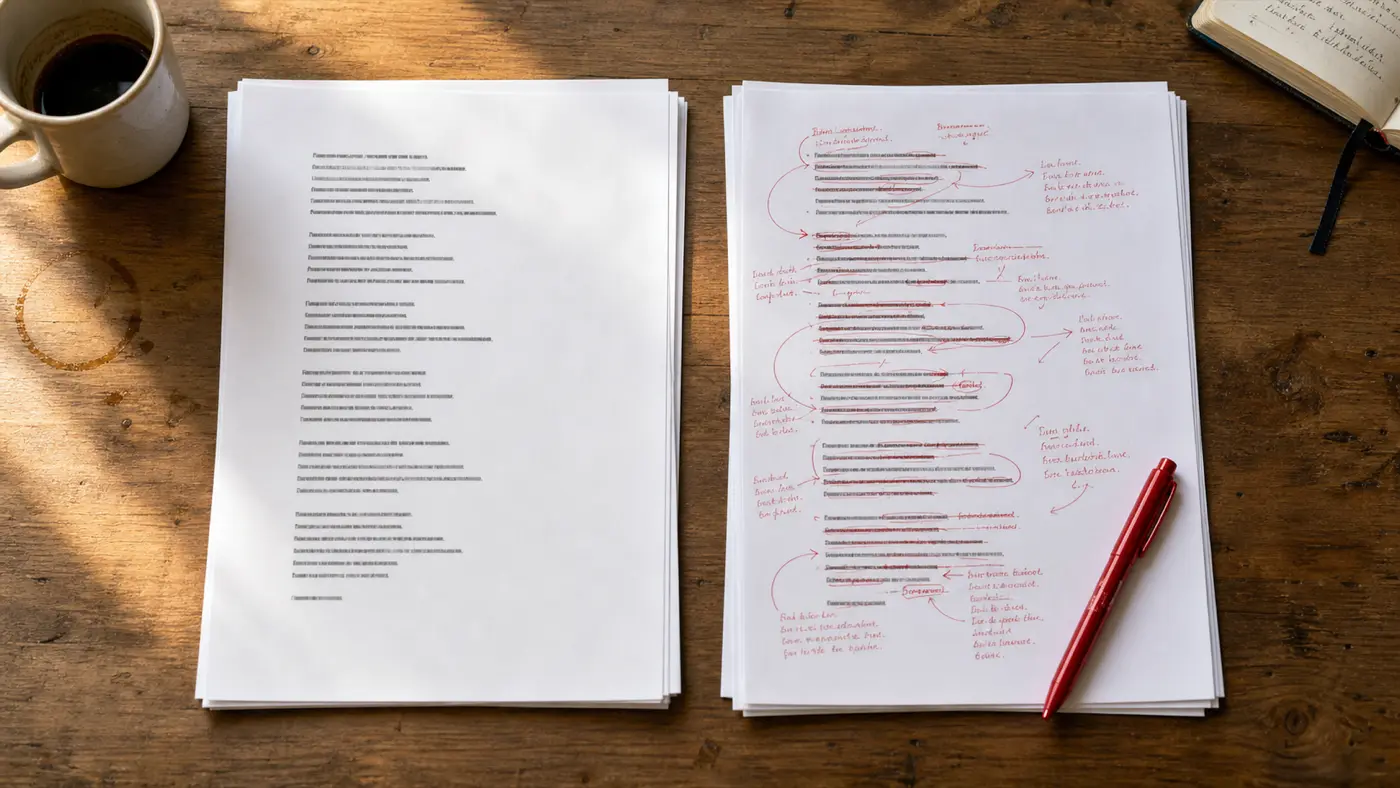
Same anchor: "a poem about the year after my mother died, set in her kitchen, with the third chair always empty." Same form (free verse). The AI draft, then the same poem after a poet's editorial pass.
AI first draft
After
A year has passed since you departed,
and your absence fills the kitchen still.
The third chair stands empty at the table,
a silent witness to the life we shared.
I make my morning coffee in the dawn,
remembering the way you used to laugh.
The light through curtained windows softly falls
on dishes from a dinner you would love.
Time passes, but the missing does not fade.
I keep your chair just where it always was.
After poet refinement
Inventory
A year. The third chair has not moved.
I move it once a week, just to break the pattern,
just to keep the absence from setting into the floor.
I make her coffee on Tuesdays.
I drink it.
It does not matter if I drink it.
The kitchen has agreed
to hold the silence as if it were a third person.
The kitchen has been kinder than I expected.
The differences. The AI draft uses fluent but generic language ("a silent witness to the life we shared", "the missing does not fade"). The refined version uses specific gestures ("I move it once a week, just to break the pattern"), names a specific ritual ("I make her coffee on Tuesdays"), and personifies the kitchen in a way that lands the emotional weight ("the kitchen has been kinder than I expected"). The title shifts from descriptive ("After") to evocative ("Inventory"). Same brief, same anchor; the second poem reads as the poet's, not the engine's.
The voice problem and how to solve it
Voice is the hardest problem in AI-assisted poetry. The fastest practical fix: write 8-12 of your own short poems by hand before you generate anything. Read them. Notice your patterns, your sentence-length tendencies, your favoured imagery, your characteristic line breaks, your idioms. When you then generate a poem and refine it, you have a reference for what your voice actually sounds like. You can replace the AI's smooth lines with your specific voice, line by line, because you know what your voice IS.
Without this calibration, even careful editing of AI output produces a poem in nobody's voice in particular. With the calibration, the same editorial pass produces a poem that sounds like you wrote it (because in the editorial sense, you did).
Disclosure, copyright, and ethics
The legal and ethical landscape in 2026:
- Copyright (US). Human-edited AI-assisted work is copyrightable to the human editor in most circumstances, per US Copyright Office guidance, as long as substantial human creative input is involved (selection, editing, arrangement). Pure AI-generated work with no human creative editing is not copyrightable. Most AI-assisted poetry collections that go through real editorial refinement clear this bar.
- Copyright (UK and EU). Similar but evolving. UK case law is moving toward "the human author of the AI-assisted work owns the copyright when meaningful human creative input is present." EU regulations under the AI Act add disclosure requirements in some commercial contexts.
- KDP disclosure. Amazon KDP requires a checkbox during upload disclosing AI-generated content, and accepts AI-assisted books with proper labelling. Audiobooks are different: ACX/Audible officially require human narration, so an AI-narrated audiobook distributes via Google Play Books, Kobo, or Spotify/Findaway (with disclosure) rather than ACX.
- Workshop and submission ethics. Poetry workshops, journals, and competitions vary. Most major literary journals as of 2026 require disclosure of AI use; some prohibit AI-assisted work entirely. If you submit, read submission guidelines carefully.
- Reader trust. The reader-side ethics question is harder. Disclosing prominently in the front matter ("This collection was written using AI as a drafting tool, with extensive human editing") respects the reader. Hiding it betrays them if discovered. Most successful AI-assisted collections disclose openly and let the work earn its readers.
Marketing AI-assisted poetry to skeptics
The poetry community is more skeptical of AI than most creative communities. Marketing AI-assisted poetry into this audience requires care:
- Do not lead with "AI wrote this." Lead with the work. The poems are either good or not; the production method is secondary in the reader's experience. Disclose, but do not make the disclosure the marketing angle.
- Do lead with the editorial labour. "Two years of refinement", "every line edited by hand", "AI as a draft engine, voice as a human signature", the framing that survives the skeptic is the framing that emphasises the human work, not the machine work.
- Find your audience first. Mindfulness audiences, recovery audiences, faith audiences, and creator-audiences are more open to AI-assisted poetry than the literary-MFA audience. Build there.
- Avoid AI-poetry-themed marketing surfaces. The "AI poetry generator" search cluster attracts skeptics who arrive ready to dismiss. The "indie poetry collection" search cluster attracts readers who arrive ready to read. Choose your channels.
- Let the work age. First-week reception of AI-assisted poetry is harsher than long-tail reception. Many AI-assisted collections that received skeptical early reviews are quietly bestselling six months later because the work survives the second read. Plan for the long tail, not the launch.
FAQ
Is AI-assisted poetry the same as AI-generated poetry?
No. AI-generated poetry is what comes out of the generator with no editing. AI-assisted poetry is what a human poet produces using AI as one tool among many during drafting and refinement. The first is what the critics rightly dismiss; the second is what serious indie poets are shipping in 2026.
Can AI write a sonnet that actually scans?
In 2026, yes for the line count and rhyme scheme. The classical iambic pentameter, five strict metrical feet per line, is harder; AI produces approximate pentameter rather than strict pentameter. For most contemporary readers (and most contemporary sonnet writers, including the most-published) approximate pentameter is acceptable. For strict-form formal-verse audiences, the AI draft needs metrical refinement by hand.
What about Mary Oliver, Ocean Vuong, Maggie Smith, could AI write like them?
It can imitate the surface (similar imagery, similar line break tendencies). It cannot replicate the voice, because voice in those poets is built from a specific lifetime of specific reading and specific living. AI can produce a poem that "sounds Mary Oliver-ish"; it cannot produce the next Mary Oliver poem. The voice is not portable.
Will AI replace poets?
No. It will replace certain forms of poetry production (greeting-card verse, generic motivational poetry, low-effort lead-magnet collections). It will not replace the poet who is doing real editorial work, real specificity, real voice. The market for handmade poetry is unchanged. The market for production-line poetry shrinks because AI does that more cheaply.
Should I disclose AI use on my book?
Yes for the platform forms (KDP, ACX), and yes in some visible form within the book (front matter or colophon). The framing matters: disclose the workflow rather than just the technology. "Drafted with AI assistance, edited and arranged by the author" reads differently from "AI-generated content."
Where do I draw the line between editing and writing?
There is no clean line, and it does not matter. What matters is whether the resulting poem is one you can stand behind in your own voice. If you can read the finished poem aloud and say "this is mine," you have done enough editing. If you cannot, keep editing. The reader's experience is the test, not the percentage of AI-original lines remaining.
What if I just want to write entirely by hand?
That is also fine. AI assistance is a tool, not a requirement. Many of the best contemporary indie poetry collections are written entirely by hand. If you do use Inkfluence in this mode, the platform supports it: the import flow brings in your DOCX/PDF/EPUB manuscript, and the editor handles formatting, cover, and exports without ever generating a line of poetry. Use the platform as a publishing pipeline, skip the generator.
Are there collections that have done this well?
Yes, but most do not advertise their AI assistance, which is part of why the visible AI-poetry conversation is dominated by the worst examples. Many of the indie poetry collections currently selling on KDP in the $2.99-$12.99 band are AI-assisted with significant human editing. The reader cannot tell because the editorial work is real.
Try the workflow
Generate a first draft with the AI Poetry Book Writer, then refine line by line in the editor. Highlight a passage and click Improve to refine wording without rewriting meaning. The platform handles the form rules; you handle the voice. Free to start, no credit card.
Already have a manuscript? Import it and skip the generator entirely. Use Inkfluence purely as the publishing pipeline (cover, EPUB, ACX audiobook, KDP-ready PDF) for handwritten work.
Related resources
AI Poetry Book Writer
The full collection generator with cover and exports.
Poetry Forms Explained
Nine forms with structure rules and AI-generated examples.
How to Publish a Poetry Book on Kindle
Complete indie poet guide to KDP.
How to Create an ACX Audiobook
Audible submission spec and workflow.
For poets
Persona page covering the full indie-poet workflow.
AI Poetry Generator
Free inline poem generator with form and theme picker.
AI Haiku Generator
Free 5-7-5 haiku in any theme.
AI Sonnet Generator
Free 14-line Shakespearean sonnets, ABAB CDCD EFEF GG.
Founder, Inkfluence AI
Sam is the founder of Inkfluence AI. He built the platform to make book creation accessible to everyone - from first-time authors to seasoned publishers.
Helpful links
Ready to Create Your Own Ebook?
Start writing with AI-powered tools, professional templates, and multi-format export.
Get Started FreeRelated Articles
 AI Writing
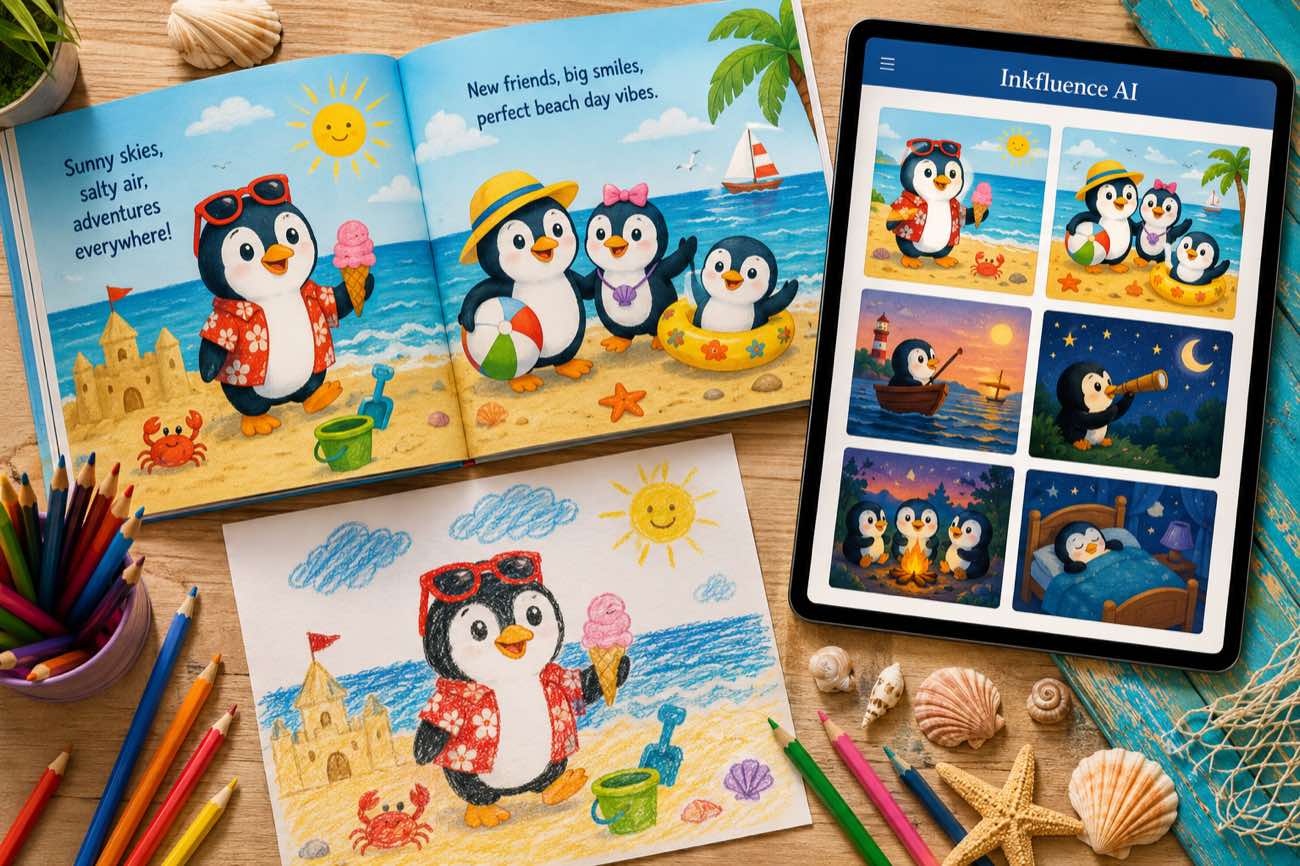
 How to Make a Children's Picture Book with AI: Idea to Printed Book in a Day
The complete 2026 workflow for making a fully illustrated children's picture book with AI: age-band word counts, page planning, consistent characters, cover design, and publishing it on Amazon KDP with the right disclosure.
 AI Writing
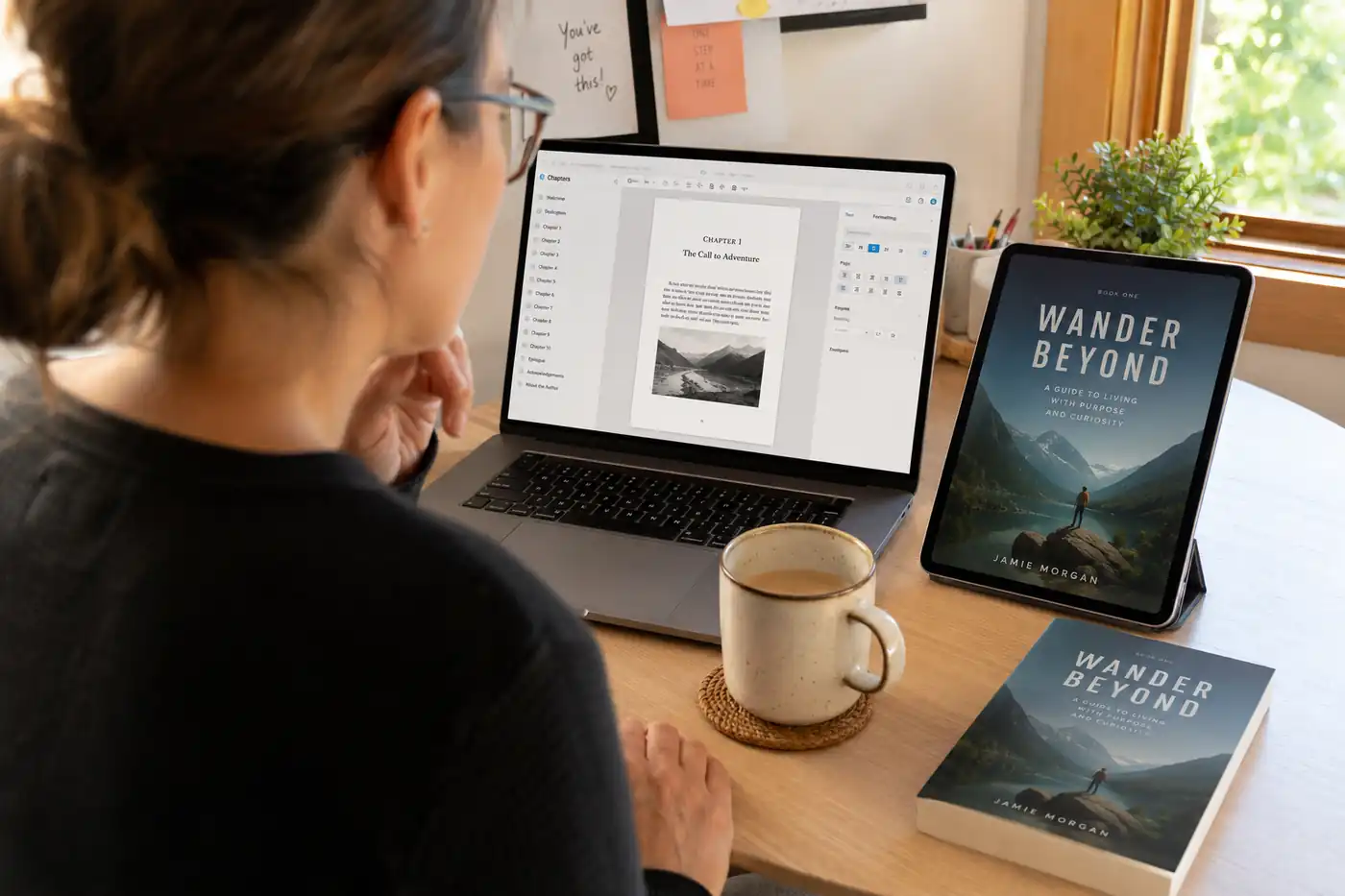
 The 9 Best Ebook Creators in 2026: AI, Formatting, and Design Tools Compared
Not every "ebook creator" does the same job. We compare the 9 best tools of 2026 across three categories: AI generators that write the book, formatting tools that typeset it, and design tools that make it beautiful, with verified pricing for each.
 AI Writing
 The State of AI Audiobooks in 2026: What 8,358 AI-Narrated Chapters Reveal
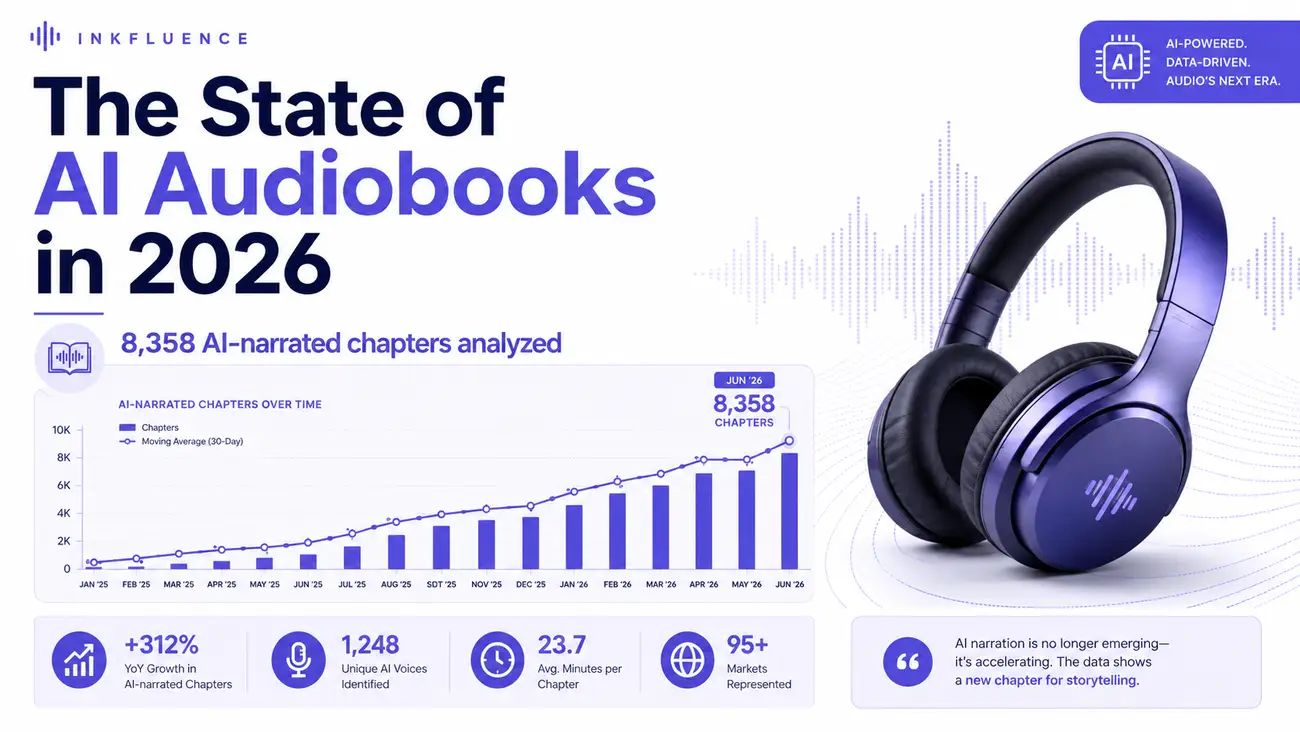
We looked at 8,358 chapters our users narrated into audiobooks with AI. Monthly narration grew from a handful of chapters in late 2025 to nearly 3,000 a month by mid-2026, 99% of jobs finished cleanly, and listeners consistently pick natural, conversational voices over dramatic ones. Here is the first-party data and what it means for authors.
Get ebook tips in your inbox
Join creators getting weekly strategies for writing, marketing, and selling ebooks.