
Poetry Forms Explained: 9 Forms With AI-Generated Examples (2026)
A practical guide to the nine poetry forms most indie poets actually use in 2026: free verse, sonnet, villanelle, haiku sequence, ghazal, prose poem, list poem, couplet sequence, and concrete poem. Structural rules, an AI-generated example for each, and where each form belongs in a collection.
Quick Answer
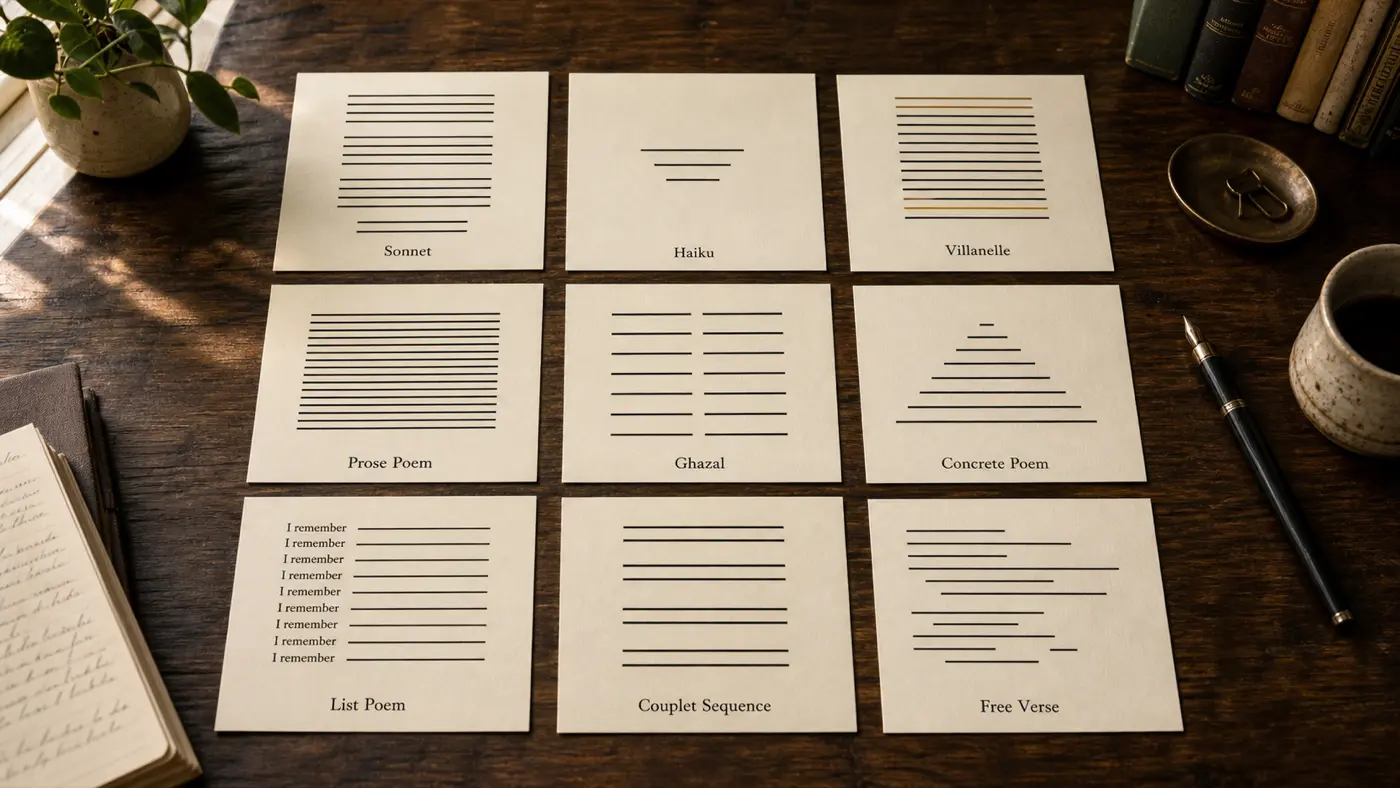
The nine poetry forms most indie poets use in 2026 are: free verse (variable line length, no rhyme), sonnet (14 lines, ABAB CDCD EFEF GG), villanelle (19 lines with two refrains), haiku sequence (3 lines per haiku in 5-7-5 syllables), ghazal (5-9 couplets with a repeating refrain word), prose poem (one paragraph of poetic language), list poem (anaphoric, repeating opening phrase), couplet sequence (linked pairs of lines), and concrete poem (visual shape carries meaning). Each form has structural rules that hold across centuries, and each one earns its place by what it can do that the others cannot. Inkfluence AI generates all nine with the structural rules enforced at generation time.
Why this matters
Form is not decoration. Form is the rule that makes the freedom mean something.
Most contemporary poetry is free verse, and most free verse is good. But the formal forms (sonnets, villanelles, ghazals, haiku) survived for centuries because they do something free verse cannot: they impose a constraint that forces the poem to discover its own argument. A sonnet that lands at 14 lines, with three quatrains and a closing couplet that turns, has done structural work no free-verse poem can claim. The constraint is the meaning.
This guide walks through each of the nine forms an indie poet should know in 2026: what the rules are, what each form does well, and where each one belongs in a collection. Every form section ends with an example, generated by AI in the proper structure, plus a link to the dedicated generator for that form. Use it as a reference before starting your next collection, or share with a poetry workshop.
1. Free verse
What it is. Poetry without a fixed metre, line length, or rhyme scheme. Line breaks are deliberate but determined by rhythm and meaning rather than a predetermined pattern. The dominant form of contemporary poetry since the early 20th century, and the default mode for most indie collections in 2026.
The rules anyway. Free verse is not formless. The line break is the unit of meaning, and where you break a line determines what the reader emphasises. Variable line lengths create rhythm: short punchy lines mixed with longer flowing ones. The poem still needs an arc, an opening that grounds the reader in a specific image, a middle that complicates, and an ending that lands. Walt Whitman, William Carlos Williams, Mary Oliver, and Ocean Vuong all wrote primarily in free verse.
What it does well. Conversational intimacy. Direct address. Specific image-driven observation. Emotional flexibility (the form does not impose a tone). Most modern memoir-poetry, BookTok-driven Instagram poetry, and contemporary literary collections live here.
Example, free verse
Inventory
The first breath of the morning
arrives uninvited, like rent.
I count what I still own:
the kettle's small click,
the chipped mug that holds it,
the window that pretends not to leak.
The list is shorter than yesterday.
The list is always shorter than yesterday.
Generate your own free verse poems with the AI poetry generator.
2. Sonnet
What it is. A 14-line lyric poem in a fixed structure. The two dominant variants are the Shakespearean (English) sonnet, three quatrains and a closing couplet, ABAB CDCD EFEF GG rhyme, and the Petrarchan (Italian) sonnet, an octave (8 lines) and a sestet (6 lines), ABBA ABBA CDC DCD or similar.
The rules. Exactly 14 lines. Iambic pentameter feel (do not force it mechanically, natural English rhythm with five rough beats per line is the standard). The rhyme scheme is non-negotiable for the chosen variant; slant rhymes (boat / bought, lake / luck) are accepted by most contemporary readers. The closing couplet (in Shakespearean) or the sestet (in Petrarchan) must turn, the poem pivots from observation to verdict, from question to answer, from image to meaning.
What it does well. Argument. The sonnet is the form for working out what you actually think about a thing. The 14-line constraint forces compression; the closing couplet forces a verdict. Used historically for love poems (Shakespeare, Petrarch, Elizabeth Barrett Browning) but in contemporary indie poetry it shows up frequently for reckoning, vow, parting, and grief.
Example, Shakespearean sonnet
The Second Check
She tells herself the night is just a room.
She rises once, then twice, to test the door.
The clock keeps time the way a metronome
insists on what the dancer can't afford.
A second check, a third, a fourth, a fifth.
The chain across the latch is not enough.
She counts her own heartbeats as if they shift
the math of being safe from being rough.
But morning comes the way it always comes,
indifferent to the night's accumulated case.
The light forgives nothing, but it sums
the hours back to something like a place.
She leaves the door unchecked, walks down the stair.
The room remembers nothing. So does the air.
Generate your own sonnets with the AI sonnet generator. Per the Academy of American Poets glossary, the form has been continuously productive in English since the 16th century.
3. Villanelle
What it is. A 19-line poem in a fixed pattern: five tercets (3-line stanzas) followed by a closing quatrain (4 lines). Two refrain lines repeat: the first line of the first tercet (A1) and the third line of the first tercet (A2). The pattern is A1bA2 / abA1 / abA2 / abA1 / abA2 / abA1A2.
The rules. Exactly 19 lines. Two refrain lines that repeat exactly as established in the first tercet (small grammatical variation is sometimes accepted in contemporary villanelles, but the words should remain recognisable). The "b" rhyme threads through every stanza. The closing quatrain ends with the two refrain lines back-to-back, creating the form's characteristic landing.
What it does well. Obsession. The repeated refrain lines mean the form is structurally about coming back to the same thought from different angles. Used famously in Dylan Thomas's "Do Not Go Gentle into That Good Night" and Elizabeth Bishop's "One Art." Contemporary indie villanelles often handle grief, addiction, longing, or the nagging unresolved thought.
Example, villanelle
The Wider Memory
I do not recall the colour of the door.
I recall the sound it made when it was shut.
The house has fewer rooms than it did before.
I touched the handle once, perhaps twice more.
The wood was warm, or cold, I am not sure.
I do not recall the colour of the door.
The kettle's whistle, sharper than a chore.
A voice that called my name, then went mute.
The house has fewer rooms than it did before.
A photograph slipped sideways on the floor.
Someone's hand reached down to set it right.
I do not recall the colour of the door.
The garden held a shape I can ignore.
A bird, perhaps. Or just a bit of light.
The house has fewer rooms than it did before.
What's left is sound, not sight, not what it wore.
A click. A footstep. Then the night's quiet rite.
I do not recall the colour of the door.
The house has fewer rooms than it did before.
The full collection generator at Inkfluence AI produces villanelles in proper 19-line structure with the refrain pattern enforced.
4. Haiku sequence
What it is. A series of haiku (typically 4-7) linked by a shared image, moment, or progression. Each haiku is exactly 3 lines in 5-7-5 syllable structure (in English approximation; the original Japanese is more complex). Within a sequence, the haiku usually share a setting, season, or emotional register.
The rules. 5-7-5 syllables per haiku. A specific concrete image (avoid abstraction). A kireji (cutting word) or pivot, usually after the first or second line, where one image meets another. Traditional haiku also include a kigo (seasonal reference); contemporary haiku often relax this. In a sequence, the haiku should progress, image to image, moment to moment, rather than restating the same observation.
What it does well. Compressed observation. Time-marked moments. Mindfulness collections, nature collections, daily-practice journals. The constraint forces the poet to choose every syllable.
Example, haiku sequence (3 of 5)
Threadwork
the needle waits, still
between the thumb and the cloth
deciding to bleed
a knot at the end
catches the thread, holds the thread
holds my hand in place
morning light again
the seam I sewed last evening
no longer my own
Generate your own haiku with the AI haiku generator. Per the Poetry Foundation glossary, the contemporary English haiku is a creative adaptation of the Japanese original rather than a direct equivalent.
5. Ghazal
What it is. A poem of 5-9 couplets (sometimes more), each ending with a repeating refrain word called the radif. A rhyme appears just before the radif (called the qafia). Each couplet is semantically independent, they share thematic concern but do not need to follow narratively. The final couplet traditionally references the poet, called the takhallus.
The rules. 5-9 couplets minimum. Every couplet ends with the same refrain word. The qafia (the rhyme just before the refrain) is consistent across couplets. Each couplet should stand alone as a complete thought. The last couplet often includes a self-reference (the poet's name, role, or signature image).
What it does well. Variations on a theme. Persistent grief or persistent love. The form is structurally about the same word coming back, which suits emotions that recur. Originated in 7th-century Arabic poetry, became a major form in Persian and Urdu literature, and has been adapted into English by poets including Agha Shahid Ali and Adrienne Rich.
Example, ghazal (5 of 6 couplets)
Carrying the door
All winter I have been carrying the door.
The lock undone, the hinges still, the door.
I lay it down at intervals to sleep.
In dreams a bird flies sideways through the door.
A neighbour asks me where I'm going next.
I tell her: nowhere yet, just with the door.
The handle warms beneath my hand by noon.
By dusk the wood remembers what's the door.
A child runs past, asks why I'm walking slow.
A child cannot yet need to keep the door.
6. Prose poem
What it is. A short paragraph (or 2-3 short paragraphs) of condensed, image-rich language without line breaks. The form is paragraph-shaped, the language is poetic, every sentence carries weight, the images compress, the rhythm comes from sentence length variation rather than line breaks.
The rules. No line breaks. 80-200 words typically. The "poem" status comes from concentration of language, not from form. Sentences vary in length. Specific concrete images dominate. The piece earns its title and its placement in a poetry collection by the density of its language relative to ordinary prose.
What it does well. Lyric narrative. Memory pieces. Moments that need a longer breath than line-broken poetry allows but are too compressed to be flash fiction. Russell Edson, Charles Simic, Anne Carson, and Claudia Rankine all wrote in the form. Contemporary indie poets often use prose poems as connective tissue between sections of a collection.
Example, prose poem
Forecast
On the night I missed the last train, you stayed on the line and named the streets between us in order, like a rosary that knew the way home. The phone got hot against my ear. The taxi cost more than the train. You named one more street, and one more, until I was at the door, and the door knew me, and the door was you.
7. List poem
What it is. A poem built on anaphora, a repeating phrase or word at the start of each line or stanza. The repetition creates the rhythm; the variation in what follows creates the meaning. Often visually formatted as a list (each item on its own line) but with the language and compression of poetry.
The rules. A clear repeating opening element. 10-25 lines typically (longer is rare and usually fails). The variations across the list should escalate, intensify, or pivot, not just repeat the same idea with different words. The final item often breaks the pattern slightly or lands the poem.
What it does well. Cumulative force. Inventory pieces. Naming what was lost or what was found. Joy Harjo's "She Had Some Horses" and Patricia Smith's "Skinhead" use the form. Contemporary indie poets often use list poems for grief inventories, gratitude practices, and moments of catalogue.
Example, list poem
Things the body remembers
Things the body remembers without permission:
the taste of rust before the bleed,
the weight of a held breath,
the shape of a door closing,
the precise temperature of a hand on the back of the neck,
the angle of a chair pulled out at midnight,
the silence between a question and the answer that came too late,
the specific brightness of a streetlight outside a window in a year I had decided to forget,
the small, reflexive flinch.
8. Couplet sequence
What it is. A poem (or short collection) built from 5-8 linked couplets, pairs of lines, each couplet self-contained but threading through a larger thematic arc. Couplets may rhyme (slant or full) or stay unrhymed. Separated by blank lines so each pair stands alone visually.
The rules. Each couplet is exactly 2 lines. The couplets connect through image, theme, or emotional progression, they should accumulate, not just sit beside each other. Optional rhyme; if used, consistent across the sequence. The opening and closing couplets carry the most weight (one to set up, one to land).
What it does well. Aphoristic compression. Each couplet works like a small sonnet, a complete thought in two lines. Suits collections of observations, vows, instructions, or proverbs. Often used in contemporary indie poetry for short-form daily-practice books and Instagram-friendly visual layouts.
9. Concrete poem
What it is. A poem in which the visual arrangement of words on the page is part of the meaning. The shape of the poem reflects its subject (a poem about falling arranged as a descending staircase, a poem about a tree shaped like a tree). Whitespace, indentation, and line shape carry intent, not just rhythm.
The rules. The visual shape must matter to the meaning, not just be decorative. Every leading space and indent is intentional. Reproduces using monospace or carefully-formatted CSS (white-space: pre) so the shape survives the reader's font size changes. 8-30 lines typically.
What it does well. Visual play. Subject-shape correspondence. Poems where the form itself is a metaphor for the content. Originated in classical Greek shaped poetry, revived in 20th-century concrete poetry movements. In digital publishing, requires careful CSS to render correctly across Kindle, EPUB, and print, most generic ebook formatters mangle concrete poems. The Inkfluence renderer applies white-space: pre automatically inside concrete poem blocks so the shape survives.
Mixing forms in a collection
The strongest indie poetry collections almost never lock themselves to one form. The variation is part of the reader's experience: a sonnet sequence in section three feels different after the haiku sequence in section two, which felt different after the lyrical free verse in section one. The contrast is the engine.
A useful default mix for a 5-section collection: lyrical free-verse-led opener, formal-form-heavy middle (sonnets and villanelles), short-form section (haiku sequence and couplet sequence), experimental section (prose poem, list poem, concrete), and a closing section that returns to free verse with the threads tied. The AI Poetry Book Writer rotates form mixes by section automatically when generating a collection, but you can override and lock specific sections to specific forms if you prefer.
Five common form mistakes
- Calling something a sonnet that isn't 14 lines. The form name carries a contract. If a poem is 12 lines or 16, it is not a sonnet (it might be a great poem, but call it free verse or "after the sonnet" or "compressed sonnet"). Readers familiar with the form will notice the mismatch and lose trust.
- Ignoring the syllable count in haiku. Same principle. 5-7-5 is the contract. Modern English haiku sometimes relax the count for natural rhythm, but a "haiku" with 4-9-4 syllables is just a tercet.
- Treating villanelles as five-tercet poems. The refrain pattern is the form. A 19-line poem in tercets without the repeating refrains is not a villanelle.
- Workshop-style titles. "Sonnet for the People I Cannot Stop Thinking About" or "Villanelle After the Election" feels academic. Strong contemporary poetry titles are 1-4 evocative words. Let the form be visible from the structure, not from the title.
- Form-only collections that never vary. 50 sonnets in a row is a sonnet sequence, which is a real form, but it requires care. For most indie collections, mixing forms produces a more varied reader experience than form-locking the entire book.
FAQ
Which form should I use for my first poetry collection?
Start with mixed free verse (variable line lengths, deliberate breaks, no rhyme constraint) for most of the collection. Add 2-3 formal-form pieces (a sonnet, a villanelle, a haiku sequence) as anchors. The formal pieces give the collection structural backbone; the free verse gives it flexibility. This mix is what most indie poetry bestsellers in 2026 use.
Do I need to know the rules to break them?
Yes. A sonnet that is "almost" 14 lines reads as a failed sonnet. A sonnet that is intentionally 12 lines, with a clear reason, can read as a "broken sonnet" in dialogue with the form. The reader needs to know the form was the reference point. If the rules feel like obstacles rather than tools, you have not yet learned the form well enough to break it usefully.
Can AI write in formal forms correctly?
Yes, when the structure is enforced at generation time. Most generic AI poetry generators produce "poetry-shaped prose" that ignores form rules, sonnets that are 12 or 16 lines, haiku that have nine syllables in the middle line, villanelles that drop the refrain. The Inkfluence AI generator enforces the line counts and refrain patterns at generation time, so a sonnet really lands at 14 lines and a villanelle at 19.
What about other forms not listed here?
There are dozens of other established forms: pantoum, sestina, ode, elegy, blank verse, terza rima, limerick, cinquain, tanka. The nine in this guide are the ones indie poets in 2026 use most often in published collections. The rarer forms have their own audiences (the sestina has a small but loyal readership, for example) but tend to be saved for specific projects rather than the bread-and-butter of a typical collection.
How do I render a concrete poem on Kindle?
The challenge with concrete poems on reflowable Kindle is that the reader can change font size, which destroys carefully-arranged shapes. The standard solutions are: render the concrete poem as an image (PNG embedded in the EPUB) for Kindle, render it as white-space: pre in CSS for desktop EPUB readers, or include a print-only paperback if the shape is critical to the work. Most indie poets who include concrete poems also produce a paperback edition specifically because the shape needs print to land.
Are formal forms commercially viable for indie poets?
Yes, in two scenarios. First, formal forms work well as the structural backbone of a mixed collection, readers respond to the variety. Second, single-form collections (sonnet sequences, haiku books, ghazal collections) have smaller but loyal audiences, particularly in the workshop and MFA-adjacent reader market. Pure-form collections sell less broadly than mixed collections but tend to have higher per-reader engagement and stronger word of mouth.
How long does a poetry collection need to be?
For Kindle, the practical floor is around 30 poems (~30-50 pages) for a paid collection. Most bestselling indie poetry books run 60-120 poems across 80-150 pages. Below 30 poems, readers feel cheated regardless of price. Above 150, attention spans drop. See our complete KDP poetry publishing guide for the full economics.
Where can I learn more about each form?
The Poetry Foundation glossary and the Academy of American Poets glossary are the standard references for every form definition. Both are free, both maintain example poems, both are kept current. For working poets, "The Making of a Poem" (Mark Strand and Eavan Boland) and "A Poet's Glossary" (Edward Hirsch) are the standard print references.
Try the form-specific generators
Each form has its own generator that produces examples in proper structure with one click:
- AI Haiku Generator, 5-7-5 in any theme
- AI Sonnet Generator, 14-line Shakespearean sonnets, ABAB CDCD EFEF GG
- AI Poetry Generator, free verse, prose poem, couplet, and haiku samples
- AI Poetry Book Writer, full collections with form rotation across all 9 forms
Free to start, no credit card. Generate a single poem to test the form, or a complete published collection in under an hour.
Related resources
AI Poetry Book Writer
The full collection generator with cover and exports.
AI Haiku Generator
Free 5-7-5 haiku in any theme.
AI Sonnet Generator
Free 14-line Shakespearean sonnets, ABAB CDCD EFEF GG.
AI Poetry Generator
Free verse, prose poem, couplet, haiku samples.
How to Publish a Poetry Book on Kindle
Complete indie poet guide to KDP.
How to Create an ACX Audiobook
Audible submission spec and workflow.
For poets
Persona page covering the full indie-poet workflow.
The Real Cost of Publishing
Editing, cover, audiobook, ISBN: every line item with sources.

Founder, Inkfluence AI
Sam is the founder of Inkfluence AI. He built the platform to make book creation accessible to everyone - from first-time authors to seasoned publishers.
Helpful links
Ready to Create Your Own Ebook?
Start writing with AI-powered tools, professional templates, and multi-format export.
Get Started FreeRelated Articles
 AI Writing
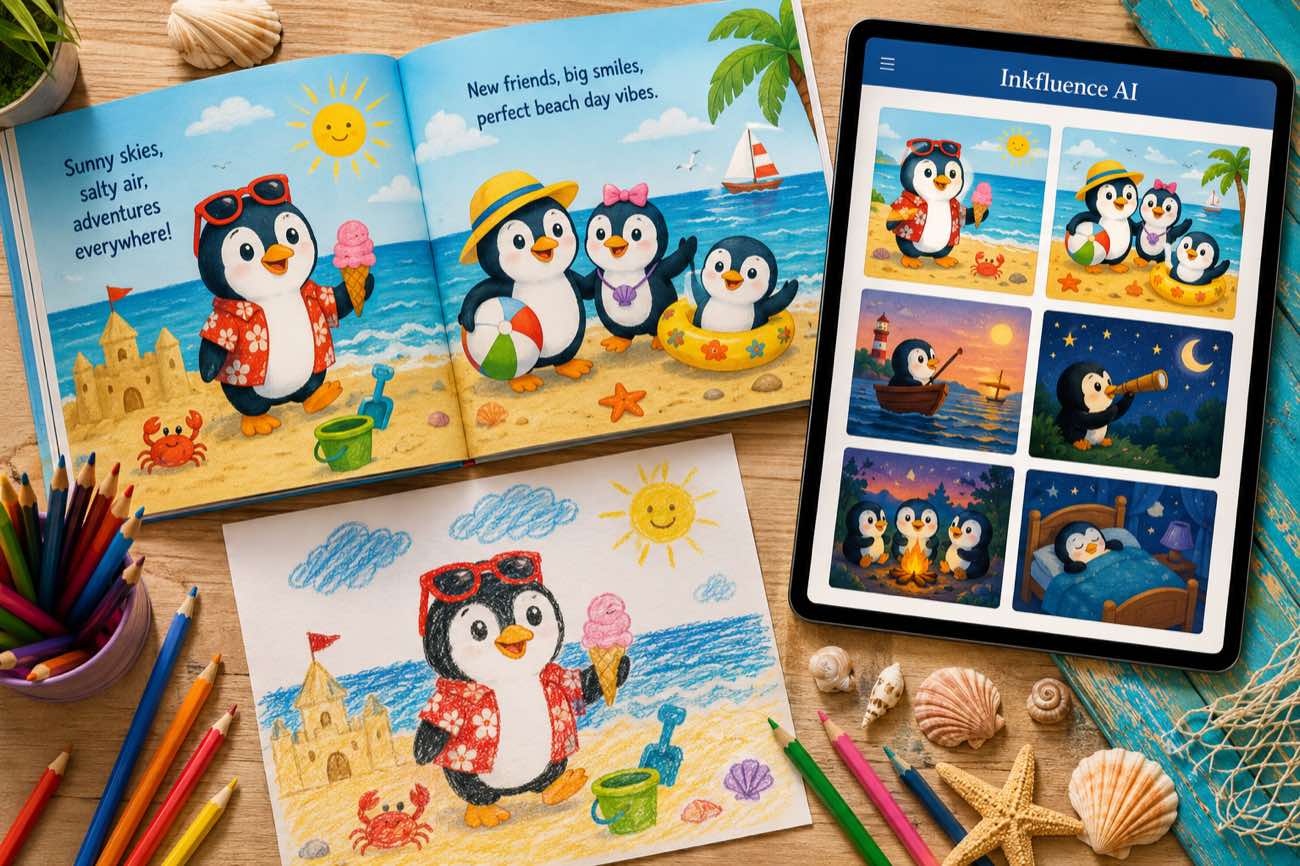
 How to Make a Children's Picture Book with AI: Idea to Printed Book in a Day
The complete 2026 workflow for making a fully illustrated children's picture book with AI: age-band word counts, page planning, consistent characters, cover design, and publishing it on Amazon KDP with the right disclosure.
 AI Writing
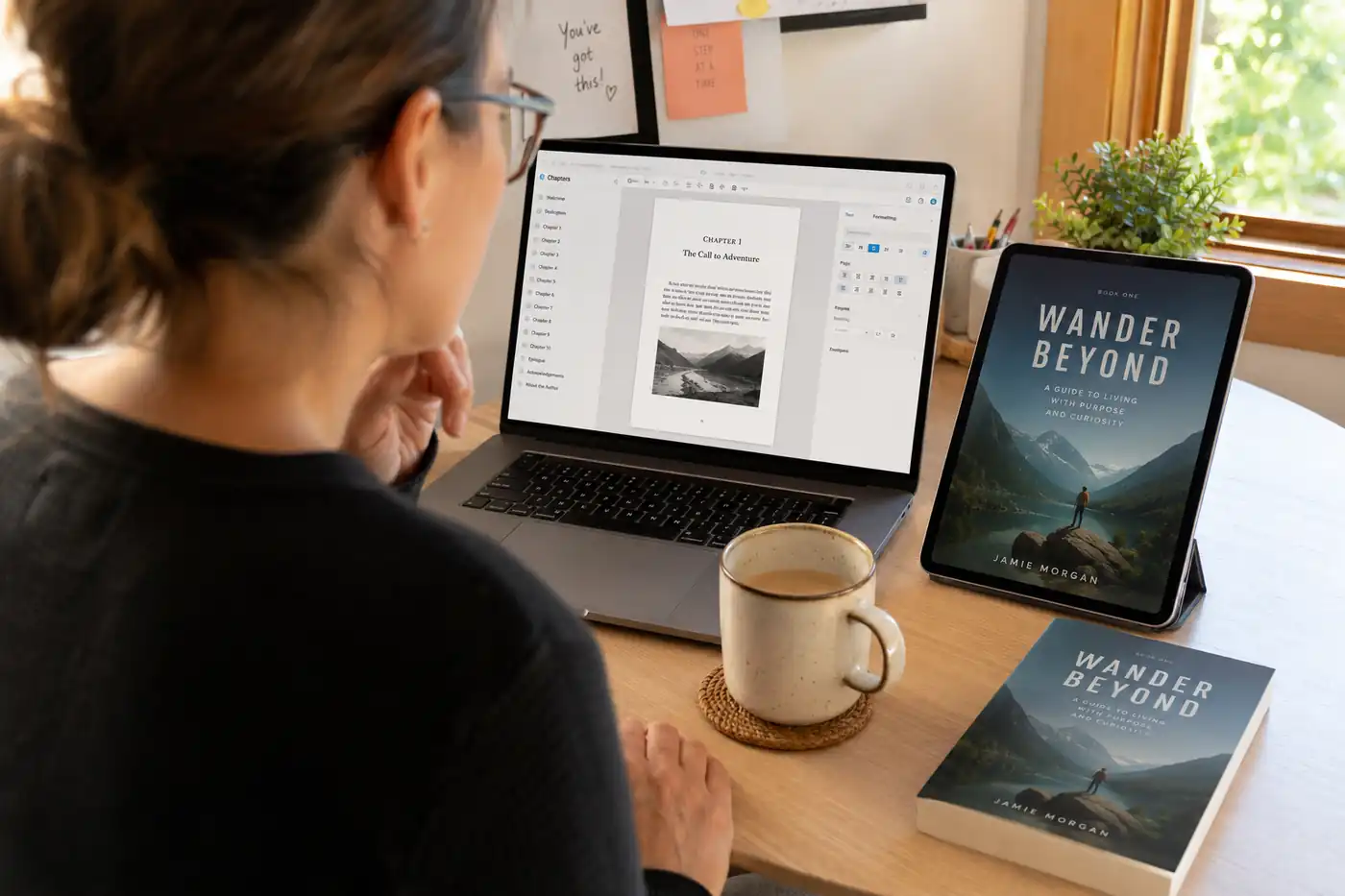
 The 9 Best Ebook Creators in 2026: AI, Formatting, and Design Tools Compared
Not every "ebook creator" does the same job. We compare the 9 best tools of 2026 across three categories: AI generators that write the book, formatting tools that typeset it, and design tools that make it beautiful, with verified pricing for each.
 AI Writing
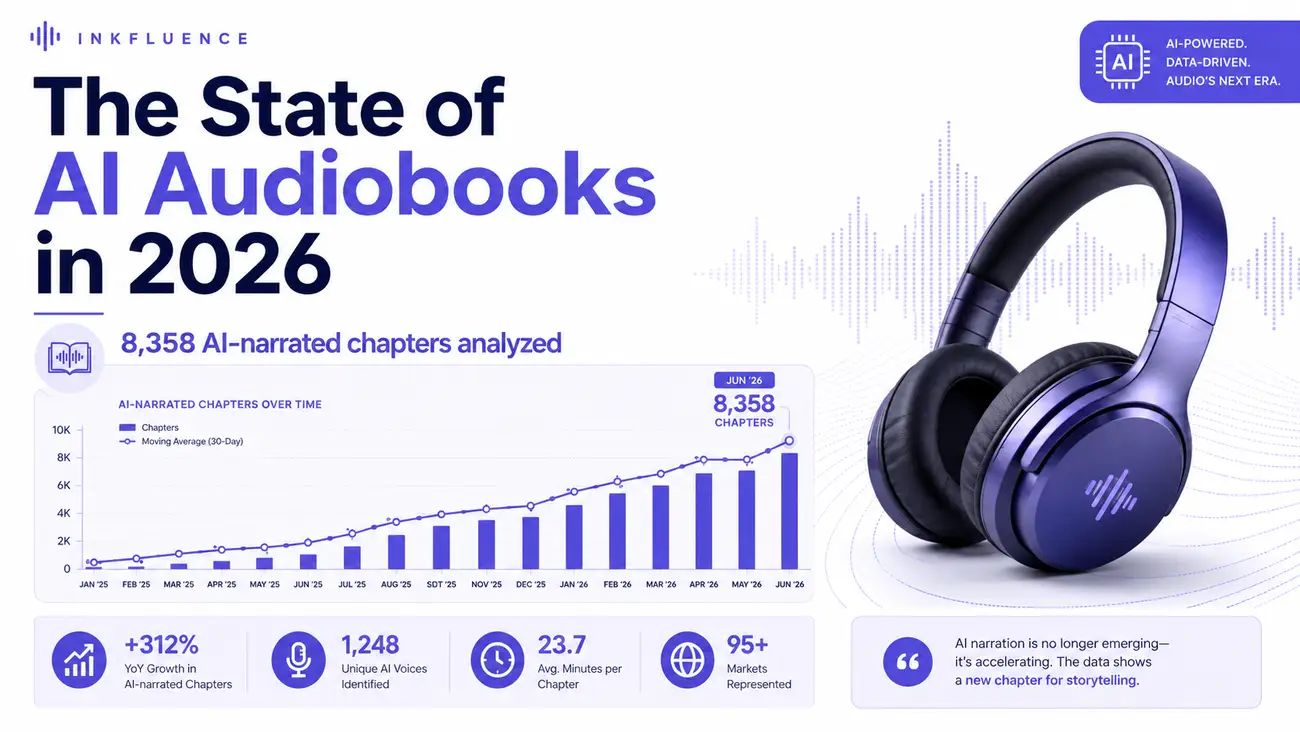
 The State of AI Audiobooks in 2026: What 8,358 AI-Narrated Chapters Reveal
We looked at 8,358 chapters our users narrated into audiobooks with AI. Monthly narration grew from a handful of chapters in late 2025 to nearly 3,000 a month by mid-2026, 99% of jobs finished cleanly, and listeners consistently pick natural, conversational voices over dramatic ones. Here is the first-party data and what it means for authors.
Get ebook tips in your inbox
Join creators getting weekly strategies for writing, marketing, and selling ebooks.