
Generate poetry instantly. Publish a full collection.
Pick a form and a theme below for an instant sample. When you're ready, take your collection from a single poem to a printed book with cover, EPUB, and audiobook.
Unlimited regenerations. No signup needed for the inline tool.

Want a full poetry collection with cover and audiobook?
Build the full collection →Nine forms, one platform
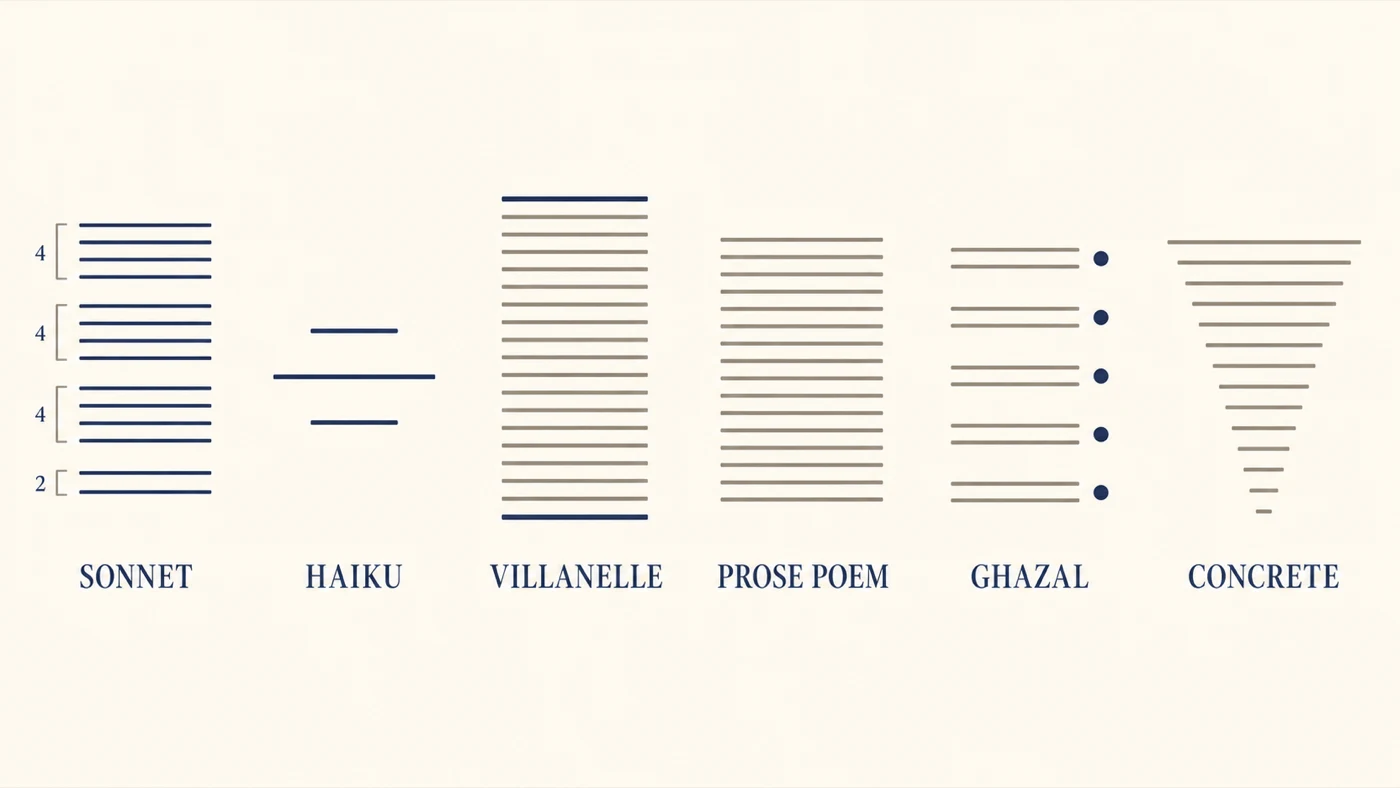
The full collection generator handles every form below. Sonnets land at 14 lines, villanelles at 19, haiku in proper syllable structure.
Free verse
Sonnet
Villanelle
Haiku sequence
Ghazal
Prose poem
List poem
Couplet sequence
Concrete
How AI poetry generators actually work
A short, honest explainer for anyone wondering what the tool is doing under the hood.
The inline generator above is template-driven: it picks one of several hand-written poems for each form-and-theme combination, all written by a human poet against the same set of imagery and emotional registers. It is fast, free, and unlimited because it does not call an AI model. That keeps the tool snappy and lets us put it on a public page without rate limits.
The dashboard generator (the one that builds full collections) is different. It uses a large language model with a custom prompt that enforces form structure: a sonnet really lands at 14 lines, a villanelle at 19 with the refrain pattern, a haiku in proper syllable shape. The model receives the theme you describe, the section arc the AI planned, and the form rules for that particular poem. It returns one poem at a time, which then flows into the editor with stanza markup preserved.
This split (templates for the public-facing widget, real generation for the full book) is deliberate. Templates produce a reliable taste of voice. The full generator produces something publishable. Most poets use the inline tool for inspiration, then move into the dashboard once they know the direction they want to take a collection.
Where people use the AI poetry generator
Wedding readings and toasts
Couples generate love poems for ceremonies, vows, and signature cocktail menus. The free inline tool covers the brief, the dashboard turns it into a printed booklet.
Greeting cards and Etsy products
Etsy sellers and small print-on-demand brands use the generator for original verse on cards, posters, and wall prints, then refine in the editor.
Funeral and bereavement readings
Quiet, tender language for memorials, eulogies, and remembrance services. The Loss theme is the most used on this page.
Coaches and therapists
Generated as a prompt for journaling exercises with clients, or compiled into a chapbook lead magnet for an email list.
Teachers and workshop leaders
Form-specific examples for teaching sonnets, villanelles, haiku. Students generate, compare, then write their own using the example as scaffolding.
Indie poets warming up
A starting line, a rhythm, a way of seeing a familiar theme from a different angle. Most poets use it as a kindling tool, not a finishing tool.
AI poetry generator vs general AI chat
Why a purpose-built poetry tool produces something usable in two clicks where a general chatbot produces a coin-flip.
| Capability | General AI chat | Inkfluence |
|---|---|---|
| Sonnet really lands at 14 lines | Sometimes 12, sometimes 16 | Always 14, every time |
| Form rules per poem type | Approximate | Enforced (rhyme, meter, refrain) |
| Output formatting | Plain text, inconsistent line breaks | Semantic stanza structure preserved |
| Path to a book | Copy-paste into Word, format yourself | One-click full collection with cover and EPUB |
| Cost | $20/mo subscription typical | Free for the inline tool, $9.99 for full books |
Why AI poetry tools matter to indie poets in 2026
Until 2024, AI poetry tools were curiosities. They produced approximately-shaped poems with broken meter, generic imagery, and no awareness of form. Most working poets dismissed them on first contact, and rightly so. The output was "poetry-shaped prose" rather than poetry: text broken into lines because the machine had been told to break lines, not because the lines themselves were doing musical work.
The 2025 generation of language models changed the floor of what was possible. The same model that can write a passable cover letter can now write a passable sonnet, given the right structural prompt. The change is not that the AI suddenly understands poetry the way a poet does. The change is that the AI has read enough form examples to follow the rules when explicitly told to follow them. A sonnet that lands at exactly 14 lines, in three quatrains and a closing couplet, with the ABAB CDCD EFEF GG rhyme scheme intact, is now a baseline expectation, not an unusual result. The same is true for villanelles, ghazals, haiku sequences, prose poems, and concrete poems.
What still differentiates a publishable poem from an AI draft is voice and specific imagery. The AI tends toward smooth, plausible, generic phrasing. A working poet revises generic phrases into specific ones, replaces stock imagery with imagery only they could have written, and makes the kinds of structural choices (a line break here instead of there, a stanza joined or split) that the AI cannot anticipate. The model produces the structural backbone. The poet produces the voice. This is why the most-shipped indie poetry collections in 2026 are AI-assisted at the drafting stage and human-edited at the line level. The result is faster than writing from scratch, more consistent than first drafts, and more quickly publishable than the traditional route.
The widget at the top of this page is a small demonstration of the principle: hand-written templates for the inline tool (because that produces a snappier preview), real AI generation in the dashboard (where the full collection lives). Both serve the same end. A poet starts with a structurally correct draft and ends with a finished book.
Common mistakes when generating poems with AI
Generic prompts produce generic poems
"Write a poem about love" gets you a love poem nobody will remember. "Write a poem about the love between a parent and an adult child during a slow goodbye" gets you a specific poem with real emotional weight. The specificity of the prompt is the specificity of the poem.
Treating the first draft as the final poem
The AI gives you a structurally correct draft. Your voice is what makes it yours. Always do at least one revision pass: replace generic words with specific ones, rewrite the line breaks to where you want them, cut anything that does not earn its place.
Asking for a form the AI cannot enforce well
Strict iambic pentameter, perfect classical Greek shaped poetry, or rare medieval forms are at the edge of what AI can do reliably. Stick to the well-supported forms (sonnet, villanelle, haiku, ghazal, prose poem, list, concrete) for the most consistent output.
Mixing too many styles in one collection
A book with one example of every form reads like a sample reel. Pick a primary form and one or two complementary forms, and let the collection breathe through that constraint.
Free for the inline tool, optional plans for full books
- Unlimited poems on this page
- 5 chapters/month for full books
- PDF export
- Cover designer
- 35 chapters/month for full books
- EPUB and DOCX export
- 15 audiobook chapters/month
- Improve on selection
- Unlimited chapters
- 30 audiobook chapters/month
- Priority generation queue
- ACX-spec audiobook bundle
No per-poem credits. Cancel any time. Full pricing comparison
Sources and references
- Adult-poetry print sales growth (US): NPD BookScan figures via Publishers Weekly category roundups, indicating poetry as the fastest-growing print category in adult trade for five consecutive years.
- NEA Survey of Public Participation in the Arts: roughly 28 million US adults read poetry annually, the highest rate in the survey's history.
- Form definitions: Poetry Foundation glossary; Standard Ebooks z3998:poem semantic markup specification; The New Princeton Encyclopedia of Poetry and Poetics.
- KDP poetry pricing band: Direct observation of the Kindle Poetry bestseller list, May 2026.
- Audible AI-narration policy: ACX content guidelines, AI-narrated content disclosure section.