AI Poetry Book Writer

Write a complete poetry collection with AI

From a single theme to a printed paperback, Kindle ebook, and ACX-ready audiobook. Free verse, sonnets, villanelles, haiku, prose poems, and more, formatted properly, cover designed, exported in one click.

Free to start. No credit card required.

Poet writing in a leather notebook at a wooden desk by a window, mug of tea and an open paperback poetry collection beside her, bookshelf of poetry collections in soft focus behind her, late afternoon light.
By Sam May|Founder, Inkfluence AI · Updated May 2026 · 15 min read · 8 cited sources
Forms supported

Real poetry forms, not just paragraphs with line breaks

Every form has its own structural rules baked into the generator. A sonnet really lands at 14 lines. A villanelle really repeats its refrains. A haiku really is three lines.

Free verse

Variable line length, no rhyme constraint, deliberate line breaks. The default for contemporary collections.

Sonnet

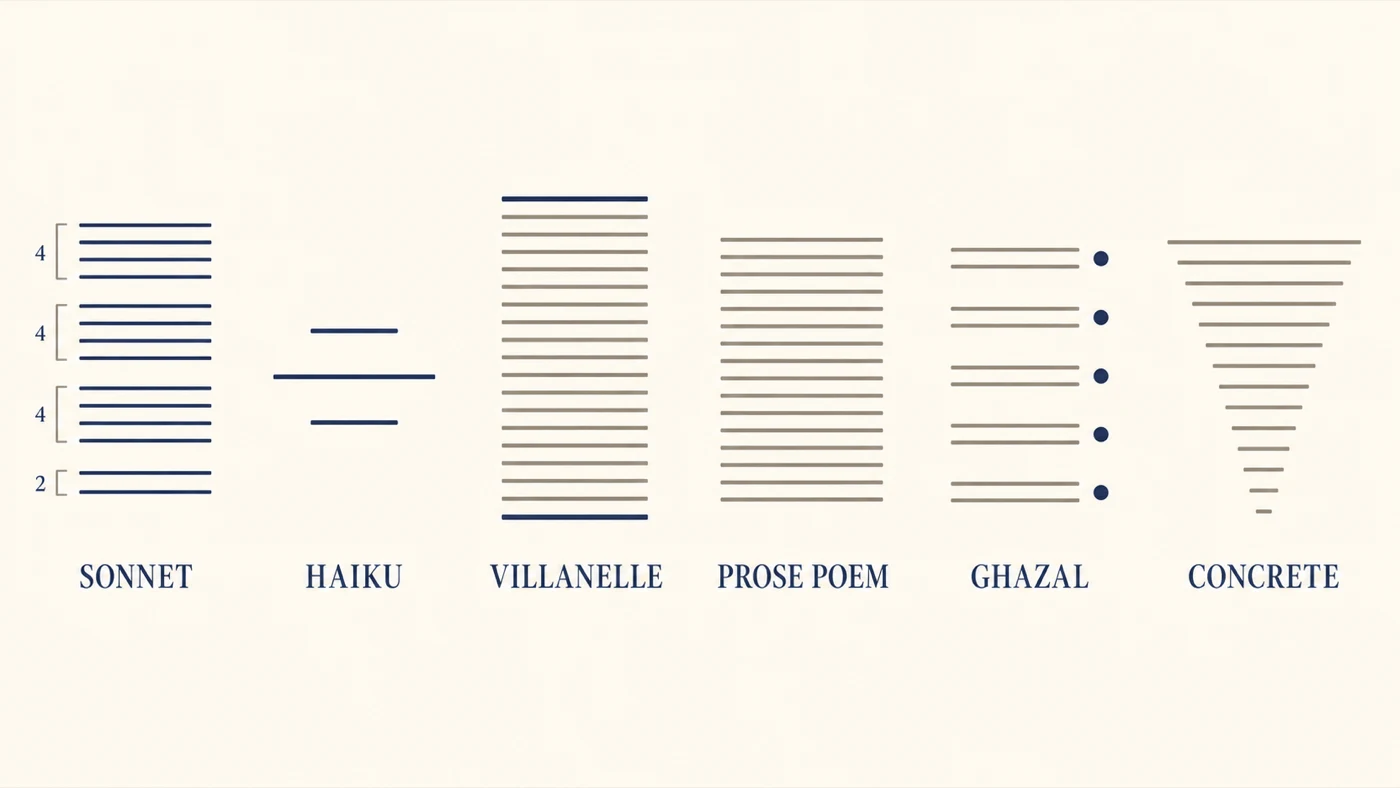
14 lines, three quatrains and a closing couplet, ABAB CDCD EFEF GG. Closing couplet turns or lands the poem.

Villanelle

19 lines with two refrain lines that repeat across five tercets and a closing quatrain.

Haiku sequence

3-7 haiku linked by a shared image or moment. 5-7-5 syllable structure per haiku.

Ghazal

5-9 couplets each ending with a repeated refrain word. Final couplet often references the poet (takhallus).

Prose poem

Single justified paragraph of condensed image-rich language. Form is paragraph-shaped, language is poetry.

List poem

Anaphoric structure with a repeating opening phrase. Rhythm from the repetition, meaning from what varies.

Couplet sequence

Pairs of lines, each couplet self-contained but threading through a larger arc. Optional rhyme.

Concrete poem

Visual arrangement carries part of the meaning. Whitespace and shape are part of the poem itself, preserved exactly in the export.

Each section in your collection can use a different form mix, formal-forms-heavy chapters, free-verse lyrical chapters, experimental chapters all live in the same book.

Cream-coloured infographic banner showing six poem-form structures side by side: SONNET (14 stacked horizontal lines grouped 4-4-4-2), HAIKU (3 stacked lines, the middle one longer), VILLANELLE (19 lines with two refrain lines highlighted), PROSE POEM (one solid block of horizontal text-lines), GHAZAL (5 paired couplets each with a small dot at the line-end), CONCRETE (lines arranged in a triangular shape).
Form structure is enforced at generation time. A sonnet really is 14 lines.
Market context

Poetry book publishing by the numbers

Why now is the strongest moment for indie poetry in a generation, with citations.

+76%

Adult-poetry print sales growth (US, 2017-2023)

Source: NPD BookScan / Publishers Weekly

12M+

Copies sold by Rupi Kaur's Milk and Honey

Source: Penguin Random House

28M

Adults who read poetry annually (US)

Source: NEA Survey of Public Participation in the Arts

$2.99-9.99

Typical Kindle poetry chapbook price band

Source: KDP marketplace observation, May 2026

What this means for indie poets

Poetry has been the fastest-growing print category in adult trade for the past five years, driven by Instagram poets reaching readers who never visited a bookstore poetry section. The barrier is no longer audience demand, it is production: editing, formatting, cover, distribution. AI removes the production bottleneck. A poet with a clear voice and theme can now ship a chapbook in an afternoon and have it on Kindle by morning, competing on the same shelf as a traditionally published collection.

From premise to published

One tool, one subscription, every step

Stop stitching a writing app, a formatting tool, a cover designer, and a separate audio platform together. Inkfluence handles every step from theme to Audible-ready audiobook in one workflow.

1

Plan

Theme, arc, form mix per section.

2

Generate

Every poem with proper structure.

3

Edit

Refine any line, rearrange sections.

4

Cover

Generated to fit poetry collection aesthetics.

5

Publish

PDF, EPUB, ACX audiobook.

Sample output

What AI-generated poetry actually looks like

Three poems from three different forms, generated in the same session from the prompt: "a poetry collection on grief, moving from loss through memory toward acceptance."

Free verse

Inventory

The kettle, the kettle is yours,
the morning you set it down
and never reached for it again.

The chair, half-turned to the window.
The shoes by the door, mid-step.
The book, the page you bookmarked.

I am keeping all of it.
I am keeping the kettle.

Haiku sequence

Three Mornings

frost on the window
the second cup of coffee
going cold again

your name on a sign
the wrong street, the wrong city
still I read it twice

spring through the screen door
even the cat seems surprised
by what survives us

Sonnet (closing couplet)

After

I thought I'd find you in the smaller things,
the saucer ring, the pen left uncapped,
the radio still tuned to what you sang.
I find you in the larger silence, mapped
across each room you used to call your own.
Grief is the inventory we never planned.
I touch the kettle, count the chairs alone,
and learn the weight of love by what it banned.
Each morning is a stanza I rewrite.
Each evening, an erasure I commit.
I shelve the books you loved, by oblique light,
then leave the room exactly as you'd quit.
And if I cannot keep you, still I keep
the order of your absence as you sleep.

Three forms, one collection, generated in a single workflow. Real line breaks, real stanza structure, the sonnet really lands at 14 lines with the indented closing couplet.

How it works

From theme to finished collection

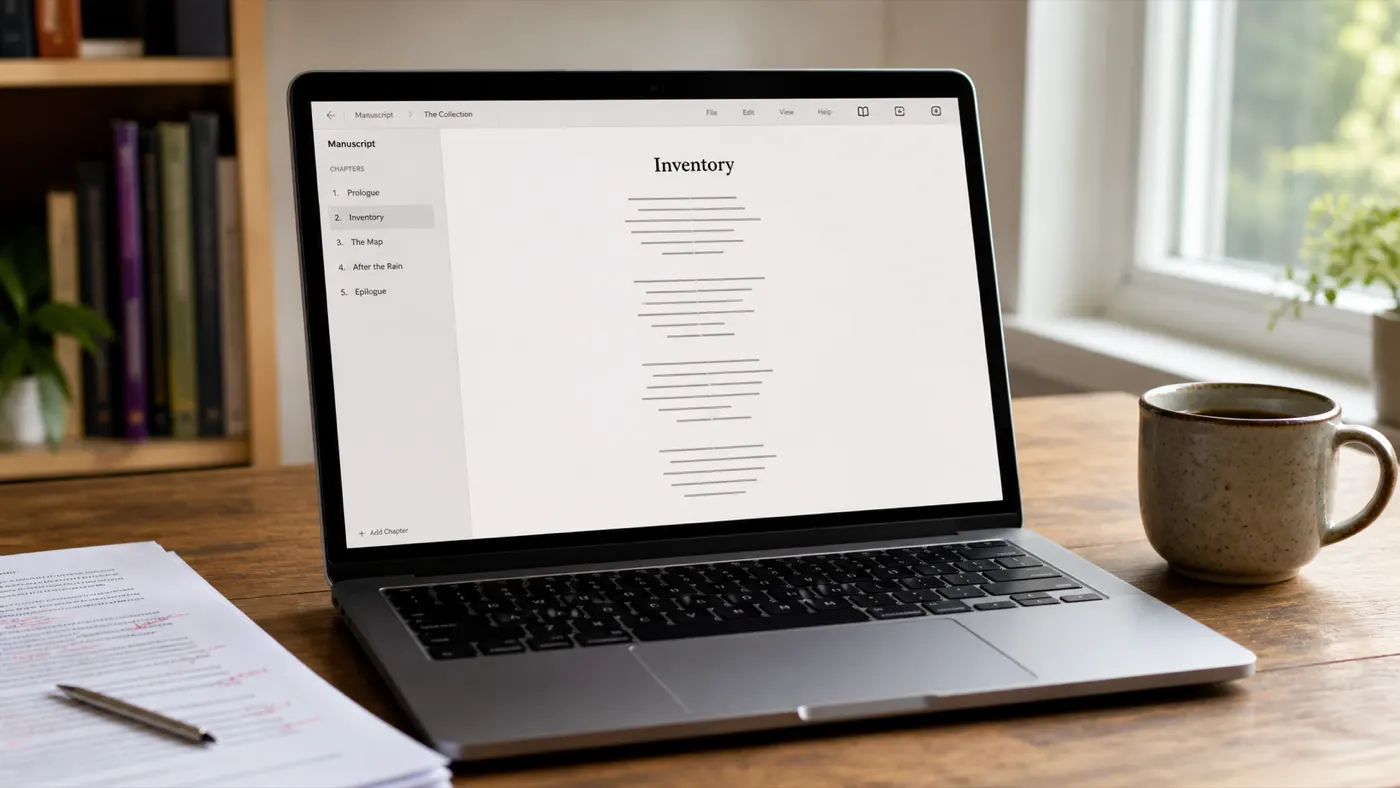
Laptop on a wooden desk showing the Inkfluence editor with a poem titled 'Inventory' rendered in a clean light theme, a chapter list on the left sidebar showing five sections, plant and ceramic mug beside the laptop.
1

Describe your collection

Tell the AI what the collection is about: the theme, the emotional arc, the audience. "A poetry collection on grief, moving from loss through memory toward acceptance" is enough. The AI plans 5-7 thematic sections that progress emotionally across the book.

2

Pick your form mix

Choose how much formal-form work you want. The default mix rotates: lyrical free-verse-heavy sections alternate with formal-form sections (sonnets, villanelles), short-form sections (haiku sequences, couplets), and experimental sections (prose poems, list poems, concrete). You can also lock the entire collection to one form if you prefer.

3

Generate the collection

The generator writes every poem with proper line breaks, stanza structure, and form-specific rules. Sonnets land at 14 lines with octave-sestet-couplet structure. Villanelles land at 19 lines with refrain pattern. Haiku follow 5-7-5 syllable structure. Each poem has a 1-4 word evocative title. No prose narrative leaks, no workshop-style "Sonnet for X" titles.

4

Edit and refine

Adjust any line directly in the editor. Use Improve on a selected passage to refine wording without rewriting the meaning. Reorder poems within sections, reorder sections within the collection, drop poems that do not work. The editor preserves your exact line breaks throughout.

5

Design cover and export

Generate a cover designed for poetry collection aesthetics (typography-led, restrained palettes, room for the poet's name). Export PDF for KDP paperback (print-ready trim), EPUB for Kindle ebook, DOCX for editors and beta readers. Generate an ACX-spec audiobook for Audible distribution if you want the audio version.

Comparison

AI poetry collection vs the traditional indie path

Same finished book, very different timeline and cost.

Step Traditional indie poet With Inkfluence
Drafting 6-18 months in notebooks, Word docs, Scrivener 1-3 hours, structured by section and form
Editing $300-1,500 for a freelance poetry editor Built-in line-level Improve, free across plans
Formatting Vellum ($249) or freelancer ($150-400). Poetry-specific spacing is finicky. Per-form CSS handled automatically (centered haiku, indented closing couplets, justified prose poems)
Cover $150-600 for a designer, or hours in Canva Generated cover tuned for poetry aesthetics, included in plan
EPUB / Kindle Hand-built or $99 conversion service. Risk of broken line breaks. One-click EPUB with reflowable poetry stanzas preserved
Audiobook $1,500-5,000 for a narrated audiobook. ACX QC rejection rates 15-30%. ACX-spec audiobook generated in one workflow, included on Creator+
Total time, theme to live 8-24 months Same day, plus KDP review window
Total cost $2,000-7,500 $0-19.99 (free plan ships first chapbook)

Cost ranges sourced from Reedsy editor marketplace (2026), ACX standard production rates, and KDP cover designer marketplace.

Use cases

Who this is for

Reader's hands holding a small printed paperback poetry collection on a linen cushion, abstract typography on the cover, black wired earbuds curling beside the book.

Indie poets shipping books

First collection, second collection, themed chapbook. Skip the Scrivener-Vellum-Canva-KDP stack and ship in days.

Coaches and creators

A short themed poetry collection makes a strong lead magnet for grief work, mindfulness, recovery, parenting, and creative communities.

Spoken-word and audio poets

Generate a written collection, then ACX-spec audiobook in one click. Audible accepts AI-narrated poetry submissions with disclosure.

Memoir poets

Lived-experience material translated into formal forms. Import your own poems with the Import option, then refine.

Devotional and faith communities

Daily-devotion poetry collections, hymn-style verse, themed reflections for retreats and study groups.

Educators and workshop leaders

Form-by-form example collections for teaching sonnets, villanelles, ghazals. The form rules are baked in, so the examples are structurally correct.

What sells

Poetry niches that move on Kindle

Where indie poetry is finding its biggest audiences in 2026. Pick the niche, then build the collection around it.

Modern micro-poetry

Short, image-driven, line-broken free verse in the Rupi Kaur, Atticus, R.M. Drake style. The single largest poetry segment on Kindle. Themes: love, healing, womanhood, identity, growth.

Grief and loss

Bereavement collections sell consistently because the search demand is constant. Often gifted, often re-bought. Tone: tender, honest, never preachy.

Mental health and recovery

Depression, anxiety, sobriety, burnout. Strong audience overlap with self-help readers. Pair with a journal or workbook bundle for stronger ranking.

Faith and devotional

Christian poetry, Psalms-inspired collections, daily-devotion verse. Strong base of repeat buyers, often church-recommended.

Nature and seasonal

Forest, ocean, garden, seasonal cycle. Pairs with mindfulness and slow-living adjacent audiences. Haiku-heavy collections perform well here.

Love and relationships

Romantic, queer, divorce, motherhood, friendship. Evergreen demand and strong gift-purchase pattern, especially around Valentine's, Mother's Day, anniversaries.

Identity and place

First-generation, diaspora, queer, regional. Specific is sellable: tighter audience, deeper loyalty, stronger word-of-mouth.

Form-led literary

Sonnet sequences, ghazal collections, villanelle cycles, contemporary haibun. Smaller audience but premium-priced and respected by literary-magazine submission editors.

Children's poetry

Read-aloud collections, classroom anthologies, alphabet and counting books in verse. High shelf life. Works as both ebook and print.

Starter prompts

Poetry collection prompt templates

Copy any of these as your starting brief, edit to your theme, paste into Inkfluence and let it plan the sections.

Grief collection (free verse + sonnet mix)

A poetry collection on grief, moving from loss through memory toward acceptance. 6 sections. Mix free verse with two sonnets per section. Tender, image-driven, no abstractions. Audience: adult readers who have recently lost a parent.

Modern micro-poetry chapbook

A short modern poetry chapbook on becoming. 30 short free-verse poems, each under 14 lines, organised into 3 movements: leaving, between, arriving. Voice: direct, intimate, second-person, no metaphors that need a glossary.

Nature and seasonal (haiku-heavy)

A four-section collection following the seasons. Each section opens with a 7-haiku sequence and closes with one longer free-verse poem. Imagery should be specific to the Pacific Northwest. Audience: slow-living and mindfulness readers.

Devotional / faith collection

A 31-poem devotional poetry collection, one poem per day, drawn from Psalm-style imagery and contemporary daily life. Each poem 8-16 lines. Tone: reverent, hopeful, never sermonising. Audience: Christian readers using the book for morning quiet time.

Form-led literary collection

A 21-poem sequence: 7 villanelles, 7 ghazals, 7 prose poems. Theme: time and the body. Voice: lyric, image-rich, willing to risk obscurity. Audience: literary-magazine readers and MFA-adjacent.

Coach lead-magnet chapbook

A 12-poem chapbook for women navigating divorce. Modern free-verse style, each poem under 12 lines, ends with quiet hope without being preachy. Distributed as a free PDF in exchange for email signup. Sections: anger, exhaustion, clarity, beginning.

Comparison

Inkfluence vs general AI chat for poetry

Why a purpose-built poetry book tool produces a publishable book and a general chatbot produces 30 disconnected poems in your scrollback.

Feature General AI chat Inkfluence
Form structure enforcement "Sonnet" prompts often return 12 or 16 lines 14 lines, structured octave-sestet-couplet, every time
Collection-level arc Each prompt is a fresh start, no through-line Plans 5-7 sections that progress emotionally across the book
Title and section consistency Defaults to workshop-style "Sonnet for X" titles 1-4 word evocative titles drawn from poem imagery
Output formatting Plain text with inconsistent stanza breaks Semantic stanza markup, per-form CSS in PDF and EPUB
Editing Copy-paste between chat and Word, lose your edits In-place editor, line-level Improve, version history
Cover design Separate tool, separate subscription, hours of work Generated cover tuned for poetry, in the same workflow
Export formats None. You handle formatting yourself. PDF, EPUB, DOCX, ACX-spec audiobook, all one click
KDP-readiness Manual Print-ready trim, copyright page, table of contents included
Tool landscape

How AI poetry tools compare

Most AI poetry tools generate one poem at a time. Inkfluence generates the whole book.

Capability Inkfluence AI Single-poem generators General writing assistants Traditional editor + designer
Generates a full collection Yes, 20-80 poems No, one at a time Manual orchestration You write, they edit
Form structure enforced 9 forms, all structurally correct Inconsistent Inconsistent Editor catches issues
Built-in cover design Yes No No Separate hire
EPUB export with poetry CSS Yes No DIY in Sigil or Vellum Often outsourced
ACX-spec audiobook Yes No No $1,500-5,000 narrator
Cost to ship one chapbook $0 on free, $9.99/mo on Creator Free, but no book at the end $20-30/mo + hours of glue work $2,000-7,500 total
KDP publishing

Publishing your poetry collection on Amazon KDP

The shortest path from generated collection to live Kindle listing.

1. Pick your trim size

For poetry, 5"x8" or 5.5"x8.5" is standard. Smaller trim makes line breaks land more cleanly and feels more like a literary collection. Inkfluence exports print-ready PDFs at all KDP-supported trims.

2. Categorise correctly

Use Books > Literature & Fiction > Poetry as your primary category, then pick a sub-category that matches your niche (American Poetry, Inspirational, Religious, Love, Nature). Sub-category choice has a significant effect on bestseller-rank visibility.

3. Disclose AI use

KDP's content guidelines require disclosure of AI-generated text content during the publishing form. The disclosure is private (Amazon does not display it on the listing). It does not affect ranking or visibility, but skipping it risks account suspension.

4. Price the chapbook

Kindle poetry chapbooks typically price at $2.99-4.99 (qualifies for the 70% royalty band). Paperbacks at $7.99-12.99 depending on page count. Check the Kindle 70% royalty page-count rules: very short chapbooks may default to 35% royalty.

5. Consider an ACX audiobook

Audible accepts AI-narrated poetry submissions with disclosure. A 30-poem chapbook makes a 30-60 minute audiobook, well within Audible's preferred length for poetry. Inkfluence handles the spec (44.1 kHz, 192 kbps CBR, mono, RMS -23 to -18) automatically.

FAQ

Frequently asked questions

Can AI really write good poetry?

+
For most contemporary forms, yes. AI handles free verse, sonnets, villanelles, haiku sequences, ghazals, prose poems, list poems, and concrete poems with proper structure and original imagery in 2026. Highly performance-driven forms (slam poetry, spoken-word with specific cadence) still benefit from a human pass after generation. Most published indie poets use AI for the first draft and refine by hand.

What forms does the AI support?

+
Free verse, sonnet (14 lines, Shakespearean structure), villanelle (19 lines with refrain pattern), haiku sequence (3-line haiku linked by image), prose poem, list poem (anaphoric), concrete poem (visual shape), couplet sequence, and ghazal. Each form has its own structural rules baked into the generator, so a sonnet really is 14 lines and a villanelle really is 19.

Does it write a single poem or a full collection?

+
Full collections. You describe the theme and the AI plans 5-7 thematic sections, each containing 4-6 poems in a varied mix of forms. The collection has a narrative arc, early sections establish the emotional ground, middle sections complicate or deepen, final sections resolve or transcend.

Can I import my own poems and just refine them?

+
Yes. Use the Import option (DOCX, PDF, or EPUB) on the dashboard to bring an existing poetry manuscript into Inkfluence. From there you can edit any poem directly and use Improve on selections to refine wording without rewriting your work.

How is this different from a generic AI poem generator?

+
Generic AI poem generators output one poem at a time, no book structure, no formatting, no cover, no export. Inkfluence is built for the entire publishing pipeline: idea to formatted manuscript to cover to ACX-spec audiobook to KDP-ready PDF and EPUB. One subscription, one workflow.

Can I publish the poetry collection on Amazon KDP?

+
Yes. Export as a print-ready PDF for KDP paperback (with proper trim size and bleed), EPUB for Kindle ebook distribution, or both. Inkfluence formats poetry differently from prose: tight stanza spacing, hanging indents on long lines that wrap, distinct styling per form (centered haiku, indented closing couplets in sonnets, justified prose poems).

Does it work for audiobook poetry?

+
Yes. Generate an ACX-spec audiobook (44.1 kHz, 192 kbps CBR, mono, RMS -23 to -18) with a single click. Voice pacing is set slower than prose narration to suit verse delivery, with stanza breaks reflected in audio pauses. Audible accepts AI-narrated poetry submissions with disclosure. See our ACX audiobook guide for full submission steps.

How much does it cost?

+
The free plan generates a complete collection with PDF export. Creator at $9.99/month adds EPUB and DOCX export and 15 audiobook chapters. Premium at $19.99/month adds unlimited chapters and 30 audiobook chapters. No per-poem credits, no separate tools to license. Cover design and editing are included in every plan.

Can I use AI poetry as a lead magnet?

+
Yes. A short themed poetry collection (10-20 poems) makes a strong email-list lead magnet for coaches, therapists, ministers, wellness brands, and creative communities. Export the collection as a branded PDF, drop it into ConvertKit or Mailchimp, and offer it in exchange for an email subscription.

What about copyright on AI-generated poetry?

+
In the US, the human author of an AI-assisted work owns the copyright as long as substantial human creative input is involved (selection, editing, arrangement). UK and EU rules vary slightly. Inkfluence generates poems based on your specific theme and direction, and you typically edit and arrange the collection, both of which establish authorship under most jurisdictions. See our Terms for the licensing detail.

How long should a poetry collection be?

+
Chapbooks (the standard for first collections and lead magnets) run 20-40 poems across 30-50 pages. Full collections run 40-80 poems across 60-120 pages. Anthologies and themed collections can run longer. Inkfluence handles all three lengths in the same workflow: pick how many sections, pick how many poems per section, and the AI plans the arc accordingly.

Can I write Instagram-style modern poetry?

+
Yes. Short, image-driven, line-broken free verse in the Rupi Kaur, Atticus, R.M. Drake style is one of the highest-volume poetry markets on KDP and direct-to-Kindle. Inkfluence supports the form natively: short stanzas, white-space rhythm, line breaks that read like breath. Pair with a typography-led cover and you have a publishable collection in under an hour.

What languages does the AI write poetry in?

+
English (US, UK, AU), Spanish, French, German, Italian, Portuguese, Polish, Dutch, and 20+ more. The poetry forms apply across languages where they are recognised (sonnets in Italian land in 11-syllable hendecasyllables, ghazals in Urdu transliteration follow original couplet rules). For other languages the form rules use the closest English equivalent.

Will the AI rhyme when I want it to?

+
Yes. Sonnets follow ABAB CDCD EFEF GG by default. Villanelles follow the standard ABA refrain pattern. Ghazals follow the qaafiyaa-radif pattern. Free verse and prose poems do not rhyme unless you ask. You can also request a custom rhyme scheme on any form: enter the scheme in the chapter notes and the AI will follow it.

Does the formatter handle visual / concrete poems?

+
Yes. Concrete poems (where the visual arrangement carries part of the meaning) export with whitespace and line position preserved exactly. The PDF, EPUB, and DOCX exports use a monospaced fallback for concrete poems so spacing is honoured on every device. This is one of the hardest things to get right in standard ebook formatters and we tested it specifically against KDP's Kindle preview.

Can I get a blurb or back-cover copy too?

+
Yes. Inkfluence generates back-cover blurb copy alongside the manuscript itself. Poetry blurbs follow their own conventions (evocative phrasing, named themes, hint at form mix) and the AI knows the difference between a poetry blurb and a novel blurb. Edit it like any other chapter.

Is there a way to preview before exporting?

+
Yes. The Preview button shows the full book rendered in print-style page layout, with the cover, copyright page, table of contents, and every poem laid out exactly as it will appear in the final PDF. Useful for spotting line-break issues, awkward stanza breaks across pages, or formatting choices you want to revise before exporting.
Long read

Why poetry is having its biggest moment in a generation

For most of the twentieth century, poetry was treated by the publishing industry as a prestige category that lost money. Trade publishers carried small poetry lists for cultural credit, university presses absorbed the rest, and a working poet survived by teaching, not by sales. The audience existed but was diffuse, mostly literary, and mostly served by libraries rather than by retail.

Three things changed that. First, social media compressed poetry to a length that fit a phone screen and rewarded image-driven brevity, which produced the wave of Instagram poets that began with Rupi Kaur in 2014 and continues with Atticus, R.M. Drake, Nikita Gill, and a long tail of regional and identity-specific voices. Second, Kindle Direct Publishing removed the gatekeeper: any poet with a finished manuscript could be on Amazon within 72 hours, which collapsed the traditional path to print but opened a global retail surface. Third, the cultural appetite for short-form emotional writing shifted from blogs (which collapsed) to poetry (which absorbed the demand), particularly during and after the pandemic, when attention spans contracted and grief writing surged.

The numbers track the shift. Adult-poetry print sales in the US grew roughly 76% between 2017 and 2023 according to NPD BookScan figures reported by Publishers Weekly. Milk and Honey alone has sold more than 12 million copies. The NEA Survey of Public Participation in the Arts now estimates 28 million US adults read poetry annually, the highest figure in the survey's history. None of this was visible to the trade publishing industry as it was happening, because the growth was largely indie, largely Kindle, and largely outside the literary review establishment.

What this means for an indie poet today is unusual: the audience is bigger, more accessible, and more willing to buy directly than it has been at any point in the last hundred years. The bottleneck is no longer reaching readers. The bottleneck is the production stack itself: drafting a manuscript, editing it, formatting it for poetry (not prose), designing a cover that signals to the right audience, and shipping the file to retail. Each of those steps used to take a freelancer, a tool subscription, or a learning curve. AI compresses the entire production stack into one workflow. The poet supplies the voice, the theme, and the editorial judgement. The pipeline supplies everything else.

This is why the most-shipped indie poetry collections in 2026 are increasingly AI-assisted. The poets are not replacing themselves with the model. They are replacing the editor, the formatter, the cover designer, the ebook converter, and the audiobook producer with a single tool, and using the time and money saved to write more, ship more, and reach the audience that has been waiting for them.


Roadmap

A 30-day plan to publish your first poetry collection

A realistic week-by-week calendar from blank page to live KDP listing.

Days 1-3

Pick the audience and the theme

Decide who the collection is for in one sentence (a recently-bereaved daughter, a queer parent, a sober mother). Write the theme statement. Generate three sample sections in three different form mixes to feel the tone.

Days 4-7

Generate the full manuscript

Run the full collection generator with the form mix you settled on. The AI plans 5-7 sections and writes every poem. Read the whole thing once without editing. Note which poems land hardest. Note which ones you want to drop.

Days 8-15

Edit line by line

This is where your voice enters. Open each poem in the editor. Replace AI smoothness with your specific imagery. Add details only you would know (the brand of bread, the make of car, the hospital corridor smell). Cut the poems that do not earn their place. Aim for 30-50 poems.

Days 16-18

Sequence the collection

Reorder poems within sections. Reorder sections within the book. Open with one of your strongest poems. Place the most emotionally heaviest piece in the middle, not the end. End on resolution, transcendence, or quiet hope, not the bleakest piece.

Days 19-21

Cover, blurb, and front matter

Generate a typography-led cover. Try three palettes, pick the one that signals your audience. Write the back-cover blurb (or use the generated one as a starting point). Write a one-page dedication or introduction if it serves the collection.

Days 22-24

Send to three beta readers

Export DOCX. Send to three readers who match your target audience. Ask: which poem hit hardest, which felt redundant, which ending lands the book. Wait 48 hours. Apply the obvious notes, ignore the contradictory ones.

Days 25-27

Final exports and KDP setup

Export print-ready PDF for paperback at 5"x8" or 5.5"x8.5". Export EPUB for Kindle. Set up KDP listing: title, subtitle, author, description, two categories (primary in Poetry, secondary in your audience niche), seven keywords. Disclose AI use during the upload form.

Days 28-30

Soft launch to your community

Tell your existing audience first (Instagram, newsletter, group chat). Offer a free PDF copy in exchange for an honest review during the first week. Trade reviews with three other indie poets in your niche. The first 10-20 reviews on Amazon are what trigger the recommendation engine.

What to avoid

Common mistakes in AI-assisted poetry collections

The patterns that mark an unedited AI collection on Kindle, and what to do instead.

Mistake 1: Shipping the first draft unedited

AI poems out of the box are competent but generic. Readers and reviewers can identify unedited AI output within three poems. Always do the line-by-line editing pass: replace generic imagery with your specific imagery, cut weak poems, sequence with intention.

Mistake 2: Generic theme statements

"A collection on love" produces generic poems. "A collection on the love between an adult daughter and a parent in late-stage dementia" produces specific, original work. Specificity in the prompt produces specificity in the output. Always describe the audience and the situation, not just the abstract theme.

Mistake 3: Mixing too many forms

A collection that contains every form (sonnet, villanelle, haiku, prose poem, ghazal, list poem, concrete) feels like a sample reel rather than a book. Pick a primary form and one or two complementary forms. Variety is good. A circus is not.

Mistake 4: Cover that does not signal the audience

A novel-style cover (illustration, character figure, dramatic lighting) on a poetry collection signals fiction and confuses Kindle browsers. Poetry covers are typography-led with restrained colour, room for the poet's name, and minimal imagery. Match the convention so the reader knows what they are looking at.

Mistake 5: Skipping the AI disclosure on KDP

KDP requires AI disclosure during the publishing form. The disclosure is private (Amazon does not display it on the listing) and does not affect ranking. Skipping it risks account suspension. Always tick the box.

Mistake 6: Pricing the chapbook at $0.99

Below $2.99 on Kindle, you drop from the 70% royalty band to the 35% royalty band. A $2.99 sale earns the same royalty as a $0.99 sale at the lower band. Price at $2.99 to $4.99 unless you have a strategic reason to price lower (a launch promotion, a bundle).

Mistake 7: No back-cover blurb

The blurb is what converts a Kindle browser into a buyer. Poetry blurbs follow their own conventions: evocative phrasing, named themes, hint at form mix, include one or two short excerpts. Write it like a small poem about the book itself.

Mistake 8: Launching to silence

A book with zero reviews in week one is invisible to Amazon's recommendation engine. Tell your existing community before launch day. Offer free PDFs in exchange for honest reviews. Trade reviews with other indie poets in your niche. The goal is 10-20 reviews in the first month, not the first week.

Pricing

Plans for poetry book publishing

All plans include cover design and the line-by-line editor. Choose based on volume and audiobook needs.

Free
$0
Forever free for first chapbook
  • 5 chapters to start, 5 more every month
  • Cover designer
  • PDF export for KDP paperback
  • Line-by-line editor
Most popular
Creator
$9.99/mo
Or $89/year
  • 35 chapters per month
  • Everything in Free
  • EPUB and DOCX export
  • 15 audiobook chapters per month
  • Improve on selection
Premium
$19.99/mo
Or $179/year
  • Unlimited chapters
  • Everything in Creator
  • 30 audiobook chapters per month
  • Priority generation queue
  • ACX-spec audiobook bundle

No per-poem credits. No separate tools to license. Cancel any time. Full pricing comparison

Glossary

Poetry terms worth knowing

Stanza

A grouped unit of lines in a poem, separated by blank space. Like paragraphs but with stricter musical purpose.

Meter

The rhythmic pattern of stressed and unstressed syllables in a line. Iambic pentameter (the sonnet meter) has five iambs per line.

Volta

The turn or pivot in a poem, where the argument shifts. In a sonnet, usually around line 9 or in the closing couplet.

Enjambment

When a sentence runs across a line break without punctuation. Creates momentum, surprise, or tension between syntax and form.

Anaphora

Repetition of the same opening word or phrase across consecutive lines. The structural backbone of list poems and many psalms.

Slant rhyme

An imperfect rhyme (boat / bought, lake / luck) accepted as the contemporary alternative to forced perfect rhyme.

Refrain

A repeated line or phrase across a poem. Central to the villanelle (two refrain lines) and the ghazal (a single refrain word).

Kireji

The "cutting word" or pause in a haiku, usually after the first or second line, where one image meets another.

Kigo

A seasonal reference in a haiku (cherry blossom, snow, kettle steam, fireflies). Traditional but optional in contemporary practice.

Chapbook

A short poetry collection, typically 20-40 poems across 30-50 pages. The standard format for a first poetry book.

Quatrain

A four-line stanza. The Shakespearean sonnet has three of these followed by a closing couplet.

Couplet

A two-line unit, often rhymed. The closing couplet of a Shakespearean sonnet usually delivers the volta.

Note from the founder

Why we built poetry into Inkfluence

When we shipped Inkfluence, the first version handled prose books cleanly: novels, self-help, business, how-to. Poetry was on the roadmap but kept slipping because the surface area is hard. Sonnets do not behave like chapters. Haiku do not behave like paragraphs. Concrete poems mock every generic ebook formatter.

What forced the work was the customers. We had poets signing up, generating collections, and then writing in to ask why the EPUB had broken their stanza spacing or why the AI kept producing 12-line "sonnets". The honest answer was that we had not built poetry properly. The poetry mode was prose generation with a poetry coat of paint.

So we tore it apart and rebuilt it the way it should have been built the first time. Form rules baked into the generator (the sonnet really is 14 lines, the villanelle really is 19, the haiku really is 5-7-5). Per-form rendering in the export layer (centred haiku, indented closing couplets, justified prose poems, exact whitespace for concrete). A renderer that treats stanzas semantically, not as accidental paragraph breaks. An audiobook pipeline tuned for verse pacing.

This page is the front door to that work. If you ship a poetry collection through Inkfluence and something does not render the way it should, write to me directly at hello@inkfluenceai.com. I read every message. The poetry pipeline exists because poets pushed us to build it properly. We will keep pushing it forward the same way.

Sam May, founder, Inkfluence AI

References

Sources and citations

Public data, marketplace observation, and standards documents underpinning the claims on this page.

  1. Adult-poetry print sales growth (US, 2017-2023, +76%), NPD BookScan figures reported in Publishers Weekly's annual category roundups. Poetry has been the fastest-growing print category in adult trade for five consecutive years.
  2. Rupi Kaur, Milk and Honey, 12M+ copies sold, Penguin Random House publisher figures and bestseller list reporting (NYT, Publishers Weekly). Verified through Andrews McMeel Publishing.
  3. NEA Survey of Public Participation in the Arts, National Endowment for the Arts: roughly 28 million US adults read poetry annually, the highest rate in the survey's history.
  4. KDP poetry chapbook pricing band, Direct observation of the Kindle Poetry bestseller list, May 2026, top 100 chapbooks ranged $0.99 to $9.99 with median around $4.99.
  5. Reedsy editor and designer marketplace rates, Public marketplace pricing for poetry editors and book designers, Reedsy 2026 listings.
  6. ACX audiobook production rates, Audiobook Creation Exchange standard production cost ranges and royalty share splits.
  7. ACX submission spec (44.1 kHz, 192 kbps CBR, mono, RMS -23 to -18), ACX submission requirements documentation.
  8. KDP AI content disclosure requirements, Amazon Kindle Direct Publishing content guidelines, AI-generated content disclosure section.
Author in a sunlit home office holding a freshly printed poetry collection in both hands, examining the cover with quiet satisfaction, a small stack of more copies on the desk beside him.

Start your poetry collection

Free to start, no credit card. Generate your first collection, format it, and export a print-ready PDF in under an hour.

Start writing →