
Etsy AI Disclosure Explained 2026 (Exactly What to Tick, Type, and Avoid)
A complete plain-English guide to Etsy AI disclosure rules in 2026. The exact form fields, the disclosure language buyers expect, what gets flagged, and how Inkfluence AI auto-handles it on every listing.
Quick Answer
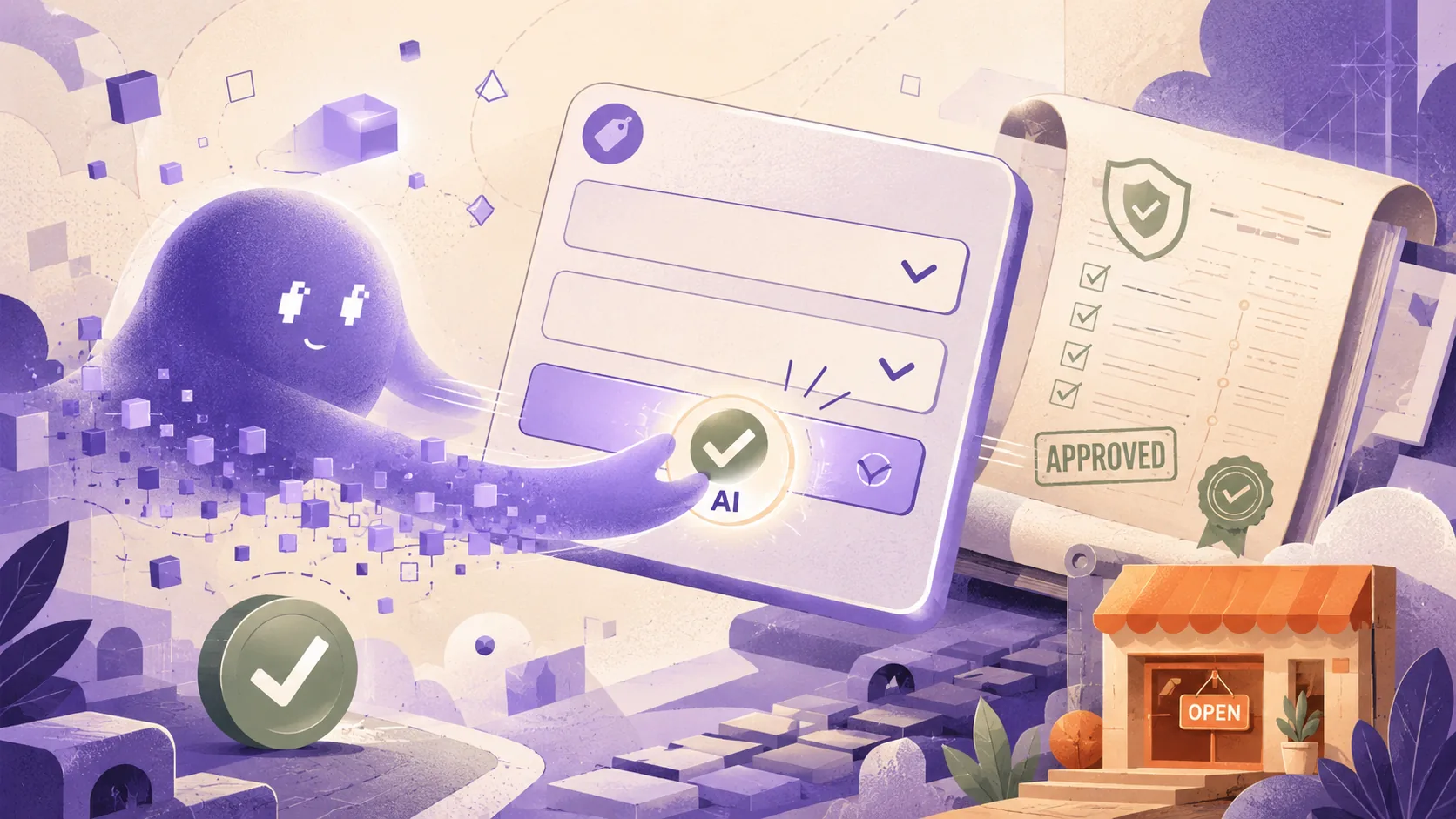
Etsy requires AI-generated digital products to be (1) categorized as "Designed by a seller" under the Creativity Standards, (2) set with the three production dropdowns correctly (who_made = "I did", when_made = "Made to order", is_supply = "a finished product"), and (3) disclosed with explicit AI mention in the listing description. The rules were tightened on June 10, 2025. Listings that skip disclosure get flagged and removed by Etsy's automated moderation. Inkfluence AI sets the production fields correctly via the Etsy API and auto-appends an AI disclosure line to every published listing's description, so you never have to remember the policy text.
By Sam May, founder of Inkfluence AI · Updated August 2026
Why this matters
Get this right once and every future Etsy listing is safe.
Etsy's AI disclosure rules are the single most-confused area of selling AI-generated digital products on the platform. The rules ARE clear, but they're scattered across three different Etsy policy pages. Sellers either over-disclose (writing apologetic paragraphs in their listings that hurt conversion) or under-disclose (getting flagged and removed). Neither is necessary.
This guide gives you the exact wording, the exact form fields, and the exact disclosure language that keeps your listings safe AND maximises conversion. Inkfluence AI handles all of this automatically on every published listing, but understanding the rules yourself means you can verify the system is working and edit if you want different language.
86.6M¹
Active Etsy buyers (Q1 2026)
3²
Production dropdowns to set
Jun 2025³
Creativity Standards update
1-click
Inkfluence handles it all
Inkfluence AI is the only AI ebook tool with native Etsy publishing that automatically handles AI disclosure correctly. Read on if you want to understand the rules, OR skip ahead and just generate your first compliant Etsy listing free here (5 chapters free, no card required).
Etsy's AI policy in plain English
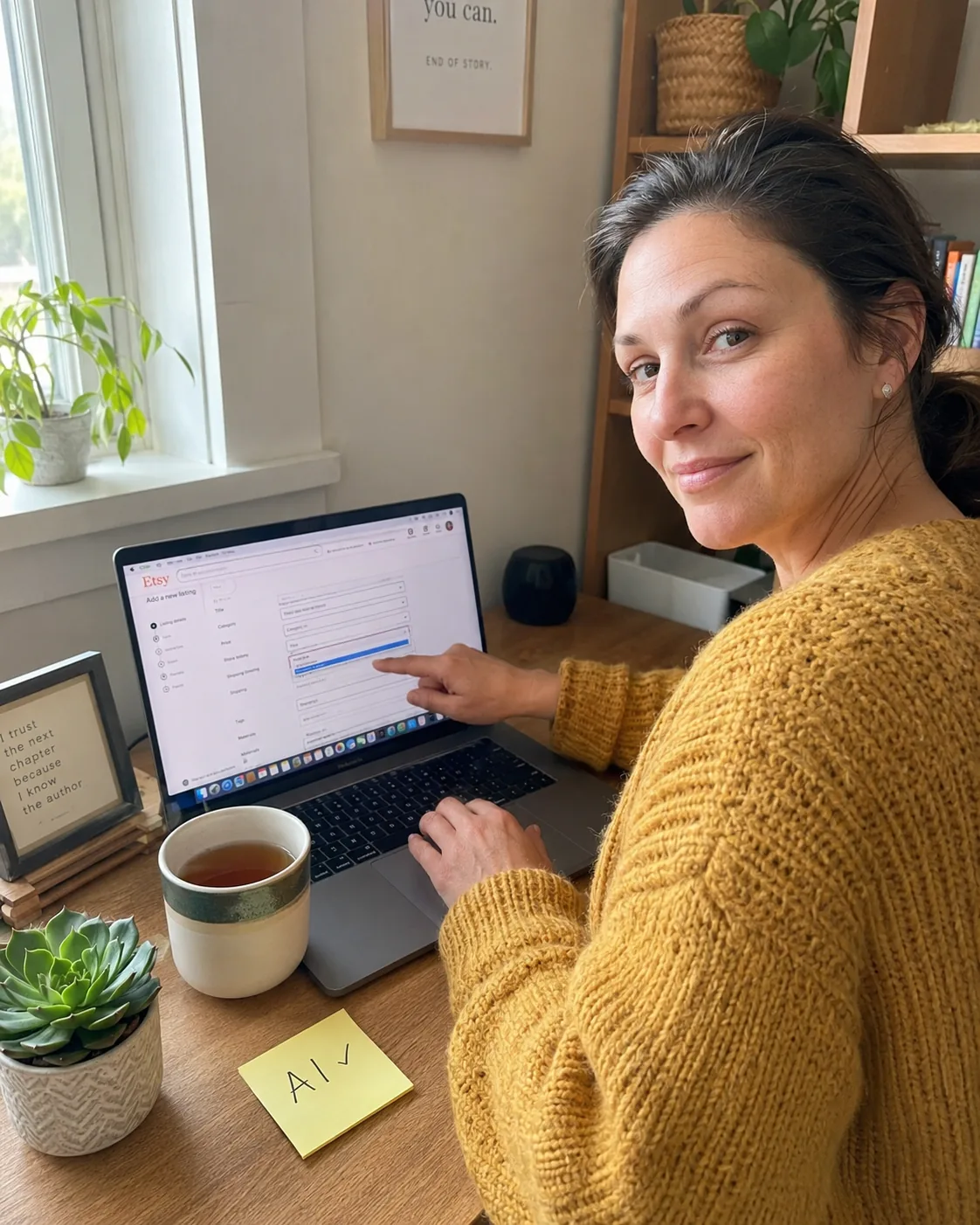
Etsy permits AI-generated digital products under their Creativity Standards, last meaningfully updated on June 10, 2025. The full policy lives at etsy.com/legal/creativity but the practical version is this:
The 3 conditions
- You disclose that AI was used in the creation process.
- You list yourself as the designer (you wrote the prompt, directed the output, edited the result, chose the cover).
- You don't infringe on copyrighted characters, names, or artistic styles.
That's it. Three conditions. Meet all three and you're compliant. Skip any one and you risk flagging.
What Etsy is NOT doing: banning AI as a category, requiring a special review, charging extra fees, or limiting which AI tools you can use. They explicitly welcome seller-prompted AI creations. The compliance bar is honesty about how the product was made, not a quality judgment about AI itself.
What changed on June 10, 2025: Etsy explicitly added digital downloads to the Creativity Standards (previously the rules were more focused on physical goods), prohibited reselling third-party templates as your own, and tightened enforcement on undisclosed AI listings. The platform has gotten significantly stricter on enforcement in 2025-2026, with automated detection and member reporting both catching undisclosed AI content.
What "Designed by a seller" actually means
This is the most-misunderstood part. Etsy's Creativity Standards categorize AI-generated items under "Designed by a seller". Not "Made by a seller." The distinction matters because Etsy is historically a handmade marketplace, and "made" implies physical craft. "Designed" is the right framing for AI-generated digital products.
"Designed by a seller" means YOU directed the creation process: you chose the topic, you wrote the prompts, you reviewed the output, you edited where needed, you picked or designed the cover, and you decided what to sell. The AI was your tool, the way a sewing machine is a quilter's tool. You're still the designer.
✅ Counts as "Designed by a seller"
- You used Inkfluence AI to generate an ebook from your prompt and reviewed the output
- You wrote ChatGPT prompts and edited the response heavily
- You used Midjourney for a cover image you chose and refined
- You used AI for first-draft text and rewrote 30%+ of it
❌ Does NOT count
- Reselling another creator's AI-generated ebook
- Selling AI prompts themselves as the product
- Selling AI-generated content that uses copyrighted IP
- Listing AI output verbatim without review or any human direction
The second bullet on the right matters: Etsy explicitly prohibits selling AI prompts as the deliverable. If your "product" is a list of ChatGPT prompts, that's against policy. If your product is an ebook that you generated using AI prompts, that's fine. The difference is what the buyer receives.
The three production dropdowns explained
Etsy's API exposes three production fields when you create a listing. The Etsy seller dashboard surfaces these as form dropdowns. Here's exactly what to set for an ebook made with an AI ebook generator:
Field 1: who_made = "I did"
You directed the creation. You own the listing. Even if AI did the typing, you wrote the prompts and made the decisions. This is the right answer for any AI-generated product where you were the prompt-author and editor.
API value: who_made=i_did · Other valid values: "Another company or person" (rarely used for digital), "A member of my shop" (multi-seller shops)
Field 2: when_made = "Made to order"
For digital downloads, each sale delivers a copy of your master file. That technically fits "Made to order" (Etsy creates the download instance at purchase). If you have a backlog of older ebooks, "Made within the last year" or "Made between" with a date range also works.
API value: when_made=made_to_order · Other valid: "Made within the last year", "Made between 2020-2025", various specific year ranges
Field 3: is_supply = "a finished product"
Ebooks, workbooks, devotionals, kids activity books, planners. These are all finished products, not raw materials/supplies. Set this to false (not a supply).
API value: is_supply=false
That's the three. Inkfluence's Etsy integration sets all three correctly via the Etsy API on every published listing, so you never have to remember the dropdown sequence. If you're publishing manually, set these three in the Production section of the listing form.
The AI disclosure line in your description
The production dropdowns alone aren't enough. Etsy's Creativity Standards also require the AI use to be disclosed in the listing description. This is the part most undisclosed listings miss.
The disclosure doesn't need to be long, apologetic, or buried at the bottom. A single line is sufficient. Most successful AI ebook sellers use one of these formulations:
"Created with AI assistance. Edited and finalized by the seller."
"AI-generated content. Curated and designed by [Your Shop Name]."
"This digital product was created using AI tools and reviewed by the seller."
"Created with AI assistance using Inkfluence AI." (this is what we auto-append)
Where to put it: typically at the bottom of the description, separated from your main sales copy with a divider line ("---") so it doesn't interrupt the buyer's flow. Visible and findable, but not the headline.
How Inkfluence handles this
When you publish from Inkfluence to Etsy, we auto-append "Created with AI assistance using Inkfluence AI (inkfluenceai.com)." to your listing description, separated by a divider. You can edit or remove it before publishing if you want different wording, but having something there is what keeps your listing safe. Try it free →
What gets listings flagged and removed
Etsy's enforcement has three layers: automated AI detection (looking for telltale patterns in text and images), manual moderation review (triggered by reports or automated flags), and member reports (other sellers flagging your listing). Any of the three can lead to removal.
What we see flagged most often in 2025-2026:
-
1. No mention of AI anywhere
The single most common removal reason. Listings that look AI-generated (cover style, prose patterns) but never mention AI in the description get auto-flagged. Adding the disclosure line solves this entirely.
-
2. AI-generated content using copyrighted IP
"AI-generated Harry Potter fan fiction," "Marvel character workbooks," "Disney princess colouring book". These get removed instantly. The IP rules apply regardless of how the content was made.
-
3. Selling AI prompts as the product
"50 ChatGPT prompts for productivity" sold as a prompt pack is against policy. Same content packaged as "Productivity playbook with AI-generated examples" is fine. The framing as the actual deliverable matters.
-
4. Production dropdowns set incorrectly
Listings that set "who_made = Another company" (implying the seller didn't create it) for AI-generated content get flagged because Etsy treats the seller as the designer, not "no one." Use "I did" for any AI listing you directed.
-
5. Bulk duplicate listings
Sellers who upload 50+ near-identical AI-generated listings in a day trigger Etsy's spam filters. Spread your launches out (5-10 per week is fine) and vary your titles, descriptions, and covers per listing.
Sellers occasionally report false-positive flagging in 2025-2026 (compliant listings getting taken down by mistake) but Etsy's appeal process generally restores them within 3-7 days if you can show the disclosure line and IP compliance. Keep screenshots of your listings as a defensive measure.
Etsy vs Amazon KDP disclosure compared
If you sell on both platforms (most successful AI ebook authors do), the disclosure requirements differ:
| Aspect | Etsy | Amazon KDP |
|---|---|---|
| AI disclosure required? | Yes (Creativity Standards) | Yes (since Sept 6, 2023) |
| Where the disclosure lives | Listing description + production dropdowns | KDP publishing form (internal) |
| Visible to buyers? | Yes, in the description | No, kept internal at Amazon |
| AI-assisted vs AI-generated distinction? | Same disclosure for both | Yes. Only AI-generated needs disclosure, AI-assisted (edits, suggestions) does not |
| Penalty for non-disclosure | Listing removed | Account flagged, repeat = ban |
| Inkfluence handles automatically? | Production fields + description line auto-set; you tick "With an AI generator" on the draft | Manual (you tick the box at publish) |
For a deeper comparison of the two platforms, see our Etsy vs Gumroad guide and Gumroad vs Amazon KDP comparison. The full Amazon KDP AI disclosure policy is covered in our KDP AI disclosure guide.
How Inkfluence handles disclosure automatically
The whole reason we built native Etsy integration into Inkfluence AI was to remove this entire compliance burden from sellers. Here's exactly what happens when you click "Publish to Etsy" from inside Inkfluence:
1. Production fields set correctly via the Etsy API
Our backend sends who_made=i_did, when_made=made_to_order, is_supply=false with every published listing. You never see these dropdowns; they're set right by default.
2. AI disclosure auto-appended to the description
We add a divider plus the line "Created with AI assistance using Inkfluence AI (inkfluenceai.com)." to your listing description before publishing. You can edit or delete this in the publish preview if you want different wording.
3. Categorization as "Designed by a seller"
By default, our publish flow uses the Etsy taxonomy ID for ebooks (which is correctly classified under "Designed by" in the Creativity Standards framework). No manual category mapping needed.
4. Tags within Etsy's content rules
Our AI tag generator avoids prohibited terms (copyrighted brand names, restricted categories) and stays within Etsy's 13-tag-per-listing, 20-character-per-tag limit. Each tag is alphanumeric and CSV-formatted for the API.
One step stays yours: the listing arrives in your shop as a draft, and you tick "With an AI generator" under "How it's made" before activating it. Total time from "I have a book idea" to "live on my Etsy shop with compliant disclosure": under 30 minutes on your first book, under 15 minutes once you know the workflow. Try it free with 5 chapters →
Example disclosure language (copy/paste)
If you're publishing manually (not using Inkfluence's auto-disclosure), copy any of these and paste at the bottom of your listing description:
Minimal (1 line)
---
Created with AI assistance. Edited and finalized by the seller.
Standard (3 lines, fits most use cases)
---
About this digital product:
This [ebook/workbook/journal] was created with AI assistance. Content has been reviewed, edited, and curated by the seller. Cover design and final formatting by [Your Shop Name].
Detailed (for niches where buyers care more, e.g. Business playbooks)
---
How this was made:
This product was developed using AI tools (Inkfluence AI) to generate structured content based on prompts and frameworks I provided. The output was then reviewed, edited for accuracy and tone, and formatted into the final product you receive. The cover was designed using AI-assisted design tools.
By purchasing this product, you receive the digital files for personal or commercial use as outlined in Etsy's standard digital download terms.
Pick whichever fits your brand. The minimal version is sufficient for compliance. The longer versions add buyer transparency for niches where it's expected (business guides, professional content). Don't apologise for using AI. Buyers in 2026 are comfortable with AI-assisted products if the value is real.
Self-audit your existing listings
If you've been selling on Etsy before reading this and you're not sure whether your listings are compliant, run this 4-point check on each:
- Does the description contain explicit mention of AI use (the word "AI" or "artificial intelligence" appears at least once)?
- Is "who made it" set to "I did" (not "Another company")?
- Is the product listed in the digital downloads category (not a category that implies handmade physical goods)?
- Does the product NOT use copyrighted characters, names, or recognizable artist styles?
If you answer YES to all 4: compliant, no action needed.
If you answer NO to any: edit the listing now. Etsy lets you update existing listings without re-publishing. The change goes live immediately. Adding a disclosure line to 10 existing listings takes ~15 minutes total.
If you're using Inkfluence's Etsy publish flow going forward, all four points are handled automatically on every new listing. You only need to audit listings that pre-date your Inkfluence usage.
Skip the policy memorisation
Generate compliant Etsy ebooks in one click with Inkfluence AI
Write a complete ebook, design the cover, and publish to your Etsy shop with AI disclosure auto-handled. Free tier includes 5 chapters per month, no card required, no credit needed to test the workflow.
Start free →FAQ
Is it really required to disclose AI on every Etsy listing?
Will buyers stop buying if I disclose AI use?
What if I used AI only for the cover but wrote the book myself?
Does Etsy detect AI content automatically?
What if I sell AI ebooks on Etsy and physical paperbacks on Amazon KDP?
Can I use the word "handmade" anywhere on an AI listing?
What about AI-assisted editing (Grammarly, ChatGPT for tweaks)?
Has Etsy ever banned a seller permanently for AI non-disclosure?
Does Inkfluence let me customise the AI disclosure text?
What to read next
How to sell AI-generated books on Etsy
The complete Etsy AI ebook playbook: policy, niches, pricing, and the one-click publish workflow.
Best ebook niches on Etsy in 2026
18 specific Etsy ebook niches with price bands, competition density, and content-type mapping.
Sell ebooks on Etsy with Inkfluence
The complete one-click publish flow, AI disclosure handling, fees explained, and Etsy SEO basics.
Etsy vs Gumroad for ebook sellers
Side-by-side: fees, traffic, audience, and the dual-platform strategy most successful sellers use.
Amazon KDP AI disclosure policy
The Amazon side of the disclosure question. Different rules, different visibility, same general approach.
Inkfluence AI for Etsy sellers
Persona page covering weekly workflow, niche scaling, side-hustle math, and 5-10 listing sweet spot.
Sources & references
- Etsy Investor Relations, Q1 2026 10-Q filing (active buyer count 86.6M as of March 31, 2026). investors.etsy.com
- Etsy Open API v3 documentation (production fields: who_made, when_made, is_supply). developers.etsy.com
- Etsy, "Creativity Standards" (updated June 10, 2025, with explicit AI disclosure obligation). etsy.com/legal/creativity

Founder, Inkfluence AI
Sam is the founder of Inkfluence AI. He built the platform to make book creation accessible to everyone - from first-time authors to seasoned publishers.
Helpful links
Ready to Create Your Own Ebook?
Start writing with AI-powered tools, professional templates, and multi-format export.
Get Started FreeRelated Articles
 Selling
 Why Recurring AI Affiliate Programs Beat One-Time Payouts in 2026
The math behind why recurring commission affiliate programs build sustainable income while one-time payouts produce volatile spikes. Worked examples at three retention scenarios, where recurring breaks even, and how to spot programs that pay out consistently.
 Selling
 How to Write Affiliate Content That Ranks for AI Tools in 2026
A practical guide to writing AI-tool affiliate content that actually ranks on Google in 2026. Keyword strategy, post structure, internal linking, citations, AI-citation optimization, and refresh cadence.
 Selling
 How to Make Money Promoting AI Tools in 2026
A grounded guide to earning real money from AI tool affiliate programs in 2026. Revenue models, where to find programs, content that actually converts, realistic earnings at three traffic tiers, and the mistakes that quietly kill payouts.
Get ebook tips in your inbox
Join creators getting weekly strategies for writing, marketing, and selling ebooks.