
The AI Picture Book Maker
That Paints Every Page of Your Story
Describe the story. Inkfluence writes the read-aloud text, paints a matching illustration for every page with the same characters throughout, and hands you a print-ready picture book.
Square 8.5" x 8.5" print format, a cover with the title painted into the art, full-bleed pages, and export to PDF and EPUB. Age-appropriate writing for ages 2 to 8. You own full commercial rights.
Quick Answer
An AI picture book maker creates a complete illustrated children's book from one idea: short read-aloud text on every page, a matching illustration painted for each scene with the same characters throughout, a cover with the title lettered into the artwork, and print-ready square PDF export. Inkfluence AI generates the full book in about ten minutes, writes for ages 2 to 8 in 30+ languages, and exports the 8.5" x 8.5" square format used for children's picture books on Amazon KDP. Unlike image generators such as Midjourney, it handles the whole book: story, consistent characters, page layout, cover, and export. Every page's text and art can be edited or regenerated individually, and you own full commercial rights on every plan.
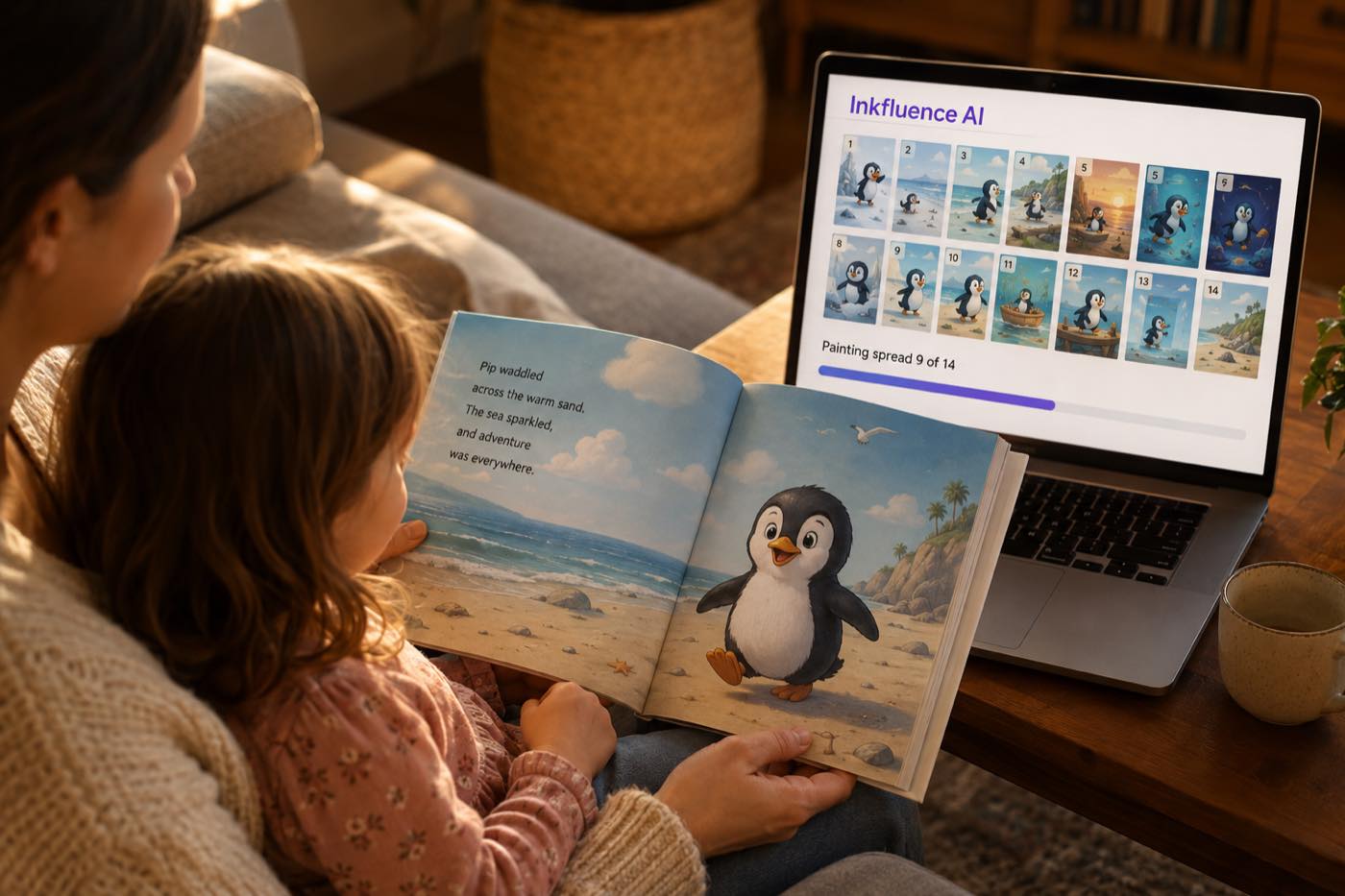
What is an AI picture book maker?
An AI picture book maker is a tool that produces a finished, illustrated children's book rather than raw text or single images. The distinction matters because a picture book is a coordinated object: the words on each page, the picture that shows those exact words happening, the characters staying recognisable from cover to final page, and a physical format built for a child's hands and a parent's lap.
Most "AI children's book" workflows stitch together a chat tool for the story, an image generator for pictures, and a design tool for layout. The result usually fails in the same place: the fox on page 3 looks nothing like the fox on page 7, the art shows a generic forest while the text describes a moonlit garden, and the "cover" is a picture with no title on it. Inkfluence AI's picture book mode was built to close exactly those gaps.
You describe the story you want. Inkfluence plans the book page by page, writes short read-aloud text tuned to your chosen age range, paints one illustration per page that depicts what that page's text says, keeps every character visually consistent throughout, paints a cover with the title hand-lettered into the artwork, and exports a square, print-ready book.
Real pages from a real generated book
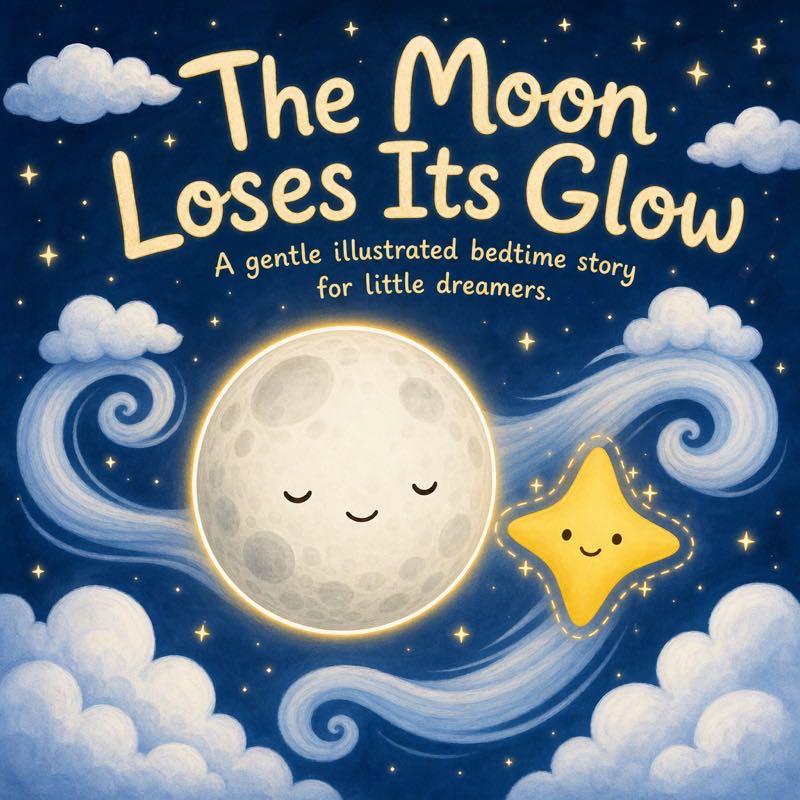
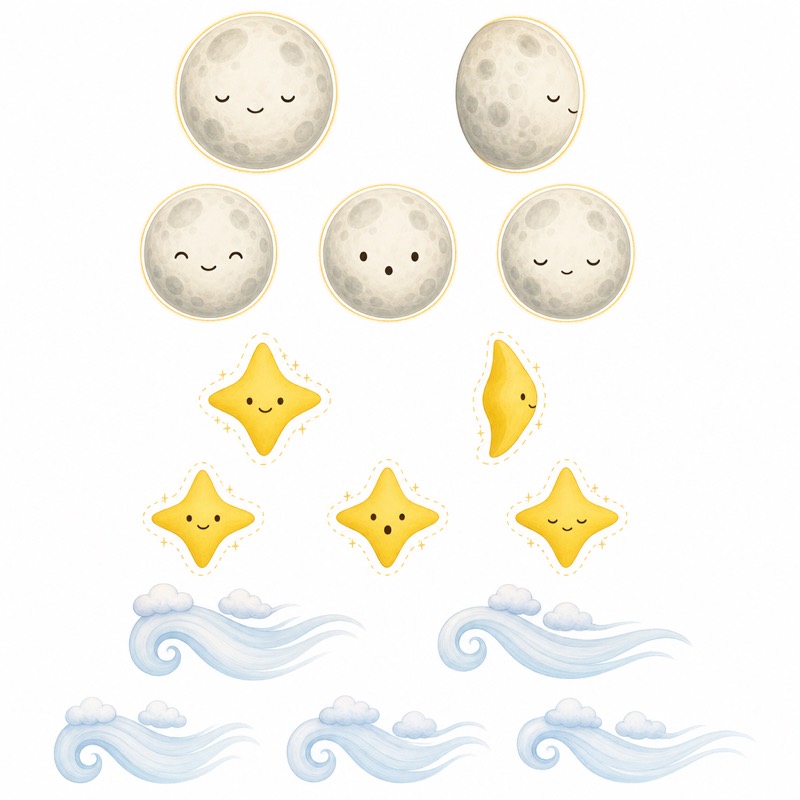
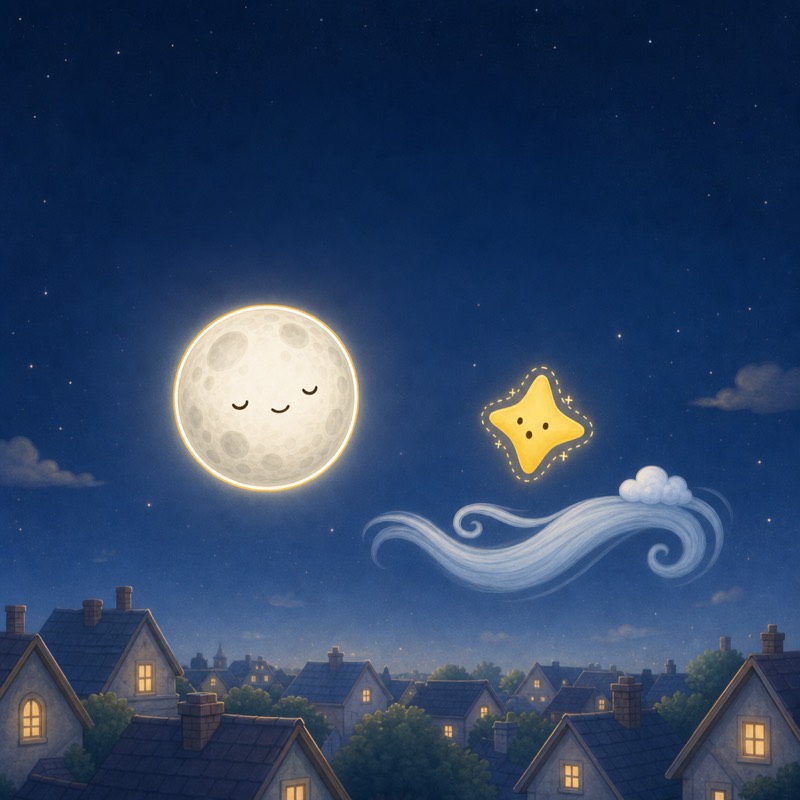
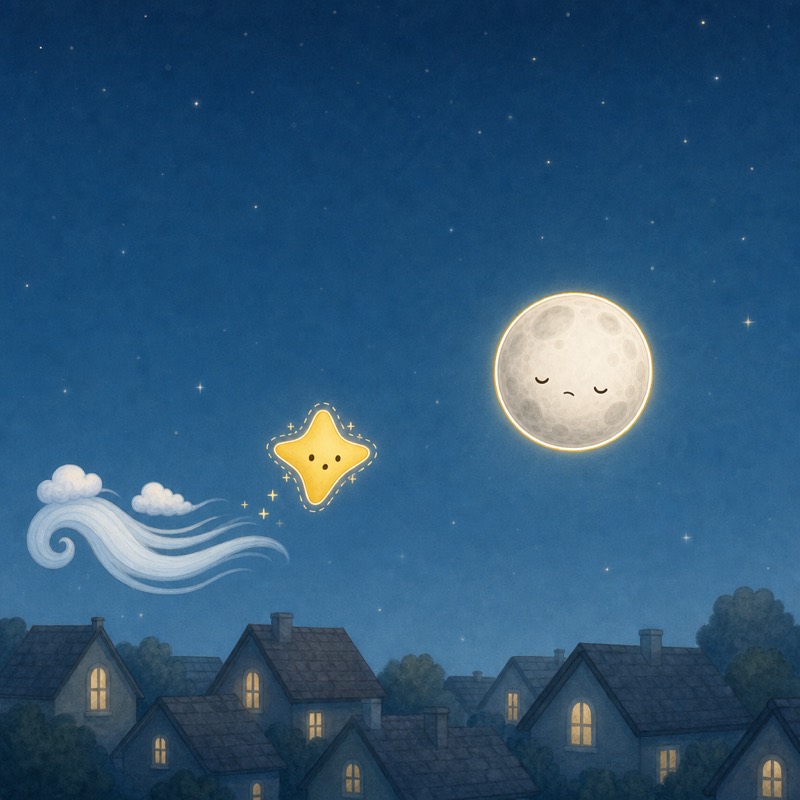
These are unedited outputs from a single prompt: "a bedtime story about the moon losing its glow." Same moon, same owl, same fox on every page, and a cover with the title painted into the art.
How the picture book maker works
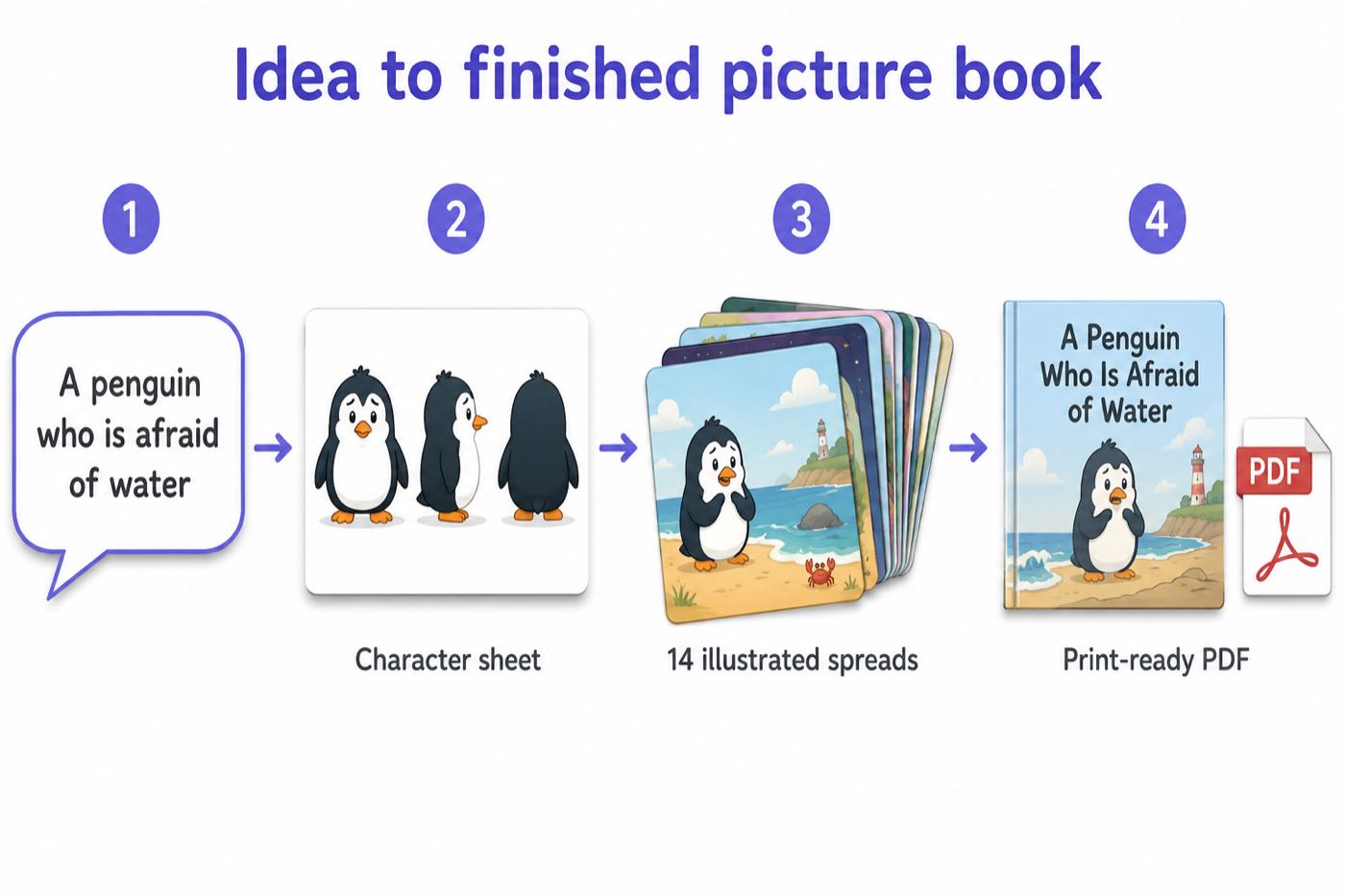
Describe the story
One sentence is enough: "a shy hedgehog who learns to dance," "a little boat that is scared of the sea." Pick the age range and Inkfluence plans the book as a sequence of pages, each with its own scene.
Review the page plan
Before anything is painted you see the page list. Rename pages, reorder them by dragging, or approve as-is. This is where the story arc is in your hands.
Writing and painting happen together
Each page gets a few lines of read-aloud text, and its illustration is painted to show that exact moment: the same characters, in the scene the words describe, with room in the composition for the text to sit on the art. The cover is painted last of all its own: one piece of artwork starring your cast, with the title and subtitle lettered directly into it.
Edit anything, then export
Change any page's words, regenerate any illustration, or swap the cover. Then export: a square 8.5" x 8.5" PDF with full-bleed art for printing at home, a KDP package (the art inside the margins, plus a wrap cover) for Amazon, or EPUB for e-readers. Flip through the finished book in the built-in book preview before you download. For a single printed copy, to check or to give, see how to print one copy of a book.
What makes a picture book work
Picture books follow craft conventions refined over a century of bedtime reading, and the generator was built around them rather than against them:
Short, rhythmic text
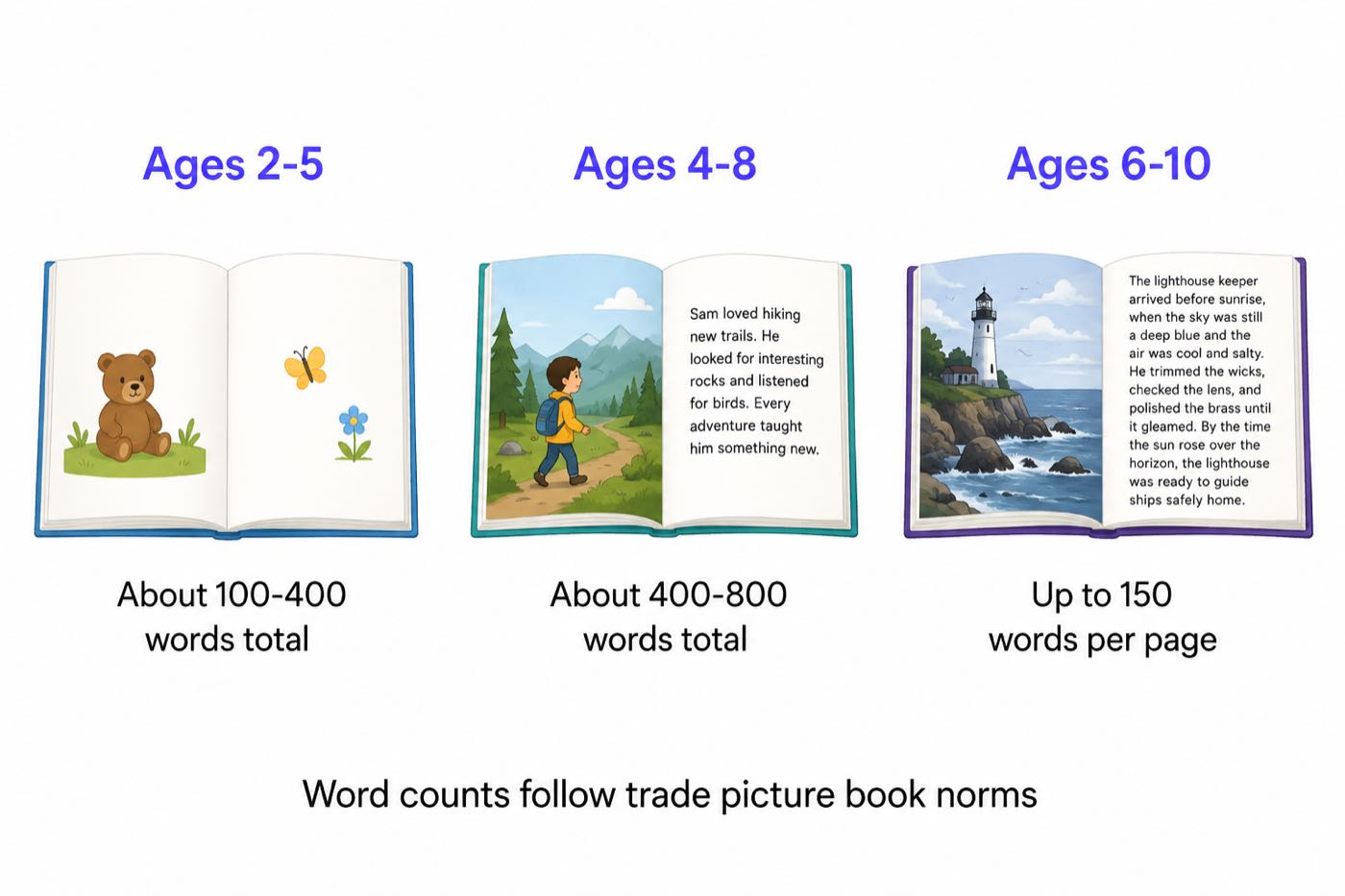
Trade picture books average well under 500 words total. Inkfluence writes 5 to 30 words per page for ages 2 to 5 and 15 to 60 for ages 4 to 8, in language built to be read aloud.
The picture expands the words
In a good picture book the art does not just repeat the text, it adds what the words leave out: background life, weather, expressions. Each Inkfluence illustration depicts its page's moment and enriches it.
A square, lap-sized format
Square trims like 8.5" x 8.5" are the self-publishing standard for picture books: big art, comfortable for shared reading, and accepted print sizes on the major platforms. Selling to bookshops through IngramSpark as well? Its cover is built on its own template, and our IngramSpark cover calculator gives the square paperback and hardcover sizes.
Characters a child can track
Children follow picture books through the characters. A fox that changes colour halfway through breaks the spell, which is why character consistency is the feature everything else here depends on.
The 14-page arc, page by page
Every book the maker plans follows the arc a century of bedtime reading settled on. Here is the actual shape, using a real generated book ("a penguin who is afraid of water") as the example:
Meet the hero in their world. Pengo on the rocky shore, happy everywhere except one place. One character, one telling detail, no plot yet.
One child-sized problem arrives. The waves curl closer and Pengo's feet say no. Never two problems.
Tries and small failures. A brave step, a calm breath, making friends with the tiniest wave. Each try teaches something and fails differently; this stretch earns the re-reads.
The turn. A buddy arrives, and following him into the shallows is suddenly possible. The emotional high point lives here, not on the last page.
Resolution with warmth. Splashing back on purpose, laughing. Solved, never lectured.
The comfort landing. Warm rocks, tired flippers, courage means you can try again. The page that sends a child to sleep instead of winding them up.
The generator also varies how pages open (a sound effect, a spoken line, the weather, a question to the listener) and how long they run, mixing single-line pages with fuller ones, because the variance is the read-aloud pacing. Planning a longer story? The planning guide goes deeper, and the full workflow is written up in how to make a picture book with AI.
Picture book maker vs. image generators vs. photo apps
Three kinds of tools get recommended for AI children's books, and they solve different problems:
| Capability | Image generators (Midjourney, DALL-E) | Photo storybook apps | Inkfluence AI |
|---|---|---|---|
| Writes the story | No | Template-based | Yes, age-tuned per page |
| Consistent characters across pages | Manual prompting | One photo character | Yes, whole cast |
| Art matches each page's text | You prompt each image | Loose | Painted per page |
| Cover with lettered title | No | Varies | Yes |
| Print-ready square PDF | No | Some, often paid per book | Yes, plus EPUB |
| Also makes non-picture books | No | No | 33 book types |
Photo-personalisation apps turn one photo of a child into a cartoon hero. Inkfluence writes an original story from your description instead, for authors making books to publish and sell and for parents who want an original story rather than a template; a story built around your own child also makes a personal gift, which the personalized children's book maker walks through.
Who makes picture books with AI
Parents and grandparents
The single most common picture book on the platform is personal: a bedtime story starring the child it is read to, an adventure for a grandchild's birthday, a book about the new baby for the older sibling, a personalized Christmas book with the siblings and the dog in it. These books are not competing on Amazon; they are competing with every other bedtime, and a story where the hero shares your child's name wins that contest every night. If it is your first book of any kind, the first-time author guide covers the basics.
Self-publishers building a children's catalogue
Children's books are one of the strongest self-publishing categories because adults buy them as gifts, in print, repeatedly. The historical barrier was illustration cost: at about $1,500 to $11,000 per book, testing three ideas meant risking thousands of dollars. AI illustration collapses that risk, which changes catalogue strategy entirely: publish the three ideas, see which one sells, invest in the winner. The KDP publishing guide covers the store side, our guide to self-publishing a children's book on Amazon KDP covers the picture-book paperback, and the royalty calculator shows per-sale earnings by platform.
Teachers and classroom creators
A book about this class, this term's topic, with this class's in-jokes, is a different reading-corner object than anything on the shelf. Teachers use picture book mode for phonics-friendly early readers, topic explainers with a story wrapper, and end-of-year keepsakes. The same book can be translated for multilingual classrooms while keeping every illustration.
First-party platform data
Numbers from the Inkfluence platform itself, as of August 2026 (we publish these because most "AI children's book" statistics online are guesses):
- 100,000+ books have been created on the platform overall, and more than 3,000 of them are children's books, making it a consistent top-five category.
- Books are written in 30+ languages; roughly 84% are English, with Spanish the largest non-English group, which is why one-click translated editions exist.
- The most common children's book length chosen is 10 to 14 pages, matching the toddler and pre-reader band rather than the 32-page trade standard, because most makers are parents building bedtime books, not bookstore inventory.
Pricing
Picture books use the AI illustration allowance included with paid plans; the writing, editor, cover designer, and PDF export are available from the free plan up.
Free
$0
Try the full writing flow, editor, and cover designer with PDF export. No credit card.
Creator
$9.99/mo
Monthly AI illustration allowance sized for a full picture book each month, plus EPUB/DOCX export and audiobooks.
Premium
$19.99/mo
A larger illustration allowance for catalogue builders, unlimited chapters, and every export format.
Compare that with commissioning: a human illustrator for a self-published picture book usually costs about $1,500 to $11,000, per our children's book illustration cost guide. See the full pricing page.
How to choose your route
Three honest questions settle which kind of tool you need:
- Is the book built around a real child's photo? If the point is your child's own face as a cartoon hero, a photo-personalisation app does that. Inkfluence draws characters from your description instead, which still makes a personal gift (see the personalized children's book maker), and is better for books you intend to sell, and for stories where the hero is a moon, a hedgehog, or anyone imagined.
- Do you want to art-direct every image yourself? If illustration is the part you love, an image generator like Midjourney gives you total control, and you accept the layout and consistency work that comes with it. Our illustrator page explains what that workflow involves.
- Do you want a finished book? If the goal is a complete, printable, sellable picture book this week, the all-in-one route exists for exactly that. Story, art, cover, layout, and export in one place, with every piece still editable.
What people search for when looking for a picture book maker
Real query themes this page answers, and where to go deeper:
| Search | The short answer |
|---|---|
| best ai tools for creating children's picture books | All-in-one makers for finished books; image generators for art-directing; see the full comparison |
| how to write a children's book with ai | Premise, page plan, generate, edit aloud: the step-by-step guide |
| ai children's book generator free | The writing flow and PDF export are free; illustration allowances come with paid plans |
| amazon kdp ai content policy children's books | Disclose AI text and images at title setup; publishing proceeds normally: KDP guide |
| best ai for children's book illustrations | Consistency across pages is the test: the illustrator page explains why |
Make your first picture book tonight
One idea in, a fully illustrated book out. Edit anything, export print-ready, and read it at bedtime.
Start Your Picture Book FreeAI Picture Book Maker FAQ
What is an AI picture book maker?
Do the characters look the same on every page?
How many pages does an AI picture book have?
What age ranges does it support?
Is the picture book print-ready for Amazon KDP?
Do I have to disclose AI content to Amazon KDP?
Can I edit the story text after it is generated?
Can I write the story myself and only use AI for pictures?
What illustration style do the books use?
Is the cover designed too?
Can I make a picture book in other languages?
Do I own the rights to sell my picture book?
How much does it cost to make an AI picture book?
How is this different from using Midjourney or DALL-E for a children's book?
Sources and further reading
Related Tools
AI Children's Book Creator
The full children's book workflow: stories, chapter books, and picture books.
Halloween Story Generator
A not-too-scary Halloween picture book starring your child, with a real sample book.
AI Children's Book Illustrator
Consistent-character illustration for every page of your book.
Children's Book Illustration Cost
Illustrator rates per page and per book, and what AI changes.
Children's Book Word Count by Age
Words and pages by age band, with real picture-book data and a calculator.
In italiano: Libro per bambini con l'IA
The Italian guide to picture books, coloring books and stories for children.
AI Book Cover Generator
Covers for every genre, from picture books to thrillers.
AI Coloring Book Generator
The same pipeline in line-art mode: whole printable coloring books.
How to Make a Children's Picture Book with AI
The full step-by-step guide, from idea to KDP-ready file.
Best AI Children's Book Creators Compared
How the leading tools stack up in 2026.
How to make a picture book with AI (video)
An eight-minute walkthrough of the format, with transcript and the first week’s numbers.
Selling a Picture Book
Colour print costs on Amazon, what each copy pays, Etsy and Gumroad, and a price planner.
What the data says. We counted 102,854 books created on this platform: the median is 5 chapters and 9,337 words, non-fiction is 63.7% of it, and 40.8% get finished. Length and completion rate for nineteen genres are in AI book writing statistics, with industry context in self-publishing statistics.