
How to Plan a Children's Book with AI in 2026: The 7-Decision Pre-Writing Guide
Most children's books fail before the first sentence is written, because the planning was wrong. Age bracket, format, character, theme, arc, length, illustrations: get these seven decisions right and the AI draft writes itself. Get them wrong and no amount of AI rewriting saves the book.
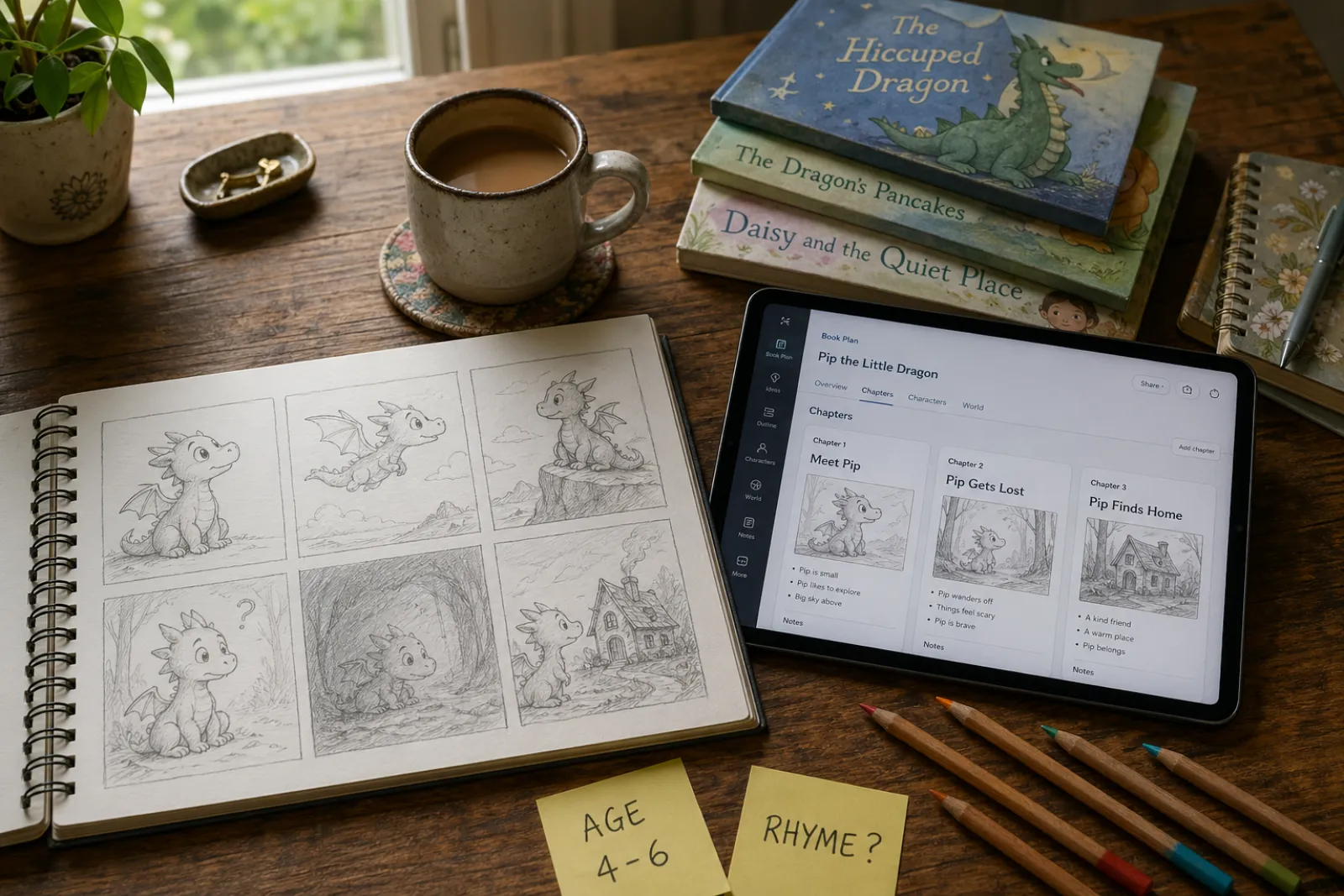
Quick Answer
Planning a children's book with AI in 2026 means making seven decisions before you generate a single word: age bracket (drives everything), format (picture book, early reader, chapter book, middle grade), main character (name, age, defining trait, voice), theme or lesson, story arc (problem to resolution), length (word count and page count), and illustration approach (none, AI, commissioned). A good plan is a 1-page brief you can hand to Inkfluence AI's children's book creator and get a draft you actually keep. A bad plan produces 8 chapters of generic kid-fiction nobody finishes editing. Spend 60-90 minutes on the plan and you save 4-6 hours of rewrites.
Why planning matters most for kids
Children's books are unforgiving. The age bracket alone determines vocabulary, sentence length, page count, plot complexity, and whether the parent or the child is reading.
Adults will tolerate a slow opening or a meandering middle. Children will not. A 4-year-old listening at bedtime gives you maybe 200 words to hook them. A 7-year-old reading independently bails on any sentence that's too long. A 10-year-old middle-grade reader spots a moralising lesson from chapter one and rolls their eyes. Each audience needs a different book, written to a different specification.
AI handles the writing. You handle the specification. This guide is the seven decisions that go into the spec, in the order you should make them, with the trade-offs spelled out. Make them right and the AI draft is 80% of a publishable book. Make them wrong and you'll edit forever.
Planning a fully illustrated picture book? The AI picture book maker plans and paints the whole thing, and the picture book guide walks that workflow end to end, including the illustrated page plan and KDP's colour printing details.
If you're planning a children's book and the AI side feels like the easy part, you've understood the problem correctly. The hard part has always been the pre-writing decisions: who's it for, how long, what's it really about. AI book generators in 2026 produce strong drafts the moment the brief is concrete. They produce mush the moment the brief is vague. This guide walks through the seven planning decisions with concrete examples, and includes a 1-page worksheet you can fill out before generating anything.
Why Planning Beats Winging It (Even with AI)
The temptation with AI children's book tools is to skip the plan. Type "a children's book about a brave little fox" and hit generate. The output is competent. The vocabulary fits. The arc resolves. So why bother planning?
Because "competent" isn't enough for a children's book. Three problems hit unplanned drafts every time:
- Wrong age fit. A vague brief produces a draft pitched at "generic kid", usually 6-8 reading age, which is the AI's default. If you wanted a picture book for 3-5 year olds, the sentences are too long, the paragraphs too dense, and you spend hours simplifying. If you wanted a middle-grade adventure, the prose is too simple and the plot too thin.
- Forgettable character. "A brave little fox" is a placeholder, not a character. The AI fills it in with a generic plucky animal protagonist. The book reads like every other AI-generated kids book. Memorable children's book characters have a specific voice, a contradiction, a quirk, and those have to come from your brief, not the AI's defaults.
- Hidden lesson didactic-ness. Without a clearly-defined theme, the AI hedges and inserts a moralising paragraph at the end of each chapter. "And so Fern learned that being brave means trying even when you're scared." Children sniff this out instantly. Planning the theme means you can ask the AI to embed it through action, not stated lessons.
Spend 60-90 minutes on the seven decisions below and the AI draft becomes a book you actually want to ship. Skip the planning and you'll either give up after the first draft or spend the next month rewriting.
Decision 1: Age Bracket, the One That Drives Everything
If you make only one decision well, make it this one. Age bracket determines reading level, sentence length, vocabulary, page count, plot complexity, theme depth, and even who's holding the book. The same character can star in a picture book or a middle-grade novel, but the format will be unrecognisable.
The five brackets that matter
- Board books (0-2). Hardback, 8-12 thick pages, 50-200 words total, mostly about objects, animals, daily routines. Rare to write without commissioned illustration; AI can draft the text but the book lives or dies on the art. Mostly out of scope for AI book generators.
- Picture books (3-5). 32 pages standard, 200-1,000 words, read aloud by a parent. Strong rhythm, repetition, a single clear emotional beat per spread. Theme delivered through action, not narration. The protagonist solves a small problem in a specific way that feels true.
- Early readers (5-7). 32-64 pages, 1,500-5,000 words, read aloud OR by the child. Short chapters (2-3 pages), large type, illustrations on most pages. Vocabulary controlled to common words plus a few new ones per page. Plot is single-thread, no subplots.
- Chapter books (7-9). 5,000-15,000 words, 6-12 short chapters of about 800-1,500 words each, occasional black-and-white spot illustrations. Read independently. Plot can have one subplot. Characters start to have inner lives.
- Middle grade (8-12). 25,000-50,000 words, 15-25 chapters, no required illustrations. Multi-character casts, real subplots, themes about identity, friendship, family, courage. The Newbery zone. Often where authors actually want to write but don't realise picture books are a different craft entirely.
How the decision changes everything downstream
A "brave little fox saves the forest" book at 3-5 might be 600 words across 14 spreads, with the fox's bravery shown through one specific tiny action (returning a lost acorn at night). At 8-12 it's a 35,000-word adventure with a fox protagonist who has a sister, a fear, a flaw, and a 14-chapter arc that takes her across three forest territories. Same hook. Different book.
If you're not sure which bracket fits your idea, ask: who is the reader, and how long can they sit still? A 4-year-old at bedtime gets 8-12 minutes. An 11-year-old in their room gets 30-40 minutes per session. The book has to fit the session.
Decision 2: Format. Picture Book, Early Reader, Chapter Book, or Middle Grade
Format follows from age but adds practical constraints AI tools need to know. The same age bracket can support multiple formats:
- Picture book vs. early reader at 5-7. Picture book is 32 pages with art on every spread, ~500 words. Early reader is 48-64 pages, smaller pages, ~3,000 words, more reading practice. Same age, very different book.
- Chapter book vs. middle grade at 8-9. Chapter book is ~10,000 words, simple plot, single POV. Middle grade pushes 30,000+, layered plot, sometimes dual POV. Use chapter book if it's the child's first independent series; middle grade if they've already finished a few.
For AI tools, format means three things: structural blueprint (the chapter shape and rhythm), length control (in practice, the chapter count you set: state the age band and the AI writes to its rhythm), and illustration policy (whether to leave room for art, write to the picture, or assume a text-only book). Inkfluence's Kids Fiction blueprint handles all four formats above; you tell it the age and the format and the word-count target adjusts automatically. For comparison against other tools, our 2026 AI book tool comparison covers which platforms have dedicated children's-book blueprints versus generic chatbot output.
Decision 3: Main Character. Name, Age, Defining Trait, Voice
The character brief is where most plans go vague. "A brave little fox" is the most-typed prompt in AI children's book gen, and it produces the most-forgotten output. Concrete characters need four things spelled out:
- Name. Something specific. Not "Foxy" or "Little Bear." A name with a small flavour: Pip, Mira, Wren, Otto, Hazel, Tariq, Niko. Names that aren't trying to be cute work better than names that are.
- Age (and matching reader age). The protagonist is usually 1-2 years older than the target reader. A 4-year-old reader connects with a 5-6 year old protagonist. An 8-year-old reader connects with a 10-year-old. This is craft-rule-of-thumb that AI tools follow when told.
- Defining trait + contradiction. One adjective is too thin. "Brave" is generic. "Brave but scared of the dark" is a character. "Curious but easily distracted" is a character. The contradiction is what creates the conflict that drives the plot.
- Voice marker. One repeated phrase, expression, or habit that makes the character recognisable across pages. Pip mutters "well that's that" when something goes wrong. Mira always asks "but why?" three times. Otto draws a mental map of every room he enters. These are tiny but make the character feel real and consistent across the book.
Three example briefs that produce good drafts:
- "Pip, a 5-year-old hedgehog, is brave outside but scared of his own shadow at bedtime. He says 'well that's that' when something goes wrong. Picture book, 600 words, ages 3-5."
- "Mira, an 8-year-old amateur detective, asks 'but why?' three times before she'll accept any answer. She lives with her grandmother in a flat above a launderette. Chapter book, 9,000 words, ages 7-9."
- "Tariq, a 11-year-old map-maker, draws every room he enters. He's looking for his missing father, who left a hand-drawn atlas behind. Middle grade, 35,000 words, ages 8-12."
Each of those briefs is one sentence. Each makes the AI's job easy. Compare to "a brave little fox", and the difference between a memorable book and a forgettable one is right there.
Decision 4: Theme or Lesson, Without Becoming Preachy
Every children's book has a theme, even if the author didn't plan one. The question is whether you control the theme or let the AI default to a vague kindness/courage/friendship message. Plan it, or it plans itself badly.
Concrete themes that work
- Picture book themes are concrete and small. Sharing one specific toy. Trying again after a fall. Telling the truth when it's uncomfortable. Saying sorry first. Don't pick "kindness", pick the one moment of kindness the book is about.
- Early reader and chapter book themes can be slightly broader. Belonging in a new place. Finding your own way to do something. Standing up for a friend. Still grounded in one specific situation, not a general principle.
- Middle grade themes can be ambiguous. Identity, family complications, what it means to be brave when bravery doesn't look heroic. The hallmark of good middle grade is that the theme is questioned, not preached.
How to keep AI from preaching it
The single most useful instruction in your brief: "Show the theme through action and consequences. Do not state the moral at the end of any chapter." Inkfluence's Kids Fiction blueprint defaults to this; many general AI tools do not. If you're using a general chatbot, this line in the prompt is non-negotiable or you'll get "and so Pip learned..." at the end of every chapter.
Decision 5: Story Arc. Problem, Try, Try Again, Resolution
Children's stories have one classic shape that works at every age: problem, first attempt fails, second attempt fails worse, third attempt succeeds (often unexpectedly), resolution that ties to the theme. This is the "try, try, try" pattern, and AI tools structure to it well when told.
Picture book arc (32 pages, ~500 words)
- Pages 1-4: Setup. Meet the character, see their world.
- Pages 5-8: Inciting incident. The problem appears.
- Pages 9-14: Try 1. First attempt. Doesn't work.
- Pages 15-20: Try 2. Tries differently. Fails worse, raises stakes.
- Pages 21-26: Try 3. Tries the surprising thing (often related to character's defining trait or contradiction). It works.
- Pages 27-32: Resolution. Quiet ending that lands the theme without stating it.
Chapter book arc (~10 chapters, ~10,000 words)
- Chapters 1-2: Setup. Character, world, normal life.
- Chapter 3: Inciting incident.
- Chapters 4-5: First attempt at solving the problem.
- Chapter 6: Setback. Stakes raise.
- Chapters 7-8: Second attempt. Different approach, different failure.
- Chapter 9: Climax. The character does the thing only they could do (theme moment).
- Chapter 10: Resolution and quiet final beat.
Middle-grade arc (~20 chapters, ~35,000 words)
Same try-try-try pattern, but with a B-plot (often a friendship or family thread) that runs alongside the A-plot, and a midpoint twist that reframes what the protagonist is actually trying to do. Inkfluence's outline step generates these arcs automatically when told the format and length, and surfaces them as a chapter list you can edit before drafting. For longer middle-grade and series planning specifically, our series authors guide covers continuity tooling.
Decision 6: Length. Word Count and Page Count by Age
A common mistake: writing a 20,000-word "picture book" or a 4,000-word "middle-grade novel." Length is a marketing category, not a stylistic choice. Use these targets:
- Picture book (3-5): 200-1,000 words. 500 is the sweet spot. 1,200+ won't sell as picture book.
- Early reader (5-7): 1,500-5,000 words. 2,500-3,500 is the common range.
- Chapter book (7-9): 5,000-15,000 words. 8,000-10,000 is most common.
- Middle grade (8-12): 25,000-50,000 words. 30,000-40,000 is the standard.
- Upper middle grade (10-13): 40,000-60,000 words.
State the word count in your brief ("picture book, ages 3-5, around 500 words") and expect to trim: AI drafts tend to overshoot picture-book length, and the real length control is the chapter count you set plus your edit pass. Conversely, if you ask for a "middle grade novel" without word count, you'll get something around 15,000 words, which is too short. Always state the word count in the brief. The full Inkfluence AI book writer lets you set a word-count target per book and per chapter, with the engine respecting both bounds.
Decision 7: Illustrations. None, AI, or Commissioned
Illustrations are the part of children's book publishing that AI tools most often get wrong, because the right answer depends on age and budget, not technology.
Picture books (3-5)
The illustrations are the book. AI-generated picture book illustrations have improved dramatically in 2026, but consistency across spreads is still hit-and-miss; your fox's spots or your hedgehog's scarf can drift between pages. For self-publishing on KDP at low risk, AI illustrations can work for an affordable test. For a book you want to query traditional publishers with, commission a human illustrator. The text-and-art-don't-match problem is the most common reason picture books get rejected. Our cost comparison includes illustration budget ranges by approach.
Early readers and chapter books (5-9)
Illustrations are decorative: black-and-white spot art every 1-3 pages. AI is fine for this, especially for indie KDP. Specify "black and white line illustrations, simple style, consistent character design" in your image prompt. You can also publish text-only at this age, especially for early readers using larger type and shorter chapters.
Middle grade (8-12)
Most middle grade is text-only. Some have a few black-and-white interior illustrations, especially in adventure or mystery genres. AI for chapter-opener illustrations works fine. Don't over-decorate; it dates the book.
Cover (every age)
The cover always matters. AI cover generators in 2026 produce competitive cover art for indie children's books. Inkfluence's children's book creator includes an AI cover designer that integrates the title and author byline directly into the artwork, particularly useful for picture books where the cover is the marketing.
The 1-Page Children's Book Planning Worksheet
Before you generate, fill this out. It takes 15-30 minutes if you've already thought about the book, longer if you haven't. The worksheet answers all seven decisions in a form you can paste directly into an AI tool.
Children's Book Planning Worksheet
1. Age bracket and format
[ ] Picture book (3-5) [ ] Early reader (5-7) [ ] Chapter book (7-9) [ ] Middle grade (8-12)
2. Target word count
_____ words (use the ranges from Decision 6)
3. Main character: name, age, defining trait + contradiction, voice marker
e.g. "Pip, a 5-year-old hedgehog, brave outside but scared of his own shadow at bedtime, says 'well that's that' when something goes wrong."
4. Setting (where the story happens)
e.g. "An old oak tree in a hedgerow. The forest beyond. Pip's burrow under the roots."
5. The problem the character has to solve
e.g. "His sister Rose's favourite acorn has rolled into the dark place under the bramble, and she's crying."
6. Theme, shown through action, not stated
e.g. "Bravery isn't the absence of fear. It's doing the thing for someone you love."
7. Story arc: problem, try 1 fails, try 2 fails worse, try 3 succeeds (use character's contradiction)
Sketch the three attempts in one line each.
8. Ending image (the last beat the reader sees)
e.g. "Rose, asleep with the acorn in her paw. Pip, eyes still open, listening to the night."
9. Illustration approach
[ ] None (text-only) [ ] AI-generated [ ] Commissioned human illustrator
10. One-sentence pitch (the way you'd describe it to a friend)
e.g. "A brave-but-scared hedgehog has to fetch his sister's acorn from the scariest place in the hedgerow at night."
That worksheet, paste-ready, is the entire brief. Drop it into Inkfluence AI's children's book creator as the idea, set the chapter count to match your format, and the AI generates a draft that already reads like the book you imagined.
Try it now
Paste your worksheet, get a children's book draft in minutes
The Kids Fiction blueprint in Inkfluence's children's book creator reads the worksheet above as a brief. Picture book through middle grade, with age-appropriate vocabulary, character continuity, and a cover designer included. Free to start, no card needed for the first 5 chapters.
Pressure-Test the Plan with AI Before You Generate the Book
Before committing to a full draft, paste your worksheet into ChatGPT, Claude, or your AI tool of choice and ask:
- "Is this brief age-appropriate? What word would a 4-year-old not understand?" Use this to catch vocabulary that's too high.
- "What's the theme? State it in one sentence as a child would understand it." If the AI's restated theme is "be kind" or "try hard," your brief is too generic. Push back until the theme is specific.
- "Walk me through the three attempts. Does the third one feel earned, or convenient?" "Convenient" is the deadliest critique in children's books. It means the resolution feels like the author swooped in to save the protagonist instead of the protagonist solving it themselves.
- "What makes this character recognisable? Could I swap them with any other plucky animal?" If yes, your character isn't specific enough. Add a quirk, a contradiction, a voice marker.
Five minutes of pressure-testing fixes problems that would otherwise show up only after you've generated the full book. The cost of fixing them in the brief is one paragraph rewrite. The cost of fixing them after generation is rewriting half the manuscript.
From Plan to Draft
Once the brief is solid, generating the draft is the fast part. The flow:
- Paste the worksheet into the AI tool's idea field.
- Set the chapter count (1 chapter for a picture book, 6-12 for chapter book, 15-25 for middle grade).
- Generate the outline. Read it. Adjust any chapter that drifts from your arc.
- Generate the full draft.
- Edit for voice, character consistency, and any moralising that snuck in. Plan for 4-8 hours of editing on a chapter book or middle grade. Picture books edit in 1-2 hours.
- Generate or commission the illustrations.
- Design the cover. Format for KDP. Publish.
The drafting tutorial, actually writing the book once the plan is in place, is covered in the How to Write a Children's Book with AI guide. This planning guide is the prequel to that one. Get the plan right and the writing guide is mostly mechanical.
Frequently Asked Questions
How long does it take to plan a children's book before generating it with AI?
60-90 minutes if you've thought about the book before. 2-3 hours if you're starting from a vague idea. The seven decisions in this guide can each be made in 5-10 minutes, with most of the time on the character, the arc, and the worksheet itself. Pressure-testing with AI takes another 10-15 minutes.
Do I need to plan if I'm using a children's book AI tool?
Yes, for any age above board books. The AI tool can produce a draft from a vague brief, but the draft will be generic. The seven decisions above are what make the difference between a forgettable AI-generated kids book and one that reads like the book you imagined. The tool handles the writing; you handle the brief.
What's the most common planning mistake?
Underspecifying the character. "A brave little fox" is the most common starting point, and it produces the most generic output. Add a name, an age, a contradiction, and a voice marker (four words each), and the AI draft is a different book.
How do I plan a children's book series instead of a one-off?
Series planning adds two layers: the season-long arc (what changes about the protagonist across the whole series) and the per-book arc (the standalone story for this book). Most successful indie children's series settle on a recurring protagonist + a problem-of-the-week structure. Plan book 1 as a complete standalone first, then sketch books 2-5 as one-line pitches before drafting.
Is AI children's book content allowed on Amazon KDP?
Yes. KDP permits AI-generated and AI-assisted content with disclosure. Children's books are one of the most active KDP categories. Categories: Children's Books > [age range] > [theme]. Use two sub-categories per book. For the full KDP listing flow, see our guide to selling ebooks on Amazon KDP.
Do AI tools handle picture book page-by-page format?
The best ones do. Inkfluence's Kids Fiction blueprint writes picture books to a spread-friendly rhythm when you ask for it in the brief ("one to two sentences per spread, leave room for illustration"): the instruction lives in your prompt, and the age-appropriate pacing does the rest. Generic AI tools tend to write a single block of prose and require manual splitting. Specify "format as 14 spreads of 2-3 sentences each" if your tool doesn't do it natively.
Should the protagonist be a child or an animal?
Both work. Animals are slightly easier for ages 3-5 (lower stakes, less identity-dependent). Children protagonists work better for chapter books and middle grade because reader identification matters more. Either way, give them a specific name, age, and trait. "A small bear" loses to "Wren, a 6-year-old badger who keeps lists in her head" every time.
What about rhyming picture books?
Plan rhyming separately. AI tools can produce rhyming picture book text but the meter often slips, and rhymes go forced. If you want a rhyming book, plan it in two passes: prose draft first to lock the story, then a rhyming rewrite (manual or AI-assisted) where you control the meter line by line. Don't try to plan story and rhyme at the same time.
How do I plan illustrations if I'm not an illustrator?
Three approaches. (1) AI illustrations: write image prompts during planning ("Pip the hedgehog in the dark hedgerow, scared but determined, watercolour style"). One per spread for picture books, one per chapter for chapter books. (2) Commission: write a 1-page art brief for each spread or chapter and hire a freelance illustrator. (3) Text-only: skip illustrations entirely, especially for early readers and chapter books where they're optional.
Final Thoughts: The Plan Is the Book
Children's books punish vagueness more than any other genre. The reader has 200 words to be hooked, no patience for a confused middle, and no tolerance for a moralising ending. The AI handles the words. You handle the choices.
Spend the 60-90 minutes on the worksheet. Pressure-test the brief. Get the seven decisions right before you generate a single sentence. The book you imagined is on the other side of those decisions, and the AI draft is closer than you think, but only if the plan is solid.
Ready to start?
Plan it. Generate it. Publish it. This week.
Open the worksheet. Make the seven decisions. Paste the brief into the children's book creator. Have a full draft in under 20 minutes, edit it across two evenings, and ship to KDP by the weekend.
Related reading
Companion guide
How to Write a Children's Book with AI in 2026
The drafting and publishing half of the flow. Once your plan is solid, this is the writing tutorial.
Tool
AI Children's Book Creator
Kids Fiction blueprint, age-appropriate vocabulary, cover designer included. Free to start.
Comparison
Best AI Tools for Writing a Book in 2026
Children's-book-friendly tools compared on blueprint, voice control, and KDP-ready output.
Publishing
How to Sell Ebooks on Amazon KDP in 2026
Once your children's book is drafted, the KDP listing, categories, and pricing strategy.

Founder, Inkfluence AI
Sam is the founder of Inkfluence AI. He built the platform to make book creation accessible to everyone - from first-time authors to seasoned publishers.
Helpful links
Ready to Create Your Own Ebook?
Start writing with AI-powered tools, professional templates, and multi-format export.
Get Started FreeRelated Articles
 Self-Publishing
 How to Publish AI-Generated Books on Amazon KDP in 2026 (Step-by-Step)
Step-by-step guide to publishing AI-generated books on Amazon KDP in 2026. Covers manuscript formatting, AI disclosure requirements, cover rules, common mistakes that get books flagged, and which AI book types actually sell.
 AI Writing
 How to Write a Children's Book with AI in 2026 (Step-by-Step Guide)
Learn how to write a children's book with AI in minutes. This guide covers concept, characters, age-appropriate writing, the kids fiction blueprint, cover design, and publishing your children's ebook.
Get ebook tips in your inbox
Join creators getting weekly strategies for writing, marketing, and selling ebooks.