
How to Write a Memoir with AI in 2026: A Step-by-Step Guide
A practical, honest guide to writing a memoir with AI in 2026. The 7-step process from premise to published book, what AI does well, what stays in your hands, and why the system handles "I met Quincy Jones at a charity benefit" without turning it into fan fiction.
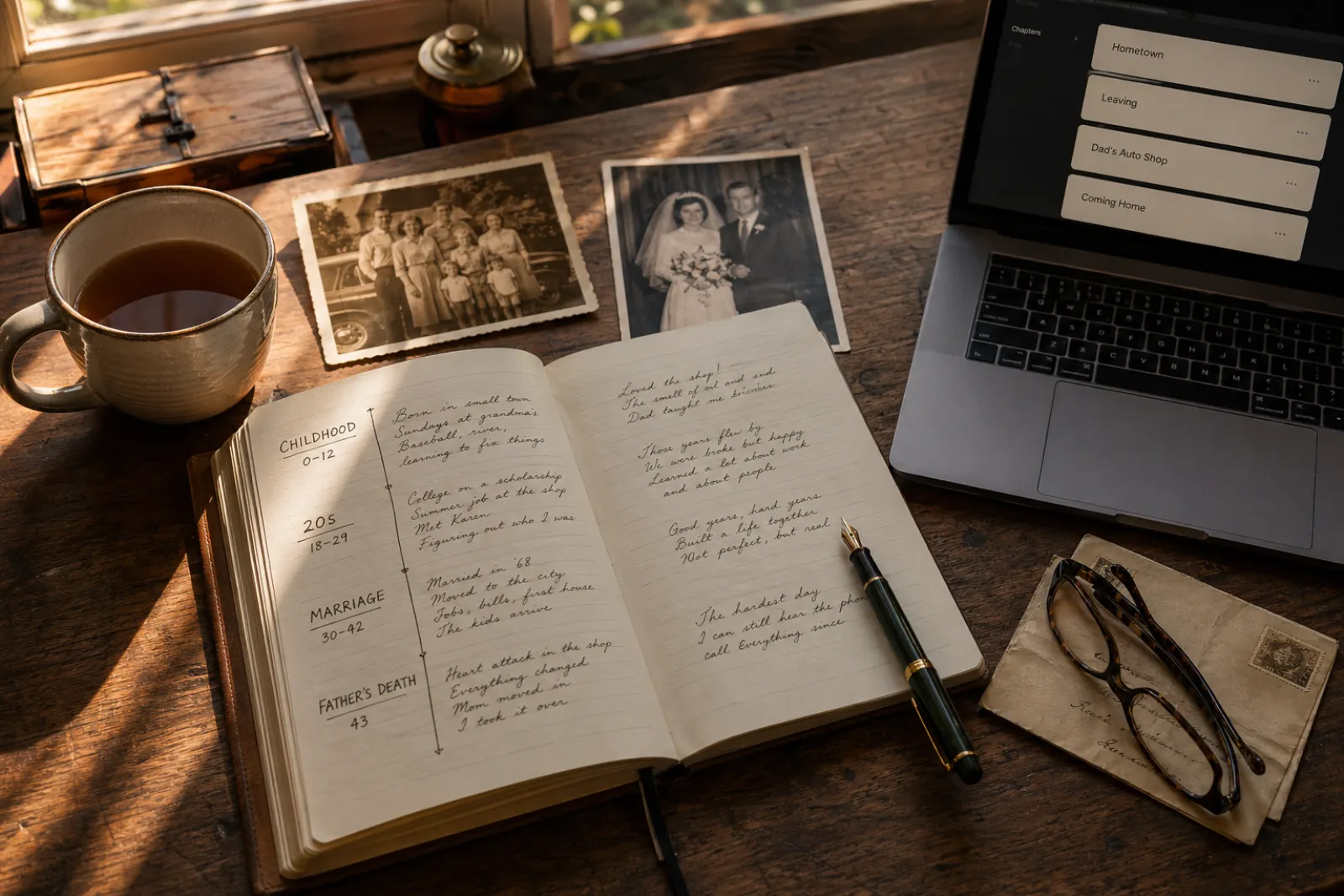
Quick Answer
Writing a memoir with AI in 2026 takes 6 to 10 weeks of part-time work and produces a 60,000-80,000 word manuscript ready for KDP. The AI handles chapter structure, retrospective voice, and pacing. You provide the actual life events, real people, and personal voice.
Inkfluence AI's biography blueprint enforces memoir-specific guardrails (no invented dialogue, no cinematic dramatisation, retrospective voice baked in) and correctly handles real names, including casual mentions of public figures or fictional movies, without misrouting your memoir into fiction territory.
The realistic workflow: a chronological-by-age-bracket prompt, 6-8 chapters, real names of family and friends, AI drafts each chapter with dignity and restraint, you edit for voice and personal stories. For the related concern about hallucinated facts in non-fiction, see how to prevent factual errors in AI-generated non-fiction.
Why memoir is different
Memoir is the most voice-sensitive genre AI handles. Get it right and you save 6 months.
A bad AI memoir reads like a generic life-coach blog post: smooth, structured, emotionally hollow. A good AI memoir reads like the author sat down with a patient editor and dictated their life across six afternoons. The difference is partly the tool (does it have a memoir blueprint, or just a generic fiction template?) and largely the prompt (do you write your real names, real events, and real voice into the brief, or do you describe abstractly?).
This guide is the practical version. The seven steps. The prompt patterns that work. The famous-person mentions that won't break the system. The 4-8 hours of editing that turn the AI draft into your memoir.
If you've waited until you had time to write your memoir, you've waited longer than necessary. AI tools in 2026 don't replace the part of memoir-writing that matters (your voice, your life, your reflection), but they remove the part that has stopped most people from finishing (chapter structure, pacing, the blank page). The trade-off is that you have to feed the system specifically (names, dates, places, real moments) and you have to edit. Done well, you ship a memoir in 6 to 10 weeks instead of 1 to 3 years.
What AI Actually Does for Memoir (and What It Doesn't)
Useful to be honest about both ends of this.
What AI does well for memoir
- Chapter structure. A 6-8 chapter chronological memoir or a 5-chapter thematic memoir, with each chapter following a context-setting → experience → turning-point → reflection arc. The skeleton is the easy part for AI; it's where most aspiring memoirists get stuck.
- Retrospective voice. "Looking back, I see now that..." is the natural register of memoir, and AI tuned for memoir defaults to it. Generic AI tools default to present-tense action writing, which reads wrong for memoir.
- Pacing. Memoir collapses time. A childhood chapter might span 10 years; a turning-point chapter might span 3 hours. AI handles this asymmetry as long as the brief tells it which periods are dense and which are sparse.
- Continuity. Your sister's name in chapter 1 is still her name in chapter 7. Your father's death doesn't drift between two different years. The story bible holds these facts.
What AI cannot do for memoir
- Generate actual life events. The AI doesn't know what happened to you. If you don't write the real moments into the brief, it makes up generic ones. This is the single most common failure mode for AI memoir.
- Capture personal voice. Your voice is the texture of how you say things. AI produces competent prose that approximates a memoir voice but doesn't reach yours until you edit. Plan for editing.
- Make the reflection meaningful. The reflective insight at the end of each chapter (what did this teach you, what would you tell your younger self) is where memoir earns its weight. AI can produce reflective-sounding prose, but the actual insight has to be yours. Edit these passages hard.
- Replace your memory. If you can't remember the names of your fourth-grade teachers, AI can't either. Do the memory work first.
Step 1: Pick Your Memoir's Shape
Three structures cover almost every memoir. Pick one before you write anything.
Chronological by age bracket
Six chapters covering ages 0-15, 15-30, 30-45, 45-60, 60-70, 70+. Best for whole-life memoirs and family histories. Easiest to outline.
Single-arc focused
Five to seven chapters covering one defining experience: an illness, a career chapter, a marriage, a loss, a transformation. Best for tight, focused memoirs that want to do one thing well.
Thematic
Each chapter explores a theme through your life across all ages: "On Loss", "On Money", "On Love", "On Work". Best for memoirs that want to feel essayistic rather than narrative.
Pick the structure that fits the book you want, not the book you think you should write. Most first-time memoirists start with chronological and that's almost always the right choice.
Step 2: Write the Brief That Carries the Whole Book
The single most important step. The AI's output quality is set by your prompt quality. A vague prompt produces vague memoir. A specific prompt with real names, real events, and real moments produces specific memoir.
The structured brief format that works:
A memoir of my life and family, told chronologically across six chapters by age bracket. I want to capture the people who shaped me and the moments I'd like my sons to remember after I'm gone. Reflective, honest, no embellishment. Chapter 1, Childhood (Ages 0-15): Growing up in Brooklyn in the 1970s. My parents Frank and Rosa, my older sister Lena. Public school days, summers at Coney Island, my dad's auto shop, the day I broke my arm at age 11. The neighborhood we never left. Chapter 2, Young Adulthood (Ages 15-30): Leaving home for college at SUNY Albany, dropping out after two years, working as a session musician in NYC studios, meeting Quincy Jones at a charity benefit in 1992 that changed how I thought about music, marrying Carla in 1994. Chapter 3, Building a Family (Ages 30-45): The births of my three sons (Marco, Daniel, and Tomas). Buying our first house in Hoboken, Carla starting her bakery, my brief stint touring with a jazz quartet, the years that taught me what fatherhood actually means. (continue for chapters 4, 5, 6)
What the brief is doing:
- Frames the genre explicitly as memoir, reflective, honest, no embellishment. This routes correctly to the biography blueprint.
- Names real people with their actual names. Frank, Rosa, Lena, Quincy Jones, Carla, Marco, Daniel, Tomas. The AI captures these as the cast and uses them consistently across chapters.
- Pins specific moments: "the day I broke my arm at age 11", "meeting Quincy Jones at a charity benefit in 1992". These become anchors the AI uses to ground each chapter in real life rather than abstractions.
- Gives explicit chapter structure with age brackets and content bullets. AI book writers with advanced-spec support lock these chapters as the outline rather than rearranging them.
- States the reader and intention: "I'd like my sons to remember after I'm gone". This shapes the voice register toward intimate, family-facing memoir rather than commercial memoir.
What to avoid in the brief:
- Generic abstractions like "growing up was hard" or "I had ups and downs". The AI generates generic memoir from generic prompts. Be specific.
- The word "novel" if you mean memoir. "A novel inspired by my life" routes to fiction, not biography. Use "memoir", "autobiography", "personal history", or "the story of my life".
- Cinematic framing: "tense", "dramatic", "thriller-style". The biography blueprint forbids these and the prompt fights against the format.
Step 3: Generate the Outline
Submit the brief and let the AI generate the chapter outline. With an explicit chapter structure in the brief (recommended for memoir), the outline locks to your structure rather than the AI inventing its own. With a more open brief, the AI proposes a 6-8 chapter chronological structure that you review and edit.
Read the outline carefully. Three things to check:
- Are the chapter titles specific? "Growing Up in Brooklyn" is good. "Childhood" is too generic, every memoir has a childhood chapter. Push for specifics.
- Does the outline include your real moments? If you wrote "the day I broke my arm at age 11" in the brief and the outline doesn't reference it, the AI didn't anchor on your specifics. Edit the outline manually to add them back.
- Is the pacing right? A 60-year life across 6 chapters means ~10 years per chapter on average. If chapter 5 covers 30 years and chapter 6 covers 6 months, that's wrong unless you're deliberately compressing midlife and dwelling on retirement.
The outline takes 5-15 minutes to review and edit. Get it right before you draft chapters; outline drift compounds across drafting and is painful to fix later.
Step 4: Draft Chapters One at a Time
Generate chapter 1 first. Read it. Edit any generic passages, add personal stories, fix anywhere the voice drifts toward life-coach mode. Only then generate chapter 2.
This sequential approach matters because each chapter feeds context into the next. If chapter 1 has a specific opening line about your father's auto shop, chapter 4 should reference back to that scene when you talk about taking your own son there years later. AI book writers with story-bible continuity (Inkfluence AI, Novelcrafter, Sudowrite with Story Bible) handle this automatically. Generic chatbots don't, and you end up rewriting continuity by hand.
Chapter rhythm to expect from the biography blueprint:
- Context setting: time, place, emotional state, your age. 200-400 words.
- The experience: the actual events of this chapter. Honest recounting, not cinematic detail. 1,500-2,500 words.
- Turning point: the moment of change, realization, or shift. The chapter's emotional pivot. 300-600 words.
- Reflection: retrospective insight on what this chapter meant. Look-back-with-distance voice. 400-700 words.
Total per chapter: 2,500-4,500 words. Six chapters at this pace land your memoir at 15,000-27,000 words. For a longer memoir (60,000-80,000 words), bump chapter length and add 2-4 sub-chapters within each major section.
Step 5: Edit for Voice, Not Structure
The biggest editing mistake first-time AI memoirists make is editing the structure. The structure is fine. The structure is where AI is strong. Spend your editing time on three things instead:
Voice
Read each chapter aloud. Wherever the prose sounds smooth but doesn't sound like you, rewrite that paragraph in your voice. AI prose has a recognizable competent-but-flat texture; your voice has the cadence, vocabulary, and sentence rhythms that make it yours. The reader doesn't care about elegant sentences as much as they care about feeling like a real person is in the room.
Personal stories
The AI gave you scene structure. You give it the specific stories. Where the AI wrote "my dad worked long hours at the shop", replace with "my dad came home at 10pm smelling like brake fluid, threw his cap on the kitchen table, and told my mother the same joke about the Buick that wouldn't start. Every night. For thirty years." Specificity is what separates memoir from biography blog post.
Reflection passages
The AI ended each chapter with reflective passage. Read those carefully. The AI's reflections sound thoughtful but are usually generic ("looking back, I now see how much my parents shaped who I became"). Replace with your actual reflection. What did you actually realise looking back? What would you actually tell your younger self? Be specific. Be honest. The reflective passages are where readers connect with you, and they have to be yours.
Plan 4-8 hours of editing across the full memoir. Rushing this step is the difference between an AI memoir that reads as authored and one that reads as scraped. Our guide to avoiding generic AI output covers this in more detail.
Step 6: Cover, Format, and Publish
For self-publishing on KDP, the workflow on a tool with built-in cover and EPUB:
- Cover: 1600x2560 JPG. For memoirs, the conventional cover style is portrait-led (a faded vintage photo, a single object that anchors the book) with a clean serif title. Avoid stock-photo handshakes and abstract gradients. The cover designer outputs at the right spec.
- EPUB: one-click export from the writing tool. Inkfluence AI bundles EPUB + JPG cover for direct KDP upload. Other tools require Calibre or Reedsy Book Editor for EPUB conversion.
- Book description: 2-3 paragraphs for the back cover and KDP listing. Lead with the central question or hook. Avoid spoilers about the climactic chapters.
- KDP categories: pick "Biographies & Memoirs > Memoirs" plus a second relevant category (e.g., "Family Memoirs", "Music Memoirs", "Immigrant Memoirs"). Two categories total.
- Pricing: $4.99-$7.99 typical for indie memoir. Use the royalty calculator to model per-sale earnings.
- AI disclosure: select "Yes" for AI-assisted text content during KDP upload. Required since 2023, doesn't affect royalty eligibility.
Total time from "memoir is finished" to "memoir is live on Amazon": 2-3 days.
Step 7: Decide Whether to Show It to People
This step gets skipped in most memoir guides and it's the one that separates published memoirists from people with a memoir in a drawer.
Three audiences to consider, in order of stakes:
Family members named in the memoir
If your memoir mentions your sister, your mother, your ex-spouse, your children, or anyone with a meaningful presence in the book, decide before publishing whether to show them the relevant chapters first. There's no universal right answer. Some authors share for fact-check and emotional buy-in; others publish first and discuss after. Whichever you choose, choose deliberately. Memoirs that surface family conflicts publishers haven't been told about cause real damage.
Beta readers outside the family
2-3 people who match your target reader (not your family, not your friends who'll just be supportive). Ask: where did you put the book down? What chapter felt thinnest? Was there anything that took you out of the book? Beta readers catch tonal issues, pacing problems, and chapters that didn't earn their length.
A developmental editor (optional but recommended)
If you have $1,500-$3,000 of budget for a memoir-savvy editor, this is the highest-leverage spend you can make. They'll catch the things friends and family won't tell you. Reedsy and the Editorial Freelancers Association directories list memoir specialists. See our breakdown of AI vs ghostwriter cost for how the AI-plus-editor hybrid path works.
The Famous-Person Question
One legitimate worry first-time AI memoirists have: "I met Quincy Jones at a charity benefit. I went to a Star Wars premiere with my dad. I worked with Stevie Wonder for two years. Will the AI turn my memoir into fan fiction or sci-fi if I mention these people and films?"
Tested in real cases on the biography blueprint: no.
The classification system distinguishes between (a) memoir context that mentions famous people the author met (e.g., "I worked with Stevie Wonder as a recording engineer") and (b) fan fiction set in an existing IP universe (e.g., "a story about a wizard at Hogwarts"). Famous-person mentions in memoir context route to biography. Casual film references ("my daughter and I watched Star Wars together every Sunday") don't trigger fan-fiction routing because the prompt is clearly autobiographical.
Where it does matter: avoid framing the book as "a novel inspired by my life" if you mean memoir. The word "novel" plus the implication of fictionalisation correctly routes to fiction. If you want a memoir, write "memoir", "autobiography", "the story of my life", or "personal history". The classifier respects the genre signal you give it.
For more on how the system handles real names and life events across long memoirs, see our deep-dive on how AI handles long-form personal narrative.
Frequently Asked Questions
How long does it take to write a memoir with AI?
Can AI write a memoir from just a few details about my life?
What if I mention famous people I met or movies I watched? Will the AI turn it into fiction?
How long should an AI-written memoir be?
Should I include real names of family members?
What if I forget the names of teachers, colleagues, or distant relatives?
Can AI write a memoir about trauma or sensitive topics?
Should I hire a ghostwriter for my memoir instead?
Can I publish an AI-assisted memoir on Amazon KDP?
What's the best AI tool for writing a memoir in 2026?
How much does it cost to write and publish an AI memoir?
What if I want my memoir to read like literature, not a blog post?
What to Read Next
AI vs Ghostwriter Cost in 2026
Verified pricing breakdown and the hybrid path that beats both for most memoirs.
Best AI Book Writers for Nonfiction Authors
8 tools tested across 9 nonfiction formats including biography and memoir.
Best AI Book Generator for Self-Publishing
Ranked tools on the full indie self-publishing workflow with real all-in cost.
How to Plan a Children's Book with AI
Same planning-first approach applied to a different genre. Useful if you're considering a kids book next.
How to Avoid Generic AI Book Output
Practical techniques for making AI-generated writing sound personal and authored.
Best Practices for Co-Writing a Book with AI
The complete editing framework for turning AI drafts into polished, personal books.

Founder, Inkfluence AI
Sam is the founder of Inkfluence AI. He built the platform to make book creation accessible to everyone - from first-time authors to seasoned publishers.
Helpful links
Ready to Create Your Own Ebook?
Start writing with AI-powered tools, professional templates, and multi-format export.
Get Started FreeRelated Articles
 AI Writing
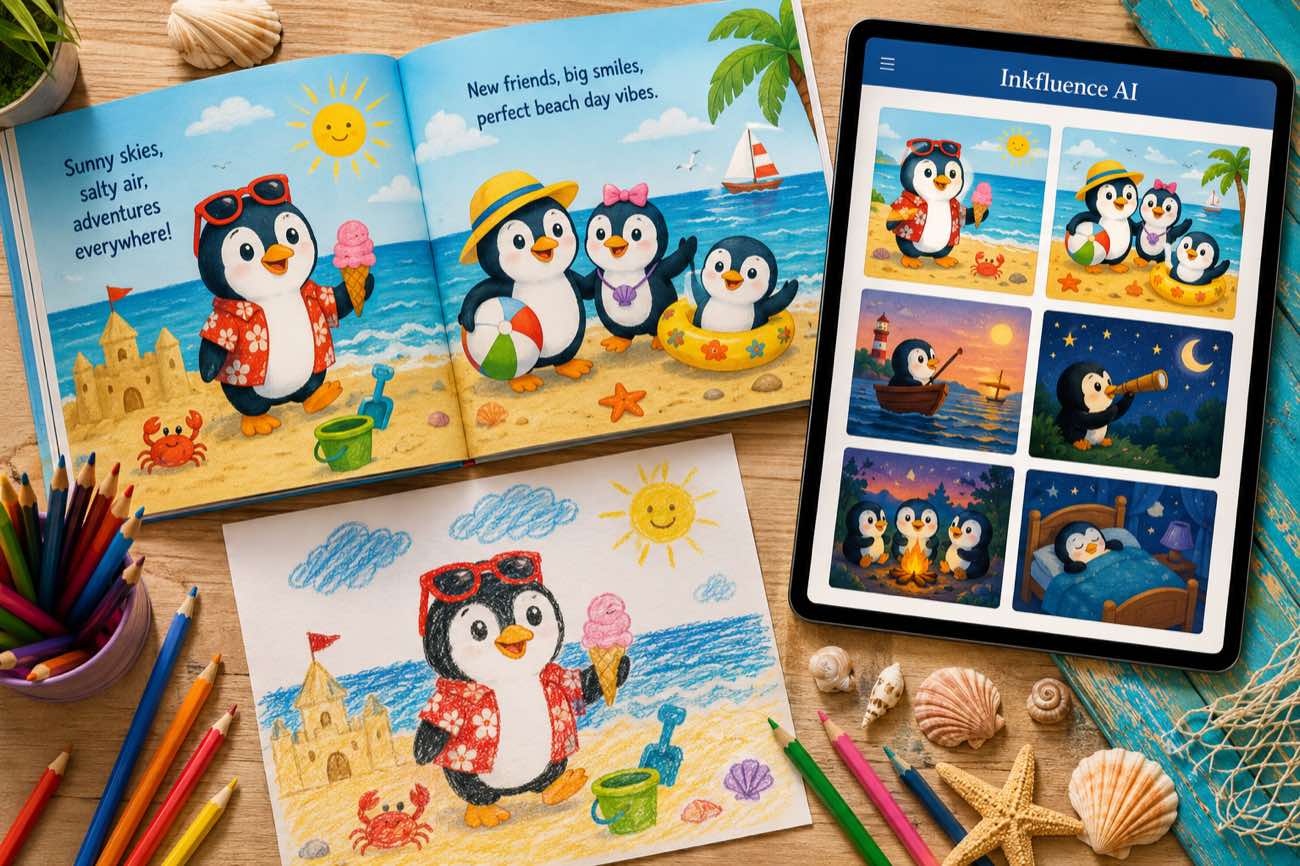
 How to Make a Children's Picture Book with AI: Idea to Printed Book in a Day
The complete 2026 workflow for making a fully illustrated children's picture book with AI: age-band word counts, page planning, consistent characters, cover design, and publishing it on Amazon KDP with the right disclosure.
 AI Writing
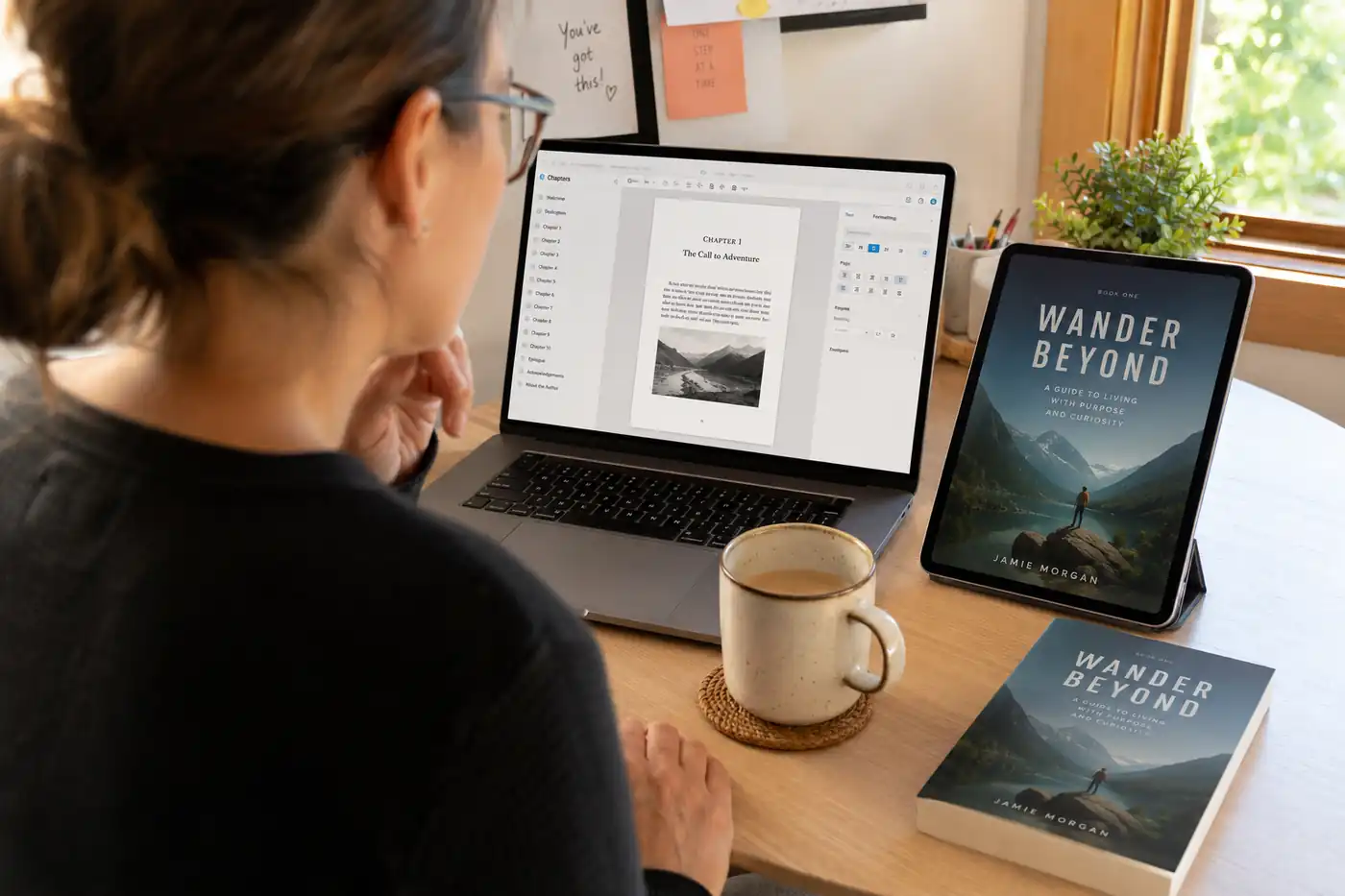
 The 9 Best Ebook Creators in 2026: AI, Formatting, and Design Tools Compared
Not every "ebook creator" does the same job. We compare the 9 best tools of 2026 across three categories: AI generators that write the book, formatting tools that typeset it, and design tools that make it beautiful, with verified pricing for each.
 AI Writing
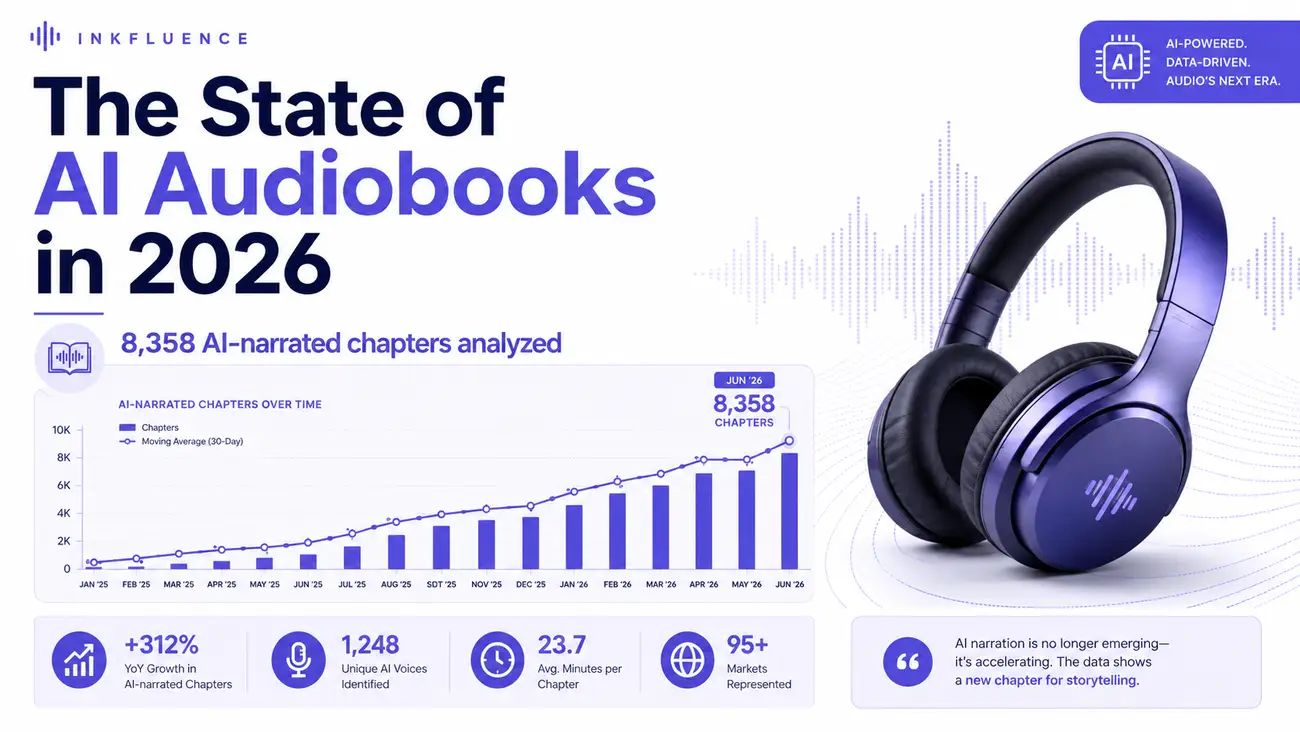
 The State of AI Audiobooks in 2026: What 8,358 AI-Narrated Chapters Reveal
We looked at 8,358 chapters our users narrated into audiobooks with AI. Monthly narration grew from a handful of chapters in late 2025 to nearly 3,000 a month by mid-2026, 99% of jobs finished cleanly, and listeners consistently pick natural, conversational voices over dramatic ones. Here is the first-party data and what it means for authors.
Get ebook tips in your inbox
Join creators getting weekly strategies for writing, marketing, and selling ebooks.