
How to Make a Children's Picture Book with AI: Idea to Printed Book in a Day
The complete 2026 workflow for making a fully illustrated children's picture book with AI: age-band word counts, page planning, consistent characters, cover design, and publishing it on Amazon KDP with the right disclosure.
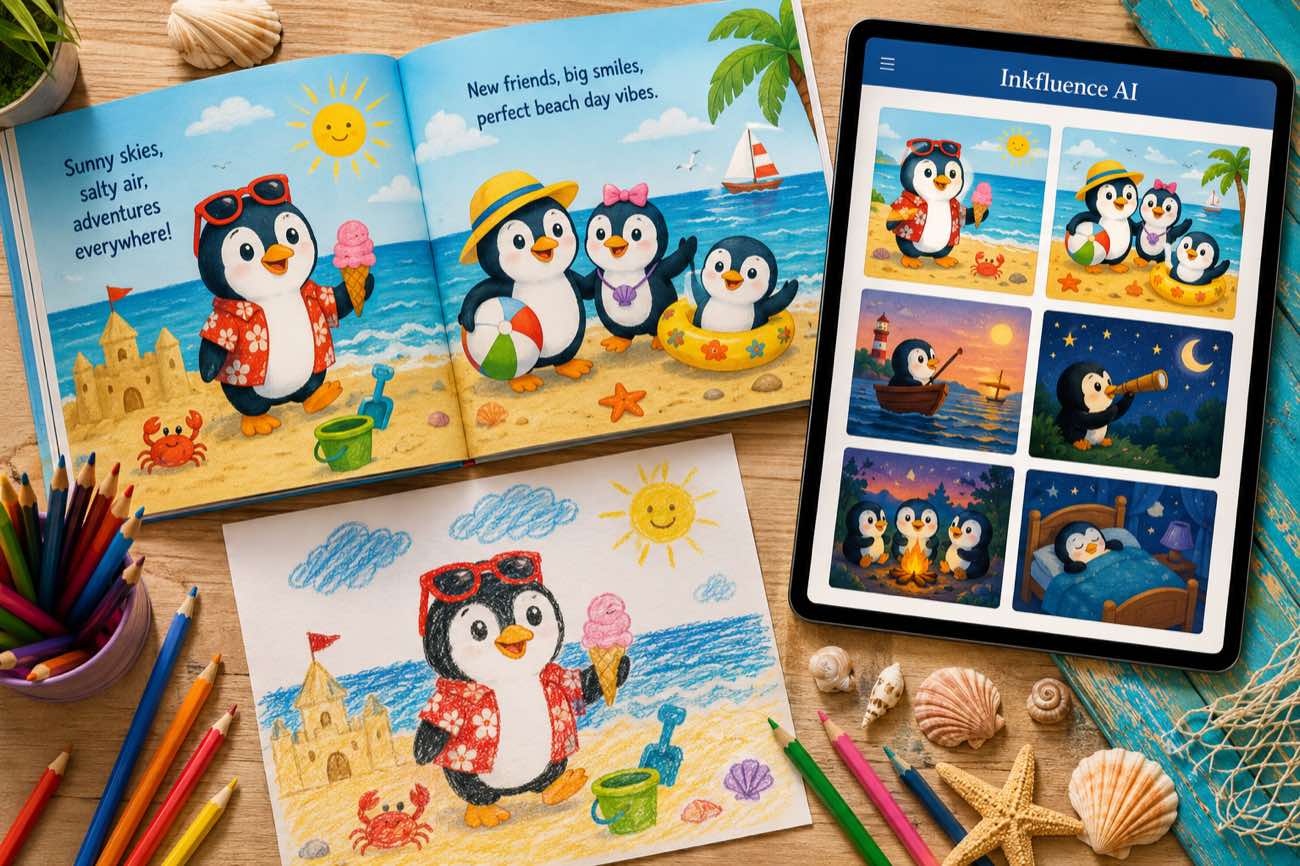
Quick Answer
To make a children's picture book with AI in 2026: pick an age band (2 to 5 or 4 to 8), describe your story idea in one or two sentences in Inkfluence AI's picture book maker, review and reorder the page plan it proposes, and let it write the read-aloud text and paint a matching illustration for every page with consistent characters throughout. Edit any page's words, regenerate any image, then export a print-ready square 8.5" x 8.5" PDF and publish on Amazon KDP, disclosing AI-generated content during setup. Total time: under a day. Total cost: from $9.99/month, versus about $1,500 to $11,000 to commission human illustration.
A picture book is the most collaborative object in publishing: words that beg to be read aloud, art that shows what the words leave out, and a physical shape built for a lap. It has also always been the most expensive kind of book for a self-publisher to make, because every one of its 12 to 32 pages needs illustration. This guide walks the whole 2026 workflow, from blank idea to a printed square book on Amazon, using AI for both the words and the pictures.
Disclosure up front: Inkfluence AI is our product, and this guide uses it for the workflow. The craft advice (word counts, page rhythm, read-aloud tests, KDP policy) applies whatever tools you use.
Updated August 2026. KDP policy details verified against Amazon's published guidelines at publication.
Step 1: Choose the age band before anything else
Every other decision (word count, sentence rhythm, page count, even how much the pictures must carry) follows from who the book is for. Publishing uses fairly stable bands, and the children's book creator writes to all of them, from toddler picture books through middle grade:
| Age band | Words per page | Total length | What the pictures do |
|---|---|---|---|
| Toddler / pre-reader (2-5) | 5 to 30 | 8 to 16 pages, under 300 words | Carry most of the story |
| Early reader (4-8) | 15 to 60 | 12 to 24 pages, under 800 words | Share the story with the text |
| Trade picture book standard | varies | 32 pages, ~500 words average | The format bookstores expect |
If you remember one number from this table: a picture book is short. First-time authors overwrite. Trade picture books average around 500 words in total, and the modern trend is shorter still. The words are a script for a parent's voice; the art is the film. (Writing for readers older than 8? That is a chapter book, and a different workflow: our all-ages children's book guide covers it.)
Step 2: Write a premise that gives the AI a story, not a topic
The difference between a flat generated book and a charming one is usually in the premise. A topic ("a book about sharing") produces a lecture. A story premise (a character, a want, an obstacle) produces a tale. If you want to warm up on premise-writing first, the free AI story writer is a low-stakes sandbox for testing story ideas before committing one to a full book:
- "A little moon slowly loses its glow, and the animals it shines on set out to help it shine again."
- "A shy hedgehog wants to join the forest dance, but every time someone looks at her, she rolls into a ball."
- "A small tugboat is frightened of the open sea, until the day the big ships need his help."
Character, want, obstacle. One sentence is genuinely enough; the generator builds the arc. If you have names, colours, or details you care about, include them and they will be honoured.
Premise cookbook: steal these shapes
Ten premise patterns that reliably produce charming books. Swap in your own animal, place, and worry:
- The small fear: "A penguin who is afraid of water learns to love the splash."
- The lost thing: "A firefly loses her light and the night garden helps her look for it."
- The big feeling: "A little thundercloud cannot stop rumbling when he is angry."
- The wrong body: "A crocodile who wants to be a ballerina, and will not take no."
- The new arrival: "A hermit crab moves house and nothing feels like home yet."
- The impossible wish: "A snail dreams of seeing the top of the mountain."
- The helper: "The moon loses her glow, and the animals she shines on set out to help."
- The reluctant hero: "A small tugboat is frightened of the open sea, until the big ships need him."
- The bedtime wind-down: "The whole forest gets ready for sleep, one animal at a time."
- The mischief loop: "A raccoon who cannot stop borrowing things learns what giving back feels like."
Stuck on a name for it? The free book title generator will throw twenty at you, and the description generator writes the back-cover blurb once the book exists.
Step 3: Review the page plan like an editor
Before anything is painted, the picture book maker shows you the book as a list of pages, each a scene. This is the highest-leverage minute of the whole process: reorder pages by dragging, rename a scene that feels off, cut one that repeats. Picture books live or die on page-turn rhythm (each turn should answer a small question and ask a new one) and it is far easier to fix in the plan than in the finished book.
What a healthy 14-page arc looks like
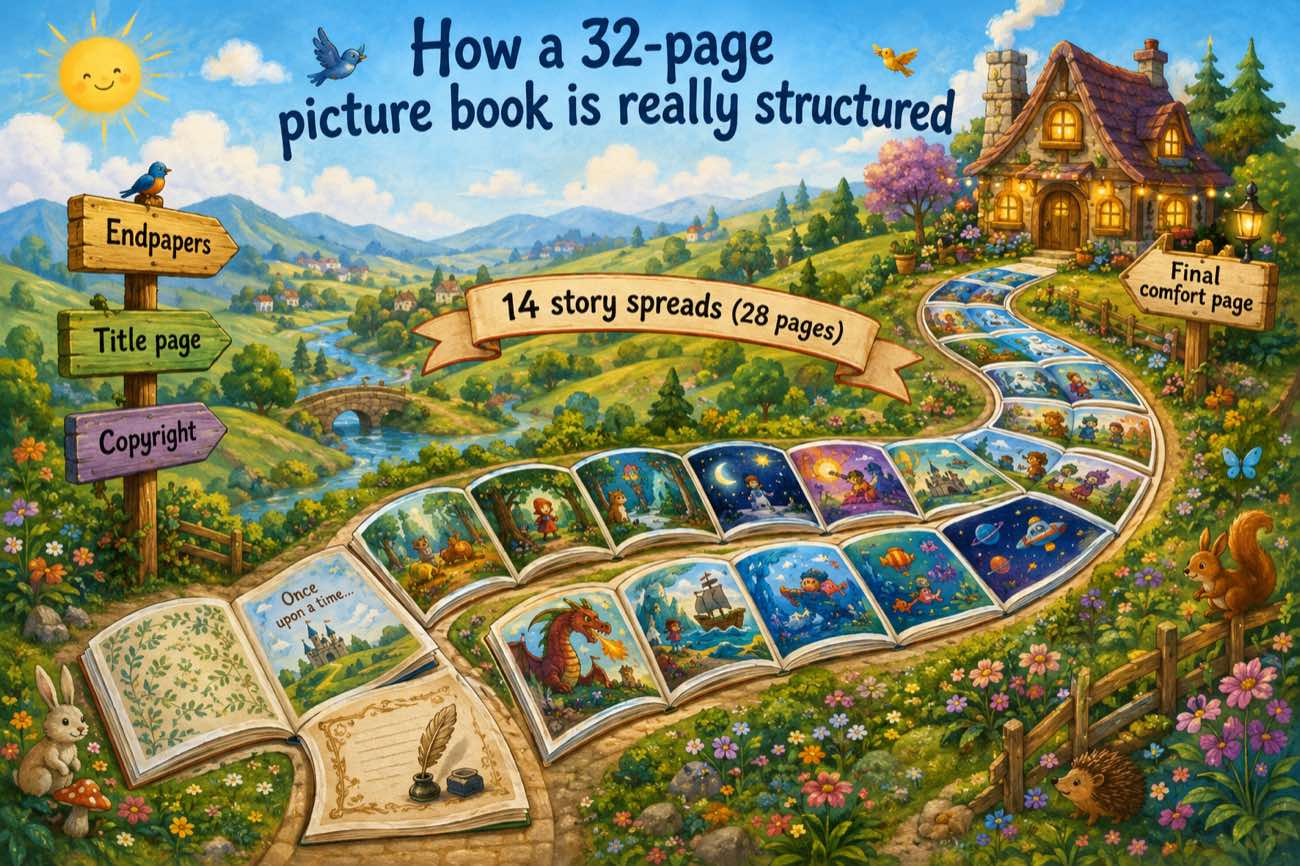
Fourteen story pages is the sweet spot of the 32-page trade format, and a century of picture books has settled on a remarkably stable shape for them. When you review your page plan, check it against this map:
- Pages 1 to 2: meet the hero in their world. One character, one setting, one small telling detail. No plot yet.
- Pages 3 to 4: the problem arrives. One clear, child-sized problem. Not two.
- Pages 5 to 9: tries and small failures. Each attempt teaches something and fails differently. This is where the book earns its re-reads.
- Pages 10 to 12: the turn. Help arrives, courage is found, or the trick finally works. The emotional high point lives here, not on the last page.
- Page 13: the resolution. The problem is settled with warmth, never with a lecture.
- Page 14: the comfort landing. A quiet final beat that sends a child to sleep rather than winding them up. Bedtime books live and die on this page.
Two rhythm tricks professional picture books use that you can apply directly in the page plan. First, vary how pages open: a sound effect on one page, a spoken line on the next, then the weather, then a question to the listener. Fourteen pages that all start with the hero's name read like a shopping list. Second, vary page length deliberately: a single dramatic line on one page, three fuller lines on the next. The variance is the pacing. For a deeper treatment of story planning, our guide to planning a children's book with AI goes chapter by chapter.
Step 4: Let it write and paint, then judge like a child
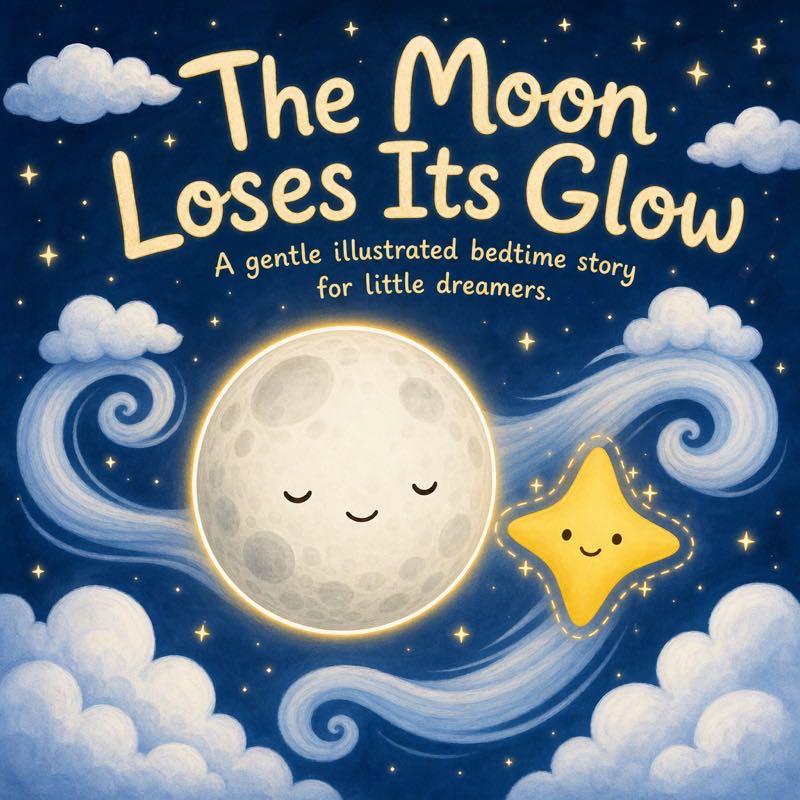
Generation takes a few minutes: each page gets its read-aloud text, and an illustration painted to show that page's exact moment, with the story's cast kept visually consistent throughout. The cover is painted last as a single artwork with the title hand-lettered into it. If you want to see finished results before making your own, the public book gallery has real reader-published examples to flip through.
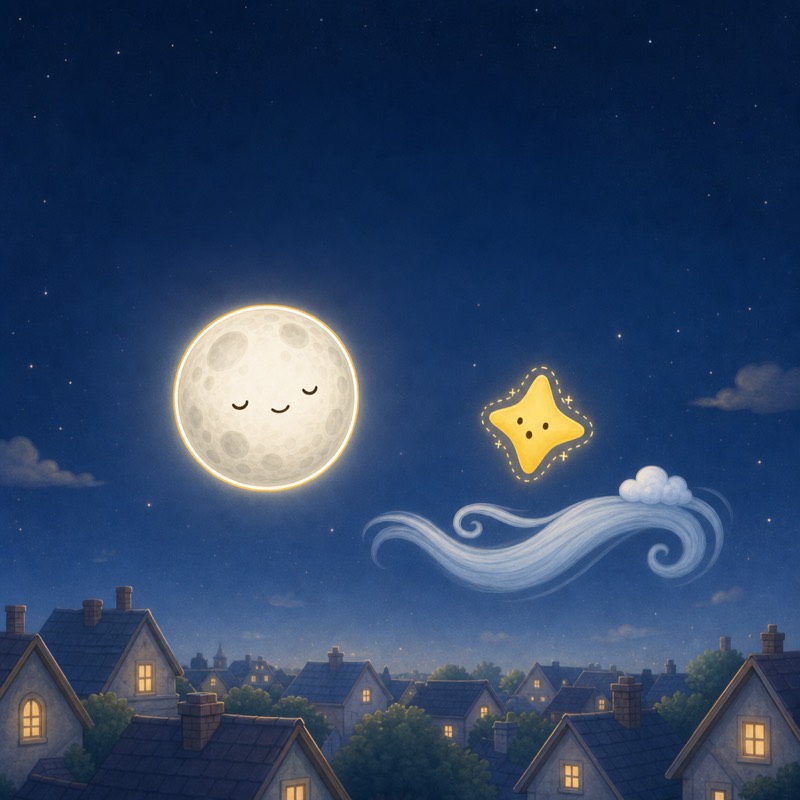
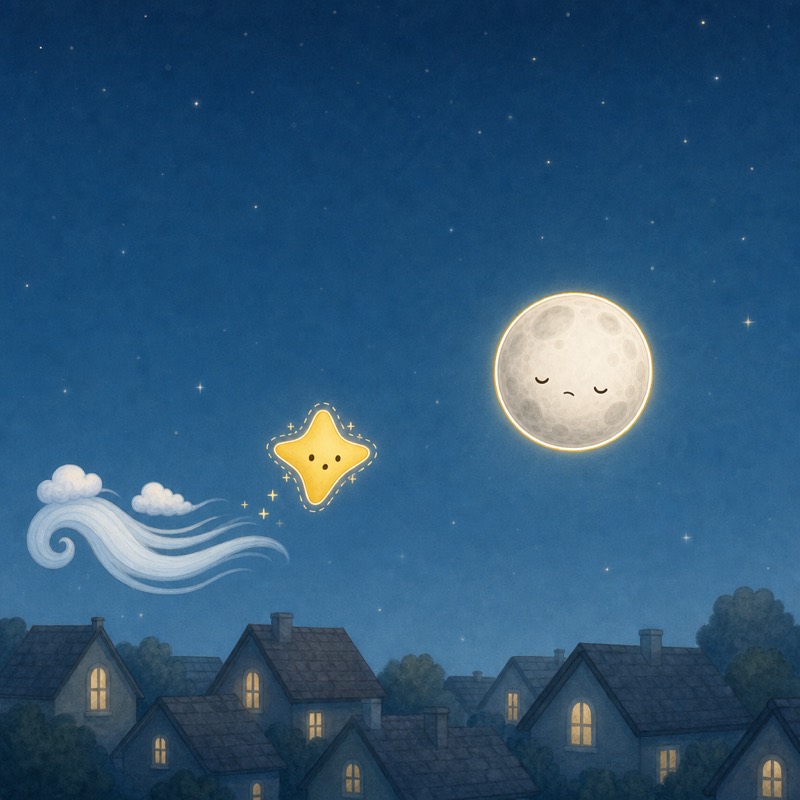
When you review the finished pages, check three things in order:
- Do the characters stay themselves? Same fox, same vest, page after page. If one page drifted, regenerate just that image; the rest of the book is untouched.
- Does each picture show its page's words? The art should depict the moment the text describes and add something the words do not say: weather, background life, an expression.
- Would a child point at something? The best pages have a detail worth a small finger: a snail in the corner, a worried star. If a page is technically fine but flat, regenerate for charm.
Why the characters stay the same, mechanically
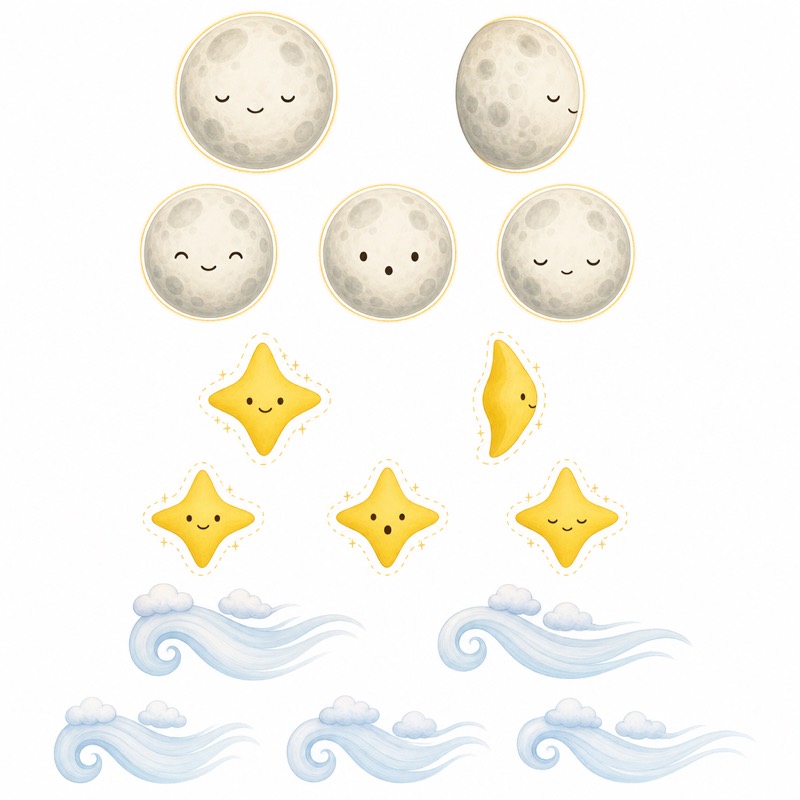
Character consistency is the single hardest problem in AI illustration, and it is worth understanding how a purpose-built tool solves it. Before any page is painted, the story's cast is fixed on a character sheet: each character's species, colours, clothing, and proportions, drawn once from several angles. Every page is then painted against that sheet rather than from a fresh text prompt, which is why page 12's penguin still has the same scarf as page 1's. General image generators treat every prompt as a blank canvas, which is why DIY workflows drift: we wrote up the failure modes (prompt drift, style drift, the re-roll lottery) on the AI children's book illustrator page, and our tool comparison tests which products can actually pass the line-up test: generate three pages of the same character and see if you would recognise them.
Step 5: Edit the words with your voice out loud
Every page's text is editable, and the single best editing tool is your own voice: read the book aloud, literally. Anywhere you stumble, a parent at bedtime will stumble every night. Shorten it. And be careful with rhyme: it is delightful when effortless and painful when forced, and a single forced line breaks the spell for the adult reading it. If the rhyme is not flowing, prose with a strong beat almost always reads better.
The read-aloud checklist
- One breath per sentence. If you need to inhale mid-sentence, a tired parent will too. Split it.
- Name feelings plainly. "Pip was scared" beats "a shiver of apprehension". The pictures carry the nuance.
- Give the child a line. A repeated refrain ("Not today, said the snail") becomes the line children join in on by the third read. One refrain per book, used three to five times.
- Put the page's best word last. The final word before a page turn does the pulling: "and then she heard a... knock."
- Cut every adverb you find. "She tiptoed" needs no "quietly".
A worked example of the kind of edit that transforms a page. Generated: "Pip felt very nervous as he slowly approached the enormous, sparkling ocean." After the read-aloud pass: "Pip stopped. The sea was big. The sea was loud. Pip's feet said no." Same beat, half the words, and a rhythm a four-year-old will chant. This pass is also where the read-aloud checklist doubles as audiobook prep: text that survives it narrates beautifully in the AI audiobook generator later.
Step 6: The cover sells the book to an adult
Remember who buys picture books: parents, grandparents, teachers. The generated cover (your cast in one joyful scene, title lettered into the art) is designed for exactly that shelf-glance. If you want to adjust it, the cover designer lets you refine or replace it, and every AI cover you generate stays in your gallery to re-apply later.
Run the thumbnail test before you commit: shrink the cover to the size of a postage stamp, which is how Amazon shoppers will first see it. The character should still be recognisable and the title still readable. Busy backgrounds and thin lettering fail at 100 pixels; one big friendly character and chunky hand-lettered type survive. If you want to iterate beyond the painted cover, the AI book cover generator covers the full toolkit.
Step 7: Export and publish on Amazon KDP
Export produces a square 8.5" x 8.5" PDF (the standard KDP picture book trim) with full-bleed art for printing at home, a KDP package whose interior keeps the art inside the page margins and whose wrap cover is sized to the page count, plus EPUB with the images bundled in for e-readers. On the KDP side, three things matter for children's books in 2026:
- Disclose AI content. KDP asks during title setup whether your book contains AI-generated content (text, images, or translations). Answer yes for both text and images. Disclosure is a policy requirement, not a penalty: AI-disclosed children's books are published and sell on Amazon every day.
- Print matters more here than any category. Adults buying for young children overwhelmingly prefer physical books, so set up the paperback, not just the ebook.
- The description sells to the adult. Lead with age suitability, reading level, and what the child takes away, not a plot summary. The free book description generator drafts this in the right frameworks.
The KDP details that catch picture book authors out
- Paperbacks need at least 24 pages. KDP will not print shorter. A 14-spread story made on Inkfluence AI comes to about 17 pages, so the KDP package adds blank endpapers at the front and back to reach 24, and its READ ME states the final count. If you would rather those pages had something on them, add a dedication, questions for grown-ups, an activity page or an about the author page in the editor.
- Full-bleed art needs bleed. Art that runs to the page edge must extend 0.125" past the trim at the top, bottom and outside edge. Inkfluence AI's KDP package sidesteps this: its interior keeps each picture inside the page margins, so choose No bleed when you upload. If you lay out your own edge-to-edge PDF elsewhere, build it with bleed.
- Colour printing costs more than novels. A premium colour paperback of 24 to 40 pages costs a flat $4.20 to print on Amazon.com at the square 8.5" x 8.5" trim ($3.60 at trims up to 6.12" x 9"). At a $12.99 list price, KDP's 60% royalty minus printing leaves $3.59 per copy; below $9.99 the rate drops to 50%. Run your own numbers in the free royalty calculator before setting a price.
- Category and keywords sell to the gift buyer. "Bedtime story about bravery ages 3-5" is a search phrase; put it in your keywords. Our Kindle publishers guide covers the full KDP setup, and the KDP AI disclosure walkthrough shows the disclosure screens step by step.
For the whole upload, from trim and bleed to proof copies, our guide to self-publishing a children's book on Amazon KDP walks through each KDP screen with print costs for five Amazon marketplaces.
What it costs in 2026
| Route | Typical cost | Time |
|---|---|---|
| Commission a human illustrator | About $1,500 to $11,000 | 2 to 6 months |
| DIY with an image generator + design tool | $20 to $50/month in subscriptions | Days to weeks of prompting and layout |
| All-in-one picture book maker | From $9.99/month | Under a day |
For illustrator rates per page and a calculator for your own page count, see our guide to children's book illustration cost.
Human illustration remains the right choice for some books; nothing here argues otherwise. What has changed is the floor: a parent can now make a real, printed, personal book for their child for the price of a paperback (or a grandparent can, with themselves in the story: see the personalized book for grandparents), and a self-publisher can test a children's book idea without betting four figures on it. Current plan details are on the pricing page, and if you are weighing AI against hiring humans across the whole book (not just illustration), we ran those numbers in AI vs ghostwriter costs.
The numbers behind this guide (first-party data)
- Authors have created 89,000+ books on Inkfluence AI, over 3,000 of them children's fiction, one of the platform's largest categories.
- Books generate natively in 30+ languages; picture books translate especially well because the art is language-neutral.
- The images in this guide are unedited output from the premise "a bedtime story about the moon losing its glow": the cover, the character sheet, and the first two pages, exactly as generated.
Six mistakes that sink first picture books
- Overwriting. The number one killer. If your 4-8 book passes 800 words, it is a chapter book wearing a picture book's clothes. Cut scenes, not sentences.
- A topic instead of a story. "A book about kindness" produces a lecture. Give a character a want and an obstacle, and let kindness be how they win. The planning guide is the antidote to this one.
- Forced rhyme. If you have to bend a sentence to land the rhyme, the adult reading it winces every night. Strong-beat prose beats weak verse, always.
- Characters that drift. A fox that changes colour on page 6 breaks the spell for a child, who tracks the book entirely through its characters. This is the first thing to check on every generated page.
- Ebook-only publishing. Adults buying for young children overwhelmingly want the physical object. Skipping the paperback skips most of the market. Beyond Amazon, digital copies also sell well on Etsy: see the best ebook niches on Etsy, where children's printables rank high.
- A cover that dies at thumbnail size. Amazon buyers see your cover smaller than a postage stamp first. Big character, chunky title, done.
After the first book: where picture books go next
The economics of AI picture books change what a finished book can become, because the marginal cost of the next version is close to zero. The same pipeline now also produces whole coloring books in line art and ABC and counting books with a guaranteed A-to-Z, which turn one audience into a product family:
- Translations. The art is language-neutral, so a Spanish, French, or German edition keeps every illustration and only rewrites the words. Each edition is minutes, and each is a separate product on KDP.
- A read-aloud audiobook. Picture book text is already a read-aloud script. The AI audiobook generator narrates it with a warm voice for screen-free bedtimes and car rides.
- A series. The same cast in a new situation is exactly what young readers want (every successful picture book character is a series). Your hero's look is already established, so book two starts from a running start.
- Direct sales. Beyond Amazon, finished PDFs sell as digital downloads on Etsy and Gumroad, and printed copies work for school fundraisers and gifts (for a single gift copy, see how to print one copy of a book). The children's book creator page covers formats and rights, and how to sell children's books works out what each of those routes pays per copy.
- The classroom. Teachers generate books that star their own class topics: a phonics sound, a science unit, a school value. Fourteen pages on "the water cycle, told by one raindrop" lands better than a worksheet.
If your ambitions run longer than 32 pages, the same platform writes full-length books too: see the AI book generator for chapter books and beyond, and the guide to writing a children's book with AI for older age groups. First book ever? Start with the first-time authors guide.
Frequently asked questions
Can I make a picture book about my own child?
Yes: name the hero after your child and describe them in the premise, as the personalized children's book maker shows step by step. For books built around your child's photo as the artwork, dedicated photo-personalisation apps are the better tool; Inkfluence draws original storybook characters rather than cartooning photos.
How many pages should my first picture book be?
Aim for 10 to 14 pages for ages 2 to 5, or 12 to 20 for ages 4 to 8. Shorter than you think. You can always make the sequel longer.
Can I translate the finished book?
Yes, and this is a picture book superpower: the illustrations are language-neutral, so a Spanish or French edition keeps every image and only the words change. Multilingual editions of the same book are minutes each, not re-illustration projects. Books also generate natively in 30+ languages from the start if you write the premise in your language: see the Spanish children's book guide for an example of the localized surface.
Do I own the rights to sell it?
Yes. Books you create on Inkfluence are yours to sell on every plan, including free. KDP, Etsy, Gumroad, school fundraisers, anywhere.
What if I already wrote the story?
Paste your text page by page in the editor and generate illustrations to match. The AI works as your illustrator while every word stays yours. See the AI children's book illustrator for that workflow.
Does a picture book have to rhyme?
No, and most modern trade picture books do not. Rhyme done well is wonderful and rhyme done adequately is worse than no rhyme, because the adult reads the flaw aloud every single night. Rhythmic prose with a strong beat is the safer default.
Who owns the copyright to an AI picture book?
You own the books you make and can sell them commercially on every Inkfluence plan. On the legal layer, the US Copyright Office currently gives purely AI-generated images limited protection while your text, arrangement, and the book as a whole are a stronger basis. For most self-publishers this is a practical non-issue; franchise builders should read the Copyright Office guidance in the sources.
What is the minimum page count for a KDP paperback?
24 pages. When a picture book made on Inkfluence AI comes up short (a 14-spread story is about 17 pages), the KDP package adds blank endpapers to reach 24 automatically. If you prefer pages with something on them, add a dedication, questions for grown-ups, an activity page or an about the author page first.
Can I make an audiobook version?
Yes, picture book text is already a read-aloud script, so it narrates beautifully. Generate it with the same project, choose a warm voice, and distribute wherever you like. Note that Audible's ACX requires human narration, but Spotify, YouTube, and direct sales have no such rule.
How is this different from photo-personalised book apps?
Photo apps put your child's actual face into template stories, which makes a lovely one-off gift. Inkfluence draws original storybook characters in an original story, which is what you want for books you intend to sell, and for stories whose hero is a moon, a tugboat, or a shy hedgehog.
Sources
Related reading
- AI Picture Book Maker: the tool this guide uses, explained end to end
- Halloween Story Generator for Kids: a real seasonal picture book starring a named child, with its pages, text and character sheet
- How to Make a Picture Book with AI (Video): the eight-minute walkthrough, with transcript
- AI Children's Book Illustrator: consistent characters for a story you already wrote
- Best AI Children's Book Creators Compared: honest rankings of every tool in the category
- How to Write a Children's Book with AI: the craft guide for all ages, not just picture books
- How to Plan a Children's Book with AI: story structure in depth
- Children's Book Word Count and Page Count by Age: words per page by age band, with a budget calculator
- Publishing AI-Generated Books on KDP: the disclosure screens, step by step
Sources

Founder, Inkfluence AI
Sam is the founder of Inkfluence AI. He built the platform to make book creation accessible to everyone - from first-time authors to seasoned publishers.
Helpful links
Ready to Create Your Own Ebook?
Start writing with AI-powered tools, professional templates, and multi-format export.
Get Started FreeRelated Articles
 Publishing
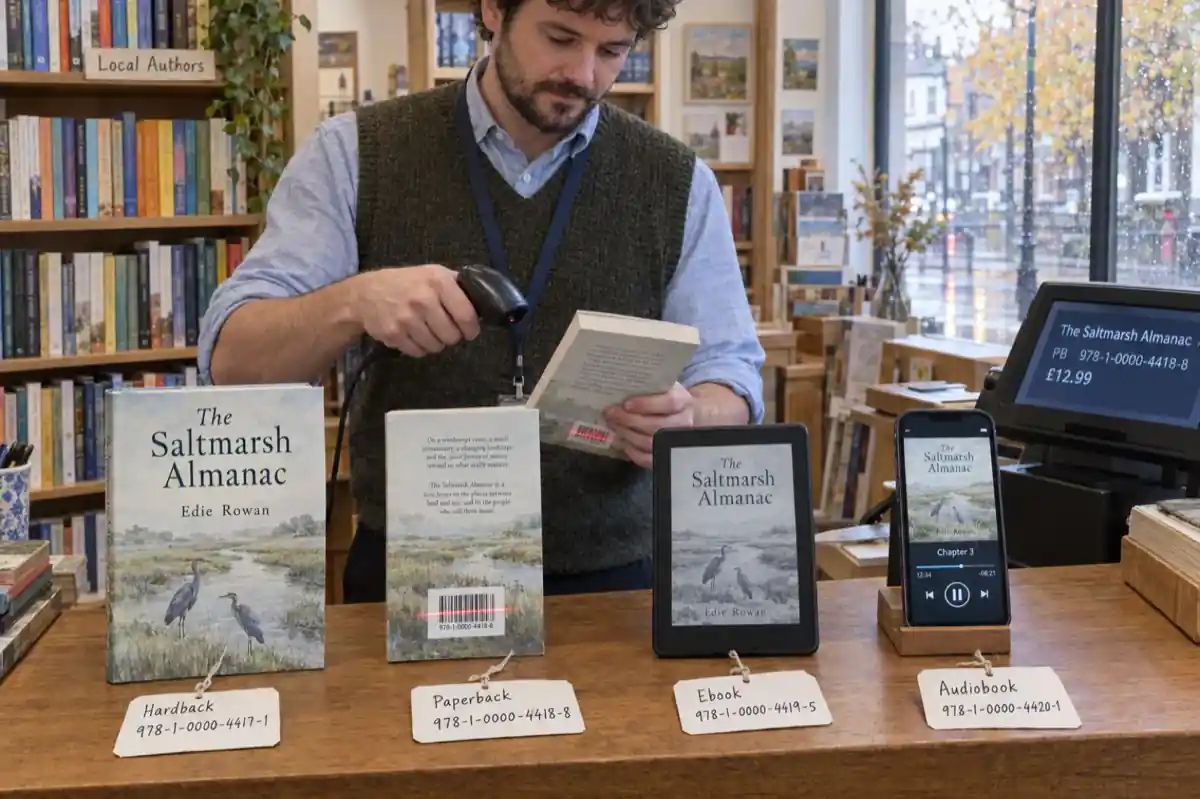
 Do You Need an ISBN? Free vs Bought, Cost by Country, and Which Formats Need One (2026)
When a self-published book needs an ISBN and when it does not, what one costs in the US, UK, Canada, Australia, New Zealand, India, Germany, Italy and France (checked at each agency on 13 October 2026), free ISBNs from KDP, IngramSpark and Draft2Digital, and a picker that tells you how many you need.
 Publishing
 IngramSpark AI Policy (2026): What It Accepts, the Setup Question and the "Assisted By" Credit
IngramSpark accepts AI-drafted books with significant human editing and the "Assisted By - Generative AI" credit, and refuses works created solely with generative AI. Its exact wording, covers and translations, how it differs from KDP, a checker for your book, and an editing workflow.
 Publishing
 IngramSpark vs KDP (2026): Fees, Print Quality, Distribution, and Whether to Use Both
IngramSpark vs Amazon KDP compared on 2026 fees, print cost per copy for real trim sizes, earnings per sale, distribution, paper and binding options, and file specs, with a per-copy earnings calculator and the setup for using both with one ISBN.
Get ebook tips in your inbox
Join creators getting weekly strategies for writing, marketing, and selling ebooks.