
IngramSpark vs KDP (2026): Fees, Print Quality, Distribution, and Whether to Use Both
IngramSpark vs Amazon KDP compared on 2026 fees, print cost per copy for real trim sizes, earnings per sale, distribution, paper and binding options, and file specs, with a per-copy earnings calculator and the setup for using both with one ISBN.
Quick Answer
Use KDP for Amazon and IngramSpark for bookshops, libraries and jacketed hardcovers, with your own ISBN on both and KDP Expanded Distribution off. Both are free to set up. KDP pays more per Amazon sale (60% of list minus printing); IngramSpark pays the wholesale price minus printing and a 1.875% fee.
KDP and IngramSpark both print your book only when someone orders it, and both cost nothing to set up. The difference is who they sell to. KDP is Amazon's own service: it sells your paperback on Amazon at a royalty, and it can pass the book to a few distributors for a smaller one. IngramSpark is the self-publishing arm of Ingram, the book wholesaler that bookshops and libraries order from: it sells your book at a trade discount to a network its 2026 rate card puts at more than 45,000 retailers, libraries, universities and educators.
So the question is rarely "which one". It is how much of each, and what it costs you per copy. This guide answers that with the numbers each company publishes: setup and distribution fees, print cost per copy for five real books, what you earn per sale on each route, what each one prints, and whether the files you made for one will work on the other. Every figure was read on the company's own help pages or price documents on 13 October 2026, and each is listed under Sources.
Prices are in US dollars for Amazon.com and IngramSpark's US rate card unless a line says otherwise. Both companies change prices: IngramSpark can revise its schedule once a year (by no more than 5%, its rate card says), and KDP updates its tables without notice. Check the live calculators before you set a price.
IngramSpark vs KDP at a glance (checked 13 Oct 2026)
The table sets the two side by side on the points authors ask about most. Paperback figures are for a black-and-white book unless the row says otherwise.
| Amazon KDP | IngramSpark | |
|---|---|---|
| Setup fee | $0 | $0 (print, ebook or both) |
| Changing files later | Free | Free since 1 Feb 2026 |
| Distribution fee | None | 1.875% of list price per sale |
| How you are paid | 60% of list ($9.99 and up) or 50% (under $9.99) minus printing; 40% minus printing through Expanded Distribution | List price minus your wholesale discount (53% to 55% recommended in the US) minus printing and the fee |
| Print cost, 300-page 6 x 9 | $4.60 | $5.71 |
| Where it sells | Amazon marketplaces; US and UK distributors through Expanded Distribution (paperback only, not guaranteed) | 45,000+ retailers, libraries, universities and educators, including online stores |
| Hardcover | Case laminate; not in Expanded Distribution | Case laminate, cloth with gold spine text, dust jacket; distributed |
| Paper choices | Cream, white, groundwood; standard and premium colour | Cream, white (50 lb and 70 lb), groundwood; standard, premium and ultra-premium colour |
| Minimum pages | 24 (paperback), 75 (hardcover) | 18 |
| Maximum list price | $250 (paperback, Amazon.com) | $124.99 unless support agrees |
| Free ISBN | Yes, usable on KDP only | US accounts only, usable on IngramSpark only (imprint shows as Indy Pub) |
| Cover file | Your own PDF built to KDP's formula, barcode optional | Built on IngramSpark's emailed template as a PDF/X, or in its free Book-Building Tool; barcode required, placed free if you leave a 1.75 x 1 in space |
| Returns | No setting | You choose returnable or not |
| Payment | About 60 days after month end (90 for Expanded Distribution) | 90 days after month end |
Two rows decide most authors' choice. The "how you are paid" row means KDP keeps your per-copy earnings higher on Amazon, often by $3 to $4 a copy for a typical paperback. The "where it sells" and "hardcover" rows mean IngramSpark is how a bookshop or library orders your book in the normal way. If you want to compare what you would make on Amazon against other stores and formats in one place, our royalty calculator covers KDP, IngramSpark and the main ebook stores.
Need the book first?
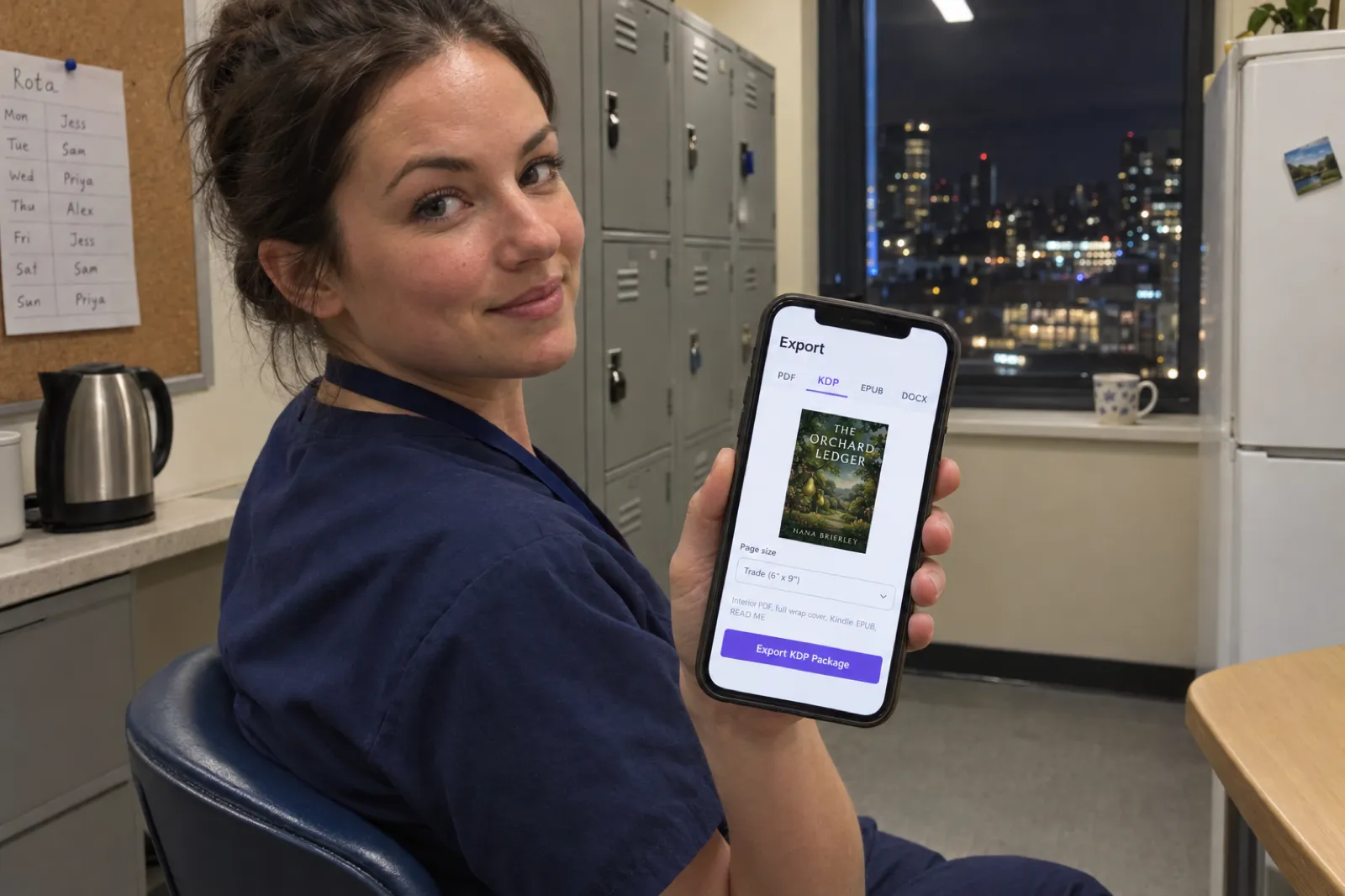
Inkfluence AI writes and formats the whole book, then exports a print-ready interior PDF at the trim size you choose, a full wrap cover and a Kindle EPUB in one package. Start free; any paid plan or credit pack unlocks the print package.
Start your book freeWhich one should you use?
Work from where you expect your readers to buy, not from which company sounds more professional.
- You will sell mainly on Amazon: KDP alone is enough. It pays the most per Amazon sale, its print cost is lower on every black-and-white book in our table, and it puts the book on Amazon without a middle step. This covers most first books, ebooks with a paperback edition, and anything you sell through Amazon ads.
- You want bookshops, libraries or schools to be able to order it: add IngramSpark. Booksellers order from wholesalers on trade terms, and IngramSpark is a wholesaler's own route in. KDP's Expanded Distribution also reaches distributors, but it is paperback only, a long list of content types is not accepted (see Distribution), and KDP says acceptance is not guaranteed.
- You want a hardcover in shops, or a dust jacket: IngramSpark. KDP prints case laminate hardcovers for Amazon, but hardcovers are not eligible for its Expanded Distribution, and it does not print jackets.
- You are printing a colour picture book under 72 pages cheaply: check IngramSpark's standard colour. KDP's standard colour starts at 72 pages, so a 32-page KDP picture book prints in premium colour at $4.20; IngramSpark's standard colour rate puts the same book at about $2.48. Its premium colour is $4.44. Our children's book publishing guide covers the KDP side in detail.
- You make low-content books (journals, planners, colouring books): stay on KDP. KDP's own Expanded Distribution page says its distributors do not currently accept journals, notebooks, planners or colouring books, which tells you what the bookshop market thinks of them. Our low-content books guide covers the KDP rules.
If more than one of those applies, you use both, and the rest of this guide shows how to do that without breaking either account's rules.
Fees and setup costs in 2026
IngramSpark
IngramSpark's 2026 rate card, effective 1 February 2026, lists combined print and ebook setup, print-only setup and ebook-only setup as free in every currency. Its help centre announcement of the same changes says three things happened that day: print-on-demand prices were adjusted so that "some books costing more to print, while others will cost less"; books enabled for distribution are assessed a 1.875% market access fee; and revisions became free for all books. The rate card calls the same charge the global distribution fee: "1.875% of the local list price at the time of sale".
The other fees on the rate card are small or optional:
- File copies administration: $25 per title to have the files Lightning Source holds sent back to you, limited to five a year.
- Payment by check: $25 per check, US payments only. Direct deposit avoids it.
- Printed inside cover (duplex): $0.30 per cover printed.
- Rush printing on copies you order yourself: 30% on top of the print charge.
- Order handling and shipping on copies you order for yourself, calculated at the time of order.
On copies you order for yourself there is a volume discount: 2% from 100 copies, rising in steps to 10% from 500, 20% from 1,500 and 35% from 10,000. Sales through the distribution network cost you nothing upfront: the rate card says "No costs are billed to the publisher for wholesale channel orders"; printing comes out of what you are paid. To price your author copies for any binding, trim, page count and quantity, use our IngramSpark cost calculator.
Amazon KDP
KDP charges nothing to publish and has no distribution fee. Its cost to you is the royalty structure: 60% of the list price for paperbacks listed at $9.99 or more on Amazon.com, 50% at $9.98 or less, minus printing. Expanded Distribution pays 40% of the list price minus printing. Proof copies and author copies cost the printing cost plus shipping and any tax.
Neither company edits, designs or formats your book; IngramSpark's file guide says it "will not perform work of an editorial nature such as proofreading, editing for content, typesetting". The other costs (an ISBN, a cover designer, an editor) are the same whichever printer you choose; our breakdown of the real cost of publishing a book prices each one.
Print cost per copy: five real books
Both companies publish their print prices as a formula, so the numbers below are exact for the rates in force on 13 October 2026, not estimates.
- KDP: fixed cost plus page count times a per-page cost, set by marketplace, ink and whether the trim is "regular" (up to 6.12 inches wide and 9 inches tall) or "large". A black-ink paperback of 110 pages or fewer pays only a fixed $2.30 (regular) or $2.84 (large) on Amazon.com; above that it is $1.00 plus $0.012 a page (regular) or $0.017 (large).
- IngramSpark: "cost per page x number of pages + cost per unit". Books narrower than 6.15 inches are "small"; wider ones use the large rate. A small black-and-white paperback on 50 lb white or cream paper is $1.33 plus $0.0146 a page; large is $1.39 plus $0.0212.
| Example book | KDP (Amazon.com) | IngramSpark (US) | Difference |
|---|---|---|---|
| Novel, 5 x 8, 250 pages, black and white, cream paper | $4.00 | $4.98 | +$0.98 |
| Non-fiction, 6 x 9, 300 pages, black and white, white paper | $4.60 | $5.71 | +$1.11 |
| Workbook, 8.5 x 11, 120 pages, black and white, white paper | $3.04 | $3.93 | +$0.89 |
| Picture book, 8.5 x 8.5, 32 pages, premium colour | $4.20 | $4.44 | +$0.24 |
| Hardcover, 6 x 9, 300 pages, black and white (case laminate) | $9.25 | $9.27 | +$0.02 |
Sources: KDP Paperback Printing Cost and Hardcover Printing Cost help pages; IngramSpark Rate Card effective 1 February 2026. KDP's 6 x 9 hardcover figure is its own worked example. With a dust jacket, the IngramSpark hardcover is $7.76 plus $0.0147 a page: $12.17 for 300 pages.
Print cost per copy, paperbacks (checked 13 Oct 2026)
Bar length = cost / $5.71 (the highest value). Violet = KDP, grey = IngramSpark.
Novel, 5 x 8, 250 pages
Non-fiction, 6 x 9, 300 pages
Workbook, 8.5 x 11, 120 pages
Picture book, 8.5 x 8.5, 32 pages, premium colour
Three things stand out. First, KDP is cheaper to print on every black-and-white paperback here, by roughly a dollar a copy, because its fixed cost is $1.00 against IngramSpark's $1.33 and its per-page cost is lower ($0.012 against $0.0146 for regular trims). Second, the gap closes on colour and disappears on hardcover. Third, the cheapest colour option in the whole comparison is IngramSpark's standard colour on short books: $1.23 plus $0.0392 a page for a large trim, so about $2.48 for a 32-page 8.5 x 8.5, a book KDP cannot print in standard colour at all because its standard colour needs 72 pages.
Two IngramSpark details change the arithmetic slightly. It stores every interior with an even page count and uses the last page for its own manufacturing information, adding pages if needed. And a 6.14 x 9.21 book counts as small at IngramSpark (under 6.15 inches wide) but large at KDP (over 6.12 inches), so for that one trim IngramSpark's per-page rate is the lower of the two. If you are still choosing a size, our KDP trim sizes guide shows which sizes cost more to print.
What you earn per copy
Print cost is only half of it. The bigger difference is how each company works out your share.
KDP on Amazon
KDP's formula is "(Royalty rate x list price) - printing costs = royalty", with its own example: "(0.60 x $15) - $5.00 = $4.00" for a 333-page regular-trim paperback on Amazon.com. The rate is 60% at $9.99 and above and 50% at $9.98 and below on Amazon.com (the thresholds are 7.99 GBP on Amazon.co.uk and 9.99 EUR in the euro marketplaces). KDP also sets a minimum list price, which is your printing cost divided by the royalty rate, so it never lets a sale lose money.
KDP Expanded Distribution
For copies sold through KDP's distributors, the royalty is "40% of the book's list price effective in the distribution channel at the time of purchase, minus printing costs". On a $16.99 book with $4.60 printing that is $2.20.
IngramSpark
IngramSpark "pays the publisher the wholesale price less the cost of printing for each book sold through the global distribution network", and the 1.875% fee comes off too. Its own help centre example: a $25.99 book at a 55% discount has a wholesale price of $11.70; subtract $7.18 for printing a 6 x 9 black-and-white paperback plus the 1.875% fee, and you are paid $4.52. That example is consistent with the rate card for a book of about 368 pages.
The same 300-page 6 x 9 paperback at $16.99, on each route:
| Route | Your share before printing | Printing | Fee | You earn |
|---|---|---|---|---|
| KDP, sold on Amazon.com (60%) | $10.19 | $4.60 | $0 | $5.59 |
| KDP Expanded Distribution (40%) | $6.80 | $4.60 | $0 | $2.20 |
| IngramSpark, 55% discount | $7.65 | $5.71 | $0.32 | $1.62 |
| IngramSpark, 40% discount | $10.19 | $5.71 | $0.32 | $4.16 |
You earn per copy: 6 x 9, 300 pages, $16.99
Bar length = earnings / $5.59 (the highest value).
That is the core trade. On Amazon, KDP earns you about three and a half times what the bookshop-friendly IngramSpark setting does on the same book. Through bookshops, IngramSpark at 55% is the price of being stockable, and KDP's Expanded Distribution pays a little more per copy but reaches fewer buyers and accepts fewer books. That is why "use both" is the usual answer: KDP keeps the Amazon sales at the higher rate, and IngramSpark handles the sales KDP cannot make.
The same comparison for the other example books, at a 55% IngramSpark discount:
| Book and list price | KDP Amazon | KDP Expanded | IngramSpark 55% | IngramSpark 40% |
|---|---|---|---|---|
| Novel, 5 x 8, 250 pages, $14.99 | $4.99 | $2.00 | $1.49 | $3.73 |
| Workbook, 8.5 x 11, 120 pages, $12.99 | $4.75 | $2.16 | $1.68 | $3.62 |
| Picture book, 8.5 x 8.5, 32 pages premium colour, $12.99 | $3.59 | $1.00 | $1.17 | $3.11 |
Worked from the published formulas above. A picture book at 8.5 x 8.5 is only eligible for KDP Expanded Distribution in colour, and KDP's distributors do not accept every book, so the middle column is what you would earn if accepted.
For pricing beyond print, including where the $9.99 line sits for ebooks and how list prices compare by genre, our guide to how to price an ebook covers the ebook side.
Calculator: your book on KDP and IngramSpark
Pick your trim, paper and page count, then a list price and the IngramSpark discount you would use. The calculator applies KDP's Amazon.com printing table and royalty rates and IngramSpark's 2026 US rate card and fee, the same formulas as the tables above, and shows what each route pays per copy. It runs in your browser; nothing is sent anywhere.
IngramSpark vs KDP earnings per copy
Paperback, US dollars, rates checked 13 Oct 2026.
| Route | Your share | Printing | Fee | You earn |
|---|
KDP: Amazon.com printing cost (regular trim up to 6.12 x 9 in; black ink 110 pages or fewer pays the fixed cost only; standard colour from 72 pages), royalty 60% at $9.99 and up, 50% below, Expanded Distribution 40%. IngramSpark: 2026 US rate card, small trims under 6.15 in wide, standard colour on 50 lb paper, premium colour on 70 lb, cream paper up to 6.14 x 9.21 in, fee 1.875% of list price. Taxes, currency conversion and returns are not included.
A quick reading guide for the result. If KDP on Amazon beats IngramSpark by a wide margin, as it does for most black-and-white books, make sure Amazon buyers land on the KDP edition and let IngramSpark carry the rest. If the IngramSpark row goes negative at 55%, your list price is too low for bookshop terms: raise it, or accept that the book is an Amazon book. For an all-platform view including ebook stores, use our royalty calculator, and for monthly income at a sales volume, the ebook income calculator.
Wholesale discount and returns on IngramSpark
The discount is the setting that most changes your IngramSpark earnings, so it is worth understanding what it buys.
IngramSpark's help centre says a wholesale discount "of 53% to 55%, with a 'returnable' status, generally allows for the widest availability through most retailers and bookstores", because it lets them "receive their standard trade discount" from the wholesalers they buy through. It gives the regional figure as 53% to 55% for the US and Canada and 48% to 55% for the UK, Europe and Australia. Its discount worksheet adds the other side: a discount under 53% in the US and UK (under 48% in Australia) means a bookstore gets a "short discount", which "is not typically a big enough incentive" to stock the book. Online retailers are different; the same worksheet says you "can get away with a shorter discount" there, because an online retailer only orders after the reader has paid.
The minimum discount IngramSpark allows is shown on its title setup page and can change; its 2023 worksheet gave the range as 40% (minimum) to 55% (maximum). IngramSpark also warns that changing the list price, discount or returns option later "can have a negative impact on the compensation you receive", so set them deliberately the first time.
Returns
Bookshops expect to be able to send back copies that do not sell. IngramSpark's FAQ leaves the choice to you: your book can be returnable or not. A returnable book is easier for a shop to order, but returns are deducted from what you are paid. The user guide also notes that if you switch a book from returnable to non-returnable, returns are still accepted for 180 days. A sensible pattern for a first book: 55% and returnable if you will actively pitch it to bookshops and libraries; a shorter discount and non-returnable if you only want the book orderable and listed in online stores beyond Amazon.

Distribution: where each one sells
KDP
KDP sells paperbacks on the Amazon marketplaces that support print (its help pages note that Amazon.com.br, Amazon.com.in and Amazon.com.mx do not). Expanded Distribution makes the paperback available to distributors in the United States and the United Kingdom, "but booksellers and libraries around the world may purchase books from these distributors". It is free to enrol, and KDP is direct about the limits: enrolment "doesn't guarantee it will be accepted by distributors or ordered by a particular bookseller or library", and KDP "can't provide details on which booksellers and libraries purchased your book".
The eligibility rules are where many authors get caught:
- Hardcovers are not eligible.
- Content not currently accepted "includes, but is not limited to" paperbacks with frequent lined or blank pages (journals, notebooks, planners, calendars), unauthorised summaries of other books, pages with a high concentration of ink, public domain content, colouring books, poorly translated content and excessively repeated content. The page also lists a table of topics under that heading, including cookbooks, workbooks, how-to books, biographies, travel guides, puzzle and activity books, and several health and finance topics.
- Trim and paper: cream paper is eligible only at 5 x 8, 5.25 x 8, 5.5 x 8.5 and 6 x 9; 8.5 x 8.5 is eligible only in colour; 8.25 x 11 and 8.25 x 8.25 are not eligible at all.
- ISBN: the paperback's ISBN "must not have been submitted for distribution through another service". That is the rule that stops you using Expanded Distribution and IngramSpark on the same ISBN.
IngramSpark
IngramSpark's rate card describes "our global distribution network of over 45,000 retailers, libraries, universities and educators". When you enable a book for distribution, IngramSpark sends its details to that network, and buyers "can then order your book via Ingram's book ordering system". Its FAQ says it can take "between 2 to 6 weeks" for a book to appear on retailer websites. Being in the catalogue is not the same as being on a shelf: IngramSpark says there is "no guarantee that any given wholesaler, reseller, or retailer will purchase or make any book available for sale". Shops order books they expect to sell, usually because a reader asked, an event is planned, or the author has pitched them.
Ingram prints in the US, UK, Australia and the UAE (no hardcovers in Sharjah, its user guide notes), usually at the facility closest to the buyer, which keeps shipping times down for overseas orders. If you are weighing the wider question of exclusive Amazon sales against going wide on ebooks too, our explainer on KDP Select vs wide distribution covers the ebook side of that decision.
Print quality, paper and binding
Search results for "IngramSpark vs KDP print quality" are full of confident opinions. Neither company publishes a comparison, and print-on-demand quality varies from copy to copy at both, so this section sticks to what each one states.
| What the specs say | Amazon KDP | IngramSpark |
|---|---|---|
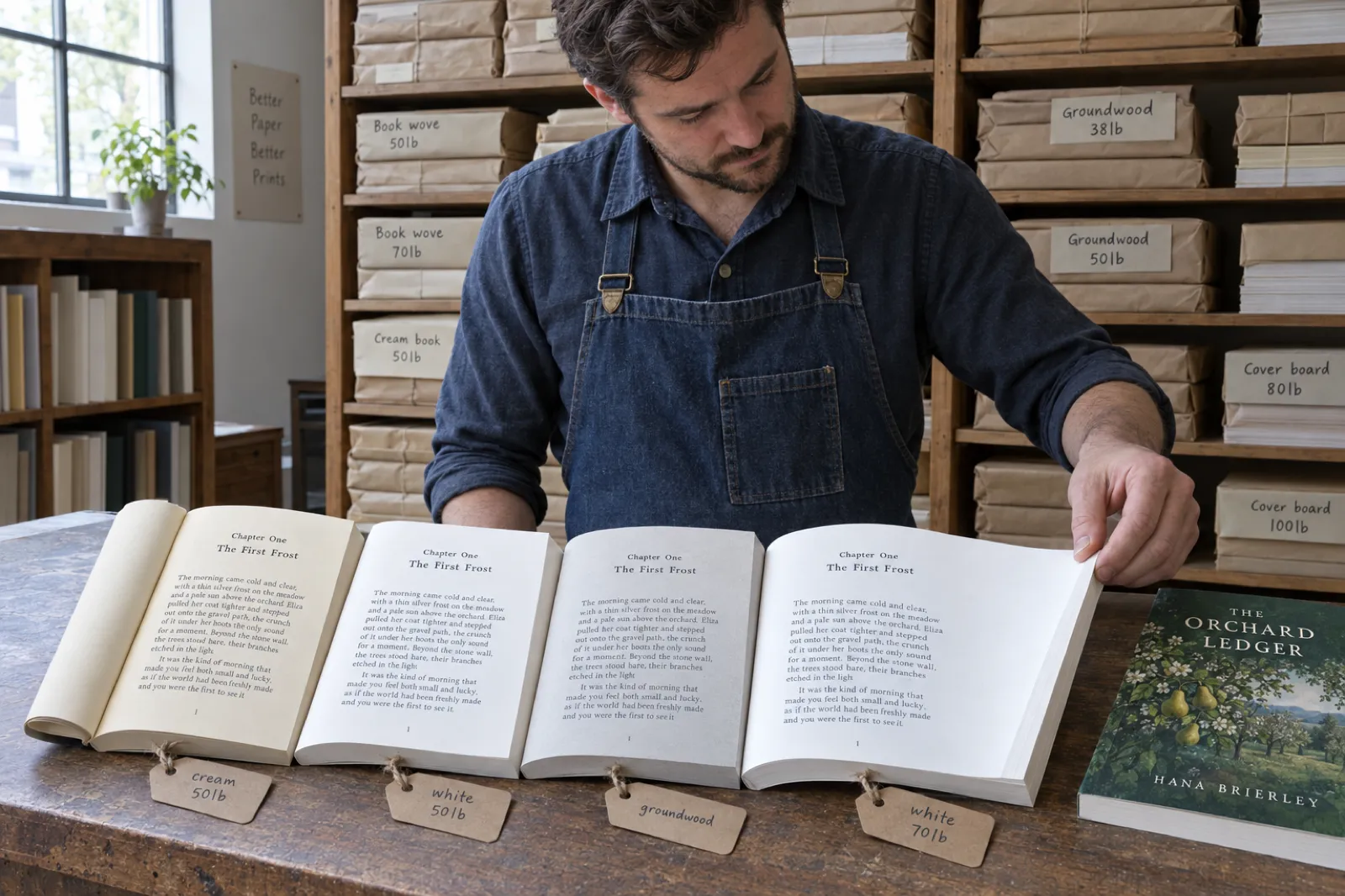
| Black-and-white paper | Cream or white, 50-61 lb (74-90 gsm); groundwood 45 lb (60 gsm) | Cream or white 50 lb (74 gsm); white 70 lb (104 gsm); groundwood 38 lb (48 gsm) |
| Colour interiors | Standard colour (50-61 lb, 72-600 pages); premium colour (60-71 lb) | Standard colour on 50 lb or 70 lb; premium colour on 70 lb; ultra-premium colour on 70 lb |
| Paperback cover | 80 lb (220 gsm) white stock, gloss or matte | Four-colour, gloss or matte lamination; optional printed inside cover (duplex, $0.30) |
| Hardcover | Case laminate only; 75-550 pages; no standard colour | Case laminate (gloss or matte), cloth-textured cover with gold spine text, dust jacket (jackets up to 6.14 x 9.21) |
| Stated tolerance | 0.0625 in either side of the cover fold lines | Cover position, trim and print position within 1/16 in (0.0625 in) |
| Consistency | Paper weight "varies based on printing location" | "There may be variations between orders, including proof orders", due to location and equipment |
The fair summary is that IngramSpark offers more ways to make a book feel premium (heavier paper, a jacket, cloth, an inside cover) and states its tolerances in detail, including how many ink voids per page its inkjet presses are allowed. KDP offers fewer choices and a cheaper standard book. Whether one prints your particular book better is something only a proof copy answers, and since a proof costs printing plus shipping on both, it is cheap to find out. Our guide to printing one copy of a book covers proofs and author copies on each.
Will the same files work on both? KDP files checked against IngramSpark's specs
This is the question that decides how much work "use both" really is. We checked the files Inkfluence AI exports for KDP (its print interior PDF and full wrap cover) against IngramSpark's File Creation Guide dated 24 August 2026 and its user guide dated September 2026, line by line. We did not upload a test book to IngramSpark, so treat this as a spec comparison and let IngramSpark's eproof have the final word. The same checks apply to KDP-ready files from any other tool.
The interior PDF: works at shared trim sizes, with three things to know
Page size matches. IngramSpark says: "If submitting an interior without bleed, please build pages to exact trim size". That is exactly what KDP asks for and what our KDP interior is. When a book has pictures running off the page, IngramSpark wants 0.125 inch of bleed on the top, bottom and outside edge and none on the binding edge, so a 6 x 9 bleed page is 6.125 x 9.25 inches. That is also KDP's bleed size, and it is the size our export produces for books with full-page photos. The same file shape is valid at both.
Trim sizes mostly overlap. Of the ten trims Inkfluence AI exports, nine are standard IngramSpark sizes: 5 x 8, 5.5 x 8.5, A5, 6 x 9, 7 x 10, 8 x 10, 8.5 x 8.5, US Letter 8.5 x 11 and A4. B5 (7.17 x 10.12) is not on IngramSpark's standard list; it falls inside the custom trim range for white-paper paperbacks (4 to 8.5 inches wide, 6 to 11 inches tall), which IngramSpark prices at the large book rate. Cream paper at IngramSpark stops at 6.14 x 9.21, so a 7 x 10 cream book is a KDP-only combination.
Fonts are embedded and pages are single. IngramSpark rejects files with unembedded fonts and files in spreads. Our interior embeds every font and exports one page per PDF page, with no crop marks, which IngramSpark also asks for.
What to adjust or check:
- PDF/X. For colour interiors IngramSpark says "Files must be PDF/X-1a:2001 or PDF/X-3:2002 compliant". Its black-and-white quick reference lists the same PDF/X settings as the expected output. Our export is a standard PDF, as KDP accepts. Converting it is a one-step job in Adobe Acrobat Pro (Print Production, Preflight, convert to PDF/X-1a). For a colour book, do it every time.
- Colour space. Our files use screen colour (RGB), with body text in a near-black rather than pure black. For black-and-white books IngramSpark converts RGB and CMYK images to grayscale when printing and says any "color shift will be the publisher's responsibility". For colour books it wants CMYK images and 100% black for text of 24 pt or smaller. The PDF/X-1a conversion handles the CMYK part; check in Acrobat's Output Preview that body text comes out as black only.
- Running feet. IngramSpark recommends a 0.5 inch margin on all sides, with headers, footers and page numbers inside it, and for colour books says they "need to remain in those margins". Our body text sits at least 0.5 inch from every trim edge (0.75 inch at the bottom and at least 0.75 inch at the spine), which fits. The page numbers and book-title footer sit lower, about 0.35 to 0.42 inch from the trim edge, placed for KDP's minimums. For black-and-white that is outside IngramSpark's recommendation but well beyond its 1/16 inch trim tolerance; for a colour book, turn them off (Export window, Header and footer, Show page numbers) or move them in a layout tool.
Also expect IngramSpark to use the last page for its manufacturing information, adding a blank page if the book needs one. Our step-by-step KDP formatting guide explains the margin and gutter rules the interior is built to.
The cover: rebuild it on IngramSpark's template
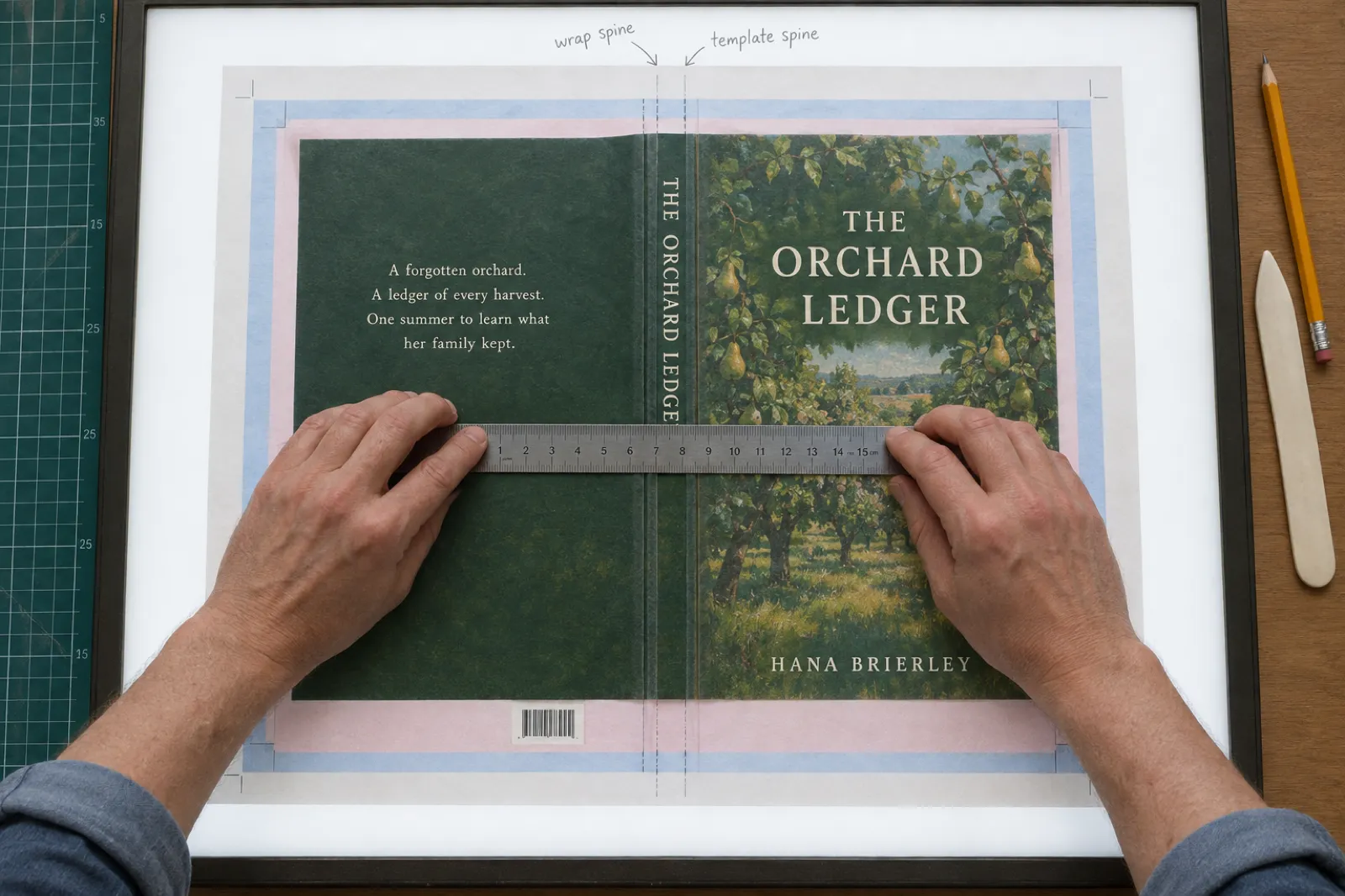
Our full wrap is built to KDP's formula: 0.125 inch bleed + back + spine + front + 0.125 inch bleed, with the spine set by KDP's per-page paper thickness (0.002252 inch per page for white paper, 0.0025 for cream). That file does not go to IngramSpark as it is, for three reasons in IngramSpark's own guide:
- The template is required. IngramSpark's cover rules say artwork "should be placed within the crop marks on the correct template produced by the template generator", and the final PDF "should be created at the size it's received". The template comes by email from the generator in your IngramSpark account (allow up to 2 hours), and its canvas includes crop marks and information outside the wrap, so its page is larger than a KDP wrap.
- The spine width is IngramSpark's. The template sets the spine from your page count, paper and binding. IngramSpark does not publish a per-page figure in its guide, and its papers are not KDP's, so assume the spine will differ from the width in our READ ME file and use the template's number.
- PDF/X and CMYK. Covers must be PDF/X-1a:2001 or PDF/X-3:2002, with CMYK images; IngramSpark converts RGB covers to CMYK before printing and warns of colour shift. Our wrap is a single 300 DPI RGB image inside a PDF.
The barcode is not one of the reasons. IngramSpark says barcodes are "mandatory on all covers", but you do not have to make one: if your cover has none, it places one in the lower right of the back cover at no cost, as long as you leave a 1.75 x 1 inch area free for it. The template also includes a barcode, centred on the back cover by default, which you may move within the back cover's safe area but not resize. KDP likewise adds its own barcode if your cover has none, which is why our wrap leaves the bottom right of the back cover clear instead of drawing one. To see the full template canvas, panel positions and barcode box for your trim and binding before you request the template, use our IngramSpark cover size calculator.
What carries over: the bleed (0.125 inch on all sides at both), the artwork resolution (300 DPI, above IngramSpark's 200 ppi floor), the spine text clearance (we keep spine text 0.125 inch inside each fold line, more than IngramSpark's 0.0625 inch), the back cover layout (blurb and imprint lines kept clear of the bottom right, where you can drag IngramSpark's barcode), and the spine text rule (we print spine text only from 80 pages; IngramSpark allows it from 48).
How to turn the KDP wrap into an IngramSpark cover
- Get your page count and paper. Open READ ME FIRST.txt in the KDP package: it lists the trim, the page count and the paper the wrap was built for.
- Request the template. In your IngramSpark account, use the cover template generator with the same trim, page count, paper and binding, and your ISBN and price for the barcode. Choose PDF output if you will work in an image editor.
- Place the front and back separately. In an editor that can export PDF/X-1a (Adobe InDesign or Photoshop, which IngramSpark's guide walks through, or Affinity Publisher), place the wrap PDF twice, masked: once aligned to the template's front panel and its outer bleed edge, once aligned to the back panel. That keeps each panel exactly where IngramSpark will trim it, whatever the spine difference.
- Rebuild the spine. Fill the template's spine area with the spine background from the wrap, and set the title and author again at the template's spine width, inside its pink safe area.
- Place the barcode, or leave the space. Move the template's barcode to the bottom right of the back cover, on its white box, without resizing it. Or leave a 1.75 x 1 inch area in the lower right of the back cover free, and IngramSpark places a barcode there at no cost.
- Cover the guides and export. Make sure the template's pink and blue guide areas are fully covered (IngramSpark says visible ones print), then export at the template's size as PDF/X-1a:2001.
- Check the eproof. IngramSpark generates an eproof after upload; its user guide puts processing at about 3 business days, and revisions before you approve the eproof cost nothing.
If you are not comfortable in a layout editor, a cover designer can do steps 3 to 6 from your wrap and the template in well under an hour. Our KDP cover size and spine width calculator shows the KDP wrap maths if you want to see where the two differ, and the book cover design guide covers back cover layout.
Or build the cover in IngramSpark's free Book-Building Tool
There is a second route that needs no layout editor. IngramSpark's free Book-Building Tool, inside your IngramSpark account, builds covers as well as interiors, and IngramSpark's help centre says: "If you have a PDF interior you can use the Book-Building Tool to create your cover". So you upload our interior PDF as the interior and build only the cover in the tool. Its cover builder starts from a layout; you add images with Add Image (IngramSpark accepts JPG, PNG and PDF files for the cover, and each image must be 5 MB or less), set the title, spine and back cover text, and press the Page Count refresh so the spine width matches your page count. The front cover JPG in our KDP package is the image to upload for the front. The builder marks the barcode area as a white box on the back cover, where the barcode will be placed; keep your design out of it. The trade-off is that the back cover and spine are rebuilt from the tool's layouts rather than carried over from your wrap, and the tool allows spine text only on hardbacks and on paperbacks over 48 pages.
One export, both platforms
The KDP package gives you an interior PDF at a trim size both printers share, a 300 DPI full wrap with bleed for KDP, the front cover JPG and a Kindle EPUB. For IngramSpark, the interior goes up after a PDF/X conversion and the wrap art moves onto IngramSpark's template, or the front cover goes into its free Book-Building Tool.
Create your bookHow to use KDP and IngramSpark together
IngramSpark's own FAQ answers the question directly: "If you choose to publish your print book directly with KDP, just be sure not to select their Expanded Distribution program." Its user guide says the same: you can have the book in your IngramSpark account and your KDP account "as long as you do not use their Expanded Distribution option". The setup most authors use:
- Buy your own ISBN for each print format. The paperback needs one, and a hardcover needs a different one. A free KDP ISBN cannot go to IngramSpark, and IngramSpark's free ISBN cannot go to KDP. Our ISBN guide has the price in each country and a picker for how many you need. US authors can buy one inside IngramSpark's setup for $85.
- Publish the paperback on KDP with Expanded Distribution off. Use your own ISBN and imprint name. Amazon buyers get the KDP edition at your 60% royalty.
- Set up the same paperback on IngramSpark. Same ISBN, same trim, same interior, the cover rebuilt on IngramSpark's template or in its Book-Building Tool. If AI drafted any of the book, IngramSpark asks about it at title setup and wants an "Assisted By - Generative AI" contributor credit; our guide to IngramSpark's AI policy covers what it accepts. Choose your discount and returns setting (see Wholesale discount and returns). Its user guide says a title that has never been in Expanded Distribution "can be set up as a new title on the IngramSpark account without having to go through the title transfer process".
- Add the hardcover on IngramSpark if you want one in shops. New ISBN, new cover file (IngramSpark says paperback and hardcover covers need "separate cover files built to the correct dimensions"). The same interior file can be used for both if the trim is the same and the copyright page lists the correct ISBNs.
- Keep the list price the same everywhere. Shops check online prices, and a wildly different price on Amazon makes a bookseller less likely to order.
- Copyright page. List each format's ISBN on the copyright page, labelled. Our copyright page template has the wording.
If your book is already on KDP
- With a free KDP ISBN: that ISBN cannot move. IngramSpark's user guide: "If CreateSpace or KDP owns the ISBN or if it is CreateSpace or KDP exclusive, it cannot be transferred." Publish a new edition with your own ISBN on both platforms.
- With your own ISBN and Expanded Distribution on: switch Expanded Distribution off first. IngramSpark's guide says the files and ISBN can then be transferred to your IngramSpark account "once Expanded Distribution is removed and CreateSpace or KDP confirms with IngramSpark support the transfer can be completed". Transfers can take up to 30 days.
- With your own ISBN and Expanded Distribution never used: set it up on IngramSpark as a new title.
Put both ISBNs on the cover and copyright page
In Inkfluence AI, the cover designer's Print tab has fields for your imprint and separate print and ebook ISBNs, printed on the back cover; paid plans can write a custom copyright page that appears in the PDF and the EPUB.
Set up your bookISBN rules for both, in one place
- KDP's free ISBN works only on KDP. It is fine if Amazon is your only print store.
- IngramSpark's free ISBN is offered to US-based authors; its user guide says the imprint "will be listed as Indy Pub", it "cannot be used on any other publishing platforms (e.g., KDP...)", it cannot be transferred, and the book must be in IngramSpark's wholesale distribution.
- An ISBN you own can be used on both, provided KDP Expanded Distribution is off for that book. Buy it from the agency in the country where you, the publisher, are based.
- Each format needs its own ISBN. Paperback, hardcover and ebook (where the store requires one) each take a separate number. IngramSpark requires an ISBN for each format "if you intend to distribute your book"; for copies you only print for yourself, it can assign a non-distributable SKU instead.
Prices and the full rules by country are in Do you need an ISBN?, including which agencies issue them free.
Ebooks and payment timing
Ebooks
Most authors publish the Kindle ebook on KDP, which needs no ISBN. IngramSpark also distributes ebooks: its pricing page says you "earn 85% of the net revenue received by IngramSpark with each sale, regardless of retailer", it offers conversion from your print file at $0.60 a page, and it needs an ISBN for an ebook you distribute. Its ebook file rules are an EPUB 3.0 that passes validation and a front cover JPG of at least 1,600 pixels on the short side and 1,873 on the long side, in RGB. Our EPUB export is EPUB 3; our front cover JPG is 300 DPI at the trim size, which clears that minimum at every trim except 5 x 8 (1,500 pixels wide). If you go wide with ebooks, Draft2Digital and Apple Books are the other common routes, and our ebook formats explainer covers which file goes where.
Payment timing
| Amazon KDP | IngramSpark | |
|---|---|---|
| When | About 60 days after the end of the month of sale; about 90 for Expanded Distribution | 90 days after the end of the month in which sales are reported |
| Reports | KDP reports dashboard; Expanded Distribution sales appear about 30 days after month end | Monthly sales report by email, within 5 business days of month end |
| Methods and minimums | Set in your KDP account; minimum thresholds apply to some methods | US ACH no minimum; PayPal $30; CAD and AUD $25; GBP no minimum; EUR 25 EUR. Checks cost $25 each |
| Currency | Per marketplace | Chosen once at signup and cannot be changed |
Making the files with Inkfluence AI
Neither KDP nor IngramSpark writes, formats or designs your book; both expect finished files. For most self-publishers that is the slow, expensive part, which is why we built Inkfluence AI to take a book from idea to print-ready files in one place. It is our first recommendation for producing the files, with the IngramSpark cover step described above.
- Writing: from a one-line idea or your own outline, it writes every chapter, keeps names and facts consistent across a novel, and lets you edit each chapter with an assistant. You can also import a Word, PDF, EPUB or text manuscript you already have.
- Interior PDF: ten trim sizes including 5 x 8, 6 x 9, 8.5 x 11, A5 and the 8.5 x 8.5 picture book size. Body text sits at least 0.5 inch from every trim edge, the gutter is sized for KDP from the real rendered page count, and the file is exactly the trim size, or trim plus bleed when the book has full-page photos. Those same page sizes are what IngramSpark asks for.
- Cover: the cover designer builds the front, back and spine as one 300 DPI wrap with 0.125 inch bleed, with the spine width set from the page count and the paper you pick in the Print tab. It is built to KDP's spine formula; for IngramSpark you move the art onto IngramSpark's template, or build the cover in its free Book-Building Tool from the front cover image.
- Ebook: a Kindle-ready EPUB 3 in the same package, plus separate PDF, EPUB and Word exports.
The limits, plainly: there is no IngramSpark-specific cover export, and the PDFs are standard PDFs rather than PDF/X; we do not make hardcover (case laminate) wraps, so a hardcover cover is built on the printer's template; the KDP package needs any paid plan or a credit pack (Creator is $9.99 a month, credit packs start at 15 chapters for $9.99); and the free plan exports PDF only, with a footer credit. Picture books are a paid feature. The AI book formatter page shows the interior layouts, the cover generator the cover side, and pricing has the plans. If you would rather lay out the book yourself, our comparisons of Atticus and Vellum and of book formatting software cover the desktop tools, which produce KDP and IngramSpark interiors too.
From idea to print-ready files
Write the book, design the cover and export the interior, wrap and EPUB from one place. Start free and upgrade when you are ready to publish.
Start writing freeEight mistakes to avoid
- Using the free KDP ISBN and then deciding to add IngramSpark. The number cannot move; you end up publishing a second edition. Decide before you publish, or buy your own ISBN from the start.
- Leaving Expanded Distribution on. It breaks IngramSpark's rule and KDP's ("must not have been submitted for distribution through another service"). Switch it off before the IngramSpark title goes live.
- Uploading the KDP wrap to IngramSpark. The spine width, template size and PDF/X rules all differ. Rebuild the wrap on IngramSpark's template, or build the cover in its Book-Building Tool.
- Setting a 55% discount on a book priced for Amazon. At $9.99, a 300-page 6 x 9 earns minus $1.40 a copy on IngramSpark at 55%: the $4.50 wholesale price does not cover $5.71 of printing. Run your numbers in the calculator first.
- Expecting distribution to mean shelf space. Both companies say listing is not a guarantee of orders. Shops order what readers ask for or what the author pitches.
- Making the book returnable without planning for returns. Returned copies come off what you are paid. If you are not pitching shops, a non-returnable setting is reasonable.
- Ignoring colour rules. A colour interior must be PDF/X with CMYK images at IngramSpark, and its page numbers need to sit inside the 0.5 inch margin.
- Skipping the proof. Both printers vary between locations and runs. One proof from each catches cover colour, paper and spine problems before readers do. KDP's most common rejection reasons are in our KDP rejected my book guide.
For the full KDP side of publishing, from account setup to the print previewer, see how to self-publish on Amazon KDP, paperback publishing on KDP and our free KDP tools. For the bigger picture across platforms, the self-publishing guide compares the main routes, and self-publishing statistics shows how many books those routes carry.
IngramSpark vs KDP: frequently asked questions
Is IngramSpark or KDP better for self-publishing?
For Amazon sales, KDP pays more per copy: 60% of a list price of $9.99 or more, minus printing. For bookshops, libraries and hardcovers with dust jackets, IngramSpark reaches further. Most authors who want both use KDP for Amazon and IngramSpark for everything else, with their own ISBN on both and KDP Expanded Distribution switched off.
Can you use KDP and IngramSpark at the same time?
Yes. IngramSpark says you can have the same print book in your IngramSpark account and your KDP account as long as you do not use KDP Expanded Distribution. You need an ISBN you own, because a free KDP ISBN only works on KDP and IngramSpark does not accept free ISBNs from other platforms.
How much does IngramSpark cost in 2026?
Title setup and file revisions are free (revisions since 1 February 2026). Books enabled for distribution pay a global distribution fee of 1.875% of the local list price at the time of sale. Printing is charged per copy at cost per cover plus cost per page; a 300-page 6 x 9 black-and-white paperback is $5.71 on the 2026 rate card. An ISBN is extra unless you use IngramSpark's free US one.
Is IngramSpark print quality better than KDP?
Neither company publishes a quality comparison, so treat claims either way with care. What the published specs do show is more choice at IngramSpark: 70 lb white paper for black-and-white books, ultra-premium colour, cloth hardcovers, dust jackets and printed inside covers, none of which KDP offers. IngramSpark itself says copies can vary between orders because they are printed at different locations. Order a proof from each before you decide.
Why do I earn less per copy on IngramSpark?
Because IngramSpark pays you the wholesale price, not a share of the list price. At the recommended 55% discount, a $16.99 book leaves $7.65 for you, from which printing and the 1.875% fee are deducted. KDP pays 60% of the same $16.99 on Amazon before printing. The discount is what lets bookshops buy your book at their normal trade terms.
What wholesale discount should I set on IngramSpark?
IngramSpark says 53% to 55% with returns allowed gives the widest availability in the US and Canada, and 48% to 55% in the UK, Europe and Australia. A lower discount earns more per copy but bookshops are less likely to stock the book. The minimum allowed discount is shown on the title setup page; IngramSpark's 2023 worksheet gave the range as 40% to 55%.
Can I upload my KDP files to IngramSpark?
The interior PDF usually can be, if it uses a trim size IngramSpark offers: both want pages at exactly the trim size with no bleed, or trim plus 0.125 inch on the outside edge and 0.25 inch in height with bleed. The cover cannot go up as it is. IngramSpark wants the cover built on the template from its own generator, with its own spine width, as a PDF/X file, or built in its free Book-Building Tool. A barcode is required, but IngramSpark places one free if you leave a 1.75 x 1 inch area clear on the back cover.
Does IngramSpark put my book on Amazon?
IngramSpark distributes to online retailers including Amazon as part of its network, so a book that is only on IngramSpark can still show up there. If you also publish the paperback on KDP, IngramSpark tells you not to enrol it in KDP Expanded Distribution. For Amazon sales, KDP pays more per copy than the wholesale route.
Should I use IngramSpark for hardcover?
Often, yes. KDP prints case laminate hardcovers but does not send hardcovers through Expanded Distribution, so bookshops cannot order them through KDP. IngramSpark prints case laminate, cloth and jacketed hardcovers and distributes them. A 300-page 6 x 9 hardcover costs about the same to print at both ($9.25 at KDP, $9.27 case laminate at IngramSpark); a dust jacket adds about $2.90.
How long does IngramSpark take to pay?
IngramSpark pays 90 days after the end of the month in which sales are reported. KDP pays about 60 days after the end of the month for Amazon sales and about 90 days for Expanded Distribution. Both have payment thresholds for some methods, so small amounts can roll over to the next month.
Sources
- IngramSpark Rate Card, effective 1 February 2026 (free title setup; global distribution fee 1.875% of local list price at time of sale; file copies $25; check payment $25; duplex cover $0.30; rush 30%; volume discounts; annual change capped at 5%; print cost per cover and per page by size, binding, ink and paper; small = under 6.15 in wide), checked 13 Oct 2026
- IngramSpark: Changes in Print Cost, Market Access Fee, and More (effective 1 Feb 2026; some books cost more, some less; 1.875% market access fee; revisions free; free title setup), checked 13 Oct 2026
- IngramSpark: Compensation payments and schedule (wholesale price less printing; 53% to 55% returnable for widest availability; 48% to 55% UK, Europe, Australia; $25.99 example paying $4.52; 90-day payment; method minimums; currency fixed), checked 13 Oct 2026
- IngramSpark: How Much Should I Discount My Book? (worksheet, 2023) (40% minimum to 55% maximum; short discount under 53% US and UK, 48% Australia; online retailers), checked 13 Oct 2026
- IngramSpark: FAQs (ISBN for each format to distribute; $85 ISBN; free ISBN; non-distributable SKU; KDP without Expanded Distribution; 2 to 6 weeks to appear; returnable choice), checked 13 Oct 2026
- IngramSpark: Pricing (free account and upload; ebook conversion $0.60 a page; ebooks 85% of net revenue received), checked 13 Oct 2026
- IngramSpark File Creation Guide, dated 24 Aug 2026 (interior trim-size pages without bleed; bleed 0.125 in on three edges; 0.5 in margins; embedded fonts; single pages; PDF/X-1a or X-3; grayscale and CMYK; last page for manufacturing information; cover template, barcode, bleed, spine safety, 48-page spine text rule, 200 ppi; ebook EPUB 3 and cover pixel minimums; trim size matrix; custom trims), checked 13 Oct 2026
- IngramSpark User Guide, September 2026 (list price cap $124.99; barcode area 1.75 x 1 in; spine text from 48 pages; separate covers per binding; KDP and CreateSpace transfers; free ISBN conditions; returns 180 days; quality tolerances 1/16 in; variations between orders; printing locations; eproof timing), checked 13 Oct 2026
- IngramSpark: Cover Template Generator (free barcode on the template; a cover submitted without a barcode gets one placed in the lower right of the back cover at no cost; leave 1.75 x 1 in free), checked 13 Oct 2026
- IngramSpark: Can I Upload a PDF For My Cover and Interior files? (JPG, PNG and PDF files for the cover; a PDF interior can be paired with a cover made in the Book-Building Tool), checked 13 Oct 2026
- IngramSpark: Book-Building Tool, Book Cover Overview (cover layouts; Add Image, 5 MB or less; barcode area; Page Count refresh sets the spine width; spine text on hardbacks and paperbacks over 48 pages), checked 13 Oct 2026
- IngramSpark: AI Disclosure and Attribution (AI disclosure at title setup; "Assisted By - Generative AI" contributor credit), checked 13 Oct 2026
- KDP: Paperback Printing Cost (fixed plus per-page cost by marketplace, ink and trim; regular vs large trims; minimum and maximum list prices; worked examples), checked 13 Oct 2026
- KDP: Hardcover Printing Cost ($5.65 + $0.012 a page regular black ink; 300-page example $9.25), checked 13 Oct 2026
- KDP: Paperback Royalty (50% and 60% rates and thresholds by marketplace; royalty formula and example; Expanded Distribution 40%), checked 13 Oct 2026
- KDP: Expanded Distribution (US and UK distributors; no guarantee; hardcovers not eligible; content not accepted; trim and paper eligibility; ISBN not submitted through another service; 40% royalty; reporting and payment), checked 13 Oct 2026
- KDP: Print Options (paper types and weights; cover stock and finishes; hardcover case laminate; trim sizes and page ranges; custom trims), checked 13 Oct 2026
- KDP: Create a Paperback Cover (wrap formula; bleed; spine text from 79 pages; 0.0625 in fold variance; CMYK and 300 DPI recommendation; barcode optional), checked 13 Oct 2026
- KDP: When will I get paid? (about 60 days after month end; 90 for Expanded Distribution), checked 13 Oct 2026
Related reading
- Do You Need an ISBN? Free vs Bought, Cost by Country
- KDP Cover Size and Spine Width Calculator
- KDP Trim Sizes: Which Size for Which Book
- How to Format a Book for Amazon KDP
- How to Create a Print-Ready PDF Book
- How to Print One Copy of a Book
- The Real Cost of Publishing a Book
- How to Publish AI-Generated Books on KDP
- How to Write a Business Book That Brings You Clients
- Children's Book Word Count and Page Count by Age
- KDP Select vs Wide Distribution
- Self-publishing on Amazon KDP
- Inkfluence AI for Kindle publishers

Founder, Inkfluence AI
Sam is the founder of Inkfluence AI. He built the platform to make book creation accessible to everyone - from first-time authors to seasoned publishers.
Helpful links
Ready to Create Your Own Ebook?
Start writing with AI-powered tools, professional templates, and multi-format export.
Get Started FreeRelated Articles
 Children's Books
 Children's Book Word Count and Page Count by Age (2026): Board Books to Middle Grade, with Real Picture-Book Data
How many words and pages a children's book needs, from board books to young adult, with every range sourced to a publisher or editor and dated, words per page from real picture books by age band, and a word-budget calculator that checks KDP's 24-page minimum.
 Publishing
 Do You Need an ISBN? Free vs Bought, Cost by Country, and Which Formats Need One (2026)
When a self-published book needs an ISBN and when it does not, what one costs in the US, UK, Canada, Australia, New Zealand, India, Germany, Italy and France (checked at each agency on 13 October 2026), free ISBNs from KDP, IngramSpark and Draft2Digital, and a picker that tells you how many you need.
 Publishing
 IngramSpark AI Policy (2026): What It Accepts, the Setup Question and the "Assisted By" Credit
IngramSpark accepts AI-drafted books with significant human editing and the "Assisted By - Generative AI" credit, and refuses works created solely with generative AI. Its exact wording, covers and translations, how it differs from KDP, a checker for your book, and an editing workflow.
Get ebook tips in your inbox
Join creators getting weekly strategies for writing, marketing, and selling ebooks.