
IngramSpark AI Policy (2026): What It Accepts, the Setup Question and the "Assisted By" Credit
IngramSpark accepts AI-drafted books with significant human editing and the "Assisted By - Generative AI" credit, and refuses works created solely with generative AI. Its exact wording, covers and translations, how it differs from KDP, a checker for your book, and an editing workflow.
Quick Answer
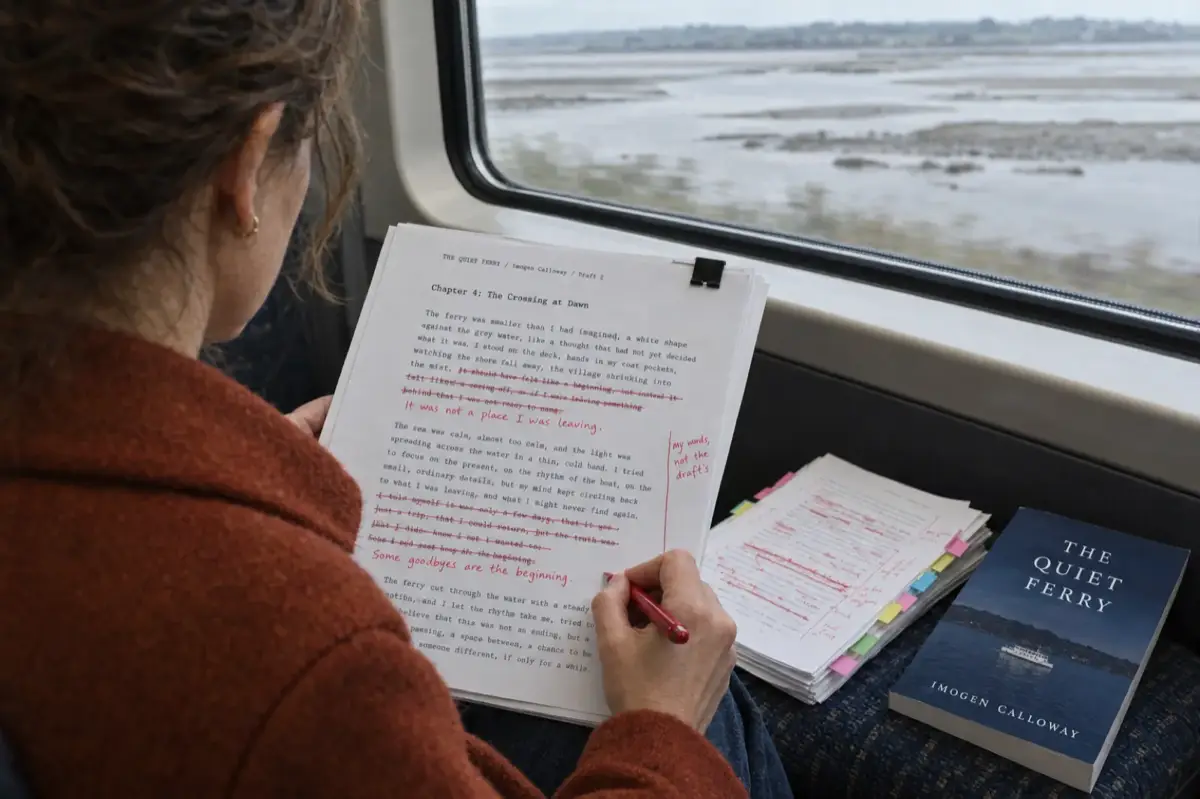
IngramSpark accepts books made with generative AI only when they have "significant and material human editorial review and contribution" and proper attribution: disclose AI at title setup and add "Assisted By - Generative AI" after the contributor it helped. "Works created solely using generative AI" are unacceptable, so an unedited generated book will be refused.
IngramSpark is how an independent author gets a book into the catalogue that bookshops and libraries order from. It is also stricter about AI than Amazon. KDP asks you to disclose AI-generated content and then lets the book through if it meets its other rules. IngramSpark sets a bar: AI may help, AI may draft, but a person has to do real editorial work on the result, and the credit has to say who did what.
Most of what is written about this online is out of date. Older articles quote the line in IngramSpark's catalogue rules that lists AI-generated content among things that "may not be accepted" and stop there. The current content guidelines page adds a footnote headed "Generative AI guidelines" that spells out what is acceptable, and a newer help article explains the title setup disclosure and the "Assisted By" contributor credit. This guide puts the two together, quotes both word for word, and turns them into practical steps.
Checked 13 October 2026. Every IngramSpark rule here was read on IngramSpark's own pages that day, and the KDP rules on KDP's own help page. Quotes are exact. IngramSpark shows its title setup AI question as an image in its help article, so we describe it rather than quote it. Neither company promises that any book will be accepted, and nothing here is a promise either. Links are under Sources.
IngramSpark's AI rules at a glance (checked 13 Oct 2026)
The table reads IngramSpark's content guidelines and its AI Disclosure and Attribution article against the situations authors actually ask about, with KDP's rule beside it for comparison. "Within the written rules" means the situation matches a line IngramSpark lists as acceptable; it is not a promise that a reviewer will approve the book.
| How the book was made | IngramSpark | Amazon KDP |
|---|---|---|
| You wrote it; AI only checked spelling and grammar | Acceptable ("used only in an assistive way") | AI-assisted: no disclosure required |
| AI helped you brainstorm or outline; you wrote the text | Acceptable (majority of the work human) | AI-assisted: no disclosure required |
| AI drafted it; you restructured and rewrote it substantially | Acceptable with attribution: disclose at setup, "Assisted By - Generative AI" after the author | Disclose as AI-generated text |
| AI drafted it; you fixed typos and a few lines | At risk: unlikely to count as "significant and material" editing | Disclose as AI-generated text |
| AI drafted it; you uploaded it as generated | Unacceptable ("Works created solely using generative AI") | Disclose; still subject to KDP's content quality rules |
| AI images you reworked (cover or interior) | Acceptable with attribution: credit the artist, then "Assisted By" | Disclose as AI-generated images |
| AI images used exactly as generated | At risk: no human contribution to point to | Disclose as AI-generated images |
| AI translation reviewed by a fluent person | Acceptable with attribution ("including translation") | Disclose as AI-generated translation |
| AI translation nobody reviewed | Not on the acceptable list | Disclose as AI-generated translation |
| Journal or notebook with mostly blank pages | May not be accepted, AI or not | Allowed as a low-content book |
| Same content as another of your titles under a new cover or title | Products may be cancelled and accounts closed | No AI rule; KDP's guidelines bar misleading and disappointing content |
The middle three rows are where most AI-assisted authors sit, and they are the reason this page exists. On KDP those three books are treated the same: all three are AI-generated, all three are disclosed, all three can be published if they meet KDP's other rules. On IngramSpark they land in three different places. The difference between them is not the tool you used. It is how much of the finished book is your work. Our IngramSpark vs KDP guide covers the rest of the comparison (fees, print cost, distribution); this page is only about AI.
Draft fast, then make it yours
Inkfluence AI starts from your idea or your own outline, writes the chapters, and gives you an editor, a whole-book review and passage-by-passage rewriting so the human edit IngramSpark asks for is real work in one place. Start free.
Start your book freeThe exact wording, line by line
IngramSpark's AI rules live in two places. The first is its content guidelines, a numbered list of content that "may not be accepted". Item 7 is the one about AI:
"Content created using automated means, including but not limited to content generated using artificial intelligence* or mass-produced processes."
The asterisk points to a footnote headed "Generative AI guidelines". This is the part most articles leave out, and it changes the meaning of item 7 completely:
Acceptable AI Content:
- "Generative AI that has been used only in an assistive way (i.e. spell check, proofing, etc…)"
- "Content or images in which the majority of the work has been written or created using human creativity and contribution"
- "Works or images using generative AI (including translation) but with significant and material human editorial review and contribution with proper attribution"
Unacceptable AI Content:
- "Works created solely using generative AI"
- "Works that violate Intellectual Property or Copyright Law"
"Proper attribution of creation must accompany all works. While your titles may not be accepted by every channel, transparency of creatorship helps maintain trust with readers and sellers, and ensures you have the best opportunity of content availability."
Here is what each line means in practice.
"Used only in an assistive way"
Spell check and proofreading are the examples IngramSpark gives, and the "etc" leaves room for similar polishing. If you wrote the book and an AI tool corrected your spelling, grammar and punctuation without changing your wording, you are here. This is the same territory KDP calls "AI-assisted".
"The majority of the work" written by a person
This covers books where AI played a supporting part: you brainstormed with it, it suggested a chapter order, it drafted a paragraph you then rewrote, but most of the book came from you. IngramSpark does not define "majority", but the plain reading is that most of the words and ideas on the page are yours.
"Significant and material human editorial review and contribution with proper attribution"
This is the line that matters to anyone who drafts with AI, and it has three conditions, all of which must be met. "Significant and material" means the editing is substantial and actually changes the book; a read-through is review, but not contribution. "Editorial review and contribution" means two things: you checked the work, and you added to it. "With proper attribution" means the credits say AI was involved, which IngramSpark handles with the "Assisted By" contributor role covered below. Note the words "works or images" and "including translation": the same standard applies to a cover, to illustrations and to a translated edition.
"Works created solely using generative AI"
"Solely" is the key word. A book where the AI produced the text and nobody did meaningful editorial work on it is unacceptable, however well it reads. So is a book where every image came straight out of a generator, if the images are the work (a picture book, for example).
"Works that violate Intellectual Property or Copyright Law"
This applies to human work too, but AI raises the odds: prompts that imitate a living artist's style, characters from someone else's series, or long passages a tool reproduced from training data. Our guide to keeping AI book content original covers the checks, and can AI-written books be copyrighted? covers what you own afterwards.
Why older articles say IngramSpark bans AI
IngramSpark's help centre also has a page called "Catalog Guidelines - Products Not Permitted". It carries the same numbered list, written under the Lightning Source name, and on 13 October 2026 its item 7 had no asterisk and no footnote: "Content created using automated means, including but not limited to content generated using artificial intelligence or mass-produced processes." Read alone, that sounds like a ban. The content guidelines page, with the footnote, is the one that says what is acceptable, and the AI Disclosure and Attribution article describes how to credit AI. Read all three together and the policy is clear: AI help is allowed, AI-only books are not.
An unedited generated book will be refused
Plainly: if you type a prompt, let any tool write the book, and upload what comes out, IngramSpark's guidelines describe that book as "created solely using generative AI", which is on its unacceptable list. That is true whichever tool wrote it, Inkfluence AI included. You may get through title setup; you should not count on staying in the catalogue.
Three other IngramSpark statements make the risk larger than one rejected title:
- Everything is reviewed. The AI Disclosure article says "All content in our catalog, regardless of whether AI was involved in its creation, is subject to review" against its integrity guidelines. A book can be removed after it goes live.
- Accounts can be closed. IngramSpark's article on content created using automated means or mass-produced processes says that when it identifies patterns that violate its guidelines, it "may, at its sole discretion, choose to cancel the products and close the associated accounts". Its list includes "Books that are created using automated means" and "Books that are created by bulk or mass processes".
- A second account does not help. The same article: "If multiple accounts are used to disguise any violations of the Guidelines, all accounts may be closed."
The fix is not to hide the AI. It is to do the editorial work the guidelines ask for and credit the AI honestly. The editing workflow later in this guide shows what that looks like in practice.
The title setup question and the "Assisted By" credit
IngramSpark's help article "AI Disclosure and Attribution" describes two separate things you do when you set up a title.
1. Disclose AI use at title setup
During title setup, IngramSpark asks whether AI was used in creating the book. In the article's words: "Ingram/IngramSpark gathers information regarding the use of Artificial Intelligence in the content of our catalog. Capturing this information during the title setup process allows us to better understand how publishers are using AI technology with the creation of content. We are not actively providing this information to the market."
Two takeaways. First, the answer is for IngramSpark, not for buyers: the article says it is not actively passed to the market. Second, the article shows the setup question as a screenshot, so the exact wording you see in your account is what counts; answer it truthfully for text, images and translation. Many authors search for the phrase "did you use AI tools in creating texts, images, and/or translations in your book" next to IngramSpark's name. We could not confirm that wording on IngramSpark's pages, and KDP asks its own AI questions when you publish there, so read each form on its own rather than copying answers between them.
2. Attribute the AI in the contributor fields
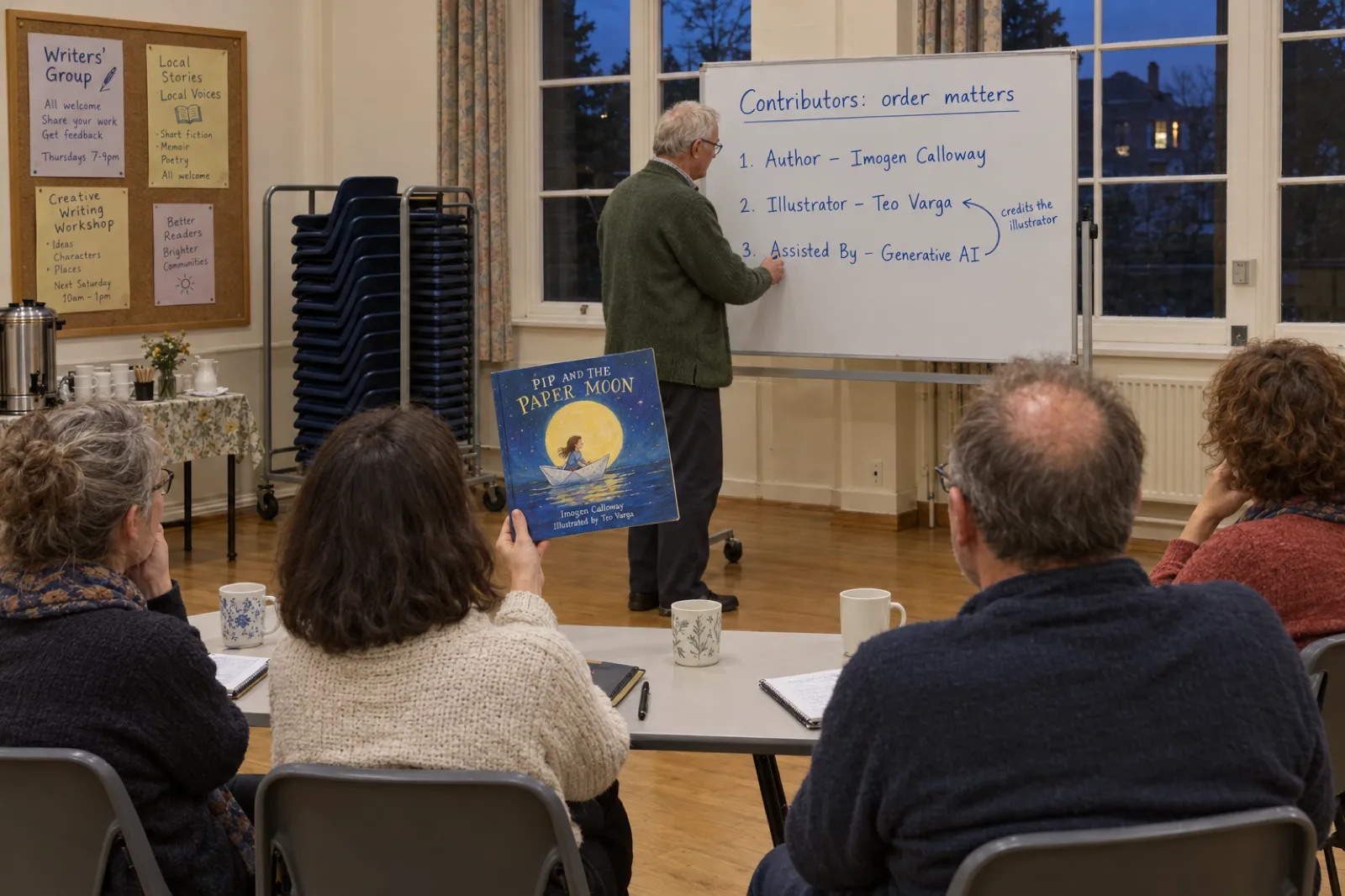
Disclosure alone is not enough. The article continues: "In addition to disclosing use of AI upon title setup, proper attribution of creation using the contributor fields in the metadata must accompany all works." Its example is a book by a human author with a human illustrator who used AI tools to create the images:
Author - John Snow
Illustrator - Rebecca Snow
Assisted By - Generative AI
And the rule that makes the example work: "The sequence of the contributors is critical. The Assisted By role is directly related to the previous contributor. There is no implication of AI assistance with the author, but rather the sequence implies that the AI assistance is attributed to the Illustrator."
So "Assisted By - Generative AI" is not a general label for the whole book. It attaches to the person listed directly before it. Applying that rule to the common cases:
| Where AI helped | Contributor order |
|---|---|
| Text only (you drafted with AI and rewrote it) | Author - your name Assisted By - Generative AI |
| Images only (you wrote the text; AI helped make the art) | Author - your name Illustrator - the person who made the art Assisted By - Generative AI |
| Text and images, same person | Author - your name Assisted By - Generative AI Illustrator - your name Assisted By - Generative AI |
| Translated edition (AI translation, human-reviewed) | Author - original author Translator - the person who reviewed and corrected it Assisted By - Generative AI |
| Spell check and proofreading only | Author - your name (IngramSpark's pages describe no credit for assistive use) |
Only the first example in the article (illustrator) comes straight from IngramSpark; the other rows apply its sequence rule to text and translation. If the contributor roles in your account do not fit your case (a cover designer who is not the illustrator, say), pick the role that describes the person, put "Assisted By - Generative AI" directly after them, and ask IngramSpark support if you are unsure. The checker below builds the list for your book in the right order.
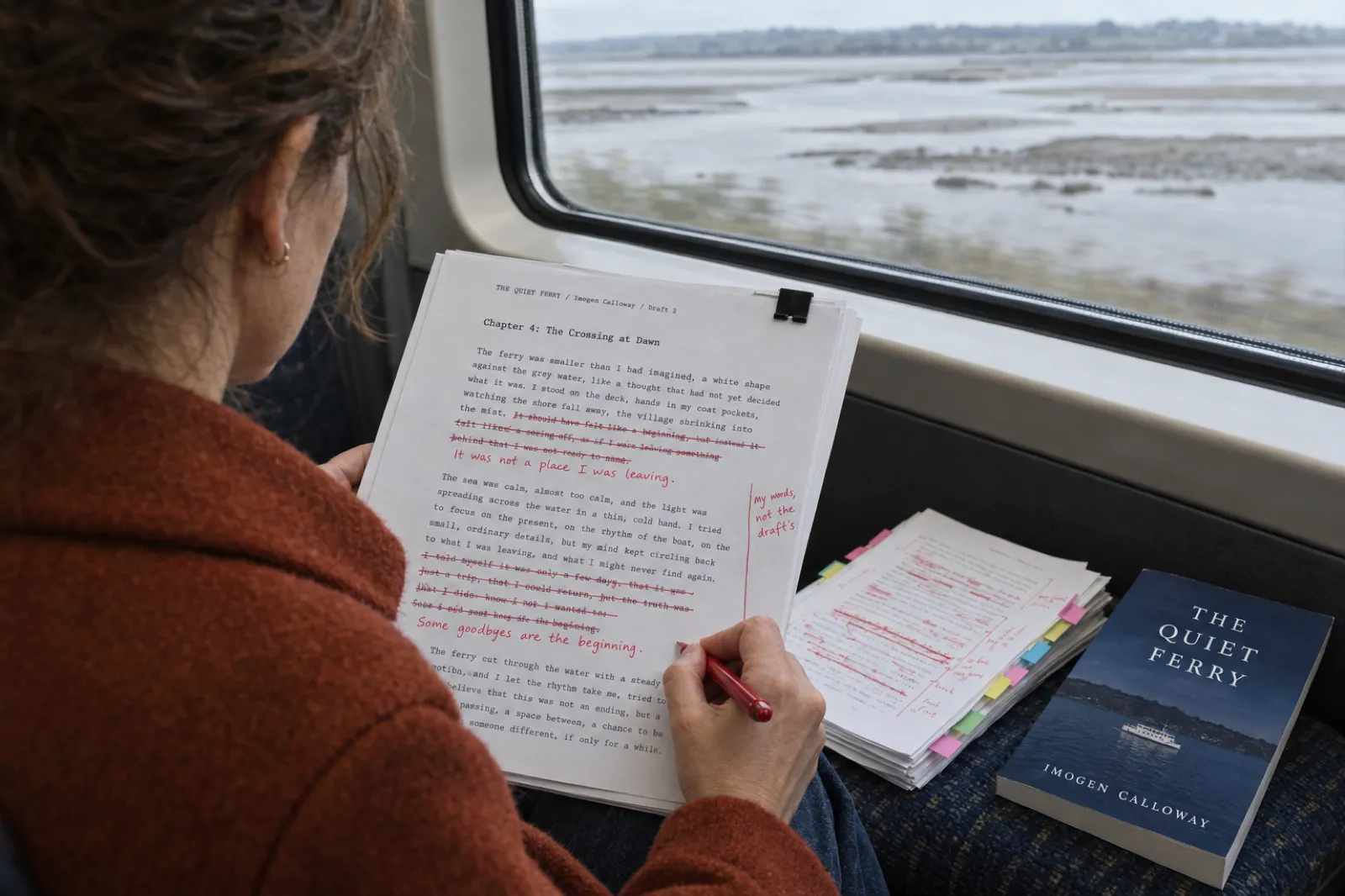
Should the book itself say anything? Neither IngramSpark page requires a statement inside the book. Some authors add a line to the copyright page, such as "Drafted with the help of generative AI tools and edited by the author", which is honest with readers and costs nothing. Our copyright page templates include wording for this, and in Inkfluence AI the Export window's Copyright page setting has a "Copyright page text" box where you can type it.
Covers and illustrations
IngramSpark's footnote names images in two of its three acceptable lines ("Content or images" and "Works or images"), so the image rules follow the text rules exactly:
- Images where most of the work is human are acceptable: you drew or painted it, and AI helped with a background texture, a colour study or clean-up.
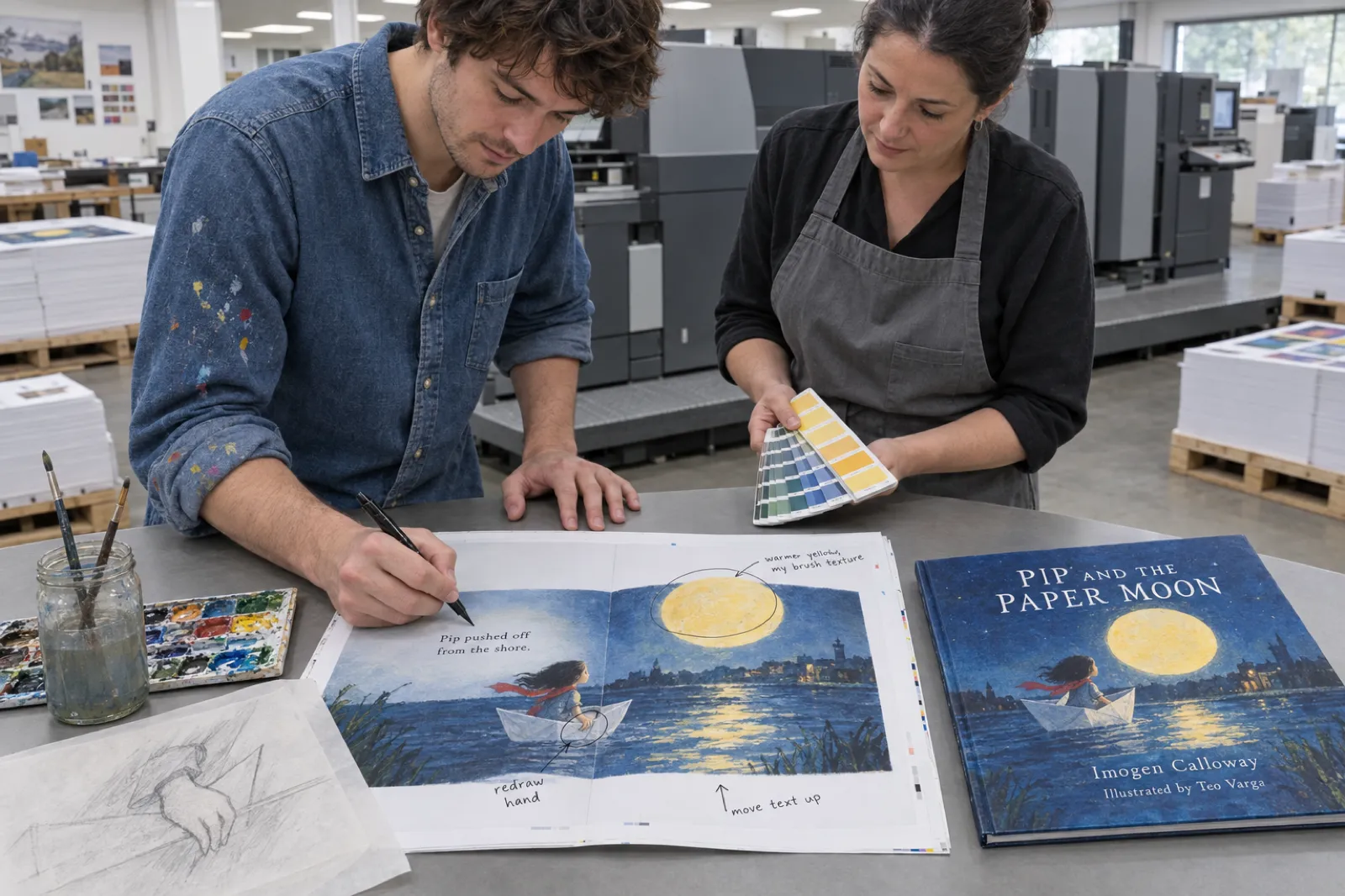
- Images made with generative AI and then substantially reworked are acceptable with attribution: a designer art-directed several generations, composited them, retouched faces and hands, redrew details, and set the lettering by hand or in a layout app.
- Images used exactly as generated are the weak case. They are not named on the unacceptable list unless the whole work is AI-only, but there is no human contribution to point to, and for a picture book, where the images are half the work, an unedited set comes close to "created solely using generative AI".
For the credit, follow IngramSpark's own example: the person who made the art is listed (Illustrator in the example), followed by "Assisted By - Generative AI". If you wrote the book and also made the AI-assisted cover yourself, you appear twice: once as author, once in the art role, with the AI credit after the second entry.
KDP handles covers differently but just as clearly: "AI-generated images include cover and interior images and artwork", and AI-generated images must be disclosed even if you edited them afterwards. So an AI-assisted cover is disclosed on KDP and attributed on IngramSpark.
Practical ways to make AI art acceptably yours:
- Direct it. Write a brief with your own composition, palette and reference sketches, and generate many options rather than taking the first.
- Rework it. Fix hands, faces and continuity between illustrations; repaint areas; combine parts of several images; adjust colour to match across the book.
- Letter it yourself. Title, author name and spine text set in a design tool by you, not baked into the generated image.
- Mix in your own work. Photographs you took, scans of your own sketches, or licensed stock reduce the AI share of the art.
- Keep the files. Save the original generations and your layered working files. If a reviewer asks what you contributed, you can show it.
In Inkfluence AI, the Cover Designer lets you upload your own cover image, generate one with AI, or design one with fonts and colours, including the back cover and spine for a paperback; Image in the editor inserts your own pictures or generates new ones inside a chapter. AI cover art is not on the free plan, AI images inside chapters come with paid plans (20 a month on Creator, 50 on Premium), and on any plan you can upload your own art. For the cover side see our AI book cover generator and how to design a book cover with AI; for picture books, the AI children's book illustrator page and our guide to consistent characters in AI children's books. If you are weighing a human illustrator instead, children's book illustration cost has the 2026 rates.
AI translations
IngramSpark names translation in its acceptable line on purpose: "Works or images using generative AI (including translation) but with significant and material human editorial review and contribution with proper attribution". A machine translation that a fluent person has read in full, corrected and made natural is acceptable with credit. A translation nobody checked is not on the acceptable list.
What review means for a translation:
- A fluent reader reads every chapter, not a sample. Translation errors cluster in idioms, dialogue, humour and technical terms.
- Names, places and invented terms stay consistent across the book.
- Metadata is translated too: title, subtitle, description and keywords.
- The credit names the reviewer: Author (the original author), Translator (the person who reviewed and corrected), then "Assisted By - Generative AI".
KDP calls an AI translation AI-generated content and requires you to disclose it. In Inkfluence AI, Translate makes a translated copy of the book that opens in the editor like any other, so the reviewer works through it there (15 translations a month on Creator, 40 on Premium). Our AI book translator page lists the languages, and Kindle Translate vs AI book translation compares Amazon's own service with doing it yourself.
Checker: what IngramSpark and KDP need for your book
Answer five questions about how the book was made. The checker reads them against IngramSpark's and KDP's written rules and tells you what each platform asks for: whether the book sits within IngramSpark's rules, what to disclose, and the contributor list in the right order, ready to copy. It reads published rules only; it cannot tell you what a reviewer will decide, and neither company guarantees acceptance.
IngramSpark and KDP AI checker
Runs in your browser. Nothing is sent anywhere.
IngramSpark
Fix before title setup:
Amazon KDP
Reads IngramSpark's content guidelines (item 7 and its Generative AI guidelines, items 2 and 8), its AI Disclosure and Attribution article and its automated-content article, and KDP's content guidelines on AI, all checked 13 Oct 2026. Contributor order follows IngramSpark's rule that "Assisted By" attaches to the contributor listed before it; the article's own example covers an illustrator, and the text and translation orders apply the same rule.
How to read the result. Green means your answers match a line IngramSpark lists as acceptable; you still need to disclose and credit correctly. Amber means the book is close to a line IngramSpark draws and a reviewer could go either way; the fix list says what moves it to green. Red means the guidelines list your situation as unacceptable or as content that may not be accepted; change the book before you set it up. The KDP panel is shorter because KDP's AI rule is shorter: say what was AI-generated, and keep the book within its content guidelines. For the full KDP walkthrough, see our KDP AI disclosure guide.
IngramSpark vs KDP on AI
The two companies ask different questions. KDP asks "what did AI make?" and wants it declared. IngramSpark asks "what did a person contribute?" and wants that contribution to be significant, with the AI credited. Here is KDP's rule, verbatim from its content guidelines:
"We require you to inform us of AI-generated content (text, images, or translations) when you publish a new book or make edits to and republish an existing book through KDP. AI-generated images include cover and interior images and artwork. You are not required to disclose AI-assisted content."
KDP defines AI-generated content as "text, images, or translations created by an AI-based tool" and adds that it counts as AI-generated "even if you applied substantial edits afterwards". AI-assisted means you created the content yourself and used AI "to edit, refine, error-check, or otherwise improve that content", or used AI to brainstorm before creating the text or images yourself.
| IngramSpark | Amazon KDP | |
|---|---|---|
| Type of rule | Acceptance standard plus disclosure and credit | Disclosure |
| AI-drafted, heavily edited | Acceptable with attribution | Still AI-generated: disclose |
| AI-drafted, unedited | Unacceptable | Disclose; content quality rules still apply |
| AI for spelling, grammar, ideas | Acceptable (assistive or majority human) | AI-assisted: no disclosure required |
| Covers and interior images | Same standard as text; credit the artist, then "Assisted By" | AI-generated images must be disclosed |
| Translations | Acceptable with significant human review and credit | AI translations must be disclosed |
| Where you declare it | Title setup question plus contributor fields | AI questions when you publish the book |
| Shown to buyers? | Setup answer "not actively" provided to the market; contributor credits are metadata | Its content guidelines page does not say |
| Blank-page journals | May not be accepted | Published as low-content books |
Two consequences follow. First, if your book is acceptable at IngramSpark it will also need a KDP disclosure whenever AI drafted any text, images or translation, because KDP's definition does not care how much you edited. Second, KDP accepting a book tells you nothing about IngramSpark: a lightly edited AI book can be live on Amazon and still fall short of IngramSpark's standard. If you publish on both, which most authors who want bookshops do, fill in each form on its own terms. The hub guide's section on using KDP and IngramSpark together covers the ISBN and Expanded Distribution side, and our overview of where you can sell AI-generated books covers ten platforms side by side, including Etsy (see Etsy's AI disclosure) and the audiobook stores (see Audible and ACX on AI narration).
One book, both platforms
Write and edit in Inkfluence AI, then export a print-ready interior PDF, a full wrap cover and an EPUB. Any paid plan or a credit pack unlocks the KDP package; the free plan exports PDF.
Start writing freeOther IngramSpark rules that catch AI books
Item 7 is not the only line in IngramSpark's content guidelines that AI-made books run into. These apply whether or not AI was involved, but AI makes each of them easier to break at scale.
- Blank pages (item 2). "Content containing material amounts of blank pages like notepads, scratchpads, journals, or similar type content." Journals, planners and notebooks may not be accepted at all. If you make prompt journals with our AI journal generator or a guided journal, publish them on KDP as low-content books (our low-content books guide has KDP's rules) rather than IngramSpark.
- Duplicates across trims (item 8) and the automated-content article: the same interior in several trim sizes, under different covers or titles, with re-sorted pages, or split into smaller books. IngramSpark may cancel the products and close the account.
- Summaries and workbooks of other people's books (item 1) "without permission from the original author". AI makes these fast to produce; IngramSpark does not want them.
- Mimicking popular titles (item 3): similar covers, cover design, titles or author names. Generated covers that echo a bestseller's look fall here.
- Misleading content (item 4): descriptions or cover art that do not match the book. An AI-written description that promises more than the book delivers is the common case.
- Prices "not reflective of the book's literary value" (item 5).
- Public domain and web content (item 9): content "freely available on the web" is refused unless you own the copyright, and an undifferentiated public domain book may not be sold.
How to edit an AI draft until it is yours: a workflow in Inkfluence AI
IngramSpark's standard is about what you do after the draft exists. Here is a concrete workflow using the tools that are in Inkfluence AI today. Nothing in it is automatic: each step is you reading, deciding and rewriting, and the tools only make that faster. That is the point. A tool that claims to make an AI book "IngramSpark-ready" without your work would be describing the book IngramSpark refuses.
- Start from your material, not a one-line prompt. Describe the book in your own words: who it is for, what you know that others do not, the stories and examples you will use. When the outline appears, the review screen lets you rename every chapter, rewrite what each chapter covers, reorder, delete and add chapters before a word is written. Restructuring the outline is your first editorial contribution. If you already have a manuscript, use Import a document (Word, EPUB, PDF or text) and work on your own draft instead.
- For fiction, set the Story Bible. In the editor's top bar, Story Bible holds the story goal, point of view, target audience, characters, key objects, non-negotiables (rules the story must keep), unresolved threads and timeline anchors. Edit it before and during drafting; chapters written or regenerated afterwards follow it. Your plot decisions are human contribution that shapes every chapter. Our explainer on how Inkfluence AI keeps a book consistent shows what it tracks.
- Make a working copy. There is no version history beyond Undo and the chapter Trash, so before heavy editing use Duplicate in the book's menu on My Books. You keep the untouched draft for comparison, which is also a record of what you changed.
- Read the whole draft before you touch it. Mark what is true, what is generic, what is wrong for your reader, and what only you could add. Most AI drafts read smoothly and say little; your job is to make every chapter say something specific.
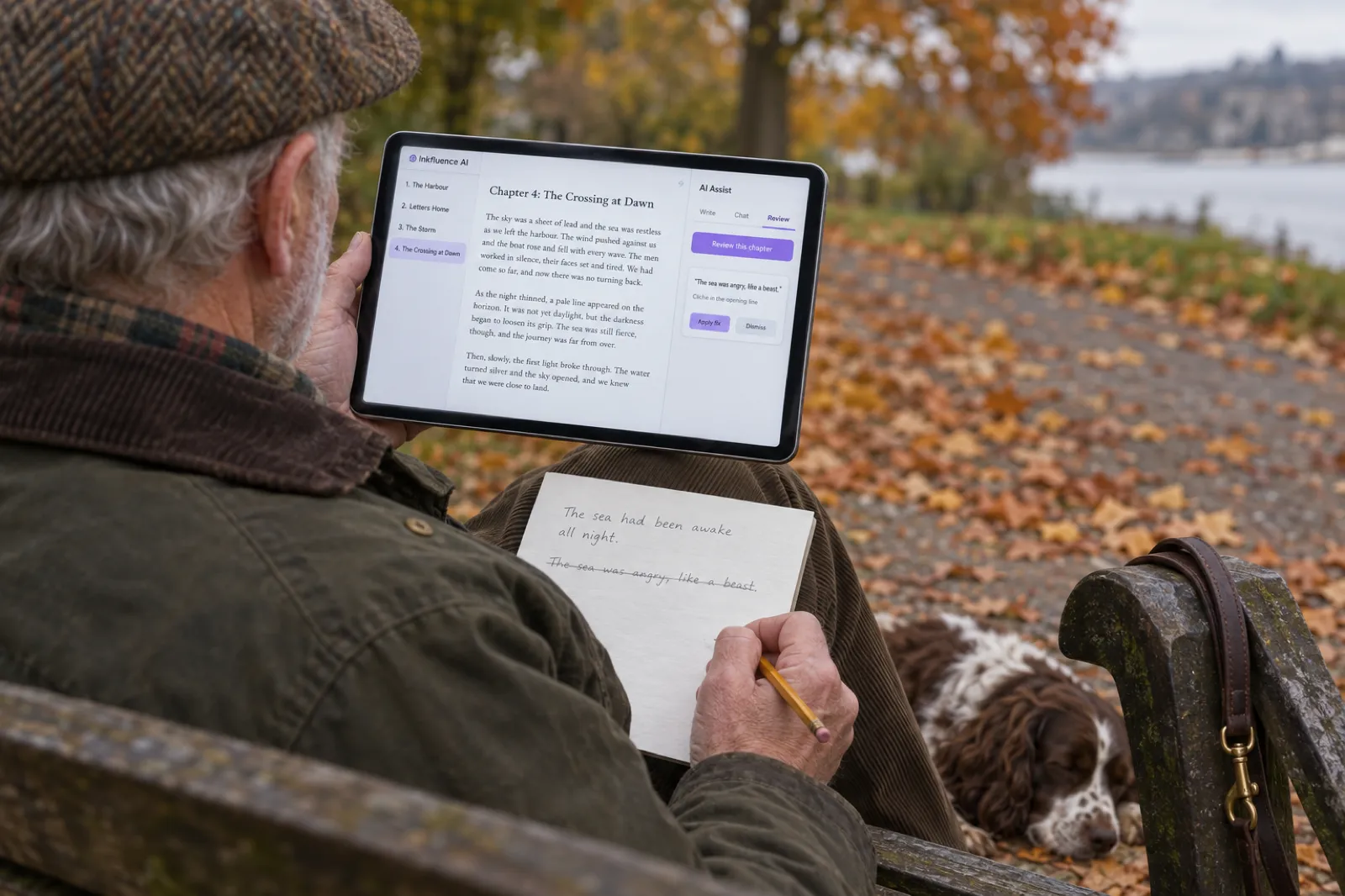
- Run a whole-book review. Open AI Assist, switch to Review and choose Whole book. It reads every chapter and writes an editorial letter (an overall verdict, the themes that matter most and the next step), then lists findings for each chapter. Treat it as an editor's notes, not as edits: decide which findings you agree with. Apply fix patches a passage in place; often it is better to rewrite the passage yourself.
- Rewrite chapter by chapter, in your words. Type straight into the editor. For a passage you want to rework with help, highlight it and use the selection toolbar (Proofread, Rewrite, Shorten, Expand, Softer, Punchier, or Custom with your own instruction). Every result appears as a preview card; choose Replace selection, Insert below or Try again, and nothing changes until you do. Then edit the result again. If a whole chapter does not work, give it a new brief with Regenerate with AI in the chapter's menu, and treat the new version as another draft to edit.
- Add what only you have. Your stories, client examples, research, interviews, photographs, opinions and mistakes. This is the "contribution" half of "review and contribution", and it is what makes a book worth buying. The Chat tab in AI Assist knows your book, so you can ask where a reader might lose interest or what a chapter is missing; write the answer yourself.
- Check every fact. The review reads like an editor; it is not a fact-checker. For non-fiction, verify every number, name, quote and claim against a source. Our guide to preventing factual errors in AI non-fiction has a method.
- Polish line by line. Tools in the editor has Find & Replace (hunt down the phrases AI drafts repeat), Readability (a live Flesch reading-ease score and grade level for the open chapter) and Book description. Use Proofread on the selection toolbar for spelling and grammar; it keeps your wording.
- Keep an edit log in Notes. The Notes panel holds your own notes for the book. Write down what you changed in each chapter and what you added. IngramSpark does not ask for this, but if a reviewer ever asks what your contribution was, you have the answer, and the duplicate draft from step 3 to show it.
- Credit and export. Set the author name in Edit book details, add an AI statement in the Export window's Copyright page text if you want one, and export. The KDP package (any paid plan or credit pack) gives a print-ready interior PDF, a full wrap cover and a Kindle EPUB; the hub guide explains what you adjust for IngramSpark, since IngramSpark wants its own cover template and PDF/X files, which we do not export. Our IngramSpark cover calculator gives the size of that cover for a paperback, hardcover or dust jacket.
Limits worth knowing: AI Assist actions (chat, review and the quick edits) count against a daily allowance of 3 on the free plan, 15 on Creator and 100 on Premium, over a rolling 24 hours; typing in the editor is unlimited on every plan. The free plan covers 5 chapters to start and 5 more each month, and exports PDF only with a footer credit. Creator is $9.99 a month and Premium $19.99; see pricing. For a deeper look at the editing side, our AI book editor page and best AI for editing a book compare the options, and book editing cost covers hiring a human editor for a final pass, which is the strongest evidence of editorial review you can have.
Your outline, your edit, your book
Shape the outline before writing, review the whole book like an editor, and rewrite any passage with a preview before it changes. Free to start, no card needed.
Open the editor freeHow much editing is enough?
IngramSpark does not publish a percentage, a word count or a checklist for "significant and material", and anyone who gives you one is guessing. What the wording does tell you is that light review is not enough (it says "significant" and "material", and it says "contribution", not only "review"), and that the test applies to the work as a whole, not to whether you touched every page.
A practical way to judge it is to ask the questions a reviewer, or a reader, would:
- Structure: did you decide the chapter order, what each chapter covers and what was cut, or did you accept the outline as offered?
- Voice: would someone who knows you recognise your way of explaining things, or does it read like every other AI book? Our guide to avoiding generic AI book output lists the giveaways.
- Substance: does every chapter contain something that came from you: an example, a story, a method, a fact you checked, an opinion?
- Accuracy: have you verified every claim you would be embarrassed to get wrong?
- Openings and endings: did you rewrite the first and last paragraphs of each chapter? They are where AI drafts sound most alike.
- Defensibility: if asked, could you show the original draft next to your version and point to what you changed and why?
If the honest answer to most of these is yes, you are in the territory IngramSpark describes as acceptable. If it is mostly no, the book belongs in the "lightly edited" row of the table at the top, and the right next step is more editing, or KDP. The best practices for co-writing a book with AI describe a working split between you and the tool that holds up, and do readers care if a book is AI-written? covers the reader side of the same question.
When KDP is the better route
Not every book needs bookshop distribution. If your book is a lightly edited AI draft, a quick guide you will update often, or a journal, KDP is the platform whose written rules fit it: disclose the AI-generated parts, meet its content guidelines, and publish. Our guide to publishing AI-generated books on KDP walks through it, and KDP rejected my book covers what happens when KDP says no.
IngramSpark is worth the extra editing when the book is one you want in bookshops and libraries, when you want a jacketed hardcover in distribution, or when you plan to pitch local shops, schools and events. The same edit that clears IngramSpark's bar also makes the book better on Amazon, so for a book you care about the extra work is rarely wasted. For the money side (setup is free, revisions free since 1 February 2026, a 1.875% distribution fee and print cost per copy), see IngramSpark fees in 2026, and for ISBNs on both platforms, do you need an ISBN? The IngramSpark cost calculator prices your own book on the 2026 rate card: print cost per copy, author copies and earnings per sale.
If IngramSpark refuses or removes your title
IngramSpark does not publish an appeal process for AI decisions in the pages we read, so work from what it does say:
- Read the message carefully. It may cite a specific guideline (AI, blank pages, duplicates, misleading content). Fix that, not something else.
- Edit the book properly. If the issue is AI, follow the workflow above. A revised interior is a full re-upload, and IngramSpark made file revisions free from 1 February 2026.
- Check the credits. Make sure the title setup AI answer and the contributor list ("Assisted By - Generative AI" after the right person) match how the book was made.
- Contact IngramSpark support through its help centre if you believe the decision was wrong, and describe your editorial contribution specifically. Your edit log and the original draft help here.
- Never open a second account to get around a decision. IngramSpark says all accounts may then be closed.
Meanwhile the book can stay on KDP if it meets KDP's rules, so a refusal at IngramSpark does not have to stop sales. If you are publishing widely, our guide to KDP Select vs wide distribution explains how exclusivity affects which other stores you can use.
Selling to AI companies: the Ingram opt-out
A separate AI question authors search for is whether Ingram sells their books to AI companies for training. Publishers Weekly reported in January 2026 that Ingram had sent its client publishers a letter offering to opt them out of Ingram "knowingly selling your products directly to AI companies for model training purposes". The letter, as quoted, said Ingram "will make reasonable efforts to honor your wishes" and that opting out "will exclude your entire catalog from sales to AI Companies"; the article noted Ingram may not always be able to tell whether a buyer is an AI company.
What we could not confirm: the article does not say whether IngramSpark self-publishing accounts are included, and we found no IngramSpark help page on the opt-out on 13 October 2026. If this matters to you, ask IngramSpark support whether the opt-out applies to your account and how to request it. It is a separate matter from the content rules above: opting out does not change what IngramSpark accepts.
Eight mistakes to avoid
- Reading item 7 alone. It reads like a ban. The footnote on the content guidelines page is where IngramSpark says what is acceptable.
- Uploading an unedited draft. "Works created solely using generative AI" are unacceptable, and repeated automated titles can cost you the account.
- Treating a typo pass as editing. "Significant and material human editorial review and contribution" asks for more than proofreading.
- Putting "Assisted By" in the wrong place. It credits the contributor directly before it. Listed after the illustrator, it says the art had AI help, not the text.
- Leaving the credit off because the edit was heavy. Attribution is required for AI-assisted works however much you edited; "proper attribution of creation must accompany all works".
- Copying the KDP answers to IngramSpark, or the reverse. KDP's definitions and IngramSpark's standard differ; fill in each form on its own terms.
- Sending journals and notebooks to IngramSpark. Blank-page content may not be accepted there at all; KDP has a low-content route.
- Publishing the same book under several covers, trims or titles. IngramSpark treats that as a pattern it may act on across the whole account.
For the wider picture of AI and publishing in 2026, see how AI is changing the book industry, our data study of what people make with AI book tools, and the self-publishing guide. If you are starting from scratch, how to write a book with AI covers the whole process, and the AI book writer page shows what Inkfluence AI does.
Write the book bookshops can order
Draft with AI, edit it into your book, and export print-ready files for KDP and the interior for IngramSpark. Start free and upgrade when you are ready to publish.
Start your book freeIngramSpark AI policy: frequently asked questions
Does IngramSpark accept AI-generated books in 2026?
Yes, with conditions. IngramSpark's content guidelines list "Works or images using generative AI (including translation) but with significant and material human editorial review and contribution with proper attribution" as acceptable, and "Works created solely using generative AI" as unacceptable. A book you drafted with AI and then substantially rewrote, credited correctly, meets the written rule. A book generated and uploaded without real editing does not.
Will IngramSpark reject a book written entirely by AI?
Its guidelines say so. "Works created solely using generative AI" is on the unacceptable list, and IngramSpark says it may cancel books created by automated means and close the accounts behind them. If you generated the book and uploaded it as it came out, expect it to be refused or removed. Edit it first.
What is the "Assisted By - Generative AI" contributor on IngramSpark?
It is the contributor credit IngramSpark uses to attribute AI help. In its help article on AI disclosure, the example lists "Author - John Snow", "Illustrator - Rebecca Snow", "Assisted By - Generative AI" and explains that "The Assisted By role is directly related to the previous contributor", so in that example the AI help is credited to the illustrator, not the author. Put the credit straight after the person the AI helped.
Does IngramSpark show my AI disclosure to readers or bookshops?
IngramSpark says it gathers AI information at title setup "to better understand how publishers are using AI technology" and that "We are not actively providing this information to the market." The contributor credits are part of your book's metadata, which is a separate thing from the setup answer. All content is reviewed against the same integrity guidelines whether or not AI was used.
Can I use an AI-generated cover on IngramSpark?
The guidelines treat images the same way as text: images where "the majority of the work" is human, or images "using generative AI" with "significant and material human editorial review and contribution with proper attribution", are acceptable. A cover used exactly as it was generated is the weak case. Rework it, credit the person who did the art and add "Assisted By - Generative AI" after them, and disclose it at title setup.
Do I have to disclose AI on IngramSpark if I only used it for spelling and grammar?
IngramSpark lists "Generative AI that has been used only in an assistive way (i.e. spell check, proofing, etc…)" as acceptable content. It asks about AI use at title setup, so answer that truthfully. Its help pages describe the "Assisted By" credit for AI that helped create content; they do not describe a credit for spell checking.
How is IngramSpark different from KDP on AI?
KDP's rule is disclosure: you must tell it about AI-generated text, images or translations, "even if you applied substantial edits afterwards", and you do not have to disclose AI-assisted content. IngramSpark's rule is a standard: AI-drafted work needs significant and material human editorial review and contribution plus attribution, and work created solely with generative AI is unacceptable. A lightly edited, disclosed AI book fits KDP's written AI rule but is at risk at IngramSpark.
Can I publish AI-made journals or notebooks on IngramSpark?
Usually not, and not because of AI. IngramSpark lists "Content containing material amounts of blank pages like notepads, scratchpads, journals, or similar type content" among content that may not be accepted, however the pages were made. KDP publishes this kind of book as low-content.
Can I opt out of Ingram selling my book to AI companies?
Publishers Weekly reported in January 2026 that Ingram had sent its client publishers a letter offering to opt them out of Ingram "knowingly selling your products directly to AI companies for model training purposes", with a promise of "reasonable efforts". The article does not say whether IngramSpark accounts are covered, and we found no IngramSpark help page about it, so ask IngramSpark support.
How much editing counts as "significant and material" for IngramSpark?
IngramSpark does not give a percentage or a checklist. Read literally, the editing has to be substantial and has to change the book: restructuring, rewriting in your own voice, adding your own material and checking facts, not a typo pass. The working test in this guide is whether you could defend every chapter as yours if a reviewer asked.
Sources
- IngramSpark: Content Guidelines (item 7 on content created using automated means; the "Generative AI guidelines" footnote with acceptable and unacceptable AI content; attribution sentence; items 1 to 9), checked 13 Oct 2026
- IngramSpark: AI Disclosure and Attribution (AI information gathered at title setup and "not actively" provided to the market; attribution in the contributor fields; "Assisted By - Generative AI" example and sequence rule; all content reviewed against the integrity guidelines), checked 13 Oct 2026
- IngramSpark: Content Created Using Automated Means or Mass-Produced Processes (products may be cancelled and accounts closed; automated, bulk, re-covered, re-titled, re-sorted and split books; multiple accounts), checked 13 Oct 2026
- IngramSpark: Catalog Guidelines - Products Not Permitted (the same numbered list under the Lightning Source name, item 7 without the AI footnote; blank-page content), checked 13 Oct 2026
- IngramSpark: Changes in Print Cost, Market Access Fee, and More (file revisions free from 1 February 2026; free title setup), checked 13 Oct 2026
- Amazon KDP: Content Guidelines (AI-generated vs AI-assisted definitions; disclosure of text, images and translations including cover and interior images; "even if you applied substantial edits afterwards"; content that is "typically disappointing to customers"), checked 13 Oct 2026
- Publishers Weekly: Ingram Offers to Not Sell Books to AI Companies (letter to client publishers; opt-out from knowingly selling directly to AI companies for model training; "reasonable efforts"), checked 13 Oct 2026
- Inkfluence AI features (outline review, Story Bible, AI Assist Write, Chat and Review, selection toolbar, Tools, Notes, Duplicate, Translate, Cover Designer, Export settings, plan allowances) as they work in the app on 13 Oct 2026
Related reading
- IngramSpark vs KDP (2026): fees, print quality, distribution
- Can you sell AI-generated books? Ten platforms' rules
- Amazon KDP AI disclosure (2026)
- How to publish AI-generated books on KDP
- Can AI-written books be copyrighted?
- Book copyright page templates
- Etsy AI disclosure explained
- Best AI book generators

Founder, Inkfluence AI
Sam is the founder of Inkfluence AI. He built the platform to make book creation accessible to everyone - from first-time authors to seasoned publishers.
Helpful links
Ready to Create Your Own Ebook?
Start writing with AI-powered tools, professional templates, and multi-format export.
Get Started FreeRelated Articles
 Children's Books
 Children's Book Word Count and Page Count by Age (2026): Board Books to Middle Grade, with Real Picture-Book Data
How many words and pages a children's book needs, from board books to young adult, with every range sourced to a publisher or editor and dated, words per page from real picture books by age band, and a word-budget calculator that checks KDP's 24-page minimum.
 Publishing
 Do You Need an ISBN? Free vs Bought, Cost by Country, and Which Formats Need One (2026)
When a self-published book needs an ISBN and when it does not, what one costs in the US, UK, Canada, Australia, New Zealand, India, Germany, Italy and France (checked at each agency on 13 October 2026), free ISBNs from KDP, IngramSpark and Draft2Digital, and a picker that tells you how many you need.
 Publishing
 IngramSpark vs KDP (2026): Fees, Print Quality, Distribution, and Whether to Use Both
IngramSpark vs Amazon KDP compared on 2026 fees, print cost per copy for real trim sizes, earnings per sale, distribution, paper and binding options, and file specs, with a per-copy earnings calculator and the setup for using both with one ISBN.
Get ebook tips in your inbox
Join creators getting weekly strategies for writing, marketing, and selling ebooks.