
How Much Does Book Editing Cost in 2026? Rates per Word by Type, and What AI Editing Covers
What a book editor costs in 2026 from three dated sources (the EFA 2026 rate chart, Reedsy's quote data and the CIEP's UK minimums): per word, per hour and per book for each type of edit and genre, a cost calculator with plan prices alongside, a real AI review we recorded, and an honest split between what AI editing covers and what a human editor is still for.
Quick Answer
Book editors mostly charge 1 to 5 cents a word. For an 80,000-word novel that is about $960 to $1,600 for a proofread, $1,600 to $2,160 for a copyedit and $2,400 to $2,800 for a developmental edit (EFA 2026 median ranges). AI editing on Inkfluence AI starts free; a whole-book review is $9.99 a month.
Checked on 13 October 2026. Every rate on this page comes from one of three primary sources we read that day: the Editorial Freelancers Association's 2026 Rate Chart, Reedsy's published editing-cost data, and the Chartered Institute of Editing and Proofreading's suggested minimum rates. Links are in Sources. Pounds are converted at the European Central Bank's reference rates for 13 October 2026 (GBP 1 = $1.3247). Inkfluence AI's features, prices and limits were checked in our product code the same day. Where we could not trace a number to its source, we left it out.
Ask what book editing costs and you get answers from a few hundred dollars to over ten thousand. The spread is real, but most of it comes from comparing different jobs: a proofread against a developmental edit, a picture book against a 120,000-word fantasy novel, a new editor against one with twenty years in your genre. This guide pins every number to a named source, shows the maths per word, per hour and per book, and then puts AI editing next to it with its real price and its real limits. If you are budgeting the whole book, our real cost of publishing breakdown covers the other lines; this page is about the edit.
Editing cost at a glance (October 2026)
The table prices one edit of an 80,000-word novel, the length Reedsy uses for its own examples. The EFA column is the 2026 median range its members reported for fiction; the Reedsy column is its all-genre average from real quotes; the UK column is the CIEP's suggested minimum hourly rate multiplied by the hours an EFA member would take at the reported fiction pace. Inkfluence AI is first because it is the cheapest place to start, not because it replaces every row below it.
| Edit (80,000-word novel) | EFA 2026 median range | Reedsy average | UK, CIEP minimum |
|---|---|---|---|
| Inkfluence AI review (chapter and whole book) | $0 on Free (3 assists a day), $9.99 a month on Creator (15 a day, whole-book review), $19.99 on Premium (100 a day) | ||
| Manuscript assessment | 1.5 to 1.8 cents a word: $1,200 to $1,440 | 2.5 cents: $2,000 | No published minimum |
| Developmental edit | 3.0 to 3.5 cents: $2,400 to $2,800 | 3.6 cents: $2,880 | GBP 1,365 to 2,482 ($1,808 to $3,288) |
| Line edit | 2.7 to 3.5 cents: $2,160 to $2,800 | Not published | GBP 1,437 to 2,730 ($1,904 to $3,617) |
| Copyedit | 2.0 to 2.7 cents: $1,600 to $2,160 | 2.7 cents: $2,160 | GBP 1,188 to 1,979 ($1,573 to $2,622) |
| Proofread | 1.2 to 2.0 cents: $960 to $1,600 | 2.0 cents: $1,600 | GBP 681 to 1,021 ($902 to $1,353) |
| Beta read (paid) | 0.5 to 0.8 cents: $400 to $640 | Not published | No published minimum |
EFA: 2026 Rate Chart, fiction rows (assessment and beta reading are not split by genre). Reedsy: average cost per word, all genres, from its editing-cost guide (last updated 9 February 2026). CIEP: suggested minimum hourly rates from 1 March 2026 times the EFA's reported fiction pages per hour (a page is 250 words); line editing uses the CIEP rate for "substantial editing, rewriting, development editing". Pounds converted at GBP 1 = $1.3247 (ECB, 13 October 2026).
Two things stand out. First, the sources agree more than the internet suggests: for the edits most indie authors buy, a copyedit or a proofread, all three land within a few hundred dollars of each other. Second, a full professional edit of a novel is not one bill but a sequence. A developmental edit, a copyedit and a proofread at the EFA fiction ranges add up to $4,960 to $6,560, which is why most self-publishers pick one or two, and why an AI first pass that costs less than a paperback is worth running before any of them.
One edit of an 80,000-word novel, by type
EFA 2026 median ranges for fiction. Bar length is cost divided by the largest figure ($2,800); the light part runs to the low end of the range, the solid part to the high end.
Inkfluence AI, Creator (one month)
$9.99: chapter reviews, whole-book review and editorial letter
Beta read (paid)
$400 to $640
Proofread
$960 to $1,600
Manuscript assessment
$1,200 to $1,440
Copyedit
$1,600 to $2,160
Line edit
$2,160 to $2,800
Developmental edit
$2,400 to $2,800
Run the free first pass before you pay for one
Import your manuscript or open a draft, then click Review this chapter. You get the exact passage, what is wrong, why it costs the reader and a fix you can apply or dismiss. The free plan includes 3 AI assists a day.
Review my first chapter freeThe types of editing, and what each one fixes
Editors use slightly different names, and some packages blend two stages, but the work falls into the same layers. They run from the whole book down to the single comma, and they are priced in that order: the higher the level, the more judgement per page, the higher the rate.
Manuscript assessment (also called an editorial assessment or critique)
The editor reads the whole manuscript and writes a report on what works and what does not: structure, pacing, character, argument, market fit. There are no changes on the page. It is the cheapest way to get a professional view of the whole book, and it tells you whether you need a developmental edit at all. EFA median: 1.5 to 1.8 cents a word. Reedsy's average range: 1.8 to 2.9 cents.
Developmental editing (structural or substantive editing)
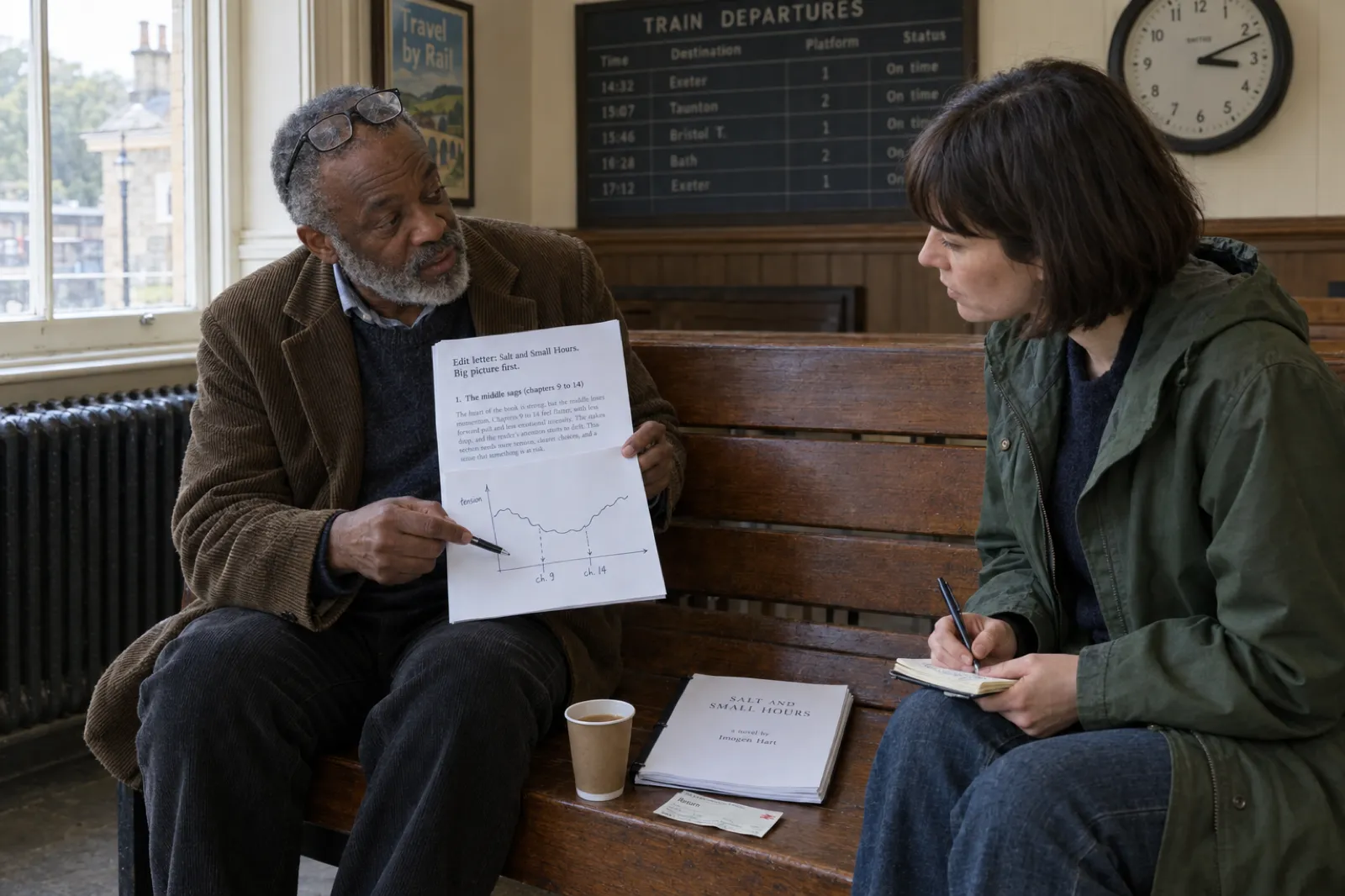
The big-picture edit: does the plot hold, does the middle sag, are chapters in the right order, does the nonfiction argument build, is anything missing or repeated. You get an edit letter and comments throughout, and you do the rewriting. It is the most expensive edit and the one worth doing first if the structure is in doubt, because every later edit assumes the chapters will stay. EFA median for fiction: 3.0 to 3.5 cents; nonfiction 4.0 to 5.0 cents; business books 4.5 to 6.0 cents. Reedsy's average range: 2.6 to 5.3 cents.
Line editing
Paragraph by paragraph: rhythm, clarity, word choice, flat or overwritten sentences, voice. It is where an editor makes good prose read well. Many editors sell it combined with a copyedit. EFA median for fiction: 2.7 to 3.5 cents; nonfiction 3.5 to 5.0 cents. Reedsy does not publish a separate line-editing figure.
Copyediting
Correctness and consistency: grammar, spelling, punctuation, capitalisation, hyphenation, the spelling of a character's name on page 40 and page 290, a timeline that does not add up, a style sheet so everything matches. EFA median for fiction: 2.0 to 2.7 cents; nonfiction 3.0 to 4.0 cents. Reedsy average range: 2.0 to 3.2 cents.
Proofreading
The last pass, ideally on the formatted pages: typos that survived, doubled words, a missing page number, a widow line, a heading in the wrong font. A proofreader does not rewrite. EFA median for fiction: 1.2 to 2.0 cents; nonfiction 2.0 to 3.0 cents. Reedsy average range: 1.4 to 2.1 cents.
Beta reading and sensitivity reading
Not editing in the strict sense, but often on the same budget. A paid beta reader reacts as a reader would (EFA median 0.5 to 0.8 cents a word). A sensitivity or authenticity reader checks how a community or experience is portrayed (EFA median 1.2 to 1.5 cents a word for sensitivity reading, 1.0 to 1.5 cents for authenticity). If you want reader reactions before you pay anyone, our AI beta reader page shows what an AI read can and cannot tell you.
Where the numbers come from, and why they differ
We used three sources because each answers a different question. Here is what each one is, and how to read it.
Editorial Freelancers Association: 2026 Rate Chart (US)
The EFA surveyed its members from November 2025 to mid-January 2026. Over 1,100 people, more than a third of the membership, reported the rates they charged during 2025. The chart shows median rate ranges per word, per hour and per page (a page is 250 words), plus how many pages an hour members get through, broken down by type of work and by genre. The EFA is clear that it neither sets nor recommends rates, and that individual editors vary with experience, turnaround, expertise and local cost of living. The EFA site also has a rate estimator and a rate converter. Of the three sources, it is the only one broken down by both edit type and genre, so it does most of the work in this guide.
Reedsy: editing cost data from real quotes
Reedsy runs a marketplace for freelance editors and says its figures come from thousands of real quotes across all genres. Its guide (last updated 9 February 2026) gives average per-word ranges by service, an 80,000-word example for each, and an on-page calculator with an average rate for each of 12 genres. Its headline figure: in 2026 it costs between $1,920 and $4,560 to hire an editor for an 80,000-word book. Reedsy's averages run slightly above the EFA medians for most services, which is what you would expect from a curated marketplace of experienced editors.
CIEP: suggested minimum rates (UK)
The Chartered Institute of Editing and Proofreading publishes suggested minimum hourly rates for a freelance editor with training in the core skills and some experience. They are not averages, and they are built to cover what a freelancer pays for themselves: holidays, sickness, National Insurance, pension, training, office costs and software. The 2026 to 2027 rates apply from 1 March 2026. The CIEP says plainly that it cannot tell anyone what to charge, that some editors charge considerably more, and that price is a business negotiation.
Why your quotes will not match any of them
All three sources list the same reasons a quote moves: the depth of intervention, the turnaround (a rush costs more), the editor's specialism and experience, how clean and well formatted the manuscript is, and the market. A median also means half the editors in the survey charge more. Treat the ranges here as the middle of the market, check a quote against them, and expect a specialist in your genre to sit above them.
Book editing cost by genre
Genre moves the rate in both directions. Reedsy says nonfiction costs more to edit than fiction because it is often denser, that heavy worldbuilding and experimental prose cost more than romance or thrillers, and that children's books cost more per word because every sentence has to be exactly right. The EFA medians, in cents per word:
| Genre (EFA 2026) | Developmental | Line | Copyedit | Proofread |
|---|---|---|---|---|
| Fiction | 3.0 to 3.5 | 2.7 to 3.5 | 2.0 to 2.7 | 1.2 to 2.0 |
| Young adult | 3.0 to 3.5 | 2.8 to 4.0 | 2.0 to 3.0 | 1.0 to 2.0 |
| Middle grade | 3.0 to 3.8 | 2.8 to 4.0 | 2.3 to 3.0 | 1.3 to 2.0 |
| Picture book | 3.6 to 4.5 | 3.5 to 5.0 | 2.5 to 3.5 | 2.3 to 4.3 |
| Memoir | 3.5 to 4.5 | 3.0 to 4.0 | 2.7 to 3.5 | 1.7 to 2.0 |
| Nonfiction | 4.0 to 5.0 | 3.5 to 5.0 | 3.0 to 4.0 | 2.0 to 3.0 |
| Business and marketing | 4.5 to 6.0 | 3.2 to 5.0 | 3.0 to 4.0 | 2.0 to 3.0 |
Reedsy's calculator splits fiction more finely. Its averages, in cents per word, with what a developmental edit of 80,000 words comes to at that rate:
| Genre (Reedsy) | Assessment | Developmental | Copyedit | Proofread | Developmental, 80,000 words |
|---|---|---|---|---|---|
| Romance | 2.1 | 2.9 | 2.2 | 1.6 | $2,320 |
| Thriller, crime, mystery | 2.3 | 3.1 | 2.4 | 1.6 | $2,480 |
| Fantasy | 2.4 | 3.1 | 2.4 | 1.7 | $2,480 |
| Science fiction | 2.3 | 3.2 | 2.2 | 1.6 | $2,560 |
| Historical fiction | 2.3 | 3.2 | 2.5 | 1.6 | $2,560 |
| Literary fiction | 2.4 | 3.3 | 2.8 | 1.9 | $2,640 |
| Young adult | 2.5 | 3.3 | 2.5 | 1.9 | $2,640 |
| Memoir and biography | 2.6 | 3.8 | 3.0 | 2.1 | $3,040 |
| Nonfiction | 2.8 | 4.4 | 3.3 | 2.4 | $3,520 |
| Middle grade | 3.0 | 4.1 | 3.4 | 2.4 | Shorter books; see the calculator |
Developmental edit of 80,000 words, by genre
Reedsy average per-word rates times 80,000. Bar length is cost divided by the largest figure ($3,520).
Romance
$2,320
Thriller, crime, mystery
$2,480
Fantasy
$2,480
Science fiction
$2,560
Historical fiction
$2,560
Literary fiction
$2,640
Young adult
$2,640
Memoir and biography
$3,040
Nonfiction
$3,520
Real books are not all 80,000 words, so the per-word rate matters more than the example. A 50,000-word self-help or how-to book at the EFA nonfiction ranges costs $2,000 to $2,500 for a developmental edit and $1,500 to $2,000 for a copyedit. If you are still deciding how long your book should be, our guides to writing a self-help book and writing a business book cover typical lengths, and children's book word counts by age covers the short end.
Children's books: the per-word trap
A 500-word picture book at the EFA's per-word picture-book rates would cost under $25 to edit, which is not how editors price them. Reedsy notes that picture-book editors often charge a flat fee, usually around $300 to $500, and its calculator's picture-book averages (43 cents a word for an assessment, 63 cents for a developmental edit) reflect that. Budget a picture book as a flat job, and see our children's book illustration cost guide for the larger line in that budget.
Per word, per page or per hour: converting a quote
Editors quote in all three units, and the EFA chart gives all three, so you can convert. The EFA counts a page as 250 words. A per-word rate times 250 is the page rate: 2.0 cents a word is $5 a page. An hourly rate needs the editor's pace, which the EFA also reports as pages per hour.
| Fiction (EFA 2026) | Per hour | Per page (250 words) | Pages an hour | Hours for 80,000 words |
|---|---|---|---|---|
| Developmental | $52.50 to $70 | $7.50 to $8.75 | 5.5 to 10 | 32 to 58 |
| Line edit | $50 to $60 | $6.75 to $8.75 | 5 to 9.5 | 34 to 64 |
| Copyedit | $40 to $50 | $5.00 to $6.75 | 6 to 10 | 32 to 53 |
| Proofread | $35 to $45 | $3.00 to $5.00 | 10 to 15 | 21 to 32 |
Hours for 80,000 words is 320 pages divided by the pages an hour. It is our arithmetic on the EFA figures, not a figure the EFA publishes, but it explains why per-word quotes exist: you know the price before the editor starts, and a messy manuscript costs the editor time rather than you. With an hourly quote, ask for an estimate of hours and a cap. On Reedsy's page, one editor describes the trade plainly: a cleaner manuscript takes less time to read and needs fewer suggestions, and stopping to correct is what takes the time.
How much does book editing cost in the UK?
UK editors mostly quote by the hour or by the job, and the reference point is the CIEP's suggested minimum. From 1 March 2026:
| Type of work (CIEP) | Suggested minimum an hour | In dollars | 80,000-word novel at EFA fiction pace |
|---|---|---|---|
| Proofreading | GBP 31.92 | $42.28 | GBP 681 to 1,021 |
| Copyediting | GBP 37.11 | $49.16 | GBP 1,188 to 1,979 |
| Substantial editing, rewriting, development editing | GBP 42.66 | $56.51 | GBP 1,365 to 2,482 (developmental) |
| Project management | GBP 46.19 | $61.19 | Not a book edit |
The CIEP minimum for copyediting converts to about $49 an hour, right at the top of the EFA's $40 to $50 median for fiction copyediting, so UK minimums and US medians land close together. Remember what a minimum means: an experienced UK editor in your genre will quote above it, and many CIEP members do. The CIEP also notes that a quick turnaround, a heavier edit and a specialism all raise the fee.
Calculator: what your edit costs, with plan prices alongside
Enter your word count and pick the edit, the genre and a rate source. The editor figure uses the source's own numbers. Underneath, the Inkfluence AI lines show what a full AI review pass would take on each plan, using the daily assist limits in our code on 13 October 2026.
Human editor
Editor = words x the source's rate. EFA: 2026 Rate Chart median ranges (fiction genres use the EFA fiction row; assessment and beta reading are not split by genre). Reedsy: average cost per word by genre from its editing-cost guide (business uses its nonfiction figure). CIEP: minimum hourly rate (substantial-editing rate for line and developmental edits) x hours at the EFA's reported pages per hour, a page being 250 words, at GBP 1 = $1.3247 (ECB, 13 Oct 2026). Inkfluence AI: one chapter review per chapter uses one assist; Free 3, Creator 15, Premium 100 a day (rolling 24 hours); the whole-book review on Creator or Premium uses one assist and reads up to 40 chapters.
Review my manuscript freeA typical result: an 80,000-word general-fiction copyedit is $1,600 to $2,160 at the EFA range, while a chapter-by-chapter AI review of the same book in 30 chapters takes 10 days of free assists, 2 days on Creator or one whole-book run. The two are not the same service, and the rest of this guide is about where each one belongs.
See what your manuscript needs before you get a quote
Run the whole-book review on Creator ($9.99 a month): an editorial letter with the 3 or 4 themes that matter most, plus findings for every chapter. Take that to an editor and you buy the edit you actually need.
Start my book reviewWhat AI editing covers on Inkfluence AI
Here is exactly what the editor does today, checked in our code on 13 October 2026, with the limits stated. Everything below sits in the editor, under AI Assist, in three tabs: Write, Chat and Review. If your book is in Word, import it first (Word files with Heading 1 for chapter titles come in cleanest; see importing a DOCX or EPUB). The three-minute video on how to import your manuscript shows it start to finish.
1. Review this chapter
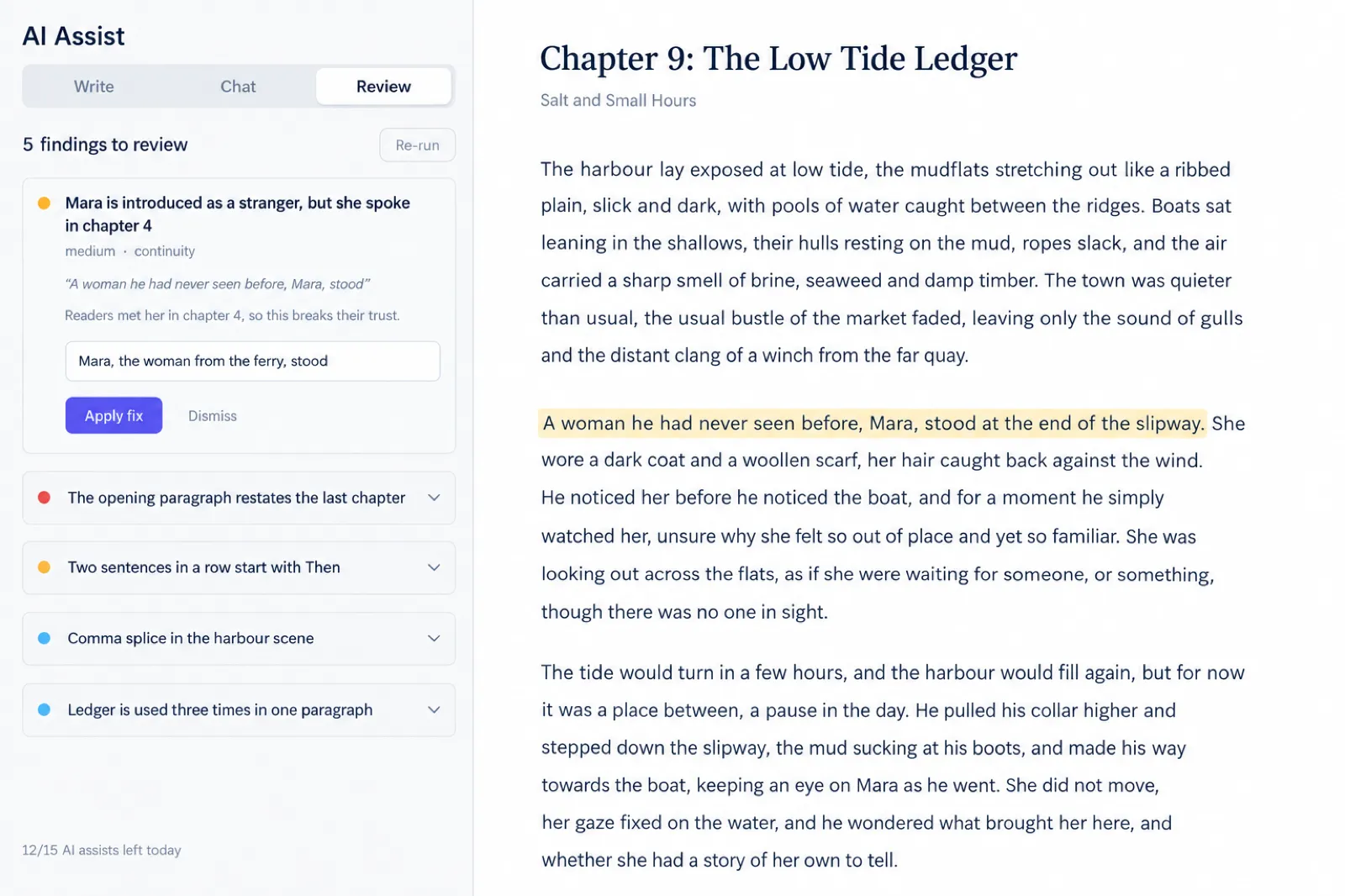
The Review tab reads the open chapter like an editor and returns 3 to 8 findings, most important first. Each finding has five parts: the exact passage (4 to 15 words quoted verbatim from your text), what is wrong, why it costs the reader, a drop-in fix in your voice, and a grade (high, medium or low) in one of six categories: clarity, pacing, repetition, continuity, grammar and style. You click Apply fix to patch that passage or Dismiss to skip it; nothing in the chapter changes until you apply. If you have changed the passage since the review ran, Apply marks the finding out of date instead of pasting over your new text. If the chapter is strong, the review returns fewer findings instead of inventing problems.
Two details matter for long books. A chapter review reads up to 30,000 characters of the chapter, roughly the first 5,000 words, so split very long chapters. And if the book has a story bible (fiction written in Inkfluence gets one automatically, and you can fill one in yourself for any book), the review reads it, which is how it can flag a name, fact or timeline that contradicts earlier chapters. Our story bible generator page explains what goes into one, and AI continuity checking for novels compares how tools handle it.
2. Whole book: an editorial letter plus findings for every chapter
On Creator and Premium, the Whole book button reads every chapter with at least 60 words, up to 40 chapters, gives each one 2 to 5 findings, and then writes an editorial letter of 250 to 400 words: a short verdict, the 3 or 4 themes that matter most across the manuscript, each tied to specific chapters, and the single highest-impact next step. Below the letter each chapter shows "Clean" or its number of findings, and you open a chapter to apply its fixes. It takes a few minutes on a long book, you can keep writing while it runs, and it uses one assist. It is the closest thing we make to a manuscript assessment, and it is the part a free plan does not include.
3. Proofread and rewrite a selection
Highlight any passage and a toolbar offers Proofread, Rewrite, Shorten, Expand, Softer, Punchier, or a custom instruction. Proofread corrects spelling, grammar and punctuation and keeps your wording and voice; if the passage is already correct, it comes back unchanged. The others deliberately change the prose. Every result is a preview: Replace selection, Insert below or Try again. The help centre's selection toolbar guide shows each one.
4. Chat with an editor that has read the book
The Chat tab already knows the open chapter, the outline and the story bible, so you can ask "where does this chapter drag?" or "does anything here contradict the story bible?" without pasting anything. Ask it to rewrite a passage and it gives two options to choose from. It works one passage or chapter per reply; it does not rewrite the whole book in one go. See chat with an AI that knows your book.
The limits, stated plainly
- Daily assists: 3 a day on Free, 15 on Creator, 100 on Premium, refilling 24 hours after your first use. A chapter review, a chat message, a quick action and a whole-book review each use one. A request that fails is refunded. Assists are separate from chapter credits, so editing never spends the credits you use to write.
- Whole-book review is on Creator and Premium only, and reads up to 40 chapters.
- No tracked changes. Fixes are applied one by one in the editor. To work with a human editor in Word, export a DOCX (Creator, Premium or any credit pack), send it, and import the edited file back.
- It is not a fact-checker. It flags contradictions inside your book; it does not verify claims against the world. Medical, legal and financial content still needs an expert.
- Prices: Creator $9.99 a month ($89 a year), Premium $19.99 a month ($179 a year). The pricing page has the full plan list.
What does it actually find? Across 893 real chapters the review read (figures pulled in September 2026), style, clarity and pacing made up about three quarters of findings and grammar under a tenth; the full breakdown lives on our AI book editor page. That mix is the point: most of what a manuscript needs is the judgement a grammar checker cannot make. For other angles, see the AI manuscript editor, AI developmental editor and AI novel editor pages, and our roundup of the best AI for editing a book.
A real AI review, finding by finding
Promises about AI editing are cheap, so here is one real review, unedited, with our verdict on each finding. It was run on 31 August 2026 in our own test account, on a 1,730-word chapter called "Pick a Profitable AI Niche" from a practical business book. We did not pick it for how well it went; it is the review on record in that account. The review returned seven findings.
| Finding (grade, category) | What it said | Our verdict |
|---|---|---|
| High, continuity | "Use the scorecard to move through three phases" is followed by four steps. | Real catch, apply. The list has four items (map, measure, test, choose). A reader notices; a copyeditor would charge to find it. |
| Low, grammar | A space before the comma after "Buyer-Pain Fit Scorecard". | False alarm. The text readers see has no space there. |
| Medium, style | The heading "Find a Buyer Before You Build" is vague; suggests adding a clause. | Dismiss. The suggested heading is longer and weaker. |
| Medium, repetition | "Score the Niche Before You Build" repeats the earlier heading's idea. | Judgement call. The echo is deliberate; we would keep it. |
| Medium, clarity | The scorecard gives no minimum total or worked example. | Fair point, weak fix. The note is useful, but the fix only rewords the sentence; the chapter already treats scores below 3 as a warning. |
| Low, clarity | "Build a list of 30 plumbing companies" is too prescriptive. | Dismiss. Specific numbers are a strength in a how-to book. |
| Low, pacing | The "Quick checklist" repeats earlier advice. | Partly right. It is a recap by design; the suggested heading is clumsy. |
One clear catch, one false alarm, five judgement calls. That is what AI editing is like in practice, and it is why the review gives you cards to accept or reject rather than rewriting your chapter: a fast first reader that finds real problems among suggestions you will turn down. A human editor's notes also need accepting or rejecting, but a good one wastes less of your time on the second kind. The useful habit is the same with both: apply what is clearly right, think about what is arguable, and ignore the rest without guilt.

What AI editing does well, and what a human editor is still for
We build an AI editor, and we still recommend human editors for some books. Here is the split as we see it, from the inside.
| Job | AI editing (Inkfluence AI) | Human editor |
|---|---|---|
| Typos, grammar, punctuation | Strong, instant, any number of passes | Strong; a proofreader on the final layout still catches what text tools miss |
| Repetition, flabby or unclear sentences | Strong at finding them; fixes need your judgement | Strong, and better at keeping your voice |
| Consistency inside the book (names, facts, timeline) | Good with a story bible; the chapter review checks against it | Good, with a style sheet built as they read |
| Pacing and where readers drift | Useful pointers, chapter by chapter, and themes across the book in the editorial letter | Better: reads the whole book as one experience |
| Structure, premise, market fit | A starting point for the conversation | The reason to hire one. Developmental judgement is where experience shows |
| Sensitive topics and lived experience | Not a substitute | Sensitivity or authenticity reader (EFA median 1.0 to 1.5 cents a word) |
| Expert accuracy (medical, legal, technical) | Does not verify facts against the world | A specialist editor or fact-checker (EFA fact-checking median $50 to $60 an hour) |
| Cost and speed | $0 to $19.99 a month; minutes | About $960 to $2,880 an edit for an 80,000-word novel; weeks |
Put simply: AI editing is the best value first pass there is, and for many books (a lead magnet, a workbook, a first ebook, a short how-to) it plus a careful read-through is enough. A human editor is worth the money when the structure is in doubt, when the voice is the product (literary fiction, memoir), when the subject is sensitive or technical, or when the book carries your professional reputation. Run the AI pass first either way: a cleaner manuscript makes the human edit cheaper, and a manuscript assessment more useful.
One rule people ask about: using AI to edit your own writing is not something Amazon asks you to declare. KDP's content guidelines call text you wrote and then edited, refined or error-checked with AI "AI-assisted" and say you do not need to tell them; text an AI tool created is "AI-generated" and must be disclosed. Our KDP AI disclosure guide covers the details.
Fix the cheap problems with AI, pay a human for the expensive ones
Review every chapter, apply the fixes you agree with, and read the editorial letter. Then decide whether you need a developmental edit, a copyedit, or just a proofread. Creator is $9.99 a month; Free includes 3 AI assists a day.
Edit my book nowWhat to buy at each budget
Most self-publishers cannot buy every layer. Here is a ladder that spends each dollar on the biggest remaining risk, using the 80,000-word fiction figures from the EFA ranges. Scale by your word count, or use the calculator.
- $0. Self-edit with distance: put the draft away for two weeks, then read it aloud. Run a chapter review on the free plan (3 a day), apply the clear fixes, and trade manuscripts with two or three readers in your genre.
- $10 to $20. One month of Creator ($9.99) or Premium ($19.99): a whole-book review with an editorial letter, a review of every chapter, and proofread passes on anything that still reads rough. For a lead magnet, workbook or short guide, this plus a careful final read is often enough to publish. Our ebook launch checklist covers the rest of the release.
- $400 to $640. Add paid beta readers (EFA median 0.5 to 0.8 cents a word) if you are unsure whether the story or argument lands, or an AI pass plus our AI beta reader if the budget is tighter.
- $960 to $1,600. A professional proofread on the formatted file. For a print book this is the human pass with the best return, because it catches layout errors no text tool sees.
- $1,600 to $2,160. A copyedit instead of, or before, the proofread, if the AI pass still leaves lots of findings per chapter or the book is going to print with your name on it as a professional.
- $2,400 to $2,800. A developmental edit, if beta readers or the editorial letter keep pointing at the same structural problem. Or a manuscript assessment ($1,200 to $1,440) to find out first.
- $4,960 to $6,560. Developmental edit, copyedit and proofread, the full professional sequence. Worth it for a book that has to compete with traditionally published titles in a crowded genre, or that represents your business.
Whatever you choose, do it in order: structure first, sentences second, typos last. Paying for a copyedit and then rewriting half the chapters after a developmental edit means paying for the copyedit twice.
Does the edit pay for itself?
Divide the edit by what you earn per copy. If your ebook earns you about $3 a sale, a $2,160 copyedit needs 720 sales to pay back, and a $9.99 AI review needs four. Our royalty calculator and KDP royalties guide give your real per-copy figure, and how to price an ebook covers the price itself. A human edit is an investment in reviews and the next book as much as in this one, so the payback sum is a floor, not a verdict.
How to hire an editor and read a quote
A good edit starts with a clear brief. Before you contact anyone:
- Know which edit you are buying. Reedsy's editors point out that many authors tick both copyediting and proofreading because they think the words mean the same thing. Use the definitions above, and ask the editor to say in writing what their service includes.
- Send the word count, genre and audience. These set the price. Our book length statistics help if you are unsure what is normal for your type of book.
- Ask for a sample edit. Many editors edit a few pages so you can both see the fit. It is the best way to judge whether they keep your voice.
- Check the quote against the ranges here. Well below the EFA median for your genre is a question to ask, not a bargain to grab; well above is fine if their experience in your genre justifies it.
- Get the terms written down: what is included, how many rounds, the turnaround, rush fees, whether a style sheet or edit letter is part of it, and when you pay. Reedsy suggests asking about paying in instalments, or a discount if you will work together on several books.
- Find editors through the directories of the EFA (US) and the CIEP (UK), or a curated marketplace such as Reedsy, where you can see experience and reviews.
Send the editor a clean file. If you wrote in Inkfluence AI, export a DOCX on any paid plan or credit pack; editors work in Word with tracked changes, and you can import the edited file back afterwards. After the edit, our guides on formatting a book for KDP, the AI book formatter, a copyright page template and whether you need an ISBN take you to upload.
Seven ways to cut the bill without cutting quality
- Cut before you hire. Every word you remove is a word you do not pay to edit. Reedsy's own advice is to trim superfluous scenes in the self-editing phase; at 3 cents a word, cutting 8,000 words saves $240 on a developmental edit.
- Run an AI pass first. Fixing the repetition, unclear sentences and contradictions yourself means the editor spends their hours on what you cannot fix alone. Editors on Reedsy say a cleaner manuscript takes less time.
- Buy an assessment before a full developmental edit. At the EFA medians it costs about half as much and tells you whether you need the bigger edit.
- Do not buy two overlapping services. If your copyeditor will also check the final layout, you may not need a separate proofread.
- Edit the opening chapters professionally and apply the lessons. Some editors offer a partial edit; the pattern they find in chapters 1 to 3 is usually the pattern in chapters 4 to 30.
- Avoid rush fees. Book the editor weeks ahead; all three sources list turnaround as a reason quotes rise.
- Stay with an editor who works. A second book with the same editor goes faster, and at least one editor on Reedsy's page says she keeps returning clients at her old rate.
Writing the book is the other half of the budget. If you have not finished the draft, AI vs a ghostwriter compares that cost, and our AI book writer drafts a full book you then edit with the same tools. For a memoir, see how to write a memoir with AI. Planning a second language edition? The AI book translator is cheaper than paying to edit twice, though a native reader is still worth it for anything literary.
Start with the edit that costs nothing
Open your book in Inkfluence AI, run a chapter review, and apply the fixes you agree with. Upgrade to Creator for the whole-book review and editorial letter when you want the full picture.
Open my bookFrequently asked questions
How much does it cost to edit a book in 2026?
For an 80,000-word novel, one professional edit costs about $960 to $2,880 depending on the type. Editorial Freelancers Association members report median rates that put fiction proofreading at $960 to $1,600, copyediting at $1,600 to $2,160 and developmental editing at $2,400 to $2,800. Reedsy's quote data puts one edit of an 80,000-word book at $1,920 to $4,560. A developmental edit, a copyedit and a proofread together come to roughly $5,000 to $6,600 at the EFA ranges.
How much does a book editor charge per word?
Mostly between 1 and 5 cents a word. The EFA's 2026 median ranges for fiction are 1.2 to 2.0 cents for proofreading, 2.0 to 2.7 cents for copyediting, 2.7 to 3.5 cents for line editing and 3.0 to 3.5 cents for developmental editing. Nonfiction runs higher: 3.0 to 4.0 cents to copyedit and 4.0 to 5.0 cents for a developmental edit. Reedsy's averages are 1.4 to 2.1 cents for proofreading up to 2.6 to 5.3 cents for developmental editing.
How much does it cost to edit a 50,000-word book?
At the EFA's 2026 nonfiction median ranges, a 50,000-word nonfiction book costs about $2,000 to $2,500 for a developmental edit, $1,750 to $2,500 for a line edit, $1,500 to $2,000 for a copyedit and $1,000 to $1,500 for a proofread. At Reedsy's nonfiction averages it is about $2,200 for a developmental edit, $1,650 for a copyedit and $1,200 for a proofread.
How much does a book editor cost per hour?
EFA members report median hourly ranges of $40 to $50 for fiction copyediting, $45 to $60 for nonfiction copyediting, $52.50 to $70 for fiction developmental editing and $35 to $45 for fiction proofreading. In the UK, the CIEP's suggested minimums from 1 March 2026 are GBP 31.92 an hour for proofreading, GBP 37.11 for copyediting and GBP 42.66 for substantial or developmental editing.
How much does book editing cost in the UK?
The CIEP publishes suggested minimum hourly rates rather than per-word prices: GBP 31.92 for proofreading, GBP 37.11 for copyediting and GBP 42.66 for substantial editing from 1 March 2026. At the pace EFA members report for fiction, an 80,000-word novel is about 32 to 53 hours of copyediting, which is roughly GBP 1,190 to GBP 1,980 at the CIEP minimum. Experienced editors charge more.
How much does it cost to edit a children's book?
Children's books are short but cost more per word. The EFA's 2026 median ranges for picture books are 3.6 to 4.5 cents a word for developmental editing and 2.5 to 3.5 cents for copyediting, yet Reedsy notes that picture-book editors often charge a flat fee instead, usually around $300 to $500. Middle-grade and young adult novels sit close to adult fiction rates.
What is the difference between copyediting and proofreading, and do I need both?
Copyediting fixes grammar, consistency, word choice and facts in the manuscript before layout. Proofreading is the last check of the formatted pages for typos and layout errors. Many self-published authors buy one or the other; a clean, AI-checked manuscript that goes straight to ebook can often skip a separate proofread, while a print book benefits from a proof pass on the laid-out pages.
Which type of editing should I pay for first?
Start with the biggest problems. A manuscript assessment (EFA median 1.5 to 1.8 cents a word) or a developmental edit tells you whether the structure works; there is no point paying to polish sentences in chapters you may cut. Copyediting comes after the structure is settled, and proofreading comes last, on the formatted file.
Can AI edit my book instead of a human editor?
AI handles the first pass well: typos, repeated words, unclear sentences, pacing drags and facts that contradict earlier chapters, in minutes and for a monthly price. Inkfluence AI reviews a chapter on the free plan and a whole book with an editorial letter on Creator ($9.99 a month). A human editor is still the better choice for developmental judgement, voice-sensitive literary prose, sensitive topics and expert fact-checking.
Do I have to disclose AI editing on Amazon KDP?
No. KDP's content guidelines call text you wrote yourself and then edited, refined or error-checked with AI tools "AI-assisted", and say you do not need to tell them. You must disclose AI-generated content: text, images or translations an AI tool created, even if you edited them heavily afterwards.
Sources
Every external fact on this page was read on the source below on 13 October 2026. Inkfluence AI facts were checked in our product code the same day; the review in "A real AI review" is a record from our test account dated 31 August 2026.
- Editorial Freelancers Association: Editorial Rates, 2026 Rate Chart (median rate ranges from a member survey run November 2025 to mid-January 2026, over 1,100 respondents, 2025 rates; per word, per hour, per 250-word page, pages per hour), checked 13 Oct 2026
- Reedsy: How Much Does an Editor Cost? What to Expect for Pro Services (last updated 9 February 2026; per-word averages by service, 80,000-word examples, per-genre calculator averages, picture-book flat fee $300 to $500), checked 13 Oct 2026
- Chartered Institute of Editing and Proofreading: Suggested minimum rates (2026 to 2027, from 1 March 2026), checked 13 Oct 2026
- European Central Bank: euro foreign exchange reference rates (13 October 2026: EUR 1 = USD 1.1188 = GBP 0.84460), checked 13 Oct 2026
- KDP: Content Guidelines, artificial intelligence content (AI-generated vs AI-assisted), checked 13 Oct 2026
Related reading
- Best AI for Editing a Book (2026)
- The Real Cost of Publishing an AI Book
- AI Book Editor and AI Manuscript Editor
- AI Developmental Editor and AI Beta Reader
- Children's Book Illustration Cost in 2026
- AI vs Ghostwriter Cost
- How to Publish AI-Generated Books on KDP
- KDP Rejected My Book: Fixes
- Help: get an editorial review of your chapter or book

Founder, Inkfluence AI
Sam is the founder of Inkfluence AI. He built the platform to make book creation accessible to everyone - from first-time authors to seasoned publishers.
Helpful links
Ready to Create Your Own Ebook?
Start writing with AI-powered tools, professional templates, and multi-format export.
Get Started FreeRelated Articles
 Publishing
 Do You Need an ISBN? Free vs Bought, Cost by Country, and Which Formats Need One (2026)
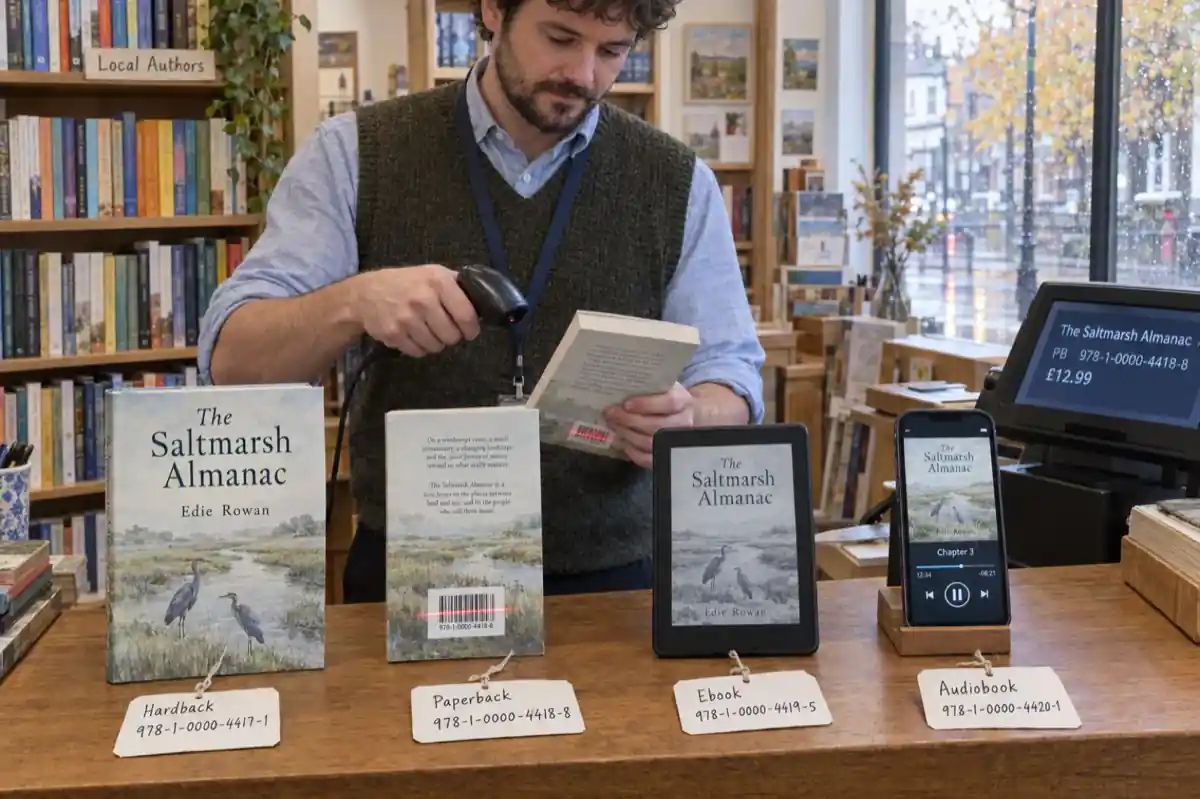
When a self-published book needs an ISBN and when it does not, what one costs in the US, UK, Canada, Australia, New Zealand, India, Germany, Italy and France (checked at each agency on 13 October 2026), free ISBNs from KDP, IngramSpark and Draft2Digital, and a picker that tells you how many you need.
 Publishing
 IngramSpark AI Policy (2026): What It Accepts, the Setup Question and the "Assisted By" Credit
IngramSpark accepts AI-drafted books with significant human editing and the "Assisted By - Generative AI" credit, and refuses works created solely with generative AI. Its exact wording, covers and translations, how it differs from KDP, a checker for your book, and an editing workflow.
 Publishing
 IngramSpark vs KDP (2026): Fees, Print Quality, Distribution, and Whether to Use Both
IngramSpark vs Amazon KDP compared on 2026 fees, print cost per copy for real trim sizes, earnings per sale, distribution, paper and binding options, and file specs, with a per-copy earnings calculator and the setup for using both with one ISBN.
Get ebook tips in your inbox
Join creators getting weekly strategies for writing, marketing, and selling ebooks.