
How to Write a Self-Help Book: Outline Template, Chapter Structure, Length and Examples (2026)
A step-by-step guide to writing a self-help book: the reader promise, the transformation arc, a chapter template and a free outline builder, exercises, client stories with consent, citing research responsibly, length, and how to publish and sell it.
Quick Answer
To write a self-help book, pick one reader with one problem and write the promise in a sentence. Turn your method into 3 to 6 steps, give each step a chapter with a story, a mindset shift and an exercise, and frame them with chapters on the problem and on keeping the change. Most land at 8 to 12 chapters.
Self-help books are built on a simple deal with the reader: you have a problem, and by the last page you will have a way through it. The books that keep that deal are not the ones with the most inspiring sentences. They are the ones with a clear promise, a method the reader can follow, and something to do at the end of every chapter.
This guide is for coaches, therapists, teachers, managers and anyone who has helped people with the same problem often enough to have a method. It covers the whole job, from the reader promise to publishing. There is a free outline builder halfway down that turns your reader, problem and promise into an 8 to 12 chapter plan you can copy or send straight into Inkfluence AI.
Still choosing a topic? Start with our 55 self-help book ideas, grouped by the reader's problem (career, money, relationships, grief, burnout and more), each with a working title and a first-chapter angle. Pick one, then come back here to build the book.
Self-help book formats at a glance (13 Oct 2026)
"Self-help book" covers everything from a 20-page lead magnet to a 50,000-word hardback. Decide which one you are writing first, because it sets the length, the number of chapters and where the book will sell. The traditional figure comes from a literary agent's published guideline; the other rows are our suggestions for self-published books, not industry rules.
| Format | Length | Chapters | Suits | Where it sells |
|---|---|---|---|---|
| Mini-book or lead magnet | 5,000 to 12,000 words | 5 to 8 | Coaches building an email list; one quick win | Free download on your site, in exchange for an email address |
| Short self-help ebook | 12,000 to 30,000 words | 8 to 12 | A first book that solves one problem well | Kindle, Gumroad, Etsy, your own site |
| Full self-published book | 30,000 to 50,000 words | 10 to 14 | An established method with stories and research behind it | Kindle and paperback on KDP, plus an audiobook |
| Traditionally published | 40,000 to 55,000 words (agent Rachelle Gardner's guideline) | 10 to 14 | Authors with a platform who want bookshop distribution | Through a publisher, after a proposal and an agent |
| Companion workbook | 10 to 25 exercises | One section per book chapter | Habit, money, confidence and communication books | Paperback at 7 x 10 in, printable PDF |
For a first book, the short ebook is the sweet spot: long enough to teach a whole method, short enough to finish and test on real readers before you write the long version.
Step 1: one reader, one problem, one promise
Most self-help manuscripts that stall do so because the author is writing for everyone about everything. "A book about confidence" has no edges. "A book for new managers who freeze before hard conversations" has edges, and once the edges are there, every chapter, story and exercise has a job.
Write three things on a card before you write anything else:
- The reader. One person, described by their situation, not their demographics. "New managers who used to be the best person on the team" is better than "professionals aged 25 to 40".
- The problem, as they would say it. "I put off hard conversations until small problems become big ones." Use the words people actually use with you. Those are also the words they type into Amazon and Google.
- The promise. What they can do by the last page that they cannot do now. Make it something they could notice in a normal week: "have one honest, calm conversation a week without dreading it".
Then join them into a single promise sentence: "This book is for [reader]. Right now: [problem]. By the end: [promise], using [your method]." That sentence becomes your back-cover hook, your Amazon description opener and the test you hold every chapter to. If a chapter does not move the reader from the problem towards the promise, it belongs in a different book.
| Vague promise | Sharper promise | Why it is better |
|---|---|---|
| "Become your best self" | "Keep a 20-minute morning routine for 30 days, even with small children" | The reader can picture it and tell whether it worked |
| "Overcome procrastination forever" | "Clear the week's admin in one 45-minute session" | No "forever"; a concrete, repeatable result |
| "Heal your anxiety" | "Ten grounding practices for busy weeks, and when to ask for more help" | Describes what the reader does, not a clinical outcome |
| "Find love" | "Go on three good first dates in the next two months, without the apps wearing you down" | Specific, time-bound to the plan, honest about effort |
| "Get rich with side hustles" | "Choose, test and price one weekend side project in 6 weeks" | Promises a skill, not an income figure you cannot prove |
Notice that the sharper promises are smaller. That is deliberate. A small promise that the book keeps earns reviews and word of mouth; a huge one that it cannot keep earns refunds. If you are stuck on the title, the free book title generator works well once the promise sentence is written, and our pages for self-help authors and life coaches show how others frame theirs.
Step 2: map the transformation arc
A self-help book is a journey with a start and an end, and the reader should always know where they are on it. Almost every book in the genre, whatever the topic, follows the same three-part arc:
- Where you are (about 3 chapters). The cost of the problem, why it happens, and why the usual fixes have not worked. This is where the reader decides you understand them. Rush it and they will not trust the method.
- The method (3 to 6 chapters). One chapter per step, in the order the reader should do them. This is the heart of the book and where most of your words go.
- Making it last (2 or 3 chapters). Setbacks, the people around the reader, and a plan for after the last page. Most first drafts skip this part, and it is the part readers remember when the method meets a bad week.
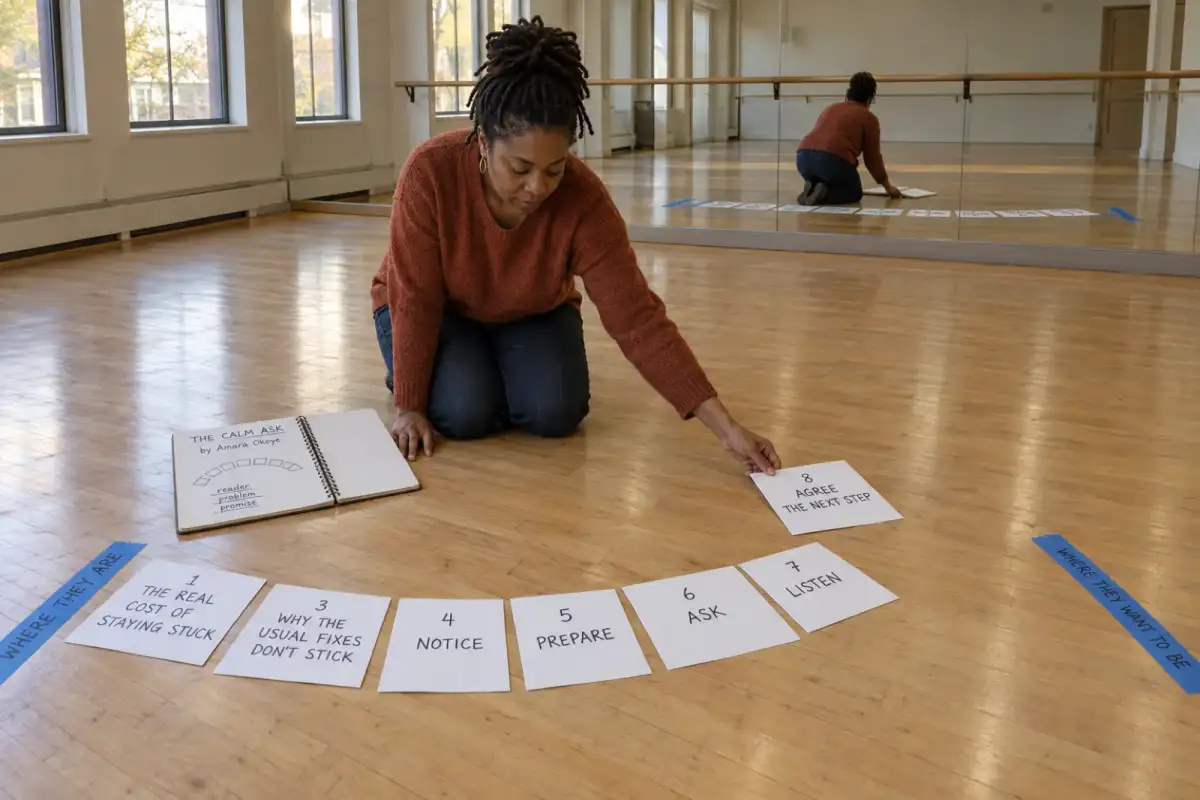
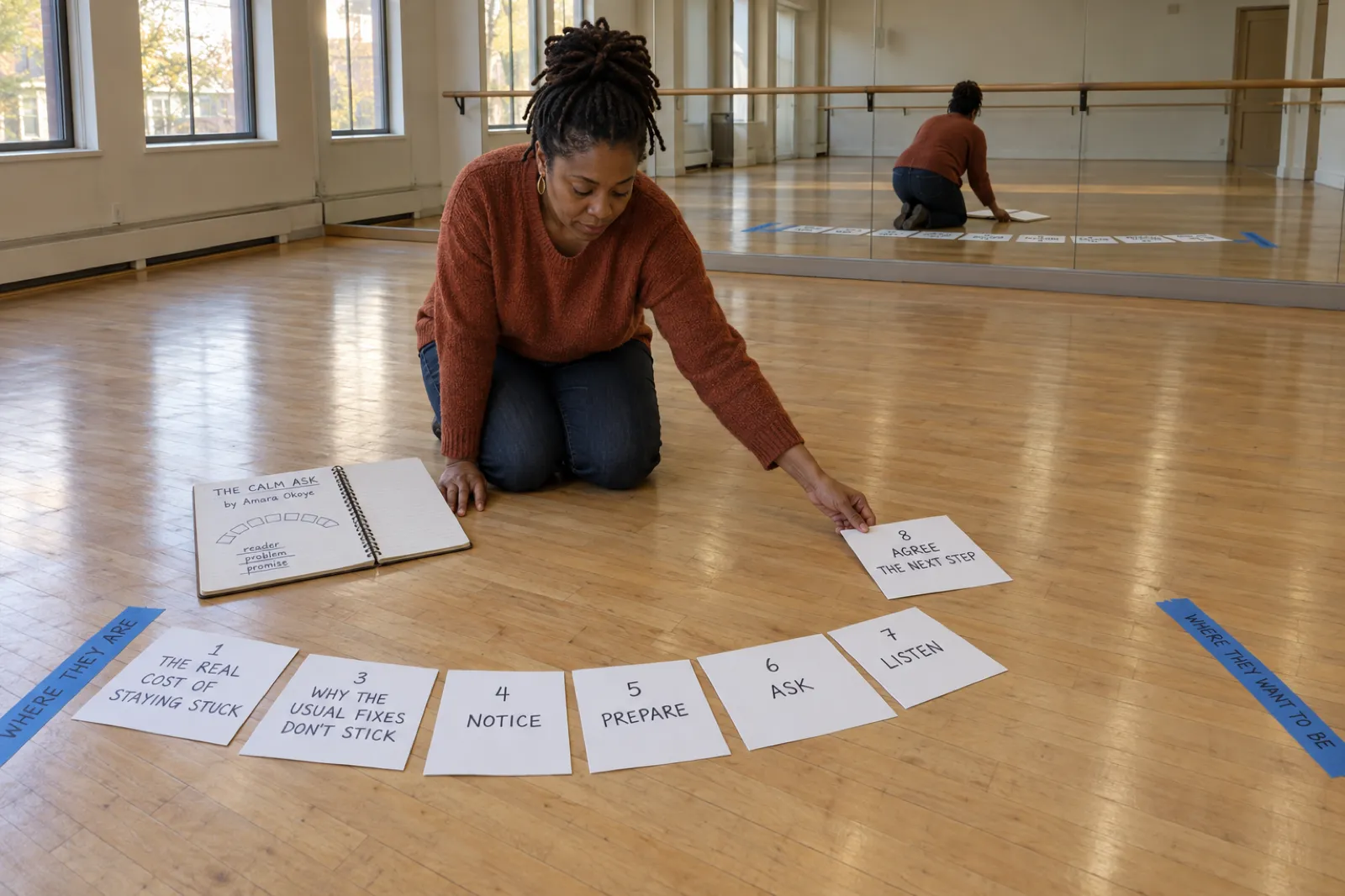
Lay it out physically before you write: one index card per chapter on the floor, from "where they are" to "where they want to be". If two cards make the same point, merge them; if a reader could not make the jump between two cards alone, you are missing a chapter.
Turn what you already do into steps
You probably have a method already, even if you have never named it. Look at what you do with a client, a team member or a friend who comes to you with this problem. What do you ask first? What do you get them to try? What do you do when it does not work? Write those moves down in order and you will usually find 3 to 6 of them. Give the set a short, plain name ("The Calm Ask", "The Friday Hour") and give each step a one- or two-word label. Names help readers remember the method and talk about it, which is how self-help books spread.
Step 3: the self-help chapter template
Self-help chapters work best when they repeat a pattern the reader learns to expect. The pattern below is the one most strong books in the genre share, and it is close to how Inkfluence AI structures a personal development chapter. Each part has one job:
| Part | Its job | Rough share of the chapter |
|---|---|---|
| 1. Opening story or scene | A moment the reader recognises from their own life, ending on the chapter's question | 10% |
| 2. The shift | The old belief next to the new one, stated plainly | 10% |
| 3. Why it works | The reasoning, an example, and a source if you make a factual claim | 25% |
| 4. The steps | Exactly what to do, in order, with timings | 25% |
| 5. Exercise | Something the reader does before the next chapter, with a way to tell it worked | 20% |
| 6. Takeaway and bridge | One memorable sentence, a short recap, and a line that pulls the reader into the next chapter | 10% |
Here is that template filled in for one chapter of an example book, The Friday Hour, for freelancers who leave invoices and admin until the last minute. The chapter teaches step 3 of the method, "Send".
Example chapter plan: Chapter 6, Send
- Opening scene: It is the 28th. A designer has finished three projects this month and invoiced none of them, because each invoice "only takes five minutes" and so never gets done. Ends on: What if the problem is not the five minutes, but deciding when they happen?
- The shift: Old belief: "I'll send it when I have a minute." New belief: "Invoices go out in one batch, at one time, every week."
- Why it works: Batching similar tasks removes the decision each time. Example of a week with scattered admin versus a week with one session. No statistics unless you have a source to hand.
- The steps: Keep a "to send" list from step 2. At the start of the Friday Hour, send every item on it in one sitting. Use one saved template per client type. Set reminders for anything unpaid after 14 days.
- Exercise: Write your two invoice templates and your polite 14-day reminder now. You will know it is working when nothing finished this week is still unsent on Monday.
- Takeaway: "Money you have earned is not yours until you ask for it." Bridge: the next chapter, "Schedule", makes the Friday Hour hard to skip.
The chapter is about one thing. Readers often try the exercise and come back days later; a chapter with one idea and one action survives that gap.
The self-help book outline template
Copy this into your notes and fill in the brackets. It assumes a 10-chapter book with a 4-step method; add or remove method chapters to match your steps. The builder below does the adjusting for you.
WORKING TITLE: [Method name]: [Promise]
This book is for [reader]. Right now: [problem]. By the end: [promise], using [method name].
PART 1: WHERE YOU ARE
Chapter 1: The real cost of staying stuck. Meet the reader, name the cost, make the promise. Exercise: a 1 to 10 starting-point check on five statements, kept for chapter 10.
Chapter 2: Why it keeps happening. The root cause in plain language. Exercise: a three-day pattern log.
Chapter 3: Why the usual fixes don't stick. The central shift; introduce [method name] and its steps. Exercise: old way and new way table.
PART 2: THE METHOD
Chapter 4: [Step 1]. What it is, why it works, how to do it this week, what gets in the way. Exercise: a 7-day challenge.
Chapter 5: [Step 2]. Same pattern. Exercise: a worksheet with a worked example first.
Chapter 6: [Step 3]. Same pattern. Exercise: a script or template to use in real life.
Chapter 7: [Step 4]. Same pattern. Exercise: a 14-day tracker.
PART 3: MAKING IT LAST
Chapter 8: When you slip. Setbacks are part of the process. Exercise: an if-then plan for the three likeliest setbacks.
Chapter 9: The people around you. Support, surroundings, asking for help. Exercise: a support map.
Chapter 10: Keeping it for good. Re-take the chapter 1 check, compare, and write a 90-day plan.
And here is the same template filled in for The Friday Hour:
| Chapter | What it covers | Exercise |
|---|---|---|
| 1. The Real Cost of Staying Stuck | Late payments, weekend dread, the hours lost to restarting admin | Starting-point check: five statements rated 1 to 10 |
| 2. Why It Keeps Happening | Admin has no deadline until it is urgent; every small task needs a decision | Three-day log of when admin gets avoided |
| 3. Why the Usual Fixes Don't Stick | Apps and willpower versus one fixed weekly session; introduces the four steps | Old way and new way table |
| 4. Collect | One inbox for receipts, one list for everything owed and owing | 7-day challenge: drop everything in one place |
| 5. Sort | Four piles: send, pay, file, decide | Sorting worksheet with a worked example |
| 6. Send | Invoices and reminders in one batch | Two invoice templates and a 14-day reminder |
| 7. Schedule | Protecting the hour: time, place, what happens if Friday is lost | 14-day tracker |
| 8. When You Slip | The busy month, the holiday, the client crisis | If-then plan for three setbacks |
| 9. The People Around You | Partners, accountants, clients who pay late | Support map |
| 10. Keeping It for Good | Tax season, growth, and the 90-day plan | Re-take the chapter 1 check |
Have an outline? Get the first draft today
Paste your promise sentence and chapter list into Inkfluence AI. It shows you the outline to edit first, then writes every chapter with an opening scene, a mindset shift, reflection prompts and a time-bound challenge. Five chapters are free.
Start your self-help book freeFree self-help outline builder
Fill in the three boxes and the builder lays out an 8 to 12 chapter outline using the arc above: three chapters on where the reader is, one chapter per step of your method, and two or three on making the change last. Every chapter gets a job, an exercise and a story slot. Add your method's steps for a tighter outline, or leave them blank to get starting steps you can rename. It runs in your browser; nothing you type is sent anywhere unless you press the button to open it in Inkfluence AI.
Self-help outline builder
Reader, problem and promise in, chapter-by-chapter outline out.
Your promise sentence
Fill in the boxes above to build your outline.
Working title ideas
The button opens your dashboard with this outline loaded as the book idea. You can edit it before anything is written, and you will see the chapter plan to rename, reorder or remove before the chapters are drafted.
Treat the output as a first cut. The opening and closing chapters are deliberately general; rename them in your reader's words ("Why Sunday Nights Feel Heavy" beats "Why It Keeps Happening"). If you want more structure ideas, the free book outline generator covers other genres, and how to write a non-fiction book covers the wider process.
What people write self-help books about
Self-help is one of the most common kinds of book people make in Inkfluence AI. On 13 October 2026 we counted 8,004 personal development books, about 6.5% of the 100,000+ books in the app (test accounts excluded), started by 5,403 different authors. One in five (20.8%) is written in a language other than English, across 55 languages.
To see which problems people choose, we matched the titles and briefs of the 6,343 English-language ones against simple topic keywords. A book can match more than one topic, and about four in ten match none of them, so read these as a rough map, not a census.
Topics of English-language self-help books made in Inkfluence AI
6,343 books, counted 13 Oct 2026. Share of books whose title or brief mentions the topic. Bar width = share / largest share.
Habits and productivity lead, which suits the "one method, clear steps" structure in this guide. Healing, stress and grief books are nearly as common, which is why the sections on stories, research and claims below matter: those readers are often in a hard place.
We also looked at how many chapters authors give these books, among the 1,914 with a stored chapter and word count:
Chapters per personal development book in Inkfluence AI
1,914 books with a stored chapter and word count, counted 13 Oct 2026. Bar width = share / largest share.
Many of the shortest books are first drafts made within the free plan's five chapters.
Authors who go past a starter draft mostly land in the 8 to 12 range this guide recommends, and a sizeable group writes 13 or more. Our AI book writing statistics page has the typical length of a personal development book in words, alongside every other book type.
Step 4: exercises readers actually do
Exercises turn a book the reader agrees with into one they use. Readers skip vague ones ("reflect on your relationship with money") and do specific ones ("list every subscription you pay for and circle the ones you have not used this month").
Five rules that make exercises get done:
- One per chapter, tied to that chapter's step. Several small exercises in a chapter feel like homework; one good one feels like progress.
- Say how long it takes and what is needed. "10 minutes, a pen and your last three bank statements."
- Show a worked example first. A filled-in version shows what a good answer looks like and lowers the fear of doing it wrong.
- Give a finish line. "You will know it is working when..." followed by two or three signs the reader can actually observe.
- Connect the first and last chapters. A starting-point check in chapter 1 that the reader repeats in the final chapter lets them see how far they have come, which is the strongest ending a self-help book can have.
| Exercise type | Best for | Example |
|---|---|---|
| Self-assessment | Chapter 1 and the final chapter | Rate five statements from 1 to 10: "I raise problems the week they happen." |
| Journal prompts | Reflective books, mindset chapters | "When did you last say yes when you meant no? What did it cost you that week?" |
| 7-day challenge | Building a habit | "Each day this week, start the task you are avoiding for five minutes. Tick the box." |
| Script or template | Communication, money, boundaries | "Open with: I want to talk about X because I care about Y." |
| Tracker | Anything measured over weeks | One line a day for 14 days: what you did, how it went, 1 to 5 |
| If-then plan | Setbacks chapter | "If I miss Friday, then I do the hour first thing Monday." |

When to make a companion workbook
If your readers need to practise a lot, keep each exercise in the book short and put the full worksheets, trackers and answer lines in a separate companion workbook. The book stays readable on a Kindle, and the workbook can be printed at a larger size with room to write. It is also a second product for readers who already trust you.
In Inkfluence AI you make the companion as its own book: choose Workbook from the formats on the dashboard and describe it as "a companion workbook for [your title], with one section of exercises per chapter". The Workbook structure explains each concept, shows a worked example, sets the exercise and leaves full-width answer lines for handwriting. Choose the Workbook book style in Preview and the 7 x 10 in Workbook page size when you export. One honest limit: the PDFs are for printing or writing on in an annotation app; we do not make fillable form PDFs. Our guides to creating a workbook with AI, making a guided journal and the workbook generator go further, and coaches comparing tools can read the best AI for workbooks, journals and coaching.
Step 5: stories and case studies, with consent
Stories are what make a self-help book believable. Readers remember the manager who rehearsed one sentence in the car park long after they forget the principle. You have three kinds to draw on, and each has its own rules.
Your own story
Your "before" is often the strongest material in the book, because it proves you have stood where the reader stands. Tell it honestly, including the parts that did not work. If your story involves other people (a former partner, a boss, family), change details so they are not identifiable, or ask them. Being your story does not make it only yours.
Client and reader stories
These carry the most weight and the most responsibility. A practical standard for any author:
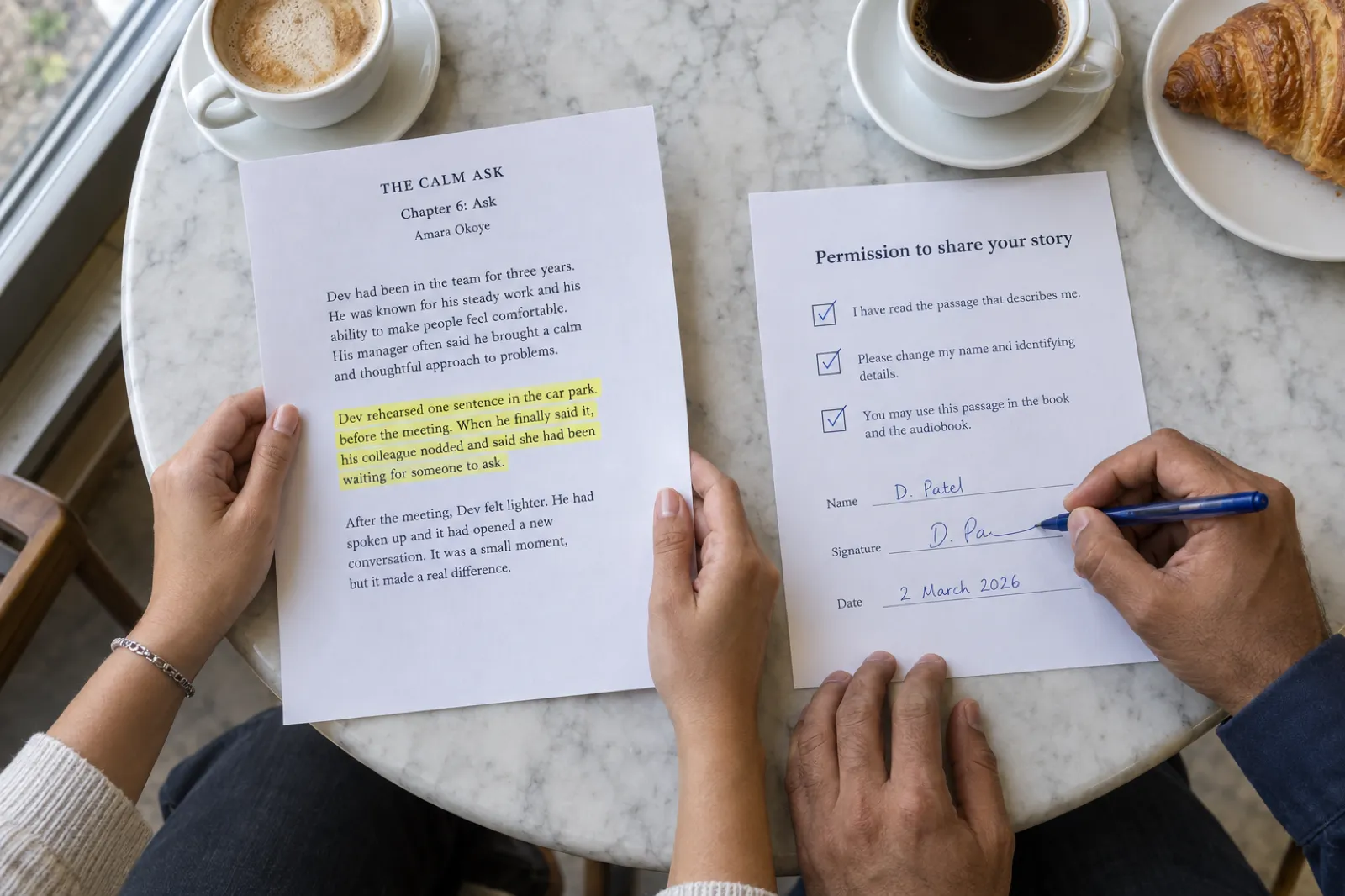
- Get written permission from anyone who could recognise themselves, even with a changed name. A one-page form is enough: they have read the passage, they choose whether their name and details are changed, and they agree to its use in the book and any audiobook or translation.
- Let them read the passage before publication, not just the idea of it.
- Change identifying details (name, job, city, distinctive events) unless they want to be named.
- Keep the form on file for as long as the book is on sale.
If you are a psychologist, the bar is set for you. The American Psychological Association's Ethics Code, Standard 4.07, says psychologists "do not disclose in their writings, lectures, or other public media, confidential, personally identifiable information concerning their clients/patients" obtained in their work, unless they take reasonable steps to disguise the person, the person has consented in writing, or there is legal authorisation. Other professions have their own codes; therapists and counsellors should check theirs before using any client material. Our page for therapists covers the kinds of books that work without case material at all.
Composite and illustrative examples
A composite blends several real people into one example. It protects privacy and is common in the genre, but say so, once, near the start: "Names and details in this book have been changed, and some examples combine several people." Never present an invented person as a real client.
This matters if you draft with AI. Inkfluence AI gives each non-fiction chapter its own example person at outline stage, so chapters do not all lean on the same "Sarah, 34". Those people are illustrative examples, not real clients. Keep them as clearly hypothetical ("Imagine a manager we'll call Dev..."), or replace them with your real, consented stories, which will almost always be better.
Step 6: cite research responsibly
Self-help sits close to psychology, and psychology has had a hard decade. In 2015 the Open Science Collaboration repeated 100 studies published in three psychology journals. 97% of the original studies had statistically significant results; 36% of the replications did, and the replication effects were on average half the size of the originals. That does not mean research is useless. It means a single study is a clue, not a fact, and a book that says "science proves" is claiming more than science does.
Habit formation is a good example of how to cite well. The often-repeated "21 days to form a habit" does not come from the best-known study on the subject. Lally and colleagues followed 96 volunteers who each picked an eating, drinking or activity habit to do daily for 12 weeks. The time it took people to reach their peak automaticity ranged from 18 to 254 days. So the honest sentence is: "In one study of 96 people, new daily habits took anywhere from 18 to 254 days to become automatic, so expect it to take a while and do not quit at day 21."
How to handle research in your book:
- Cite the study, not the article about it. Follow every blog, TED talk or newspaper claim back to the paper, read at least the abstract, and cite that.
- Prefer reviews to single studies. A meta-analysis or systematic review pools many studies and is less likely to be overturned.
- Describe what was measured. "In one study of 96 adults..." tells the reader how much weight to give it.
- Use honest verbs. "Found", "suggests" and "is linked with" are accurate; "proves" almost never is.
- Check for retractions before you rely on a paper: the publisher's page will show a retraction notice, and search the title with "retraction".
- Keep a references list in one consistent style, with the DOI for journal articles, at the end of each chapter or the book.
A note for AI drafting: the personal development structure in Inkfluence AI is set not to cite statistics, percentages or named studies unless you provide them, so the draft will not invent a study for you. That also means the research is your job. Add the sources you have read when you edit, and see our guide to preventing factual errors in AI non-fiction for a checking routine.
Step 7: stay clear of therapy and health claims
Many self-help books touch mental health: stress, grief, anxiety, burnout. Writing about them is fine and often valuable. The risk is in the promise. "Cure your anxiety" or "heal trauma without therapy" is a treatment claim, and advertising regulators, Amazon's rules against misleading content and Etsy's medical claims policy all bite hardest on titles, covers and sales copy. Promise what the reader will do (a routine, a practice, a plan) rather than a clinical outcome, never suggest anyone stop treatment or medication, describe your background exactly ("coach", not "therapist", unless you are one), and add a short note at the front: this book is general information, not therapy or medical advice, and if you are struggling, contact a doctor or a local crisis line. Our guide to writing a health or wellness ebook has the full claims rules by regulator and store, a claim checker and a disclaimer builder.
In Inkfluence AI, books about overcoming depression, anxiety, grief or burnout are written in the warm personal development structure rather than the protocol-style health one; you still add the note and choose the promise.
Your method, written up as a real book
Describe your reader and your method, edit the outline, and get full chapters with stories, shifts and exercises in place. You add your real stories, your sources and your voice.
Write your self-help bookHow long should a self-help book be?
There is no single right length, but there are useful reference points:
- Traditional publishing: literary agent Rachelle Gardner gives 40,000 to 55,000 words for self-help in her guide to the word counts publishers want to see. Expect agents and editors to look for something in that range.
- Self-published ebooks: readers judge a self-help ebook by whether it solves the problem, not by its page count. A tight 15,000 to 30,000-word book beats a padded 50,000-word one.
- Per chapter: 1,500 to 3,000 words is a comfortable range for a self-help chapter. At 10 chapters that is 15,000 to 30,000 words; to reach 50,000, chapters need to average about 5,000 words, which usually means more stories and research per chapter rather than more chapters.
Chapter count is the main length lever, and it is the right one: each method step deserves its own chapter, so the method decides the length. If your outline has 9 chapters and the draft feels thin, the fix is usually a richer story and a better exercise in each chapter, not three extra chapters.
Inkfluence AI does not take a word or page target; it writes each chapter at roughly 1,000 to 1,500 words, so you set length with the number of chapters and deepen them as you edit. If you are deciding between a short and a long book, our post on short versus long ebooks covers how each sells.
Write it with Inkfluence AI, step by step
Inkfluence AI is built for exactly this kind of book: a method with steps, written warmly, with an exercise in every chapter. Here is the route from promise sentence to finished files.
- Describe the book on the dashboard. Paste your promise sentence, your method steps and, if you have it, your chapter list (the builder above does this for you). Inkfluence AI picks the book type from your description; self-help books get the Personal Development structure. You can change the book type later in the editor's Settings.
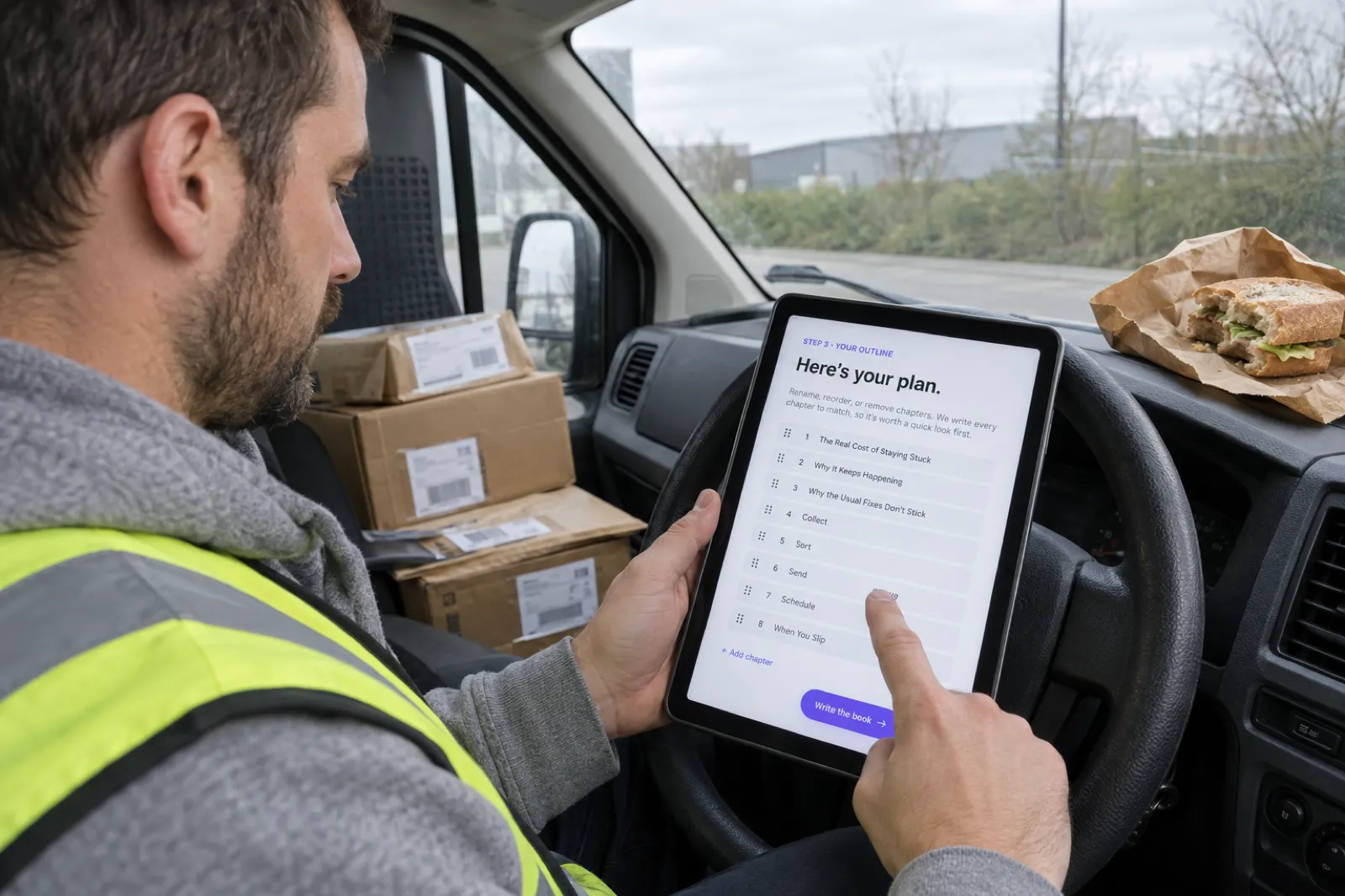
- Check the outline. Before anything is written, you see "Here's your plan": rename, reorder or remove chapters, or add one. It puts foundational shifts first, then practical skills, then longer-term change, and gives each chapter its own method, opening and example person so chapters do not repeat.
- Generate the chapters. Each personal development chapter opens with a scene the reader recognises, presents one mindset shift (old belief next to new), explains why it works, gives reflection prompts, sets a time-bound challenge with a "you'll know it's working when" checklist, and ends with a takeaway and a bridge to the next chapter, under headings written for its topic.
- Edit as the author. This is where it becomes your book. Replace example people with your real, consented stories, add the research you have read, and cut anything you would not say to a client. AI Assist in the editor can rewrite a passage, answer questions about the chapter, or review a chapter or the whole book.
- Add the front matter. Your "not therapy or medical advice" note as its own short chapter at the front, and an About the author section in the export settings. Paid plans and credit packs can also replace the copyright page text; the book copyright page template has nonfiction wording, with a disclaimer line, you can paste in.
- Make the cover. Upload your own, design one with fonts and colours, or generate one in the Cover Designer; the AI book cover generator shows what it makes. AI cover art is not on the free plan.
- Export. The free plan exports PDF with a small footer credit and a closing credit page. Creator ($9.99 a month, 35 chapters a month) and Premium ($19.99 a month, unlimited chapters), and any credit pack, unlock EPUB, Word, unbranded PDF and the KDP package: print interior, full-wrap paperback cover, Kindle cover and Kindle EPUB, with a READ ME file. Prices are on the pricing page.
Three related book types are worth knowing. If your book is more about meaning, faith or encouragement than a step-by-step method, the Inspirational structure fits better; see the AI inspirational book writer and how to write an inspirational book. If you want a short giveaway to grow a coaching list, read how coaches use lead magnets to book clients. If your readers are business owners and the book is there to win clients, see how to write a business book. The AI self-help book writer page shows sample output, and the non-fiction walkthrough goes screen by screen.
Comparing options? See the best AI for writing non-fiction, AI vs ghostwriter cost, and, for ownership, can AI-written books be copyrighted.
Five chapters free
Draft Part 1 and the first steps of your method today and see whether the voice is right before you commit.
Try Inkfluence AI freePublish and sell your self-help book
Amazon KDP (Kindle and paperback)
Most self-help books sell on Amazon. What to have ready:
- The files. A Kindle EPUB and, for paperback, a print interior PDF and a full-wrap cover. Our guide to formatting a book for KDP covers margins and bleed, KDP trim sizes helps you choose between 5.5 x 8.5 and 6 x 9 in for the book (and 7 x 10 for a workbook), and the cover size and spine width calculator works out the wrap.
- Categories and keywords. KDP lets you select 3 categories and up to seven keywords or short phrases. Use your reader's own words from Step 1: "hard conversations at work" will find more of the right readers than "communication".
- The description. Open with your promise sentence. KDP's metadata guidelines do not allow reviews, quotes or testimonials, website links or time-sensitive offers in the description, so save client praise for your own sales page. The book description generator and author bio generator help here.
- AI disclosure. KDP asks you to disclose AI-generated text, images or translations when you publish, even if you edited them heavily afterwards. Using AI only to edit, refine or brainstorm text you wrote yourself counts as AI-assisted and does not need disclosing. Our KDP AI disclosure guide explains the boxes.
For the full route, see how to publish AI-generated books on KDP; for the money, KDP royalties explained and how to price an ebook.
Selling direct, and as a lead magnet
Self-help authors with an audience often earn more selling direct. From the Publish page, paid plans can list a book on Gumroad or Etsy, and any plan can download a PDF to sell from your own site (free plan PDFs carry a small footer credit). Many coaches also give a short version away: the first three chapters, or a one-step mini-book, in exchange for an email address, then sell the full book or a programme. See selling ebooks on Etsy and Gumroad and the ebook launch checklist.
The audiobook
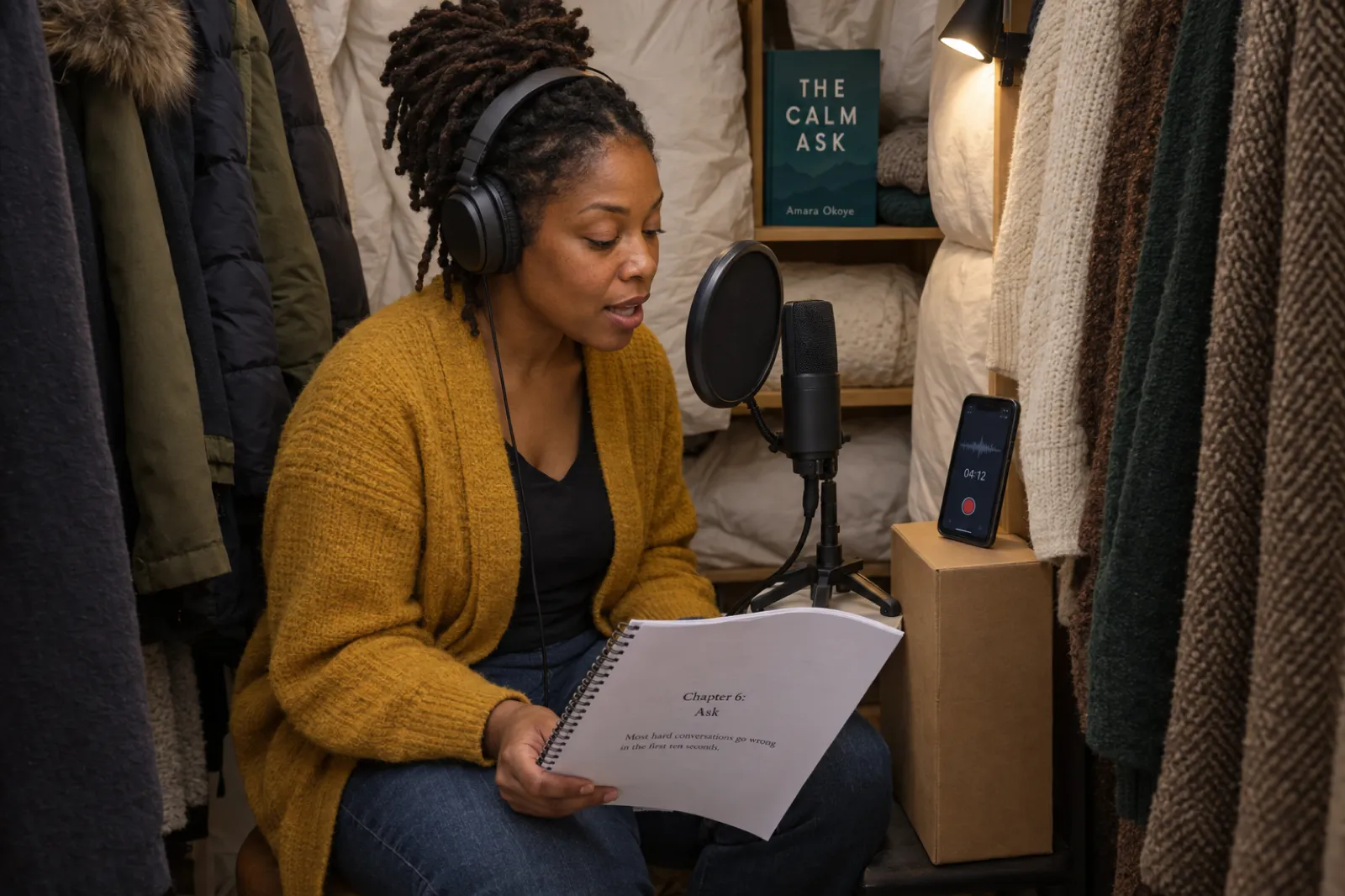
Self-help suits audio: people listen on walks and commutes, and a book that teaches a method rewards a second listen. There are two routes in Inkfluence AI's audiobook studio. AI narration uses your monthly audiobook chapters (15 on Creator, 30 on Premium). Or you record each chapter yourself in the browser or upload your own recording, which does not use any audiobook chapters; the studio opens on any paid plan or with chapter credits on your account. On the platform, 120 personal development books already have a finished audiobook.
Reading it yourself is worth considering for self-help: your voice is part of the trust the book is built on, and Audible's ACX does not accept AI-narrated audiobooks, while it does take your own narration. Narrate your own audiobook covers the setup and the file specs, and AI narration and ACX covers where AI-narrated books can go.
Self-help book checklist
- One reader, one problem and one promise, joined into a single sentence.
- A named method with 3 to 6 plainly labelled steps.
- An outline in three parts: where you are, the method (one chapter per step), making it last.
- Every chapter follows the same pattern and teaches one idea.
- One exercise per chapter, with time, materials, a worked example and a finish line.
- A starting-point check in chapter 1 that the reader repeats at the end.
- Written permission on file for every recognisable person; composites labelled once at the start.
- Every research claim traced to the study itself, described honestly, and checked for retraction.
- No cure, treatment or guaranteed-result promises in the title, cover or description; a "not therapy" note if the book touches mental health.
- Length set by chapters: 8 to 12 for a short ebook, 10 to 14 for a full book.
- KDP files, 3 categories, up to 7 keywords, a description without testimonials, and the AI question answered honestly.
- An audiobook plan, and a companion workbook if your readers need to practise.
Ready to write it?
Turn your promise sentence into an outline, a full draft and print-ready files, and spend your time on the parts only you can write: your method, your stories and your voice.
Start writing freeFrequently asked questions
How do I start writing a self-help book?
Start with one sentence before any chapter: who the book is for, the problem they have now, and the result they will have by the end. Then turn the method you already use with people into 3 to 6 steps, give each step its own chapter, and wrap them in an opening that names the problem and a closing that plans for setbacks. The outline builder on this page turns those three answers into an 8 to 12 chapter outline.
How many words is a self-help book?
It depends on where it will be sold. Literary agent Rachelle Gardner lists 40,000 to 55,000 words for self-help books aimed at traditional publishers. Self-published self-help ebooks are often much shorter: one clear problem solved in 8 to 12 chapters of 1,500 to 3,000 words each (12,000 to 36,000 words) is a complete, useful book. Chapter count is the main lever: more chapters means a longer book.
How many chapters should a self-help book have?
Most self-help books work well with 8 to 12 chapters: about 3 that name the problem and introduce your method, one chapter per step of the method, and 2 or 3 that cover setbacks, the people around the reader, and keeping the change going. Fewer than 8 usually means a step is missing; more than 14 usually means two books.
Can anyone write a self-help book?
Yes. You do not need a degree or a licence to write one. Readers trust self-help authors who have solved the problem themselves or helped other people solve it, and who are honest about what they are and are not. If your book touches mental health, describe yourself accurately, promise what the reader will do rather than a clinical outcome, and add a short note that the book is not therapy.
How do I outline a self-help book?
Use three parts. Part 1, where the reader is: the cost of the problem, why it happens, and why the usual fixes fail. Part 2, the method: one chapter per step, each with a story, a mindset shift, clear instructions and an exercise. Part 3, making it last: setbacks, support and a plan for after the last page. The template on this page lays it out chapter by chapter.
Can I use client stories in my self-help book?
Only with care. Get written permission from anyone who could recognise themselves, let them read the passage, and change names and identifying details. Psychologists are bound by a stricter rule: the APA Ethics Code (Standard 4.07) says they do not disclose confidential, personally identifiable client information in their writings unless they disguise the person, have written consent, or have legal authorisation. If a story is a composite of several people, say so.
Should I cite research in a self-help book?
Cite it when you make a factual claim about how people work, and cite the study itself, not a blog about it. Read past the headline: a large replication project in psychology found that only 36% of 100 replications produced statistically significant results, against 97% of the originals. Use phrases like "one study found" instead of "science proves", and check that a paper has not been retracted before you rely on it.
Can AI write a self-help book for me?
AI can draft one from your outline, and it saves the slowest part of the work. Inkfluence AI writes each personal development chapter with an opening scene, a mindset shift, reflection prompts, a time-bound challenge and a key takeaway, and it does not cite statistics or named studies unless you give them. You still supply what makes a self-help book work: your method, real stories with permission, and a final edit in your own voice. On Amazon KDP you must disclose AI-generated text when you publish.
How do I publish and sell a self-help book?
Export a Kindle EPUB and a print-ready paperback PDF, then publish on Amazon KDP, where you choose up to three categories and up to seven keywords. You can also sell the PDF or EPUB directly on Gumroad, Etsy or your own website, use a short version as a free lead magnet, and add an audiobook. Our KDP formatting and royalties guides cover the files and the money.
Should a self-help book have a workbook?
A companion workbook suits books where the reader has to practise: habits, confidence, money, communication. Keep the exercises inside the main book short, and put the longer worksheets, trackers and answer pages in a separate workbook in a larger trim size such as 7 x 10 inches. It also gives you a second product to sell to the same readers.
Sources
Every external fact on this page was read on the source below on 13 October 2026. Inkfluence AI facts were checked against the app's code on the same day.
- Rachelle Gardner: How Long Should My Book Be? (literary agent; "Self-help: 40-55k"; post dated 19 Jan 2021), checked 13 Oct 2026
- American Psychological Association: Ethical Principles of Psychologists and Code of Conduct (effective 2003, amended 2010 and 2016; Standard 4.07, Use of Confidential Information for Didactic or Other Purposes), checked 13 Oct 2026
- Open Science Collaboration (2015). Estimating the reproducibility of psychological science. Science, 349(6251), aac4716 (100 replications; 97% of originals and 36% of replications significant; replication effects half the size), abstract read via Europe PMC, checked 13 Oct 2026
- Lally, P., van Jaarsveld, C. H. M., Potts, H. W. W., & Wardle, J. (2010). How are habits formed: Modelling habit formation in the real world. European Journal of Social Psychology, 40(6), 998-1009 (96 volunteers, 12 weeks, 18 to 254 days to reach 95% of peak automaticity), abstract read via Crossref, checked 13 Oct 2026
- Amazon KDP: KDP Categories (select 3 categories), checked 13 Oct 2026
- Amazon KDP: Make Your Book More Discoverable with Keywords (up to seven keywords or short phrases), checked 13 Oct 2026
- Amazon KDP: Content Guidelines (AI-generated versus AI-assisted content and disclosure), checked 13 Oct 2026
- Amazon KDP: Metadata Guidelines for Books (what the description may not contain), checked 13 Oct 2026
- Inkfluence AI usage counts: all books in the app on 13 Oct 2026 (100,000+, test accounts excluded); personal development books 8,004 by 5,403 authors; topics from keyword matches on 6,343 English-language titles and briefs; chapter counts from 1,914 books with a stored chapter and word count; finished audiobooks counted the same day. Book length by type: AI book writing statistics.
Related reading
- AI Self-Help Book Writer
- 55 Self-Help Book Ideas to Write: Topics and Title Ideas
- How to Write a Health or Wellness Ebook You Can Sell
- How to Create a Workbook with AI
- The Best AI for Writing Non-Fiction
- Inkfluence AI for Self-Help Authors
- Inkfluence AI for Life Coaches
- Inkfluence AI for Spiritual Coaches
- AI Journal Generator
- Book Copyright Page Template
- How to Write a Business Book That Brings You Clients

Founder, Inkfluence AI
Sam is the founder of Inkfluence AI. He built the platform to make book creation accessible to everyone - from first-time authors to seasoned publishers.
Helpful links
Ready to Create Your Own Ebook?
Start writing with AI-powered tools, professional templates, and multi-format export.
Get Started FreeRelated Articles
 Children's Books
 Children's Book Word Count and Page Count by Age (2026): Board Books to Middle Grade, with Real Picture-Book Data
How many words and pages a children's book needs, from board books to young adult, with every range sourced to a publisher or editor and dated, words per page from real picture books by age band, and a word-budget calculator that checks KDP's 24-page minimum.
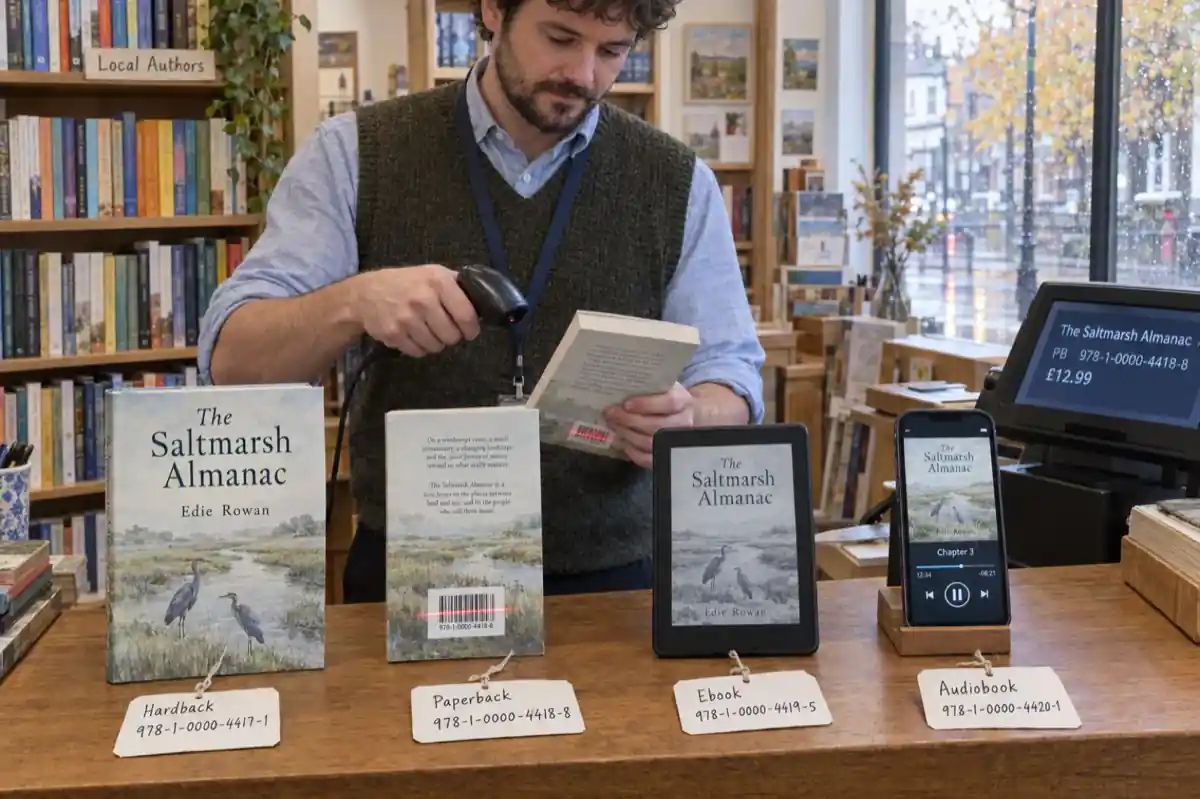 Publishing
 Do You Need an ISBN? Free vs Bought, Cost by Country, and Which Formats Need One (2026)
When a self-published book needs an ISBN and when it does not, what one costs in the US, UK, Canada, Australia, New Zealand, India, Germany, Italy and France (checked at each agency on 13 October 2026), free ISBNs from KDP, IngramSpark and Draft2Digital, and a picker that tells you how many you need.
 Publishing
 IngramSpark AI Policy (2026): What It Accepts, the Setup Question and the "Assisted By" Credit
IngramSpark accepts AI-drafted books with significant human editing and the "Assisted By - Generative AI" credit, and refuses works created solely with generative AI. Its exact wording, covers and translations, how it differs from KDP, a checker for your book, and an editing workflow.
Get ebook tips in your inbox
Join creators getting weekly strategies for writing, marketing, and selling ebooks.