
Best AI for Writing Non-Fiction Books in 2026: 6 Tools Tested
We tested 6 AI writing tools on real non-fiction book projects - self-help, business, how-to, and educational content. Here is which tools produce the most useful, structured, and publish-ready non-fiction.
Quick Answer
The best AI for writing non-fiction books in 2026 is Inkfluence AI for structured, full-length non-fiction - it handles 20+ non-fiction formats from self-help to business guides with automatic outlining, chapter generation, and export to PDF, EPUB, and DOCX. ChatGPT with GPT-4o is best for brainstorming, research assistance, and drafting individual chapters when you want maximum control over structure. Claude excels at nuanced, well-reasoned content for complex subjects. Jasper is strongest for marketing-oriented non-fiction like lead magnets and brand content.
Non-fiction is where AI writing tools deliver their highest value. Unlike fiction, where voice, style, and emotional resonance define quality, non-fiction success depends on structure, clarity, and actionable content - exactly the strengths of modern AI.
But the non-fiction category is enormous. A self-help book about overcoming anxiety requires a completely different approach from a technical manual on cloud architecture. A business thought-leadership book needs authority and fresh insight. A workbook needs actionable exercises and fillable frameworks. A cookbook needs precise instructions and tested proportions.
Most AI writing tool comparisons test with a single generic prompt and declare a winner. That tells you nothing about non-fiction book creation, which requires maintaining structure, depth, and consistency across 40,000-80,000 words and 8-15 chapters. We tested 6 tools on actual non-fiction projects across four sub-categories to find out which ones produce genuinely useful books.
What Does Non-Fiction AI Writing Actually Require?
Before comparing tools, understand why non-fiction is uniquely suited to AI assistance - and where AI commonly fails.
Structure is everything. Non-fiction readers expect a logical progression: problem, context, solution, application. Each chapter should build on the previous one while standing alone as a useful resource. AI tools that generate chapters independently (without awareness of what the other chapters cover) produce books with massive overlap. Chapter 3 repeats what chapter 1 already said. Chapter 7 introduces a concept that should have been defined in chapter 2. The best tools handle this by maintaining awareness across the entire manuscript.
Specificity beats generality. The most common flaw in AI-generated non-fiction is vagueness. "Exercise is important for mental health" is true but useless. "Walk for twenty minutes before you open your laptop, leave your phone in another room while you do it, and write down the one thing you noticed" is useful, because a reader can do it tomorrow and tell whether it worked. Tools that produce specific, actionable content outperform those that generate polished but generic prose.
Frameworks and methodology matter. The best non-fiction books give readers a system. A named framework, a step-by-step method, a diagnostic tool. AI tools that understand this produce structured, actionable chapters. Tools that treat non-fiction like longer blog posts produce shallow content that reads well but teaches nothing.
Varied chapter openings. One of the most noticeable flaws in AI non-fiction is repetitive structure. Every chapter opens with a definition, follows with three examples, and closes with a summary. Real books vary: one chapter opens with a story, the next with a surprising statistic, another with a question. The best AI tools rotate opening styles and frameworks automatically.
Quick Comparison: 6 AI Tools for Non-Fiction Books
| Tool | Best For | Structure | Depth | Variety | Export | Price |
|---|---|---|---|---|---|---|
| Inkfluence AI | Full books, any nonfiction | ★★★★★ | ★★★★☆ | ★★★★★ | ★★★★★ | Free / $9.99+ |
| ChatGPT (GPT-4o) | Research, drafting, brainstorm | ★★☆☆☆ | ★★★★★ | ★★★☆☆ | ★☆☆☆☆ | Free / $20/mo |
| Claude | Complex topics, reasoning | ★★★☆☆ | ★★★★★ | ★★★★☆ | ★☆☆☆☆ | Free / $20/mo |
| Jasper | Marketing, lead magnets | ★★★☆☆ | ★★★☆☆ | ★★★☆☆ | ★★☆☆☆ | $39/mo+ |
| Sudowrite | Narrative nonfiction, memoir | ★★★☆☆ | ★★★★☆ | ★★★★☆ | ★★☆☆☆ | $10-$22/mo |
| Squibler | Structured outlines | ★★★★☆ | ★★★☆☆ | ★★☆☆☆ | ★★★☆☆ | $16/mo+ |
Detailed Reviews
Inkfluence AI - Best for Complete Non-Fiction Books
Inkfluence AI is purpose-built for book creation, and non-fiction is where it performs best. The system handles 20+ non-fiction formats: self-help, business, how-to guides, workbooks, cookbooks, health guides, course companions, and more. Each format adapts the writing style, structure, and tone to match genre expectations.
The standout feature for non-fiction is the detailed outline system. Before generating any chapters, the AI creates a comprehensive outline where each chapter gets a unique angle, framework, and opening approach. This eliminates the repetitiveness that plagues AI-generated non-fiction from chat-based tools. Chapter 1 does not sound like chapter 5 because they were planned as distinct units with different structural approaches.
Chapter generation maintains awareness across the full book. Later chapters reference frameworks introduced earlier, build on concepts without re-explaining them, and draw connections across the manuscript. The result reads like a book, not a collection of independent articles stitched together.
After generation, the built-in editor lets you refine every chapter. Export to PDF, EPUB, and DOCX with professional formatting, or generate an audiobook and design a cover from the same dashboard. The free tier includes 5 chapters, which is enough to test with a short guide or lead magnet.
Strengths: End-to-end book creation, format-aware writing, chapter variety, professional export, integrated cover and audiobook.
Weaknesses: Less granular control over individual paragraphs compared to ChatGPT. Best for generating complete chapters rather than iterating on specific passages.
Write your non-fiction book today
20+ non-fiction formats. Outline, write, edit, and export from one dashboard. Free to start.
Start Writing FreeChatGPT (GPT-4o) - Best for Research and Drafting
ChatGPT remains the most versatile AI writing tool. For non-fiction, its strength is depth and research. You can ask it to explore a topic from multiple angles, generate examples, explain complex concepts simply, and iterate on specific paragraphs until they are exactly right. The conversational interface means you can steer the output precisely.
The weakness for book writing is fundamental: ChatGPT has no book-awareness. It generates text in a conversation, not in a manuscript. There is no outline structure, no chapter management, no awareness of what other chapters contain. You are responsible for maintaining consistency, avoiding repetition, managing word counts, and assembling everything into a formatted document.
For non-fiction specifically, ChatGPT excels at brainstorming chapter ideas, generating detailed frameworks, and creating the research foundation for a book. Many authors use it alongside a dedicated book tool - brainstorm and research in ChatGPT, then build the actual book in a structured environment. See our detailed ChatGPT vs dedicated tools comparison.
Strengths: Deepest knowledge base, most granular control, excellent for research and complex topics.
Weaknesses: No book structure, no chapter management, no export, massive assembly effort for full books.
Claude - Best for Complex and Nuanced Topics
Claude produces the most thoughtful, nuanced AI writing available. For non-fiction covering complex subjects - philosophy, psychology, ethics, policy, interdisciplinary topics - Claude's output reads as genuinely reasoned rather than pattern-matched. It acknowledges complexity, presents multiple perspectives, and avoids the oversimplification that makes other AI non-fiction feel shallow.
The extended context window (200K tokens) is valuable for non-fiction. You can paste your entire outline and multiple completed chapters, and Claude will generate new chapters with full awareness of the existing content. This partially solves the cross-chapter consistency problem that plagues ChatGPT.
Like ChatGPT, Claude has no book-creation infrastructure. No outline generator, no chapter manager, no formatting tools, no export. You are assembling the book manually. For authors who want maximum control and are comfortable with the assembly process, Claude produces excellent raw content. For those who want a finished book without managing the pipeline, a dedicated tool is more practical.
Strengths: Most nuanced reasoning, large context window, excellent for complex subjects.
Weaknesses: No book infrastructure, manual assembly required, slower generation.
Jasper - Best for Marketing Non-Fiction
Jasper is built for marketing content, and that focus has advantages and disadvantages for non-fiction books. If you are writing a lead magnet, a brand guide, a marketing playbook, or any content designed to drive business action, Jasper's marketing DNA produces punchy, persuasive prose. The templates for different content types give you a starting structure.
For general non-fiction - self-help, educational, how-to - Jasper's output leans too promotional. It reads like long-form ad copy rather than a book. The prose is polished but shallow, heavy on benefits language and light on genuine substance. Readers looking for depth will be disappointed.
Jasper also lacks book-specific features. No outline system, no chapter-level management, limited export options. For a 5,000-word lead magnet, Jasper works well. For a 50,000-word book, the manual effort overwhelms the benefits.
Strengths: Marketing tone, persuasive writing, good templates for short-form business content.
Weaknesses: Promotional tone for general non-fiction, no book structure, expensive for book-length projects.
Sudowrite - Best for Narrative Non-Fiction
Sudowrite is primarily a fiction tool, but its prose quality makes it surprisingly effective for narrative non-fiction: memoir, creative non-fiction, essay collections, and journalistic long-form. The "Describe" and "Rewrite" features help you polish prose to a literary standard that other AI tools cannot match.
For structured non-fiction (how-to, business, educational), Sudowrite is less suited. It does not understand frameworks, step-by-step structures, or actionable content formats. It generates beautiful prose but lacks the organizational thinking that separates a helpful book from a pleasant read. For more on Sudowrite, see our full Sudowrite review and pricing breakdown.
Strengths: Best prose quality, excellent for memoir and creative non-fiction, strong editing tools.
Weaknesses: Not built for structured non-fiction, weak on actionable content, no chapter-level book management.
Squibler - Best Outlining for Non-Fiction
Squibler offers a solid outline-first approach to book writing. The AI generates chapter structures with descriptions, and you can expand each chapter individually. For non-fiction, the outlining quality is good - it understands logical chapter progression and topic distribution.
Chapter generation quality is a step below Inkfluence AI and ChatGPT. Output tends toward generic and repetitive, especially for longer books. The tool works best when you use it for structure and then heavily edit the generated content. Export options include Word and PDF.
Strengths: Good outlining, clear interface, reasonable pricing.
Weaknesses: Generic chapter output, repetitive across chapters, fewer non-fiction formats.
Also considered: First Book ai
First Book ai is a per-book generator for non-fiction business books, sold as $29 credits on its site and as lifetime tiers on AppSumo (checked 14 September 2026). It builds a style profile from a pasted writing sample, then writes one book in a fixed shape of eight chapters with three sub-sections each, with one generated cover and DOCX, EPUB, Markdown and PDF export. It is not ranked here because it covers one non-fiction category with one structure: no how-to, workbook, study-guide or memoir formats, no interior images, no audiobook, and no import. For a single business book it is a reasonable purchase; the Inkfluence AI vs First Book ai comparison sets out the trade.
Which AI Tool Is Best for Each Non-Fiction Category?
Non-fiction is too broad for a single recommendation. Here is which tool works best for each major non-fiction subcategory:
| Non-Fiction Category | Best Tool | Runner-Up | Why |
|---|---|---|---|
| Self-Help / Personal Development | Inkfluence AI | Claude | Warm, actionable tone with frameworks and exercises built in |
| Business / Thought Leadership | Inkfluence AI | ChatGPT | Structured authority content with unique frameworks per chapter |
| How-To / Educational | Inkfluence AI | ChatGPT | Step-by-step structure, practical examples, varied formatting |
| Workbooks / Journals | Inkfluence AI | Squibler | Dedicated workbook format with exercises and reflection prompts |
| Memoir / Creative Non-Fiction | Sudowrite | Claude | Best prose quality and narrative voice for personal stories |
| Technical / Scientific | Claude | ChatGPT | Most accurate reasoning, nuanced treatment of complex subjects |
| Lead Magnets / Short Guides | Inkfluence AI | Jasper | Quick generation with PDF export for email list building |
| Health / Wellness | Inkfluence AI | Claude | Supportive tone with accurate health-adjacent content |
| Cookbooks / Recipe Collections | Inkfluence AI | ChatGPT | Dedicated recipe format with ingredient lists and instructions |
| Travel Guides | Inkfluence AI | ChatGPT | Location-aware format with practical traveler information |
The pattern is clear: for any non-fiction category that benefits from structured book creation (which is most of them), a dedicated book creation tool outperforms general-purpose AI. The exceptions are memoir/creative non-fiction (where prose quality matters most) and highly technical content (where reasoning depth matters most).
Key Takeaways
- Best overall for non-fiction books: Inkfluence AI - handles 20+ non-fiction formats with automatic outlining, chapter variety, and professional export to PDF/EPUB/DOCX.
- Best for research and brainstorming: ChatGPT (GPT-4o) - deepest knowledge base, most granular control, ideal for complex research tasks.
- Best for complex/academic topics: Claude - most nuanced reasoning, 200K token context window for full-manuscript awareness.
- Best for marketing non-fiction: Jasper - persuasive, brand-oriented prose for lead magnets and marketing playbooks.
- Best for memoir/narrative: Sudowrite - highest prose quality for personal stories and creative non-fiction.
- Timeline: A complete 50,000-word non-fiction book can be outlined, generated, and exported in a single day with Inkfluence AI, plus 1-2 days of editing.
- Key to quality: Detailed outline with unique frameworks per chapter, specific audience targeting, and 2-5 hours of editing to add personal voice and real examples.
How Do You Get Better Non-Fiction Output from Any AI?
Regardless of which tool you use, these techniques dramatically improve non-fiction AI output:
Start with a Detailed Outline
Never generate chapters without an outline. The outline should specify: chapter title, core argument, key frameworks or methods, examples to include, and how this chapter connects to the previous and next chapters. A dedicated outline generator can create this structure in minutes.
Specify Your Audience
AI writes differently for "readers" than for "first-time managers at tech startups who have never managed anyone before." The more specific your audience definition, the more targeted and useful the output becomes. Include their knowledge level, their goals, and their biggest pain point.
Demand Specifics
Add instructions like "include specific numbers, percentages, and examples" and "avoid generic advice that could apply to any topic." AI defaults to generality. Pushing for specificity transforms the output from self-help platitudes to genuinely useful guidance.
Vary the Structure
If every chapter follows the same format, readers get bored. Request different opening styles: chapter 1 opens with a personal anecdote, chapter 2 opens with a shocking statistic, chapter 3 opens with a question. Mix in case studies, frameworks, exercises, quizzes, and story-driven sections to keep the reading experience dynamic.
Edit Ruthlessly
AI generates good first drafts. The final quality comes from editing. Read every chapter out loud. Cut filler phrases ("it is important to note that," "in today's world," "as we discussed"). Replace vague claims with specific evidence. Add your personal experience and perspective - this is what makes a book uniquely yours rather than generic AI content. The AI book editor can help streamline this process.
For more strategies, read our guide on how to avoid generic AI book output.
What Is the Best Workflow for Writing a Non-Fiction Book with AI?
Here is the workflow that produces the best non-fiction books across any tool:
Phase 1: Research and Planning (1-2 hours)
Define your audience, core thesis, and unique angle. Research competing books in your category. Identify what existing books miss or get wrong - your book's value comes from filling that gap. Use ChatGPT or Claude for research brainstorming if needed.
Decide on your non-fiction format. A self-help book needs exercises and transformation arcs. A business book needs case studies and frameworks. A workbook needs fillable activities. A study guide needs summaries and review questions. Choosing the right format ensures the AI generates the right kind of content.
Phase 2: Outline (30 minutes)
Generate a detailed chapter outline using your outline generator of choice. Review it critically: are any chapters too similar? Is there a logical progression? Does each chapter deliver a clear, distinct takeaway? Adjust until the structure is solid.
Phase 3: Chapter Generation (1-3 hours)
With Inkfluence AI, all chapters generate from your outline with appropriate structure and variety. With ChatGPT or Claude, generate each chapter individually, providing the full outline as context and the previous chapter's ending to maintain flow.
Phase 4: Editing (2-5 hours)
This is where your book becomes genuinely good. AI provides the structure and content; editing adds personality, precision, and polish. Add personal anecdotes. Sharpen examples. Cut filler. Ensure the tone is consistent. Add transitions between chapters. For hands-on co-writing strategies, see best practices for co-writing a book with AI.
Phase 5: Export and Publish (30 minutes)
Export to PDF, EPUB, or DOCX. Design or generate a cover. Optionally create an audiobook. Publish to Amazon KDP, Apple Books, or sell direct on Gumroad or Etsy.
Ready to write your non-fiction book?
From outline to finished book in a single session. 20+ non-fiction formats, professional export, free to start.
Write Your Book FreeFrequently Asked Questions
What is the best AI for writing non-fiction books?
Inkfluence AI is the best all-around tool for non-fiction books because it handles the complete workflow: outlining, chapter generation with variety and structure, editing, cover design, and export. For research-heavy projects, ChatGPT complements nicely. For complex academic or philosophical topics, Claude produces the most nuanced content.
Can AI write a good non-fiction book?
AI can produce an excellent first draft of a non-fiction book. The structure, organization, and base content will be solid. The gap between an AI first draft and a publishable book is editing: adding your personal experience, sharpening examples with real data, and ensuring the advice is genuinely actionable rather than generically inspiring. Plan for 2-5 hours of editing on a typical AI-generated non-fiction book.
How long does it take to write a non-fiction book with AI?
With a dedicated book creation tool like Inkfluence AI, a 50,000-word non-fiction book can be outlined, generated, and exported within a single day. Editing adds another day or two for a thorough pass. Compare this to 3-6 months for a traditional manuscript. Realistically, plan for one weekend for the first draft and another weekend for editing.
Is AI-generated non-fiction accurate?
AI non-fiction is generally well-reasoned and structurally sound, but you should fact-check all specific claims, statistics, and references. AI can occasionally present plausible but incorrect information with confidence. For how-to and opinion-based non-fiction, accuracy is less of a concern. For health, legal, financial, or technical content, every factual claim should be verified. We cover the full workflow in how to prevent factual errors in AI-generated non-fiction.
Which AI produces the least generic non-fiction?
Inkfluence AI produces the most varied non-fiction because its outline system assigns unique frameworks, opening styles, and examples to each chapter before generation begins. Claude produces nuanced content that avoids oversimplification. ChatGPT can produce specific output but requires very detailed prompting for each chapter to avoid defaulting to generic structures.
Can I sell AI-written non-fiction books?
Yes. Amazon KDP, Apple Books, Kobo, and other platforms accept AI-assisted books. Amazon requires disclosure that AI was used in content generation. The key is adding genuine editorial value: your perspective, your expertise, your real-world examples. Books that are pure unedited AI output can be identified by readers and reviewers, and they tend to get poor reviews. Books where AI provides the structure and you provide the substance sell well. See our guide to publishing AI-generated books on KDP.
What types of non-fiction work best with AI?
Structured, practical non-fiction works best: self-help, how-to guides, business books, educational content, workbooks, cookbooks, and travel guides. Narrative non-fiction (memoir, essays, journalism) requires more human voice and personal experience - AI can assist but should not drive. Technical manuals work well when supplemented with human expertise for accuracy. See our full breakdown of what types of books suit AI creation.
How do I make AI non-fiction sound less robotic?
Three techniques: First, edit ruthlessly - cut every "it is important to note that" and "in today's rapidly evolving landscape." Second, add personal stories and real examples from your experience. Third, vary the structure across chapters so the book does not feel formulaic. AI produces the scaffold; your voice makes it a book worth reading.
Related Reading
- AI Book Writer - Write Your Book
- How to Avoid Generic AI Book Output
- Best Practices for Co-Writing a Book with AI
- Complete AI Book Generator Comparison 2026
- What Types of Books Suit AI Creation?
- AI Tools for Authors vs ChatGPT
- Free AI Book Writer
- How to Self-Publish on Amazon KDP
- Best AI Book Writers for Nonfiction Authors 2026 (8 tools ranked)
- How to Write a Self-Help Book: Outline Template and Chapter Structure

Founder, Inkfluence AI
Sam is the founder of Inkfluence AI. He built the platform to make book creation accessible to everyone - from first-time authors to seasoned publishers.
Helpful links
Ready to Create Your Own Ebook?
Start writing with AI-powered tools, professional templates, and multi-format export.
Get Started FreeRelated Articles
 AI Writing
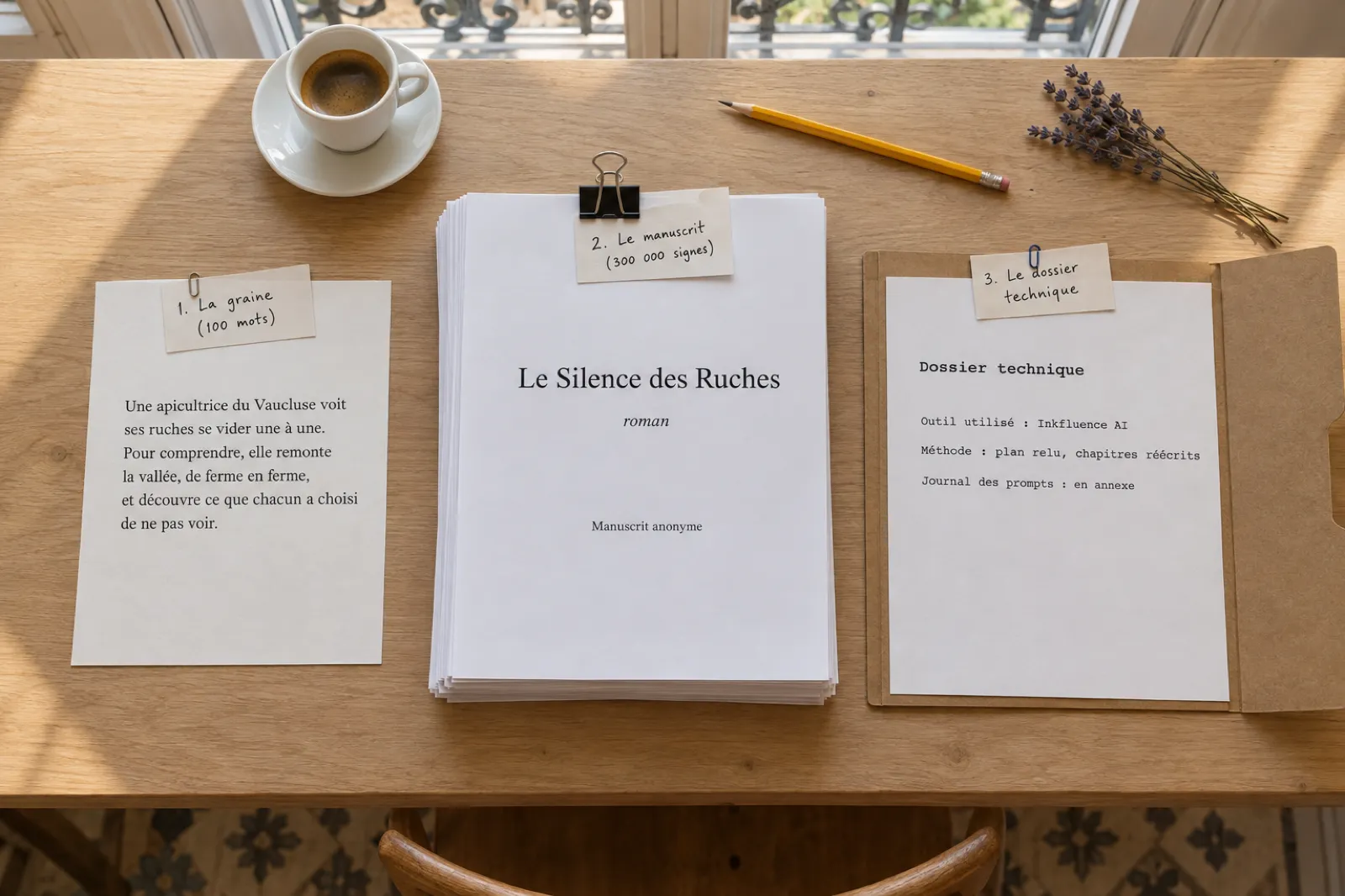
 Prix Pascal: The New Literary Prize for Novels Written with AI, and How to Enter by 30 November 2026
France's new Prix Pascal is a literary prize that asks entrants to say how they used AI instead of hiding it. The rules in plain English, what 300,000 characters means in words and chapters, the technical file, and a five-week plan to submit a French novel on time.
 AI Writing
 Sudowrite vs Novelcrafter (2026): Price, Built-in AI vs Your Own Key, Story Bible vs Codex
Sudowrite ($10 to $59 a month, AI built in) against Novelcrafter ($4 to $20 a month, AI from your own provider): price, how the AI is paid for, Story Bible against Codex, drafting, editing, export and series, read on both vendors' sites on 17 October 2026, with a picker.
 AI Writing
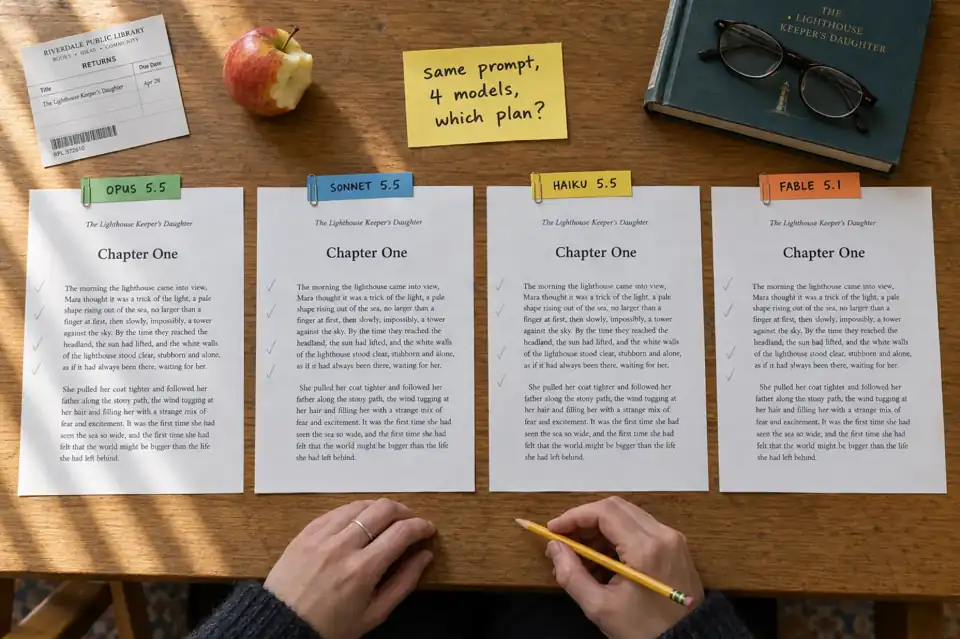
 Which Claude Model Is Best for Writing? Opus 5.5, Sonnet 5.5, Haiku 5.5 and Fable 5.1 Compared (October 2026)
Which Claude model should you write with in October 2026? Opus 5.5, Sonnet 5.5, Haiku 5.5 and Fable 5.1 compared on what Anthropic actually publishes: which plan includes each one, API prices, context and output limits, speed, and what each is built for. Plus the maths of fitting a whole book, and when a book tool is the better pick.
Get ebook tips in your inbox
Join creators getting weekly strategies for writing, marketing, and selling ebooks.