
Which Claude Model Is Best for Writing? Opus 5.5, Sonnet 5.5, Haiku 5.5 and Fable 5.1 Compared (October 2026)
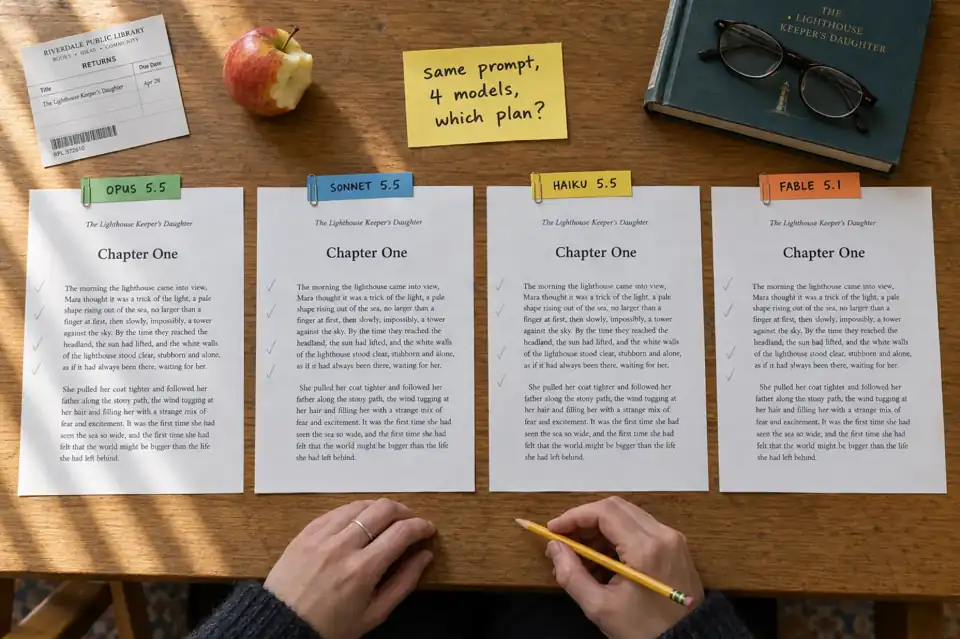
Which Claude model should you write with in October 2026? Opus 5.5, Sonnet 5.5, Haiku 5.5 and Fable 5.1 compared on what Anthropic actually publishes: which plan includes each one, API prices, context and output limits, speed, and what each is built for. Plus the maths of fitting a whole book, and when a book tool is the better pick.
Quick Answer (October 2026)
Claude Opus 5.5 is the best Claude model for most writing. Anthropic names it the default pick and says it writes more clearly and naturally than earlier models. It needs a paid plan (Pro, $20 a month). On the free plan, use Sonnet. To write a whole book, Inkfluence AI handles the outline, chapters, story bible and export.
Anthropic released four new Claude models between 1 September and 7 October 2026, so most "best Claude model for writing" advice online now names models that have been replaced. This guide sticks to what Anthropic itself publishes about each current model: which plan includes it, what it costs, how much text it can hold and write at once, how fast it is, and what Anthropic says it is for.
One thing to know up front: Anthropic makes no claim about fiction, dialogue or storytelling for any current model. Its only writing claims are about clarity and natural communication, and those are quoted below exactly as published. Where a page ranks Claude models for fiction, that ranking comes from the page's author, not from Anthropic. We have not run our own prose tests for this guide, so you will not find a fiction leaderboard here. You will find the facts that decide which model fits your plan, your budget and the length of what you are writing.
Claude for writers at a glance (checked 9 Oct 2026)
4
current models: Fable 5.1, Opus 5.5, Sonnet 5.5, Haiku 5.5
1M tokens
API context for all four, roughly 555,000 words
128K tokens
longest single API reply, about 71,000 words
Sonnet + Haiku
the models on the free claude.ai plan; Opus needs Pro
Which Claude model for which writing job (October 2026)
Start here if you only need the answer for one kind of writing. The "why" column only uses what Anthropic publishes; the plan column is from the claude.ai pricing page on 9 October 2026.
| Writing job | Best pick | Why | Plan needed |
|---|---|---|---|
| A whole book, fiction or non-fiction | Inkfluence AI | Outline, chapters written in order, a story bible that updates as the book grows, an editor, then PDF, EPUB and DOCX export in one place | Free to start (5 chapters, plus 5 a month) |
| Long, careful writing in a chat (chapters, reports, long articles) | Claude Opus 5.5 | Anthropic's default recommendation; launch notes say its writing is "clearer and easier to follow" | Pro $20/mo or Max |
| Novels and short fiction in a chat | Opus 5.5, or Sonnet on the free plan | No fiction claim exists for any model; Opus 5.5 carries the strongest writing claims Anthropic makes | Pro for Opus; Free for Sonnet |
| Editing a full manuscript in one go | Opus 5.5 | 1M-token context on paid plans holds a long novel with room to spare | Pro or Max |
| Essays and academic writing | Opus 5.5 for structure; Sonnet 5.5 for drafts | Opus "puts the most important information up front"; both know the world to June 2026 only | Pro for Opus; Free for Sonnet |
| Blog posts, newsletters, articles | Sonnet 5.5 | Anthropic lists "content creation" under Sonnet 5.5 in its model selection matrix | Free (Sonnet), any plan |
| Emails and short everyday copy | Sonnet 5.5 | "The best combination of speed and intelligence" in Anthropic's own description | Free |
| Bulk short copy (titles, blurbs, alt text, summaries) | Haiku 5.5 | Fastest and cheapest; Anthropic positions it for "quick and repetitive workloads (like summaries...)" | Free, or API from $0.10 / $0.50 per million tokens |
| Research carried through to a long finished document | Fable 5.1 | Anthropic: "analysis carried through to a finished document"; also the slowest and dearest | Max, or Pro with usage credits |
If you take one thing from the table: the model matters less than the plan you are on and the length of the job. Free users choose between Sonnet and Haiku. Paid users get Opus 5.5, which is what Anthropic tells everyone to start with. And once the job is a whole book, the hard part stops being sentence quality and becomes keeping 20 or 30 chapters consistent, which is a workflow problem more than a model problem.
The current Claude lineup for writers (October 2026)
These are the four current models on Anthropic's models overview page, with the claude.ai plan access from the pricing page. Every figure was checked on Anthropic's own pages on 9 October 2026.
| Model | Released | On claude.ai | API price (input / output per million tokens) | Context (API / claude.ai paid) | Speed | Anthropic's description |
|---|---|---|---|---|---|---|
| Claude Fable 5.1 | 1 Sep 2026 | Pro (usage credits), Max | $10 / $50 | 1M / 1M | Slower | "For demanding reasoning and long-horizon agentic work" |
| Claude Opus 5.5 | 22 Sep 2026 | Pro, Max | $4 / $20 | 1M / 1M | Moderate | "For long-running agentic coding and knowledge work" |
| Claude Sonnet 5.5 | 28 Sep 2026 | Free (Sonnet), Pro, Max | $2 / $10 | 1M / 1M | Fast | "The best combination of speed and intelligence" |
| Claude Haiku 5.5 | 7 Oct 2026 | Free (Haiku), Pro, Max | $0.10 / $0.50 for prompts up to 100,000 tokens; $0.50 / $2.50 above | 1M / 500K | Fastest | "For high-volume, latency-sensitive tasks such as classification, extraction, and routing" |
Notes: the free plan lists "Sonnet" and "Haiku" without version numbers, so Anthropic does not state which exact versions free users get. All four models have a reliable knowledge cutoff of June 2026 and a maximum single reply of 128,000 tokens on the API. Comparative speed is Anthropic's own label, relative to the current lineup.
What changed this autumn. Fable 5.1 arrived on 1 September at the same prices as Fable 5. Opus 5.5 followed on 22 September; Anthropic says it "performs at the level of Claude Fable 5.1 on most work and costs 40% less to run than Opus 5." Sonnet 5.5 came on 28 September, described by Anthropic as running "30%+ faster" than Sonnet 5 and costing "up to 30% less for most work." Haiku 5.5 landed on 7 October at a tenth of Haiku 4.5's per-token price for prompts up to 100,000 tokens. Claude Sonnet 4.5 was deprecated on 30 September and retires from the API on 30 November 2026, with Sonnet 5.5 as the named replacement.
Older models still in the picker. Fable 5, Opus 5, Opus 4.8, 4.7, 4.6 and 4.5, Sonnet 5, Sonnet 4.6 and Haiku 4.5 are all still available as legacy models. Opus 4.6 is still active on the API, with retirement not sooner than 5 February 2027. There is little reason to pick an older model for writing: Opus 5 costs more per token than Opus 5.5 ($5 / $25 against $4 / $20), and Anthropic's prompting guide notes that Opus 5's "default user-facing responses run longer than prior models'." If you have a favourite older model for a particular voice, it still works for now; check the deprecations page before you build a long project around it.
If you want to see how these compare with GPT and Gemini models for long fiction, that cross-vendor view lives in our guide to the best AI models for novel writing. This page stays on Claude only.
Best Claude model for creative writing and fiction
Here is everything Anthropic says about how the current models write, quoted from its launch pages and documentation:
- Opus 5.5: "Opus 5.5 communicates more naturally than prior models. Early testers found its writing clearer and easier to follow." Also: "It puts the most important information up front, and its style makes it a better work partner over long sessions." One tester is quoted as saying "it writes the way I do."
- Sonnet 5.5: "Like Opus 5.5, Sonnet 5.5 writes more clearly than our previous generation of models," and "It's got some of Opus 5.5's natural writing upgrades, which makes it more fun to work with." Early testers called it "a better partner for collaboration than Sonnet 5."
- Fable 5.1: "Claude Fable 5.1's writing has few stock phrases and little unexplained jargon. In some cases, though, its prose is denser than Claude Fable 5's: sentences run longer and there are fewer paragraph breaks."
- Haiku 5.5: no writing-quality claim. Anthropic describes it for "quick and repetitive workloads (like summaries, compactions, database queries, and classification requests)."
That is the whole list. None of it mentions fiction, dialogue, character voice, pacing or genre. Anthropic's writing claims are about clear, natural communication, which matters for fiction but is not the same thing as storytelling. So the honest answer to "which Claude model is best for creative writing" is that Anthropic does not say, and any confident ranking you read elsewhere is that site's opinion or its own test.
What the facts do support:
- Start with Opus 5.5 if you are on a paid plan. It carries the strongest writing claims Anthropic makes, it is the general default, and its 1M-token context on claude.ai means your outline, character notes and earlier chapters can all stay in view.
- Use Sonnet on the free plan, and for fast drafting on any plan. Anthropic says Sonnet 5.5 shares "some of Opus 5.5's natural writing upgrades" and runs faster at half the per-token price. For brainstorming scenes, trying three openings or drafting a rough chapter, speed is worth a lot.
- Treat Fable 5.1 as a specialist, not a prose upgrade. Anthropic's own note says its prose can run denser, with longer sentences and fewer paragraph breaks, which is usually the opposite of what fiction wants. It ships a fix for that, covered in the prompts section below.
- Judge with your own pages. Give two models the same scene brief and the same style sample and read both. Our guide on how to evaluate AI fiction quality lists what to look for, from repeated phrases to point-of-view slips.
Opus vs Fable for fiction
Fable 5.1 costs 2.5 times as much per token as Opus 5.5 ($10 / $50 against $4 / $20), runs slower, and on the Pro plan is only available through usage credits. Anthropic's own advice is to start with Opus 5.5 and move to Fable 5.1 only "when your evals on Claude Opus 5.5 at higher effort still fall short", and it says the gap between the two "is narrower than these scores suggest." Fable's listed strengths are long agentic sessions, multistep research and building finished documents, spreadsheets and slides. None of those is chapter writing. For fiction, Opus 5.5 is the more sensible default on both cost and Anthropic's own guidance.
Romance, fantasy, fanfiction and other genre fiction
Genre fiction has its own beats: the meet-cute and the black moment in romance, the rules of a magic system in fantasy, canon details in fanfiction. No Claude model is tuned for any genre; you get those beats by putting them in the prompt or the outline. Dedicated tools do this for you: see the AI romance novel writer, the AI fantasy novel writer and the AI fanfiction writer.
Best Claude model for writing a book
For book-length work the question is not only which model writes the best paragraph. It is whether the model can see the whole book while it writes, how much it can write in one reply, and what happens when a conversation gets long. Here are the numbers.
How long are real books written with AI?
We measured this. In a sample of 1,200 books finished on Inkfluence AI in the 30 days to 9 October 2026 (picture books and colouring books excluded), the median book was 9,232 words, one book in ten passed 24,000 words, and the longest one in a hundred passed 82,000 words. The longest book in the sample ran to 114,790 words. The median chapter was 1,765 words. For a wider view of what people write, see our AI book writing statistics.
What fits in Claude's context window
Anthropic's conversion for the current tokenizer is that 1M tokens is "roughly 555k words", which works out at about 1.8 tokens per word. It also says "200k tokens is roughly 150k words." Using those two figures:
| Book | Words | Tokens on current models (about 1.8 per word) | Share of a 1M window | Share of a 200K window (about 150,000 words) |
|---|---|---|---|---|
| Typical AI-written book (our median) | 9,232 | ~16,600 | 1.7% | 6% |
| Longer guide or novella (our top 10%) | 24,137 | ~43,400 | 4.3% | 16% |
| Short commercial novel | 50,000 | ~90,000 | 9% | 33% |
| Long novel (our top 1%) | 82,518 | ~148,500 | 15% | 55% |
| Longest book in our sample | 114,790 | ~206,600 | 21% | 77% |
| Epic fantasy | 200,000 | ~360,000 | 36% | Does not fit |
Tokens needed to hold the whole book
Current Claude tokenizer, about 1.8 tokens per word. The dashed line marks 200,000 tokens. All of these fit in a 1M-token window.
Source: Inkfluence AI sample of 1,200 finished books, 30 days to 9 Oct 2026; token conversion from Anthropic's models overview.
So the short version is this. Every current Claude model can hold even the longest book in our sample inside its 1M-token window on the API, with most of the window left over for your outline, notes and instructions. Opus 5.5, Sonnet 5.5 and Fable 5.1 get the same 1M window on paid claude.ai plans; Haiku 5.5 gets 500K there. The older models that are limited to 200K on claude.ai can hold a typical book easily, but a long novel would take more than half the window before you have typed a word, and the longest books in our sample would leave almost nothing for the conversation. Anthropic does not publish the context window for the free plan.

Holding a book is not the same as writing one
Three limits matter more than the window size:
- One reply tops out at 128,000 tokens on the API, which is about 71,000 words at 1.8 tokens a word. That ceiling includes thinking: Anthropic's docs say "the tokens Claude spends reasoning are billed as output tokens, even when the thinking text isn't returned to you, and they count toward max_tokens alongside the response text." Opus 5.5 and Fable 5.1 think on every request, so the visible reply is always shorter than the cap. A full novel needs several replies; in practice you write a chapter at a time.
- Long chats get summarised on claude.ai. Anthropic's help centre says: "When your conversation approaches the context window limit, Claude summarizes earlier messages to continue the conversation seamlessly." That needs code execution turned on, and "Longer conversations that trigger automatic context management consume more of your usage limit." A summary of chapter 3 is not chapter 3, so small details (an eye colour, who knows a secret) can drop out.
- Usage limits, not tokens, are what run out on paid plans. Paid plans have "a session limit that resets every five hours, and weekly limits that reset once every week." Anthropic does not publish these in tokens, and pasting a whole manuscript into every message uses them up quickly.
A workable way to write a book in claude.ai
- Write the outline first, one paragraph per chapter, with what changes in each. Our free book outline generator gives you a starting structure.
- Put the outline, a character list and a style sample in a Project, so every chat starts with them. (The free plan allows up to five Projects.)
- Keep a running facts list, a simple story bible: names, ages, places, what each character knows, and what has already happened. Update it after every chapter.
- Write one chapter per chat, giving Claude the outline entry, the facts list and the last page of the previous chapter rather than the whole book.
- Every few chapters, paste the full draft (if your model has the window for it) and ask for a continuity check against the facts list. Our guide to AI continuity checking covers what to ask for.
It works, and plenty of authors do it. It is also a lot of copying and pasting, and the facts list is only as good as your memory to update it. That is the part a dedicated tool takes off your hands.
What happens on the free plan
Free claude.ai gives you Sonnet and Haiku, up to five Projects, and usage limits Anthropic does not quantify. You can draft a short book this way: a 9,000-word guide is well within reach. A full-length novel on the free plan means many sessions spread over days as limits reset, and no Opus. If you want a free route built for whole books, see how to write fiction with AI for free and the free AI novel writer.
When a book tool beats a chat window
A chat window is the right place to think out loud, write short pieces, and rework a passage you are stuck on. It is a weak place to manage a 30-chapter manuscript, because you become the project manager: carrying the outline between chats, updating the facts list, stitching chapters into one file, and formatting it for a store.
For writing a whole book, Inkfluence AI is our pick, and it is built for exactly that job:
- Outline first. You describe the book and it plans the chapters. In the step-by-step flow you review and edit that outline before any chapter is written.
- Chapters with continuity. Fiction chapters are written in order, each one with the earlier chapters in mind, so the plot builds rather than repeats. See how outlining and writing chapters in sequence works.
- A story bible that keeps up. For fiction, characters, places and what has happened so far are tracked as the book grows, and you can open and edit the story bible in the editor, for example to fix a name before the next chapter.
- Editing in the same place. A full chapter editor, plus an AI editing assistant on paid plans for book chat, instant edits and editorial reviews.
- Export without reformatting. PDF on every plan; EPUB and DOCX on Creator and Premium. Covers, series continuation through the AI book series writer, and audiobooks are in the same app.
Honest limits: the free plan gives you 5 chapters to start plus 5 more each month, PDF export only (with a small Inkfluence credit), and 3 Smart Continue generations a day. EPUB and DOCX export, the AI editing assistant and audiobooks start at Creator ($9.99 a month, 35 chapters); Premium ($19.99) has unlimited chapters. There is no word-count dial: you set length by the number of chapters, and chapters typically land in the 1,000 to 2,000 word range. Full details are on the pricing page, and our Inkfluence AI vs Claude comparison sets the two side by side.
Write the whole book, not just the next reply
Outline, chapters in order, a story bible that keeps up, and a finished file at the end. Free to start, no credit card.
Start your book freeOpus vs Sonnet for writing
This is the choice most paid users face every day, so here it is on Anthropic's published facts:
| Opus 5.5 | Sonnet 5.5 | Haiku 5.5 | |
|---|---|---|---|
| Writing claim from Anthropic | "communicates more naturally than prior models"; writing "clearer and easier to follow" | "writes more clearly than our previous generation"; "some of Opus 5.5's natural writing upgrades" | None |
| API price per million tokens | $4 in / $20 out | $2 in / $10 out | $0.10 in / $0.50 out (prompts to 100K) |
| Speed | Moderate | Fast | Fastest |
| Free claude.ai plan | No | Yes (as "Sonnet") | Yes (as "Haiku") |
| Context on paid claude.ai | 1M | 1M | 500K |
| Thinking | Always on (adaptive) | Adaptive | Adaptive |
| Best writing use | Chapters, long reports, edits where clarity matters most | Drafts, articles, emails, quick iterations | Bulk short copy and summaries |
On the API, Opus 5.5 costs exactly twice what Sonnet 5.5 does for the same number of tokens. On claude.ai, the difference shows up as how fast you reach your usage limit rather than as a bill, since Anthropic says usage depends on the model you choose.
When Sonnet is enough. Anything short, anything you will rewrite anyway, and anything where you want five options quickly: openings, titles, alternative versions of a paragraph, a first pass at a blog post. Sonnet 5.5's Anthropic description, "the best combination of speed and intelligence", is a fair summary for everyday writing.
When to switch to Opus. Long pieces where structure carries the reader, a chapter you intend to keep, or an edit across a whole manuscript. Anthropic's note that Opus 5.5 "puts the most important information up front" also makes it a good fit for non-fiction chapters and reports, where the reader wants the point first.
Is Claude Fable 5.1 worth it for writing?
For most writers, no. The facts:
- Price: $10 input and $50 output per million tokens, 2.5 times Opus 5.5.
- Access: not on the free plan. On Pro it is available through "usage credits". On Max it is listed as "50% of weekly limits", with usage limits applying.
- Speed: Anthropic labels it "Slower", the slowest of the four.
- Anthropic's own advice: "For most workloads, start with Claude Opus 5.5." Use Fable 5.1 "for demanding reasoning and long-horizon agentic work, or when your evals on Claude Opus 5.5 at higher effort still fall short."
- Prose note: "In some cases its prose is denser than Claude Fable 5's, with longer sentences and fewer paragraph breaks."
Where it may earn its price: a long research project that has to end as a finished document, such as a heavily sourced non-fiction book chapter or a report built from many papers. Anthropic's model selection matrix lists "analysis carried through to a finished document" as a Fable 5.1 use case. One practical tip from Anthropic's prompting guide: at its highest effort levels Fable 5.1 "may draft much of that deliverable in its thinking and then write it out again as the reply, which means a longer wait and more output tokens." For long writing, run it at the default high effort.
Best Claude model for essays, academic and non-fiction writing
For essays, papers and non-fiction chapters, use Opus 5.5 for the version you plan to keep and Sonnet 5.5 for outlines, rough drafts and rewording. Opus's "most important information up front" style suits argument-led writing, and its 1M context on paid plans lets you load your sources alongside the draft.
Three cautions that apply to every Claude model:
- Knowledge cutoff. All four current models have a reliable knowledge cutoff of June 2026. Anything after that needs a source you supply or a web search, and every citation should be checked against the original.
- Search is a tool, not a model feature. Web search is available on every claude.ai plan, including free. Ask Claude to search and cite, then open the sources yourself; the model choice does not change what the search finds.
- Your institution's rules come first. Many universities restrict AI-written work. The watermark section below matters here too.
For non-fiction books specifically, structure matters more than any one paragraph: each chapter needs its own job, its own examples and no repeats. Our comparison of the best AI for writing non-fiction covers tools that plan that for you, and the AI chapter generator drafts one chapter at a time from your outline.
Best Claude model for everyday writing: emails, posts and copy
For emails, social posts, product descriptions and newsletter sections, Sonnet 5.5 is the default: fast, on the free plan, and the model Anthropic files "content creation" under. Switch to Opus 5.5 for the email that really matters (a pitch, a hard conversation, a cover letter) and to Haiku 5.5 when you need a lot of short pieces quickly.

On the API the price gap is large. Here is a worked example for 1,000 short pieces of about 150 words each (roughly 270,000 output tokens), with a 300-token prompt for each (300,000 input tokens), at list prices and before any thinking tokens:
| Model | Input cost | Output cost | 1,000 pieces, floor |
|---|---|---|---|
| Haiku 5.5 | $0.03 | $0.14 | ~$0.17 |
| Sonnet 5.5 | $0.60 | $2.70 | ~$3.30 |
| Opus 5.5 | $1.20 | $5.40 | ~$6.60 |
| Fable 5.1 | $3.00 | $13.50 | ~$16.50 |
Haiku 5.5's low price applies to prompts up to 100,000 tokens. A prompt longer than that, such as a whole manuscript pasted in for a summary, is billed at $0.50 input and $2.50 output per million tokens, five times the base rate.
Need the book around the copy?
If the short pieces are for a book (a blurb, chapter summaries, a description for the store page), Inkfluence AI writes the book and keeps everything in one project, ready to export.
Try Inkfluence AI freeWhat it costs: claude.ai plans vs the API
There are two ways to pay for Claude. The claude.ai apps charge a monthly plan with usage limits; the API charges per token with no plan. Most writers use the apps.
claude.ai plans (checked 9 October 2026)
| Free | Pro | Max (5x or 20x) | |
|---|---|---|---|
| Price | $0 | $20/month, or $17/month billed annually ($200 up front) | From $100/month |
| Fable | No | Usage credits | "50% of weekly limits" |
| Opus | No | Yes | Yes |
| Sonnet and Haiku | Yes | Yes | Yes |
| Context window | "Up to 1M, varies by model" | Same | Same |
| Projects | Up to 5 | Unlimited | Unlimited |
| Also | Web search, file creation, memory | Claude Code and more Claude models | 5x or 20x Pro usage, "Higher output limits" |
Anthropic does not publish a per-reply output length for claude.ai; the 128,000-token figure is the API limit. Max only says "Higher output limits".
API cost of drafting an 80,000-word novel
Assumptions, stated so you can redo the sums: 80,000 words at 1.8 tokens per word is 144,000 output tokens. Written as 30 chapters with a 12,000-token prompt each (outline, notes, the end of the previous chapter), that is 360,000 input tokens. No thinking tokens, no rewrites, list prices.
| Model | Output (144K tokens) | Input (360K tokens) | Floor per draft |
|---|---|---|---|
| Fable 5.1 | $7.20 | $3.60 | ~$10.80 |
| Opus 5 (legacy) | $3.60 | $1.80 | ~$5.40 |
| Opus 5.5 | $2.88 | $1.44 | ~$4.32 |
| Sonnet 5.5 | $1.44 | $0.72 | ~$2.16 |
| Haiku 5.5 | $0.07 | $0.04 | ~$0.11 |
Cost floor for one 80,000-word draft (API list prices)
Treat these as floors, not quotes. Real runs cost more for three reasons: thinking tokens are billed as output (and Opus 5.5 and Fable 5.1 always think), most authors regenerate or revise chapters, and pasting the whole manuscript into each request multiplies the input bill. As an example of the last one, sending a 150,000-token draft with each of 30 chapter requests to Opus 5.5 adds about 4.5 million input tokens, around $18, unless you use prompt caching. In the other direction, the Batch API takes 50% off for work that can wait. Our AI cost calculator runs these numbers for your own book, and the real cost of bring-your-own-key vs all-included tools compares API billing with a flat plan.
Prompts that make any Claude model write better
On Claude 4.7 and later models, the API rejects non-default temperature, top_p and top_k values with an error, so the old trick of "turning the temperature up" for livelier prose is gone. Anthropic's answer is to "use prompting to guide model behavior". Here is what its own guides recommend that applies to writing:
- Say what to do, not what to avoid. Anthropic's example: instead of "Do not use markdown in your response", try "Your response should be composed of smoothly flowing prose paragraphs." The same goes for style: "write in short, plain sentences in close third person" works better than a list of banned habits.
- Show a sample. "Examples are one of the most reliable ways to steer Claude's output format, tone, and structure." Paste a page of your own writing inside example tags and ask Claude to match its rhythm and vocabulary, not its content. Anthropic suggests three to five examples for best results.
- Match your prompt to the output you want. "The formatting style used in your prompt may influence Claude's response style." A prompt written as a bulleted list invites bullets back; a prompt written in prose invites prose.
- Put long material first. Anthropic advises placing long documents "near the top of your prompt, above your query, instructions, and examples." For a chapter, that means outline and earlier text first, then the instruction.
- Ask for the length you want. Raising or lowering effort on Opus 5 "does not reliably change visible response length", per Anthropic; the reliable lever is stating the length in the prompt.
- On Fable 5.1, remove mannered prose. Anthropic's prompting guide says the short instruction "Please remove all mannered prose." tends to work, and offers a longer version that defines the problem: "Mannered prose substitutes metaphor and flourish for direct statement... The fix is to say what you mean. When a literal phrase is available, use it."
These help on every model. They also explain why a good brief matters more than the model badge: two people using the same model with different prompts will get very different pages.
Claude's text watermark: what writers should know
Anthropic now marks text written by its current models. Its help article "How Claude marks AI-generated content" lists text watermarking for Fable 5.1, Opus 5.5, Sonnet 5.5 and Haiku 5.5, along with older models back to Opus 4.5, Sonnet 4.5 and Haiku 4.5. The key facts, from Anthropic's own pages:
- Where it applies: "Marks will apply to output from supported Claude models across Claude Platform (API), Claude, Claude Code, Claude Cowork, and Claude Tag, and wherever Claude is offered, worldwide."
- Editing: the mark "will travel with the text when it's copied and pasted elsewhere, and may persist through some editing." Anthropic's explainer adds: "Light editing probably won't remove the watermark completely; a complete rewrite where every word is replaced will."
- Who can detect it: a detection service in private preview for eligible organisations "such as regulators, law enforcement, media, fact-checkers, independent researchers, educational organizations, and EU civil society groups." Anthropic says it plans to widen access.
- Quality: "Watermarking does not impact the quality of Claude's output. To a reader, a watermarked response is indistinguishable from an unwatermarked one."
- Limits: "A detected mark provides a signal that content was processed by Claude, but is not fully conclusive."
What it means in practice: if you publish text drafted with Claude, assume it can be identified as AI-assisted. That does not change what you should already be doing. Amazon KDP asks authors to disclose AI-generated content when they publish; our guide to the KDP AI disclosure policy explains what counts. For ownership questions, see whether AI-written books can be copyrighted.
Putting it together
For most people reading this, the decision is short. On the free plan, write with Sonnet and use Haiku for quick batches. On a paid plan, make Opus 5.5 your default, drop to Sonnet 5.5 for speed, and leave Fable 5.1 for long research-to-document work, which is what Anthropic itself advises. For a whole book, the bottleneck is no longer the model's memory; it is keeping the outline, the facts and 30 chapters in step, and that is where a book tool earns its place. Our round-up of the best AI for writing novels and the best AI novel writer ranking cover the dedicated tools in more depth.
Ready to write the book?
Describe your idea, review the outline, and get chapters written in order with a story bible that keeps track. Start free with 5 chapters.
Write your book with Inkfluence AIFrequently asked questions
What is the best Claude model for writing?
As of October 2026, Claude Opus 5.5 is the best Claude model for most writing. Anthropic recommends it as the default model and says its writing is "clearer and easier to follow" than earlier models. It needs a paid plan (Pro from $20 a month). On the free plan, Sonnet is the best option.
Which Claude model is best for creative writing and fiction?
Anthropic makes no fiction or creative-writing claim for any current model. Its strongest writing claims are for Opus 5.5 (more natural communication, clearer writing), so Opus 5.5 is the sensible starting point on a paid plan, with Sonnet on the free plan. Test with your own scene brief and style sample before committing a whole novel.
Is Claude Opus or Sonnet better for writing?
Opus 5.5 carries Anthropic's strongest writing claims and is its default recommendation; Sonnet 5.5 "writes more clearly than our previous generation", is faster, and costs half as much per token on the API. Use Opus for long pieces you will keep and Sonnet for drafts, short pieces and quick variations.
Which Claude model is best for writing a book?
Opus 5.5 on a paid plan: its 1M-token context holds even a 115,000-word novel (about 207,000 tokens) with room to spare. But one API reply is capped at 128,000 tokens including thinking, and claude.ai summarises long chats, so books are written chapter by chapter. For a whole book with outline, continuity and export handled for you, a book tool such as Inkfluence AI's novel writer is the better fit.
Can I use Claude Opus for free?
No. The free claude.ai plan includes Sonnet and Haiku only. Opus needs Pro ($20 a month, or $17 a month billed annually) or Max (from $100 a month). On the API, Opus 5.5 costs $4 per million input tokens and $20 per million output tokens.
Is Claude Fable 5.1 worth it for writing?
For most writing, no. It costs 2.5 times as much as Opus 5.5 per token, is the slowest current model, and is not on the free plan (Pro gets it through usage credits). Anthropic says to start with Opus 5.5 for most workloads and notes Fable 5.1's prose can be denser, with longer sentences. It suits long research that must end as a finished document.
What is the best Claude model for essays and academic writing?
Opus 5.5 for final drafts, since Anthropic says it "puts the most important information up front", and Sonnet 5.5 for outlines and rough drafts. All current models have a reliable knowledge cutoff of June 2026, so check every fact and citation, and follow your institution's rules on AI use.
Can Claude write a whole book?
Yes, in pieces. A whole novel fits in the 1M-token context of current models, but a single API reply tops out at about 71,000 words, claude.ai summarises earlier messages when a chat gets long, and paid plans have five-hour and weekly usage limits. Writing one chapter per chat with an outline and a running facts list works; a dedicated AI book writer automates those steps.
Is Claude better than ChatGPT for writing?
Neither company publishes a writing comparison with the other, so there is no official answer. Both work well for drafting and editing; the bigger difference for books is workflow. See our Inkfluence AI vs ChatGPT and Inkfluence AI vs Claude comparisons, and the best AI models for novel writing for a cross-vendor view.
Does Claude watermark the text it writes?
Yes. Anthropic's help centre lists text watermarking for all current models (Fable 5.1, Opus 5.5, Sonnet 5.5, Haiku 5.5) and several older ones, on the API and the Claude apps worldwide. The mark may survive some editing, detection is currently a private preview for eligible organisations, and Anthropic says it does not affect output quality.
Sources
All external facts in this guide come from Anthropic's own pages, each checked on 9 October 2026.
- Models overview (lineup, prices, context, output, speed, knowledge cutoff, words per token): platform.claude.com/docs/en/about-claude/models/overview, checked 9 Oct 2026
- Claude Fable 5.1 model page (released 1 September 2026, $10 / $50): platform.claude.com/docs/en/models/fable-5-1/overview, checked 9 Oct 2026
- What's new in Claude Fable 5.1 (denser prose, formatting, content provenance): platform.claude.com/docs/en/models/fable-5-1/whats-new-fable-5-1, checked 9 Oct 2026
- Prompting Claude Fable 5.1 (writing density, mannered prose, long outputs): platform.claude.com/docs/en/build-with-claude/prompt-engineering/prompting-claude-fable-5-1, checked 9 Oct 2026
- Prompting best practices (prose paragraphs, examples, Opus 5 length): platform.claude.com/docs/en/build-with-claude/prompt-engineering/claude-prompting-best-practices, checked 9 Oct 2026
- Choosing a model (selection matrix): platform.claude.com/docs/en/about-claude/models/choosing-a-model, checked 9 Oct 2026
- Pricing (Haiku 5.5 tiers, Batch discount, legacy prices): platform.claude.com/docs/en/about-claude/pricing, checked 9 Oct 2026
- Model deprecations (Sonnet 4.5 retirement, sampling parameters): platform.claude.com/docs/en/about-claude/model-deprecations, checked 9 Oct 2026
- Thinking (thinking tokens billed as output): platform.claude.com/docs/en/build-with-claude/thinking, checked 9 Oct 2026
- Claude plans and pricing: claude.com/pricing, checked 9 Oct 2026
- Introducing Claude Opus 5.5 (22 Sep 2026): anthropic.com/claude-opus-5-5, checked 9 Oct 2026
- Introducing Claude Sonnet 5.5 (28 Sep 2026): anthropic.com/claude-sonnet-5-5, checked 9 Oct 2026
- Introducing Claude Haiku 5.5 (7 Oct 2026): anthropic.com/claude-haiku-5-5, checked 9 Oct 2026
- Context window on paid plans: support.claude.com/en/articles/8606394, checked 9 Oct 2026
- Usage and length limits (summarising long chats, session and weekly limits): support.claude.com/en/articles/11647753, checked 9 Oct 2026
- How Claude marks AI-generated content: support.claude.com/en/articles/16266773, checked 9 Oct 2026
- How Claude's text watermark works (14 Aug 2026): anthropic.com/news/claude-text-watermark, checked 9 Oct 2026
- Book-length figures: Inkfluence AI, sample of 1,200 books finished in the 30 days to 9 Oct 2026, excluding picture and colouring books; word counts summed from chapter text.
Related reading

Founder, Inkfluence AI
Sam is the founder of Inkfluence AI. He built the platform to make book creation accessible to everyone - from first-time authors to seasoned publishers.
Helpful links
Ready to Create Your Own Ebook?
Start writing with AI-powered tools, professional templates, and multi-format export.
Get Started FreeRelated Articles
 AI Writing
 Best AI for Editing a Book (2026): 9 Tools Compared by Editing Job
Which AI should edit your manuscript? We compare ProWritingAid, Grammarly, AutoCrit, Sudowrite, Novelcrafter, ChatGPT, Claude, the free checks in Google Docs and Word, and Inkfluence AI by the job each does best: grammar, line editing, story feedback, or editing and publishing in one place. Prices checked 2 October 2026.
 AI Writing
 How to Make a Children's Picture Book with AI: Idea to Printed Book in a Day
The complete 2026 workflow for making a fully illustrated children's picture book with AI: age-band word counts, page planning, consistent characters, cover design, and publishing it on Amazon KDP with the right disclosure.
 AI Writing
 The 9 Best Ebook Creators in 2026: AI, Formatting, and Design Tools Compared
Not every "ebook creator" does the same job. We compare the 9 best tools of 2026 across three categories: AI generators that write the book, formatting tools that typeset it, and design tools that make it beautiful, with verified pricing for each.
Get ebook tips in your inbox
Join creators getting weekly strategies for writing, marketing, and selling ebooks.