
Best AI for Writing Novels in 2026: 8 Tools Tested Head-to-Head
We tested 8 AI novel writing tools on plot consistency, character memory, dialogue quality, export options and price, with every price re-checked on the vendors' own pricing pages on 11 September 2026. Find the best AI for writing your novel in 2026.

Quick Answer
The best AI for writing novels in 2026 is Inkfluence AI for most authors. It generates structured novels with consistent characters across chapters, maintains plot continuity with a story bible, the last three chapters in full and a running record of the whole book, and exports directly to PDF, EPUB, or DOCX. For literary fiction requiring heavy stylistic control, Sudowrite offers granular prose editing. For power users who want to plug in their own AI account, Novelcrafter is the strongest organiser. For fantasy world-building, NovelAI provides deep lore tools. All of them beat ChatGPT for novel-length projects because they are purpose-built for long-form fiction rather than chat-based Q&A.
Updated 11 September 2026 · 16 min read

Updated 11 September 2026
We re-tested the tools below, added Novelcrafter and Squibler to make it 8, and re-checked every price on each vendor's own pricing page on 11 September 2026 (the pricing table further down shows what we found). One data point worth knowing before you pick a tool: across the 87,000+ books created on our platform, a typical AI-written novel chapter runs about 1,900 to 2,000 words, so a full novel is a 30,000-to-40,000-word production job, and the tools that handle continuity across that length are the ones worth paying for. For a per-novel cost breakdown and full feature matrix of the same tools, see our companion Best AI Novel Writer 2026 hub. For branching-novel or gamebook-style plotting, our free interactive fiction generator plots a 13-node branching tree in seconds. And for the novelist persona specifically (story-bible continuity, 30-day workflow, KDP-ready publishing), see For Novelists.
Writing a novel has always been one of the hardest creative challenges: sustaining a coherent plot, developing characters across hundreds of pages, and maintaining voice consistency chapter after chapter. AI tools in 2026 can now handle the structural heavy lifting, but not all tools are equal. Some lose track of characters by chapter 3. Others produce generic prose that reads like a Wikipedia summary.
We tested 8 AI writing tools specifically for novel writing, evaluating them on what actually matters: plot consistency, character memory, dialogue quality, prose style, export options, and price. Here is what we found. For a hands-on walkthrough, see the novel writing guide.
How Long Is an AI-Written Novel Chapter? (First-Party Data)
Before the tool comparison, here is a benchmark you will not find anywhere else, measured from real fiction written on our platform. An AI-drafted chapter that reads like a genuine chapter, not a scene fragment, runs to a median of roughly 1,900 to 2,000 words for adult fiction, and closer to 1,500 words for children's and middle-grade fiction. A full-length novel of fifteen to twenty of those chapters lands around 30,000 to 40,000 words and up.
That length is exactly where weaker AI writers start to fray. Sustaining a coherent scene across 2,000 words, then doing it again over twenty chapters without losing the thread, is a completely different task from generating a slick 300-word sample. As you read the reviews below, judge each tool on whether it holds real chapter length and continuity across a whole book, not on how good one paragraph looks in isolation.
What Makes a Good AI Novel Writer?
Not all AI writing tools are built for fiction. A tool that writes decent blog posts might produce terrible novels. Here are the 6 criteria that separate good novel AI from bad:
1. Character memory
Can the AI remember that Sarah has brown eyes in chapter 1 and not give her blue eyes in chapter 8? This is the single biggest differentiator.
2. Plot continuity
Does the story build logically? Or does the AI introduce a subplot in chapter 4 and forget about it by chapter 6?
3. Dialogue quality
AI dialogue often sounds stilted. The best tools produce conversations that sound like real people talking, with distinct voices per character.
4. Prose variation
Does it vary sentence structure? Or does every paragraph follow the same Subject-Verb-Object pattern with identical transitions?
5. Structure and export
Can you export a properly formatted manuscript with chapters, table of contents, and metadata? Or do you get a wall of plain text?
6. Editing tools
Can you rewrite a paragraph, change tone, expand a scene, or regenerate dialogue without restarting the whole chapter?
Want to test this yourself?
Inkfluence AI generates a full novel outline and first chapters in under 5 minutes. No credit card needed.
Try the AI Novel Writer FreeQuick Comparison: 8 AI Novel Writing Tools
| Tool | Character Memory | Plot Continuity | Export Formats | Free Tier | Price |
|---|---|---|---|---|---|
| Inkfluence AI | Story bible + last three chapters read verbatim + running record | Strong (outline-driven) | PDF, EPUB, DOCX | Yes (5 chapters, 5 more monthly) | Free / $9.99 / $19.99 per month |
| Sudowrite | Story Bible | Good (beat sheets) | DOCX | Trial, no card | $10 / $22 / $44 per month on annual billing ($19 / $29 / $59 monthly) |
| Novelcrafter | Codex (auto-linked wiki) | Good (scene beats, manual) | DOCX, Markdown | No (Scribe tier has no AI) | $4 / $8 / $14 / $20 per month, bring your own AI key |
| Claude | Long single-session context | Good (single session) | Copy-paste | Yes | Free / $20 per month |
| NovelAI | Lorebook entries | Manual (user-driven) | TXT, copy-paste | Limited trial | $10 / $15 / $25 per month |
| Squibler | Elements (characters, settings) | Good (outline-first) | PDF, DOCX | Yes (1,000 credits) | $29.99 or $89.99 per month ($15.83 / $49.17 annual) |
| ChatGPT | Conversation context only | Weak (no persistence) | Copy-paste | Yes | Free / $20 per month |
| Jasper AI | Document context | Moderate | DOCX | 7-day trial | $69 per month ($59 annual) |
What Each Tool Costs (Prices Verified 11 September 2026)
Every figure below was read from the vendor's own pricing page on 11 September 2026. Where a tool shows annual-billing prices by default, we list both. Prices change; if you are reading this months later, treat the table as a starting point and re-check before you subscribe.
| Tool | Free option | Entry paid plan | Top plan | What the money buys |
|---|---|---|---|---|
| Inkfluence AI | 5 chapters to start, 5 more every month, PDF export, cover designer | Creator $9.99/mo ($89/yr) | Premium $19.99/mo ($179/yr) | Chapters per month, EPUB and DOCX export, audiobook narration, higher image allowance |
| Sudowrite | Trial, no card required | Hobby & Student $10/mo billed annually ($19 monthly), 225,000 credits | Max $44/mo billed annually ($59 monthly), 2,000,000 credits | Credits only; every plan has every feature. Professional sits between at $22/mo annual ($29 monthly), 450,000 credits |
| Novelcrafter | None (Scribe $4/mo is the no-AI tier) | Hobbyist $8/mo | Specialist $20/mo | Features and collaboration. No AI usage is included on any tier; you connect your own AI account and pay that provider separately |
| NovelAI | Limited trial | Tablet $10/mo | Opus $25/mo | Larger memory, stronger models and image credits on Scroll ($15) and Opus |
| Squibler | Free plan, 1,000 AI credits | Plus $29.99/mo ($15.83/mo annual), 10,000 credits | Pro $89.99/mo ($49.17/mo annual), unlimited credits | Credits; Plus adds PDF and DOCX export and is pitched at one 200 to 300 page book |
| Claude | Free tier | Pro $20/mo | Higher tiers for heavier use | Usage limits and model access; no book features |
| ChatGPT | Free tier | Plus $20/mo | Pro $200/mo | Usage limits and model access; no book features |
| Jasper AI | 7-day trial | Pro $69/mo per seat ($59 annual) | Business, custom pricing | Marketing features and seats; nothing novel-specific |
What a full novel costs in practice. A 30,000 to 40,000 word draft is 15 to 20 chapters. On Inkfluence AI that fits inside one month of Creator at $9.99, cover and export included. On Sudowrite the same draft lands in the Professional tier once you count rewrites, so budget $22 to $29 for the month. Novelcrafter looks cheapest on paper, but every generated word is billed by your AI provider on top of the subscription, and you assemble the cover, EPUB and audiobook elsewhere. Squibler's Plus tier is priced for one book at a time; its 10,000 credits are pitched at a single 200 to 300 page book.
Detailed Reviews
1. Inkfluence AI - Best Overall for Novel Writing
Best for: First-time novelists, romance writers, anyone who wants a complete book (not just prose fragments).
Inkfluence AI is purpose-built for book creation. You describe your novel idea, choose "Fiction" or "Romance Novel" as your blueprint, and the AI generates a full outline with chapter summaries. Then it writes each chapter in order, with the story bible, the previous 3 chapters in full and a running record of the whole book (who knows what, where everyone is, what has already happened) for story continuity. Character names are extracted from your prompt and tracked across the entire book.
What sets it apart:
- Full rich text editor built in. You can rewrite paragraphs, expand scenes, change tone, or regenerate dialogue without leaving the app.
- Automatic audiobook generation from your novel chapters.
- AI cover designer creates a professional book cover from a text description.
- Exports to PDF, EPUB, and DOCX with proper formatting, table of contents, and chapter headings, through the same AI ebook generator export path as the non-fiction side.
- Free tier includes 5 chapters. No credit card required.
Limitations: The AI model is optimized for commercially viable fiction. If you are writing experimental literary fiction with unconventional structures, you may need more manual editing.
2. Sudowrite - Best for Literary Prose Style
Sudowrite built its reputation on prose quality. The "Describe" and "Expand" tools let you rewrite sentences with more sensory detail, vary pacing, and shift voice. The Story Bible feature tracks characters, locations, and plot threads across your manuscript.
Best for: Experienced writers who want AI assistance with prose polishing rather than full book generation. Writers who already have an outline and want help with scene-level writing.
Limitations: Exports DOCX only. No built-in cover designer. No audiobook generation. Plans run $10 to $44 a month on annual billing ($19 to $59 monthly) and are metered in credits, with no permanent free tier. The learning curve is steeper than purpose-built book tools.
3. Novelcrafter - Best for Power Users Who Bring Their Own AI
Novelcrafter is the organiser's tool. Its Codex is a wiki for characters, places and lore that links itself into your scenes, so the AI can be handed exactly the entries a scene needs. You write scene by scene from beats, review with chat, and share a Codex across every book in a series. It connects to most major AI providers through your own account, and the 2026 plans are $4 (Scribe, no AI), $8 (Hobbyist), $14 (Artisan) and $20 (Specialist) per month.
Best for: Series authors and planners who already have an AI subscription or API key and want total control over prompts, models and structure.
Limitations: No AI usage is included on any plan; every generated word is billed by your provider on top. There is no one-prompt full-novel mode, no cover designer, no audiobook and no EPUB export (DOCX and Markdown only). The setup rewards tinkerers and punishes anyone who wants a finished book this weekend.
4. Claude - Best Raw Prose, No Book Features
Claude's long context window means it can hold an entire short novel in memory during a single conversation. The prose quality is arguably the best of any LLM for literary fiction. But like ChatGPT, it is a chat interface, not a book writing tool.
Best for: Writers who want high-quality prose generation for individual chapters and are comfortable managing their own manuscript structure elsewhere.
Limitations: No book structure, no export, no chapter management, no cover design. You must copy-paste each chapter into a separate document. Context resets between conversations.
5. NovelAI - Best for World-Building and Fanfiction
NovelAI occupies a unique niche: it is built by and for creative fiction writers, with a heavy focus on anime, fantasy, and fan fiction communities. The Lorebook system lets you define detailed character profiles, locations, and lore that the AI references during generation.
Best for: Fantasy world-building, fanfiction writers, writers who want granular control over AI behavior through custom training data.
Limitations: No structured book export. You get raw text that you must format yourself. The AI generates text in a linear stream, not in organized book chapters. The UI is functional but not modern.
6. Squibler - Best for Outline-First Drafting
Squibler generates a structured first draft from your concept, genre and core elements, organised into chapters and scenes, and pairs it with a screenplay mode, an outline generator and an editing pass it calls Smart Writer. Characters and settings live as reusable elements. The free plan carries 1,000 AI credits, Plus is $29.99 a month ($15.83 on annual billing) with 10,000 credits, PDF and DOCX export, and Pro is $89.99 ($49.17 annual) with unlimited credits.
Best for: Writers who want a complete outline-driven draft and also write screenplays, and who are happy to pay per project.
Limitations: Credits, not chapters, are the unit, so a long novel with rewrites eats the Plus allowance fast. No EPUB export, no audiobook, and no dedicated cover designer (its image generation is for scene visuals). The monthly price is three times Inkfluence AI's Creator tier for a comparable draft.
7. ChatGPT - Most Accessible, Worst for Novels
ChatGPT is the tool most people try first for novel writing. It produces decent prose for short passages, but it fundamentally fails at novel-length fiction because it has no persistent memory between sessions. Ask it to write chapter 5 and it may contradict what happened in chapter 2, unless you manually paste the entire manuscript back into the context window.
Best for: Brainstorming ideas, writing individual scenes, generating character backstories. Not recommended for writing a full novel.
Limitations: No book structure. No export. No chapter management. Context resets between sessions. You end up doing more prompt engineering than actual writing.
8. Jasper AI - Built for Marketing, Not Novels
Jasper is a content marketing tool that added long-form document support. It can write fiction passages, but it is optimized for blog posts, ad copy, and marketing materials. The template system does not include fiction-specific workflows.
Best for: Writers who also do content marketing and want one tool for both. Not recommended as a primary novel writing tool.
Limitations: $69 a month per seat ($59 on annual billing). No fiction-specific features. No character memory. No plot tracking. No book export.
Scorecard: How the 8 Tools Rate
Each tool is scored out of 5 on the six criteria from the top of this guide, based on our hands-on testing of each tool's documented features and output. Price is scored on what a full 30,000 to 40,000 word draft costs, not the headline entry price.
| Tool | Character memory | Plot continuity | Dialogue | Prose variation | Structure & export | Price per novel | Total /30 |
|---|---|---|---|---|---|---|---|
| Inkfluence AI | 5 | 5 | 4 | 4 | 5 | 5 | 28 |
| Sudowrite | 4 | 4 | 5 | 5 | 2 | 3 | 23 |
| Novelcrafter | 5 | 4 | 4 | 4 | 2 | 3 | 22 |
| Claude | 3 | 3 | 5 | 5 | 1 | 4 | 21 |
| NovelAI | 4 | 2 | 4 | 4 | 1 | 4 | 19 |
| Squibler | 3 | 4 | 3 | 3 | 3 | 2 | 18 |
| ChatGPT | 2 | 2 | 4 | 3 | 1 | 4 | 16 |
| Jasper AI | 2 | 2 | 2 | 2 | 2 | 1 | 11 |
Reading the scores. Sudowrite and Claude win on sentence craft and lose on everything that turns prose into a book. Novelcrafter matches Inkfluence AI on memory because its Codex is excellent, then gives the points back on export and on the provider bill you pay separately. The tools that score 4 or 5 on structure and export are the ones you can publish from without a second subscription.
Ready to write your novel?
Describe your story idea and get a full chapter outline in under 2 minutes.
Start Writing FreeBest AI by Genre
Different genres have different demands. Here is which AI tool works best for each. The full genre-by-genre verdicts, including horror, erotica, memoir, LitRPG and children's books, are in Best AI by Fiction Genre.
| Genre | Best Tool | Why |
|---|---|---|
| Romance | Inkfluence AI | Dedicated romance blueprint with character chemistry tracking, meet-cute structures, and tension arcs |
| Fantasy / Sci-Fi | Inkfluence AI for a finished book; NovelAI scene by scene | Inkfluence AI's story bible holds magic rules and names for the whole book and exports it; NovelAI's Lorebook is the better co-writing experience if you assemble the book yourself |
| Thriller / Mystery | Inkfluence AI | Fiction blueprint with chapter context maintains red herrings, clues, and plot twists across chapters |
| Literary Fiction | Sudowrite | Prose refinement tools (Describe, Expand, Rewrite) give more control over sentence-level style |
| Children's Fiction | Inkfluence AI | Age-adapted language, kids content blueprint with simple vocabulary and fun examples |
| Series / Shared World | Novelcrafter | One Codex shared across every book in a series, so names, places and rules stay consistent from book one to book five |
| Fan Fiction | NovelAI | Community-focused, NSFW toggle, custom character profiles for existing IP characters |
Why ChatGPT Is Not Enough for Novels
We need to address this directly because "can I write a novel with ChatGPT?" is one of the most common questions. The answer: you can write novel content with ChatGPT, but you cannot write a novel.
Here is the fundamental problem:
- No persistent memory: ChatGPT forgets everything between sessions. A 15-chapter novel requires 15+ sessions, each time re-uploading context.
- No structure: There is no concept of "chapters," "books," or "manuscripts." You get a stream of text in a chat window.
- No export: You must manually copy each chapter, paste it into Word, add formatting, build a table of contents, and handle pagination yourself.
- No character tracking: By chapter 5, ChatGPT may change your protagonist's name, age, or backstory unless you include a character sheet in every prompt.
- No editing loop: If you want to rewrite chapter 3, you start a new conversation. The AI does not know what chapters 1 and 2 said.
Dedicated novel writing tools solve all of these problems. Inkfluence AI, for example, generates a structured outline first, then writes each chapter sequentially with the last three chapters in full and a running record of the rest as context. Character names are extracted and tracked. The output is a properly formatted book you can export immediately.

Best AI for Writing Fanfiction in 2026
Fanfiction has specific requirements that mainstream AI tools often fail at. We cover this in much more depth in our dedicated Best AI for Writing Fanfiction (2026) guide, but here is the summary:
- Existing characters: The AI must write in-character for established characters from existing media (Harry Potter, Marvel, anime, etc.).
- Canon consistency: Events, relationships, and world rules must match the source material.
- Creative freedom: Fanfic often explores AU (alternate universe), crossover, and "what if" scenarios that require flexible AI.
- Community norms: Fanfic has its own formatting conventions (tags, warnings, author notes).
Best options for fanfiction:
- NovelAI - The fanfic community's tool of choice. Custom Lorebook entries let you define characters from any fandom. The AI model is trained on creative fiction and adapts well to existing IP.
- Inkfluence AI - Works well for longer fanfiction (multi-chapter). Describe the characters and setting in your prompt, and the fiction blueprint maintains consistency. Export to EPUB for AO3-style reading.
- ChatGPT - Good for short one-shots. Struggles with multi-chapter fanfic for the same memory reasons described above.
Novel Writing Workflow with AI
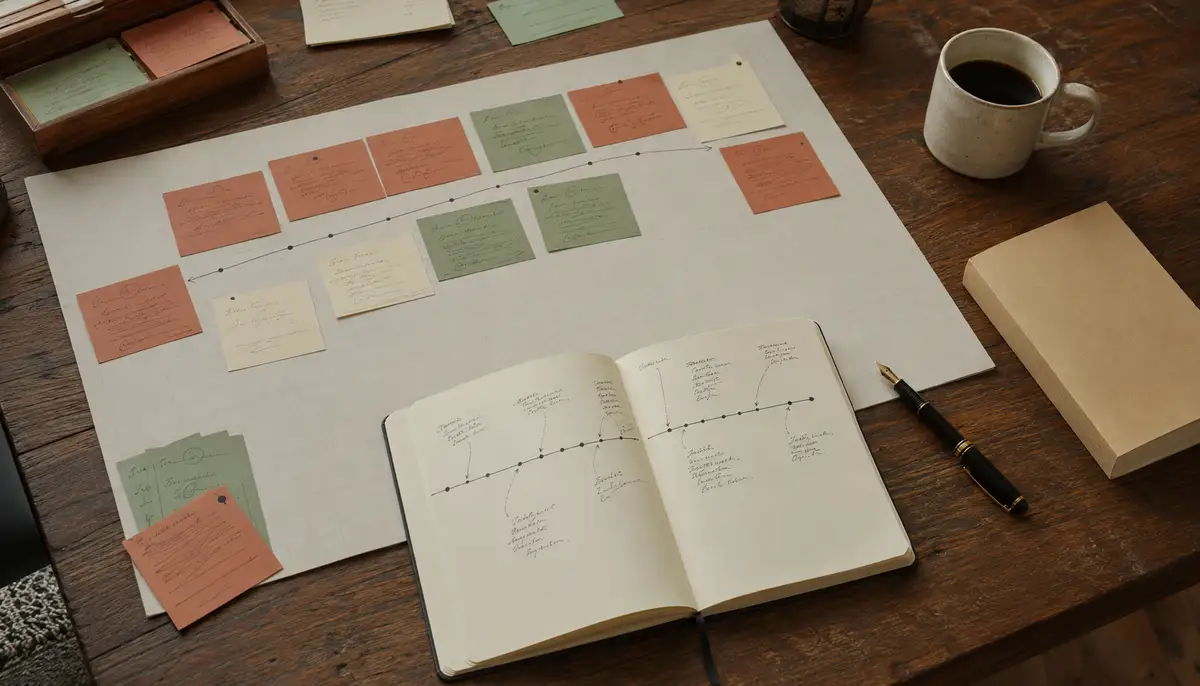
Regardless of which tool you choose, here is the workflow that produces the best results:
Step 1: Define your premise (5 minutes)
Write 2-3 sentences describing your novel: genre, main character, central conflict, setting. The more specific you are, the better the AI output. "A detective in 1920s Chicago investigates a jazz musician's murder" beats "a mystery novel."
Step 2: Generate the outline (2 minutes)
Let the AI create a chapter-by-chapter outline. Review it. Rearrange chapters, rename them, add or remove sections. The outline is your novel's skeleton. Time spent here saves hours of rewriting later.
Step 3: Generate chapters sequentially (10-20 minutes)
Write chapter 1, then chapter 2, and so on. Do not skip ahead. Each chapter builds on the context of previous ones. In Inkfluence AI, this happens automatically: the AI reads the last 3 chapters in full, with the story bible and a running record of the book, before writing the next one.
Step 4: Edit each chapter (30 minutes - 2 hours)
This is where your novel becomes yours. Add personal anecdotes, refine dialogue, cut AI filler phrases, adjust pacing. Use the built-in editor to rewrite specific paragraphs or expand key scenes.
Step 5: Design the cover and export (5 minutes)
Generate a professional cover, add your author name, and export to PDF or EPUB. If publishing on Amazon KDP, use the KDP publishing guide for formatting requirements.
Total time: 1-3 hours for a complete first draft, compared to 3-6 months writing manually. The AI handles structure and drafting; you focus on voice, style, and story.
5 Mistakes That Ruin AI Novels
After watching a lot of AI novels get written, the single biggest predictor of whether one holds together is not prose quality, it is whether the tool still remembers the early chapters by the time it writes the late ones. Most "ruined" AI novels are not badly written sentence to sentence. They fall apart because a character's motivation in chapter 2 is forgotten by chapter 11. The mistakes below all trace back to that one weakness.
1. Publishing without editing
AI-generated novels need editing. Always. Raw AI output reads like AI output. The editing step is what turns a draft into a book that readers enjoy.
2. Vague prompts
"Write me a fantasy novel" will produce generic fantasy. "A 12-year-old orphan discovers she can control weather in a world where climate magic is outlawed" will produce something specific and compelling.
3. Skipping the outline
Jumping straight to chapter writing without an outline leads to novels that meander, repeat themes, and lose plot threads. The outline is the most important step.
4. Using ChatGPT for the whole book
ChatGPT is great for brainstorming. It is terrible for writing full novels. Use a dedicated tool for the actual book, and ChatGPT for ideation if you want.
5. Ignoring your unique voice
The best AI novels are not 100% AI-written. They are AI-drafted and human-edited. Your personal experiences, humor, and perspective are what make the book worth reading.
Your novel is waiting
Join thousands of authors who have written their first book with AI. Free to start, no credit card needed.
Write Your Novel FreeThe novelist-specific workflow: 30 days from premise to KDP (April 2026 update)
The section above covered general AI novel-writing workflow. This April 2026 update goes deeper into the novelist-specific path (as opposed to short-story writers, gamebook authors, or non-fiction book writers). Novelists have a different set of constraints and a different publishing workflow, and the tool you pick should match that.
What makes the novelist workflow different
A novelist typically writes 60,000 to 100,000 words per project, structured into 15 to 40 chapters, targeting Amazon KDP or a traditional query-letter path. The three hard problems are: (1) continuity across 30+ chapters (character names, timeline, world rules), (2) voice consistency (chapter 28 should sound like the same author who wrote chapter 2), and (3) publishing workflow (EPUB + cover + audiobook + KDP disclosure). Novelists who self-publish also need a repeatable process because the economics reward series and rapid release, not one-off novels.
A realistic 30-day timeline
Days 1-2: Plotting and story bible
Define premise, protagonist, antagonist, supporting cast, setting, tone. Generate the chapter outline using three-act, Save the Cat, or seven-point structure. For branching or gamebook-style novels, use our AI interactive fiction generator to plot a 13-node branching tree.
Days 3-18: Chapter drafting with continuity
Generate each chapter sequentially. A novelist-native tool reads the full story bible plus the last chapter's ending into every new chapter prompt, so character names stay locked and plot threads flag for payoff. Target 3,000-5,000 words per writing day.
Days 19-24: Self-editing into your voice
4 to 8 hours of editing per full novel. Focus on voice consistency, dialogue distinctness, emotional beats, continuity sweeps, and opening/closing chapter polish.
Days 25-28: Cover and formatting
Design KDP-spec cover (1600x2560 JPG). Export EPUB, PDF, and DOCX. An integrated novelist tool handles all of this in one subscription; tool-sprawl stacks add $30 to $200+ per novel.
Days 29-30: Publish
Upload to Amazon KDP with AI-content disclosure. Set pricing in the 70% royalty tier ($2.99-$12.99). Write book description, add keywords, launch.
Cost breakdown: why one novelist tool beats three
A full 60,000-word novel costs roughly $9.99 on an integrated novelist platform (Creator tier on Inkfluence AI, which bundles cover designer + EPUB/PDF export + ACX-spec audiobook). The same novel on a tool-sprawl stack (separate drafting tool + separate cover designer + separate audiobook service + separate EPUB conversion) runs $259 to $273. Most novelists who write three or more novels a year find the bundled workflow pays for itself inside the first month.
For the full ranked breakdown of 8 novel-specific tools tested on real novel projects, with a complete feature matrix and per-novel pricing comparison, see our Best AI Novel Writer 2026 hub. The novelist persona page at For Novelists goes deeper on story-bible continuity, fiction blueprints, and the KDP publishing flow.

Frequently Asked Questions
Answers to the most common questions about AI novel writing tools.
What is the best AI for creative writing in 2026?
It depends on the format. For full novels with continuity, Inkfluence AI holds character and plot across chapters. For literary prose experiments, Sudowrite stands out. For short stories and flexible creative pieces, the AI story writer handles any length or genre, and for fan works the AI fanfiction writer keeps characters in voice. ChatGPT and Claude help brainstorm but lose the thread over long projects.
What is the best AI for writing stories?
For short stories, flash fiction, and one-shots, the AI story writer generates a complete, structured story from a prompt and exports to PDF or EPUB. For novel-length stories, the AI novel writer keeps characters and arcs consistent across 30,000 or more words. Both adapt to any genre and are free to start.
Can AI write a whole novel by itself?
AI can draft a complete novel, but the best results come from a human-AI workflow: you set the premise, characters, and beats, the AI drafts each chapter against that plan, and you edit for voice and emotional depth. Tools with a story bible (like Inkfluence AI) hold continuity across the book so chapter 20 still matches chapter 1.
What is the best AI for writing novels in 2026?
Inkfluence AI is the best overall AI for novel writing. It generates structured novels with character memory, maintains plot continuity across chapters, and exports to PDF, EPUB and DOCX. For literary prose polishing, Sudowrite is strong. For planners who bring their own AI account, Novelcrafter is the best organiser. For fantasy world-building, NovelAI is the community favourite.
Can AI write a full novel?
Yes. Purpose-built AI tools can generate a complete novel with chapters, character arcs, dialogue and plot structure, and the generation itself takes 10 to 20 minutes. The key is a tool with chapter context and character tracking, followed by an editing pass to add your own voice.
Is ChatGPT good for writing novels?
ChatGPT is useful for brainstorming ideas and writing individual scenes, but it is not recommended for complete novels. It lacks persistent memory between sessions and has no book structure, chapter management or export. Dedicated novel writing tools solve all of those problems.
What is the best free AI for writing novels?
Inkfluence AI offers the most usable free tier for novel writing: 5 chapters to start and 5 more every month, with character memory, plot continuity and PDF export. Squibler's free plan carries 1,000 AI credits. ChatGPT and Claude have free tiers but no book structure. NovelAI and Sudowrite offer limited trials.
How long does it take to write a novel with AI?
AI generation takes 10 to 20 minutes for a full draft. Editing adds 1 to 5 hours depending on how much you personalise the text, so the total from idea to publishable novel is typically 2 to 6 hours, compared with 3 to 6 months writing by hand.
What is the best AI for writing fanfiction?
NovelAI is the fanfiction community favourite, with Lorebook entries for character profiles and world rules. Inkfluence AI works well for longer multi-chapter fanfiction thanks to its chapter context system. ChatGPT is adequate for short one-shots only.
Can I publish an AI-written novel on Amazon?
Yes. Amazon KDP allows AI-assisted books but asks you to disclose AI-generated content when you publish. The more you edit and add original material, the stronger your position. Many authors use AI for first drafts and edit heavily before publishing.
Which AI writes the best dialogue?
Claude produces arguably the best raw dialogue among general chat tools. Among dedicated book tools, Inkfluence AI produces natural dialogue when you pick the storytelling tone, and Sudowrite gives the most granular control over dialogue refinement with its Describe and Expand tools.
Do AI novels sound robotic?
Raw AI output can sound formulaic. Choose a specific tone, edit the output to add your own voice, vary sentence structure and add real-world detail. The editing step is what separates a publishable AI novel from text that is obviously machine-written.
What is the best AI for writing romance novels?
Inkfluence AI has a dedicated romance novel blueprint that structures stories with meet-cute scenes, tension arcs and character chemistry, and tracks relationships across chapters.
Can AI write a series of novels?
Yes. In Inkfluence AI you create a project per book and reference earlier plot events in your prompt; the chapter context system keeps each book consistent. Novelcrafter goes further with a Codex that is shared across every book in a series.
Does Inkfluence AI keep characters consistent across chapters?
Yes. Fiction on Inkfluence AI is written one chapter after another, never in parallel, and every chapter is generated with the story bible, the last three chapters in full, and a running record of everything before them in view. A continuity validator then checks each chapter for name consistency, point of view, timeline contradictions, unresolved threads, key objects and cast, and rules you mark as non-negotiable in the story bible are pinned into every chapter. There is no numeric score for this; it runs automatically on every fiction book.
Does Inkfluence AI give feedback on writing quality?
Yes, as editorial notes rather than a score. The assistant reviews a chapter or the whole book, six quick actions rewrite, expand, shorten, proofread or change the tone of any selection, and the export preview audits the EPUB against Amazon KDP, Apple Books, Google Play and Kobo requirements. Tools such as Sudowrite and Novelcrafter give feedback through their own chat and review features; a numeric per-scene score is a different design choice that Inkfluence AI does not make.
How much does AI novel writing software cost?
As of 11 September 2026: Inkfluence AI is free or $9.99 to $19.99 a month. NovelAI is $10 to $25. Sudowrite is $10 to $44 a month on annual billing ($19 to $59 monthly). Novelcrafter is $4 to $20 plus your own AI provider's bill. Squibler is $29.99 or $89.99 a month, or $15.83 and $49.17 on annual billing. ChatGPT Plus and Claude Pro are $20. Jasper is $69 a month. For novel writing specifically, Inkfluence AI offers the most finished-book features per dollar.
Related guides
- AI Novel Writer - Write Complete Novels
- Best AI for Writing Fanfiction (2026)
- Inkfluence AI vs BookNova: prices, reviews and terms of a lifetime-plan novel generator
- Mejores IA para escribir novelas (the Spanish edition, with Spanish-language novel data and a chapter planner)
- Meilleure IA pour écrire un livre (in French: ten tools compared for writing a whole book in French, with prices)

Founder, Inkfluence AI
Sam is the founder of Inkfluence AI. He built the platform to make book creation accessible to everyone - from first-time authors to seasoned publishers.
Helpful links
Ready to Create Your Own Ebook?
Start writing with AI-powered tools, professional templates, and multi-format export.
Get Started FreeRelated Articles
 Publishing
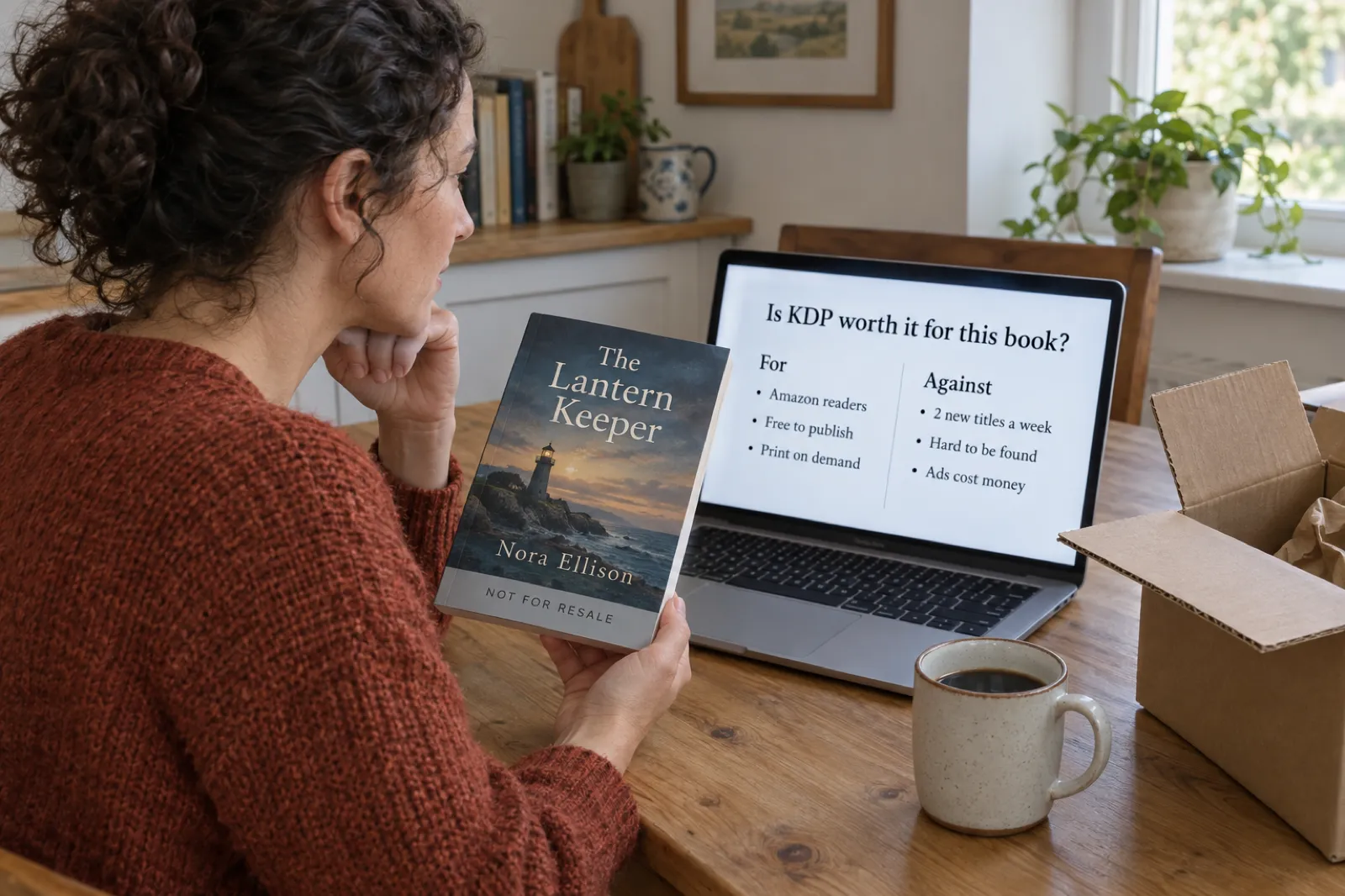
 Is KDP Worth It in 2026? An Honest Verdict by Book Type
A dated verdict for novels, non-fiction, picture books, coloring books, journals and family books: what changed on KDP in 2026, what publishing really costs, what most authors earn, when Etsy, Gumroad or going wide fits better, and a checklist that picks the route for your book.
 Publishing
 How Much Do KDP Authors Make? Real 2026 Numbers, by Format and Catalogue Size
Most KDP authors earn under $100 a month and a minority earn a living. The 2026 survey numbers, what one copy earns in each format under KDP's new rules, why most books sell little, and what changes it, with an estimator for your own catalogue.
 Publishing
 KDP Picture Book Bleed and Canvas Size for Illustrators (8.5 x 8.5, 8 x 10, 8.5 x 11), 2026
The exact KDP page size with bleed, canvas pixels for Procreate, Photoshop and Canva, two-page spread sizes, safe areas and the four-sided bleed mistake, with a free calculator for every picture book trim.
Get ebook tips in your inbox
Join creators getting weekly strategies for writing, marketing, and selling ebooks.